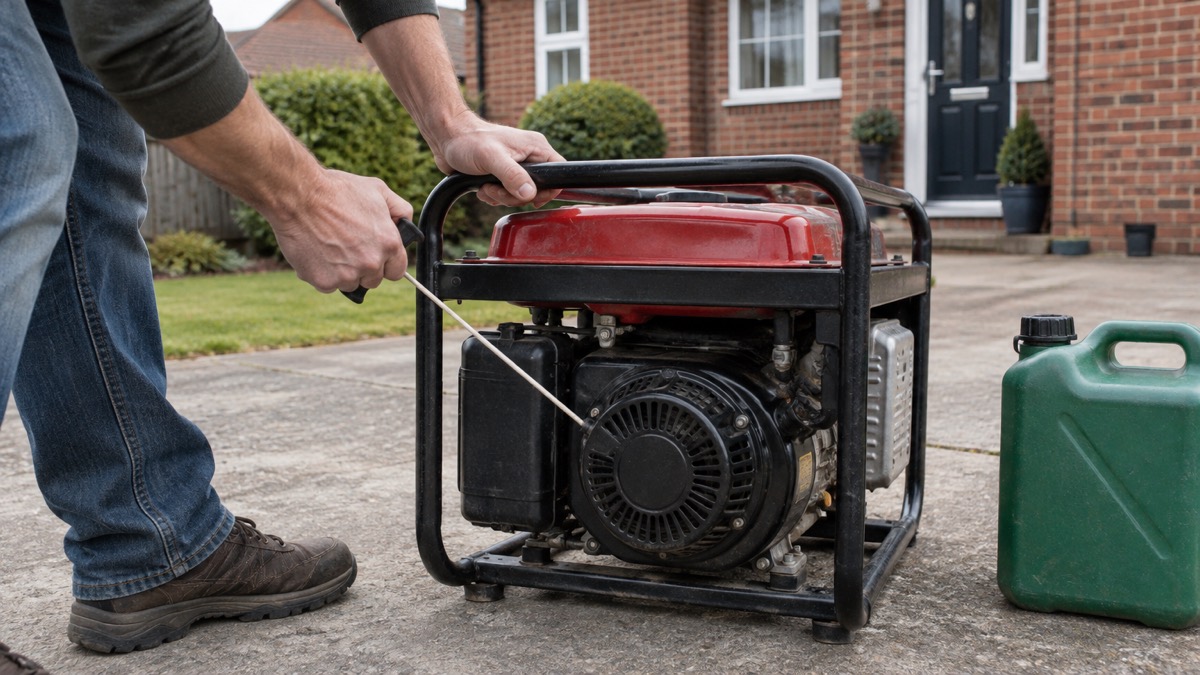
The Champion CPG3500UK is a petrol portable generator built for exactly the situation most households buy one for: the mains has gone off and you need to keep a few essentials running. Champion describes it as a 196cc, 6.5hp four-stroke machine that produces 2500 running watts, 2800 maximum watts and 3125 starting watts, with a 14.3 litre fuel tank that Champion says will run it for up to 12 hours at 50% load1.
For a household, that means it can carry a fridge, freezer, lights, phone charging and a router through a long outage, provided you plan the load and run it outdoors. It is an open-frame petrol generator rather than a quiet inverter type, and Champion lists its noise level as 68 dBA at 7 metres1. It is not a whole-house solution and it must never be run indoors.
This page sets out what the machine does, what it can and cannot power, how to keep it ready between outages, how to run it safely, and what the warranty covers. If you are still deciding between a generator and a battery power station, the backup power section and the comparison of a power station or a petrol generator will help you choose.
What the CPG3500UK is and what it suits
The CPG3500UK is a petrol portable generator with a durable tubular steel frame and a heavy-duty industrial frame design1. Champion lists its intended uses as powering some appliances, construction equipment, power tools and lighting, and as home backup power during emergencies1. For a prepping household, the last of those is the one that matters.
It is a conventional open-frame generator, not an inverter. That distinction matters in an emergency because inverter generators produce cleaner power for sensitive electronics, while open-frame machines are generally simpler and heavier. If you want to understand the difference before committing, read inverter or open-frame generator. The CPG3500UK sits in the open-frame camp.
The engine is a Champion single-cylinder, four-stroke OHV unit of 196cc and 6.5hp, and it starts with a manual pull cord using TCI ignition1. There is no electric start, so starting it in the cold or the dark is a physical job. Champion states that all newly manufactured products are EU Stage V compliant, the current emissions standard for this kind of engine1.
What it suits is a household that wants a substantial petrol generator for longer outages and is prepared to store fuel safely, run the machine outdoors and maintain it. What it does not suit is anyone who needs to run it indoors, in a garage or in a shed, or anyone who wants something they can leave unattended.
Power output: what 2500 watts will actually run
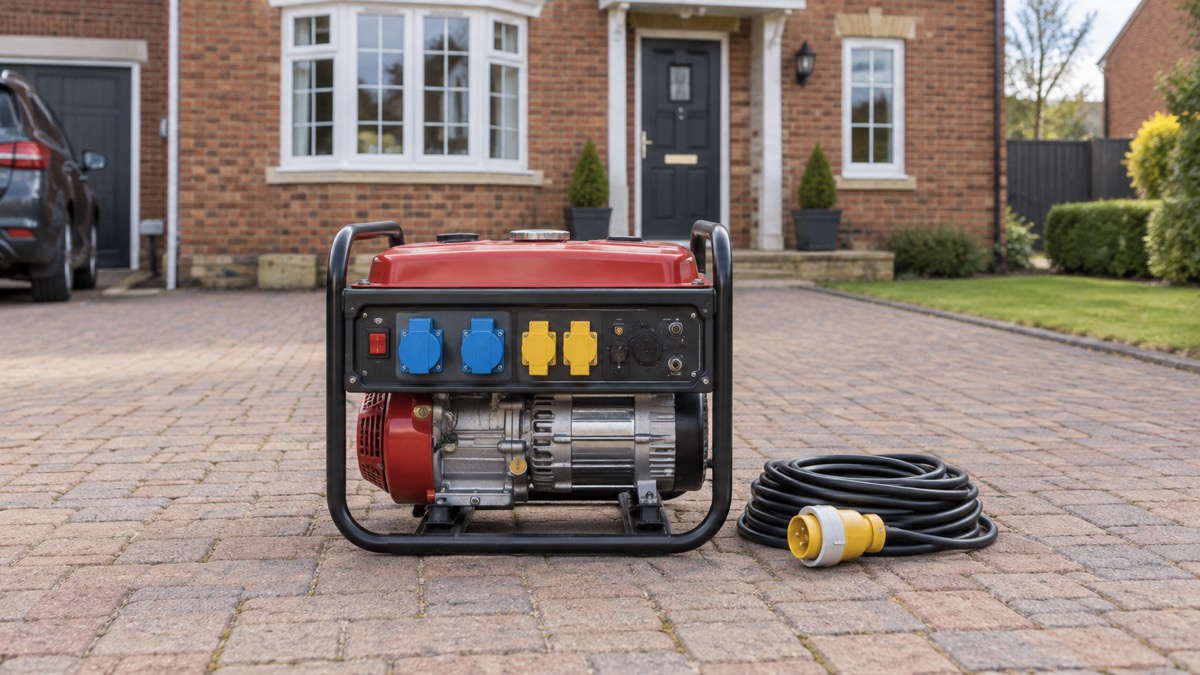
The headline figures are 2500 running watts, 2800 maximum watts and 3125 starting watts1. The running figure is the one to plan around. The starting figure is the brief surge the generator can supply when a motor-driven appliance such as a fridge compressor kicks in, and it is why a generator can start an appliance that draws more than its running rating for a moment.
Champion's own guidance on adding up loads is simple: only add watts together if you plan on using the products at the same time1. In other words, work out what you will run simultaneously, not everything you own. A fridge, a freezer, a few lights and a phone charger is a very different load from a kettle, a microwave and an electric heater together.
The machine has multiple outlets: 1 x 120V 16amp and 1 x 240V 16amp, with 230V/220V (UK/EU) and 110V sockets, plus a 12V battery charging outlet1. The 230V socket is the one household appliances use. The 110V socket is a site-voltage outlet, and Champion warns that dual voltage generators will only give approximately 50 to 60% of the rated output on 120V1. Treat the 110V side as one for 110V site equipment, not as a second full-power domestic supply.
If you are unsure how much your appliances draw, the guide to watts, watt-hours and surge explains the arithmetic, and what size generator do I need walks through sizing for a power cut. Deciding what is worth running at all is covered in deciding what to keep running when the mains fails.
| Specification | Figure |
|---|---|
| Rated output | 2500 watts1 |
| Maximum output | 2800 watts1 |
| Starting output | 3125 watts1 |
| Outlets | 1 x 120V 16A, 1 x 240V 16A, 230V/220V and 110V sockets, 12V charging outlet1 |
| 110V output limit | approx. 50 to 60% of rated output on 120V1 |
Run time: up to 12 hours on a full tank
Champion states that with a 14.3 litre fuel tank the unit can run up to 12 hours at 50% load1. That is the figure to plan an outage around. Half load on this machine is around 1250 watts, so a modest emergency load of a fridge, freezer, lights and communications should sit at or below that, and a full tank should see you through a long evening and night.
Two things change that. First, load: the harder you work the generator, the more fuel it burns, so running a heater or a kettle will shorten the time between refuels. Second, the 12 hour figure is a maker's estimate at a stated load, not a guarantee. The general guide to how long a generator will run on a tank of fuel explains why real run times vary.
For a household, the practical point is fuel storage. A 14.3 litre tank is a substantial amount of petrol to keep, and petrol storage at home is regulated. Read how much petrol can I store at home safely before you buy jerrycans, and store fuel only as that guidance allows. Never refuel a hot engine, and never store petrol indoors.
Built-in protection: AVR, overload protection and low oil cut-out
The CPG3500UK carries several protective features that matter in an emergency, when the machine may be run for long periods by people who are not used to it.
- AVR (automatic voltage control): Champion lists overload protection and AVR among its features1. AVR holds the output voltage steadier as the load changes, which is kinder to appliances.
- Overload protection: if you draw more than the generator can supply, the overload protection is there to protect the machine1. It is not a licence to overload it: Champion lists overloading beyond the generator's limits as a condition that voids the warranty1.
- Low oil shut-off: the engine has a low oil shut-off sensor and an automatic low oil cut-out, with a 600ml oil capacity1. If the oil level falls too far, the engine stops rather than running dry.
- Brushless alternator: Champion states it is fitted with a maintenance-free brushless alternator1, which removes brushes as a wear item.
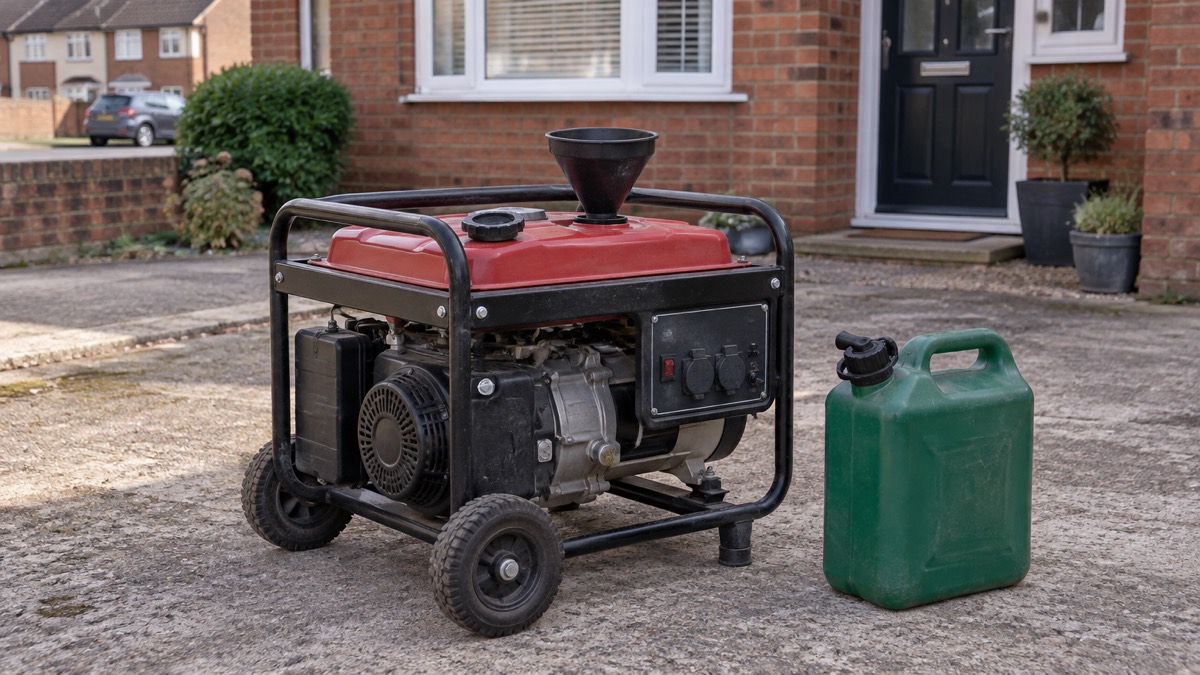
These features reduce the chance of damage, but they do not make the generator safe to run indoors, and they do not replace checking the oil before each use. The low oil cut-out is a backstop, not a substitute for topping up.
Running it safely: carbon monoxide, fuel and electricity
This is the section to read before you ever start the machine. A petrol generator produces carbon monoxide, a colourless, odourless gas that can kill. The fire and rescue service and the Health and Safety Executive warn that generators must be run outdoors, well away from windows, doors and vents. The maker's own instructions for the Champion CPG3500UK cover starting and running the machine, and its manual pull start with TCI ignition is described in the maker's specification1.
The fire and rescue service advises that generators are run outdoors only, and the Health and Safety Executive treats petrol generators as a carbon monoxide risk whenever they are used in an enclosed space. The NHS advises that carbon monoxide poisoning can cause headaches, dizziness, nausea and confusion, and that anyone affected should get fresh air and urgent medical help. Fit an audible carbon monoxide alarm, and read carbon monoxide from generators: warning signs and can you run a generator indoors or in a garage for the detail.
On electricity, never connect the generator to your home's wiring yourself. Connecting a generator to the fixed wiring requires a proper changeover arrangement installed by a competent electrician, and a DIY lead can backfeed the mains and endanger linesmen and your own household. The guide to connecting a generator or battery to your home's wiring explains the safe options. For plug-in appliances, use extension leads rated for the load and avoid daisy-chaining them; extension leads and overloading with backup kit covers this.
On fuel and flames, switch off and let the engine cool before refuelling, and never store petrol near a flame or a heat source. The full safety picture, including siting and weather, is in generator safety: carbon monoxide, fuel and electric shock, and can you run a generator in the rain covers wet weather.
Keeping it ready between outages
A generator that will not start is worse than no generator, because you have planned around it. The CPG3500UK is a petrol machine with a pull start, so keeping it ready is mostly about fuel, oil and exercise.
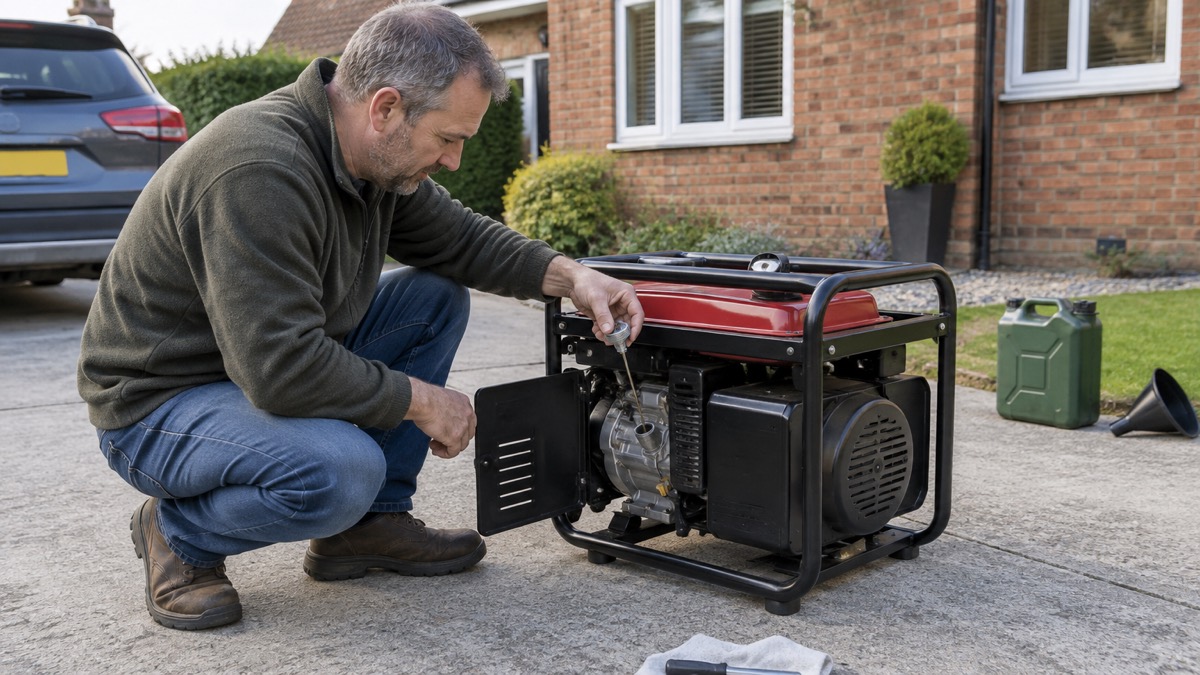
- Check the oil before every use. Top up to the dipstick mark, following the maker's instructions for the Champion CPG3500UK1.
- Run it under load every few months. Starting it and letting it idle is not enough; plug in a load so the engine works and the fuel system stays clear.
- Manage the fuel. Petrol degrades in storage. Keep only what you can store safely and rotate it, following how much petrol can I store at home safely.
- Store it dry and covered. Keep it out of the weather and away from the house, and follow how to store a generator after a power cut.
- Check it starts in the cold. The Champion CPG3500UK has a manual pull start with TCI ignition1, and pull-start engines can be harder in freezing weather; will a generator start in cold weather covers this.
The power cut backup power checklist and the backup power checks before winter checklist are worth working through before the season when outages are most likely.
Support and warranty: what is covered and what is not
Champion's warranty is generous on paper for domestic use, but the conditions matter for a household that may use the machine hard during an outage.
For domestic usage, Champion warrants the mechanical and electrical components for up to three years from the original date of purchase, or 1000 hours, whichever comes first: Year One covers parts and labour, and Years Two and Three cover parts only1. The same three-year domestic structure appears across Champion's generator range2.
For industrial and commercial use, the cover is shorter: Year One parts and labour, and Year Two parts only, or 1000 hours, whichever comes first1. Using the generator for hire purposes is listed as a condition that voids the warranty1.
The exclusions are the part to read carefully. Champion states the warranty will be voided or not apply if the product is misused, neglected, involved in an accident, abused, overloaded beyond the generator's limits, modified (including exhaust extension and filtration), installed improperly in any outbuilding, shed, garage, confined space or vehicle, connected incorrectly to any electrical component, or used for hire purposes1. Normal maintenance is not covered, and the warranty excludes cosmetic defects, worn parts including piston and rings, spark plugs and filters, accessory parts such as funnels, spanners, spark plug tubes, stands, wheels and recoil assemblies, most electrical components other than the main control unit, and all hoses, pipes, reducing valves and regulators1. Problems caused by non-original Champion parts, alterations by anyone other than the manufacturer, and any third-party electrical equipment are also excluded1.
Two further points. The warranty only applies to the original purchaser and is not transferable1, so a second-hand CPG3500UK carries no remaining manufacturer cover. And Champion excludes any 12V battery supplied over one year old from warranty1.
| Cover | Domestic use | Industrial and commercial use |
|---|---|---|
| Year 1 | Parts and labour1 | Parts and labour1 |
| Year 2 | Parts only1 | Parts only1 |
| Year 3 | Parts only1 | Not covered1 |
| Limit | 1000 hours, whichever comes first1 | 1000 hours, whichever comes first1 |
For the wider Champion range, see the Champion brand page. If you are weighing this machine against a battery alternative for a shorter outage, the portable power stations guide sets out what they do differently, and using generators and power stations during an outage covers running either through a cut.
Sources (10)
- Champion 2800 Watt Petrol Generator CPG3500, Champion Power Equipment, 2026-10-25
- Champion 3600 Watt Inverter Petrol Generator, Champion Power Equipment, 2026-10-25
- Champion 3200 Watt Petrol Generator, Champion Power Equipment, 2026-10-25
- Champion 7000 Watt LPG Dual Fuel Generator CPG7500E2-DF, Champion Power Equipment, 2026-10-25
- Champion 3600 Watt LPG Dual Fuel Inverter CPG4000DHY-DF, Champion Power Equipment, 2026-10-25
- Champion 3500 Watt Inverter Petrol Generator 73001i-E, Champion Power Equipment, 2026-10-25
- Champion 2200 Watt LPG Dual Fuel Inverter Generator 92001i-DF, Champion Power Equipment, 2026-10-25
- Champion 2200 Watt Inverter Generator 92001i, Champion Power Equipment, 2026-10-25
- Champion 3750 Watt Frame Type Inverter CPG4000DHY, Champion Power Equipment, 2026-10-25
- Champion 2800 Watt LPG Dual Fuel Generator CPG3500E2-DF, Champion Power Equipment, 2026-10-25

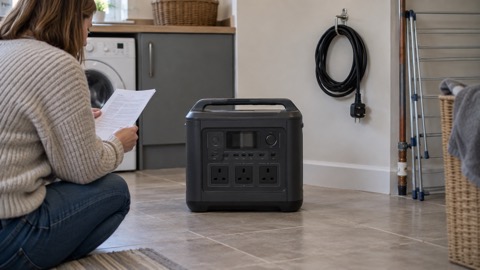 BLUETTI Apex 300 Power Station
 BLUETTI Elite 100 V2
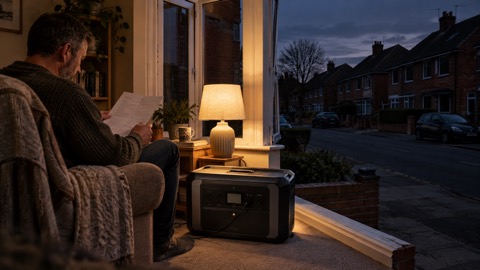 Anker SOLIX C2000 Gen 2
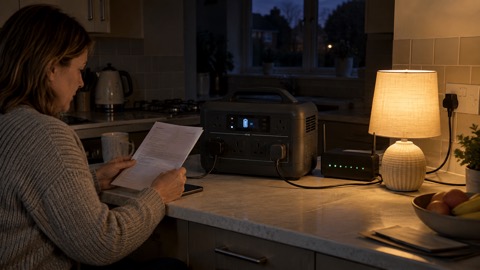 Anker SOLIX C1000 Power Station
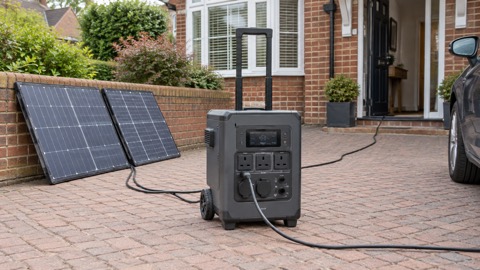 EcoFlow DELTA Pro
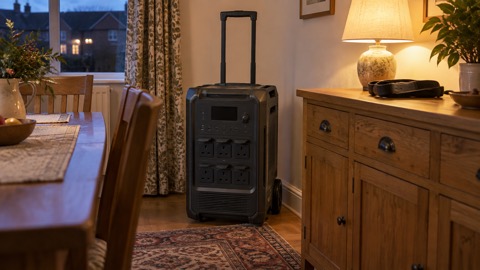 BLUETTI Elite 400
 Anker SOLIX C300 Power Station
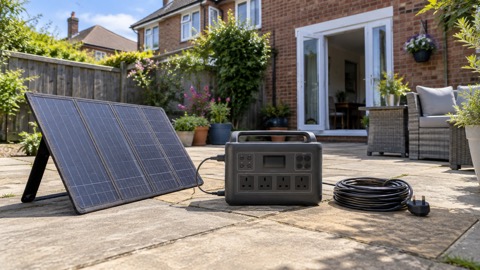 EcoFlow DELTA 3
 EcoFlow DELTA 2 and DELTA 2 Max
 EcoFlow DELTA and DELTA Max
 EcoFlow RIVER 3 and RIVER 3 Plus
 EcoFlow RIVER 2 and RIVER 2 Max