

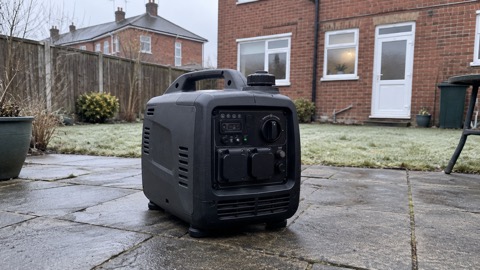
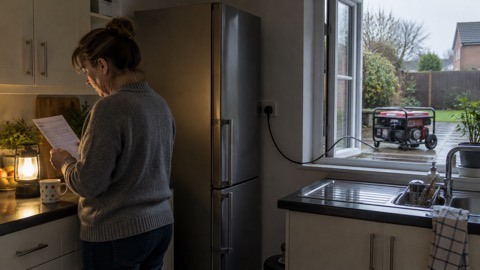
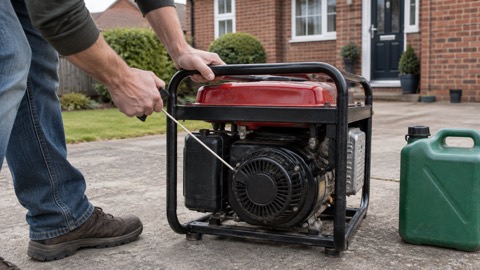
A Champion generator is a petrol or dual fuel machine that gives a household its own electricity when the mains fails. The range sold in the UK runs from small inverter units that will keep a fridge and a few lights going, up to larger petrol generators for heavier loads. The first thing to understand is that a generator is outdoor equipment: the Health and Safety Executive advises that fuel-driven equipment such as petrol and diesel generators must not be used indoors1. Get that rule fixed in your mind before you buy anything.
The second thing is to match the machine to the job. Champion's own wattage guide lists a refrigerator at 50 to 250 watts with a starting coefficient of 3, so the surge when the compressor kicks in can be several times the running figure2. Add up what you actually want to run, allow for the biggest start-up surge, and choose a machine with headroom. A generator with 2500 running watts and 3125 starting watts, such as the CPG3500UK, gives a working margin for a fridge plus a few small items3.
The third is safety. Carbon monoxide from a generator's exhaust has no smell and no colour, so a working alarm is your only warning if fumes build up. Fire and rescue services advise testing carbon monoxide alarms at least once a month4. This page sets out what Champion makes, how to choose by wattage, where a generator must never go, how to fuel and connect it safely, and how to keep it serviced between emergencies.
What Champion makes for UK households
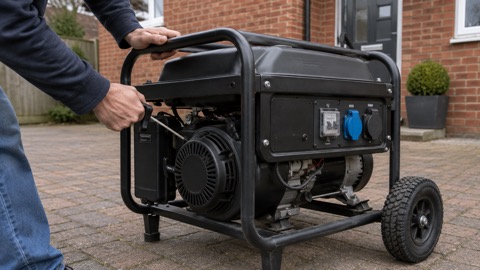
Champion's UK range is built around portable generators for the home, the garden, camping and travel. The CPG3500UK is described by the maker as ideal for powering some appliances, construction equipment, power tools and lighting, and as usable for home back-up power during emergencies3. It carries 230v/220v (UK/EU) and 110v sockets plus a 12V battery charging outlet, so it can charge a battery as well as run mains appliances3.
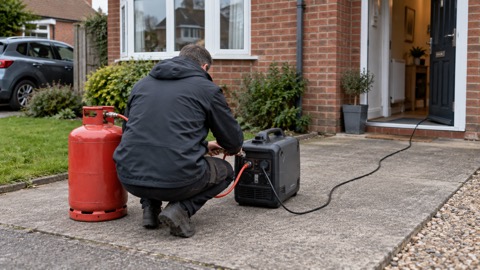
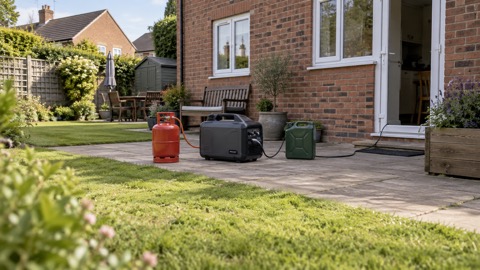
The range splits into two broad families. Conventional petrol generators, such as the CPG3500UK, are straightforward machines with a steel frame and a Champion single cylinder, 4-stroke OHV engine3. Inverter generators, such as the 3500 Watt Inverter, use True Sine Wave technology to protect sensitive electronics against surges6. Dual fuel models, such as the 82001i-E-DF, run on petrol or LPG and are factory fitted rather than converted after purchase7.
| Family | What it does | Models in the UK range |
|---|---|---|
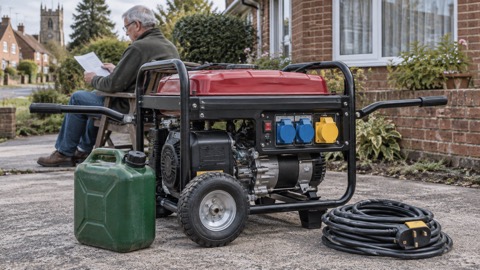
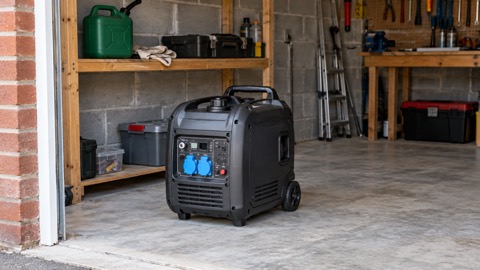
| Petrol generators | General backup power for appliances, tools and lighting | Champion 3200 Watt Petrol Generator, Champion CPG9000E2, Champion CPG4000E1, Champion 5500W Petrol with Remote Start |
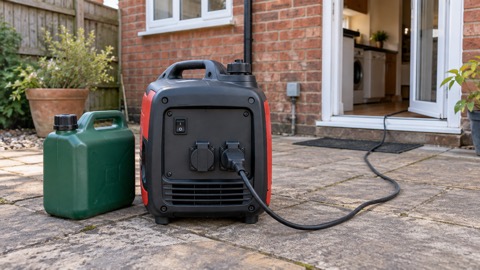
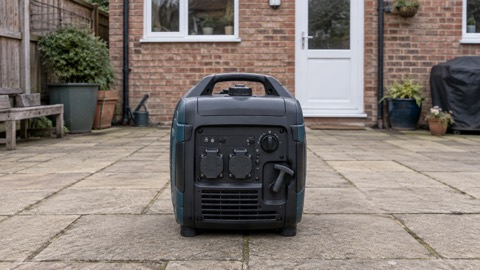
| Inverter generators | Steadier power for electronics such as laptops and TVs | Champion 3000W Atom Fusion Inverter, Champion 2200W Mighty Atom Inverter, Champion 3500W Petrol Inverter, Champion 3600W Digital Hybrid Inverter, Champion 3600W Petrol Inverter |
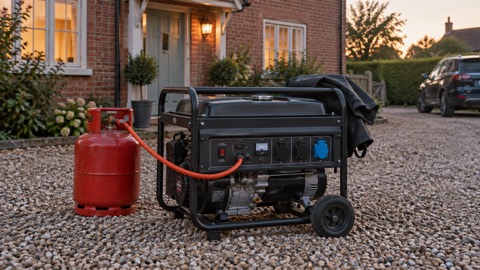
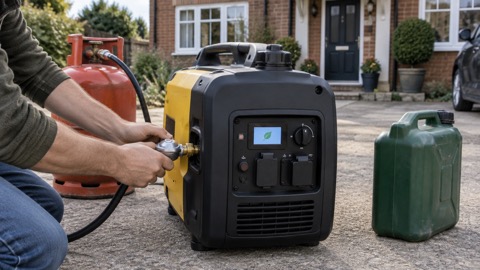
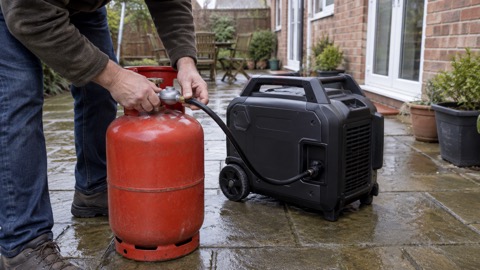
| Dual fuel generators | Petrol or LPG, factory fitted | Champion 3000W Atom Fusion LPG Dual Fuel, Champion 2200W Mighty Atom LPG Dual Fuel, Champion 82001i-E-DF, Champion 3500W LPG Dual Fuel Inverter, Champion CPG3500E2-DF, Champion CHG3500-DF, Champion 500988-DF-UK 3600W Dual Fuel |
For the wider picture of how a generator fits into a household plan, see Backup Power at Home: A Household Guide. If you are starting from scratch, Getting Started: Preparing Your Household for an Emergency sets out the order to do things in.
Portable generators: what they do in a power cut
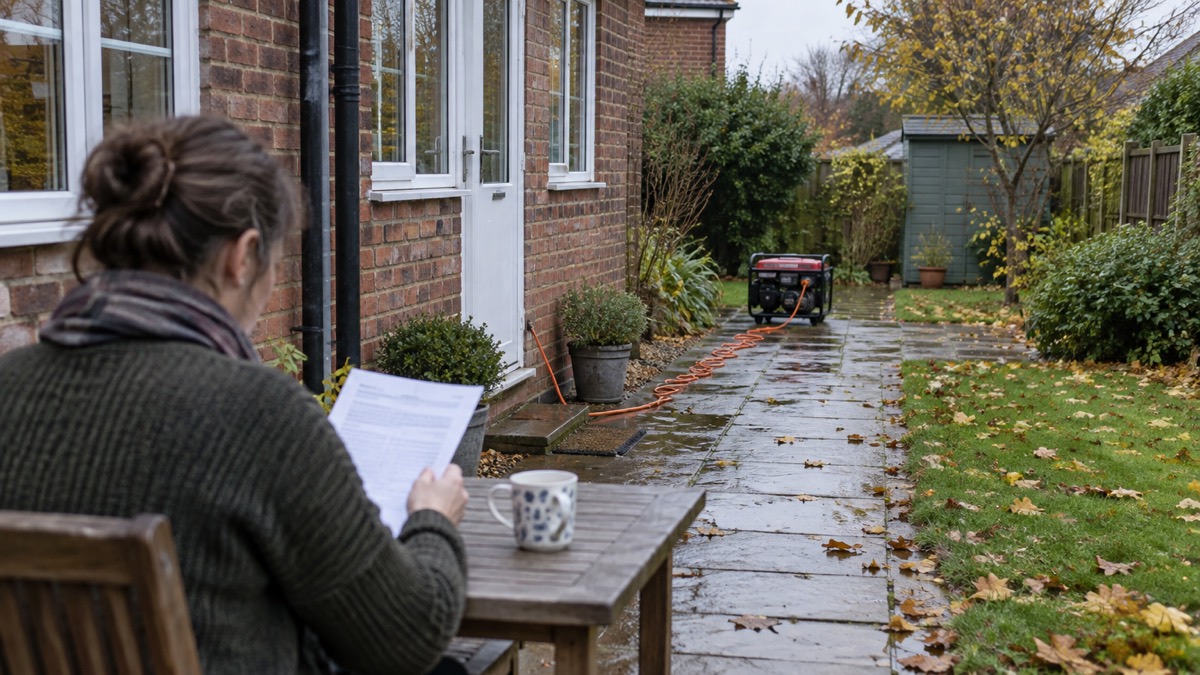
A portable generator turns fuel into mains electricity you can plug appliances into directly. That makes it useful in a power cut for keeping a fridge cold, running lights and charging phones, and for jobs around the house and garden at other times. The maker describes the CPG3500UK as suitable for powering some appliances, construction equipment, power tools and lighting, and as home back-up power during emergencies3.
The limit is capacity. As independent testing notes, portable generators are small enough to carry and have labelled inputs, but their limited output capacity means some models will not power all appliances8. A generator that runs a fridge and a lamp will not also run an electric shower or an immersion heater. Plan what you would actually want to keep running, and accept that a generator is for essentials, not for running the house as normal.
Battery generators are a separate option: smaller and more portable than fuel-tank generators, but only really useful if you have low power demand, and sometimes chargeable with solar panels8. They produce no exhaust fumes, which changes the indoor question, but they store less energy. For most households the choice comes down to how much power you need and for how long.
Inverter generators: power for sensitive electronics
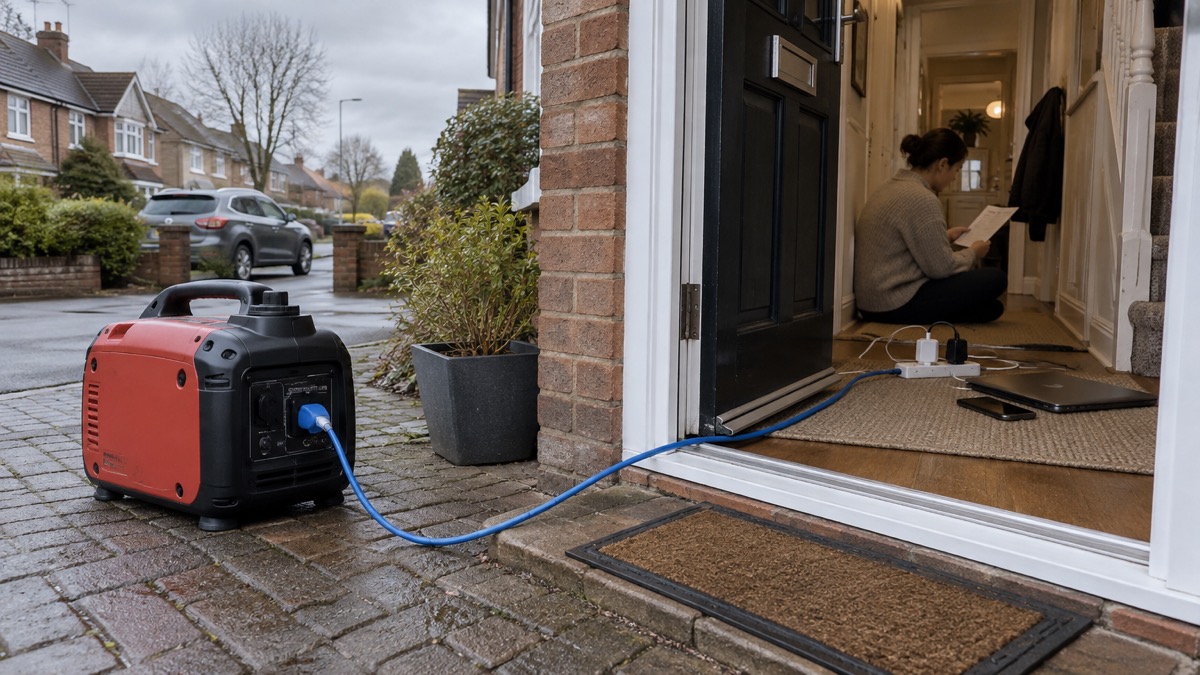
An inverter generator produces a steadier supply than a conventional machine, which matters for anything with a circuit board in it. Champion's 3500 Watt Inverter uses True Sine Wave technology to protect sensitive electronics against surges for a safe connection6. That covers laptops, televisions, routers and phone chargers, the things a household most wants back first in a long outage.
The 3500 Watt Inverter illustrates what the specification sheet tells you. It has a maximum output of 3500 watts, two 240v 13amp AC outlets, a power factor of 1.0, a 6.0 HP engine, 13/13 socket ratings and a 12/8.3 DC output6. It comes with a smart charger, a 12V DC USB adapter, a 12V DC battery charging cable, an oil funnel, a wrench and an operating manual6. It also has a 3-in-1 Intelligauge and overload protection6.
Inverter models can also be paired. The Champion Parallel Kit is a 32 Amp kit that allows any UK or EU Champion Inverter model from 1000 to 3500 watts, new or old, to be connected in parallel, and it includes two universal adapters so old and new models connect easily9. It uses 3 pin industrial waterproof sockets9. Running two smaller machines in parallel is one way to get more output without buying a single larger unit.
Choosing by wattage: starting and running power
Two numbers decide whether a generator will cope: running watts and starting watts. Running watts is what an appliance uses once it is going. Starting watts is the surge it draws in the moment it starts, which for anything with a motor or compressor can be several times higher. Champion's wattage guide gives both a power range and a starting coefficient for common appliances2.
| Appliance | Running watts | Starting coefficient |
|---|---|---|
| Refrigerator | 50 to 250 | 3 |
| TV | 100 to 350 | |
| Router | 800 to 1300 | |
| Heating | 1000 to 1800 | |
| Microwave | 1200 to 1600 | 2 |
| Washing machine | 2100 to 2400 | 1.5 |
| Steam iron | 1400 to 2260 | |
| High pressure washer | 1200 to 3000 | |
| Lawn mower | 300 to 1600 | |
| Air conditioner | 500 to 2500 |
Add up the running watts of everything you want on at once, then add the largest start-up surge on top. A machine with 2500 running watts and 3125 starting watts, such as the CPG3500UK, gives a working margin for a fridge plus a few small items3. The 82001i-E-DF is listed with a starting output of 2200 watts on petrol and 2000 watts on LPG7; a separate Champion page gives 2500 starting watts on petrol and 2250 starting watts in LPG mode for the same model, so the two figures disagree and you should check the specification on the page for the model you are buying.
Where a generator must never go
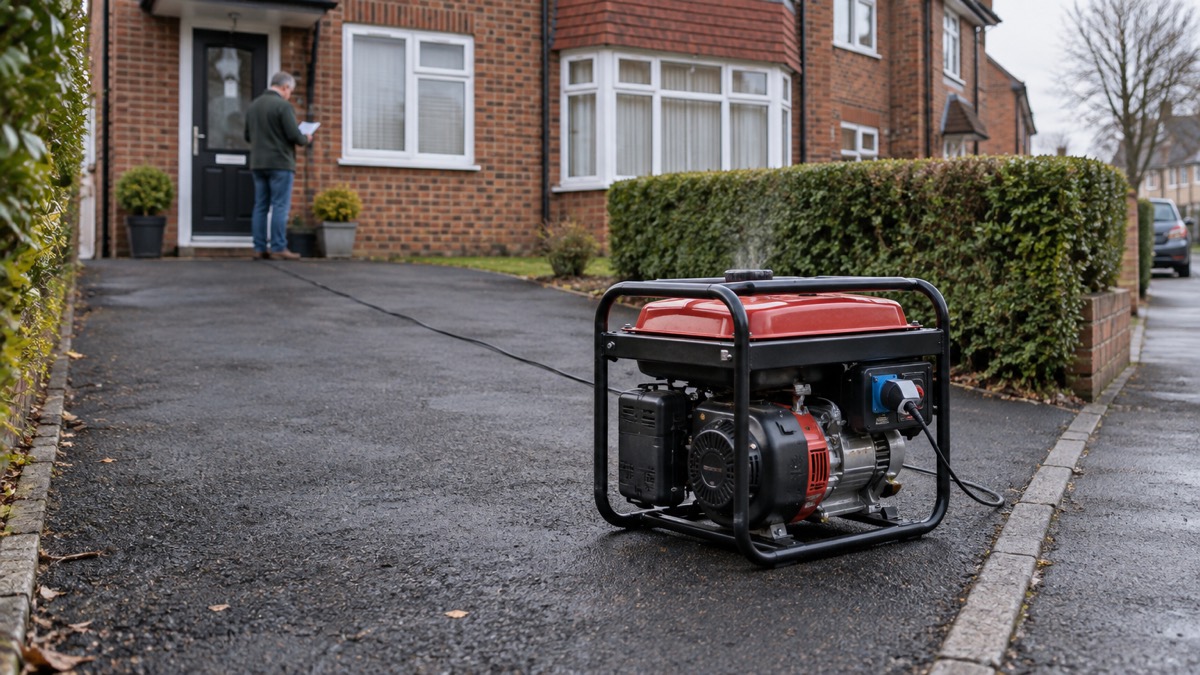
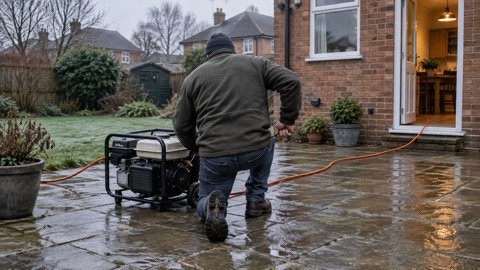
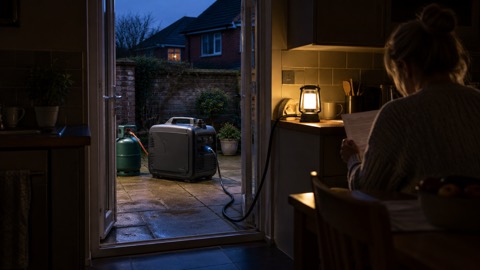
A generator produces carbon monoxide, and carbon monoxide kills. The Health and Safety Executive advises that fuel-driven equipment, including petrol and diesel generators and pumps, must not be used indoors1. The NHS in Wales gives the same instruction plainly: never use a generator indoors10. That covers the garage, the shed, the conservatory, the porch and the tent.
The fire and rescue service advice is equally direct: never run a gas, petrol or diesel-powered generator, or a heater not designed for the purpose, inside a caravan, motorhome, tent or awning5. A garage with the door open is still an enclosed space, and fumes can drift into the house through doors, windows and vents. Run the machine outside, well away from openings, and never bring it in to keep it dry or safe from theft.
"Do not use any fuel-driven equipment (petrol and diesel generators or pumps) indoors."
Champion's own warranty terms reinforce this. Cover is voided if a generator is misused, neglected, abused, overloaded beyond its limits, modified (including exhaust extension and filtration), installed improperly in any outbuilding, shed, garage, confined space or vehicle, connected incorrectly to any electrical component, or used for hire6. Improper installation is not just a safety risk; it can cost you the warranty.
Safe fuelling and fuel storage
Petrol is flammable and its vapour can ignite. Store fuel only in a suitable container, well away from the house and from any source of ignition, and never refuel a generator while it is running or still hot. Champion's inverter and dual fuel models are E10 Petrol Compliant, EU Stage V and UKCA certified, and the dual fuel models are also CE and EU5 certified6. Use the fuel the manual specifies for your model.
The maker fits overload protection to its machines, including the 3500 Watt Inverter and the CPG3500UK6. Overload protection cuts the supply if you draw more than the machine can give, which protects both the generator and your appliances. Do not defeat it by daisy-chaining more load than the machine is rated for.
Connecting appliances safely
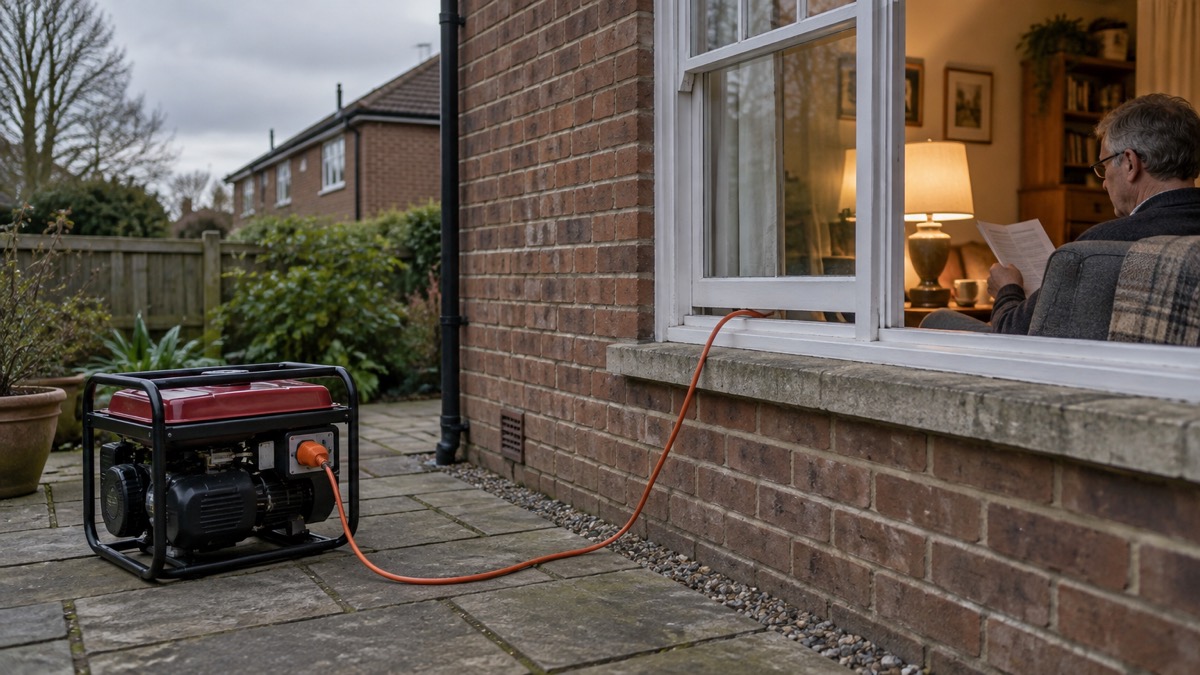
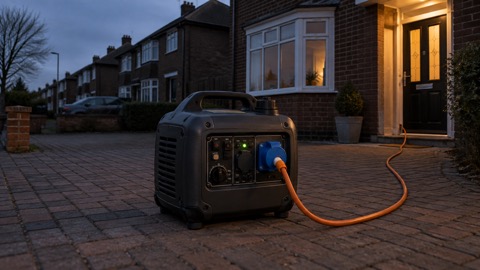
The simplest and safest way to use a generator is to plug appliances directly into its sockets with properly rated leads. Champion's CPG3500UK has 230v/220v (UK/EU) and 110v sockets plus a 12V battery charging outlet3. The 3500 Watt Inverter has two 240v 13amp outlets6. Use outdoor-rated extension leads long enough to reach from the generator's outdoor position to where you need the power.
Check your leads and appliances before use. Fire services advise checking all appliances, plugs, sockets and leads for damage such as scorch marks or exposed wiring, always using the correct fuse, and always buying approved chargers11. They also warn that overloading outlets by connecting too many appliances to a single socket can cause overheating and potentially spark a fire12. Only use properly rated and certified appliances12. Stop using any appliance if its cable is frayed or worn, and check that the cable is fastened securely to the plug13.
Keep electrical leads and appliances away from water, heat and flames14, and make sure appliances are not near water15. Turn off appliances when you are not using them14. Connecting a generator to your home's fixed wiring is a different matter: Champion's warranty is voided if a generator is connected incorrectly to any electrical component6, and fixed connection is a job for a qualified electrician. For most households, running appliances directly from the generator is the practical route.
Servicing and storing a generator between emergencies
A generator that has sat unused for a year may not start when you need it. Champion publishes a service schedule for its machines, and following it is the difference between a machine that works in a power cut and one that does not6.
| Interval | What to do |
|---|---|
| Every 8 hours or before each use | Check oil level; clean around air intake and muffler |
| First 5 hours (break-in) | Change oil |
| Every 50 hours or annually | Clean air filter; change oil if operating under heavy load or in hot environments |
| Every 100 hours or annually | Clean and adjust spark plug; clean spark arrestor; clean fuel valve filter |
| Every 250 hours | Clean combustion chamber; check and adjust valve clearance (for knowledgeable owners or certified service centres) |
| Every 3 years | Replace fuel line |
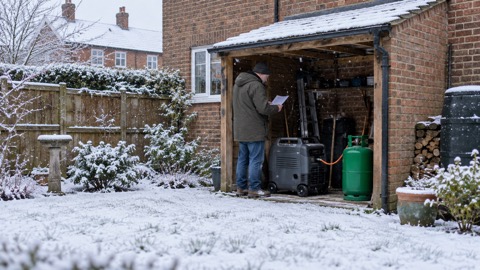
Run the machine periodically rather than leaving it idle for years. Champion's service schedule sets checks by hours of use: check the oil level and clean around the air intake and muffler every 8 hours or before each use, change the oil after the first 5 hours of break-in, and clean the air filter and change the oil every 50 hours or annually if running under heavy load or in hot environments16. Store the generator under cover, dry, with the fuel system handled as the manual directs, and keep the manual with it.
Support and warranty
Champion offers free lifetime technical support from its customer service team7. Its warranty runs to 3 years on Champion generator models, with a standard 2 years on Warrior Diesel and selected Champion products7. For domestic use on selected Champion products, the terms are up to 3 years: year one covers parts and labour, and years two and three cover parts only, from the original date of purchase or 1000 hours, whichever comes first6. Industrial and commercial use is covered for year one (parts and labour) and year two (parts only), or 1000 hours, whichever comes first6.
The exclusions are worth reading before you buy. The CPG3500UK warranty excludes cosmetic defects; worn parts including piston and rings, spark plugs and filters; accessory parts including funnels, spanners, spark plug tubes, stands, wheels and recoil assemblies; any electrical component other than the main control unit, such as wiring, fuses, connectors, switches, dials, displays and knobs; all hoses, pipes, reducing valves and regulators; failures due to acts of God and other force majeure events; problems caused by parts that are not original Champion Power Equipment parts; alteration or modification by any party other than the manufacturer; and any third party electrical equipment3.
The maker also states that the majority of competitors' dual fuel models in the UK tend to be retrofits, which invalidate the manufacturer's warranty, whereas Champion dual fuel machines are factory fitted so the 3 year warranty is fully supported7. If you are choosing between a petrol machine and a dual fuel one, that is a point in favour of the factory-fitted dual fuel models.
Safety notices and recalls
Generators and the appliances you plug into them can be subject to product recalls. The Office for Product Safety and Standards issues recalls and alert notices on its website17. Check it periodically, and check the Electrical Safety First website for recalls or safety notices on white goods18.
Register your appliances with the manufacturer so you are told about any safety recall19. Fire services advise registering electrical items for exactly this reason21, and checking periodically for recalls or safety notices related to your specific model, for example a tumble dryer22. A recall notice for a fire alarm detection system, the Bull and Cygnus Fire Alarm Detection System, was issued on 12 August 202623; if you hold that system, check the notice.
Carbon monoxide alarms are part of the same safety picture. They are available from DIY and hardware stores24, and should be tested at least once a month4. In rented accommodation in England, landlords must supply a carbon monoxide detector and alarm in any room used wholly or partly as living accommodation which contains a solid fuel burning combustion appliance25. Some telecare services offer a carbon monoxide detector that raises an audible alarm in the home and an instant alarm call to a monitoring centre when levels rise, for example from a blocked flue or faulty appliance26. For households that need extra help, see Extra Help in an Emergency: Older, Disabled and Medically Dependent Households.
Sources (26)
- Carbon monoxide safety, Mid and West Wales Fire and Rescue Service
- Champion 5500 Watt Petrol Generator With Remote Start, Champion Power Equipment, 2026-10-25
- Champion 2800 Watt Petrol Generator CPG3500, Champion Power Equipment, 2026-10-25
- Smoke alarms and CO detectors, Warwickshire County Council, 2026-10-29
- Caravan, motor home and campervan safety, Humberside Fire and Rescue Service, 2026-07-03
- Champion 3500 Watt Inverter Petrol Generator 73001i-E, Champion Power Equipment, 2026-10-25
- Champion 2000 Watt LPG Dual Fuel Inverter Generator 82001i-E-DF, Champion Power Equipment, 2026-10-25
- How to buy the best generator, Which?, 2026-01-20
- Champion Parallel Kit 75500i-WL, Champion Power Equipment, 2026-10-25
- Carbon monoxide, Public Health Wales
- Home fire safety, Northern Ireland Fire and Rescue Service, 2026-10-14
- Electrical fire safety, Warwickshire County Council, 2026-10-29
- Electrical safety, North Yorkshire Fire and Rescue Service, 2026-09-14
- Kitchen safety, Devon and Somerset Fire and Rescue Service
- Electrical safety, Lincolnshire County Council, 2026-10-29
- Strong winds and heavy rain warning information and advice, Northern Ireland Executive, 2026-01-27
- Electrical items, London Fire Brigade, 2026-10-25
- White goods, Cheshire Fire and Rescue Service, 2026-05-20
- Electrical safety, Greater Manchester Fire and Rescue Service, 2026-10-29
- Electrical fire safety leaflet, Greater Manchester Fire and Rescue Service
- Electrical fire safety, Cheshire Fire and Rescue Service, 2026-07-17
- Electrical fire safety, Warwickshire County Council, 2026-10-29
- Product recall for Bull and Cygnus Fire Alarm Detection System, Office for Product Safety and Standards, 2026-08-12
- Carbon monoxide, Devon and Somerset Fire and Rescue Service
- Fire safety in rented accommodation, Cornwall Council, 2026-10-29
- What's available from the Telecare service, Isle of Anglesey County Council, 2026-10-29
 Champion 3200 Watt Petrol Generator
 Champion CPG9000E2
 Champion 3000W Atom Fusion Inverter
 Champion 3000W Atom Fusion LPG Dual Fuel
 Champion 2200W Mighty Atom Inverter
 Champion 2200W Mighty Atom LPG Dual Fuel
 Champion 82001i-E-DF
 Champion 3500W LPG Dual Fuel Inverter
 Champion 3500W Petrol Inverter
 Champion CPG3500E2-DF
 Champion CHG3500-DF
 Champion CPG4000E1
 Champion 5500W Petrol with Remote Start
 Champion 3600W Digital Hybrid Inverter
 Champion 3600W Petrol Inverter
 Champion 500988-DF-UK 3600W Dual Fuel
 Champion CPG3500UK