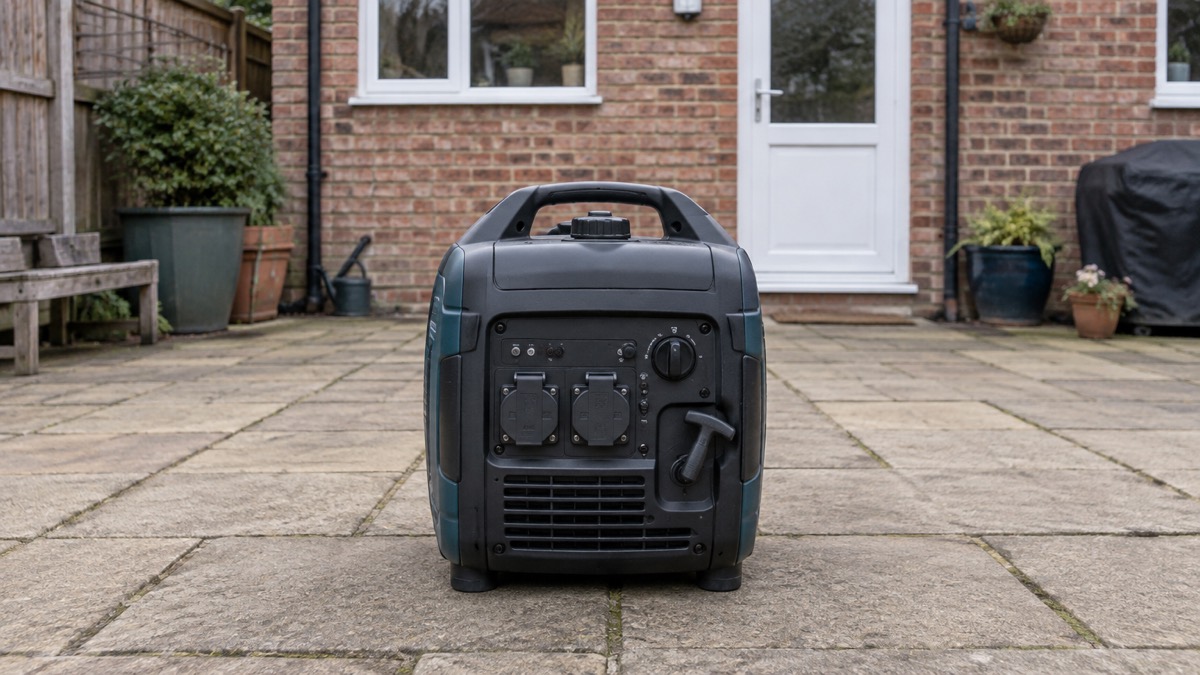
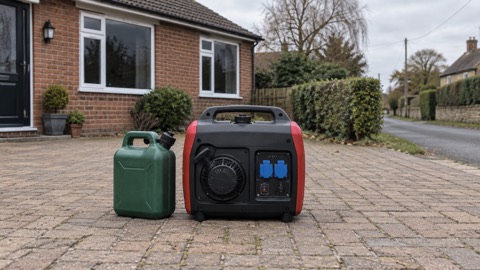
The Champion 3600W inverter generator is a petrol generator built to supply mains power to a household when the mains fails. The maker gives it a rated output of 3500 W, a maximum of 3600 W and a starting output of 4500 W, from a 212cc four-stroke engine, with two 240 V sockets rated at 13 A each1. It is an inverter model, which the maker says uses True Sine Wave technology so sensitive electronics can be connected with confidence1.
The headline numbers for planning are these: an 8.7 litre fuel tank, up to 14 hours of running at 25% load, a weight of 45.6 kg and a noise level of 61 dBA at 7 m1. It starts by recoil, electric start or a wireless remote from up to 24 m away1. It has a low oil shutoff and a 500 ml oil tank1.
Before anything else, understand the one rule that governs how you use it. A petrol generator produces carbon monoxide, and it must never be run indoors, in a garage or in any enclosed or partly enclosed space. The maker's specifications tell you what the machine can do; the safety guidance on our generator safety page tells you how to run it without harm. This page covers what the Champion 3600W is, what it can power, how to start and look after it, and where to get support.
What the Champion 3600W inverter generator is
This is a single-phase petrol generator with a 212cc Champion single cylinder, four-stroke OHV engine, running at 3600 rpm and producing 6.5 HP1. It is an inverter generator, which means the engine's output is converted to a clean mains waveform rather than the rougher supply of an open-frame set. The maker describes it as using True Sine Wave technology, safe for sensitive electronics, and adds a digital 15 second power delay on start-up and shut down so that sensitive equipment can be left plugged in1.
That combination of features is what makes it a candidate for a household that wants to keep a fridge, a freezer, a router, a phone charger or a boiler's controls running through an outage, rather than just powering a work light. If you are weighing up whether an inverter or an open-frame set suits you, our guide to inverter and open-frame generators sets out the difference.
The physical package matters as much as the electrics. The unit measures 510 x 589 x 449 mm (height x length x width) and weighs 45.6 kg, with wheels included1. That is heavy enough that you will want to plan where it lives and how you move it before an outage, not during one. It carries an IP23M rating, which indicates a degree of protection against rain falling at an angle, but that is not a licence to run it in standing water or a downpour1.
The maker lists the certifications as CARB, EU Stage V and UKCA, and states that all newly manufactured products are EU Stage V compliant1. UKCA is the UK conformity marking; our guide to UKCA, CE and battery safety markings explains what the markings mean when you check a unit.
Specifications at a glance
The maker's product page gives the full specification. The figures below are the ones that decide whether the machine suits your household and how you will store and run it.
| Specification | Maker's figure |
|---|---|
| Engine | 212cc Champion single cylinder, 4-stroke OHV1 |
| Engine output | 6.5 HP, 3600 rpm1 |
| Fuel | Petrol1 |
| Fuel tank | 8.7 litres1 |
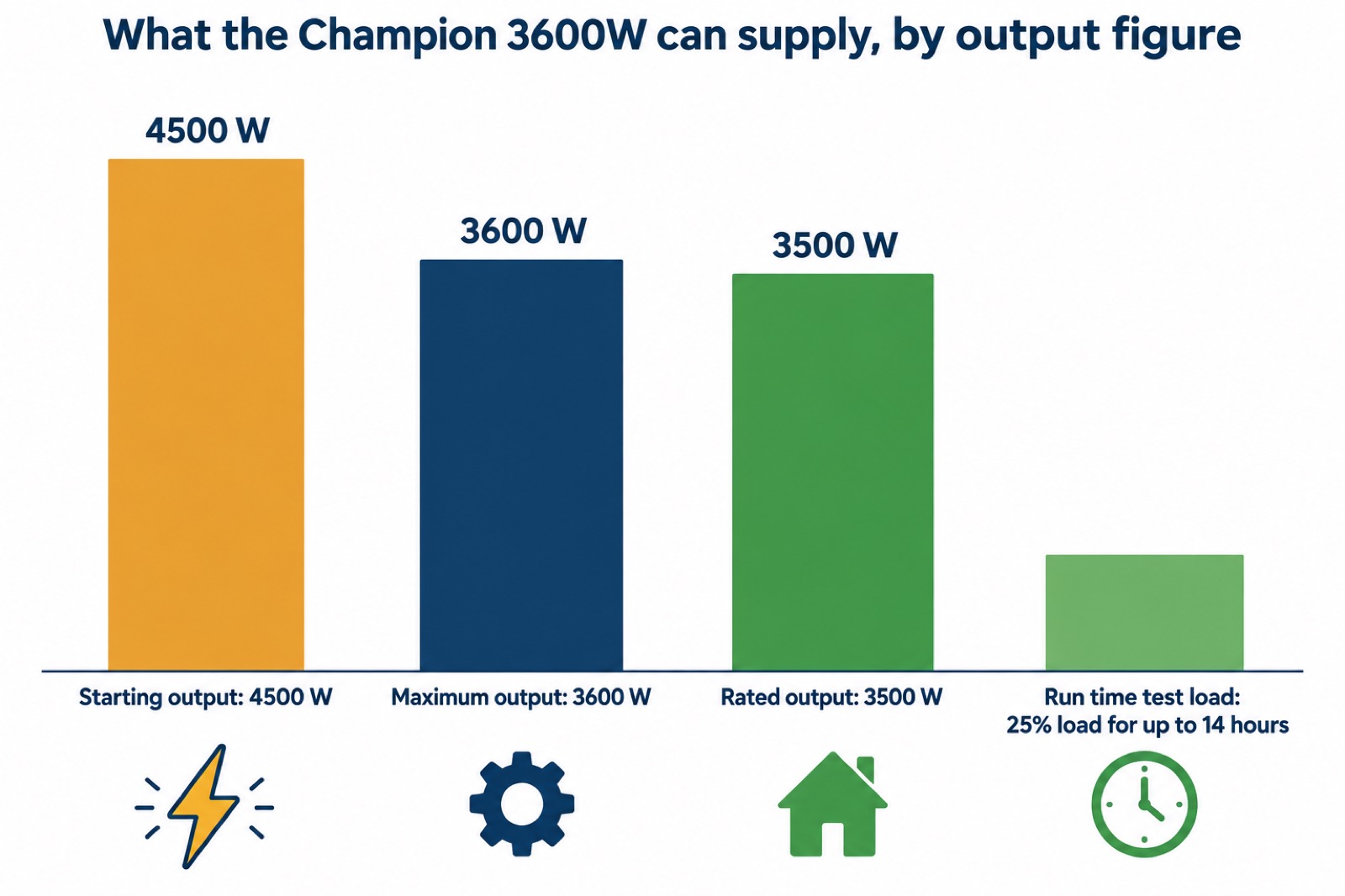
| Run time | Up to 14 hours at 25% load1 |
| Rated output | 3500 W1 |
| Maximum output | 3600 W1 |
| Starting output | 4500 W1 |
| AC outlets | 2 x 240 V, 13/13 A sockets1 |
| DC output | 12 V1 |
| Start type | Recoil, remote, electric1 |
| Remote range | Up to 24 m1 |
| Oil tank | 500 ml1 |
| Low oil shutoff | Yes1 |
| Noise | 61 dBA at 7 m1 |
| Weight | 45.6 kg1 |
| Dimensions | 510 x 589 x 449 mm (HxLxW)1 |
| IP rating | IP23M1 |
| Parallel connectivity | Yes1 |
| Warranty | 3 years1 |
The maker's page also lists a power factor of 1.0 and single-phase operation1. For a plain explanation of what rated, maximum and starting watts mean, and why a fridge or a pump needs more at the moment it starts than while it runs, see our guide to watts, watt-hours and surge.
Run time: up to 14 hours at 25% load on an 8.7 litre tank
The maker's headline claim is an extended run time: a 212cc engine with a large 8.7 litre fuel tank for up to 14 hours of runtime at 25% load1. That is the figure to plan around, and it comes with two conditions worth understanding.
First, 25% load is a light load. Twenty-five per cent of the rated 3500 W is a small fraction of what the machine can deliver, so the 14 hour figure describes a modest draw, not a house running at full stretch. The heavier the load, the shorter the run. The maker does not give a run time at higher loads on this page, so treat 14 hours as the best case at light load rather than a promise for a cold night with a heater plugged in.
Second, the maker's own figures do not agree. The product page gives the run time as up to 14 hours at 25% load from the 8.7 litre tank1, while other material from the same maker gives up to 12 hours at 25% load. The two figures have not been reconciled, so if the exact duration matters to you, plan on the shorter of the two and treat the longer as the best case.
For context on how generator run times work in general, and how load changes them, our guide to generator run time explains the relationship. If you are deciding what to keep running to make a tank last, our page on deciding what to keep running when the mains fails helps you rank the fridge, the freezer, the boiler and the phone charger.
Starting it: recoil, electric or remote from up to 24m
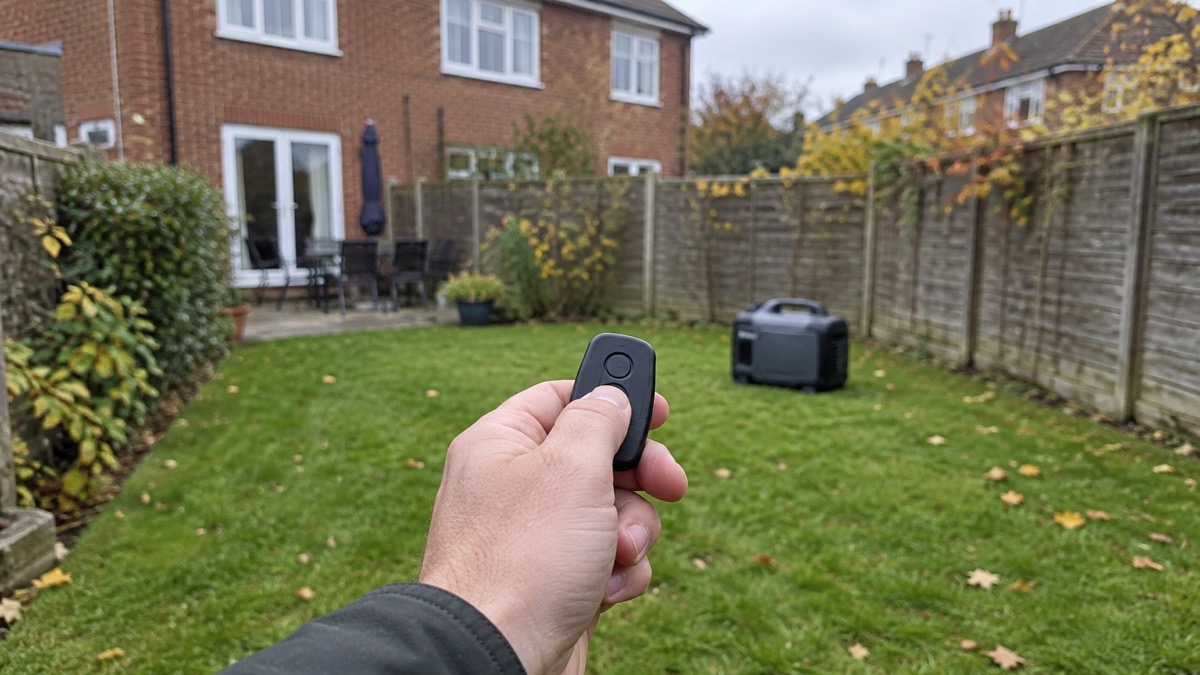
The Champion 3600W offers three ways to start: recoil, electric start and a wireless remote1. The maker's remote start feature lets you start the generator from up to 24 m away1. That range is useful: you can start the machine from inside the house or from a safe distance, rather than standing over it, which matters when the generator is sited well away from the building for carbon monoxide safety.
The remote comes as a key fob in the box1. A customer comment reproduced on the maker's page notes that the generator was very quiet in operation with a nice remote control, but that the battery seemed to go flat after a few days, though it was easily manually started1. That is a customer's experience rather than a maker's specification, but it is a useful warning: check the fob before an outage, and know that the recoil pull start is your fallback if the remote does not work.
Starting sequence, in the order the maker's features suggest:
- Site the generator outdoors, well away from doors, windows and vents, never in a garage or shed.
- Check the oil level against the maker's mark; the low oil shutoff will stop the engine if the level drops too far1.
- Fill with petrol, following the maker's manual and safe fuel handling.
- Start by remote from up to 24 m, by electric start, or by recoil if needed1.
- Let the 15 second power delay run its course before relying on sensitive equipment1.
Weight, size and noise: 45.6kg and 61 dBA at 7m
At 45.6 kg, this is not a machine you carry up a step on your own in the dark1. The maker includes wheels, which helps on a flat path, but plan the route from storage to running position in advance and get a second person for anything awkward. The dimensions, 510 x 589 x 449 mm, tell you how much space it needs in a shed or garage when not in use1.
Noise is 61 dBA at 7 m1. That is a measured figure at a set distance, and it is worth thinking about what it means for neighbours, especially in a terrace or a flat with a shared garden. Our guide to generator noise and neighbours covers how to site a set considerately. For comparison, a maker of a different kind of product, a portable power station, describes petrol generators generally as weighing 50 to 70 kg, noisy, bulky and inconvenient for long-term use2. That is a competitor's characterisation, not a measurement of this model, but it is a reminder that a petrol generator is a substantial piece of equipment.
The practical points:
- Store it where you can wheel it out without lifting.
- Keep the fuel and oil separate and labelled.
- Site it outdoors, downwind of doors and windows, before starting.
- Never run it in a garage, shed, conservatory or any enclosed space.
What it can power, and what it cannot
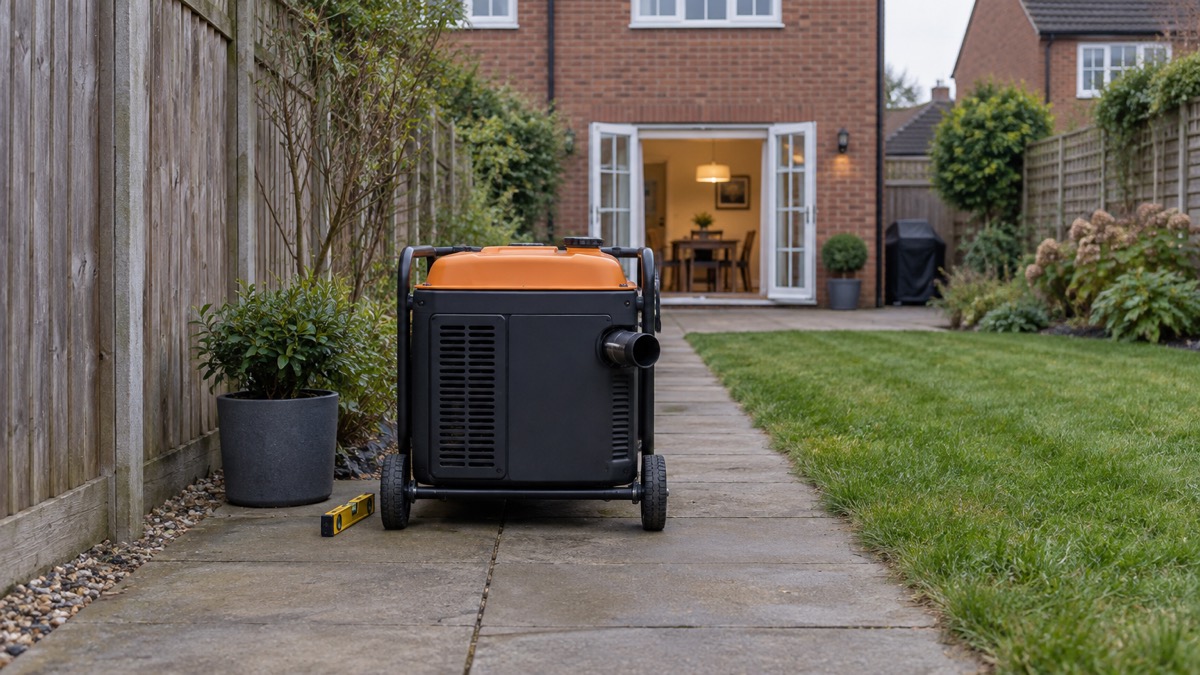
The rated output of 3500 W and the starting output of 4500 W are the figures that decide what you can plug in1. The starting figure matters because appliances such as fridges and freezers draw a surge when the compressor starts, then settle to a lower running draw. Our guide to watts, watt-hours and surge explains the difference, and our page on what size generator you need helps you add up a household's load.
The two 240 V sockets are rated at 13 A each1. That is the same as a standard UK socket, so the limit is the generator's output, not the plug. There is also a 12 V DC output1. The maker's True Sine Wave technology and the 15 second power delay are aimed at sensitive electronics, so a router, a laptop or a television can be connected with more confidence than to a rough open-frame set1.
What it cannot do is run indoors. No amount of clean power changes the fact that a petrol engine produces carbon monoxide. The maker's specifications do not override the safety rule, and our page on carbon monoxide from generators sets out the warning signs. If you are weighing a generator against a battery-based alternative, our comparison of a portable power station or a petrol generator sets the two side by side.
Using it safely: carbon monoxide, fuel and electricity
The safety rules for this machine come from the fire and rescue service, the Health and Safety Executive and the maker's own instructions, and they apply whatever the specifications say.
If you must run it in wet weather, keep it out of water and follow the maker's manual. Our page on running a generator in the rain covers this in more detail.
On fuel, store petrol only in a suitable container, away from the house and away from ignition sources, and never refuel a hot engine. Our guide to how much petrol you can store at home safely sets out the limits. On electricity, never connect the generator to your home's wiring unless it is done properly by a competent person; our page on connecting a generator to your home's wiring explains why. Use the sockets directly, keep extension leads within their rating, and see our guide to extension leads and overloading if you need to reach further.
The low oil shutoff protects the engine, not you: it stops the machine when the oil runs low, so check the 500 ml oil tank before each run1. Keep the oil funnel from the box for topping up1.
Support, warranty and where to get help
The maker lists a three year warranty on this model1. Keep your proof of purchase and the manual, and deal with the seller or the brand's UK operation if something goes wrong. Our Champion brand page gathers the range in one place.
If you are choosing between this and other Champion models, the Champion 3500W petrol inverter and the Champion 3600W digital hybrid inverter sit alongside it. For the wider picture on generators, start with our guide to portable generators, and for the household view of an outage, our power cuts guide.
Sources (2)
- Champion 3600 Watt Inverter Petrol Generator, Champion Power Equipment, 2026-10-25
- BLUETTI Elite 400 Portable Power Station, BLUETTI, 2026-10-25

 EcoFlow Dual Fuel Generator
 Honda EU70iS Generator
 Honda EU32i Generator
 Honda EG3600 Generator
 Pramac P3500i Generator
 Senci SC6000-II Home Generator
 Senci SC10000-II Generator
 Senci SC6600iED Generator
 Gorilla Power GP3800iE
 Gorilla Power GP6500E-DF
 Gorilla Power GP3500i
 Hyundai HY2250Si Generator