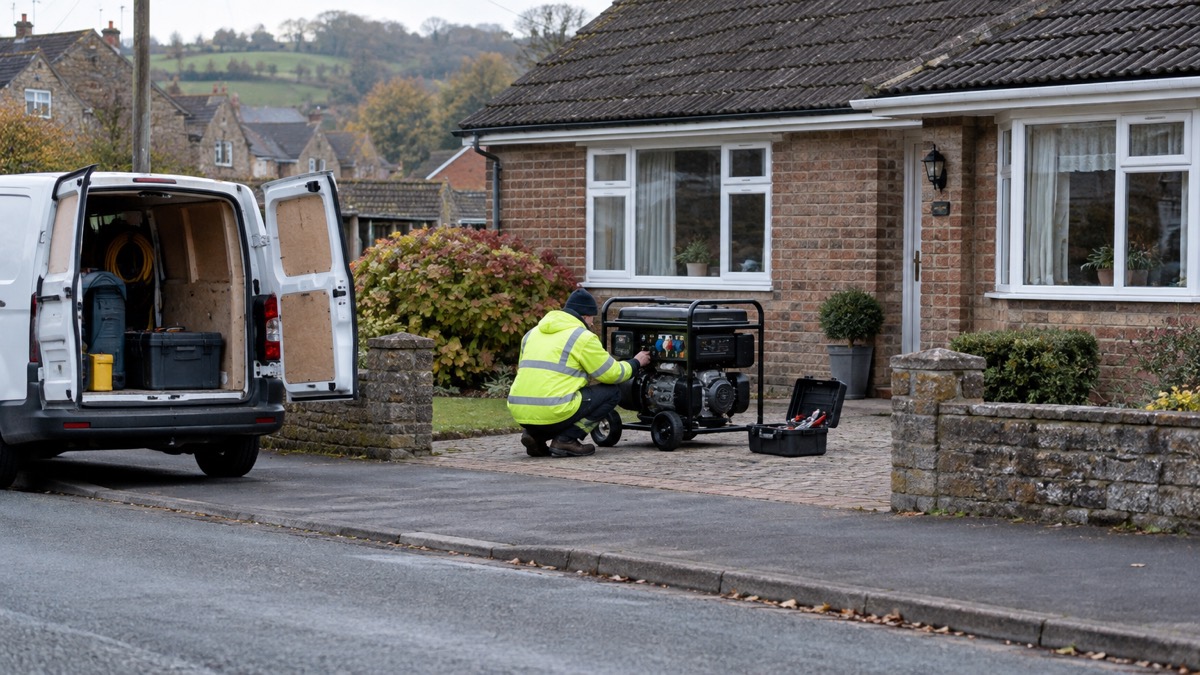
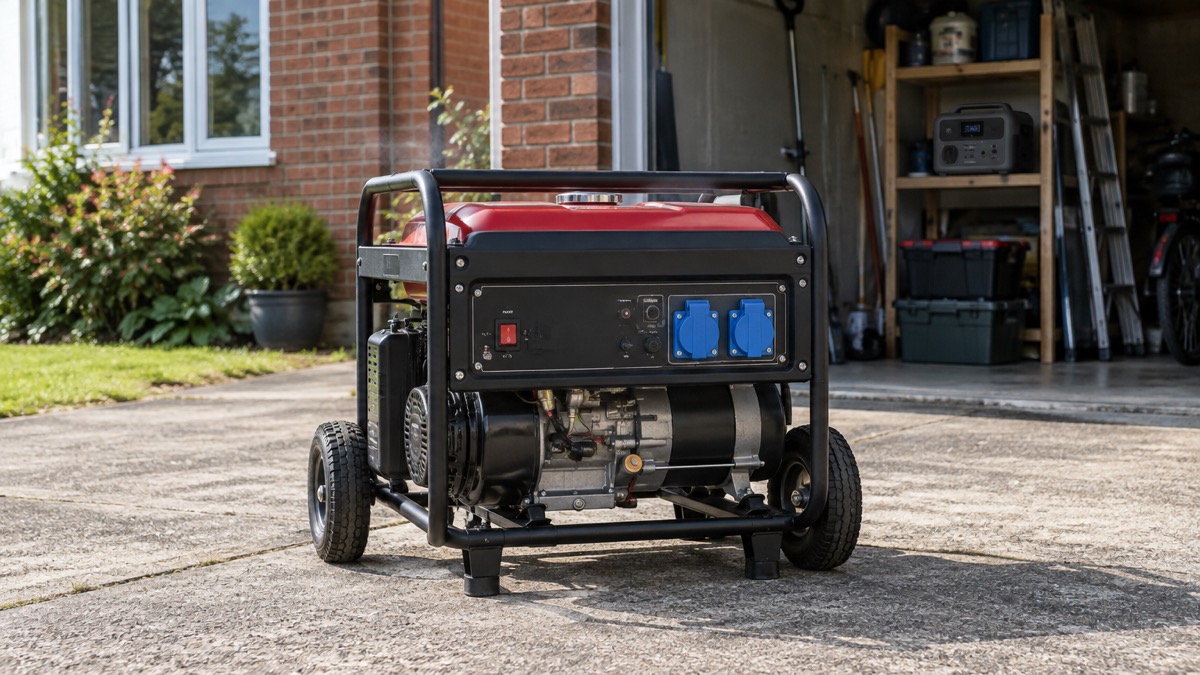
The Honda EG3600 is a petrol generator with a maximum output of 3,600W and a rated output of 3,200W at 230V1. Rated output is the figure to plan around: it is what the machine will hold continuously, while the higher maximum is a short-term ceiling. It runs on unleaded petrol with no more than 10% ethanol (E10) and has a 24-litre tank, which the distributor says gives up to 11 hours of run time1.
It is a substantial machine. It weighs 71kg, starts by recoil and runs at 79 dB(A) at 7m1. That puts it in the class of open-frame petrol generators that a maker describes as weighing 50 to 70kg, noisy, bulky and inconvenient for long-term use2. For a household, that means it is a tool for a planned outage or a long job, not something you wheel out for an evening.
This page sets out what the EG3600 can run, how long it lasts, how to handle and site it, and the safety rules that apply to any petrol generator. Those rules are not optional: a generator's exhaust fumes can kill, and the fire and rescue service and the gas safety bodies are clear about where a machine must never go.
Specifications at a glance
The EG3600 is built around a Honda GX270 four-stroke, overhead-valve, single-cylinder engine with forced air cooling1. It is a conventional open-frame petrol generator rather than an inverter model, and the distributor lists a Digital Automatic Voltage Regulator (D-AVR) to hold the output steady1.
| Specification | Figure |
|---|---|
| Maximum output | 3,600W1 |
| Rated output | 3,200W1 |
| Maximum output in kVA | 4.5kVA max, 3.2kW rated1 |
| Voltage | 230V1 |
| Sockets | 2x 115V 16A, 1x 230V 32A1 |
| Engine | Honda GX270, four-stroke, OHV, single cylinder, forced air cooling1 |
| Starting | Recoil1 |
| Fuel tank | 24 litres1 |
| Run time | Up to 11 hours1 |
| Noise | 79 dB(A) at 7m1 |
| Weight | 71kg1 |
| Dimensions | 681mm x 530mm x 570mm1 |
| Frame | Welded, powder-coated tubular steel1 |
| Anti-vibration | Rubber engine mounts inclined at 45 degrees1 |
The socket layout is worth reading carefully. There is one 230V 32A outlet and two 115V 16A outlets1. UK household appliances run on 230V, so the 230V socket is the one a home user will rely on, and it is a single 32A outlet rather than a row of domestic sockets. Plan how you will distribute power from it, and read our guide to extension leads and overloading before you do.
What it can power, and for how long
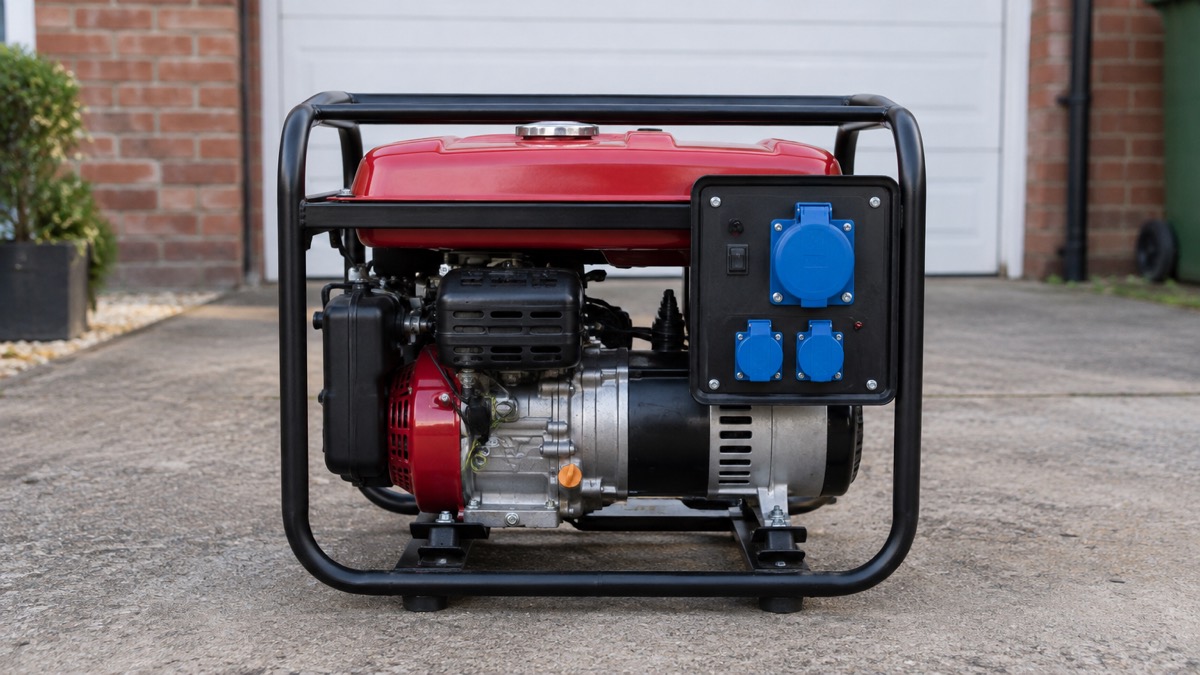
The rated output of 3,200W is the number that decides what you can run at once1. To see how that compares with household appliances, Which? gives an electric oven a maximum power rating of 3,000W3. A single oven is therefore close to the whole rated output of the machine, leaving very little headroom for anything else. Add a kettle, a heater or a power tool and you are over the limit.
That is why the sensible approach is to decide what matters most before an outage, not during one. Our guide to deciding what to keep running when the mains fails walks through that choice, and watts, watt-hours and surge explained covers why motors and compressors draw more at start-up than their label suggests.
Run time is quoted as up to 11 hours on the 24-litre tank1. Treat that as a best case. Plan on the lower figure and check your own consumption. For a wider look at how load changes run time, see how long a generator will run on a tank of fuel.
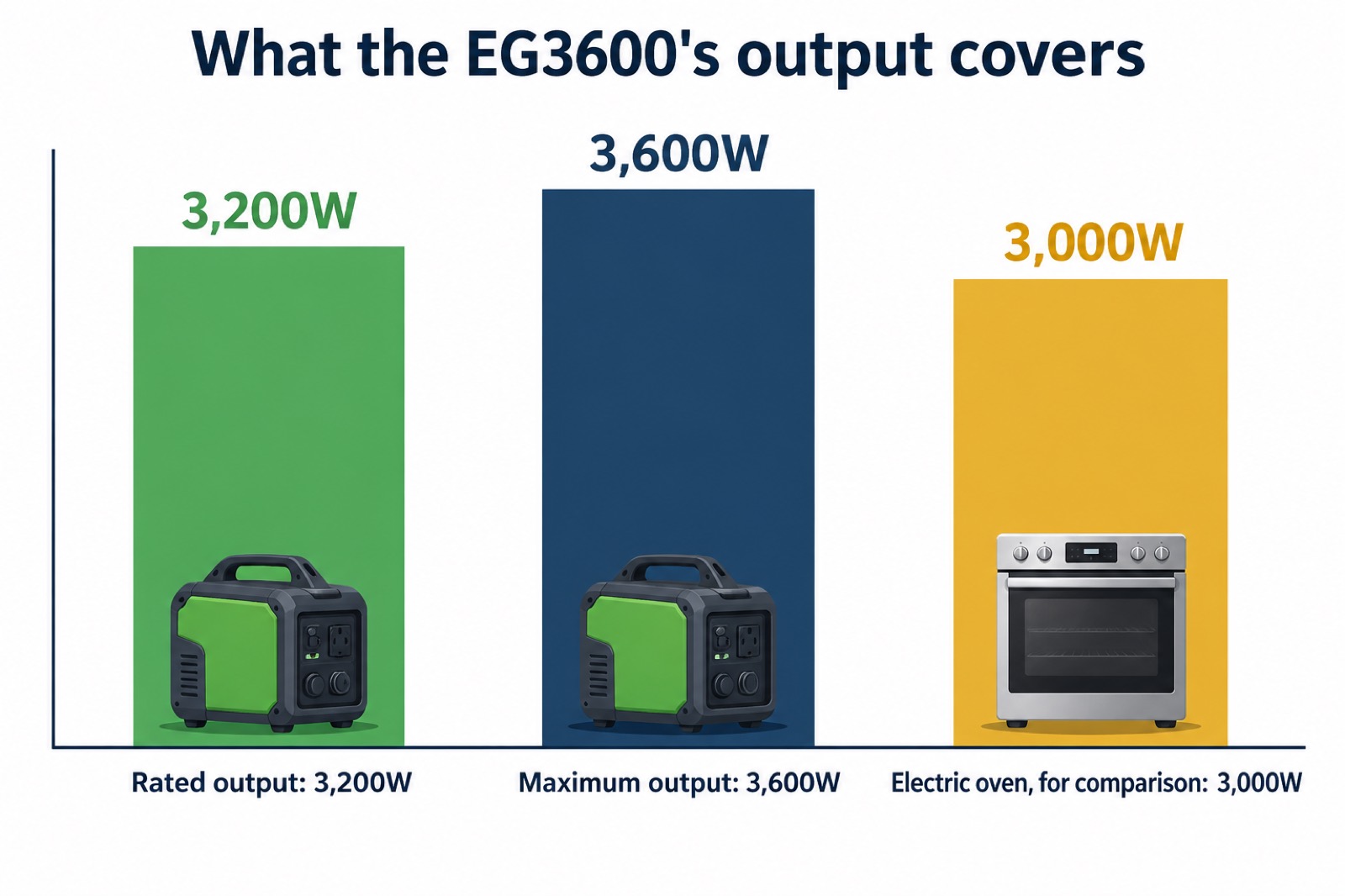
The distributor lists the machine as suited to construction sites, workshops, emergency night work, home backup, industrial lighting, sensitive power tools and general construction equipment1. For a household, the realistic uses are running a few essentials during a long outage, powering tools during repairs, and keeping lighting on when work has to continue after dark.
Fuel, starting and moving a 71kg machine
The EG3600 runs on unleaded petrol with no more than 10% ethanol, which is the E10 grade sold at UK forecourts1. Fill it outdoors, never while the engine is hot, and store spare fuel only in a proper container away from the house. Our guide to how much petrol you can store at home safely sets out the limits.
Starting is by recoil1. There is no electric start and no starter battery to maintain, which suits a machine that may sit unused for months, but it does mean a firm pull each time. Check the oil first: each order includes free Honda 0.6L 10W30 engine oil, supplied in a bottle or already in the machine1.
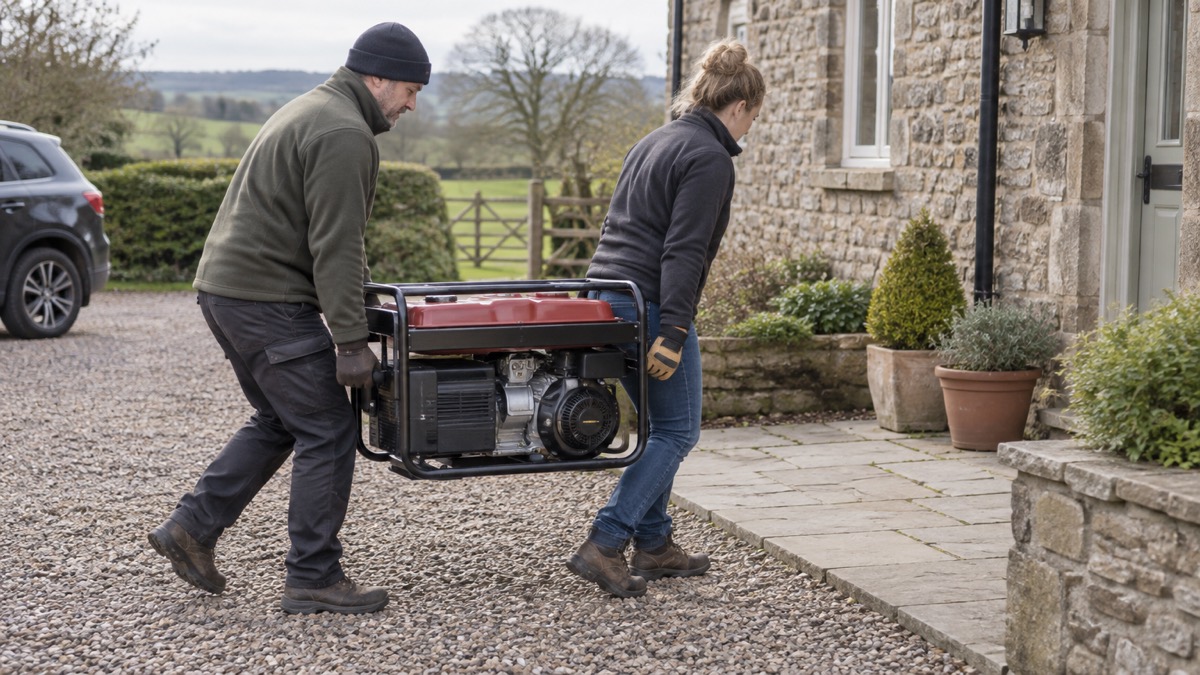
At 71kg1, the EG3600 is not a one-person carry for most people. The welded, powder-coated tubular steel frame is designed to withstand tough worksite conditions1, and the engine sits on rubber mounts inclined at 45 degrees, which the distributor says lower vibration and keep operation quieter1. Even so, plan where it will live before it arrives, and move it with help or on its wheels rather than lifting it.
Noise at 79 dB(A) and where the generator should stand
The EG3600 operates at 79 dB(A) at 7m1. Honda's own generator chooser puts its low-noise range at 83 to 92 dB(A) and its normal range at 95 to 97 dB(A)4, so the EG3600's figure is lower than either band, measured at a distance. Noise still carries: a machine running for hours will be heard by neighbours, and our guide to generator noise and neighbours covers timing and placement.
Where it stands matters far more than how loud it is. A petrol generator produces carbon monoxide, an invisible gas with no smell, and it must never run indoors, in a garage, in a shed or in any enclosed or partly enclosed space, even with the door open. The gas safety bodies advise fitting audible carbon monoxide alarms, and note that all models from one major maker are approved to EN 502915. An alarm is a backstop, not a licence to run a generator inside.
Site the machine outdoors, on level ground, well away from doors, windows and air bricks, and let it cool before refuelling. Our guides to generator safety, carbon monoxide from generators and running a generator in the rain go through the detail. Never connect a generator to your home's wiring yourself: our guide to connecting a generator or battery to your home's wiring explains why this needs a qualified electrician.
Delivery, pre-delivery testing and what comes in the box
The distributor says the machine arrives fully assembled and ready to use, typically within 3 to 5 working days1. As per Honda's recommendation, the generator is removed from the box and started and tested before delivery1. That pre-delivery inspection means a machine that has been run before it reaches you, so check the oil and fuel levels on arrival rather than assuming it is dry.
A personal delivery option covers mainland England and Wales1. If you are in Scotland, Northern Ireland or the islands, ask the supplier what is available before ordering.
Each order includes free Honda 0.6L 10W30 engine oil1. Beyond that, the machine, its frame and its control panel are what you get. There is no mention of a cover, a transfer switch or a cable in the product information, so plan for those separately if you need them.
Warranty: 5 years domestic, 1 year commercial
The EG3600 comes with a 5-year domestic warranty, subject to annual servicing1. The condition is the important part: the cover depends on the machine being serviced every year, so keep records and book it in.
Commercial use is covered differently. The distributor lists a 1-year commercial warranty1. If you will use the machine for work, that is the cover that applies, and it is much shorter than the domestic term. Other makers structure their cover differently, for example with parts-only years later in the term, but for this machine the figures above are what the distributor states.
The distributor describes itself as an Authorised UK Supplier, with pre-delivery inspection and a 1-year commercial warranty1. If you need to make a claim, go back to the supplier you bought from with your servicing records.
How it compares with other ways to keep the power on
The EG3600 is one answer to a power cut, not the only one. A petrol generator of this size gives high output for long periods, at the cost of weight, noise, fuel storage and exhaust fumes. A battery power station gives silent, fume-free power indoors, but with a much smaller store of energy. Our comparison of a portable power station or petrol generator for a power cut sets the two side by side, and portable generators: petrol, diesel, dual-fuel and inverter types explains the categories.
| What you need | What suits it |
|---|---|
| High output for hours, outdoors only | A petrol generator such as the EG36001 |
| Silent power indoors, no fumes | A battery power station2 |
| Running a few essentials overnight | A smaller, lighter option2 |
The maker's own description of fuel generators is blunt: 50 to 70kg, noisy, bulky and inconvenient for long-term use2. The EG3600 sits at the top of that weight band at 71kg1. If your need is a fridge, a phone charger and a light for a few hours, a power station will do it without the fuel and the fumes. If you need to run power tools or a large appliance for most of a day, the generator is the tool for the job.
Sources (5)
- Honda EG3600 petrol generator, Just Generators, 2026-10-25
- BLUETTI Elite 400 portable power station, BLUETTI, 2026-10-25
- How to buy the best generator, Which?, 2026-01-20
- Help me choose a generator, Honda, 2026-10-25
- Carbon monoxide alarms, CO-Gas Safety, 2024-02-18
 EcoFlow Dual Fuel Generator
 Honda EU70iS Generator
 Honda EU32i Generator
 Pramac P3500i Generator
 Senci SC6000-II Home Generator
 Senci SC10000-II Generator
 Senci SC6600iED Generator
 Gorilla Power GP3800iE
 Gorilla Power GP6500E-DF
 Gorilla Power GP3500i
 Hyundai HY2250Si Generator
 Hyundai HY1000Si Generator