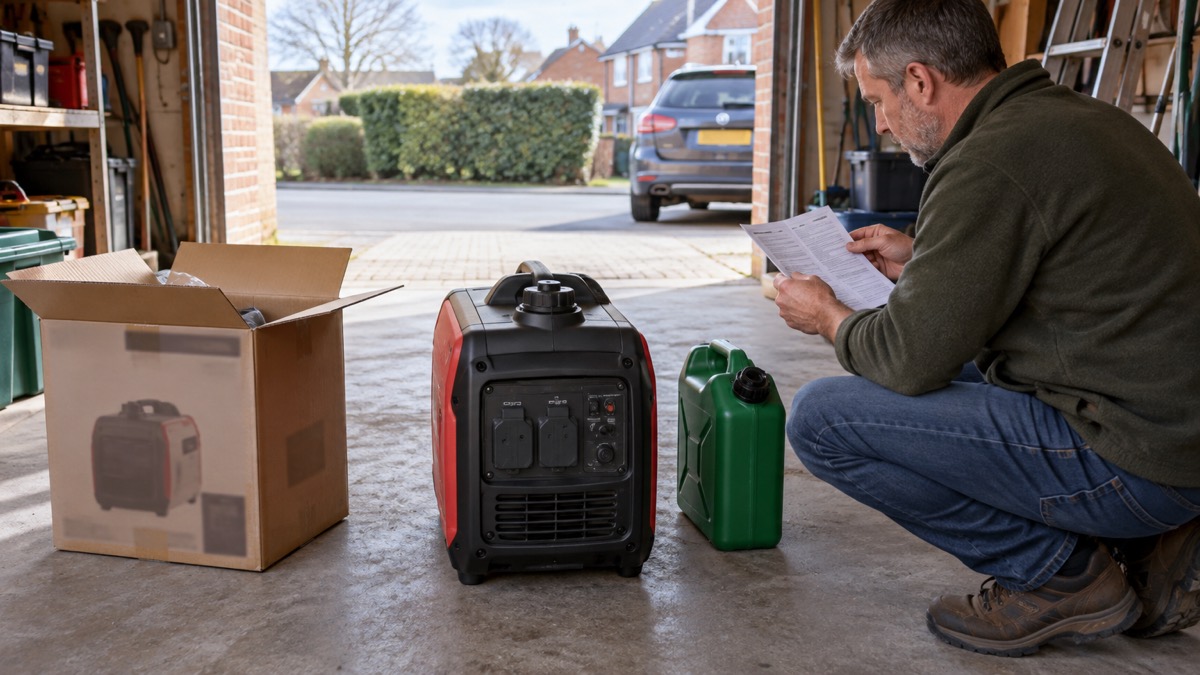
The Pramac P3500i is a petrol inverter generator: a portable engine-driven unit that produces mains-style 230V power for a household when the mains fails. It is rated at 3,000W continuously, with a maximum of 3,300W for short surges, and it runs for about 6 hours at 75% load on its 10 litre tank1. It has two 13A UK sockets and two 5V USB ports, so it can run appliances and charge phones from the same unit1.
It is a substantial piece of kit. At 49.5kg it is not something one person lifts easily, and at 61 dB(A) at 7 metres it is audible well beyond your own garden1. The supplier describes it as ideal for non-intensive domestic or semi-professional use, which is the right frame for it: occasional backup during an outage, not continuous running1.
This page sets out what the P3500i can power, how long it runs, what comes in the box, how to start and run it, and the safety rules that apply to any petrol generator. Those rules are not optional. A petrol generator produces carbon monoxide, and it must never be run indoors, in a garage or in any enclosed or partly enclosed space.
What the P3500i is and who it suits
The P3500i is a single-phase generator operating at 230V and 50Hz, using inverter technology1. Inverter output is smoothed electronically, and the supplier states that this gives stable power for the safe operation of sensitive electronics2. That matters in a household context: a fridge, a freezer, a boiler's controls, a laptop and a phone charger are all things people want back during an outage, and inverter output is the reason a generator of this kind is chosen over a plain open-frame unit.
The engine is a four-stroke OHV petrol unit of 212cc, rated at 3000 rpm and built to Stage V emissions standards1. One distributor names it as a Loncin engine and the other as a Pramac engine; both describe the same Stage V four-stroke unit, so treat the naming as a difference in how the suppliers describe it rather than a difference in the machine1.
Who it suits comes down to duty. The supplier's own description is "ideal for non-intensive domestic or semi-professional use"1. In practice that means a household that wants a few hours of power during a storm-related cut, or a small business that needs occasional backup, rather than a site that runs a generator all day. If you are weighing a generator against a battery-based alternative, the comparison of portable power stations and petrol generators sets out the trade-offs, and the guide to portable generators explains the different types.
Specifications at a glance
The figures below come from the supplier's product listings. Where the two listings differ, both are given.
| Specification | Pramac P3500i |
|---|---|
| Type | Petrol inverter generator, single-phase1 |
| Rated output | 3,000W (3.00 kVA continuous)1 |
| Maximum output | 3,300W (3.30 kVA maximum)1 |
| Voltage and frequency | 230V, 50Hz1 |
| Engine | Four-stroke OHV petrol, 212cc, 3000 rpm, Stage V1 |
| Fuel tank | 10 litres1 |
| Run time | About 6 hours at 75% load1 |
| Oil capacity | 600ml2 |
| AC outlets | Two 13A UK sockets (BS1363)1 |
| USB outlets | Two 5V 2A1 |
| Starting | Electric or recoil1 |
| Noise | 61 dB(A) at 7m1 |
| Weight | 49.5kg1 |
| Dimensions | 601 x 458 x 552mm1 |
| Warranty | 12 months or 150 hours, whichever comes first1 |
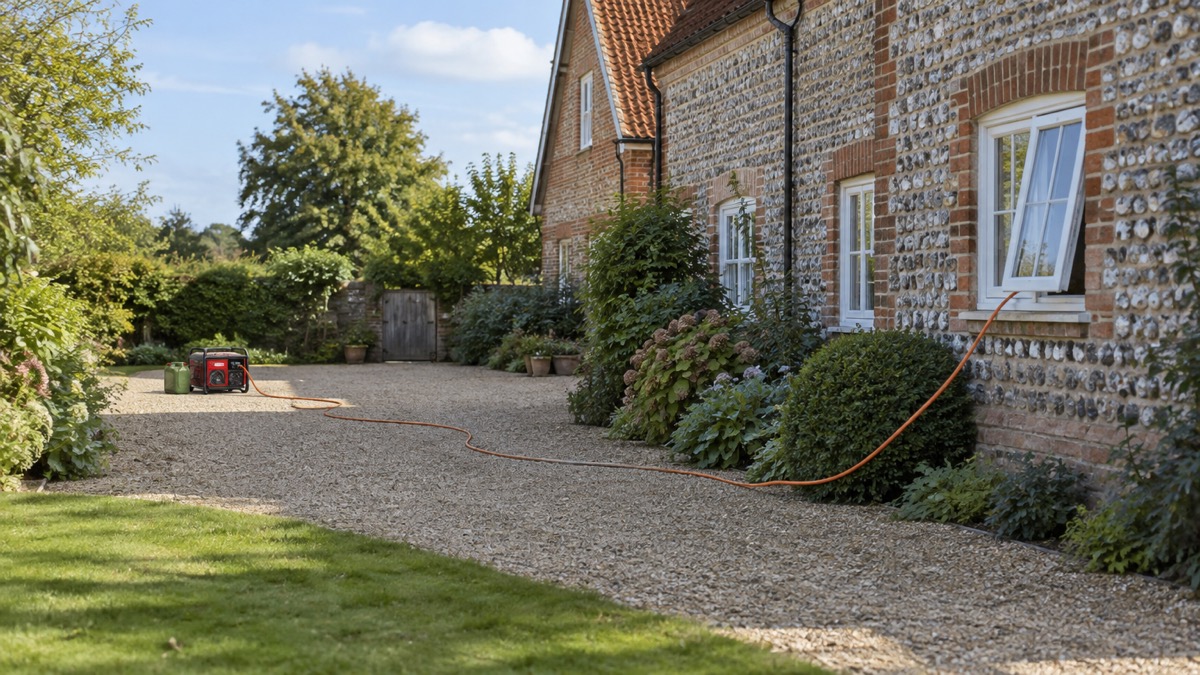
The P3500i/o version shares the same output, voltage, dimensions, weight and starting method, but its listing gives a run time of 5.5 hours at 75% load and a noise figure of 66 dB(A) at 7m3. If you are buying, check which version is being offered and which figures apply to it.
What it can power, and for how long
The headline numbers are 3,000W continuous and 3,300W maximum1. Continuous output is what the generator can supply for as long as it runs; the maximum figure is the short burst available when something with a motor starts up. The P3500i has a feature called Powerrush, which the supplier says "increases electrical current upon demand, above rated output when starting electric motors"1. That is the mechanism behind the surge rating, and it is why a fridge or freezer compressor can start on a generator whose continuous rating looks close to the appliance's running load.
Working out what your own household needs is the step before buying. The guide to watts, watt-hours and surge explains how to add up appliance loads and allow for starting surges, and what size generator you need takes the same question step by step. Deciding what to keep running helps you choose between the fridge, the heating controls and the phone chargers when you cannot have everything.
Run time is the other half of the calculation. On a full 10 litre tank the P3500i runs for about 6 hours at 75% load1. Load matters: the economy mode automatically adjusts engine speed to the optimum level for fuel economy and noise reduction, so a lighter load should stretch the fuel further, though the published figure is the 75% one1. For a sense of scale, a 1000W unit with a 5 litre tank is quoted by its maker at about 6 hours at 500W4; the P3500i carries twice the fuel and a much larger engine, so plan refuelling stops rather than expecting a full night from one tank. The guide to generator run time covers how load and fuel affect duration.
Starting it, economy mode and Powerrush
The P3500i starts either electrically or by recoil pull1. Before any start, check the oil and fuel, and site the generator outdoors on a firm, level surface, well away from doors, windows and vents. The control panel carries a digital display showing output status with a green indicator light, and overload and oil alarms with red indicator lights, alongside a voltmeter and hour meter1. The hour meter is worth using: it is how you keep track of the 150 hour warranty limit1.
Once running, economy mode is the setting for household backup. The supplier states that it "automatically adjusts the engine speed to the optimum level to provide excellent fuel economy and noise reduction"1. For a long outage, running in economy mode with a modest load is the way to make the tank last.
Powerrush is the feature that helps when a motor starts. The supplier's description is that it "increases electrical current upon demand, above rated output when starting electric motors"1. In practice, start appliances one at a time rather than switching everything on at once, so the surge from one motor is not competing with another.
"Powerrush increases electrical current upon demand, above rated output when starting electric motors."
Built-in protections and the control panel
The P3500i carries a set of protections listed by the supplier: overload, Oil Guard, overvoltage, overtemperature and short circuit, with a control panel rated IP 441. The low-oil shutdown is described as safeguarding the engine from damage automatically1. These protections are there to stop a mistake turning into a repair bill, but they are a backstop. Check the oil before every start and keep the load within the rated output.
The panel's indicator lights tell you what is happening: green for output, red for overload and oil alarms1. If a red light comes on, stop, switch off the load and investigate before restarting. The guide to generator safety covers the wider rules on fuel, carbon monoxide and electric shock.
Size, weight and noise in practice
The P3500i measures 601 x 458 x 552mm and weighs 49.5kg, so plan where it will stand before you need it: outdoors, on firm ground, with a route for the lead back to the house that does not run through water or across a doorway1. The guide to storing a generator covers where and how to keep it between uses.
Noise is the other practical constraint. The P3500i is quoted at 61 dB(A) at 7 metres1. That is a working-engine sound that neighbours will hear, particularly in a quiet street at night. The guide to generator noise and neighbours explains what the figures mean and how siting affects them. The P3500i/o listing gives 66 dB(A) at 7m, so the two versions are not identical on this point3.
Fuel, oil and what comes in the box
The carton includes an oil bottle, a funnel and plugs1. The tank holds 10 litres of petrol, which you supply yourself1. The engine oil capacity is 600ml2. Check the level before each start and top up as the maker instructs; the low-oil shutdown protects the engine, but it is not a substitute for checking1.
Storing petrol at home has limits and rules, and the guide to how much petrol you can store safely sets them out. Keep fuel in a proper container, away from the generator while it is running and away from any source of ignition.
The P3500i/o version and parallel connection
The P3500i/o is a variant of the same machine. It shares the 3,000W rated and 3,300W maximum output, the 230V single-phase inverter output, the 601 x 458 x 552mm dimensions, the 49.5kg weight and the electric or recoil starting3. Its listing gives a run time of 5.5 hours at 75% load and a noise figure of 66 dB(A) at 7m, against 6 hours and 61 dB(A) for the P3500i1. The two listings disagree on those two figures, so ask the supplier which version you are buying.
The P3500i has a connector for a parallel kit1. The product information does not state the combined output, what the kit contains or how the connection is made, so check with the supplier before relying on it. Connecting two generators in parallel is not a job to improvise; follow the kit maker's instructions exactly.
Warranty, delivery and where to get help
The warranty is 12 months or 150 hours, whichever comes first1. That hours limit is the one to watch: a household that runs the generator through several long outages could reach 150 hours well inside a year. Use the hour meter on the control panel to keep a record1. The supplier quotes an expected delivery of 2 to 3 working days1.
For the wider picture, the backup power guide covers the options for a household, and using generators and power stations during an outage sets out what to do when the power actually goes. If you are deciding between a generator and a battery unit, the guide to portable power stations explains what they do and how they differ.
Sources (4)
- Pramac P3500i Petrol Inverter Generator, Just Generators, 2026-10-25
- Pramac P3500i Petrol Inverter Generator, Generators Direct, 2026-06-05
- Pramac P3500i/o Petrol Inverter Generator, Just Generators, 2026-10-25
- BLUETTI Elite 400 Portable Power Station, BLUETTI, 2026-10-25
 EcoFlow Dual Fuel Generator
 Honda EU70iS Generator
 Honda EU32i Generator
 Honda EG3600 Generator
 Senci SC6000-II Home Generator
 Senci SC10000-II Generator
 Senci SC6600iED Generator
 Gorilla Power GP3800iE
 Gorilla Power GP6500E-DF
 Gorilla Power GP3500i
 Hyundai HY2250Si Generator
 Hyundai HY1000Si Generator