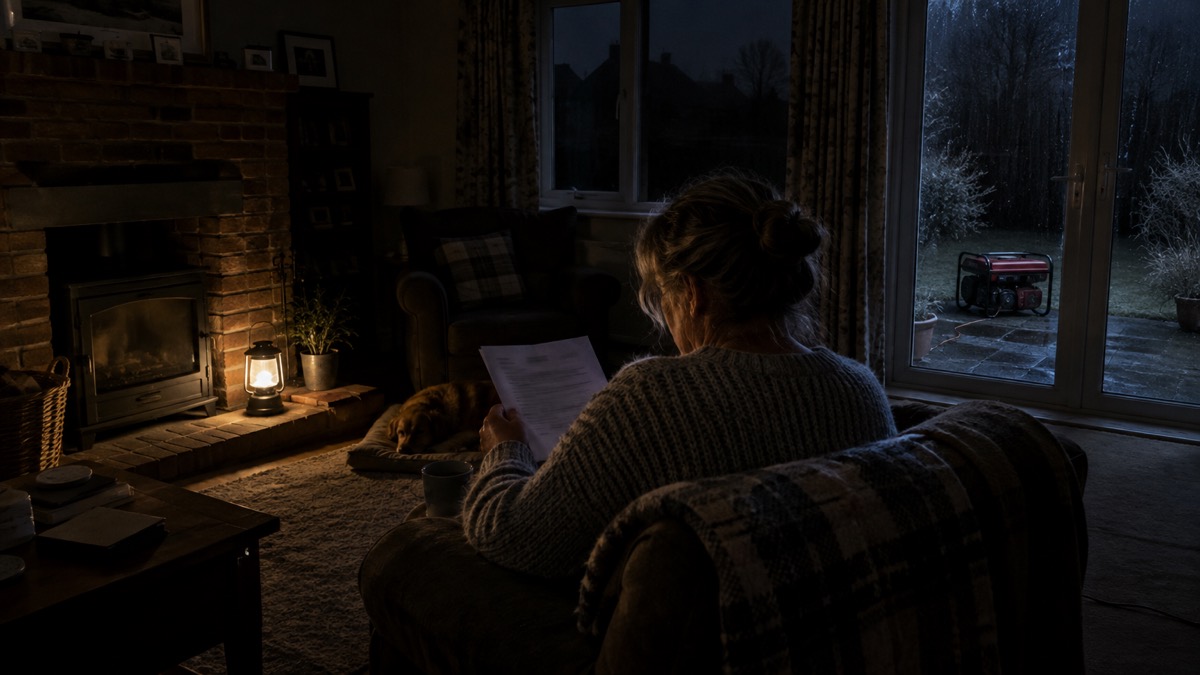
The Hyundai HY1000Si is a small petrol inverter generator: a 1kW machine with a 53 cc four-stroke engine, a 2.2-litre fuel tank and a 230V socket that takes any standard three-pin 13A UK plug1. It is built for leisure and standby use, and the distributor describes it as suited to a weekend away, a caravan or motorhome, or emergency standby at home1. For a household facing a power cut, the useful numbers are these: 900W continuous output and 1000W maximum, about 2.5 hours running at half load, and 14 kg to lift1.
That output is enough for a television, laptops, phone chargers, lights and small air pumps for inflatable beds, which the distributor lists among the things it will run1. It is not enough for the whole house, and it is not a substitute for a proper connection to your wiring. It is a petrol engine, so it produces exhaust fumes and must run outdoors, away from windows and doors, whatever the weather.
This page sets out what the HY1000Si can and cannot do, what it weighs and how loud it is, what comes in the box, and how to fill, start and store it safely. If you are still deciding between a generator and a battery, start with the backup power guide and the comparison of a portable power station or petrol generator.
What the HY1000Si is and who it suits
The HY1000Si is an inverter generator, which means it regulates its output electronically rather than by spinning a conventional alternator at a fixed speed1. The distributor states that the output is a pure sine wave, the same shape of mains supply that sensitive electronics expect, and that the machine is designed for leisure use: a weekend getaway, a holiday, or emergency standby1. It is a closed-casing design with a recoil start, so you pull a cord rather than turn a key, and it has no wheel kit1.
For a household, that combination points to a particular job. It suits someone who wants a small, light unit to keep a few essentials going for a few hours at a time, and who can store petrol safely and run the machine outdoors. It does not suit anyone who wants to power the house's circuits, run a boiler or keep a fridge going for a day. The distributor's own list of what it will run is modest: televisions, small air pumps for inflatable beds, laptops, phone chargers and lights1.
The case is described as much slimmer than earlier designs, with a new, more compact inverter board, and the distributor says the 14 kg weight allows easy storage in a car boot or caravan cupboard1. That portability is the point of the machine. It is a generator you can carry to where you need it, start, and put away again, rather than a fixed installation.
Output: 900W continuous and 1000W maximum
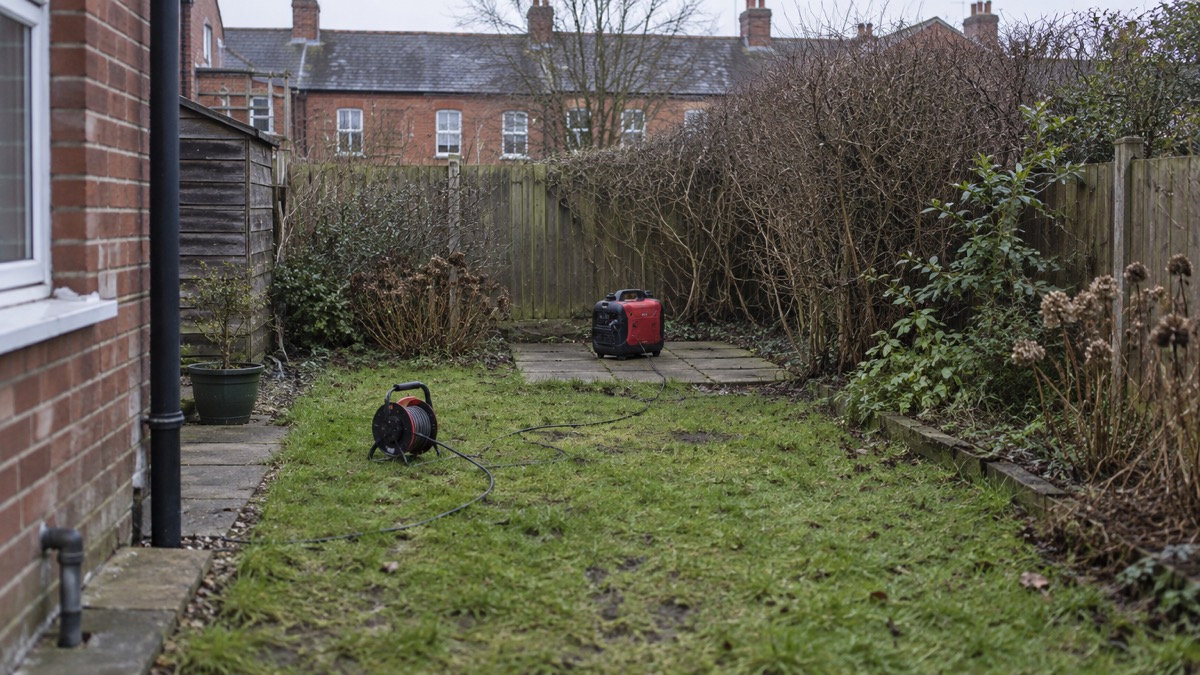
The two output figures do different jobs. Continuous output is what the generator can supply hour after hour: 900W1. Maximum output is the brief peak it can deliver, 1000W, which matters when a motor or compressor starts and draws a surge before settling down1. The distributor also gives a maximum continuous current of 4.4 A at 230V, a frequency of 50 Hz and a power factor of 11.
The machine protects itself. The distributor states that digital overload protection will shut the generator down if devices exceeding 1kW start-up or 900W continuous output are plugged into it1. That is a safety feature, not a fault: if the generator cuts out when you plug something in, the appliance is asking for more than the machine can give. Unplug it, work out what it draws, and leave it off.
Sizing is where most households go wrong, because the label on an appliance rarely tells you the start-up draw. A hair dryer is listed by one maker at 1000W, and a circular saw at 1000 to 1600 watts2. Either would sit at or beyond the HY1000Si's maximum, and the saw would trip the overload protection. The site's guide to watts, watt-hours and surge explains how to add up what you want to run, and what size generator you need takes the same question further.
| Specification | Figure |
|---|---|
| Continuous output | 900W1 |
| Maximum output | 1000W1 |
| Voltage and frequency | 230V, 50 Hz1 |
| Maximum continuous current | 4.4 A1 |
| Max power output | 1.6 hp1 |
| Engine | 53 cc, four-stroke, air-cooled, single cylinder1 |
| Rated speed | 5500 RPM1 |
| Outlets | One 230V socket for a standard 3-pin 13A UK plug, plus a 12v DC battery charging outlet1 |
What it can power in a power cut
Think in terms of a few small loads at once, not the whole house. The distributor's list of what the HY1000Si is more than capable of powering is televisions, small air pumps for inflatable beds, laptops, phone chargers and lights1. Those are all low-draw items, and several can run together within the 900W continuous limit.
What it will not do is run the big loads. The maker states that digital overload protection will shut the generator down if devices exceeding 1kW start-up or 900W continuous output are plugged into it1. That includes the appliances a household most wants in a long cut: an electric shower, a kettle, a fan heater, a full-size fridge starting up. Plan around them rather than hoping.
For the basics, official and independent guidance points to simpler kit first. One network operator suggests battery-powered lights that plug into a power socket and come on automatically during a power cut4. The essentials for coping with a cut are listed as battery candles, torches and batteries, and a mobile phone power pack5. A generator is a step up from that kit, not a replacement for it: the torches and the power bank work when the generator is out of fuel or too noisy to run at night.
Run time: about 2.5 hours at half load
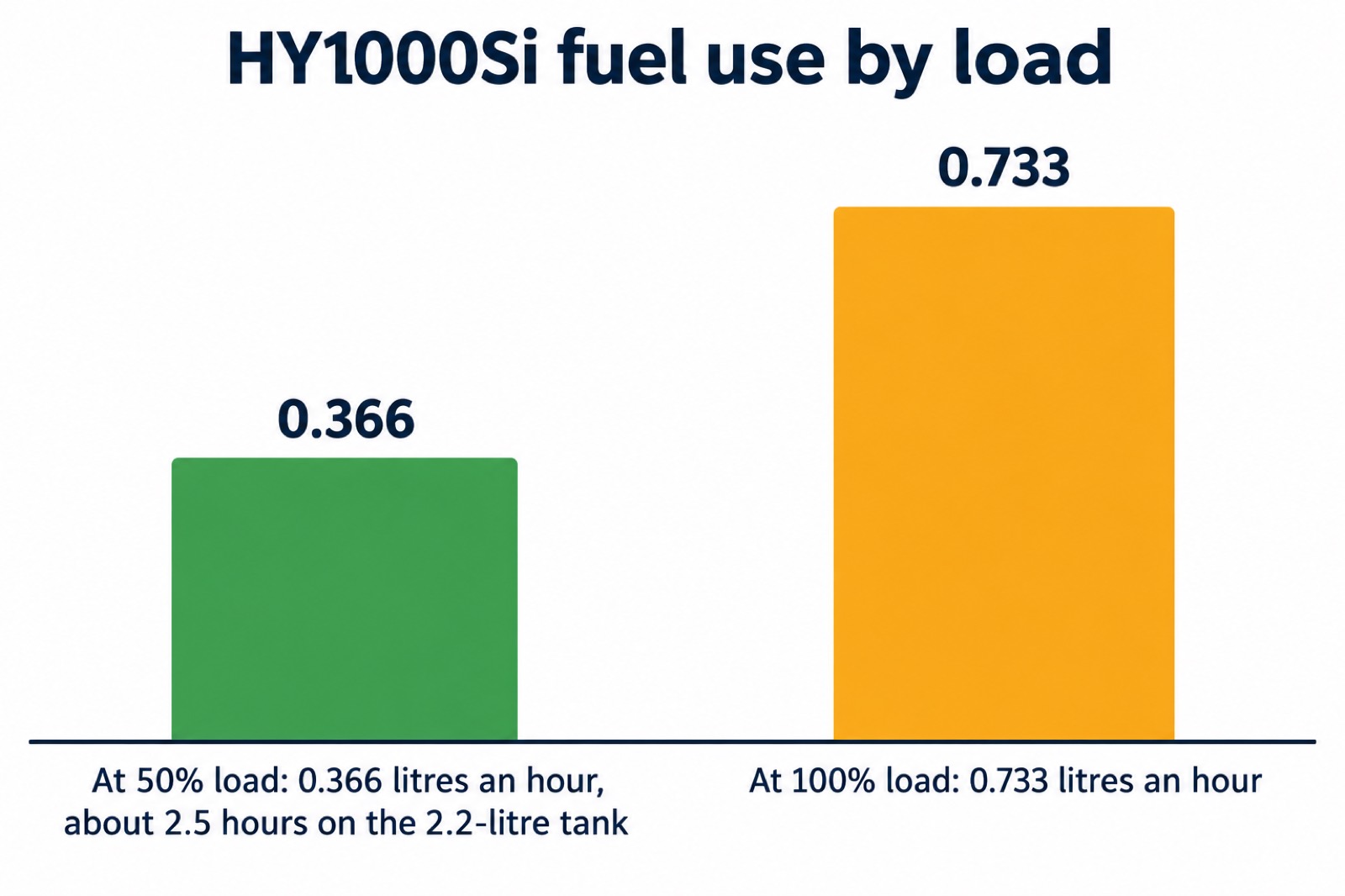
The HY1000Si holds 2.2 litres of petrol and runs for about 2.5 hours at 50% load, according to the distributor1. At that load it uses 0.366 litres an hour; at 100% load the figure rises to 0.733 litres an hour1. Those are the distributor's test figures, and real use will vary with the load, the temperature and how the machine is set.
The practical consequence is that a tank does not cover a long outage. Two and a half hours at half load means you run the generator in sessions: charge the phones and the power bank, run the laptop, put some lights on, then shut it down. That pattern also keeps noise and fumes to a minimum and leaves fuel for later. The site's guide to how long a generator runs on a tank sets out the arithmetic for other machines.
ECO mode helps here. The distributor states that ECO mode lowers the engine revs to match only the load being applied, which increases fuel economy, lowers noise and extends engine lifespan1. If you are running a laptop and a couple of lamps, ECO mode lets the engine settle rather than holding full speed. For comparison, one maker's 1000W machine with a 5-litre tank is quoted at about 6 hours at 500W7; the HY1000Si's smaller tank is the main reason its quoted run time is shorter.
Noise, weight and size
The distributor lists the noise level as 58 dBA at 7 metres1. That is a measurement at a distance, and it is the figure for normal running; ECO mode lowers it further by dropping the engine revs to match the load1. For context, one maker quotes normal generator noise at 95 to 97 dB(A) and low-noise models at 83 to 92 dB(A)8, so the HY1000Si's figure is in the quiet end of the range for small generators. Even so, it is an engine: site it away from open windows and from a neighbour's boundary, and think about the time of day before you start it. The site's page on generator noise and neighbours goes further.
Weight and size decide whether you can actually move it. The net weight is 14 kg and the gross weight 17 kg1. Fully assembled it measures 476 x 271 x 425 mm (height x width x length), and the packaged dimensions are 492 x 286 x 400 mm1. There is no wheel kit, so it is a two-handed lift for most people, and it is worth deciding where it will live and where it will run before you need it1.
| Specification | Figure |
|---|---|
| Net weight | 14 kg1 |
| Gross weight | 17 kg1 |
| Fully assembled dimensions (H x W x L) | 476 x 271 x 425 mm1 |
| Package dimensions (H x W x L) | 492 x 286 x 400 mm1 |
| Noise level | 58 dBA at 7 m1 |
| Start method | Recoil1 |
| Wheel kit | No1 |
What comes in the box and what to do before first use
The distributor lists the contents as the generator itself, a 12v DC charging cable, a spark plug spanner, an oil filler jug, engine oil of 10w40 grade and a screwdriver1. It also states that some assembly may be required1. Do that assembly before you add fuel, read the manual that comes with the machine, and check the engine oil level before the first start.
The engine is a four-stroke air-cooled single-cylinder unit of 53 cc, and it takes 10w40 or 15w40 engine oil, with a capacity of 250 ml1. Oil of 10w40 grade is in the box, so the first fill is straightforward. The machine has a low oil shutdown, which the distributor says turns the generator off should the oil level drop too far1. That protects the engine, but it is a backstop, not a substitute for checking the level.
The control panel has an LCD display that shows the hour count1. Use it to keep a record of running hours, which helps with servicing and with the warranty, listed as 3 years for home use, 1 year commercial, 90 days hire, with a maximum of 1,000 hours1. The 12v DC charging outlet and its cable are for charging a battery, not for running mains appliances1.
Using it safely: fuel, exhaust and electricity
The safety rules for the HY1000Si are the rules for any petrol generator, and they matter more than the output figures. The machine must run outdoors, away from doors, windows and vents, because its exhaust contains carbon monoxide. The site's guide to generator safety and the narrower question of carbon monoxide warning signs set out the detail.
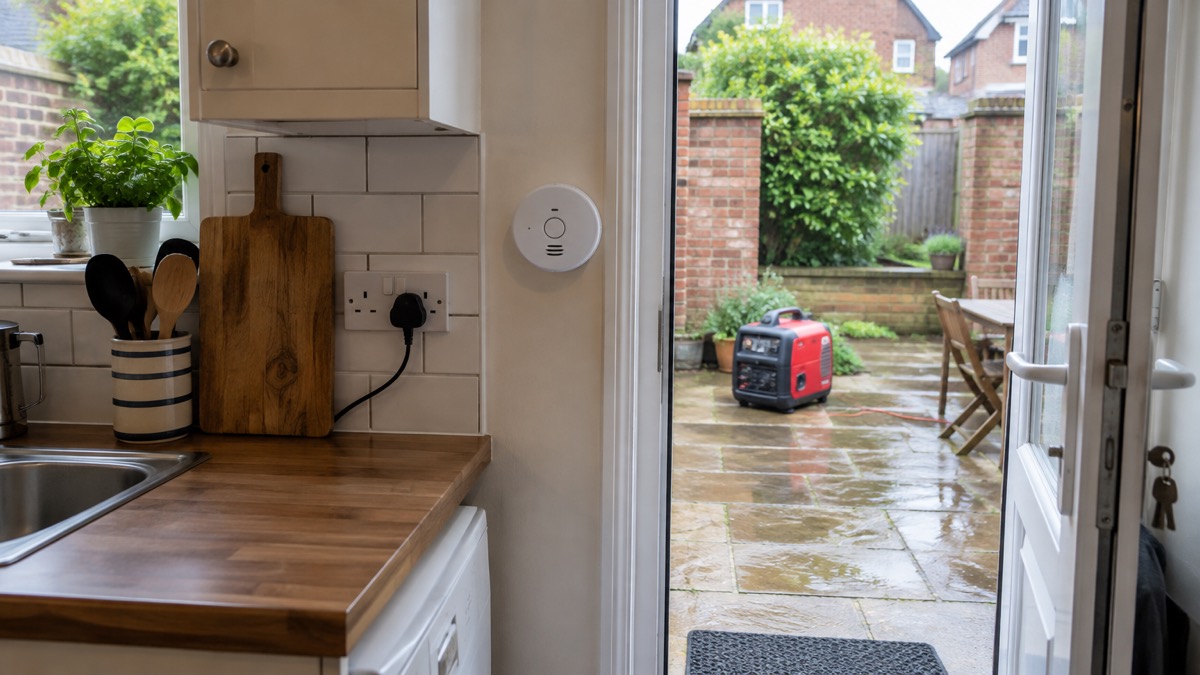
Fuel is the second hazard. Petrol is flammable, so refuel only when the engine is off and cool, never while it is running, and store petrol in a suitable container away from the house and away from any source of ignition. The site's page on how much petrol you can store at home covers the limits and the storage rules.
Electricity is the third. The 230V socket takes a standard three-pin 13A UK plug1, and the overload protection will shut the machine down if you ask for more than 1kW at start-up or 900W continuous1. Use an extension lead rated for the load, keep it out of standing water, and never run the generator in the rain without shelter that still lets the exhaust escape. The site's page on running a generator in the rain explains the trade-off.
Storing it between outages
Store the HY1000Si somewhere dry and ventilated, not in the house, and not somewhere the smell of petrol can build up. A garage or shed with ventilation is the better home for a petrol machine. Drain or stabilise the fuel if it will sit for months, and follow the manual's storage instructions.
Before winter, run through a short check: oil level, fuel, the recoil cord, the spark plug spanner in the box, and a test start outdoors. The site's winter readiness checklist and its guide to storing a generator after a power cut set out the routine. Cold weather starting is covered in will a generator start in cold weather.
Support, warranty and availability
The distributor lists a warranty of 3 years for home use, 1 year commercial, 90 days hire, with a maximum of 1,000 hours1. Keep the receipt and a note of the running hours from the LCD display, because the hour limit is part of the cover1. The machine's EAN is listed as 7324220059661.
On availability, the distributor's product page listed the HY1000Si as sold out when checked on 25 October 20261. Stock moves, so check the page for the current position. If you need backup power now and cannot wait, a battery power station needs no fuel and produces no exhaust; the site's guide to portable power stations explains what they do and how to choose one, and the power cut backup power checklist lists the basics to have ready either way.
Sources (8)
- Hyundai HY1000Si product page, Hyundai Power Equipment, 25 October 2026
- Small generators, Jackery
- Champion 2800 Watt petrol generator, Champion Power Equipment
- Being prepared for a power cut, SP Energy Networks
- 3 tips for staying safe in lightning - Met Office, Met Office
- Disabled people and carers, Ready Scotland
- BLUETTI Elite 400 portable power station, BLUETTI
- Help me choose a generator, Honda
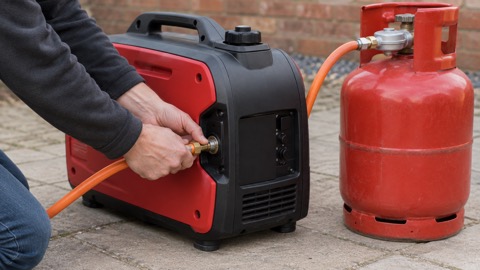 EcoFlow Dual Fuel Generator
 Honda EU70iS Generator
 Honda EU32i Generator
 Honda EG3600 Generator
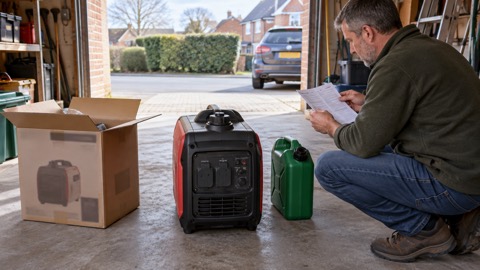 Pramac P3500i Generator
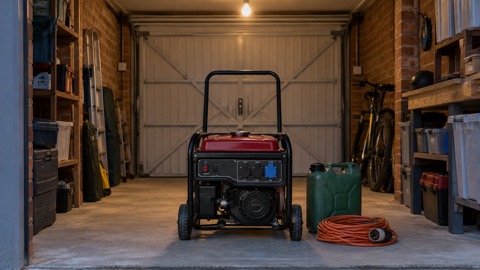 Senci SC6000-II Home Generator
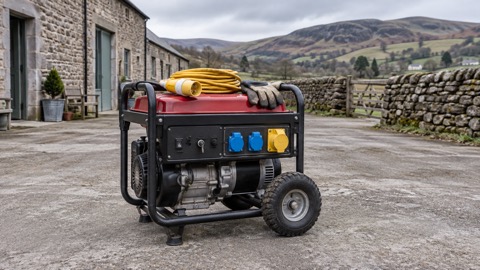 Senci SC10000-II Generator
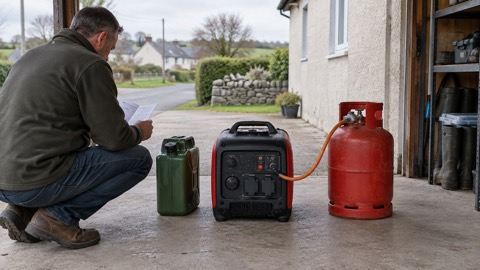 Senci SC6600iED Generator
 Gorilla Power GP3800iE
 Gorilla Power GP6500E-DF
 Gorilla Power GP3500i
 Hyundai HY2250Si Generator