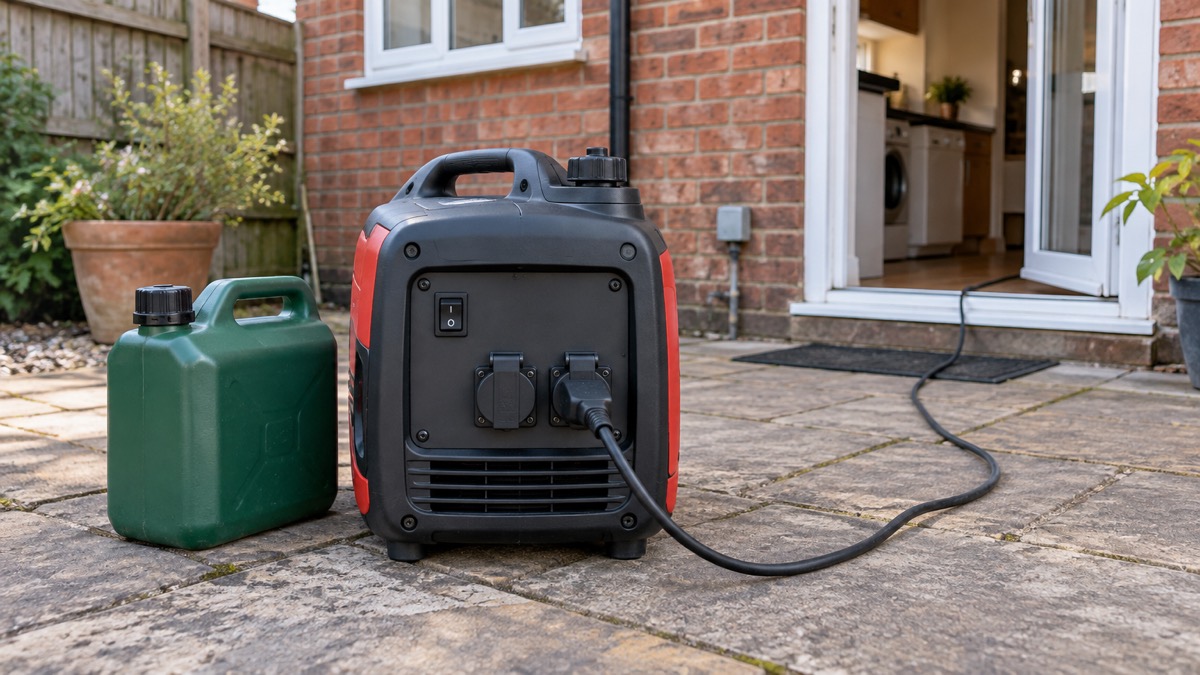
The Champion 3500W inverter generator is a petrol-powered backup generator from Champion, built to supply mains power to a household when the grid goes down. The maker lists a rated output of 3200 W and a starting output of 3750 W, with a maximum of 3500 W, from a 192 cc engine1. It is an inverter type, which means it produces a true sine wave suitable for sensitive electronics rather than the rougher supply of an open-frame set1.
For an ordinary household, the headline figures are these: the maker quotes up to 8 hours at 25% load, the unit weighs 36.9 kg and runs at 58 dBA at 7 metres, and it has two 240 V 13 amp sockets1. It starts with a recoil pull, runs on E10 petrol, and holds 600 ml of oil1.
This page sets out what the machine is, what it can run and for how long, how to start, fuel and store it safely, and what to do if something goes wrong. Every instruction here comes from the maker's own product information for this model. A generator is a serious piece of kit: run it outdoors only, and read the safety section before you use it.
What the Champion 3500W inverter generator is
This is a portable petrol generator with inverter technology. The maker states that it uses True Sine Wave technology to protect sensitive electronics against surges for a safe connection1. That matters for a household because it means laptops, routers, televisions and similar equipment can be plugged in without the risk of a dirty supply, which is the main reason people choose an inverter set over a conventional open-frame generator. If you are weighing the two types up, our guide to inverter or open-frame generators sets out the differences.
The engine is 192 cc and 6.0 HP, running on petrol, with automatic engine speed based on load1. The maker lists the phase as single and the power factor as 1.01. Output comes through two 240 V 13 amp sockets, with a socket rating of 13 / 13, plus a 12 V DC output listed as 12 / 8.31. There is a three-in-one Intelligauge for monitoring, and the unit comes with a three-year warranty1.
The headline numbers are worth setting out plainly, because they decide what the machine can and cannot do in a cut:
| Specification | Maker's figure |
|---|---|
| Starting watts | 3750 W1 |
| Rated watts | 3200 W1 |
| Maximum watts | 3500 W1 |
| Engine | 192 cc, 6.0 HP1 |
| Fuel | Petrol, E10 compliant1 |
| Fuel tank | 6.0 L1 |
| Oil sump | 600 ml1 |
| Start type | Recoil1 |
| AC outlets | 2 x 240 V 13 amp1 |
| DC output | 12 / 8.31 |
| Noise at 7 m | 58 dBA1 |
| Weight | 36.9 kg1 |
| Dimensions (HxLxW) | 500 x 610 x 470 mm1 |
| IP rating | IP23M1 |
| Warranty | 3 years1 |
The distinction between starting, rated and maximum watts is the one that trips people up. Starting watts cover the brief surge when a motor-driven appliance kicks in; rated watts are what the unit can supply continuously; maximum watts sit between the two1. Our explainer on watts, watt-hours and surge goes through the arithmetic, and the generator sizing guide helps you work out whether 3200 W continuous is enough for your household.
Run time: up to 8 hours at 25% load on a 6-litre tank
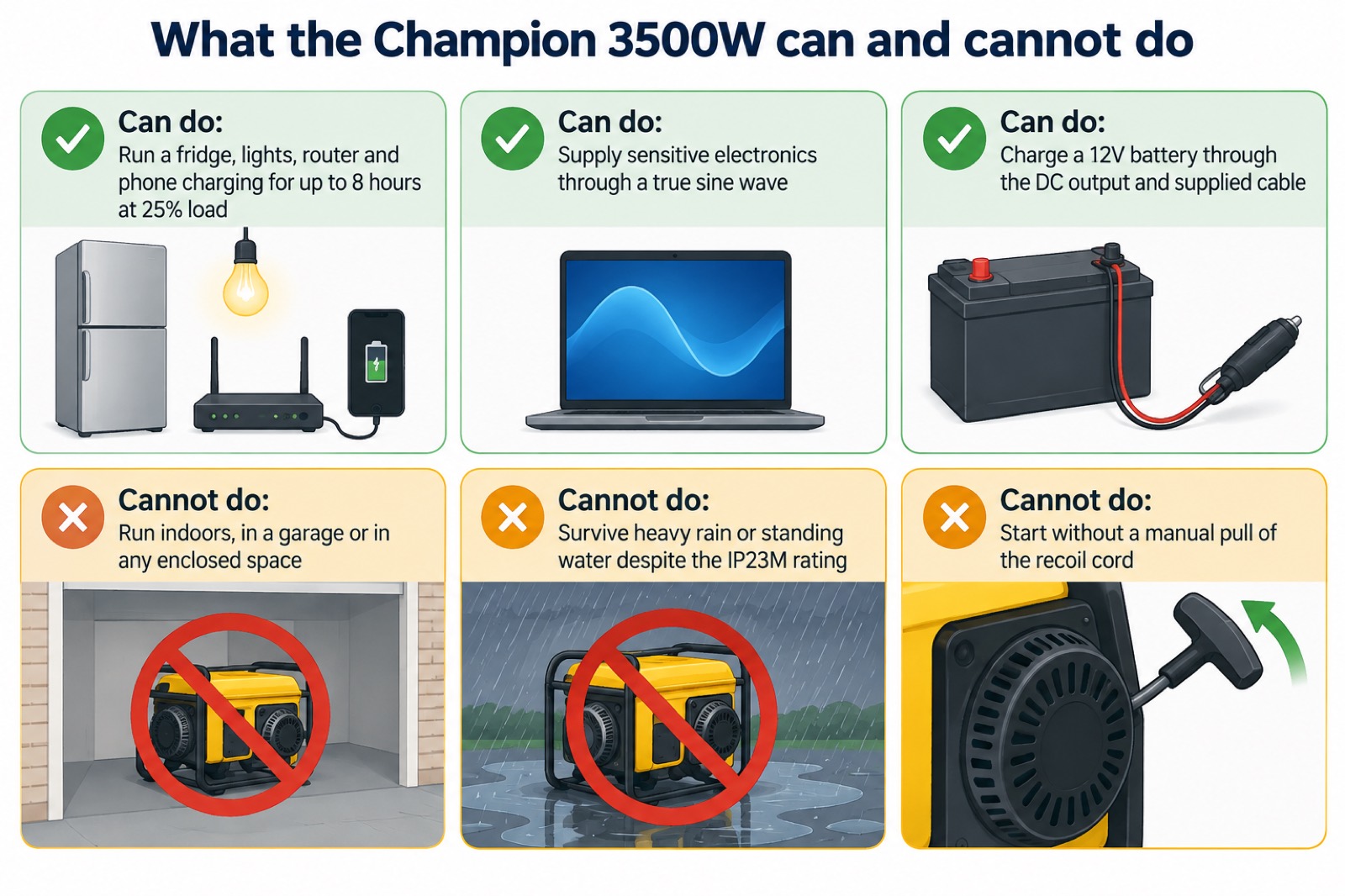
The maker quotes up to 8 hours run time at 25% load1. That is the lightest-load figure, and it is worth understanding what 25% load means in practice: a quarter of the rated output, which is roughly a fridge, a few lights and a phone charger. Run heavier loads and the tank empties faster: the maker lists 0.92 L/hour at 50% load and 1.6 L/hour at 100% load1.
The maker's own fuel consumption figures show the curve:
| Load | Fuel consumption | What it might cover |
|---|---|---|
| 25% | 0.75 L/hour1 | Fridge, lights, phone charging |
| 50% | 0.92 L/hour1 | Adding a television, router, laptop |
| 100% | 1.6 L/hour1 | Heavy loads such as heaters or power tools |
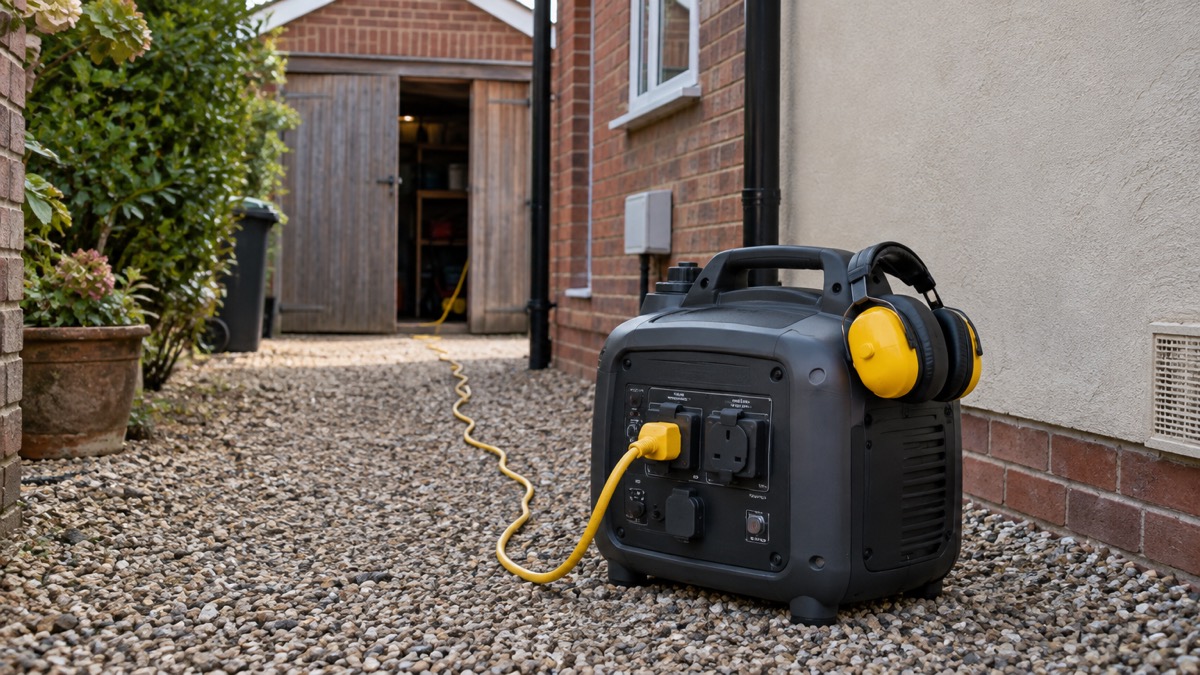
At 0.75 litres an hour, the maker's 25% load figure, the run time is up to 8 hours1. At 1.6 litres an hour, the 100% load figure, it is far shorter1. The lesson for a household is to decide in advance what you will run and in what order, and to keep the load light where you can. Our guide to deciding what to keep running helps you rank appliances before an outage rather than during one.
Fuel storage is the other half of run time. Petrol does not keep indefinitely, and there are limits on how much you can store at home safely. Our page on how much petrol you can store at home covers the rules. The maker lists the unit as E10 petrol compliant, so standard UK forecourt petrol is suitable1.
If you want to compare this with how long other machines last, our guide to generator run time on a tank of fuel sets out the general picture. For a household that mainly wants to keep a fridge cold and phones charged, the 25% figure is the one that matters, and it is generous for a unit of this size.
Safe for sensitive electronics: true sine wave and a 15-second power delay
The reason to choose an inverter generator over a cheaper open-frame set is the quality of the electricity. The maker states that the generator uses True Sine Wave technology to protect sensitive electronics against surges for a safe connection1. That is the maker's description of its own product, and it is the feature that makes this machine suitable for a home office, a router, a television or a laptop.
The second feature is a digital 15-second power delay, which the maker describes as allowing sensitive equipment to be left plugged in on start-up and shut down1. In practice, when you pull the cord, the generator waits before supplying power, so anything already connected is not hit by the initial surge. That is a convenience, not a substitute for care: unplug sensitive kit before you stop the engine, and let the unit settle before reconnecting.
"the generator uses True Sine Wave technology to protect sensitive electronics against surges for a safe connection"
It is worth being clear about what this does not mean. A true sine wave protects equipment from a poor supply; it does not make the generator safe to run indoors, and it does not remove the need for a carbon monoxide alarm. Those are separate matters, covered below.
If your main concern is a single sensitive item such as a medical device, a generator may not be the right answer at all. Our guide to powering CPAP, oxygen and other medical devices sets out the alternatives, and a battery-based approach may suit better. For a general comparison of the two routes, see portable power station or petrol generator.
Starting, fuelling and oil: recoil start, E10 petrol and a 600ml sump
Starting this generator is a manual job. The maker lists the start type as recoil, with a manual choke1. There is no electric start and no remote start on this model. The procedure, following the maker's operating manual, is to check the oil, fill with E10 petrol, set the choke, pull the cord, and let the engine settle before connecting anything.
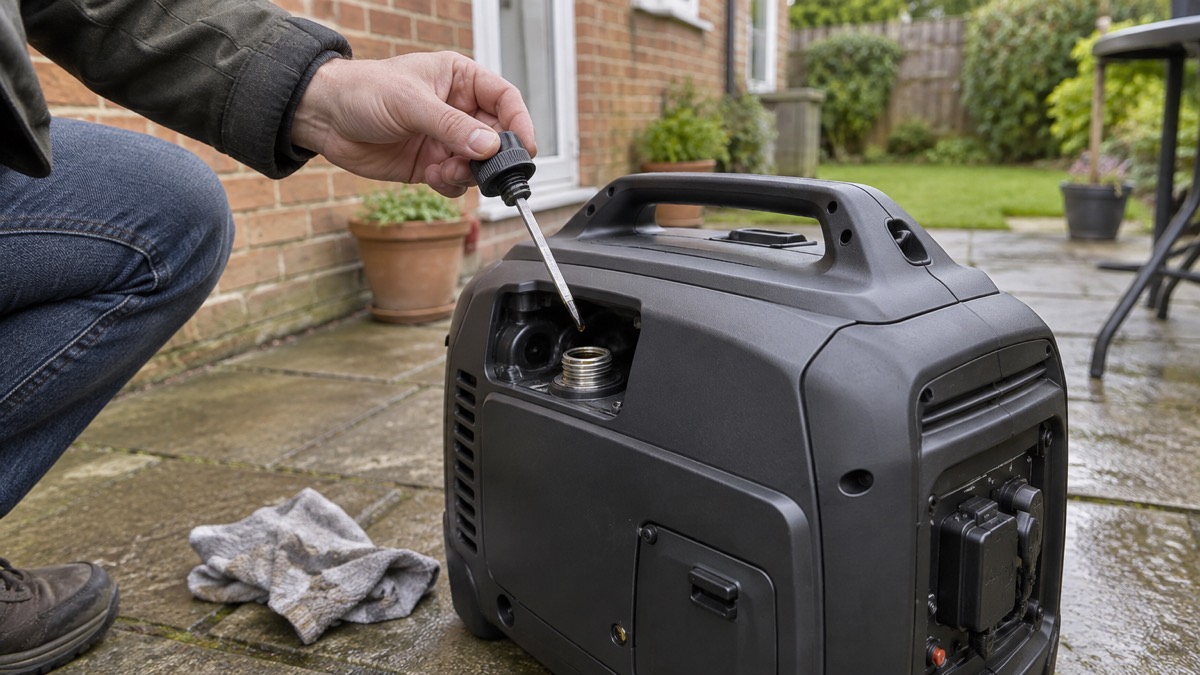
The oil sump holds 600 ml1. The maker supplies an oil funnel and a wrench with the unit, along with a smart charger, a 12 V DC USB adapter, a 12 V DC battery charging cable and the operating manual1. You will need to add engine oil before first use; check the manual for the grade.
The low oil shutoff is automatic1. If the oil level drops too far, the engine stops to protect itself. That is a safety feature, but it can catch you out mid-outage: check the oil before every run, and keep a bottle of the correct oil with the generator. If the unit cuts out unexpectedly, check the oil first.
Fuel is standard E10 petrol, and the maker lists the unit as E10 petrol compliant1. The tank holds 6.0 litres1. Fill it outdoors, with the engine off and cool, and never refuel while it is running. Store petrol only in a proper container, and follow our guidance on petrol storage at home.
Noise, weight and moving it about
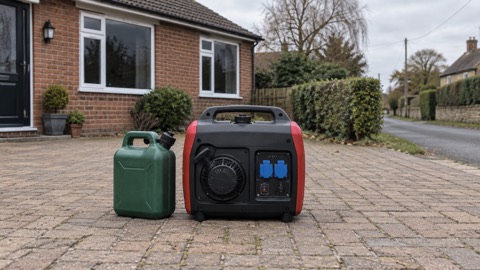
At 36.9 kg, this is not a machine you carry up a flight of stairs on your own1. It has never-flat wheels, which the maker lists as a feature, so it can be wheeled across a patio or garden rather than lifted1. Plan where it will live before you need it: a level, outdoor spot away from doors and windows, with a route you can wheel it along.
The noise figure is 58 dBA at 7 metres1. That is roughly the level of a normal conversation heard from across a room, measured at that distance, and it is quieter than many open-frame generators. It is still audible to neighbours, especially in a quiet street at night. Our guide to generator noise and neighbours covers what to expect and how to reduce friction.
The dimensions are 500 x 610 x 470 mm (HxLxW)1. That is compact enough for a shed or garage floor, but remember the unit must run outdoors, so storage and running position are two different things. Store it under cover, with the fuel drained if it will sit for a long period, and follow our guide to storing a generator after a power cut.
The IP23M rating is worth understanding. Treat it as a light shower rating at most. Our page on running a generator in the rain sets out the precautions, and the generator safety guide covers carbon monoxide, fuel and electric shock in full.
Where to get help and what the warranty covers
The maker lists a three-year warranty on this model1. Keep the receipt and the operating manual together, and register the product if the maker asks you to. If something goes wrong, the first port of call is the maker's own support, using the details in the manual.
For safety advice, the fire and rescue service is the body to listen to on generator use and carbon monoxide. Fit a carbon monoxide alarm in your home, test it regularly, and know the signs of carbon monoxide poisoning: headache, dizziness, nausea and confusion. If you suspect a leak, get everyone outside and call the emergency services. Our page on carbon monoxide from generators sets out the warning signs in detail.
If you are unsure whether a generator is the right choice for your household at all, our backup power section sets out the full range of options, from power banks to home batteries. For a household that needs to keep a fridge and a few essentials running through a multi-day outage, a petrol inverter generator like this one does the job, provided it is run outdoors and fuelled safely.
Sources (1)
- Champion 3500 Watt Inverter Petrol Generator 73001i-E, Champion Power Equipment, 2026-10-25

 EcoFlow Dual Fuel Generator
 Honda EU70iS Generator
 Honda EU32i Generator
 Honda EG3600 Generator
 Pramac P3500i Generator
 Senci SC6000-II Home Generator
 Senci SC10000-II Generator
 Senci SC6600iED Generator
 Gorilla Power GP3800iE
 Gorilla Power GP6500E-DF
 Gorilla Power GP3500i
 Hyundai HY2250Si Generator