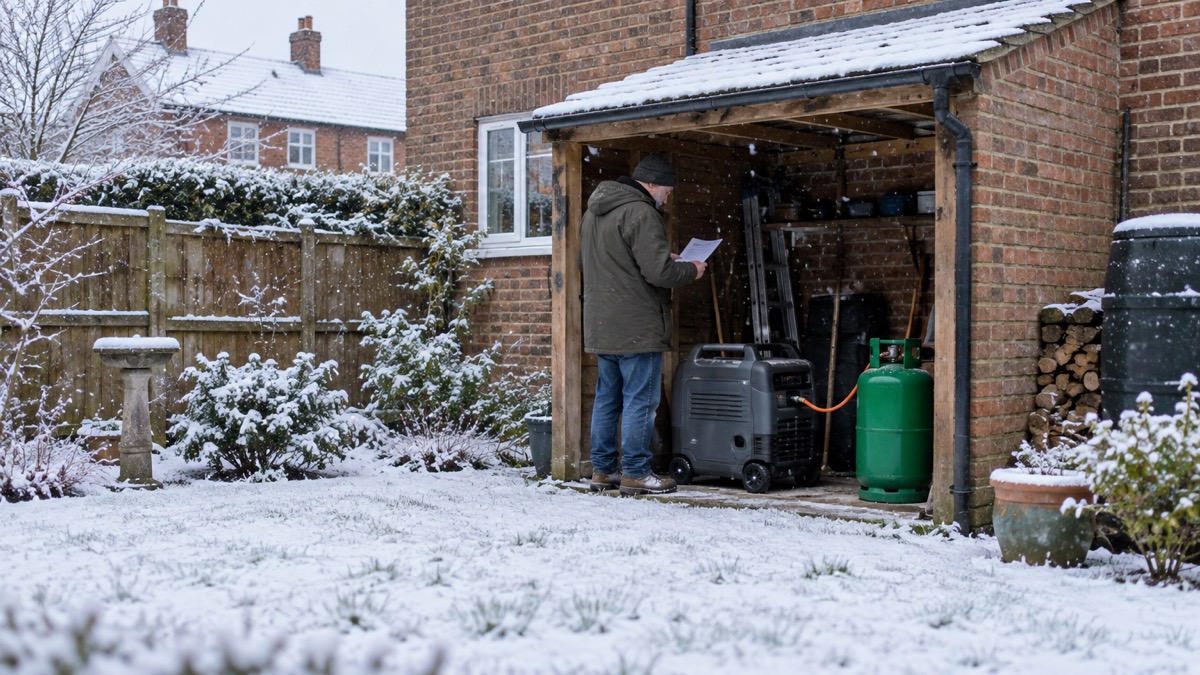
The Champion 3500W LPG Dual Fuel Inverter is a portable generator that runs on either petrol or propane, and it is built for households that want a serious amount of backup power without keeping a large stock of petrol. Champion rates it at 3,200 watts running on petrol and 2,880 watts on LPG, with starting outputs of 3,750 watts and 3,300 watts respectively1. That is enough headroom for a fridge, freezer, lights, broadband and a few small appliances, provided you add the loads up honestly and start the big items one at a time.
The headline for anyone weighing up LPG is run time. Champion states the engine has a runtime of 16 hours on only a 19kg bottle of LPG1. A 19kg propane bottle is a standard size sold for domestic and trade use, and the generator comes with the 37mBar regulator it needs1. On petrol the tank holds 6.0 litres1, so the two fuels suit different habits: petrol for occasional short runs, LPG for a longer outage where you would rather not store and rotate fuel.
Before any of that, the safety rules come first. A generator of this kind produces carbon monoxide, and it must never run indoors, in a garage, shed or other confined space. The maker's warranty is voided where the product is installed improperly, including in any outbuilding, shed, garage, confined space or vehicle1. Read the operating manual before the first start, and plan where the unit will stand outdoors before you need it.
Output: 3,200W running on petrol, 2,880W on LPG
The two figures that matter are rated watts and starting watts. Rated output is what the generator can supply continuously: 3,200 watts on petrol and 2,880 watts on LPG1. Starting, or surge, output is the brief extra it can deliver when a motor-driven appliance kicks in: 3,750 watts on petrol and 3,300 watts on LPG1. The gap between the two is what lets a fridge compressor or a pump start without tripping the generator.
The engine is a 192.0 cc unit rated at 6.0 HP, described by Champion as a 3.2-kilowatt engine, running at automatic RPM based on load1. It is a single-phase machine with a power factor of 1.0, and it uses true sine wave inverter technology1. That last point matters for a modern household: an inverter generator produces a smoother supply than an open-frame set, which is what makes it suitable for electronics such as a router, a laptop or a television. If you are new to the difference, our guide to inverter and open-frame generators explains it.
There are two 240V 13 amp sockets, each rated at 13 amps, plus a 12V DC output rated at 12 volts and 8.3 amps and a USB connection1. Overload protection is fitted, and there is an automatic low oil shutoff that stops the engine if the oil level drops too far1. The Intelligauge display gives you a readout of the machine's status1.
| Specification | Petrol | LPG |
|---|---|---|
| Rated watts | 3,200W | 2,880W |
| Starting watts | 3,750W | 3,300W |
| Max watts | 3,500W | 3,150W |
| Fuel use at 25% load | 0.88 L/hour | 0.8 kg/hour |
| Fuel use at 50% load | 1.2 L/hour | not listed |
| Fuel use at 75% load | 1.56 L/hour | 1.0 kg/hour |
| Fuel use at 100% load | 1.97 L/hour | 1.26 kg/hour |
All figures from the maker's product page1.
What it can run at the same time
Champion's own guidance is blunt: only add watts together if you plan on using the products at the same time1. That is the whole method. List what you want to run, note the watts each item draws, and add only the ones that will be on together. Then compare the total with 3,200 watts on petrol or 2,880 watts on LPG, and keep a margin for starting surges.
In practice, a household using this machine for an outage would typically run the fridge and freezer, a few lights, the broadband router and phone charging, then switch to heavier items such as a microwave or a washing machine one at a time rather than all at once. The two 13 amp sockets are the limit on how many mains items can be plugged in directly, so extension leads will usually be involved. Take care with those: our guide to extension leads and overloading sets out how to add up what is plugged into one.
If you are unsure whether your intended load fits, work through what size generator you need and watts, watt-hours and surge before buying. The starting watts figure is the one people forget: a fridge that runs on a few hundred watts may need several times that for a moment when the compressor starts.
Run time: up to 16 hours on a 19kg LPG bottle
Champion states a runtime of 16 hours on only a 19kg bottle of LPG1. That is the figure to plan around, and it is the reason many households choose the dual fuel version over a petrol-only set: a 19kg propane bottle holds a large amount of energy and does not degrade the way petrol does in storage.
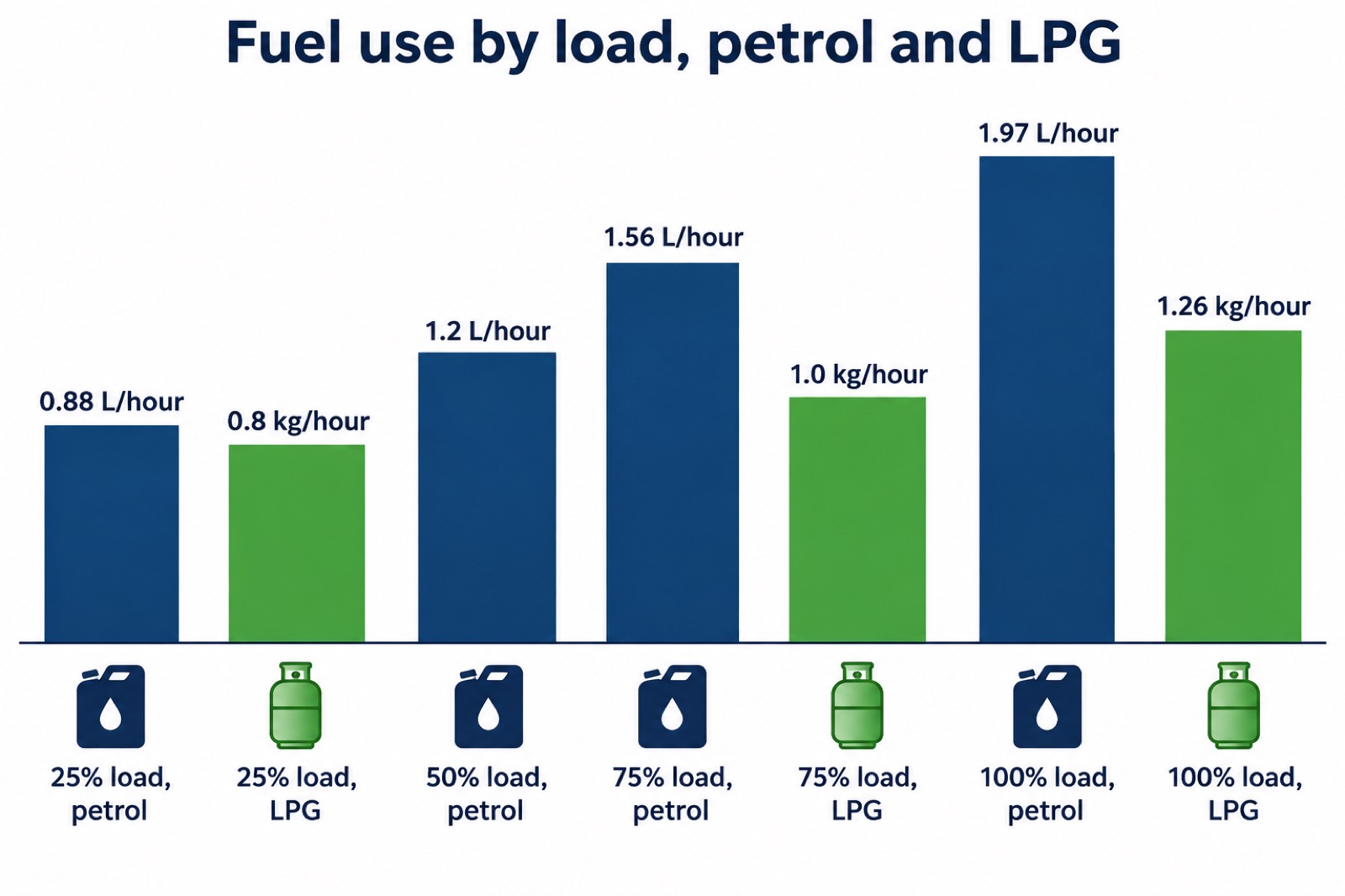
The fuel consumption table shows how load changes the picture. At 25 per cent load the engine uses 0.8 kg/hour on LPG and 0.88 L/hour on petrol; at 75 per cent load it uses 1.0 kg/hour on LPG and 1.56 L/hour on petrol; at 100 per cent load it uses 1.26 kg/hour on LPG and 1.97 L/hour on petrol1. Champion does not list an LPG figure at 50 per cent load, only a petrol figure of 1.2 L/hour1. The pattern is clear enough: the harder you work it, the shorter the bottle lasts, and economy mode is there to keep the load light.
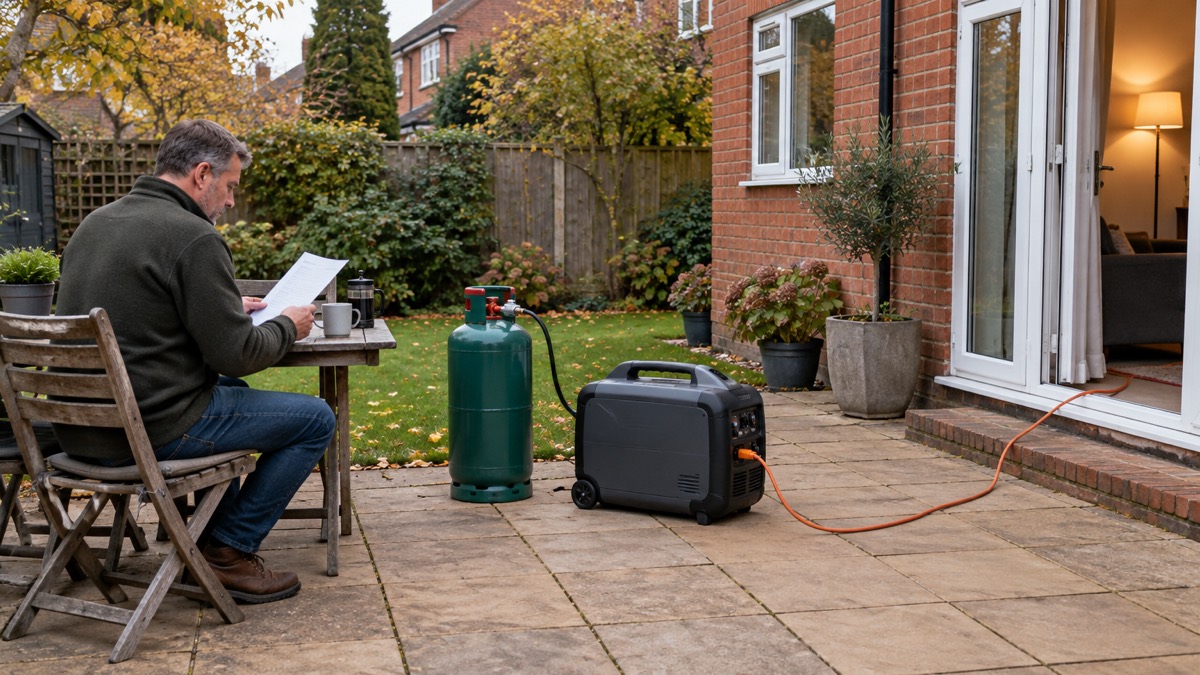
For a longer view of how fuel and load interact across generator types, see how long a generator will run on a tank of fuel. If you are deciding between the two fuels more broadly, LPG or petrol for emergencies sets out the trade-offs.
Running on LPG: the 37mBar regulator and fuel use
The generator is supplied with a 37mBar regulator1. That pressure is the UK domestic standard for propane: independent guidance from Liquid Gas UK states that a propane regulator is pre-set to 37mbar for domestic applications in the UK3. In other words, the regulator in the box matches the standard propane setup used with domestic bottles, rather than a special pressure unique to this machine.
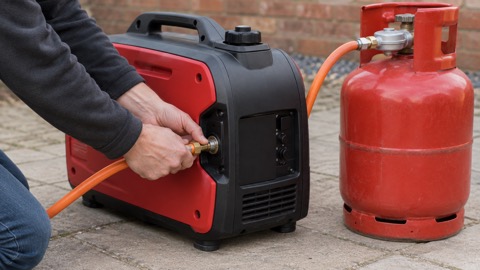
The practical points follow from that. You need a propane bottle, not butane, and the bottle connection must suit the regulator supplied. Keep the bottle upright and outdoors, and follow the maker's manual for connecting and leak-checking the regulator before each use. Our guide to LPG cylinders and regulators covers bottle sizes, connections and safe handling in more detail.
LPG has advantages beyond run time. It stores indefinitely in the bottle, so there is no rotation routine as there is with petrol, and there is no spill risk from refuelling a hot engine in the same way. The trade-offs are that you need a supplier and a bottle on hand before an outage, and that output is slightly lower on LPG than on petrol: 2,880 watts rated against 3,200 watts1. Plan your loads against the LPG figure if LPG is your main fuel.
The machine is certified as E10 petrol compliant, EU Stage V and UKCA1. E10 is the standard petrol grade sold in the UK, so filling from a forecourt is straightforward. Store any petrol in an approved container, outdoors and away from the house, and see how much petrol you can store at home safely for the rules.
Starting it and the first 5 hours
The generator has both recoil and electric start, with a manual choke1. Electric start is the easier option for most people, particularly in cold or wet weather; recoil is the fallback if the battery is flat. Champion's service guide for its inverters sets out the first service: change the oil at the first 5 hours, described as the break-in2. The oil tank holds 600 ml1.
The maker's service schedule also lists a routine of cleaning the air filter every 50 hours or annually, and changing the oil if operating under heavy load or in hot environments2. The two entries are not contradictory so much as sequential: the first oil change comes early, at 5 hours, and the routine service follows after that. Treat the 5 hour change as mandatory and the later schedule as the ongoing routine.
A sensible first-start sequence, following the maker's manual:
- Check the oil level and fill to the mark with the grade the manual specifies. The low oil shutoff will stop the engine if the level is too low1.
- Site the generator outdoors, well away from doors, windows and air bricks, on firm level ground.
- Connect the LPG bottle and regulator, or fill the 6.0 litre petrol tank1.
- Set the choke, start on electric or recoil, and let the engine settle before adding load.
- Run it lightly for the first hours, then change the oil at 5 hours2.
Noise, weight and where it can stand
Champion gives the noise level as 58 dBA at 7m1. That is a moderate figure for a generator of this output, and it reflects the inverter design and the automatic RPM that follows the load. It is still audible to neighbours, particularly in a quiet street at night, so think about where it stands and when it runs. Our guide to generator noise and neighbours covers siting and timing.
The unit weighs 43.4 kg and sits on never-flat wheels1. Its dimensions are 461 x 637 x 440 mm (height x length x width)1. That weight means one person can move it on the wheels across a flat surface, but lifting it into a vehicle or up steps is a two-person job. Plan a permanent outdoor spot that is reachable with the wheels and close enough to the house for a lead, but not against a wall under a window where exhaust could drift in.
The maker lists the machine at 58 dBA at 7m1. That is not a promise that the machine can be left out in all weathers, and it does not change the rule that it must not run indoors. If rain is forecast, a purpose-made generator cover or a sheltered outdoor position is sensible; see can you run a generator in the rain for the practical limits.
Connecting to the house, parallel use and charging
The generator has two 13 amp sockets, so the simplest approach is to run extension leads to the appliances you need. Connecting it to the house's fixed wiring is a different matter. Champion states that any manual or automatic transfer system other than those supplied by itself under the Warrior or Champion brands will not be considered suitable and will invalidate all warranties1. If you want a transfer switch, it must be the maker's own, installed properly. Our guide to connecting a generator to your home's wiring explains why this is an electrician's job.
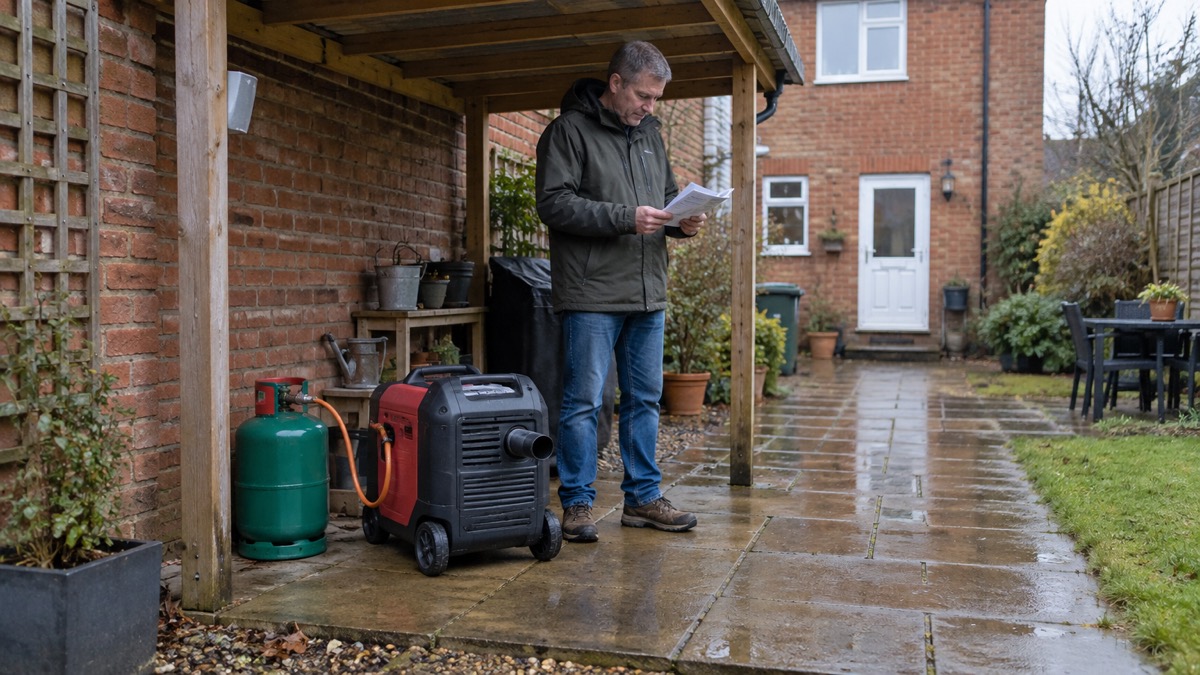
The machine is parallel connectable1, so a second compatible unit can be linked to share a larger load, using the correct parallel kit. For charging small devices, the 12V DC output and USB connection are there, and the box includes a smart charger, a 12V DC USB adapter and a 12V DC battery charging cable1. For phones and small electronics, a dedicated power bank is often simpler; see power banks and USB-C charging explained.
Economy mode saves fuel by letting the engine slow when the load is light1. Use it for overnight running of lights and the router, and switch it off when you add heavier appliances so the engine can respond.
Warranty: 3 years for home use, with conditions
Champion warrants the generator to the original purchaser for up to 3 years for domestic usage: year one covers parts and labour, and years two and three cover parts only, from the original date of purchase or 1,000 hours, whichever comes first1. Industrial and commercial use gets year one parts and labour and year two parts only, again to 1,000 hours1. The warranty applies only to the original purchaser and is not transferable1.
There are exclusions worth knowing before you buy. Batteries supplied over one year old are excluded1. The warranty is voided if the product is misused, neglected, involved in an accident, abused, overloaded beyond its limits, modified (including exhaust extension and filtration), installed improperly in any outbuilding, shed, garage, confined space or vehicle, connected incorrectly to any electrical component, or used for hire1. Fitting a non-Champion transfer switch also voids it1.
Champion's wider warranty terms, repeated across its product pages, describe a standard 2 year warranty for Warrior Diesel and selected Champion products alongside the 3 year cover for Champion generator models4. For this model, the product page's own 3 year domestic terms are the ones that apply1. Keep your proof of purchase, record the hours you run, and have the first oil change at 5 hours done and noted2.
Sources (5)
- Champion 3500 Watt LPG Dual Fuel Inverter Generator 73001i-DF, Champion Power Equipment, 2026-10-25
- Service guide: inverters, Champion Power Equipment, 2026-10-25
- LPG domestic regulator guidance, Liquid Gas UK, 2022-04
- Champion 3200 Watt Petrol Generator, Champion Power Equipment, 2026-10-25
- Champion 2000 Watt LPG Dual Fuel Inverter Generator 82001i-E-DF, Champion Power Equipment, 2026-10-25

 EcoFlow Dual Fuel Generator
 Honda EU70iS Generator
 Honda EU32i Generator
 Honda EG3600 Generator
 Pramac P3500i Generator
 Senci SC6000-II Home Generator
 Senci SC10000-II Generator
 Senci SC6600iED Generator
 Gorilla Power GP3800iE
 Gorilla Power GP6500E-DF
 Gorilla Power GP3500i
 Hyundai HY2250Si Generator