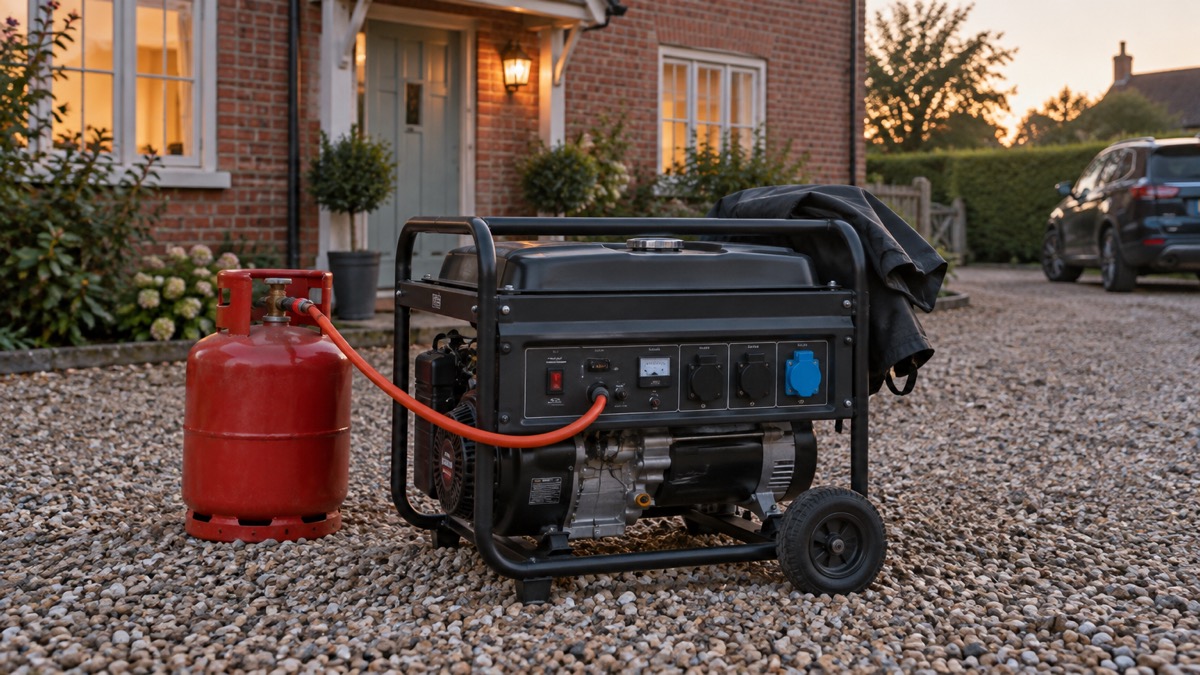
The Champion CPG3500E2-DF is a dual fuel generator: it runs on petrol or on LPG (propane) from a cylinder. The maker rates it at 2500W on petrol and 2300W on LPG, with maximum outputs of 2800W and 2600W respectively, and starting outputs of 3125W on petrol and 2875W on LPG1. In plain terms it is a mid-sized open-frame machine for keeping a fridge, lights, a TV and a few small appliances going during a power cut, which is exactly the use the maker describes1.
It is not a whole-house solution and it is not a battery. It is a petrol engine driving an alternator, so it needs fuel, oil, outdoor siting and a bit of routine care. The maker fits an electric start alongside a recoil start, automatic low oil shutoff, overload protection and a patented Volt Guard system to protect appliances from spikes and surges1. It carries a 3 year limited warranty1.
This page sets out what the maker states about the machine: what it can run and for how long, how to start it, how to site and store it safely, and what the warranty covers. It does not compare it with other generators, and it gives no prices. If you are still deciding what kind of backup power suits your household, start with Backup Power at Home: A Household Guide and Portable Generators: Petrol, Diesel, Dual-Fuel and Inverter Types.
What the CPG3500E2-DF is and who it suits
The CPG3500E2-DF is a single phase, open-frame generator built around a 196.0 cc engine running at 3000 rpm and rated at 6.0 hp, with a power factor of 1.01. It is dual fuel in the sense the maker means: it can run on propane or petrol, and the dual fuel arrangement is factory fitted rather than added afterwards1. That distinction matters for the warranty, covered below.
The maker describes it as ideal for powering a fridge, furnace, lights, TV, other small appliances or a few household items, and lists home backup power during emergencies among its uses alongside camping, travel and jobs around the house1. That is a fair description of what 2500W buys you: a handful of ordinary household loads, not an electric shower, not an immersion heater, not a heat pump.
It suits a household that wants a petrol option for convenience and an LPG option for longer running and easier storage, and that has somewhere outdoors and well ventilated to site it. It does not suit a flat with no outdoor space, anyone who cannot lift or wheel 55.0 kg, or anyone who wants something they can use indoors. If your needs are smaller and indoor use matters, a battery-based option may fit better; see Portable Power Stations: What They Do and How to Choose. If you are choosing between fuel types, LPG or Petrol Generator for Emergencies sets out the trade-offs.
Output: 2500W rated on petrol, 2300W on LPG
The numbers that decide what you can run are the rated watts, not the maximum or starting figures. The maker gives 2500W rated on petrol and 2300W on LPG, 2800W and 2600W maximum, and 3125W and 2875W starting1. Rated output is what the machine will hold continuously; starting output is the brief surge a motor draws as it starts, such as a fridge compressor kicking in1.
The difference between the two fuels is small but real: you lose 200W of rated output going to LPG. The maker also warns that 110v is 40 to 50% lower output in watts than 230v, and that if full power is required on 110v a single phase 110v only generator is required1. The machine has one 120v 16amp and one 240v 16amp AC outlet, with a socket rating of 16 / 16 amps1. For a UK household, the 240v outlet is the one that matters.
| Specification | Petrol | LPG |
|---|---|---|
| Rated watts | 2500 | 2300 |
| Maximum watts | 2800 | 2600 |
| Starting watts | 3125 | 2875 |
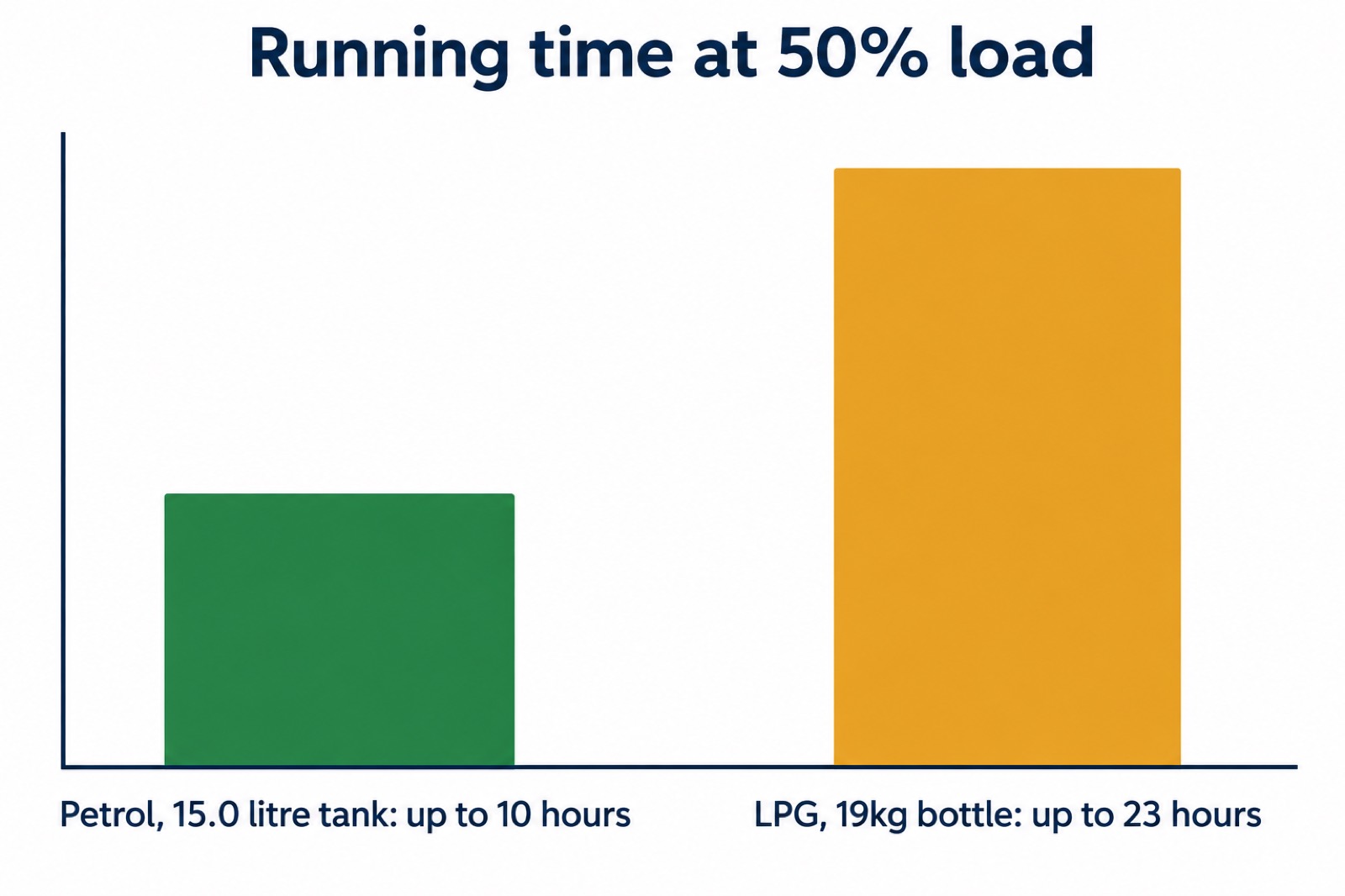
| Running time at 50% load | up to 10 hours (15.0 litre tank) | up to 23 hours (19kg bottle, 0.84kg/hr at 50% load) |
Source: maker's product page1.
Working out whether your appliances fit inside 2500W is the step people skip. Add up the running watts of everything you want on at once, then check the largest motor's starting surge against the starting figure. Watts, Watt-Hours and Surge Explained walks through the arithmetic, and What Size Generator Do I Need for a Power Cut? helps you size the load. Deciding What to Keep Running When the Mains Fails is the place to start if you have not yet decided what matters.
Running time on a tank or a cylinder
The maker states that with a 15.0 litre fuel tank the unit can run up to 10 hours at 50% load on petrol, or up to 23 hours on propane based on a 19kg bottle at 0.84kg per hour at 50% load1. Both figures assume half load; run it harder and the time falls. A fuel gauge is fitted so you can see what is left1.
The maker also states that bottled gas is about 30% to 50% cheaper to run currently than petrol, and that the larger the cylinder the cheaper the gas becomes1. That is the maker's own claim about running cost, not an independent test, and it will move with fuel prices. What it does mean practically is that a larger cylinder gives you both a lower cost per hour and a longer run between changes.
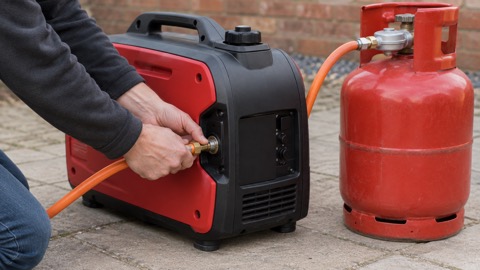
Two things follow for planning. First, decide how long an outage you are preparing for and buy fuel accordingly; How Long Will a Generator Run on a Tank of Fuel? covers the variables. Second, store fuel safely. Petrol storage at home is limited and regulated, and How Much Petrol Can I Store at Home Safely? sets out the rules. For cylinders, LPG Cylinders and Regulators for Dual-Fuel Generators explains connection and safe handling.
Starting it: electric start, recoil and cold start
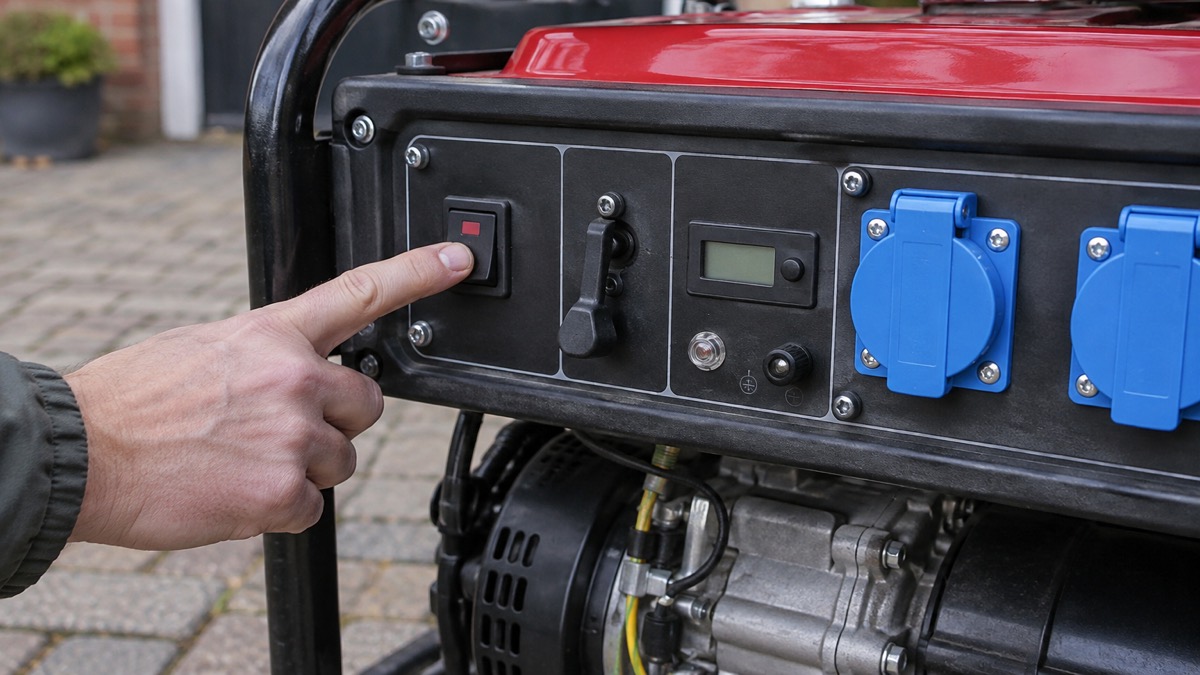
The maker lists both a recoil start and an electric start for this model1. A manual choke is fitted, and the maker also includes patented Cold Start technology1. In practice that means cold mornings are less of a struggle, but the choke is still yours to operate: set it as the manual instructs, start the machine, then ease it off.
Before every start, the maker's service schedule says to check the oil level, clean around the air intake and muffler, and check the propane hose for leaks1. Low oil shutoff is automatic, so the machine will stop rather than run dry, but that is a protection, not a routine1. The oil tank holds 600 ml1.
A 3in1 Intelli Gauge is fitted, along with a voltmeter, so you can see what the machine is doing at a glance1. The maker's break-in instruction is to change the oil after the first 5 hours1.
Built-in protection: low oil shutoff, overload and Volt Guard
Three protections matter to a household. Low oil shutoff is automatic, so the engine stops before it runs without lubrication1. Overload protection is fitted, so the machine trips rather than cooks itself if you ask too much of it1. And a patented Volt Guard system is installed to protect spikes and surges on appliances and equipment, working alongside an automatic voltage regulator (AVR)1.
Volt Guard and the AVR protect your appliances from the generator's output. They do not protect you from carbon monoxide, from electric shock, or from overloading a extension lead. Those are siting and wiring questions. Generator Safety: Carbon Monoxide, Fuel and Electric Shock is the page to read before first use, and Extension Leads and Overloading With Backup Kit covers how to connect appliances without daisy-chaining.
Weather, noise and moving it
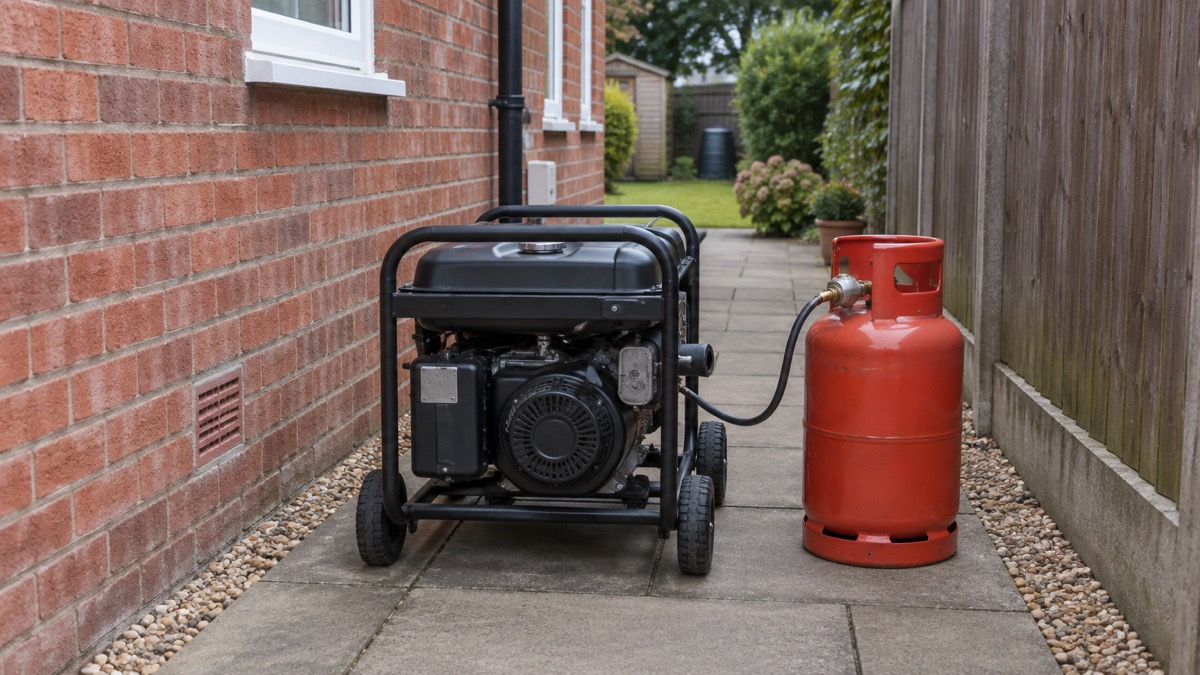
The maker gives the CPG3500E2-DF an IP23M rating1. That is a weather protection rating, not a promise that it can sit out in a storm. Run it outdoors, keep it out of direct rain where you can, and never bring it inside to keep it dry. Can You Run a Generator in the Rain? covers the practicalities.
Noise is 68 dBA at 7m1. That is measured at a distance, so it will be louder standing next to it. Site it away from open windows, including your neighbours', and think about timing if an outage runs into the evening. How Loud Is a Generator? Noise and Neighbours has more.
The machine weighs 55.0 kg and sits on never flat wheels1. Its dimensions are 525 x 715 x 500 mm (HxLxW)1. At that weight, plan where it will live before you need it: a level, firm surface outdoors, with a route you can wheel it along in the dark. Two people should lift it if it has to be carried. How to Store a Generator After a Power Cut covers storage between uses, and Will a Generator Start in Cold Weather? covers winter starting.
Fuel, emissions and UKCA certification
The maker lists the CPG3500E2-DF as E10 petrol compliant, EU Stage V and UKCA certified, and states that all newly manufactured products are EU Stage V compliant1. The emissions entry on the maker's page reads CARB1. UKCA is the UK conformity marking; if you are buying, ask for the documentation and keep it with the machine. UKCA, CE and Battery Safety Markings Explained explains what the markings mean.
E10 compliance matters because E10 is the standard petrol grade at UK forecourts. It does not mean petrol keeps indefinitely: store it properly, in a suitable container, away from the house and any ignition source, and follow the limits in How Much Petrol Can I Store at Home Safely?.
On LPG, a 37mBar regulator is included with the machine1. You still need a propane cylinder. The maker's 23 hour figure is based on a 19kg bottle1. Check the hose for leaks before each use, as the service schedule instructs, and replace the LPG hose every 3 years1.
Dual fuel conversions and the 3 year warranty
The CPG3500E2-DF carries a 3 year limited warranty1. The maker makes a specific point about dual fuel and warranty: the majority of competitors' dual fuel models in the UK tend to be retrofits which invalidate the manufacturer's warranty, while Champion dual fuel machines are factory fitted so the 3 year manufacturer's warranty is fully supported1.
"Please note that the majority of the competitions Dual Fuel models in the UK tend to be “retrofits” which invalidate the"
The practical instruction for an owner is simple: do not modify the fuel system yourself, and do not have a third party convert a petrol machine. Keep the paperwork, follow the service schedule, and if you need warranty support, go through Champion and the retailer you bought from. The maker's service schedule, including the 3 year replacement of the fuel line and LPG hose, is the record that shows the machine has been looked after1.
Where it fits in a household plan
A generator is one part of a plan, not the plan. Before an outage you need to know what you will run, where the machine will sit, how much fuel you hold and how you will connect appliances safely. Using Generators and Power Stations During an Outage covers the sequence, and the Power Cut Backup Power Checklist is a list you can work through now. Backup Power Checks Before Winter is worth doing each autumn.
Connecting a generator to your home's fixed wiring is a different matter from plugging in an extension lead, and it needs a qualified electrician and the right transfer arrangement. Connecting a Generator or Battery to Your Home's Wiring explains why. For most households, running a few appliances from the machine's own outlets is the simpler and safer route.
If you are still choosing between a generator and a battery, Portable Power Station or Petrol Generator for a Power Cut sets the two side by side, and Inverter Generator or Open-Frame Generator explains the difference in noise and power quality. The CPG3500E2-DF is an open-frame machine, so that second page is the relevant one.
Sources (2)
- Champion 2800 Watt LPG Dual Fuel Generator CPG3500E2-DF, Champion Power Equipment, 2026-10-25
- Champion 2200 Watt LPG Dual Fuel Inverter Generator 92001i-DF, Champion Power Equipment, 2026-10-25

 EcoFlow Dual Fuel Generator
 Honda EU70iS Generator
 Honda EU32i Generator
 Honda EG3600 Generator
 Pramac P3500i Generator
 Senci SC6000-II Home Generator
 Senci SC10000-II Generator
 Senci SC6600iED Generator
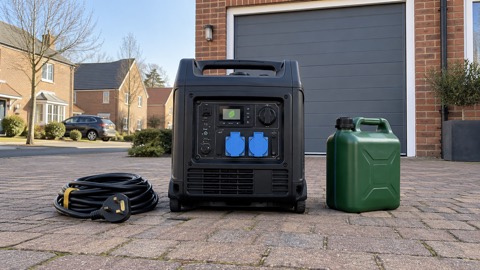 Gorilla Power GP3800iE
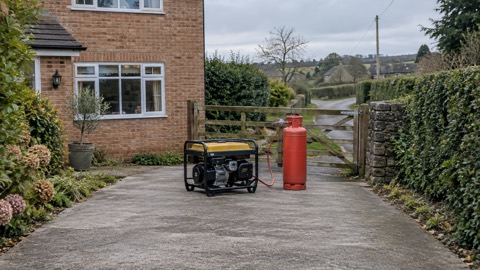 Gorilla Power GP6500E-DF
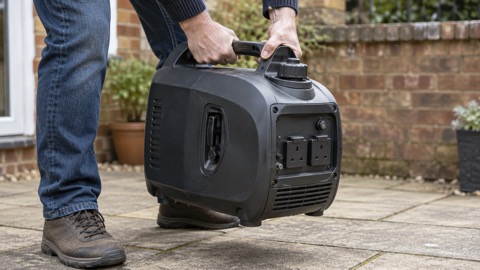 Gorilla Power GP3500i
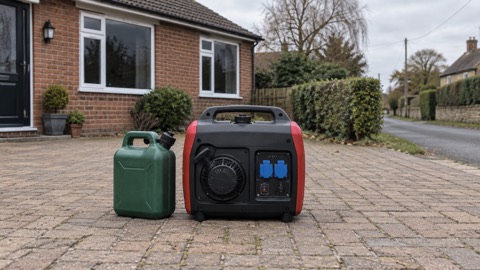 Hyundai HY2250Si Generator