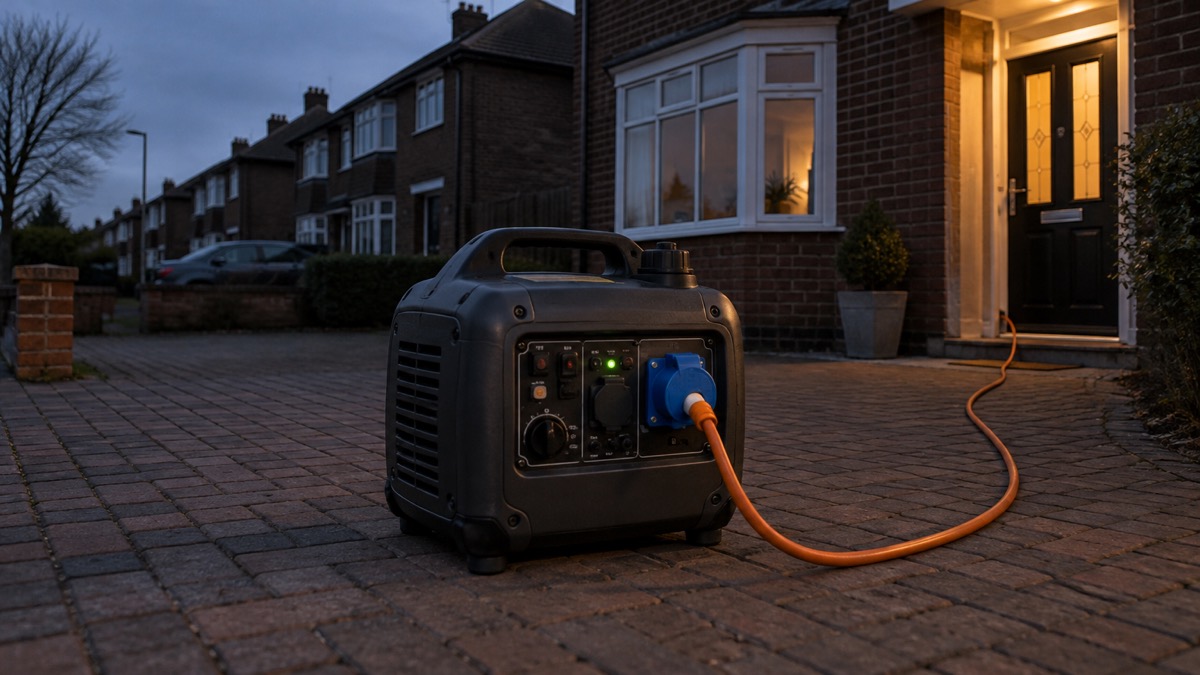
The Champion 3000W Atom Fusion is a petrol inverter generator: a portable engine that makes mains electricity for a household when the grid fails. The maker rates it at 2800W running and 4500W to start appliances with motors, from a 149cc engine, with a 4.5 litre tank and up to 11.5 hours of run time1. It weighs 21.5 kg and is built for outdoor use only.
It suits a household that wants to keep a fridge, freezer, lights, phone charging and perhaps a microwave going through a power cut, and has somewhere safe outdoors to run it. It is not a whole-house solution, and the maker's warranty is voided if the generator is installed improperly in any outbuilding, shed, garage, confined space or vehicle2.
This page sets out what the Atom Fusion can run and for how long, how to site and start it safely, how to look after it between emergencies, and what the maker's warranty covers. It does not give a price, and it does not rank the machine against others; for that wider choice, see Portable Generators: Petrol, Diesel, Dual-Fuel and Inverter Types.
What the Atom Fusion is and what it suits
The Atom Fusion is an inverter generator, which means it produces a true sine wave output. The maker states that this inverter technology makes it suitable for sensitive electronics such as computers, laptops and televisions1. That matters in a power cut, because a clean supply is what modern electronics expect.
The engine is 149cc, rated at 10.0 hp, running at 4600 rpm, single phase, with a power factor of 1.01. It starts by recoil, a pull cord, and the maker lists cold start technology, which helps it fire in low temperatures1. It is certified as E10 Petrol Compliant, EU Stage V and UKCA1.
The maker's headline figure is 3000W maximum, with 2800W rated and 4500W of starting power1. In plain terms, the rated figure is what it can supply continuously; the starting figure is the short burst a motor draws as it spins up. Our guide to Watts, Watt-Hours and Surge Explained covers why that distinction decides what you can run.
| Specification | Figure |
|---|---|
| Type | Petrol inverter generator, true sine wave1 |
| Rated output | 2800W1 |
| Maximum output | 3000W1 |
| Starting output | 4500W1 |
| Engine | 149cc, 10.0 hp, 4600 rpm1 |
| Fuel and tank | Petrol, 4.5 litres1 |
| Run time | Up to 11.5 hours1 |
| Noise | 58 dBA at 7 metres1 |
| Outlets | 1 x 240V 16A, 2 x 240V 13A via adapter1 |
| DC and USB | 12V DC output, USB connection1 |
| Weight | 21.5 kg1 |
| Dimensions | 440 x 450 x 292 mm (HxLxW)1 |
| IP rating | IP23M1 |
| Certification | E10 Petrol Compliant, EU Stage V, UKCA1 |
Output: 2800W running and 4500W to start motors
The gap between 2800W and 4500W is the whole story of what this generator can and cannot do. Anything with a motor or a heating element draws a surge as it starts, and the maker publishes starting coefficients for common appliances so you can work out the true demand1.
The maker's own wattage guide gives these figures:
| Appliance | Running watts | Starting coefficient |
|---|---|---|
| Refrigerator | 50 to 250W | 31 |
| Deep freeze | 90 to 400W | 3+1 |
| Microwave oven | 1200 to 1600W | 21 |
| Washing machine | 2100 to 2400W | 1.51 |
| Tumble dryer | 1200 to 2500W | no figure given1 |
| Oven | 1800 to 3000W | no figure given1 |
| Heating | 1000 to 1800W | no figure given1 |
| TV | 100 to 350W | no figure given1 |
| Air conditioner | 500 to 2500W | no figure given1 |
| High pressure washer | 1200 to 3000W | no figure given1 |
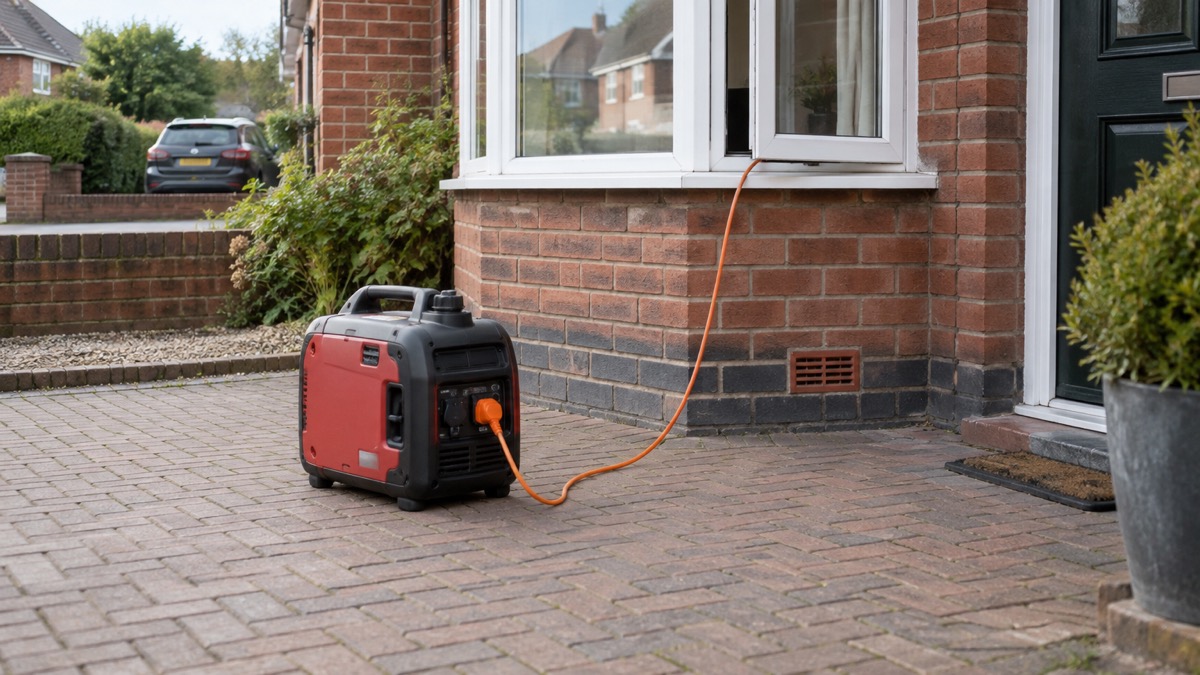
Read the coefficient as a multiplier on the running figure. A fridge at the top of its range, 250W, with a coefficient of 3, needs 750W to start; a deep freeze at 400W with a coefficient of 3 or more needs at least 1200W1. Those are small next to 4500W. A microwave at 1600W with a coefficient of 2 needs 3200W to start, which is within the starting figure but close to the maximum output1.
The lesson is to add up what you will run at once, and to start motor-driven appliances one at a time. An oven at 3000W alone sits at the maximum output, so it leaves nothing for anything else1. For a worked method, see What Size Generator Do I Need for a Power Cut?.
What it can run in a power cut, from fridges to microwaves
A power cut takes out your appliances, lights, gas boiler, heat pump, broadband and home phone3. The Atom Fusion is a way to bring some of that back, but only some, and only outdoors.
The first job in any outage is to stop the house making things worse. Official advice is to switch off and unplug appliances, especially fires, cookers, irons and hair straighteners, in case you forget they are on when power returns4. The government's own guidance adds that you should unplug your TV and PC, as they can be damaged by a surge when power comes back on5.
Then decide what matters. Keeping the fridge and freezer doors closed is the simplest way to protect food, and official advice is to limit opening the doors so food stays cold for longer6. Scottish food safety guidance sets an order for using food during a cut: chilled fridge foods first, then defrosted frozen food that does not need cooking, then room-temperature perishable food such as bread, then tinned, bottled and dried food7.
With the generator running, a sensible load for this machine is a fridge or freezer, some lights, a TV, phone charging and one cooking appliance at a time. The maker's guide puts a fridge at 50 to 250W and a TV at 100 to 350W, so both together are a small fraction of the rated output1. A microwave at 1200 to 1600W is comfortably within range if started on its own1.
Run time: up to 11.5 hours on a 4.5 litre tank
The maker states up to 11.5 hours of run time from the 4.5 litre tank1. That is the headline, and it depends heavily on what you plug in. The maker also publishes fuel consumption at four load levels, which tells you far more than the headline figure1.
| Load | Fuel use | What it means |
|---|---|---|
| 25% load | 0.9 litres per hour | Light loads: fridge, lights, TV, charging1 |
| 50% load | 1.2 litres per hour | Adding a microwave or similar1 |
| 75% load | 1.6 litres per hour | Heavier use, several appliances at once1 |
| 100% load | 2.0 litres per hour | Running at the rated limit1 |
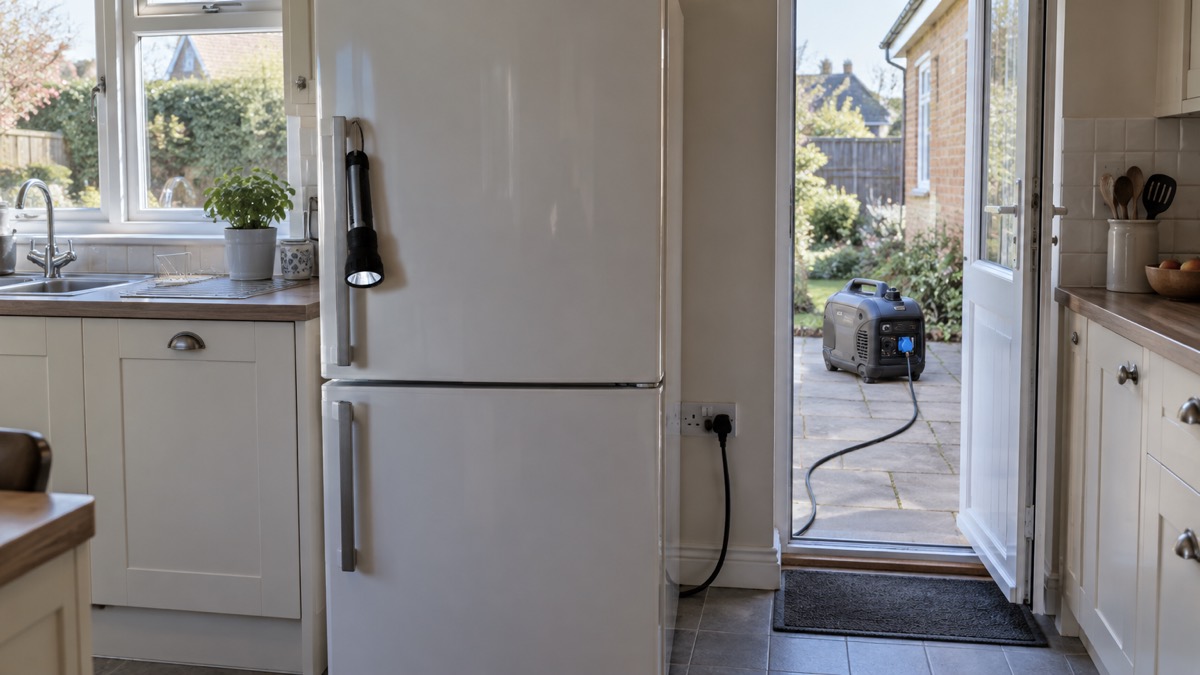
At 25% load, 0.9 litres an hour against a 4.5 litre tank gives five hours of running, well short of the headline figure1. The 11.5 hour figure reflects the lightest possible load. Plan on the consumption table, not the headline, and keep a spare can of petrol if a long outage is forecast. Our guide to How Long Will a Generator Run on a Tank of Fuel? explains how to estimate your own figure.
Fuel is also a safety matter. Petrol must be stored and handled carefully, and the generator must be refuelled only when the engine is off and cool. For how much you can keep at home, see How Much Petrol Can I Store at Home Safely?.
CO Shield and the other safety cut-outs
The Atom Fusion carries several built-in protections. The most important is CO Shield, which the maker describes as monitoring the accumulation of carbon monoxide, a poisonous gas produced by engine exhaust when the generator is running1. The maker states that if CO Shield detects unsafe elevated levels of CO gas, it automatically shuts off the engine1.
That is a backstop, not a licence to run the machine in an enclosed space. Carbon monoxide is produced by any fuel-burning appliance, and the safety charity CO-Gas Safety is clear that CO alarms are very good at preventing death or serious injury but are not health monitors2. The maker's own warranty terms void cover if the generator is installed improperly in any outbuilding, shed, garage, confined space or vehicle1.
The other cut-outs are:
- Low oil shutoff: the engine stops if the oil level drops too far, protecting it from damage1.
- Overload protection: the generator protects itself if you draw more than it can supply1.
Where and how to run it safely outdoors
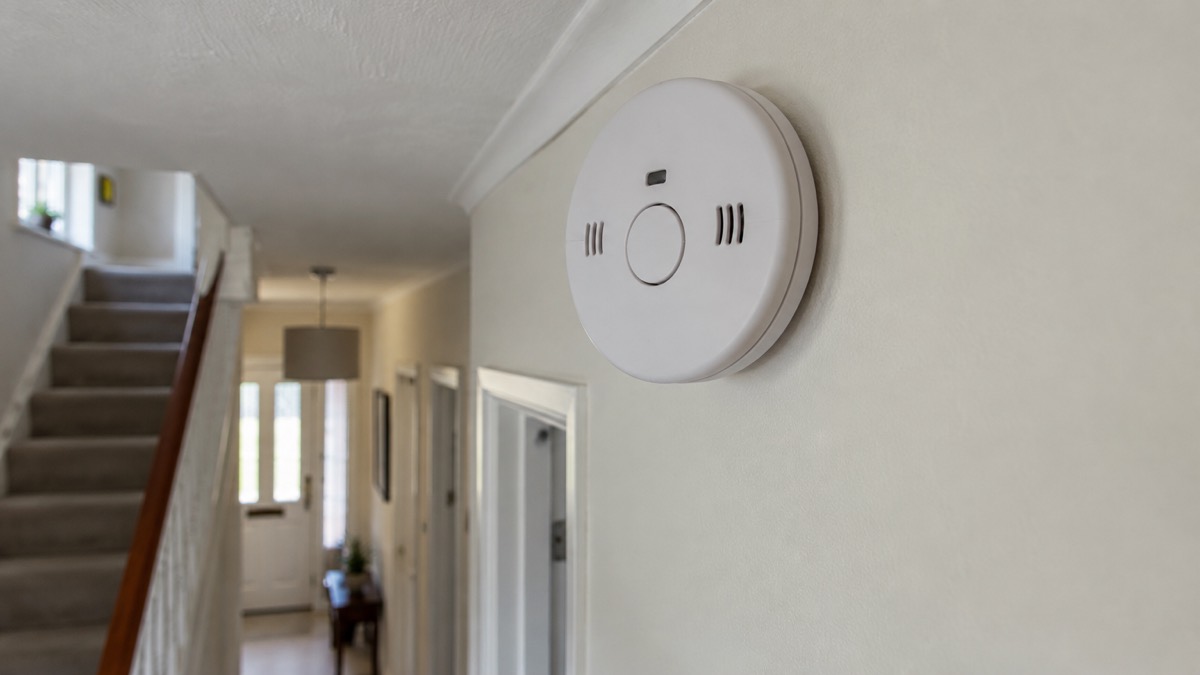
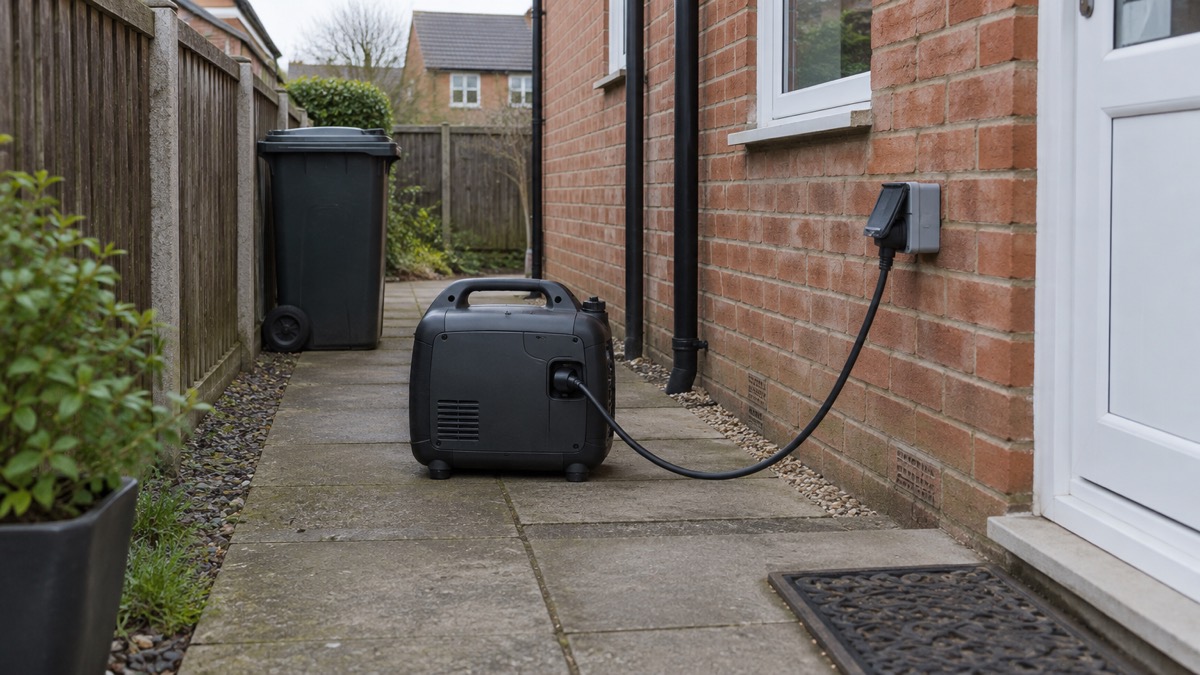
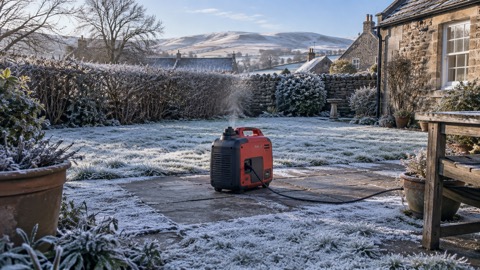
The Atom Fusion must run outdoors, on a firm, level surface, with good airflow and away from doors, windows and air bricks so exhaust cannot drift inside. Official guidance on generators is blunt: it will need to be secure with good airflow10. Secure matters as much as airflow, because a running generator is a theft risk and a trip hazard.
The maker gives the machine an IP23M rating, which indicates protection against rain falling at an angle1. That is not the same as being safe in a downpour. Keep it out of standing water, keep leads and plugs dry, and never handle it with wet hands. If conditions are truly wet, wait.
Northern Ireland government advice on fuel-burning equipment is that there must be good ventilation11. That applies to any fuel-burning appliance, and it is the reason a generator belongs outside and never in a tent, awning or caravan.
"CO Shield® technology monitors the accumulation of carbon monoxide (CO), a poisonous gas produced by engine exhaust when the generator is running"
For the full picture on siting, fuel handling and electric shock, see Generator Safety: Carbon Monoxide, Fuel and Electric Shock and Can You Run a Generator Indoors or in a Garage?.
Starting, servicing and storing it between emergencies
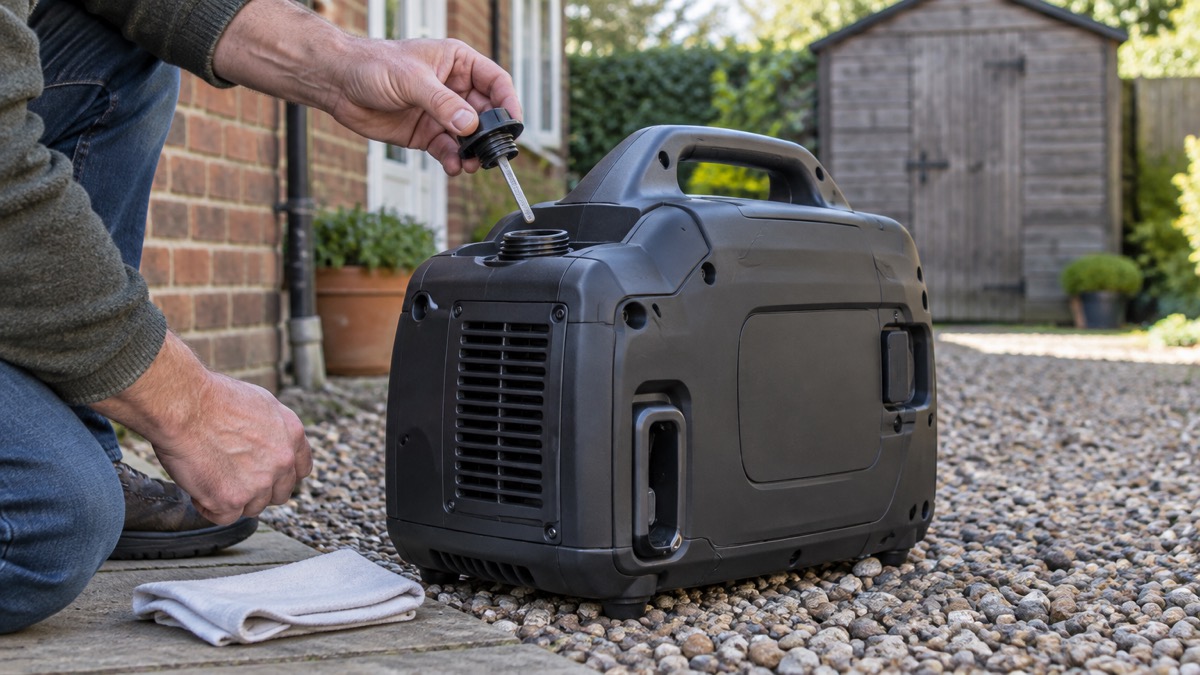
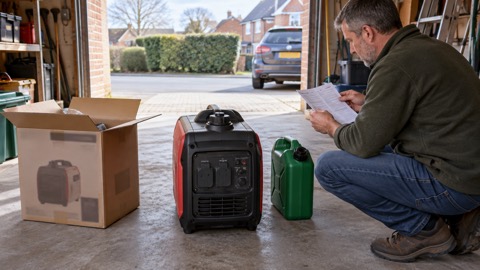
The maker's service schedule is short and worth following: every 8 hours or before each use, check the oil level and clean around the air intake and muffler1. The engine holds 580 ml of oil1. The box includes an oil funnel and a spark plug socket, but not the oil itself1.
Before first use, read the operator's manual. The maker's warranty terms void cover for misuse, neglect, accident, abuse, overloading beyond the generator's limits, modification including exhaust extension and filtration, improper installation, incorrect connection to any electrical component, or use for hire1.
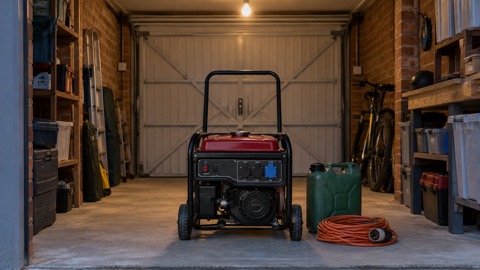
Between emergencies, store the generator somewhere dry and secure, with the fuel drained or stabilised according to the manual, and run it briefly every few months so it starts when you need it. Our guide to How to Store a Generator After a Power Cut covers this in detail, and Will a Generator Start in Cold Weather? explains the cold start feature.
A short checklist before each season:
- Check the oil level and top up if needed1.
- Clean around the air intake and muffler1.
- Check the fuel is fresh and the tank is filled for the outage you expect.
- Test-start it outdoors, never indoors.
- Check the CO Shield indicator works as the manual describes1.
- Check your leads and adapters for damage before use.
Charging a 12V battery and USB devices
The Atom Fusion has a 12V DC output and comes with a 12V DC battery charging cable1. That lets you top up a leisure battery or similar during an outage, which can then run small 12V devices or be used with an inverter. It is not a way to charge your home's wiring.
The USB connection and the included 12V USB adapter are for phones and small devices1. For laptops and tablets, USB Power Delivery over USB-C is the most powerful and flexible option, because the charger and device talk to each other to agree on the safest and fastest charging level12. Most modern laptops now charge using USB-C Power Delivery rather than a proprietary charger12. Our guide to USB-C Charging, Power Delivery and Cables Explained covers what to look for.
Warranty: three years for home use, with conditions
The maker warrants the Atom Fusion for up to 3 years for domestic usage1. The detail matters: year one covers parts and labour, years two and three cover parts only, or 1000 hours, whichever comes first1. Industrial and commercial use gets a shorter deal: year one parts and labour, year two parts only, or 1000 hours, whichever comes first1.
The warranty applies only to the original purchaser and is not transferable, and transportation charges for repair or replacement are the purchaser's responsibility1. Batteries supplied over one year old are excluded1. And, as above, the warranty is voided by misuse, neglect, accident, abuse, overloading, modification, improper installation in any outbuilding, shed, garage, confined space or vehicle, incorrect connection, or hire use1.
Keep your proof of purchase and the operator's manual. If something goes wrong, contact the maker or the retailer you bought from, quoting the model and the date of purchase.
Where to get help in a power cut
A generator is one part of a plan, not the whole of it. If you have not already, register for your network operator's Priority Services Register if anyone in the household is disabled, elderly, has a medical condition or depends on powered equipment. The government's guidance on phone and broadband outages explains that registering can enable practical help such as tailored communications, priority fault repair and additional support during service disruptions13.
Report a power cut to your network operator, and keep a phone charged. Our Power Cut Backup Power Checklist sets out a fuller kit.
For the wider picture on what to do before, during and after an outage, see Power Cuts: A Household Guide and Using Generators and Power Stations During an Outage. For the maker's other models, see the Champion brand page.
Sources (13)
- Champion 3000 Watt Atom Fusion Petrol Inverter Generator, Champion Power Equipment, 2026-10-25
- Carbon monoxide prevention, CO-Gas Safety, 2024-05-30
- Emergency power cuts, Northern Powergrid, 2026-10-25
- What to do in a power cut, SP Energy Networks, 2026-10-26
- Be informed about hazards: power cuts, UK Government, 2026-10-21
- What to do in a power cut, Northern Powergrid, 2026-10-25
- Food safety during power cuts, Food Standards Scotland, 2026-10-25
- Disabled people and carers, Ready Scotland, 2026-10-25
- Carbon monoxide emergency advice, CO-Gas Safety, 2022-07-11
- Generators, Wiltshire and Swindon Prepared, 2026-10-25
- Strong winds weather warning information and advice, NI Direct, 2026-10-24
- USB chargers, Electrical Safety First, 2026-10-25
- Phone and broadband outages - Be Ready, prepare.campaign.gov.uk (UK Government Be Ready campaign)

 EcoFlow Dual Fuel Generator
 Honda EU70iS Generator
 Honda EU32i Generator
 Honda EG3600 Generator
 Pramac P3500i Generator
 Senci SC6000-II Home Generator
 Senci SC10000-II Generator
 Senci SC6600iED Generator
 Gorilla Power GP3800iE
 Gorilla Power GP6500E-DF
 Gorilla Power GP3500i
 Hyundai HY2250Si Generator