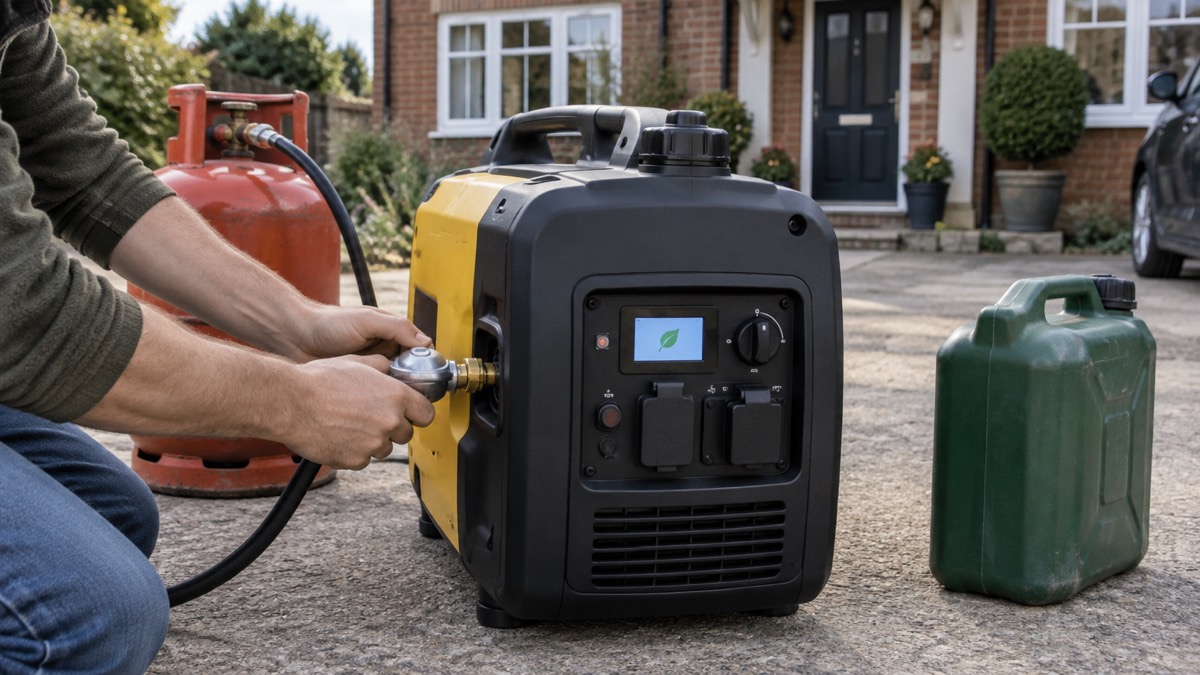
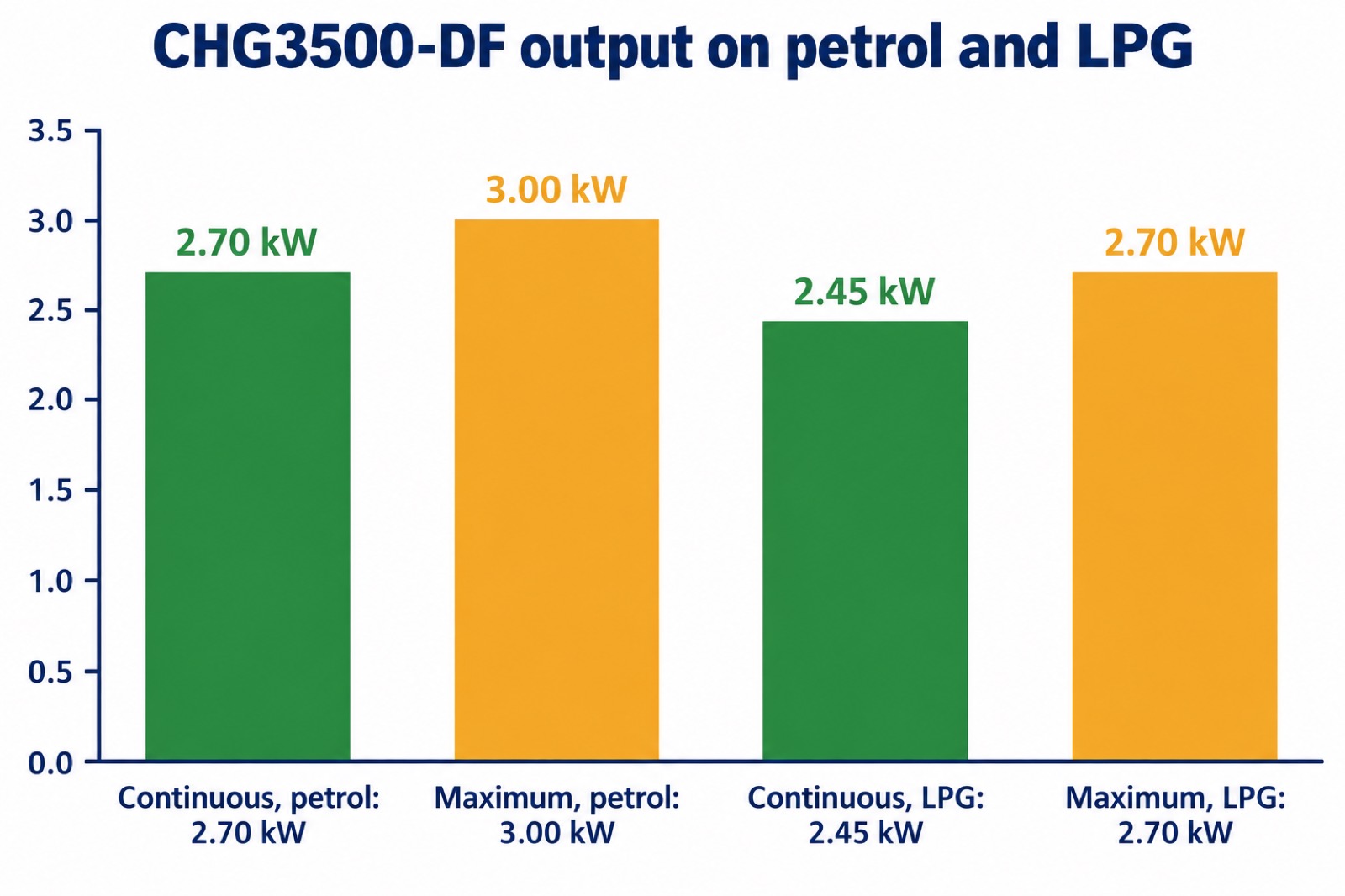
The Champion CHG3500-DF is a dual-fuel inverter generator: it runs on petrol or LPG, produces 2.70 kW continuous on petrol and 2.45 kW on LPG, and starts with a recoil pull1. It is a frame-type unit with a lifting eye, weighs 44.20kg, and is aimed at tools, lighting and small equipment rather than whole-house backup1. For a household, that makes it a serious piece of outdoor kit for a long outage, not something you wheel into the kitchen.
The numbers that decide whether it suits you are the output and the run time. On a full 3.50-litre petrol tank it runs for about 3.50 hours at 50% load1. On LPG it uses 0.70 kg/hr at 50% load1. It has two 240V 16A sockets plus two 115V sockets, automatic voltage regulation, and an Intelligauge that monitors voltage, frequency and hours1.
Before you plan around buying one, note that the UK distributor's page listed it as out of stock on 21 July 20261. The rest of this page sets out what it can do, how to run it safely, and what support comes with it.
What the CHG3500-DF is and who it suits
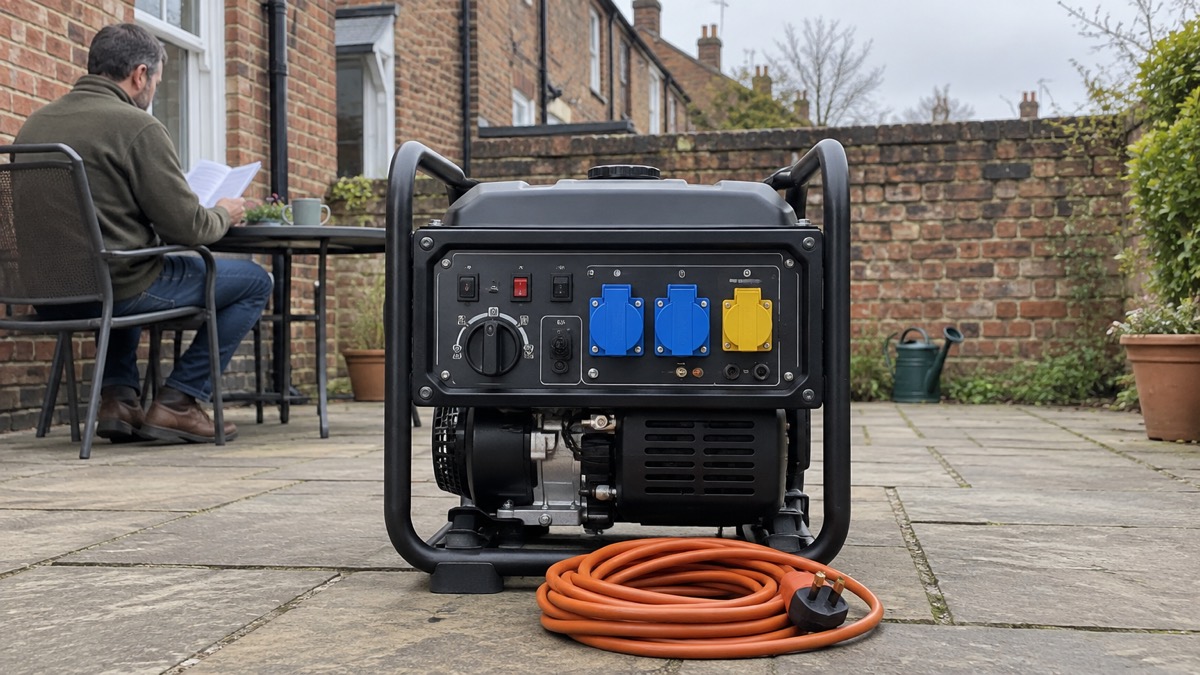
This is a dual-fuel, frame-type inverter generator from Champion, sold in the UK through a distributor1. "Inverter" matters: the set converts its output electronically, and this one carries automatic voltage regulation and a 50Hz frequency, which is the kind of supply you want for anything with a circuit board in it1. "Frame-type" means it sits in an open metal frame rather than a sealed plastic case, so it is built to be moved around a site and run outdoors.
The distributor describes its intended use as fuelling "a wide array of tools, lighting systems, and various small equipment across diverse settings", and calls it ideal for the construction or hire industry1. Read that plainly: it is designed for job sites and rental fleets, and a household buying one is borrowing a tool built for harder work than a power cut. That is not a drawback, but it sets expectations. It is heavy at 44.20kg, it is loud at 72 dB(A) at 7m, and it needs fuel stored and handled properly1.
Who it suits, then:
- A household with outdoor space that wants one machine that can run a fridge, a freezer, lights and a few tools through a long outage, on whichever fuel is easier to get1.
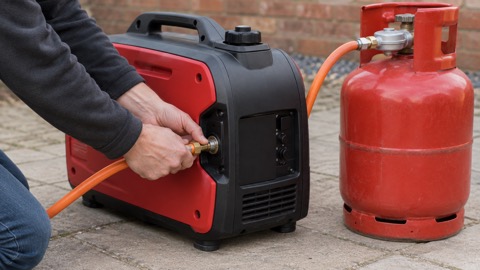
- Someone already set up for LPG, since the unit ships with a propane hose and regulator and can run on cylinders rather than petrol1.
- A user who wants to move it between a garage, a shed and a work area, using the lifting eye and frame rather than carrying it1.
It does not suit anyone who needs to run it indoors, in a garage or in a conservatory. That is covered below, and it is the single most important thing on this page.
Specifications at a glance
The figures below are the distributor's published specification for the CHG3500-DF, dated 21 July 20261. Where a figure is given for both fuels, petrol comes first.
| Specification | Petrol | LPG |
|---|---|---|
| Continuous output | 2.70 kW / 2.70 kVA | 2.45 kW / 2.45 kVA |
| Maximum output | 3.00 kW / 3.00 kVA | 2.70 kW / 2.70 kVA |
| Fuel consumption at 50% load | 3.50-litre tank, about 3.50 hours | 0.70 kg/hr |
| Fuel type | Petrol or LPG | Petrol or LPG |
| Starting method | Recoil | Recoil |
| Frequency | 50Hz | 50Hz |
| Automatic voltage regulation | Yes | Yes |
| Oil tank | 600ml | 600ml |
| Sockets | 2 x 240V 16A, 1 x 115V 16A, 1 x 115V 32A | 2 x 240V 16A, 1 x 115V 16A, 1 x 115V 32A |
| Noise level at 7m | 72 dB(A) | 72 dB(A) |
| Weight | 44.20kg | 44.20kg |
| Dimensions (W x H x L) | 481 x 461 x 612mm | 481 x 461 x 612mm |
| Certification | CE and EU5 | CE and EU5 |
| Warranty | 3-year limited | 3-year limited |
In the box you get an oil funnel and a propane hose with regulator1. You supply the petrol or the LPG cylinder, and you supply the oil.
What it can power, and for how long
The continuous rating is the figure to plan around: 2.70 kW on petrol and 2.45 kW on LPG1. The maximum figures, 3.00 kW on petrol and 2.70 kW on LPG, are for short peaks, such as a motor starting1. Keep your running load under the continuous figure and let the peaks look after themselves.
For scale, independent guidance from Electrical Safety First lists a freezer at 200 watts2, and a manufacturer's emergency power guide lists a refrigerator at 300 running watts3. Either appliance sits comfortably inside 2.70 kW. So does a set of lights, a router, a phone charger and a television, with room to spare. What you cannot do is run an electric shower, an immersion heater or a whole house's circuits at once; the plan should be a handful of chosen appliances, which is the approach set out in deciding what to keep running when the mains fails.
Run time is the constraint, not output. At 50% load the petrol tank lasts about 3.50 hours1. A long outage therefore means refuelling every few hours, in daylight if you can, with the engine off and cooled. On LPG, consumption is 0.70 kg/hr at 50% load1, so a cylinder's duration depends on how much gas it holds; the guide to LPG cylinders and regulators explains how to work that out and how to connect a cylinder safely.
If you are weighing up whether a generator or a battery is the better fit for your household, the comparison of a portable power station or a petrol generator for a power cut sets the trade-offs out side by side. The guide to portable generators covers the wider range of types.
Starting it, and the oil it needs
Starting is by recoil: a pull cord, not a button or a key1. That is worth knowing before you buy, because a cold engine on a cold morning takes a firm, steady pull, and the unit weighs 44.20kg, so it will not shift far when you pull1. Practise starting it before you need it, outdoors, so the procedure is familiar when the lights go out.
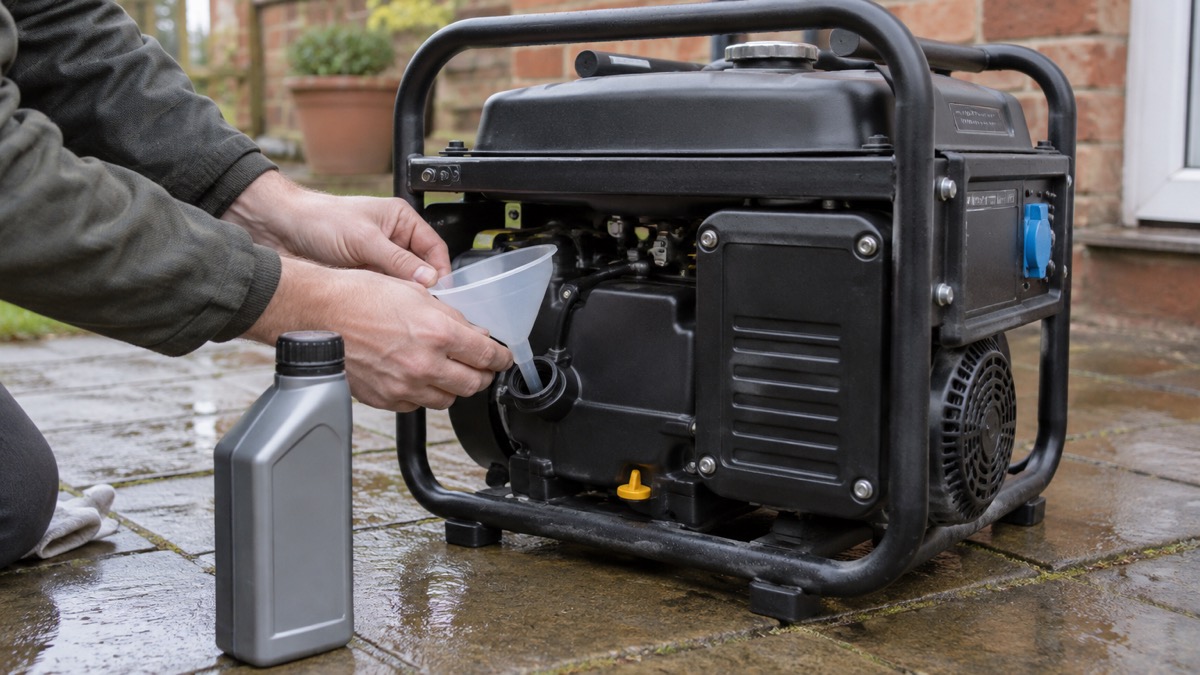
The engine has a 600ml oil tank1. Check the oil level before every run and top it up to the mark; a small engine run low on oil is a small engine that stops, or worse. The oil funnel supplied in the box is there for this job1. Change the oil at the intervals in the maker's manual, which comes with the unit.
A sensible first-run routine:
- Put the generator outdoors, on firm level ground, well away from doors, windows and air vents.
- Fill the 3.50L tank with petrol, or connect an LPG cylinder using the supplied propane hose and regulator1.
- The unit ships with an oil funnel for filling it1.
- Watch the Intelligauge for voltage, frequency and hours as the load changes1.
The generator safety guide covers carbon monoxide, fuel handling and electric shock in full, and the carbon monoxide warning signs page explains what to look for. On fuel, store petrol only in a suitable container, outdoors or in a well-ventilated shed, and never refuel a hot engine. The guide to storing petrol at home sets out the limits.
The 115V sockets, the lifting eye and the other details
The 115V sockets. The panel carries two 240V 16A sockets, one 115V 16A socket and one 115V 32A socket1. UK appliances run on 240V, so the 240V outlets are the ones a household will use. The 115V outlets are for equipment built for that voltage, typically site tools from other markets. Do not try to run a normal UK plug from them, and do not assume an adapter makes it safe; if you do not own 115V equipment, leave those sockets alone.
The lifting eye. The unit is described as a dual fuel frame-type inverter generator with lifting eye1. At 44.20kg it is a two-person lift at best, and the eye lets it be raised with proper lifting equipment instead. For most households the practical answer is to give it a permanent outdoor home and move it as little as possible. If you must lift it, use the eye and get help.
Noise. It is rated at 72 dB(A) at 7m1. That is a working machine, not a quiet background hum, and it will be heard by neighbours. The guide to generator noise and neighbours explains what the figure means in practice and how to reduce the impact.
Voltage regulation and the Intelligauge. AVR is listed as Yes, and the Intelligauge monitors voltage, frequency and hours1. Together they let you see whether the supply is steady while a fridge or a tool cycles on and off. If the readings wander, shed load before something is damaged.
Certification. The unit is CE and EU5 certified1. CE marking is the manufacturer's declaration of conformity with the applicable requirements, and EU5 is the exhaust emissions stage for non-road engines. The guide to UKCA, CE and battery safety markings explains what these markings do and do not tell you.
Warranty, support and buying one in the UK
The CHG3500-DF comes with a 3-year limited warranty and free lifetime technical support from Champion's customer service team1. Champion's own UK site also advertises free lifetime technical support with its products4. Keep your proof of purchase and the serial number; warranty claims and technical calls both start there.
On availability, the UK distributor's page listed the generator as out of stock on 21 July 2026, with an estimated delivery time of 1-2 working days stated on the same page1. Stock changes, so check the listing before you plan around it. If it is unavailable, Champion's UK range includes other dual-fuel inverter models, such as the 2200W LPG dual-fuel inverter generator4, and the Champion brand page lists the models covered here.
A few things to confirm before ordering:
- That the warranty terms are the 3-year limited warranty described1.
- That you have somewhere outdoors and well ventilated to run it.
- That you have a plan for fuel: petrol for the 3.50L tank, or an LPG cylinder and the supplied propane hose and regulator1.
- That you can move and store 44.20kg, at 481 x 461 x 612mm1.
If your main need is keeping a fridge, lights and phones going for a few hours, a battery power station may suit you better and needs no fuel at all; the guide to portable power stations explains what they do. If you want a generator, the guide to using generators and power stations during an outage walks through the sequence from the moment the power goes.
Sources (4)
- Champion CHG3500-DF dual fuel frame-type inverter generator with lifting eye, Generators Direct, 21 July 2026
- Ratings of electrical appliances, Electrical Safety First
- How to build an emergency power supply for your home, Jackery, 28 September 2026
- Champion 2200 watt LPG dual fuel inverter generator 92001i-DF, Champion Power Equipment, 25 October 2026

 EcoFlow Dual Fuel Generator
 Honda EU70iS Generator
 Honda EU32i Generator
 Honda EG3600 Generator
 Pramac P3500i Generator
 Senci SC6000-II Home Generator
 Senci SC10000-II Generator
 Senci SC6600iED Generator
 Gorilla Power GP3800iE
 Gorilla Power GP6500E-DF
 Gorilla Power GP3500i
 Hyundai HY2250Si Generator