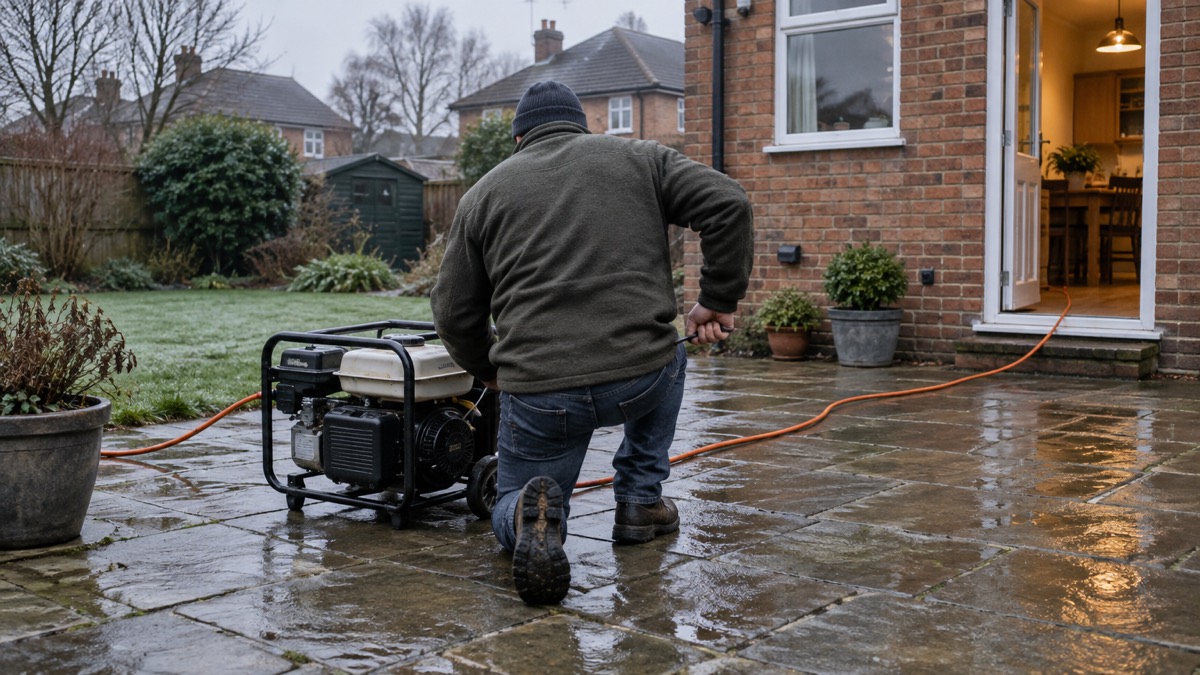
The Champion 3200 Watt petrol generator is an open-frame petrol machine built for backup power and site work. Champion gives it a maximum output of 3200 watts and a rated output of 2800 watts, from a 224.0 cc four stroke OHV engine running at 3000 rpm1. It holds 17.8 litres of petrol and, the maker states, delivers up to 12 hours of run time at 50% load1.
If you are weighing one up for a power cut, the headline is this: it is a petrol engine, it weighs 46.0 kg, and it is not a quiet inverter machine1. Plan where it will sit, how you will move it, and how you will store petrol safely before an outage, not during one.
This page sets out what the machine is, what its output figures actually mean, how long a tank lasts, what the sockets and adaptor do, the safety features built in, and how to run, store and service it. For the wider picture, start with Backup Power at Home: A Household Guide.
What the Champion 3200 Watt petrol generator is
This is a conventional open-frame petrol generator rather than an inverter model. Champion describes a four stroke OHV petrol engine giving smooth running, mounted on a hardwearing, durable frame that is easily transported, with anti-vibration mounting for extra protection and boosted reliability1. The engine is 224.0 cc and produces 6.9 hp at 3000 rpm, with a single phase output and a power factor of 1.01.
The frame design matters more than it sounds. An open-frame generator is a working machine: the engine and alternator sit exposed inside a tubular cradle, which keeps it cool and simple to service but does nothing to hush the noise. Champion describes the heavy-duty industrial frame as offering protection and aiding portability, especially with the wheels and handle kit2. At 46.0 kg dry, with dimensions of 560 x 630 x 599 mm (HxLxW), it is a two-person lift or a wheel-it-about machine, not something you carry up a garden path1.
It is a recoil start unit, so you pull a cord rather than turn a key, and Champion lists cold start technology as fitted, which helps in low temperatures1. There is a fuel gauge so you can see the level without opening the cap, and an Intelligauge for monitoring1.
Who it suits: a household with an outdoor spot to run it, somewhere safe to store petrol, and a realistic list of what it needs to keep going. If you want something you can use indoors or in a flat, a battery power station is the better fit; see Portable Power Stations: What They Do and How to Choose and the comparison Portable Power Station or Petrol Generator for a Power Cut.
Power output: 3200W peak, 2800W running
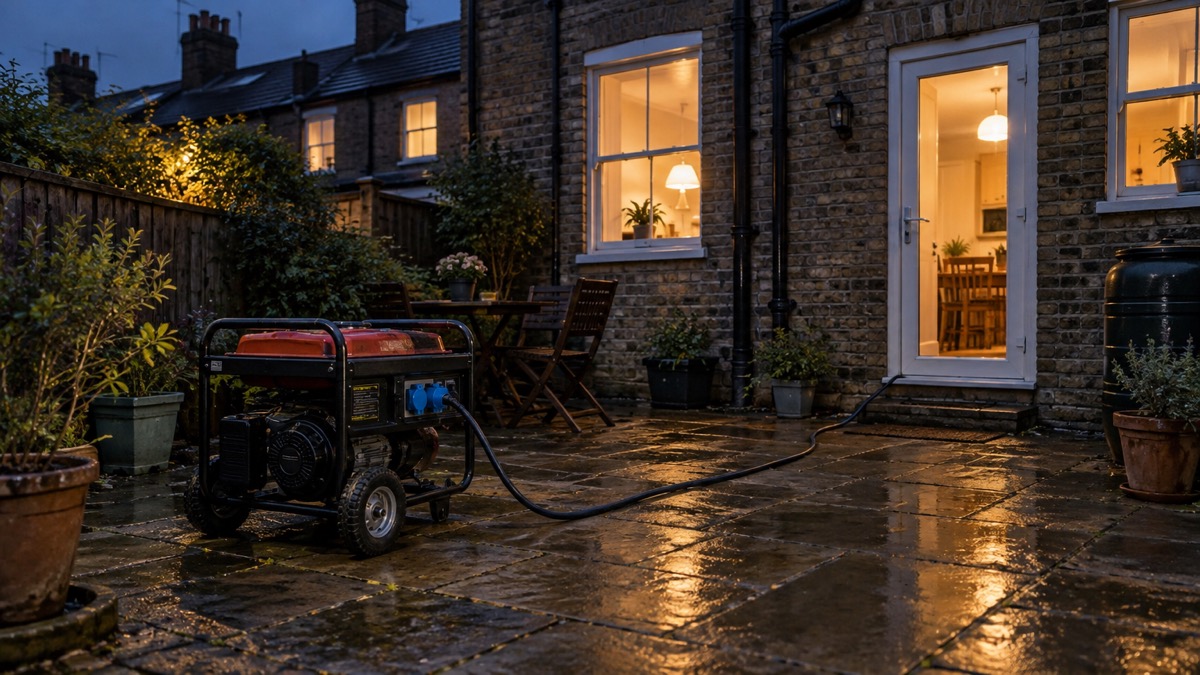
The two numbers that decide what you can plug in are the maximum and the rated output. Champion gives a maximum of 3200 watts and a rated output of 2800 watts, with starting watts of 35001. The rated figure is the one to plan around: it is what the machine will supply continuously. The maximum is a short-term ceiling, and the starting figure covers the brief surge when a motor, such as a fridge compressor, kicks in.
That distinction is the single most useful thing to understand before you buy. Champion's own guidance is to only add appliance watts together if you plan on using the products at the same time, and to use a wattage calculator for a more in-depth review2. In other words, a list of everything in the house added together is meaningless; what matters is what runs simultaneously.
| Figure | Value | What it means for you |
|---|---|---|
| Starting watts | 3500 W | Brief surge for motor starts1 |
| Maximum watts | 3200 W | Short-term ceiling1 |
| Rated watts | 2800 W | Continuous supply to plan around1 |
There is a further limit worth knowing. Champion notes that dual voltage generators will only give approximately 50-60% of the rated output wattage on 120V per socket1. That applies to the 120V side of this machine, not the 230V UK sockets, but it is a reminder to read the manual before assuming every outlet gives full power.
For a worked understanding of surge versus running load, see Watts, Watt-Hours and Surge Explained, and for sizing help, What Size Generator Do I Need for a Power Cut?.
Run time: up to 12 hours at half load on a 17.8 litre tank
Champion states the machine delivers up to 12 hours of run time at 50% load from its 17.8 litre tank1. The maker also publishes fuel consumption at three load points, which lets you see how quickly the tank empties as you ask more of it1.
| Load | Fuel consumption | What it tells you |
|---|---|---|
| 50% load | 1.46 litres per hour | The economy figure behind the 12 hour claim1 |
| 75% load | 1.73 litres per hour | Heavier use, shorter run1 |
| 100% load | 2.24 litres per hour | Full output, shortest run1 |
The lesson is simple: the 12 hour figure is a half-load figure. Run the machine hard and you will be refuelling far more often, and refuelling means shutting it down and letting it cool first. Plan your outage around a realistic load, not the best case.
For context on how tank size and load interact across machines, see How Long Will a Generator Run on a Tank of Fuel?. And because petrol is the fuel, storage is a safety question in its own right: read How Much Petrol Can I Store at Home Safely? before you buy jerry cans.
Sockets, 12V output and the 16A to 13A adaptor
Champion lists 16A 120V and 230V sockets plus a 12VDC output supply, with a socket rating given as 16/161. In plain terms, the machine has round-pin 16 amp outlets of the kind used on campsites and building sites, and a 12 volt DC outlet for small accessories.
That is why the box includes a 16 amp to 13 amp adaptor. Champion lists the box contents as the operating manual, the wheel kit and the 16amp to 13amp adaptor1. The adaptor lets you plug a standard UK three-pin extension lead into the generator's 16 amp outlet. Use a properly rated extension lead and keep the load within the machine's rated output; see Extension Leads and Overloading With Backup Kit.
The 12V DC output is a low-power supply for small items, not a substitute for a proper 12 volt charging set-up. If you want to understand what 12 volt kit can and cannot do, see 12V Inverters: Running Mains Kit From a Car or Battery.
One point on connecting to a house. A generator of this size is not designed to be wired into your home's circuits by a householder. If you want the house wiring fed during an outage, that is a job for a qualified electrician with a proper changeover arrangement; see Connecting a Generator or Battery to Your Home's Wiring. For everyday use, run extension leads to the appliances you need.
Safety features that protect the engine and your appliances
Champion builds in several protections. The specification lists automatic low oil shutoff, overload protection, Volt Guard, an automatic voltage regulator (AVR) and a fuel gauge1. Each does a specific job.
- Low oil shutoff: the engine stops itself if the oil level drops too far, protecting it from damage. The oil tank holds 600 ml1.
- Overload protection: cuts the output if you draw more than the machine can safely supply1.
- AVR and Volt Guard: work to keep the voltage steady, which matters for sensitive electronics1.
- Anti-vibration mounting: reduces vibration through the frame, which Champion says boosts reliability1.
- Cold start technology: helps starting in cold weather1.
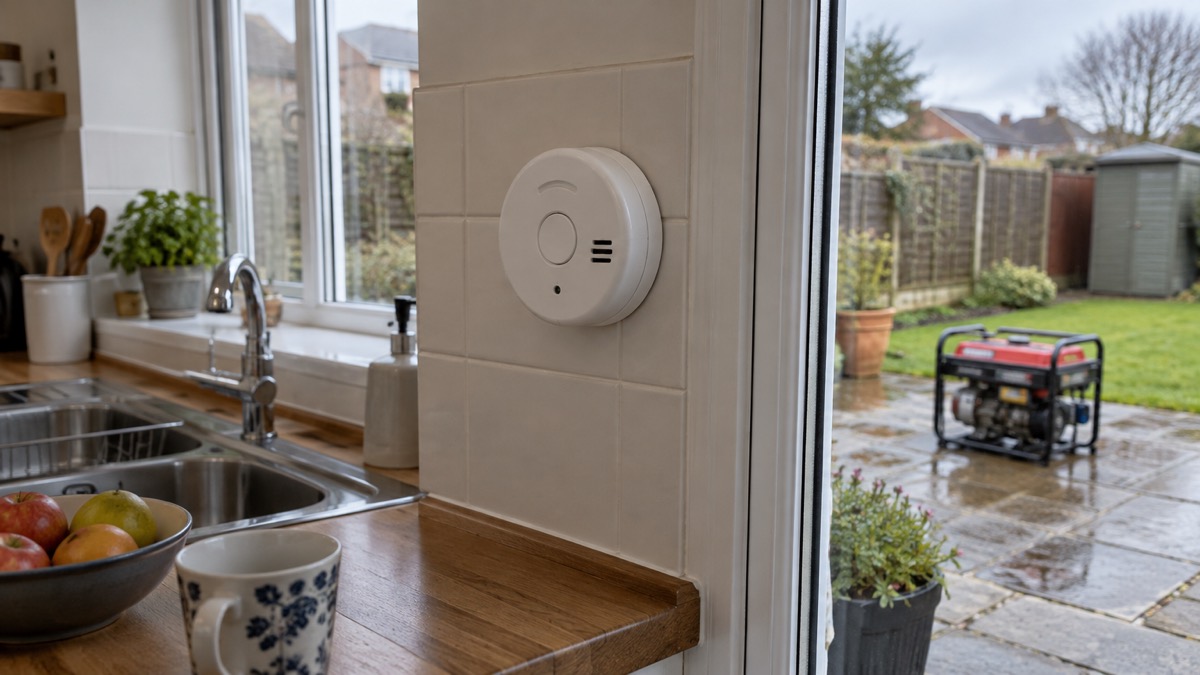
These features protect the machine and your appliances, but they do not protect people from carbon monoxide or electric shock. Those are down to where and how you run it. Read Generator Safety: Carbon Monoxide, Fuel and Electric Shock before first use, and Can You Run a Generator Indoors or in a Garage? for the indoor question in full.
Servicing, storage and cold weather
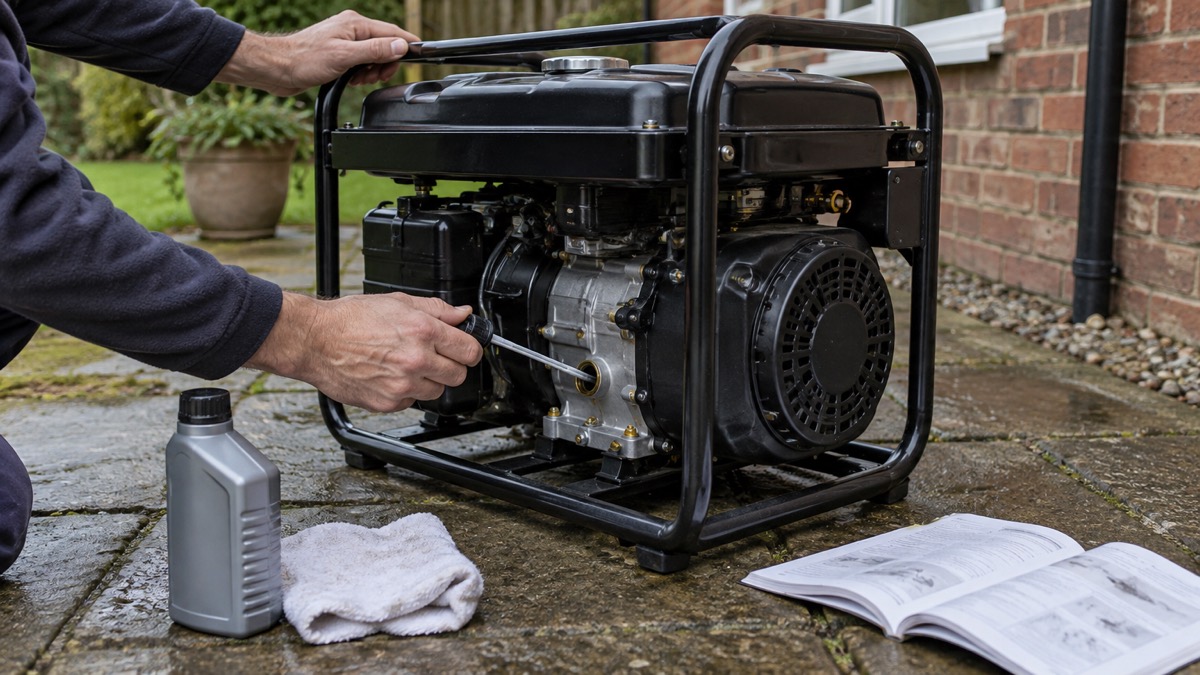
Routine care keeps a petrol generator reliable. Champion's specification gives a 600 ml oil tank and marks the more involved tasks as needing a knowledgeable owner or a certified service centre1. Follow the operating manual for oil changes and checks, and use a certified centre for anything you are unsure about.
Storage matters as much as servicing. Drain or manage fuel according to the manual, keep the machine dry and covered, and run it periodically so it starts when you need it. For the full routine, see How to Store a Generator After a Power Cut.
If you keep the machine in an unheated shed, read Will a Generator Start in Cold Weather? and do a test start before winter, as set out in Backup Power Checks Before Winter.
Noise is part of living with an open-frame machine. At 68 dBA at 7 m1, it is audible well beyond your boundary. Site it thoughtfully and tell neighbours in advance; see How Loud Is a Generator? Noise and Neighbours.
Weather, emissions and where to buy in the UK
The machine carries an IP23M rating and cold start technology1. IP23M is a weather protection rating, not a promise it can sit in the rain. Run it outdoors in a dry, ventilated spot, and if rain is forecast use a shelter that keeps water off without trapping exhaust. See Can You Run a Generator in the Rain?.
On emissions, Champion states that all newly manufactured products are EU Stage V Compliant, and lists CE and EU Stage V among the certifications1. That is the maker's statement; check current rules for your site if it matters.
On availability, Champion states this model is exclusive to Bimson Power in the UK2. Buy from a UK seller so warranty and servicing routes are clear. The warranty is 3 years1.
For the maker's wider range, see the Champion brand page, and for other models in this family, Champion 3600W Petrol Inverter and Champion 3600W Digital Hybrid Inverter. If you are still deciding between generator types, Portable Generators: Petrol, Diesel, Dual-Fuel and Inverter Types and Inverter Generator or Open-Frame Generator set out the trade-offs.
Sources (2)
- Champion 3200 Watt Petrol Generator product page, Champion Power Equipment, 2026-10-25
- Champion 3200 Watt Petrol Generator product page (alternate), Champion Power Equipment, 2026-10-25

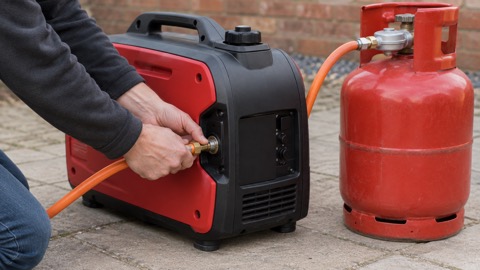 EcoFlow Dual Fuel Generator
 Honda EU70iS Generator
 Honda EU32i Generator
 Honda EG3600 Generator
 Pramac P3500i Generator
 Senci SC6000-II Home Generator
 Senci SC10000-II Generator
 Senci SC6600iED Generator
 Gorilla Power GP3800iE
 Gorilla Power GP6500E-DF
 Gorilla Power GP3500i
 Hyundai HY2250Si Generator