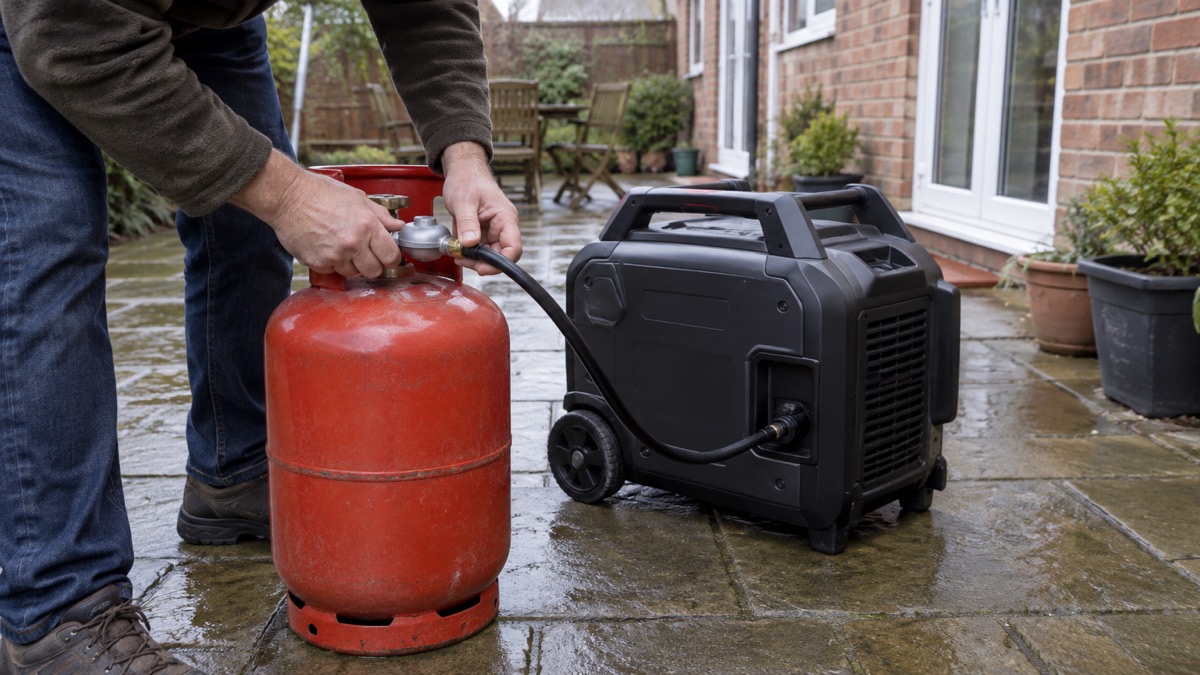
The Champion 500988-DF-UK is a dual fuel inverter generator from Champion: it runs on petrol or on propane from an LPG cylinder, and the maker rates it at 3600 watts maximum output on either fuel1. It is aimed at a household that wants a single machine able to carry a fridge, a freezer, lights, a router and phone charging through a longer outage, with the option of switching to bottled gas when petrol is awkward to store or banned on site.
The figures that decide whether it suits you are these. Rated output is 3500 watts on petrol and 3150 watts on LPG, with starting output of 4500 watts on both fuels1. The maker quotes up to 12 hours on petrol or up to 16 hours with a 9kg propane tank, at 61 dBA measured at 7 metres1. It weighs 46.7 kg and comes with wheels and a handle, so it is moved rather than carried1.
It is a petrol or propane engine, so the safety rules that govern all generators apply in full. It must never run indoors, in a garage, shed, tent or vehicle, because the exhaust gases contain carbon monoxide, which is invisible and has no smell. The UK gas safety body's case studies record deaths from generators run in enclosed or poorly ventilated spaces, and petrol is the fuel named in several of them2. Everything else on this page sits underneath that rule.
What the 500988-DF-UK is and what it suits
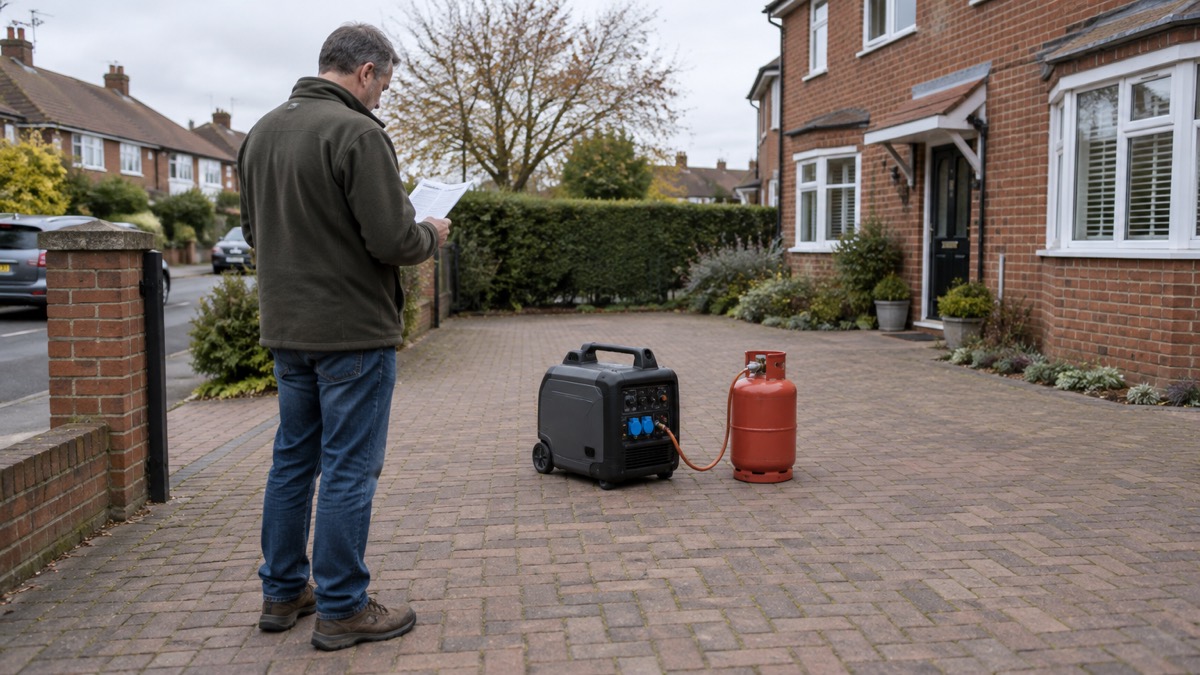
This is an inverter generator, which means the engine drives an alternator whose output is converted electronically to a clean sine wave. The maker describes it as True Sine Wave technology, safe for sensitive electronics1. In practice that is what lets you plug in a laptop, a router, a television or a modern boiler control without the rough supply that an open-frame generator can produce. If the difference between the two types is new to you, our guide to inverter and open-frame generators sets it out.
The engine is a 212cc Champion single cylinder, four-stroke OHV unit producing 6.5 HP, running at 3600 rpm1. It starts either by recoil or by electric start, and the maker lists both1. The fuel tank holds 8.5 litres and the oil sump takes 500 ml1. There are two 240V 13A outlets and a 12V DC outlet, and the machine has parallel connectivity so a second compatible generator can be linked to it1.
The maker also fits a digital 15 second power delay on start-up and shut down, which allows sensitive equipment to be left plugged in while the generator starts and stops1. That matters in a real outage: it means you are not unplugging the fridge every time you restart the machine.
Who it suits: a household with somewhere outdoors and genuinely ventilated to site it, a way to store petrol safely or a supplier of LPG cylinders, and a load that the generator's rated output can carry. If you have nowhere safe to run an engine, a battery power station is the alternative, and our comparison of generators and power stations explains the trade-off.
Specifications
| Specification | Figure |
|---|---|
| Maximum output | 3600W (petrol and LPG)1 |
| Rated output | 3500W petrol, 3150W LPG1 |
| Starting output | 4500W (petrol and LPG)1 |
| Engine | 212cc single cylinder, 4-stroke OHV, 6.5 HP1 |
| Running speed | 3600 rpm1 |
| Start type | Recoil and electric1 |
| Fuel tank | 8.5 litres1 |
| Oil capacity | 500 ml1 |
| Outlets | 2 x 240V 13A, 1 x 12V DC1 |
| Socket rating | 13/131 |
| Power factor | 1.01 |
| Phase | Single1 |
| Noise at 7m | 61 dBA1 |
| Ingress protection | IP23M1 |
| Dimensions (H x L x W) | 510 x 591 x 449 mm1 |
| Weight | 46.7 kg1 |
| Wheels | Included, with built-in handle and wheel kit1 |
| Parallel connectivity | Yes1 |
| Low oil shutoff | Yes1 |
| Intelligauge | Yes1 |
| Certification | EPA, EU Stage V, UKCA; CE and EU5 certified1 |
| Warranty | 3 years1 |
The maker states that all newly manufactured products are EU Stage V compliant1.
Run time and fuel consumption
The headline run time is up to 12 hours on petrol or up to 16 hours with a 9kg propane tank1. Those are the maker's figures and they depend heavily on what you plug in. The maker publishes consumption at three load levels, which lets you see how the load changes the picture:
| Load | Petrol consumption | LPG consumption |
|---|---|---|
| 25% load | 0.72 L/hour | 0.567 kg/hour1 |
| 50% load | 1.27 L/hour | 0.903 kg/hour1 |
| 100% load | 2.17 L/hour | 1.417 kg/hour1 |
Read the table as a warning about planning. At a light load the 8.5 litre tank stretches a long way; at full load it empties much faster. A household running a fridge, a freezer, a few lights and a router is nowhere near full load, so the realistic figure sits between the 25% and 50% rows. If you want to work out where your own appliances fall, our guide to watts and watt-hours explains the arithmetic, and how long a generator runs on a tank covers the general method.
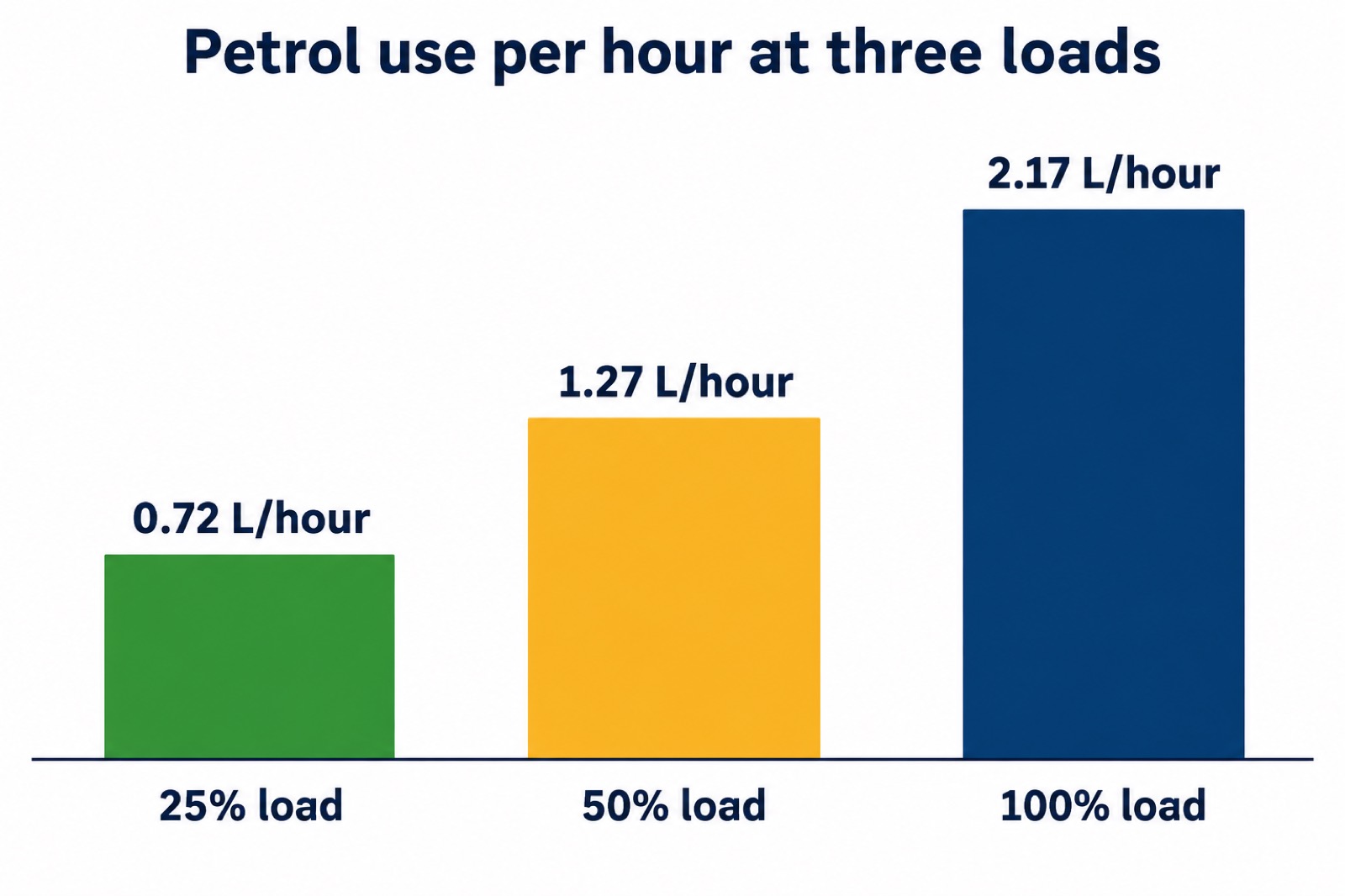
For a multi-day outage, plan fuel around the middle of that range rather than the best case. A 9kg propane cylinder gives a longer run at the same load, which is one reason a household that expects to run the machine for long stretches may prefer gas. How much petrol you may keep at home is a separate question with its own rules, covered in how much petrol you can store at home.
Petrol or propane: how the two fuels behave
The machine will run on either, and the choice is about storage, smell, safety and where you are allowed to use it, not about which is better in the abstract.
The maker sets out the case for LPG plainly: cleaner emissions allow use in situations where petrol is not appropriate, such as around food or on sites that do not allow petrol for fire risk precautions; there is no petrol storage smell; there is minimal risk of fuel spillage; there is less chance of the fuel source being stolen; and maintenance costs are lower because LPG is sealed and does not degrade, which extends spark plug and component life1. The maker adds that refuelling is easier, by connecting a new bottle, and that more councils and campsites are banning petrol and diesel1.
On the gas itself, propane and butane are different products, and propane is the one sold for outdoor use in cooler conditions. Propane is often sold in red cylinders and butane in blue, though some suppliers use other colours5. The two are often mixed to deliver the best energy yields and properties6. For a generator, the cylinder, hose and regulator are a system: the maker supplies a propane hose and regulator with the machine1, and our guide to LPG cylinders and regulators covers safe connection and storage.
| Petrol | Propane (LPG) | |
|---|---|---|
| Rated output | 3500W1 | 3150W1 |
| Run time | up to 12 hours1 | up to 16 hours on a 9kg tank1 |
| Storage smell | yes | none from the fuel itself1 |
| Spillage risk | present | minimal1 |
| Fuel degradation in store | yes | sealed, does not degrade1 |
| Site restrictions | increasingly banned on some sites1 | accepted where petrol is not1 |
The practical consequence is that LPG gives you slightly less power but a longer, cleaner, more storable supply, while petrol gives you the full rated output and is easier to buy in small quantities at short notice. Our comparison of LPG and petrol generators goes further into the trade-off.
Starting, running and linking two generators
Before first use, check the oil. The maker's schedule says to check the oil level every 8 hours or before each use, and to clean around the air intake and muffler at the same time1. Fill with the quantity the manual specifies for the 500 ml sump1. Then choose your fuel: connect the supplied propane hose and regulator to an upright cylinder, or fill the 8.5 litre tank with petrol1.
Start the engine by recoil or by the electric starter1. The digital 15 second power delay holds the output briefly on start-up and shut down so that sensitive equipment can stay plugged in1. Plug appliances into the two 240V 13A outlets, and keep the total load within the rated output for the fuel you are using: 3500W on petrol, 3150W on LPG1. Motors such as fridge and freezer compressors draw a surge when they start, which is what the 4500W starting output is for1. Our guide to sizing a generator walks through adding up a household's load.
The machine has parallel connectivity, so a second compatible generator can be linked to increase capacity1. Parallel operation needs the correct parallel kit and matched units; follow the maker's instructions for the kit rather than improvising a connection. What you must not do is feed the generator's output into your home's wiring by plugging it into a socket. Connecting a generator to the fixed wiring needs a proper transfer arrangement installed by a competent person, which our guide to connecting a generator to your home explains. For general running practice during an outage, see using generators and power stations during an outage.
Servicing by the hours
The maker publishes a servicing schedule keyed to running hours, and the Intelligauge helps you track them1. Follow it and the machine lasts; skip it and the warranty conditions may not help you.
| When | What to do |
|---|---|
| First 5 hours (break in) | Change oil1 |
| Every 8 hours or before each use | Check oil level; clean around air intake and muffler1 |
| Every 50 hours or annually | Clean air filter; change oil if operating under heavy load or in hot environments1 |
| Every 100 hours or annually | Clean and adjust spark plug; clean spark arrestor; clean fuel valve filter1 |
| Every 250 hours | Clean combustion chamber; check and adjust valve clearance, to be performed by knowledgeable, experienced owners or CPE certified service centres1 |
| Every 3 years | Replace fuel line, to be performed by knowledgeable, experienced owners or CPE certified service centres1 |
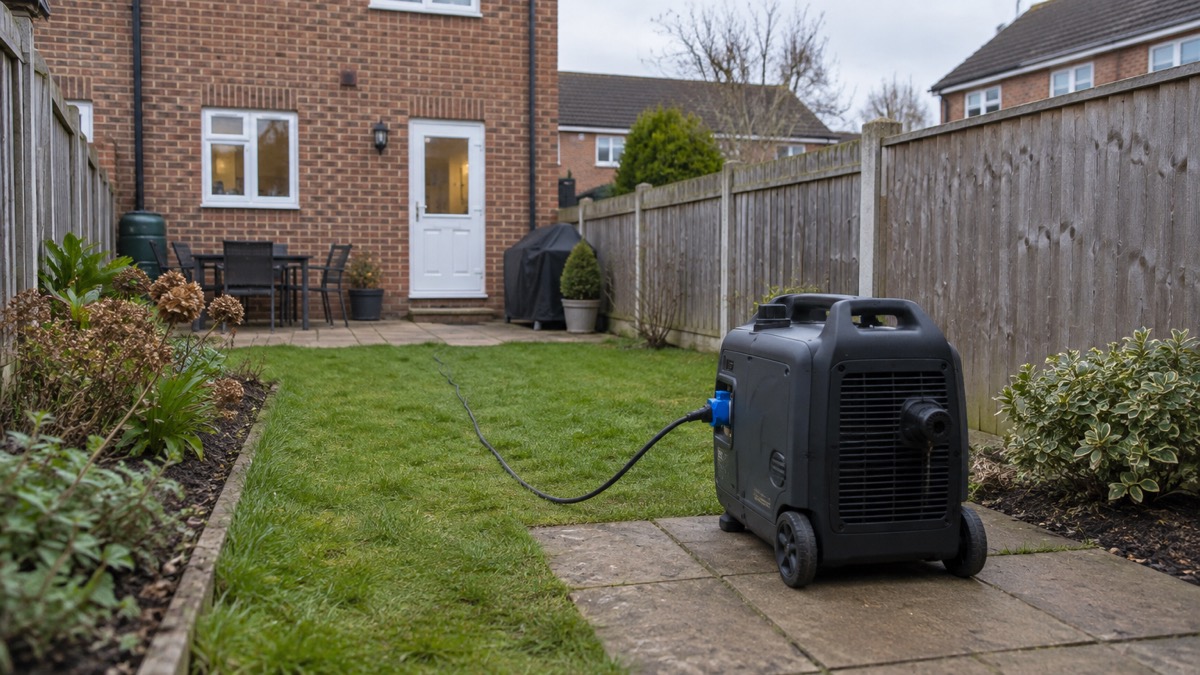
Two of those jobs are marked by the maker as work for experienced owners or a certified service centre: the 250 hour valve check and the 3 year fuel line replacement1. The rest are within reach of a careful householder with the tools supplied in the box1. Keep a note of hours and dates; the warranty runs on hours as well as years, and a record is what you would rely on if a claim arose.
Storage between outages matters as much as servicing. Run the carburettor dry or follow the maker's storage instructions in the manual, keep the machine under cover and dry, and store fuel only in proper containers in a suitable place. Our guide to storing a generator after a power cut covers the routine, and will a generator start in cold weather covers winter starting.
Warranty: three years for domestic use, with conditions
The maker warrants the 500988-DF-UK for up to 3 years for domestic usage: year one covers parts and labour, years two and three cover parts only, from the original date of purchase or 1000 hours, whichever comes first1. Industrial and commercial use gets year one parts and labour and year two parts only, or 1000 hours, whichever comes first1. The same three year domestic structure appears across Champion's generator range on the maker's product pages7.
The conditions are where households come unstuck. The warranty applies only to the original purchaser and is not transferable, and transportation charges are the purchaser's responsibility1. It is voided if the product is misused, neglected, involved in an accident, abused, overloaded beyond the generator's limits, modified (including exhaust extension and filtration), installed improperly in any outbuilding, shed, garage, confined space or vehicle, connected incorrectly to any electrical component, or used for hire purposes1. Exclusions include cosmetic defects, worn parts such as piston and rings, spark plugs and filters, accessory parts such as funnels, spanners and wheels, electrical components other than the main control unit, hoses, pipes, reducing valves and regulators, failures due to acts of God and force majeure, problems caused by non-original parts, alterations by parties other than the manufacturer, any third party electrical equipment, and batteries supplied over 1 year old1.
The maker also states that most competitors' dual fuel models in the UK tend to be retrofits which invalidate the manufacturer's warranty, and that Champion's dual fuel is factory fitted and patented so the 3 year warranty is fully supported1. That is the maker's own claim about its own product; the warranty terms above are what you would rely on.
Note the overlap between the warranty exclusions and the safety rules. Running the machine in a shed or garage is both a carbon monoxide risk and, under these terms, an improper installation that voids the warranty1. The safe way and the covered way are the same way.
Where to get help and what to check before you buy
Before buying, be clear about three things: where outdoors you will run it, how you will store petrol or an LPG cylinder, and what load you actually need. If any of those has no answer, a battery power station may suit you better, and our guide to portable power stations explains what they can and cannot do. If you are choosing between generator types more broadly, start with portable generators: petrol, diesel, dual-fuel and inverter types.
For safety, read generator safety: carbon monoxide, fuel and electric shock and carbon monoxide from generators: warning signs before the first run, not during an outage. For noise and neighbours, see how loud is a generator. For the markings on the machine, including UKCA, see UKCA, CE and battery safety markings explained.
The maker's warranty is void if the product is misused, neglected, involved in an accident, abused, overloaded beyond the generator's limits, modified (including exhaust extension and filtration), installed improperly (any outbuilding, sheds, garages, confined spaces or vehicles), connected incorrectly to any electrical component or used for hire purposes1. Champion's own pages are the place to confirm current terms, since the warranty is the maker's and can be revised.
Sources (18)
- Champion 3600 Watt Dual Fuel Inverter Generator, Champion Power Equipment, 2026-10-25
- Fatal case studies, CO-Gas Safety, 2020-02-12
- Kelly Webster and Lauren Thornton case study, CO-Gas Safety, 2018
- Matthew Nixon case study, CO-Gas Safety, 2020-11
- Liquefied petroleum gas, The Caravan Club, 2026-10-25
- What's the difference between propane and butane, Liquid Gas UK, 2026-10-25
- Champion 2200 Watt Inverter Generator 92001i, Champion Power Equipment, 2026-10-25
- Champion 3200 Watt Petrol Generator, Champion Power Equipment, 2026-10-25
- Champion 8000 Watt Petrol Generator CPG9000E2, Champion Power Equipment, 2026-10-25
- Champion 2800 Watt LPG Dual Fuel Generator CPG3500E2-DF, Champion Power Equipment, 2026-10-25
- Champion 3600 Watt Inverter Petrol Generator, Champion Power Equipment, 2026-10-25
- Champion 3500 Watt Inverter Petrol Generator 73001i-E, Champion Power Equipment, 2026-10-25
- Champion 3200 Watt Petrol Generator, Champion Power Equipment, 2026-10-25
- Champion 2200 Watt Inverter Petrol Generator 110V 92120i, Champion Power Equipment, 2026-10-25
- Champion 3750 Watt Frame Type Inverter CPG4000DHY, Champion Power Equipment, 2026-10-25
- Champion 2000 Watt LPG Dual Fuel Inverter Generator 82001i-E-DF, Champion Power Equipment, 2026-10-25
- Champion 2200 Watt LPG Dual Fuel Inverter Generator 92001i-DF, Champion Power Equipment, 2026-10-25
- Champion 2000 Watt Inverter Petrol Generator 82001i-E, Champion Power Equipment, 2026-10-25

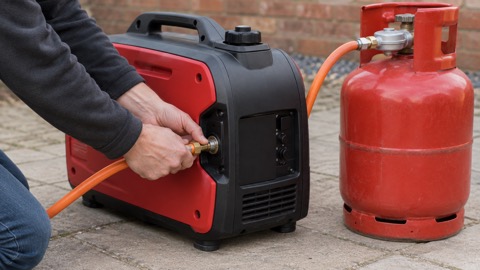 EcoFlow Dual Fuel Generator
 Honda EU70iS Generator
 Honda EU32i Generator
 Honda EG3600 Generator
 Pramac P3500i Generator
 Senci SC6000-II Home Generator
 Senci SC10000-II Generator
 Senci SC6600iED Generator
 Gorilla Power GP3800iE
 Gorilla Power GP6500E-DF
 Gorilla Power GP3500i
 Hyundai HY2250Si Generator