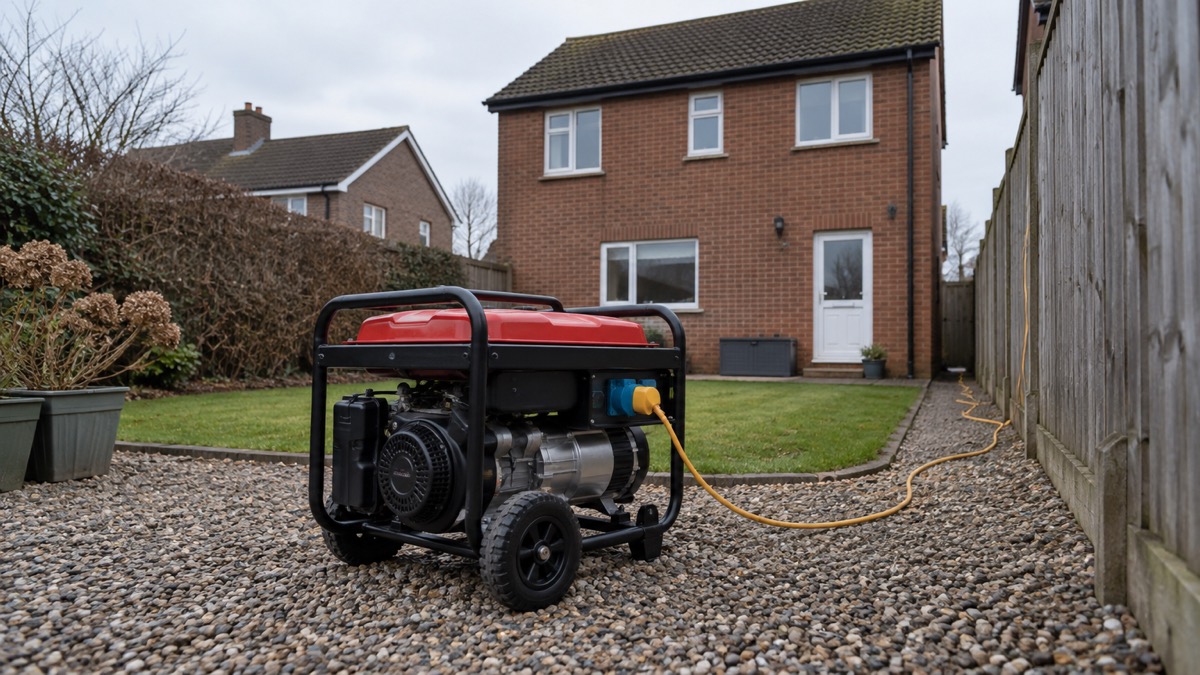
The ProMax 9000EA is a large open-frame petrol generator from Briggs & Stratton, rated at 7000 watts running and 9000 watts starting, with electric key start and 230V 16A and 32A sockets1. It weighs 126 kg3. For a household preparing for power cuts, storms or flooding, it is a serious piece of kit: enough output to carry heavy loads, but heavy enough that moving and siting it is a job in itself, and it needs petrol, servicing and a safe outdoor position every time it runs.
The first thing to settle is where it will stand. The UK Health Security Agency's public health advice for a national power outage is to place a generator outdoors at least 6 metres or 20 feet away, with the exhaust facing away from windows or doors3. That distance is not a suggestion. Portable generators have caused fatal carbon monoxide poisoning, including a case recorded by the Gas Safe Charity in which a portable generator was used while working4.
This page sets out what the machine can do, how long a tank lasts, how to move and site it, how to keep it ready between emergencies, and what the warranty covers. It does not give a price, and it does not rank the machine against others. If you are still deciding what kind of backup power suits your household, start with Backup Power at Home: A Household Guide and the comparison of a portable power station or petrol generator for a power cut.
What the ProMax 9000EA is, and what it suits
This is an open-frame petrol generator: a steel-tube frame carrying an engine, alternator and fuel tank, with the working parts exposed for cooling and access1. The maker lists it among its portable petrol generators, and the open-frame format is the heavy-duty end of that range rather than the quiet, suitcase-sized end6. The engine is a VANGUARD OHV V-Twin of 479 cc with a cast iron cylinder sleeve, and the maker states that the engines are made in Japan1.
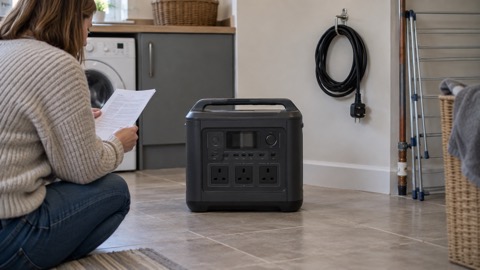
For a household, that shape of machine suits one job above all: carrying a large load for a long stretch when the mains has failed and you need power for more than phones and a lamp. It is not a machine you keep in a kitchen cupboard. The maker's own product page for a different kind of backup, a portable power station, describes fuel generators as noisy, bulky and inconvenient for long-term use, and that is a fair description of what a household is taking on7.
It also suits a household that has somewhere to run it. Because it must stand outdoors, well away from windows and doors, and on firm, level ground away from combustible materials, standing water and places where exhaust gases could collect, the practical question is not only what it can power but where it can safely stand3. A garage, a shed or a conservatory is not that place.
If your need is a fridge, a boiler and some lights for a few hours, a battery-based option may fit better; the portable power stations section explains what those do. If you need to run power tools, a pump, or a large share of a house's circuits through a long outage, an open-frame petrol machine is the category built for it. The inverter or open-frame generator comparison sets the two formats side by side.
Power output: 7000W rated, 9000W starting
The two output figures do different jobs, and mixing them up is the most common way households overload a generator. Running watts are what the machine can supply continuously: 7000 watts here1. Starting watts are the brief surge available when something with a motor kicks in: 9000 watts here1. The maker defines starting watts as the maximum current that can momentarily be supplied when starting a motor, multiplied by the generator's rated voltage1.
That matters because motors draw far more in their first second than they do while running. A fridge compressor, a freezer, a pump or a power tool will each demand a surge as it starts. The 9000 watt figure is the ceiling for that moment, not a second continuous rating. If several motor-driven appliances start at once, their surges add up, and the machine will trip or stall even though the steady load looks modest.
The machine supplies 230V at 50Hz through 230V 16A and 32A sockets, and starts on a key rather than a pull cord1. The 32A socket is the one that lets you draw the full output through a single connection; the 16A socket caps what can pass through it. Plan your leads around that, and read Extension Leads and Overloading With Backup Kit before daisy-chaining anything.
| Specification | Figure |
|---|---|
| Running watts | 7000 W1 |
| Starting watts | 9000 W1 |
| Voltage and frequency | 230V, 50Hz1 |
| Outlets | 230V 16A and 32A sockets2 |
| Starting method | Electric key start1 |
| Voltage regulation | plus or minus 2 per cent, Power Surge alternator with AVR1 |
Working out what your own household needs is a separate exercise: the generator sizing guide and Watts, Watt-Hours and Surge Explained take you through it. The short version is to add up the running watts of everything you want on at once, then check the largest motor's starting surge against the 9000 watt figure.
Run time: about six hours on a full tank
Read that carefully. It is measured at half load, so running the machine hard will use fuel faster, and running it lightly will stretch the tank a little. It is also a maker's figure for a new machine in good order, not a guarantee for a generator that has sat in a shed for two years.
For planning, treat 6 hours and 20 minutes as the working day of the machine. A long winter outage will need refuelling, and refuelling means stopping the engine and letting it cool first, following the maker's manual. It also means having petrol stored safely, which is a subject in its own right: see How Much Petrol Can I Store at Home Safely? and How Long Will a Generator Run on a Tank of Fuel?.
The tank size is worth comparing with smaller machines to see what you are buying. A fuel generator with a 5 litre tank runs about 6 hours at a 500W load7. The ProMax carries 17,8 litres, more than three times that fuel, which is what allows it to feed 7000 watts rather than a few hundred.
Moving and siting a 126kg generator
At 126 kg, this is not a machine to carry1. The maker offers an optional wheel kit and telescopic handles, which turn it into something one person can wheel rather than lift1. If you buy the machine for emergency use, think hard about the wheel kit at the same time: the moment you need the generator is the worst moment to discover you cannot get it out of the shed.
Site it before you need it. The official advice is to place a generator outdoors at least 6 metres or 20 feet away, with the exhaust facing away from windows or doors3. The maker's own guidance adds that it should stand on firm, level ground away from combustible materials, standing water and areas where exhaust gases could accumulate8. Between them, that rules out a garage, a porch, a basement, a lean-to against the house, and any spot where the ground slopes or floods.
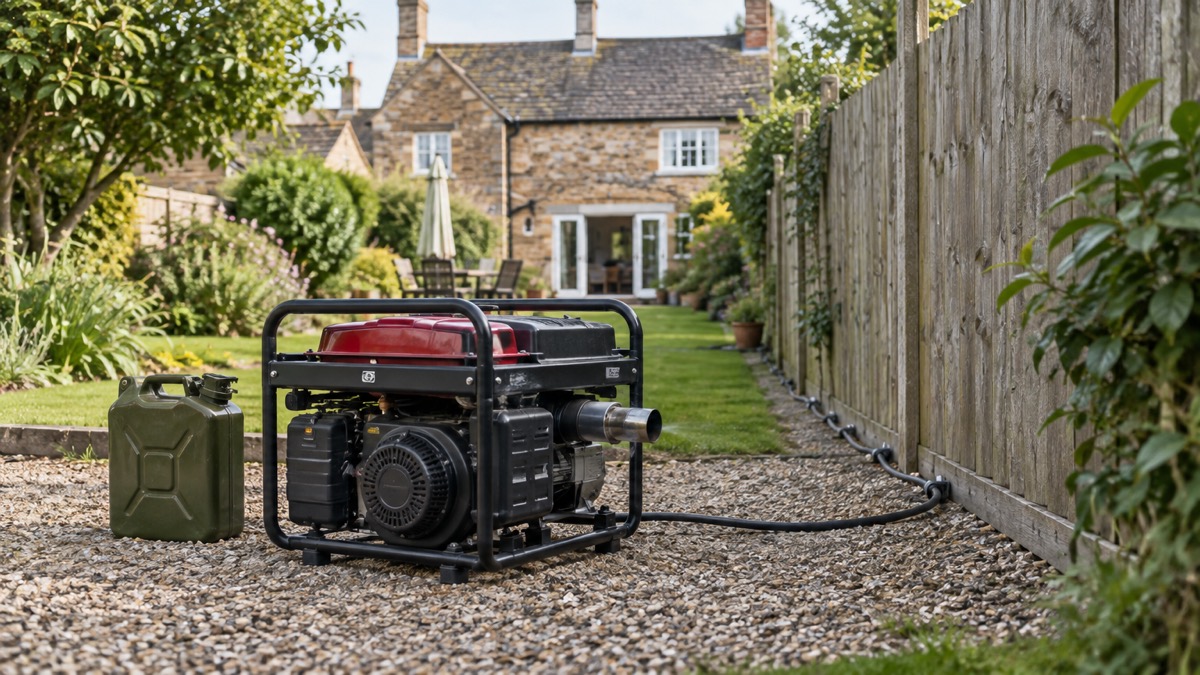
Plan the route from storage to the running position now: door widths, steps, gravel, a slope, a gate. Check the machine's dimensions against that route. A wheeled machine still has to fit through the gap and turn the corner.
Weather matters too. Running a generator in rain or snow brings its own risks, covered in Can You Run a Generator in the Rain?, and cold starts are covered in Will a Generator Start in Cold Weather?. The wider safety picture, including fuel handling and electric shock, is in Generator Safety: Carbon Monoxide, Fuel and Electric Shock and Carbon Monoxide from Generators: Warning Signs.
Sensitive electronics and voltage stability
The maker states that the machine's voltage regulation limits variation to plus or minus 2 per cent, and that it uses a Power Surge alternator with automatic voltage regulation1. That is the maker's claim for its own product, and it is the figure that matters if you want to run a laptop, a television, a router or a boiler control board rather than just lights and power tools.
A generator's output is not the same as mains electricity. Voltage moves as load changes, and the cleanest supply comes from an inverter generator, which is a different design. This machine is an open-frame unit with AVR, which limits the variation of the voltage of your generator to + or - 2%3. Whether a particular device is happy on it is a question for that device's manufacturer, not something a generator page can settle.
For a household, the practical rules are simple. Bring loads on and off one at a time rather than all at once. Keep sensitive equipment off the generator while it is starting and while it is shutting down, when the supply is least stable. Use one good extension lead rather than a chain of them, and check its rating against the load. If a device has its own power supply or charger, that unit does some of the smoothing for you.
If your concern is a medical device, a computer you work from, or a heating control board, read Powering CPAP, Oxygen and Other Medical Devices From a Battery and Connecting a Generator or Battery to Your Home's Wiring before relying on any generator. Connecting a generator to the fixed wiring of a house is not a plug-in job, and doing it wrongly can endanger the person using it and the people working on the network.
Noise, the muffler and neighbours
The maker lists a Quiet GenSet muffler on this model but does not publish a decibel figure for it1. Without that figure, any number quoted for this machine is unconfirmed. What can be said is where it sits in the wider picture: the same maker's guidance puts a petrol lawnmower at 90 dBA9, and a product page from another maker describes gas generators as reaching 70 to 75 dB10.
An open-frame machine of this size is not a quiet object. Plan on the basis that it will be heard by neighbours, and site it with that in mind as well as with the 6 metre rule5. Run it in daylight hours where you can, keep the run short and purposeful, and tell neighbours in advance if you expect a long outage and a long run. The How Loud Is a Generator? page goes further into noise and neighbours.
The muffler is part of the machine's exhaust system, and it does nothing about the other hazard. Carbon monoxide is still produced whatever the exhaust sounds like, which is why the outdoor siting rule stands regardless of how quiet the machine seems3.
Keeping it ready between emergencies
A generator that will not start is worse than no generator, because the household has planned around it. The maker fits an automatic low-oil shutdown: the engine stops if the oil level is low, preventing damage to the engine1. That protects the machine, but it also means a generator left with low oil will simply refuse to run when you need it. Check the oil before the winter, not during the first night of a storm.
A simple routine, drawn from the maker's specification and general good practice for petrol machines:
- Check the oil and top it up to the maker's level before the machine is needed; the low-oil shutdown will otherwise stop it3.
- Keep the tank and fuel fresh, following the maker's manual, and store petrol only as the petrol storage guidance allows.
- Start it briefly at the start of each season so you know the key start works and the fuel is getting through.
- Keep the wheel kit fitted so the machine can be moved by one person.
- Store it dry and covered, away from damp, and check the air filter and plugs as the manual directs.
The Backup Power Checks Before Winter checklist and How to Store a Generator After a Power Cut page turn this into a routine. The Power Cut Backup Power Checklist covers the wider kit a household needs alongside the generator: torches, a radio, charging, and a plan for the fridge.
Warranty, support and certification
The maker lists a 2 year limited commercial warranty on the generator and a 3 year limited commercial warranty on the engine1. Note the word commercial: these are limited commercial warranties, not a consumer guarantee, and the terms are set by the maker. Read them before you buy, and keep the receipt and the manual.
The maker's general guidance for its portable generators describes a three year commercial limited warranty as standard across the range11, which does not match the 2 year generator figure on this model's own page. Where the two differ, the product page figure is the one specific to this machine, and a buyer should confirm the position with the supplier. Warranty periods vary widely across the market, so check the terms for the machine you are considering.
The machine is listed as CE compliant, assessed against EN ISO 8528-13:20161. CE marking is the manufacturer's declaration that the product meets the applicable requirements. It tells you the maker has made that declaration; it does not replace the manual. The UKCA, CE and Battery Safety Markings Explained page explains what the markings mean for a buyer in the UK.
Support runs through Briggs & Stratton and its dealers. Keep the manual with the machine, register the product if the maker asks you to, and note the engine and generator warranties separately, because a claim may go to different places depending on what has failed.
Where it fits in a household plan
The ProMax 9000EA is a heavy-duty answer to a long outage. It also weighs 126 kg3, needs petrol, needs servicing, and must stand outdoors at least 6 metres from the house with the exhaust facing away from windows and doors5.
That combination suits a household with somewhere safe to run it, a way to move it, and a clear idea of what it will power. It does not suit a flat, a house with no outdoor space, or anyone who cannot manage the weight and the fuel. For those households, the portable power stations section and the power bank guidance cover the alternatives.
Whatever you choose, decide now what you will keep running, in what order, and for how long. The Deciding What to Keep Running When the Mains Fails page and Using Generators and Power Stations During an Outage take that planning further, and Power Cuts: A Household Guide covers the wider household response.
Sources (11)
- ProMax 9000EA product page, Briggs & Stratton, 2026
- Open frame generator, Briggs & Stratton, 2026
- Keeping warm or cool in extreme weather: scripts for broadcast media, GOV.UK, 2025
- Fatal case studies, Gas Safe Charity
- Matthew Nixon case study, Gas Safe Charity, 2020
- Portable petrol generators, Briggs & Stratton, 2026
- BLUETTI Elite 400 portable power station, BLUETTI, 2026
- Generators, Clarke International, 2026
- Noise level information, Champion Power Equipment, 2026
- Solar vs gas generator, Jackery UK, 2026
- Portable generators buying guide, Briggs & Stratton, 2026

 BLUETTI Apex 300 Power Station
 BLUETTI Elite 100 V2
 Anker SOLIX C2000 Gen 2
 Anker SOLIX C1000 Power Station
 EcoFlow DELTA Pro
 BLUETTI Elite 400
 Anker SOLIX C300 Power Station
 EcoFlow DELTA 3
 EcoFlow DELTA 2 and DELTA 2 Max
 EcoFlow DELTA and DELTA Max
 EcoFlow RIVER 3 and RIVER 3 Plus
 EcoFlow RIVER 2 and RIVER 2 Max