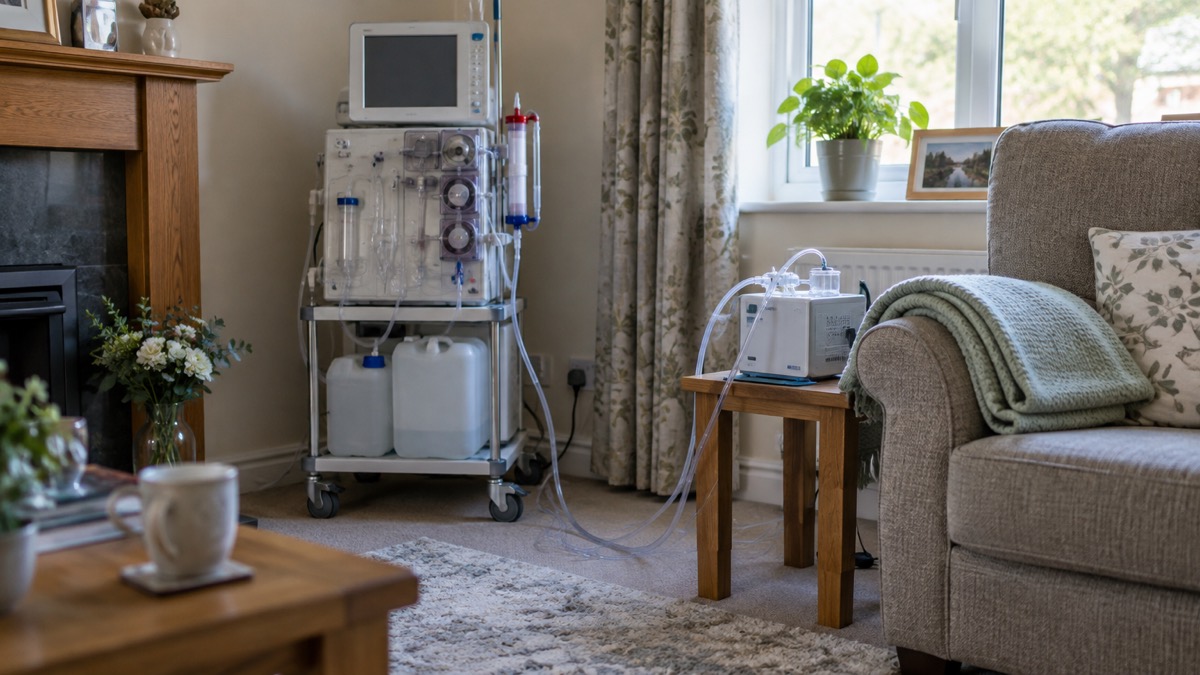
If someone in your home depends on home dialysis, or on any medical equipment that needs water or electricity, the most important step is taken before anything goes wrong: tell your water company, your energy supplier and your network operator, and join their Priority Services Register. Registration is free and only takes a few minutes1. Once you are on the register, your suppliers know you need extra support if your gas, electricity or water supply is cut off2.
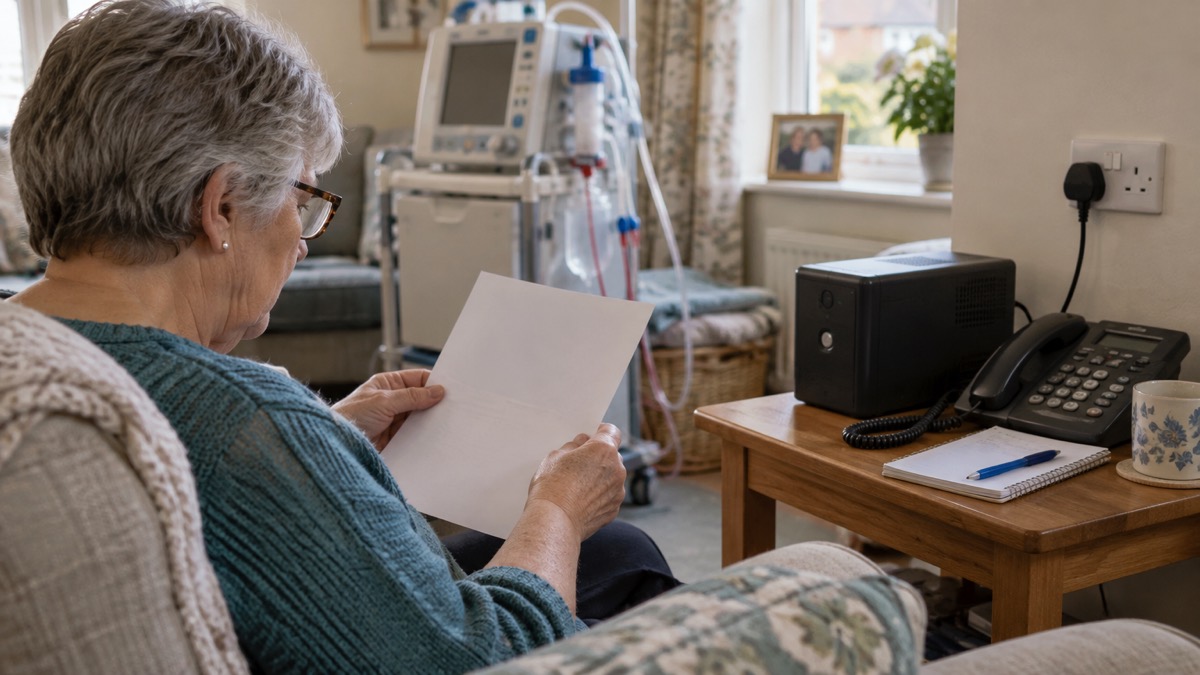
The second step is to plan with your care team. Official guidance is direct on this point: if you or a member of your household relies on a medical device that needs water to function, talk to your care team and make a plan for what to do if there is a water outage3. For home dialysis, that means your renal unit, and the plan should cover what to do about a missed session, where to go, and who to call.
This page sets out how to register, what help the water company and energy companies provide, what happens during an interruption, and what to do when the promised help does not arrive.
Tell your water company and energy network you are on home dialysis
Home dialysis uses a large volume of treated water for every session, so an interruption to your supply is not an inconvenience, it is a medical event. Local resilience guidance is blunt about the stakes: people dependent on water for health reasons such as skin ailments and dialysis can face hospitalisation or increased risk to their health without a regular supply9. That is why water companies treat dialysis patients as a priority group, and why they need to know who you are in advance.
Contact your water company and tell them that someone in the household is on home dialysis. Surrey County Council's guidance on the register notes that water companies can tell you if they are going to turn off your water4, which matters for planned work as much as for emergencies. Your water company is the main source of information during an interruption, so keep their number and website address to hand10. During an outage, check their website for service in your area and to see whether you can pick up alternative sources of water11.
Do the same with your energy supplier and your network operator, the company that runs the cables and pipes in your street. Energy suppliers and network operators both keep a Priority Services Register12, and your supplier can pass your details to your network operator to add you to their register as well, which is a good idea if you rely on your energy supply for medical reasons13. In an emergency, your gas, electricity or water supplier should keep you informed about service disruptions14.
If you are not sure who your network operator is, your energy supplier can tell you and can pass your details on. In London, for example, UK Power Networks covers most of the city and Scottish & Southern Electricity Networks covers part of west London2.
Joining the Priority Services Register: free, quick and no proof needed

The Priority Services Register is a free service that can give extra help if your electricity, gas or water stops working15. Registration is free and only takes a few minutes1. You do not need to make a case or gather paperwork: you contact the company, say what your circumstances are, and they record it.
Who counts as eligible is broad, and it deliberately includes households like yours. The register is open to people who have a disability, a long-term health condition, reliance on medical equipment, pregnancy, young children, or who are of pensionable age1. In Scotland, the criteria are set out as: use medical equipment that needs power or water; are disabled or have a long-term health condition; live with children under 5; or are over 6016. The UK government's guidance on water supply interruptions adds that people who use more water due to a medical condition are among the groups most at risk from an interruption, alongside babies and young children, older adults and people with long-term health conditions11.
What you get falls into three broad kinds of help:
- Advance warning and information: the company tells you if they are going to turn off your water4, and keeps you informed during disruptions14
- Practical support during an outage: additional help during power or water outages1
- Accessible communications: information in formats that work for you, and other practical support1
If you need information in an accessible format, or in another language, say so when you register. Accessible communications are part of what the register provides1, and companies can send SMS text message updates during an incident if they have your mobile number6. Each provider offers different schemes and eligibility criteria, so it is best to check their website for the details of what they offer12.
Register with each company separately, and again if you move or switch
There is no single national register. Each company keeps their own register4, covering the customers in its own area. That means a household on home dialysis typically needs to sign up several times:
- Your water company
- Your electricity supplier
- Your gas supplier, if different: if you have a different supplier for your gas and electricity, you'll need to contact them separately18
- Your network operator, either directly or by asking your supplier to pass your details on13
Water and telecoms suppliers may also keep a register12, so if your household relies on a landline or internet connection for medical monitoring or alarms, ask your telecoms provider too.
Two things catch households out. The first is switching supplier: if you switch supplier, you'll need to ask to join their Priority Services Register18. The second is moving home: you'll need to register again if you change suppliers or move home5. Your registration is tied to the company and the address, not to you as a person, so treat any move or switch as a prompt to re-register with everyone.
Renfrewshire Council's guidance puts the underlying duty plainly: if you or a member of your family has a specific health or medical problem that requires a permanent utility supply of water, gas or electricity, contact your supplier to register these details19. A local community risk register gives the same advice in shorter form: if required, register as a priority customer with your relevant providers20. "Relevant providers" is plural on purpose.
What happens when the water goes off
Most interruptions are short. The government's preparedness guidance says these events are usually over quickly with minimal impact, however longer water supply outages occasionally happen11. For a dialysis household, "usually" is not a plan, so it is worth knowing what the water company commits to and when.
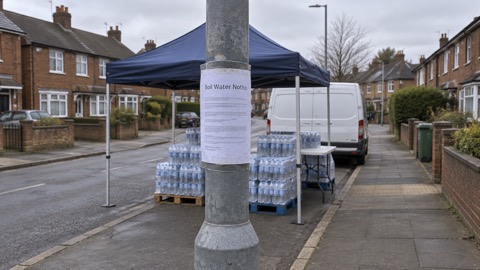
The commitments come in stages. Thames Water's incident guidance states that if your supply isn't returned within 12 hours, they'll arrange for an alternative, which includes bottled water stations set up locally to the incident in an accessible area6. Southern Water's household code of practice goes further: if the interruption lasts for more than 24 hours, we're required to provide an alternative water supply7. So the pattern to expect is: information first, bottled water stations or deliveries as the hours mount, and a formal alternative supply obligation at the 24 hour mark.
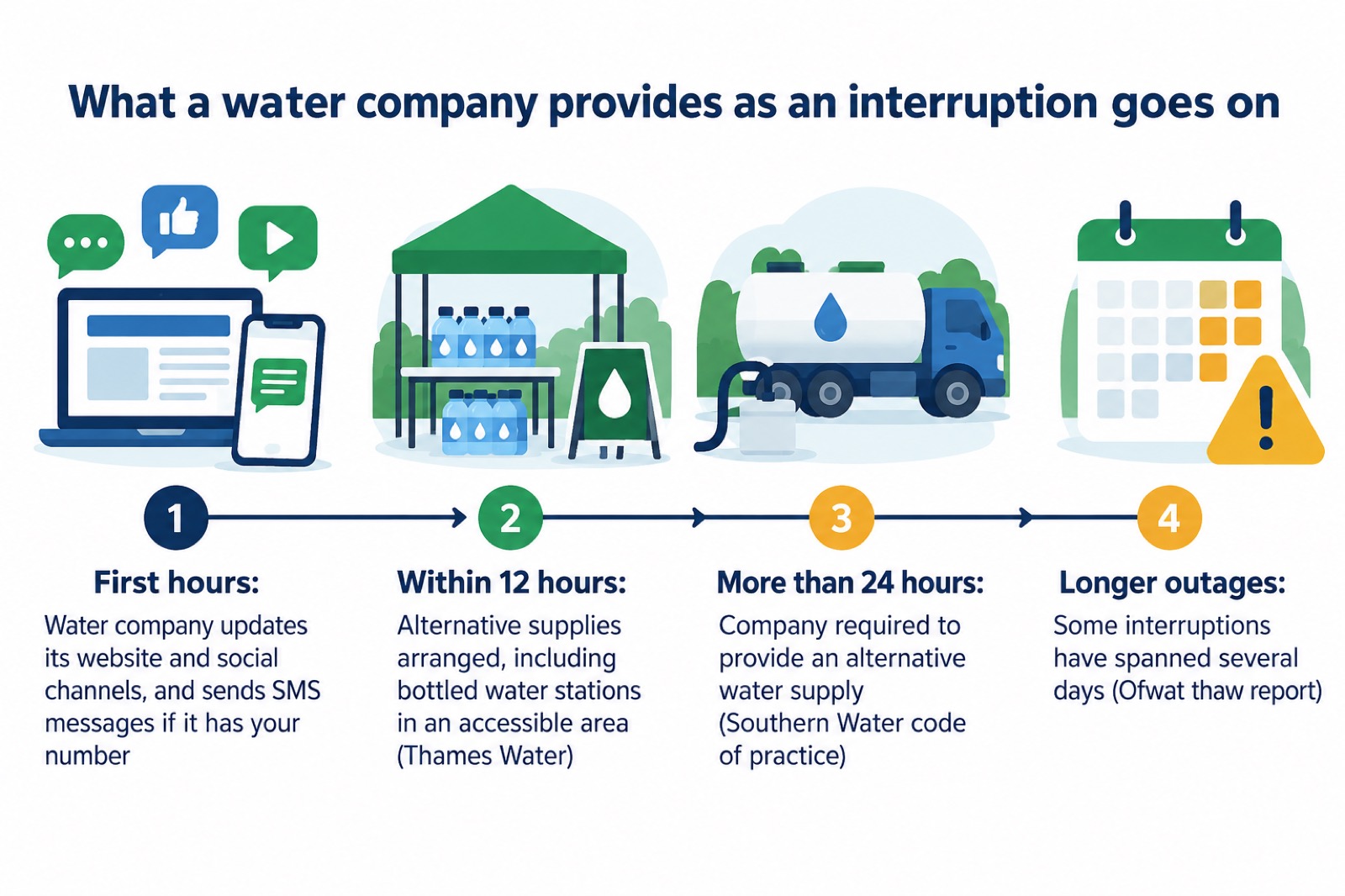
The reason to plan beyond the first day is that longer outages do happen. Ofwat's report on the 2018 thaw found that some interruptions spanned several days21. The London Risk Register assesses the impact of a failure of water supply infrastructure as up to 350,000 people affected for between 24 hours and two weeks20. When very large numbers of households are affected at once, bottled water stations and deliveries are stretched, and a household that is registered and known to the company is far more likely to be reached early.
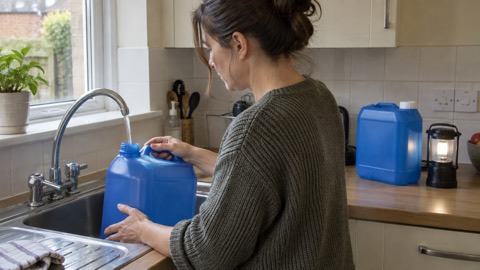
During the outage itself, the practical steps are straightforward. Check your water provider's website regarding service in your area, and to see if you can pick up alternative sources of water11. Check your local news and your water company's website regularly for advice and information on water availability in your area and water management actions in force22. If disruptions or changes to water supplies occur, contact your water company to let them know22, which matters especially if your household's need has not been met. Contact your water provider if you continue to have problems with your water supply after an outage11.
For the wider picture of what a water company does in a major incident, see how water companies respond to a major incident, and for the supplies themselves, bottled supplies, tankers and bowsers from your water company. If you need to work out how much water to keep in the house for drinking and dialysis-related use between the outage starting and help arriving, our guide on how much drinking water to store per person covers the amounts.
Powered medical equipment in a power cut
Home dialysis and much other medical equipment needs electricity as well as water, and a power cut can stop both at once. Scottish Government guidance lists the equipment that may stop working during a power cut, including ventilators, oxygen concentrators, electric wheelchairs, hoists, communication devices and feeding pumps23. Local risk assessments make the same point from the other direction: power outages cause disruption to hospitals, care homes, and life-supporting medical equipment24.
The first action in any power cut is to dial 105. This is the free power cut line, and it is the number given in official guidance across Great Britain: dial 1058, Power Cuts 10525, Power cut: 10526. It connects you to your local network operator, who will know the scale of the outage and the estimated restoration time.
Before any cut happens, the same three-part preparation applies to power as to water:
- Sign up to your energy supplier's Priority Services Register to let them know that you need additional support during a power cut3
- Ask your supplier to pass your details to your network operator as well, especially if you rely on your energy for medical reasons13
- Talk to your care team about what your equipment does during a cut, and what your fallback is3
If you are eligible, sign up to your energy supplier's Priority Services Register3. The scheme is offered by your energy supplier5, and your energy supplier and your network operator both keep one12. For a fuller treatment of backup options for running medical equipment, see backup power at home and extra help in an emergency.
Being on the register does not mean faster restoration
It is worth being clear about what the Priority Services Register does and does not do. It does not move you up the repair queue. Repairs are sequenced by the engineering, and a registered household on a broken main waits for that main like everyone else. What registration changes is what happens around the repair: you are told about shutdowns in advance4, you are kept informed14, and you are on the list the company works through when it prioritises deliveries of bottled water and other support17.
The Thames Water case study of a burst water main response makes the value concrete. The company used its Priority Services Register to prioritise support for those who needed it most, and its own assessment is that if a customer is not registered on the PSR they may struggle to get the water they need or experience delays which could impact their physical and mental wellbeing17. The delay that registration removes is the delay of not being known: the company does not have to find out who you are and what you need in the middle of an incident.
For a dialysis household, this has a practical consequence. Do not treat registration as your only plan. Treat it as the layer that gets you information and supplies, and put a second layer underneath it: an agreed plan with your renal unit3, some stored water in the house, and a way to reach the unit if phones or internet are down. Our supply interruption checklist and emergency kit guides set out what to have ready.
When the promised help does not arrive
Sometimes the help is late, or does not come at all. A very large incident can affect hundreds of thousands of households at once, as the London Risk Register's assessment of up to 350,000 people affected for between 24 hours and two weeks shows20, and distribution takes time. Storm Arwen in 2021 left 280,867 customers off supply in one network area and 243,930 in another27, a reminder of the scale a single event can reach.
If the promised supplies have not arrived, escalate in this order:
- Contact your water company and state that you are on the register and on home dialysis, and that the supplies you were told to expect have not arrived11
- Check the company's website and social channels for the latest information on bottled water stations and deliveries in your area6
- Contact your renal unit and follow the plan you agreed with them3
- Seek medical help if a dialysis session has been missed or is about to be missed, since people dependent on water for health reasons such as dialysis can face hospitalisation without a regular supply9
Keep a record of who you called, when, and what you were told. If problems continue after the supply returns, contact your water provider11. Ofwat provides information on what communication you should expect to receive from your water company in the case of an interruption to water supply10, which is the standard against which a poor response can be judged.
For more on the supplies themselves, see how to get bottled water delivered if you are vulnerable and where bottled water stations are set up. If someone calls at your door claiming to be from the water company, our guide on how to check a water company caller is genuine explains what to ask.
Keeping your details up to date
A register entry is only as good as the details behind it. Water companies have said they will update their website and social channels with regular updates, and will send SMS text messages if they've got your number and the supply is affected6, so make sure the company has a current mobile number for the household. If your phone number, circumstances or the equipment you rely on change, tell each company you are registered with.
Review your registrations once a year, and after any of these events:
- You move home, which means registering again5
- You switch energy supplier, which means asking to join the new supplier's register18
- Your medical circumstances change, for example you start or stop home dialysis
- You change your phone number or email address
Support through the register can be in place all the time, or for a short period due to something that's happened in your life18, so a change in circumstances can mean asking for help to be added as well as removed. If you are leaving your home for an extended period, Dŵr Cymru Welsh Water advises turning off the stop tap and draining down the system so there is no water in the system to freeze28, which protects the house while you are away, though a household on dialysis should discuss any extended absence from treatment with their renal unit first.
Northern Ireland households
Arrangements in Northern Ireland differ from those in Great Britain, and the contacts are different too. If you have any concerns over burst pipes or your water supply, Northern Ireland Water publishes contact information for exactly this purpose14.
The numbers to know are:
- Northern Ireland Water Leakline: for reporting a leak in the mains water supply, 24 hours a day, seven days a week29
- Northern Ireland Water Waterline: for all other emergencies including blocked manholes or sewers. You should first check whether the issue only affects your property, and contact a private contractor or landlord if so29
As in Great Britain, in an emergency your gas, electricity or water supplier should keep you informed about service disruptions14. Contact your suppliers directly to ask what priority support they offer and to register any medical dependence on the supply, since each company runs its own scheme12.
Plan with your renal unit before anything happens
Everything on this page works better if the medical plan exists first. The government's guidance for households losing essential services is explicit: if you or a member of your household relies on a medical device that needs water to function, talk to your care team and make a plan for what to do if there is a water outage3. For home dialysis, that conversation with your renal unit should cover:
- What to do if a session must be delayed or moved, and how long is safe
- Who to call at the unit out of hours, and how to reach them if phones are down
- Whether any stored water in the house is usable for your treatment, and how it should be kept
- What the unit's own contingency is if a wide area loses supply, as in the events assessed in the London Risk Register, where up to 350,000 people could be affected for between 24 hours and two weeks20
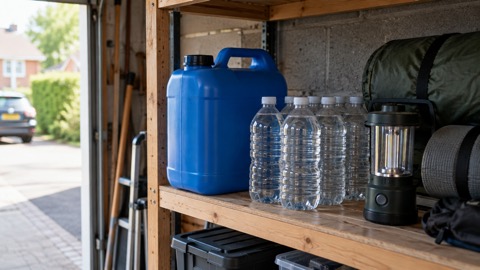
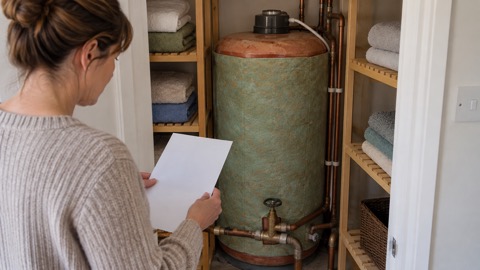
For a dialysis household, a water supply failure is the start of a bigger problem, which is why the register, the stored water and the renal unit plan need to sit together. For storing water safely at home, see storing tap water safely at home and how to store bottled water; for what is already usable in your pipes, cistern and cylinder during an outage, see usable supplies already in your home.
Sources (29)
- Storm preparation, Cornwall Council, Cornwall Council, 2026-10-29
- Keeping warm, healthy and safe in cold weather, Greater London Authority, Greater London Authority, 2026-10-25
- Loss of essential services, Greater Manchester Combined Authority, Greater Manchester Combined Authority, 2026-10-29
- Priority Services Register, Surrey County Council, Surrey County Council, 2026-10-28
- Priority Services Register, Derbyshire County Council, Derbyshire County Council, 2026-10-29
- What happens during an incident, Thames Water, Thames Water, 2026-10-28
- Southern Water household code of practice, Ofwat, Ofwat, 2022-11
- Emergency information, Basingstoke and Deane Borough Council, Basingstoke and Deane Borough Council, 2026-10-29
- Failure of water infrastructure or loss of drinking water, Wiltshire and Swindon Prepared, Wiltshire and Swindon Prepared, 2026-10-25
- Water supply interruptions or outages, Be Ready campaign, UK government, 2026-10-12
- Water supply interruptions or outages, Prepare campaign, UK government, 2026-10-12
- Help from energy supplier, Buckinghamshire Council, Buckinghamshire Council, 2026-10-29
- Priority Services Register, Derbyshire County Council, Derbyshire County Council, 2026-10-29
- Energy, power supply and utilities, nidirect, nidirect, 2025-10-23
- Guidance for staying safe at home, Oxford Health NHS Foundation Trust, Oxford Health NHS Foundation Trust, 2026-09-15
- Make an emergency plan for your home - Ready Scotland, Ready Scotland
- Spotlight on Thames Water: prioritising support for those who need it most, Wiltshire and Swindon Prepared, Wiltshire and Swindon Prepared, 2026-10-25
- Join your supplier's Priority Services Register, Ofgem, Ofgem, 2026
- Prepare your home for emergencies, Renfrewshire Council, Renfrewshire Council, 2025-10-09
- London Risk Register, Greater London Authority, Greater London Authority, 2025-01
- Thaw report, Ofwat, Ofwat, 2018-06-19
- Droughts, Prepare campaign, UK government, 2026-10-19
- Disabled people and carers, Ready Scotland, Scottish Government, 2026-10-25
- Utility failure, Essex Prepared, Essex Prepared, 2026-10-29
- Emergency home emergency plan, Royal Borough of Windsor and Maidenhead, Royal Borough of Windsor and Maidenhead, 2025-10
- Emergency plan, Ready Scotland, Ready Scotland, 2026-10-29
- Interim report on the review into the networks' response to Storm Arwen, Ofgem, Ofgem, 2022-02-17
- Prepare your home for winter, Dŵr Cymru Welsh Water, Dŵr Cymru Welsh Water, 2026-10-28
- Emergency contact numbers, Belfast City Council, Belfast City Council, 2026-10-29
 Supply Interruption Checklist
 Boil Notice Checklist
 Drinking Supply Checklist
 How Much Water to Store
 Storing Tap Water Safely
 Containers and Jerrycans
 Household Storage Tanks
 Water Already in Your Pipes
 Making Water Safe to Drink
 Boiling Water to Kill Germs
 Purification Tablets
 Emergency Filter Types
 What Water Filters Remove
 Gravity Filters Explained
 Hand Pump Filters