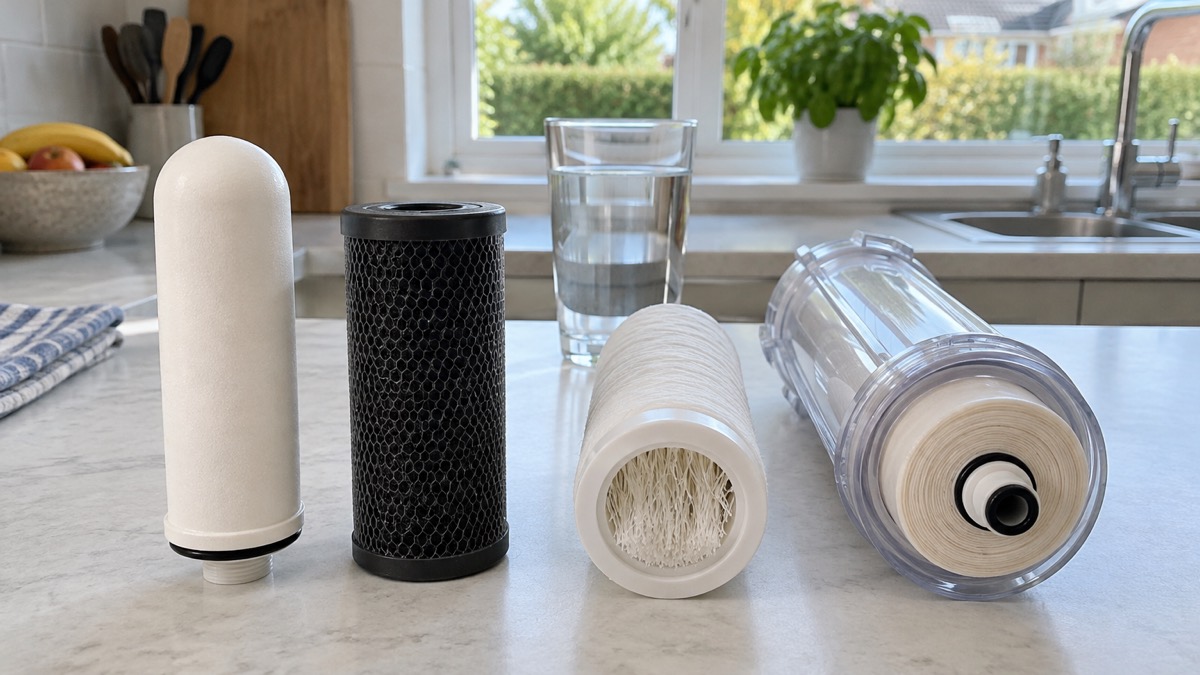
If you are choosing a filter, or wondering whether the one you own will actually make water safe, the answer depends entirely on what is inside it. No filter removes everything. Ceramic traps particles in tiny pores, carbon absorbs chemicals that affect taste, hollow-fibre ultrafiltration strains out anything above about 15 nanometres including viruses, and reverse osmosis forces water through a membrane that takes out metals and salts but wastes about 4 litres for every litre of pure water produced1.
The distinction that matters most in an emergency is between a filter and a purifier. A filter takes out particles and microbes down to a certain size. A purifier also deals with viruses, which are far smaller than bacteria and protozoa. Combined filter and purifier cartridges remove 99.99% of viruses (Rotavirus, Norovirus, Hepatitis A), 99.9999% of bacteria (E. coli, Salmonella, Dysentery) and 99.9% of protozoa (Giardia, Cryptosporidium, Amoebae)4. A basic ceramic or carbon filter does not do this on its own, so knowing which you have matters when the question is whether water is safe to drink rather than just pleasant.
This page explains each type of filter medium by what it takes out, what it leaves behind, and how to look after it. For choosing a complete filter system, see emergency filters, and for making water safe by boiling or tablets, see how to make water safe to drink.
What each filter type removes at a glance
The table below sets the four main media side by side. The figures come from makers' own specifications and from official guidance on filter candles, so treat them as what each medium is designed to do, not a guarantee for every product on the market.
| Filter medium | What it removes | What it does not do | Best suited to |
|---|---|---|---|
| Ceramic | Dirt, sediment and bacteria trapped in the pores | Metals in solution; viruses on its own1 | Household gravity and countertop systems |
| Carbon core | Impurities; improves the taste and odour of the water1 | Not a barrier against microbes on its own | Taste and chlorine complaints |
| Hollow-fibre ultrafiltration | Everything above about 15 nanometres: sand, dirt, microplastics, viruses, bacteria, cysts and protozoa2 | Chemicals and metals dissolved in the water, unless a carbon stage is added | Emergency use where viruses are a risk |
| Reverse osmosis | Metals, salts, bacteria, viruses, hormones, nitrates, microparticles3 | Wastes about 4 litres per litre produced; strips minerals, giving an "empty" taste3 | High contaminant levels |
Two points from official guidance apply across all of these. The Drinking Water Quality Regulator for Scotland notes that filters remove metals in particulate form, but not metals in solution1: a filter can catch a fleck of metal but not metal dissolved in the water. And any filter that removes chlorine must be maintained in accordance with the manufacturer's instructions to remain safe to use, because a poorly maintained device can itself cause problems with water quality8.
Ultrafiltration: the medium that removes viruses
Hollow-fibre ultrafiltration works by pushing water through bundles of tiny hollow strands whose walls are full of microscopic pores. LifeSaver, whose products use this technology, states that its ultrafiltration cartridge removes physical, insoluble contaminants above approximately 15 nanometres (0.015 microns) in size, and that this covers sand, dirt, microplastics and all waterborne microbiological contaminants such as viruses, bacteria and cysts or protozoa2.
That pore size is the whole story. Bacteria and protozoa are far larger than 15 nanometres, so they are caught mechanically. Viruses are the smallest microbes, and a 15 nanometre pore size is small enough to strain most of them out too, which is what separates ultrafiltration from ordinary filtration. The maker requires that a UF cartridge must be fitted whenever a LifeSaver product is used2, and its C1 replacement cartridge is specified to filter 500,000 litres of water while removing viruses, bacteria, cysts and parasites11.
What ultrafiltration does not do is remove things dissolved in the water. Chemicals and metals in solution pass through the membrane12. LifeSaver also sells a Graphene:Ultra filter, exclusive to its range, which the maker states is designed to remove or reduce to safe levels PFAS and PFOA (forever chemicals), heavy metals, pharmaceuticals and more13. For more on these products see the LifeSaver Bottle, LifeSaver Liberty and LifeSaver C1 pages.
Ceramic filters: trapping particles in the pores
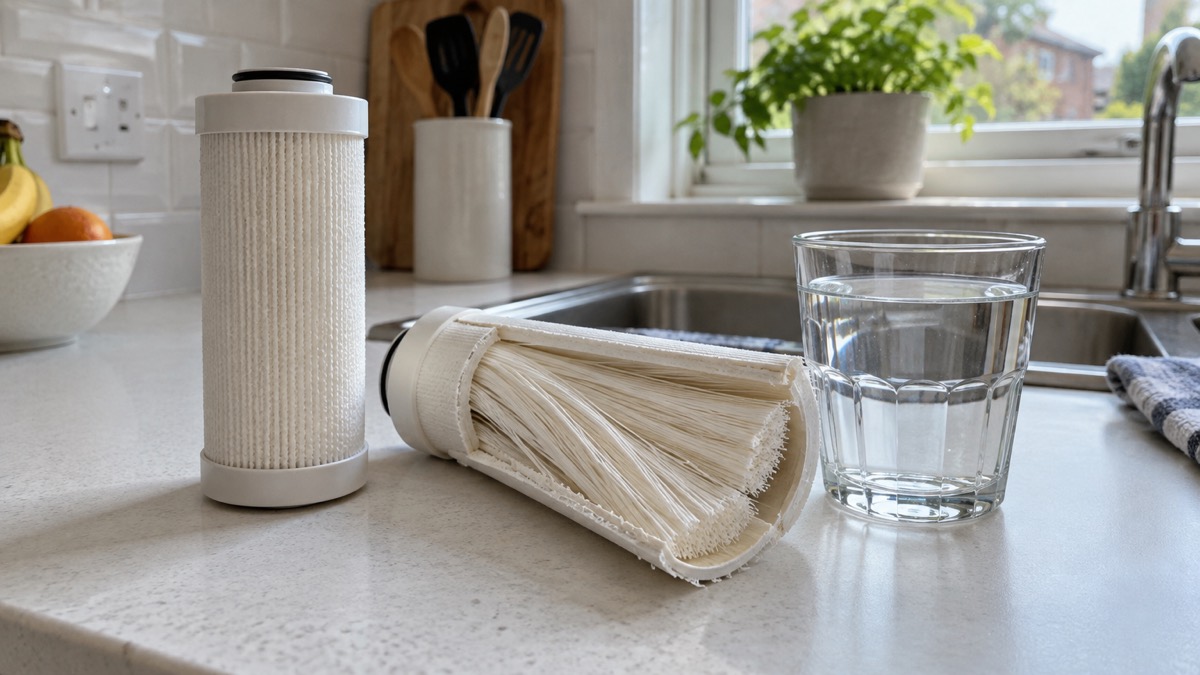
A ceramic filter is a hardened, microporous shell. Doulton, which dates its ceramic filtration heritage to 1826, explains that particles too large to fit through the pores, or to navigate the twisted path through them, get stuck and do not pass into the drinking water5. The Drinking Water Quality Regulator for Scotland describes the same mechanism for filter candles: the pores allow water to pass through but trap impurities such as dirt and bacteria1.
Ceramic depth filters carry makers' figures for microbes. Katadyn's Expedition Filter, a ceramic depth filter, is stated by the maker to reliably remove 99.99% of protozoa (Cryptosporidium and Giardia) and 99.9999% of bacteria, as well as sediments and microplastics14. Katadyn's Vario filter removes bacteria, protozoa, cysts, algae, spores and sediments15. Note that neither figure includes viruses: on its own, ceramic is a filter rather than a purifier.
One advantage of ceramic is that it can be cleaned. The surface clogs before the body does, and scrubbing the outside restores the flow, which is why ceramic systems suit long household use. The DWQR guidance notes that ceramic filter candles are made of porous materials and that the filters remove metals in particulate form but not metals in solution1. Ceramic is also made from natural materials, which Doulton describes as a more sustainable option than plastic-based filter systems, and any waste created by filtering can go straight back into the compost heap instead of landfill5. For full detail on these systems see gravity filters and ceramic candles.
What a carbon core adds: taste and chlorine
Many ceramic filters have a core of activated carbon inside the ceramic shell. The DWQR describes this construction directly: the inner core is made of activated carbon, which filters out impurities and improves the taste and odour of the water1. Doulton states that the activated carbon core in its systems and British Berkefeld systems improves taste and odour by absorbing contaminants such as chlorine, and reduces pesticides, pharmaceuticals and some heavy metals17.
Carbon is the medium to choose when the problem is taste rather than safety. United Utilities advises that a filter containing activated carbon absorbs chlorine and other substances that can influence the taste of the water, and that such filters are not necessary but some customers like to use them, provided the maker's maintenance instructions are followed18. The DWQR makes the same point about maintenance: domestic filters that remove chlorine must be maintained in accordance with manufacturers' instructions to remain safe to use9.
Carbon stages appear in other systems too. In reverse osmosis systems, an activated carbon fibre stage reduces chlorine to protect the RO membrane and enhances water taste19. LifeSaver's activated carbon filter has been tested, the maker states, to show excellent reduction of chlorine, lead, nickel and cadmium, along with improving the taste and smell of the water, and is effective for up to 250 litres20. If your concern is chlorine taste in ordinary tap water, see why does my tap water taste or smell different?.
Ceramic slightly raises mineral content and pH
Ceramic does one thing no other medium here does: it adds a little to the water. The DWQR's technical guidance states that the slight increase in pH of water passed through ceramic filters is due to soluble minerals in the ceramic, calcium and magnesium, which may partly dissolve in the water, and that a slight increase in total dissolved solids comes from the natural mineral wollastonite (CaSiO3), which is slightly soluble1.
For drinking water this is harmless and, if anything, welcome: minerals are what give water its taste, and their absence is why reverse osmosis water tastes "empty". But it is worth knowing if you test your water or run sensitive equipment. The DWQR guidance is written for private water supplies, where households treat their own water and check the results; if that is your situation, see private supplies: wells, boreholes and springs.
The same guidance carries a practical warning about maintenance: ceramic systems with internal media need more frequent filter replacement than reverse osmosis3, so budget for cartridges when choosing between them.
Reverse osmosis: thorough, but wasteful
Reverse osmosis (RO) forces water through a semi-permeable membrane3. Doulton's guidance on choosing a filter describes RO as suited to addressing high contaminant issues, and notes that it reduces a wide range of contaminants including metals and salts3. A GROHE Blue reverse osmosis system with a mineralization filter is stated by the maker to filter bacteria, viruses, hormones and nitrates, with a salt rejection of more than 97%7, and BRITA lists microparticles, including microplastic, among what its RO membrane removes19.
On the weakness side, the same guidance is blunt:
"Slow filtration rate, high wastage of water (typically for every litre of pure water 4 litres are wasted), high upfront cost, 'empty' tasting water as all the minerals are stripped from the water. Requires electrical power."
That wastage figure, about 4 litres wasted per litre of pure water produced3, matters in an emergency, when water itself is the scarce thing. RO also needs electricity and sufficient water flow3, so it is a household system for a contaminant problem, not an emergency tool. For context, the government's drought preparation advice notes that running taps while brushing teeth, shaving or washing hands can waste up to 6 litres of water per minute21, so wastage is worth minding at any time.
Sediment filters: useful first, insufficient alone
A sediment filter is a pre-filter that uses mechanical straining to capture some sediment and particles in the water via a physical barrier3. Doulton's guidance lists its strengths as being an inexpensive pre-filter for other systems, and its limitation as limited contaminant capture on its own3. It catches sand and grit; it does not make water safe on its own.
Its real job is protecting the main filter. The LifeSaver C1 manual states that removing sand, silt, sediment and organic matter will reduce the life of the ultrafiltration cartridge, and recommends using a sediment pre-filter to remove general dirt from the water first12. The same logic applies to ceramic systems: a limescale reduction cartridge can be installed ahead of the ceramic water filter cartridge to reduce limescale build-up in it22. If your source water is gritty, pre-filter it and let the finer medium do the finer work.
Which filter suits which water problem
Choose by what you need removed. The table below matches common problems to the medium that addresses them.
| Your problem | The medium that addresses it | Notes |
|---|---|---|
| Viruses (unknown or suspect source water) | Hollow-fibre ultrafiltration, or a combined filter and purifier cartridge | 99.99% virus removal claimed4; RO systems also filter viruses7 |
| Bacteria and protozoa (Giardia, Cryptosporidium) | Ceramic depth filters, ultrafiltration, combined cartridges | 99.9999% bacteria and 99.99% protozoa for ceramic depth filters14; 99.9% protozoa for combined cartridges4 |
| Chlorine, pesticides, bad taste | Activated carbon | Absorbs chlorine and other taste-influencing substances18 |
| Heavy metals (lead, arsenic, chromium) | Carbon stages in combined cartridges; RO; Graphene:Ultra | Combined cartridges filter heavy metals including lead, arsenic and chromium23; RO reduces metals and salts3 |
| Sand, silt, grit | Sediment pre-filter, then a finer medium | Limited contaminant capture on its own3 |
| Cloudy or milky tap water | None: check first | If water clears from the bottom of a glass, it is aerated water and the air does not affect quality24 |
That last row deserves a note. Affinity Water advises filling a clear glass with water and watching for a few minutes: if the water clears from the bottom of the glass, it is aerated water, and the air does not affect water quality24. No filter is needed for air. See why is my tap water cloudy or milky? for more.
For private supplies, Somerset Council lists treatment options including ultraviolet (UV) filters to remove bacteria such as E. coli, and filters to remove nitrates and other chemicals25, and the Drinking Water Inspectorate advises that cartridge filters need to be cleaned or replaced according to manufacturer's instructions26. UV treatment is covered separately on our UV purifier pens page.
When to replace a cartridge: slowing flow is the sign
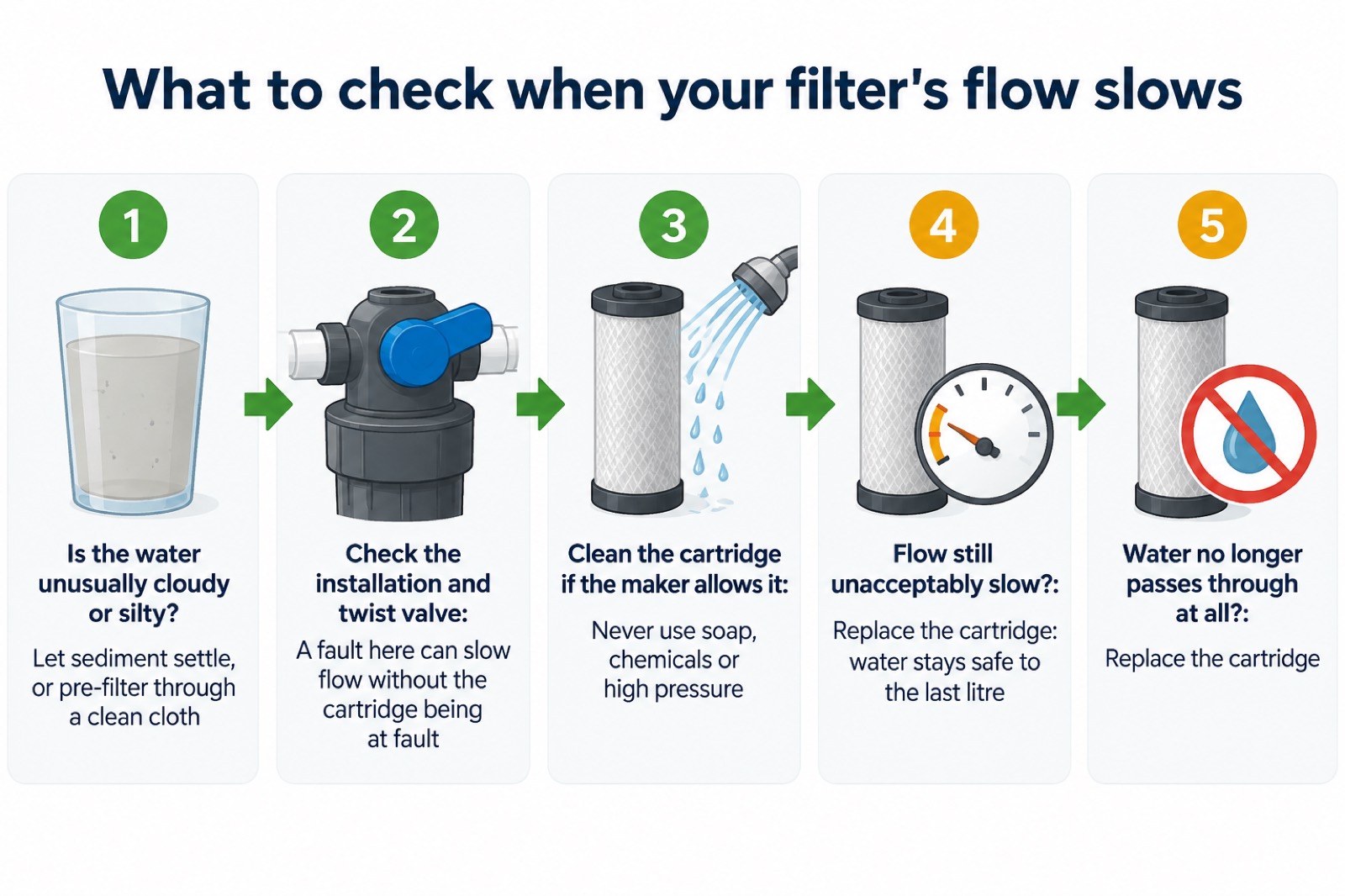
The consistent advice across makers is that flow, not a calendar, tells you when a cartridge is finished. LifeSaver states that with ultrafiltration cartridges, eventually nearly all the pores will be blocked and the flow rate will slow to a rate unacceptable to you, and that the water is equally safe from the first litre to the last10. A slow flow is therefore an inconvenience, not a safety warning: the cartridge is still cleaning the water, just slowly.
For combined filter and purifier cartridges, the rules are more specific. Once primed, the cartridge can be used continuously for up to 3 months or until it becomes blocked, whichever occurs first27. One maker's guidance adds further replace triggers: after three months of use, once it has treated 600 litres, or when the water flow becomes blocked, whichever occurs first, and also if the flow is unacceptably slow, the cartridge may have frozen or been damaged, it has been exposed to water hotter than 50°C, or storage and handling are uncertain6. When water no longer passes through the filter cartridge at all, it is time to replace it23.
Do not try to force a blocked cartridge. The maker advises against backwashing, forcing water through at high pressure, or cleaning with soap or chemicals29. For hollow-fibre cartridges, replace when the flow rate slows to a rate unacceptable to you after thorough cleaning10. Full care instructions, including priming and frost protection, are on looking after a filter.
Storing spare cartridges: 10 years sealed, 2 years opened
Spare cartridges store well, which makes them a sensible part of an emergency kit. Makers of combined filter and purifier cartridges state that the cartridge has a shelf life of 10 years if unopened27, and that an unopened cartridge has a shelf life of up to 10 years when stored correctly in its original sealed packaging6. Once opened, if cared for properly, filter cartridges can last 2 years27.
LifeSaver gives the same figure from the other direction: a foil-wrapped filter will last up to ten years before it should be primed12, and its foil-sealed C1 replacement cartridge is sold on that basis11. The practical reading is simple. Buy spares sealed, leave them sealed, and date them when you open one, because the clock changes from ten years to two the moment the packaging is opened.
Under-sink, tap-mounted and jug options
Where the filter lives in your kitchen is a separate choice from what is inside it. Dŵr Cymru Welsh Water describes two types of filter for the home: an "in-line" filter, usually fitted under the kitchen sink by a plumber, and a jug filter8. Doulton adds that tap-mounted and countertop systems take up less countertop space and are easy to uninstall leaving no issues30, which suits renters and anyone who may move house.
The medium inside can be the same in each format: ceramic and carbon cartridges are available in under-sink, countertop and gravity systems. What changes is flow, capacity and how much work you do to install it. For a fuller comparison see gravity filter or under-sink filter?, and for the systems themselves, emergency filters.
Sources (30)
- Water filter candles: technical guidance, Drinking Water Quality Regulator for Scotland, 2026-10-28
- LifeSaver FAQs, LifeSaver, 2026-10-28
- How do I choose a water filter, Doulton, 2026-10-28
- Water Filter Purifier Cartridge, LifeSystems, 2026-10-28
- Ceramic water filters: what they are and how they work, Doulton, 2026-10-28
- Water Filter Purifier Bottle FAQs, LifeSystems, 2026-10-28
- GROHE Blue Pure Eurosmart Starter Kit with reverse osmosis mineralization filter, GROHE, 2026-10-29
- Water quality in the home, Dŵr Cymru Welsh Water, 2026-10-28
- Drinking water quality FAQs: chlorine, Drinking Water Quality Regulator for Scotland, 2026-10-28
- LifeSaver FAQs (EU), LifeSaver, 2026-10-28
- LifeSaver C1 Replacement Cartridge Foil Sealed, LifeSaver, 2026-10-28
- LifeSaver C1 Instruction Manual 2026, LifeSaver, 2026
- Emergency preparedness: Graphene:Ultra, LifeSaver, 2026-10-28
- Katadyn Expedition Filter, Katadyn, 2026-10-28
- Katadyn Vario Filter, Katadyn, 2026-10-28
- Portable water filters, Doulton, 2026-10-28
- Ceramic Water Filters - What They Are & How Do They Work? | Doulton Water Filters Ltd, Doulton Water Filters Ltd
- Chlorine in your water, United Utilities, 2026-10-28
- Reverse osmosis filtration, BRITA, 2026-10-28
- LifeSaver Bottle, LifeSaver, 2026-10-28
- Be informed about hazards: droughts, Campaign for the Government's Prepare initiative, 2026-10-19
- Limescale Reduction Cartridge 9A04 for Duo systems, Doulton, 2026-10-28
- Water Filter Purifier Bottle, LifeSystems, 2026-10-28
- Water quality: appearance, Affinity Water, 2026-10-28
- Private water supplies, Somerset Council, 2026-08-12
- Protecting your private water supply, Drinking Water Inspectorate, 2026-10-28
- Water Filter Purifier Cartridge (Lifeventure), Lifeventure, 2026-10-28
- Water Filter Purifier Bottle (Lifeventure), Lifeventure, 2026-10-28
- Water Filter Purifier Soft Flask FAQs, LifeSystems, 2026-10-28
- Countertop water filter systems, Doulton, 2026-10-28
 Supply Interruption Checklist
 Boil Notice Checklist
 Drinking Supply Checklist
 How Much Water to Store
 Storing Tap Water Safely
 Containers and Jerrycans
 Household Storage Tanks
 Water Already in Your Pipes
 Making Water Safe to Drink
 Boiling Water to Kill Germs
 Purification Tablets
 Emergency Filter Types
 Gravity Filters Explained
 Hand Pump Filters
 Filter Bottles and Straw Filters