
A BRITA filter is a household water treatment device, not a water supply. It takes water that is already safe from the tap and makes it taste better and limescale-free, and in some products it reduces certain contaminants such as lead and copper1. That is worth having in an emergency, because a power cut, a storm or a burst main can leave you with water you would rather not drink neat, and a jug in the fridge means you always have cold, palatable water without opening a bottle.
What it will not do is turn unsafe water into safe water. If your water company issues a boil water notice, the instruction is to boil the water before you drink it, use it to brush your teeth, make ice cubes, prepare food, clean feeding equipment or give it to pets2. A domestic filter does not replace that step, and water companies warn that not all domestic filters can be relied upon to remove bacteria3. The practical rule for a household getting ready is simple: keep a BRITA jug or bottle for everyday taste and limescale, and keep bottled water and the means to boil water for the days when the supply itself is in doubt.
The maker's own figures set out how long each type lasts: jug and tank cartridges are replaced every 30 days1, bottle filters up to 4 weeks or 60 litres4, and under-sink cartridges up to 12 months or 1,200 litres for the P 10005. Knowing those intervals is what keeps a filter ready when you need it.
BRITA: water filters since 1966
BRITA is a water filter maker whose products for UK households fall into four groups: filter jugs and tanks, filter bottles and carafes, under-sink filter systems with their own taps, and the replacement cartridges that keep all of them running. The maker's UK pages list these as available in stock, including the mypure P1 tap system, the A 1000 and P 3000 under-sink cartridges, the Flow tank and the Active filter bottle5.
For a household building an emergency plan, the useful way to think about the range is by what each product does when the mains are working normally and what it can still do when they are not. A jug depends on a tap and a fridge; a bottle depends on nothing but a water source; an under-sink system depends on mains pressure. That hierarchy matters more in an emergency than any difference in filtration.
The maker also runs a cartridge subscription, which it says more than 10,000 customers use, delivering a 12-pack of cartridges every 12 months or every 6 months1. For preparedness the point is not the convenience but the stock: a household that always has spare cartridges on the shelf is never caught with an expired filter on the day the water goes off.
What BRITA makes for UK households
The range divides cleanly by where the water passes through the filter and what the household has to do to get a glass of it. The table below sets the types side by side by what they do and who they suit, not by which is better.
| Type | What it is | Filter life | Suits |
|---|---|---|---|
| Filter jug | Jug with a MAXTRA PRO cartridge, flip-top lid, dishwasher-safe1 | Cartridge replaced every 30 days1 | Kitchens with a fridge and a normal mains supply |
| Glass jug | 2.5 litres total, 1.5 litres filtered, Smart Light reminder in the lid11 | Cartridge replaced every 30 days11 | Households wanting filtered water kept cold and visible |
| Filter tank | Flow, 8.2 litres total including 5.2 litres filtered, fits in most fridges9 | MAXTRA PRO cartridge, 30 days9 | Larger households, or filling bottles for an outing |
| Filter bottle | Active or Vital, with a MicroDisc filter, dishwasher-safe10 | Up to 4 weeks or 60 litres4 | Grab bags, days out, working away from the kitchen |
| Under-sink system | Tap with a cartridge beneath the sink, such as mypure P15 | P 1000 up to 12 months or 1,200 litres5 | Households wanting filtered water on tap with no jug to fill |
Each type has a page of its own on this site, linked below, where the specifications and the safety points are set out in full.
Filter jugs and how they fit into an emergency plan
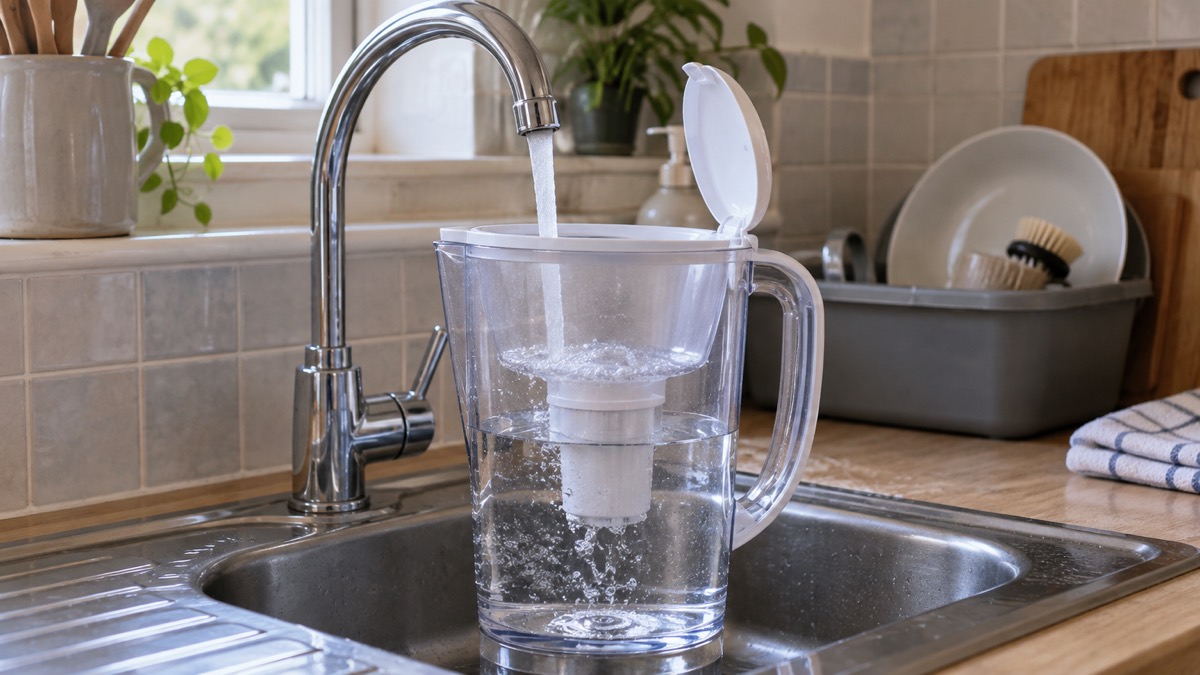
A jug is the simplest piece of water kit in the house: fill it from the tap, wait, pour. The Style Essential is a water filter jug with a flip-top lid for one-handed refilling and a dishwasher-safe body, compatible with MAXTRA PRO PURE PERFORMANCE and MAXTRA PRO LIMESCALE EXPERT cartridges1. The Glass Jug holds 2.5 litres in total and 1.5 litres filtered, and its lid carries the BRITA Smart Light, an LED that reminds you to replace the filter in advance11. The Flow tank holds 8.2 litres in total, including 5.2 litres of filtered water, and fits in most fridges9.
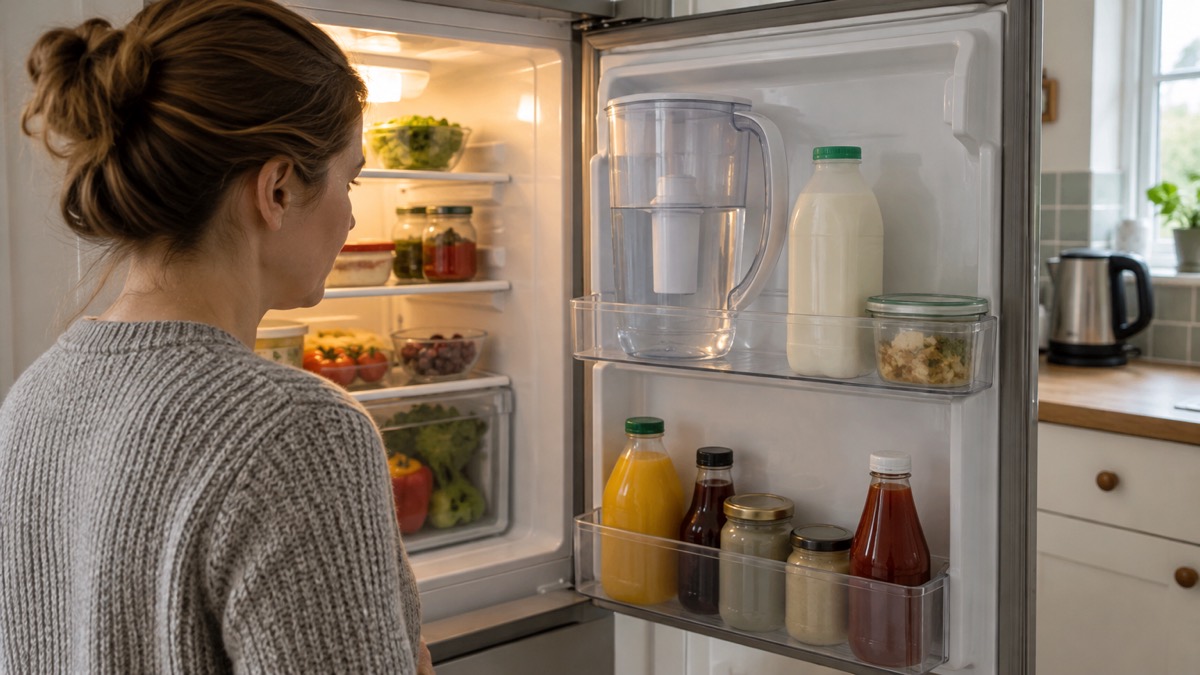
In an emergency plan the jug earns its place in two ways. First, it keeps a reserve of cold, good-tasting water in the fridge, which is exactly where BRITA advises storing filtered water to help prevent the formation of germs8. Second, it gives you a way to make tap water palatable if the supply is running but tastes or smells odd after a mains repair, which is common and not in itself a sign the water is unsafe.
What a jug cannot do is work without a tap. If the mains are off, a jug is a container and nothing more. That is why the water guide treats a jug as a comfort and quality item rather than a supply, and why emergency kit lists put water for drinking and sanitation first13. Keep the jug clean, keep a spare cartridge in the cupboard, and treat the filtered water in it as a short-term reserve rather than a long-term store.
Replacement filter cartridges
Cartridges are where a BRITA household spends its attention, because an expired cartridge is the most common way a filter quietly stops doing its job. The maker's replacement intervals vary widely by product, and they are set by time as well as by volume.
| Cartridge or product | Replacement interval | Source |
|---|---|---|
| MAXTRA PRO PURE PERFORMANCE and LIMESCALE EXPERT | Every 30 days; after four weeks at the latest | 1 |
| MicroDisc in a bottle | Every 4 weeks or after 60 litres | 4 |
| MicroDisc in a carafe | Every 4 weeks or after 150 litres | 4 |
| A 1000 under-sink | Every six months | 14 |
| P 1000 under-sink | Once a year, or 1,200 litres | 14 |
| P 3000 under-sink | Up to 12 months, or 3,400 litres | 7 |
| mypure SLIM V-MF | Up to 12 weeks or 8,000 litres | 15 |
Fitting a new cartridge is straightforward but worth doing properly. For the A 1000, the maker's steps are to unlock the cartridge using the blue levers on the filter head, with no need to turn off the water, then lock the new cartridge securely into place6. For the P 3000 the sequence adds a flush: unlock, release pressure through the flush valve and close it, remove the used filter and insert the new one, lock it in, then flush at least 1 litre of filtered water until the flow runs clear and without air7. That flush matters after any period when the system has been sitting, because it clears air and loose carbon before you drink.
For a household keeping spares, the maker's own collection lists 9 products in its filters and cartridges range8. Store cartridges somewhere dry and moderate, keep a note of the date each one went in, and replace on the maker's interval rather than waiting for the water to taste wrong.
Filter tap systems for the home
An under-sink system puts the filter out of sight and the water on tap. The mypure P1 is supplied as a kitchen tap, a P 1000 filter cartridge and an installation kit5. The P 1000 cartridge lasts up to 12 months or 1,200 litres, has an LED indicator for filter reminders, and operates at a pressure of 2 bar to a maximum of 8.6 bar5. The P 3000 is the maker's under-sink filter for high water consumption, compatible with all BRITA filter taps, lasting up to 12 months or 3,400 litres and protecting kitchen appliances against limescale7. The A 1000 is also compatible with all BRITA filter taps and is recommended for soft-water areas or households with a water softening system, lasting up to 6 months or 4,000 litres6.
The P 1000 filter reduces limescale and other modern impurities, such as certain herbicides, pesticides and pharmaceuticals if present in tap water, and its filtration runs through a pre-filter for coarse particles, a post-filter, an ion exchanger for limescale and metals like lead and copper, and activated carbon for taste and odour5. The A 1000 adds a pre-filter for coarse particles and a post-filter, with activated carbon reducing taste and odour-impairing substances such as chlorine while preserving natural minerals6.
In preparedness terms, a tap system is the least resilient of the BRITA options and the most convenient in normal times. It needs mains pressure to work at all, so a power cut that takes out a pumped supply, or a burst main, leaves it dry. Its long cartridge life is an advantage for stockkeeping, but its dependence on the plumbing is the reason the water guide recommends a jug or bottles alongside it. If you have a tap system, keep a jug and a stock of bottled water as your fallback.
What a BRITA filter can and cannot do to unsafe water
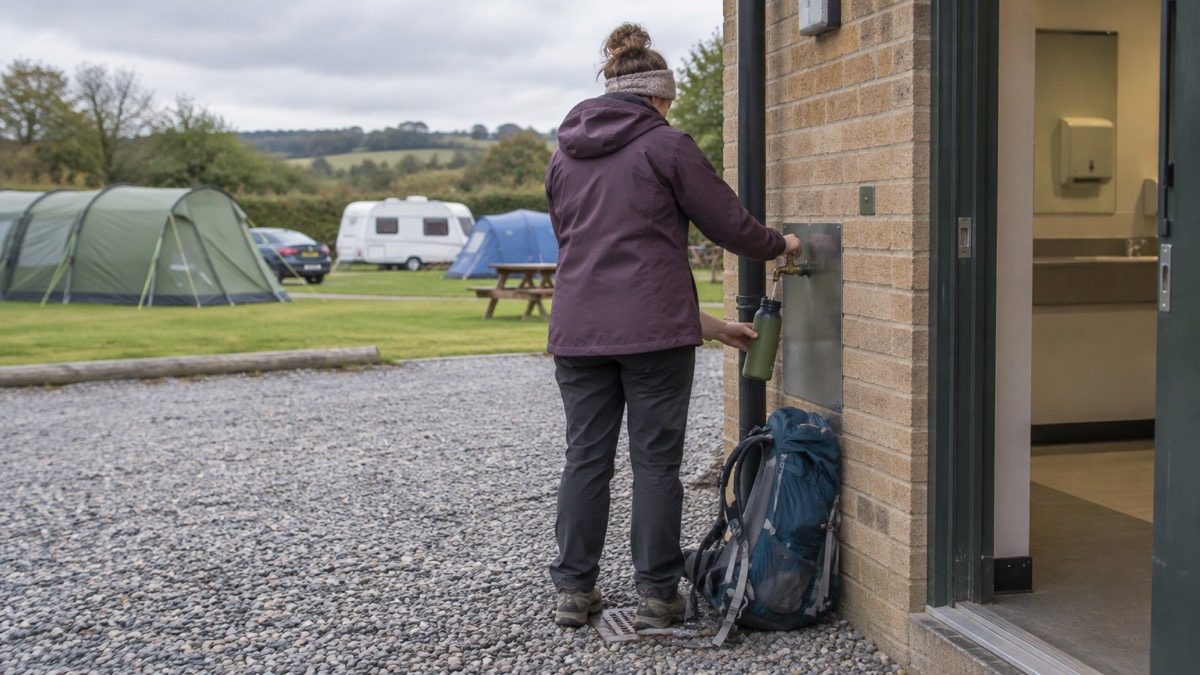
This is the section that matters most in an emergency, and the maker is clear about the scope. A BRITA water filter can reduce mains water's carbonate hardness and limescale, free and bound chlorine if present, and lead and copper, in filters based on an ion exchanger and activated carbon such as the MAXTRA cartridges1. The MicroDisc, which is based on activated carbon, helps reduce chlorine, PFAS and other taste-impairing substances4, and the Vital bottle's MicroDisc filters modern impurities such as certain herbicides, pesticides, pharmaceuticals and PFAS12.
What the maker does not claim is that any of these filters makes untreated water safe. There is no claim to remove bacteria, viruses or parasites from a contaminated supply, and the water companies' own guidance assumes as much: during a boil water notice they warn that not all domestic filters can be relied upon to remove bacteria, and advise seeking further advice from the filter manufacturer3.
The one reassuring note is about the filter material itself. BRITA states that the contents of all its water filters are food-grade quality and completely harmless, even if accidentally ingested9. That is about swallowing a cartridge's contents, not about the water going through it.
Using a filter during a boil water notice
A boil water notice is a precautionary measure, issued in writing, telling you to boil water before use while further water quality tests are carried out16. They are rare, but the systems that keep water safe can fail2. When one arrives, the instruction is to boil the water before you drink it, brush your teeth, make ice cubes, prepare food, clean feeding equipment or give it to pets2. You can generally still use the water around the home for washing, cleaning and flushing toilets, but boil it for anything you consume17.
For a BRITA household the sequence is:
- Stop using the filter for drinking water while the notice is in place, unless the maker has confirmed the specific filter removes bacteria; water companies advise that not all domestic filters can be relied upon to do so3.
- Boil the water you need, then let it cool, as the notice instructs2.
- When the notice is lifted, change the filter. Water companies are explicit: change your water filter now the boil water notice is lifted18, and replace filters as recommended in the manufacturer's operating manual3.
- If you have an ice machine, dispose of ice cubes made with unboiled water since the notice was issued, clean the machine and replace its filters per the manufacturer's instructions18.
Two groups need particular care. Do not prepare baby feeds with water without boiling it first19, though the Breastfeeding Network says you can use tap water under a boil notice for infant formula unless your water company has advised otherwise20. And fish keepers should not change the water in their fish tanks while the notice is in place3.
Arrangements differ slightly across the UK. In Scotland, Scottish Water's Interruption Notice card tells you whether you need to boil your water once work is complete and the supply restored21. In Wales, Dŵr Cymru issues notices advising all customers in the affected areas to boil their water with immediate effect before using it for drinking or cooking19. In England, notices come from your regional water company, as they did in the Brixham area of South West Water's region, where customers were advised not to use tap water for drinking or washing without boiling and cooling it first22.
Storing filters and filtered water safely
Filtered water is not sterile water, and the maker's hygiene advice reflects that. BRITA recommends storing filtered water in the fridge to help prevent the formation of germs8. That is the single most useful habit for a household: a jug kept cold, emptied and refilled regularly, and washed as part of the normal kitchen routine.
The bottles are built for cleaning. The Active bottle is easy to clean and dishwasher-safe, and the maker advises cleaning it regularly and optionally rinsing with hot water for optimal hygiene, with the filter easy to insert and remove10. The Vital bottle is likewise easy to clean and dishwasher-safe12. Both are supplied with 2 MicroDisc water filters10, and the MicroDisc pack contains 5 filters4.
For a stored reserve, official guidance is the better guide than the maker's. Lincolnshire County Council's emergency advice lists water for drinking and sanitation in the emergency kit, along with water purification tablets13, and the Royal Borough of Windsor and Maidenhead's home emergency plan lists bottled water among grab bag essentials23. Keep bottled water as your store and the jug as your day-to-day supply. If you filter water in advance, keep it in the fridge, use it within the normal life of a jug in a busy kitchen, and do not treat it as a long-life reserve.
Support, warranty and safety notices
BRITA's product pages here offer free returns and a 30-day money-back guarantee on the A 1000, P 3000, MicroDisc, Active bottle, Vital bottle and mypure SLIM V-MF6. On warranty, the maker's support information gives two different figures: an extended 12 month guarantee with registration, and a 2 year standard warranty.
Registration is the habit that matters for safety. Fire and rescue services advise registering electrical items with the manufacturer so you are informed of any safety recalls24, and the same principle applies to any appliance in the home: registration lets the maker contact you if a safety repair is needed25. BRITA's own pages do not carry a recall notice in the information here, but registering a tap system or an appliance that uses a filter is a sensible precaution, and it also validates warranties26.
For the wider picture, the water guide sets out how much to store and how to treat water in an emergency, and the emergency kit guide covers what else belongs in a grab bag alongside your water.
Sources (26)
- Style Essential water filter jug, BRITA, 2026-10-28
- Receiving a boil water notice, Drinking Water Inspectorate, 2024-05-16
- Boil water notice FAQs, Anglian Water, 2023-07
- MicroDisc water filters, BRITA, 2026-10-28
- mypure P1, BRITA, 2026-10-28
- A 1000 filter cartridge, BRITA, 2026-10-28
- P 3000 filter cartridge, BRITA, 2026-10-28
- Filters and cartridges collection, BRITA, 2026-10-28
- Flow water filter tank, BRITA, 2026-10-28
- Water Filter Bottle Model Active, BRITA, 2026-10-28
- Glass Jug, BRITA, 2026-10-28
- Water Filter Bottle Model Vital, BRITA, 2026-10-28
- Get help and advice in an emergency, Lincolnshire County Council, 2026-10-29
- Water filters and cartridges, BRITA, 2026-11-02
- mypure SLIM V-MF water filter, BRITA, 2026-10-28
- Boil your water Q&A card, Anglian Water, 2023-07
- Brixham boil water notice update, South West Water, 2024-06-09
- Boil notice for customers in Tunbridge Wells, South East Water, 2026-10-28
- Boil water notice, Dŵr Cymru, 2026-10-28
- Feeding your baby in an emergency situation, The Breastfeeding Network, 2026-10-13
- Water supply FAQs, Scottish Water, 2026-10-29
- Brixham cryptosporidium compensation update, South West Water, 2024-06-09
- Home emergency plan, Royal Borough of Windsor and Maidenhead, 2025-10
- Maintain appliances and recalls, Greater Manchester Fire and Rescue Service, 2026-10-29
- E-bikes and e-scooters safety guidance, National Fire Chiefs Council, 2022-01
- E-bikes and e-scooters, Cheshire Fire and Rescue Service, 2026-09-30