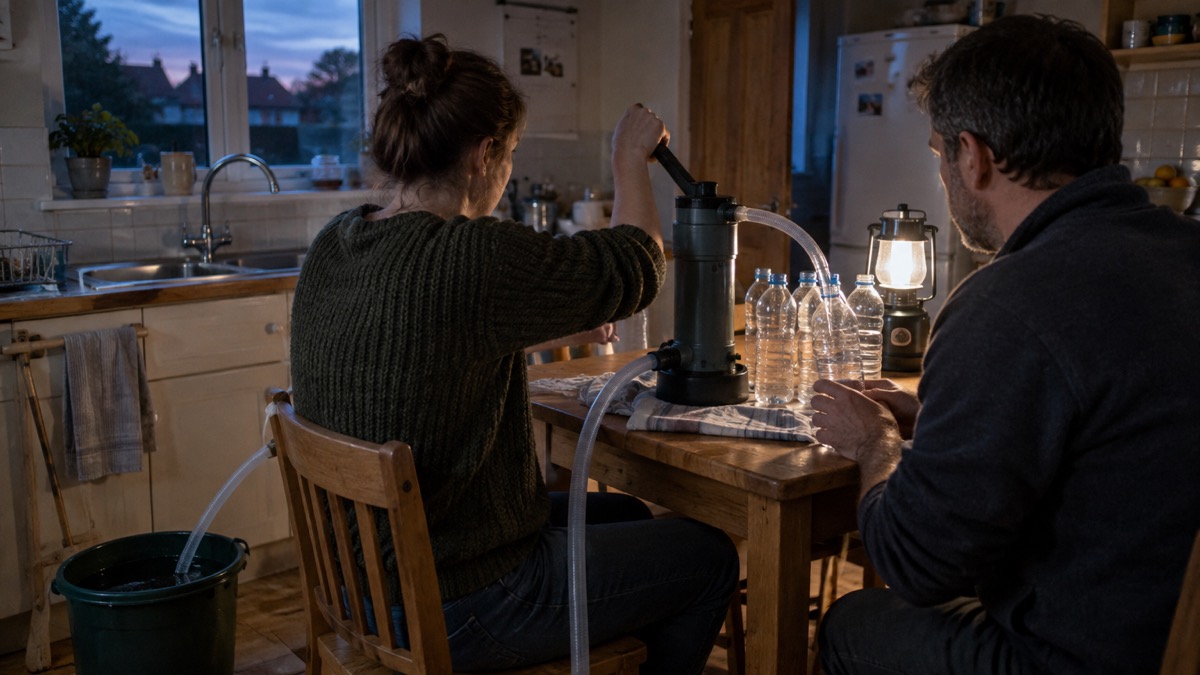
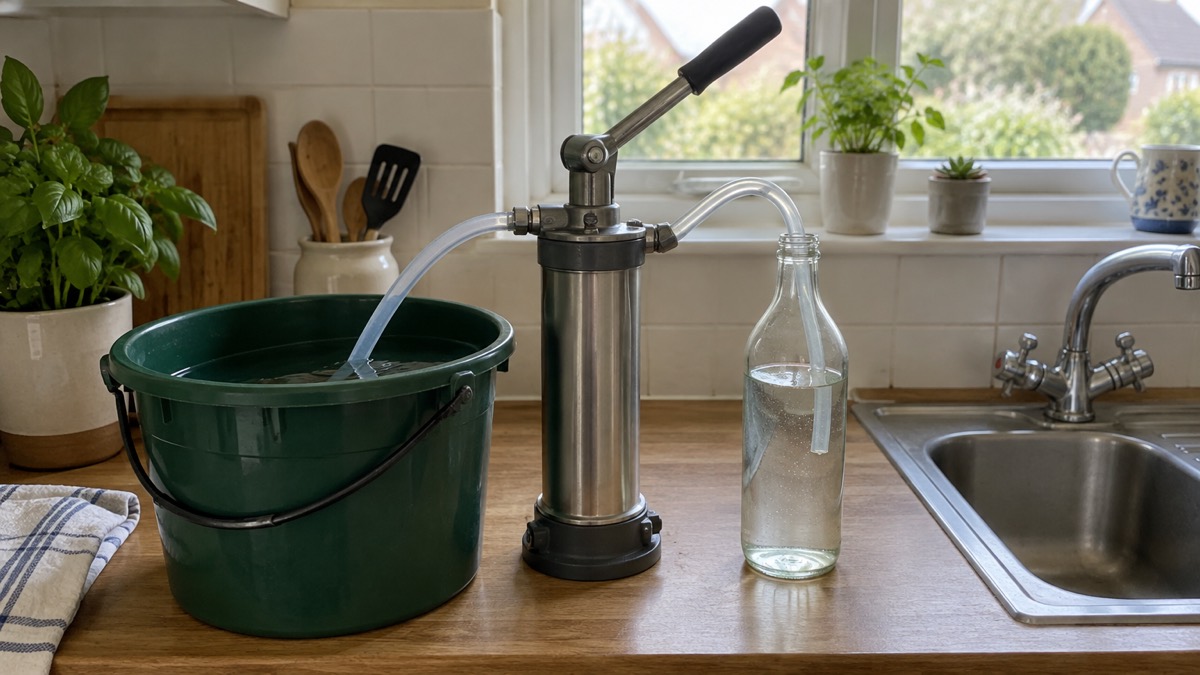
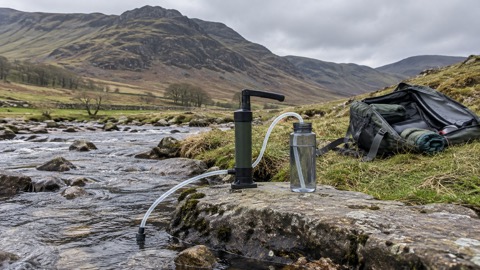
The Katadyn Vario is a hand pump water filter: you put the intake hose in a source of water, pump the handle, and filtered water comes out of the output hose. The maker rates it for a group of 2 to 5 people, lists its capacity as up to 2,000 litres depending on the water quality, and gives it two pumping modes, one for speed and one for longer cartridge life1. It weighs 425 g and is 100 mm across, so it stores in a cupboard without taking up much room1.
For a UK household, that makes it a candidate for the water part of an emergency kit: something that lets you treat collected water if the mains supply is off or you are told not to drink what comes out of the tap. It is not a substitute for stored water. The sensible approach is to keep a store of drinking water first, and treat the filter as the backup that lets you make more from other sources. Our guide to how much drinking water to store per person sets out the quantities, and how to make water safe to drink in an emergency covers the methods side by side.
This page sets out what the Vario does and does not remove, how the two modes work, how to use it on clear and muddy water, how to clean it, and which spare parts the maker sells. Everything here comes from the maker's own product information and manual, or from water company guidance where it bears on taste and smell.
What the Vario is, and who it suits
The maker describes the Vario as a portable water microfiltration system and lists its technology as a microfilter2. Its product type is a hand pump, and the maker's group size for it is 2 to 5 people1. A dual piston mechanism is what provides continuous water flow with minimal effort, according to the maker4. The pump is the whole point: there is no gravity to do the work for you and no plumbing to connect, so it works wherever you can stand a container under the output.
That shape of product suits a household that wants one filter to serve several people from collected water, rather than a bottle or straw each. If you are weighing up the types, our guide to hand pump filters for treating collected water sets the pump against other designs, and emergency filters: gravity, pump, bottle and straw types covers the whole field. The Vario sits in the pump category: more effort per litre than a gravity filter, but no need to hang anything up and no dependence on a height difference.
The maker, Katadyn, says it has been developing water treatment products since 19285. The Vario is one of its pump filters6. The maker sells replacement filters separately, so the filter is a piece of kit you maintain rather than a disposable1.
| Specification | Maker's figure |
|---|---|
| Product type | Hand pump water filter1 |
| Technology | Microfilter2 |
| Group size | 2 to 5 people1 |
| Weight | 425 g1 |
| Diameter | 100 mm1 |
| Capacity | Up to 2,000 litres, depending on water quality1 |
| Flow rate, FASTER FLOW | Up to 2 L/min1 |
| Flow rate, LONGER LIFE | Approximately 1 L/min1 |
| Filter materials | Glassfibre, ceramic, activated carbon1 |
| Water sources | Clear water, muddy water1 |
| Field cleanable | Yes1 |
| Item number | 80149321 |
| EAN | 76120131493291 |
The retailer Basecamp Food lists the same weight of 425 g and the same group size of 2 to 5, and gives the filter capacity as up to 2,000 litres depending on water quality, which matches the maker7.
What it removes, and what it does not
The maker says the filter removes bacteria, protozoa, cysts, algae, spores and sediments1. The manual gives the tested figures behind that: reduction of bacteria at 99.9999% for Klebsiella terrigena, and protozoan cysts at 99.9% for Giardia and Cryptosporidium, with the cartridge tested at 2,000 litres and found effective2. Those are the maker's own test claims for its own product. If you want to understand what such figures mean and how they are checked, our page on filter claims and certification explains log reduction and the standards behind it.
The activated carbon granulate is a separate stage. The maker says it reduces chemicals and improves taste and odour1. The manual gives the normal effective lifespan of the carbon as 200 litres, and says to replace it when you notice a change in taste or odour after filtering, or after 6 months of constant use, whichever comes first2.
What the Vario does not claim is virus removal. The maker's list of what it is effective against names bacteria, protozoa, cysts and sediments, and the removal list adds algae and spores, but not viruses1. Treat that as the limit of the product's claims. Our page on what ceramic, carbon, hollow-fibre and RO filters remove sets out how the different filter media compare, so you can see where a microfilter sits.
Two modes: faster flow or longer cartridge life
The Vario is the first filter with two filter modes, LONGER LIFE and FASTER FLOW, according to the maker's manual2. The difference is what the water passes through before it reaches the glassfibre cartridge.
In FASTER FLOW mode, the water bypasses the ceramic and goes straight to the glassfibre membrane, delivering up to 2 L/min1. In LONGER LIFE mode, the water passes through the 1.0 micron ceramic prefilter disc first, at approximately 1 L/min, before reaching the glassfibre cartridge1. The manual's pumping guide is that approximately 38 strokes per minute equals 1 litre of water in FASTER FLOW mode2.
The manual is clear about which mode to default to: to reach maximum cartridge life, always use the Vario filter in LONGER LIFE mode, and to extend cartridge life, use FASTER FLOW only when the water is clear2. The logic is that the ceramic disc takes the sediment out before it can clog the cartridge, so the cartridge lasts longer. Bypassing it buys speed at the cost of cartridge life.
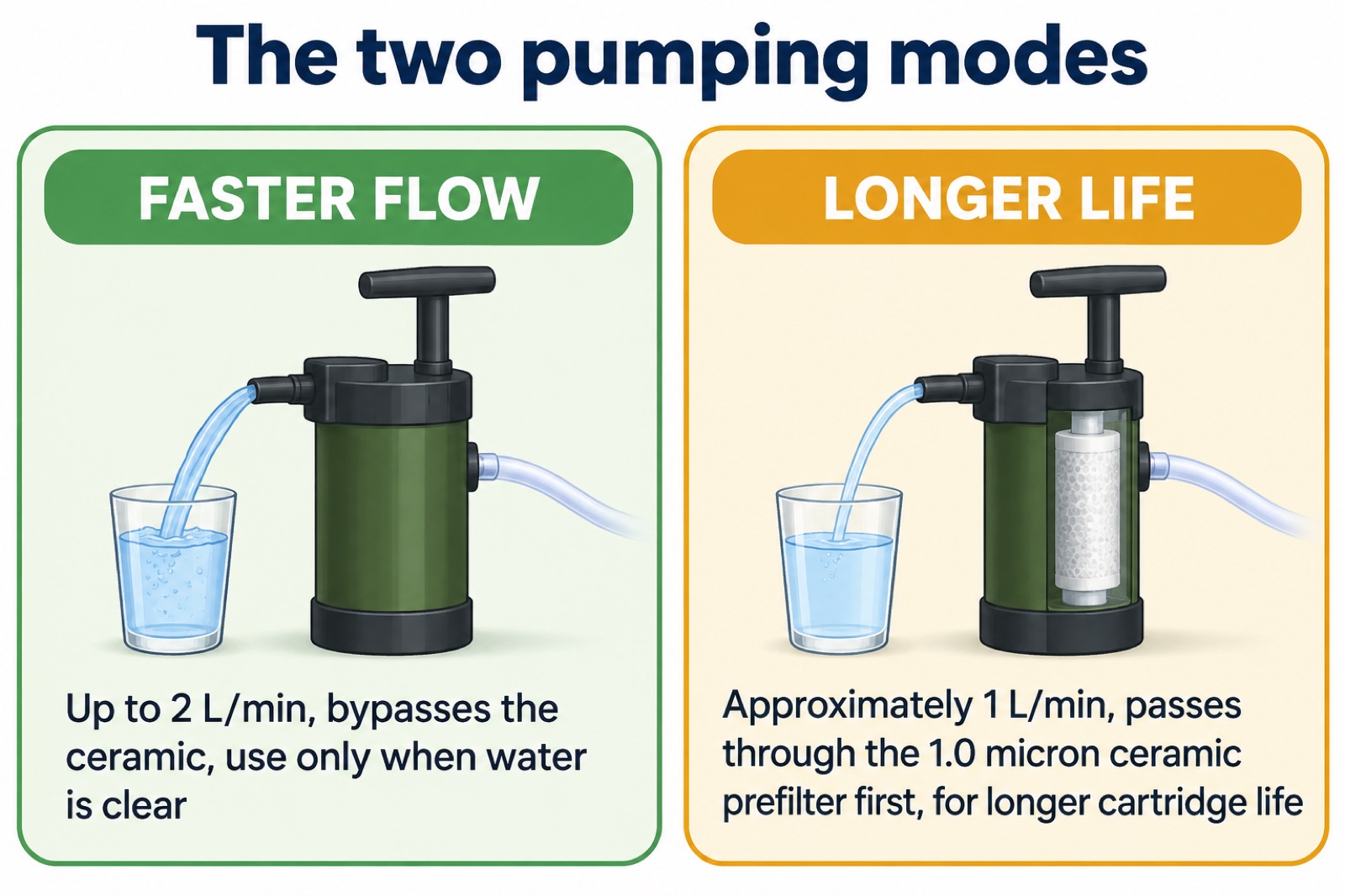
For a household, the practical rule is simple. If you are filtering clear water and want to fill containers quickly, FASTER FLOW is there. If the water is cloudy, or you want the cartridge to last as long as possible, pump in LONGER LIFE. The maker's own advice is to make LONGER LIFE your default2.
Using it on clear water and on muddy water
The maker lists the Vario's water sources as clear water and muddy water, so it is designed for both1. The mode choice follows the water: clear water can go through FASTER FLOW, turbid water should go through the ceramic prefilter in LONGER LIFE1.
For heavy sediment, the manual gives two practical steps: wrap a coffee filter or bandanna around the intake prefilter, and let sediment settle before filtering2. Both are about keeping the worst of the grit out of the filter so it does not clog. Letting a bucket stand while the mud settles, then drawing from the clearer water above the sediment, is the same idea.
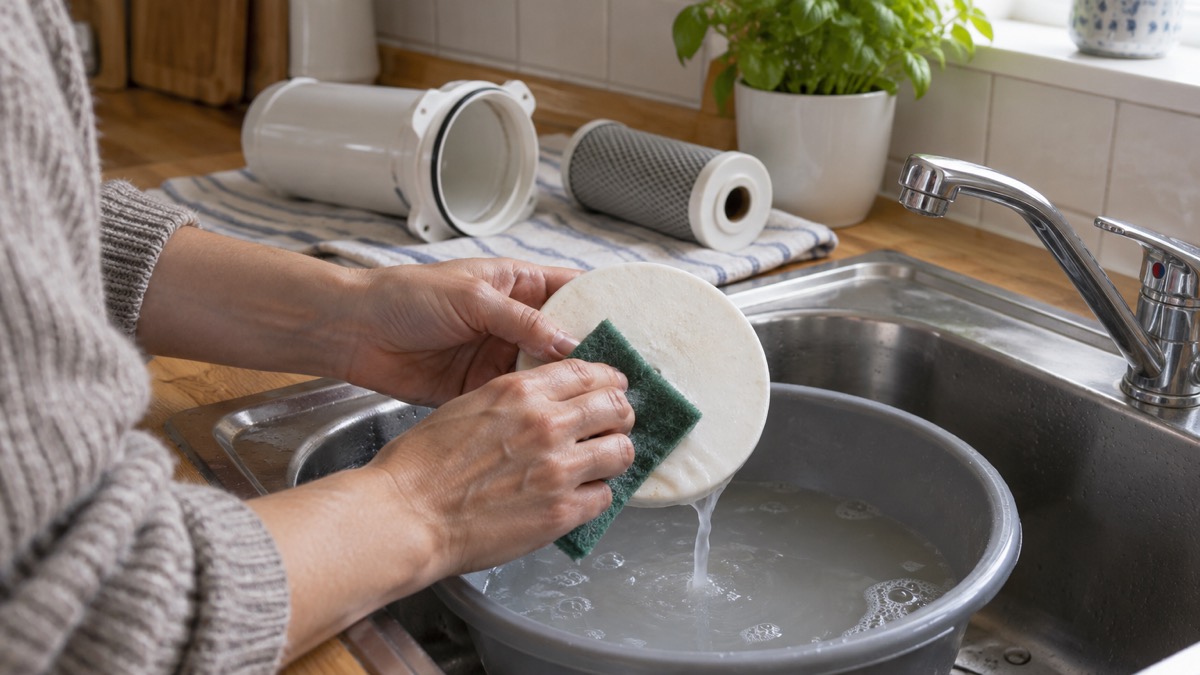
If the flow drops, the manual's troubleshooting list is: make sure the prefilter is submerged, make sure the hoses are not blocked or pinched, and clean the ceramic prefilter with the cleaning pad provided2. If the cartridge itself is clogged, the manual's temporary field fix is to remove the cartridge and swish it around in water, taking care that untreated water does not contact the cartridge output barb, and if flow is not restored, replace the cartridge2.
When you fit a new cartridge, the manual says to flush it by pumping and discarding the first litre2. Do that over a drain or onto the garden, not into your drinking container.
Fitting it to bottles and reservoirs
The Vario connects to common outdoor bottles and hydration reservoirs, and an integrated bottle thread fits directly on Nalgene bottles with a wide mouth, according to the maker1. The manual adds that the Vario allows easy filling of many hydration bladders such as Nalgene and Camelbak, fitting hydration pack bladder drink tubes2.
That matters for a household because it means you are not tied to one container. You can pump straight into a wide-mouth bottle, or into a bladder tube if you use a hydration pack. For storing water at home, our guide to containers and jerrycans for drinking supplies covers what to keep it in, and storing tap water safely at home covers preparing tap water for storage before an interruption.
The manual's storage advice is worth building into your routine from day one: store the output hose with the clip separately in the resealable bag inside the carry bag, to prevent cross contamination2. The maker lists a Vario/Camp Series Carrying Bag as an accessory for the Vario1. If your filter arrives without one, that is the bag the manual's storage advice assumes.
Filter life, cleaning and replacement parts
The maker gives the capacity as up to 2,000 litres, depending on the water quality1. The "depending on the water quality" is the important part: cloudy, silty or heavily sedimented water will use up the cartridge faster than clear water, which is why the manual pushes LONGER LIFE mode and prefiltering2. The carbon stage is shorter lived than the cartridge: the manual gives its normal effective lifespan as 200 litres, and says to replace it when taste or odour changes after filtering, or after 6 months of constant use, whichever comes first2.
The ceramic prefilter is the part you can clean to keep the cartridge going. The maker says the ceramic prefilter can be cleaned to extend the life of the glassfibre cartridge1. The manual's troubleshooting steps include cleaning it with the cleaning pad provided when flow drops2. Our page on looking after a filter: priming, cleaning, cartridges and frost covers the general routine for keeping a filter working between emergencies.
The maker sells the consumables and spares separately, and replacement filters are sold separately1. The list includes:
- Vario Replacement Cartridge, described by the maker as a replacement cartridge for the Katadyn Vario filter8
- Vario Ceramic Prefilter Disc Replacement, for the Katadyn Vario filter9
- Vario Carbon Replacement Pack (2 pcs.)1
- Vario Maintenance Kit, described as a maintenance kit with spare parts for the Katadyn Vario filter, barcode 761201315153710
- Vario Handle Set, Vario Axle Pin and Vario Pump Head1
Keeping a spare cartridge and a carbon pack with the filter means you are not caught out mid-interruption. Check the parts against your model before you store them: the maker's item number for the Vario is 8014932 and its EAN is 76120131493291.
Chlorine taste in tap water
The maker lists chlorine taste reduction among the Vario's properties, because of the activated carbon granulate1. Water companies take a practical view of the same problem. Thames Water says domestic water or jug filters can also be used to remove chlorine from tap water, as advised by the manufacturers' instructions12. Wessex Water says the taste of chlorine can be removed using a water filter, following the manufacturer's instructions13. Southern Water says you can also use a water filter that contains carbon, and that if the filter is plumbed into your water supply it must meet the Water Supply Regulations 199914.
Before you reach for a filter, though, it is worth knowing why tap water tastes of chlorine. Northumbrian Water says a small amount of chlorine is added to maintain disinfection as the water travels through the network, and it is more noticeable close to water treatment works15. Thames Water says the closer you are to water treatment works, the more noticeable it can be12. South East Water says it can happen if you live far away from the treatment works, or if the water has been in the pipes for a while16.
A chemical, antiseptic or TCP taste is a different matter. Affinity Water says certain types of plastic can react with the chlorine in water and give a bitter or TCP-type taste17. Bristol Water says this is a common problem caused by chlorine in tap water reacting with plumbing fittings like flexible hoses and tap washers18. Dwr Cymru says these tastes and odours can be caused by the reaction between the small but essential amounts of chlorine present in tap water and the plastic or rubber constituents found in common household appliances such as some kettles, tap washers, and the hoses connecting dishwashers and washing machines to the mains water supply19.
If your water tastes or smells odd, our page on why your tap water tastes or smells different walks through the causes. South East Water's checklist is a sensible first pass: ask your neighbour if they have the same problem, check which tap the problem started with, replace the washer or fittings on the tap, rinse your kettle before use, try boiling water in a saucepan instead, and check that a mains-connected washing machine has a non-return valve16.
Sources (19)
- Katadyn Vario Filter product page, Katadyn, 2026-10-28
- Katadyn Vario Water Microfilter manual, Katadyn, 2006-10-26
- Katadyn Vario product page, Katadyn, 2026-10-28
- Katadyn Vario Filter USA, Katadyn
- Katadyn, Katadyn, 2026-10-28
- Pump filters, Katadyn, 2026-10-28
- Katadyn Vario Filter, Basecamp Food, 2026-10-29
- Vario Replacement Cartridge, Katadyn, 2026-10-28
- Vario Ceramic Prefilter Disc Replacement, Katadyn, 2026-10-28
- Vario Maintenance Kit, Katadyn, 2026-10-28
- Vario Maintenance Kit, Katadyn, 2026-10-28
- Different smell or taste, Thames Water, 2026-10-28
- Tastes and smells, Wessex Water, 2026-10-28
- My water looks, smells or tastes unusual, Southern Water, 2026-10-28
- Taste and smells, Northumbrian Water, 2026-10-28
- My water smells strange, South East Water, 2026-10-28
- Tastes and odours, Affinity Water, 2026-10-28
- Taste and smell, Bristol Water, 2026-10-28
- Strange taste or smell to my water, Dwr Cymru, 2026-10-28
 Katadyn Pocket Filter
 Katadyn Explorer Filter