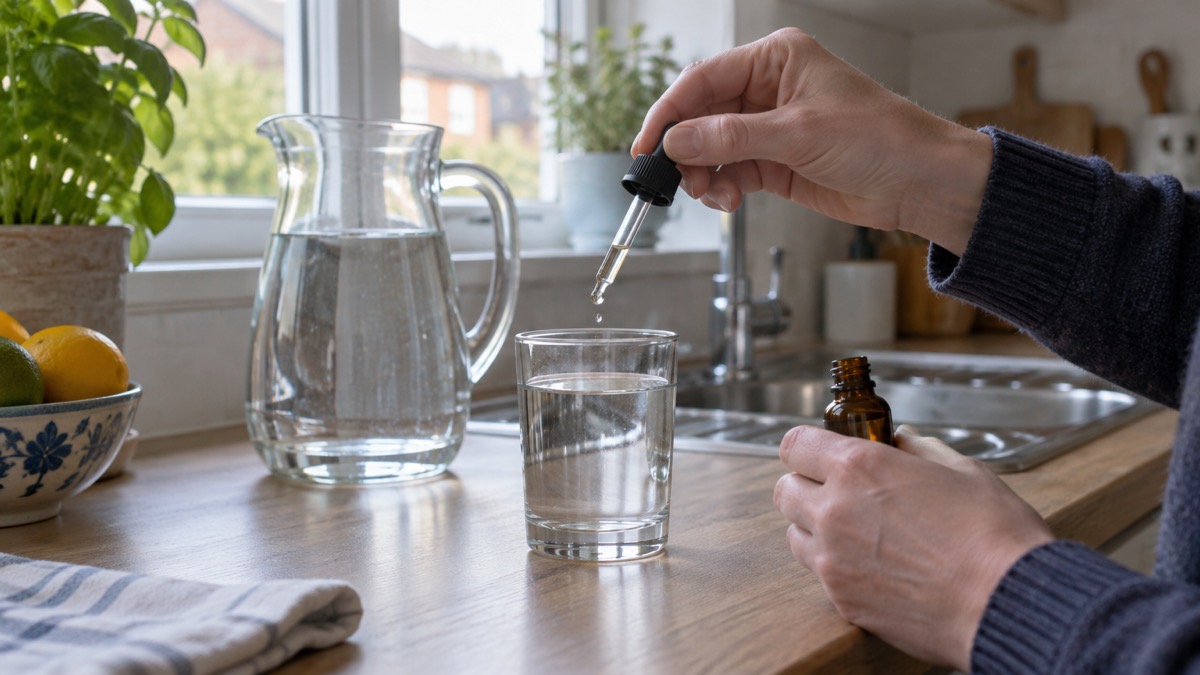
If your tap water has started to taste or smell of chlorine, or the water you stored in bottles has picked up a swimming-pool tang, Katadyn Micropur Antichlor is a small liquid additive that takes that taste away. You add three drops to a litre of water, or 1 ml to 10 litres, wait three minutes, and the chlorine is neutralised so the water tastes of nothing much again1. One 10 ml bottle treats up to 100 litres2.
It is important to be clear about what it is for. Antichlor neutralises chlorine and restores the natural taste of water; it does not disinfect, purify or make unsafe water safe1. If you are treating water of uncertain quality, that is a job for boiling or a purification product, and Antichlor comes afterwards, if at all, to improve the taste.
For an ordinary household it is a small, cheap-to-keep item for the cupboard: rarely used, with a five year shelf life, and enough in one bottle to treat a very large amount of water1. This page sets out what it does, how much to use, how it fits with chlorinated tap water and stored supplies, and how to dispose of it properly.
What Micropur Antichlor does, and what it does not
Micropur Antichlor is a dechlorination agent. The maker's description is precise: it "neutralises chlorine and restores the natural taste of water"1. That is the whole of its job. It is listed as a liquid water treatment product for tap water, and the maker describes its usage as rare, which tells you how it expects households to reach for it1.
The reason chlorine is in your water at all is worth knowing, because it explains why the taste comes and goes. Water companies add chlorine continuously during treatment as a disinfectant to kill bacteria and other microorganisms, and a small amount remains in the water to keep it safe as it travels through the pipes to your tap4. That residual is what you can taste. It is a sign the water is being protected, not a sign of a problem.
What Antichlor does not do is kill germs. The maker describes its function as neutralising chlorine and restoring the natural taste of water1. If you need to make water safe, use a proper method: see our guide to how to make water safe to drink in an emergency, and for the heat method, boiling to kill germs. Antichlor is the finishing touch for taste, not the treatment itself.
It also differs from its stablemates in the Micropur range. Micropur Forte is a purification product, and the maker notes that Antichlor can be used as a final step after Forte to improve the taste following disinfection1. Micropur Classic inactivates bacteria in water tanks and containers and keeps water free from germs, algae and odours5. Antichlor does neither of those things; it only deals with chlorine.
Dosage: three drops a litre, 1 ml per 10 litres
The dose is small and easy to remember. The maker gives it two ways: 3 drops per 1 litre, which is the same as 1 ml per 10 litres1. A full 10 ml bottle therefore treats 100 litres of water1.
| Amount of water | Drops | Liquid measure |
|---|---|---|
| 1 litre | 3 drops | 1 ml |
| 10 litres | 30 drops | 10 ml |
| 100 litres (a full bottle) | 300 drops | 10 ml |
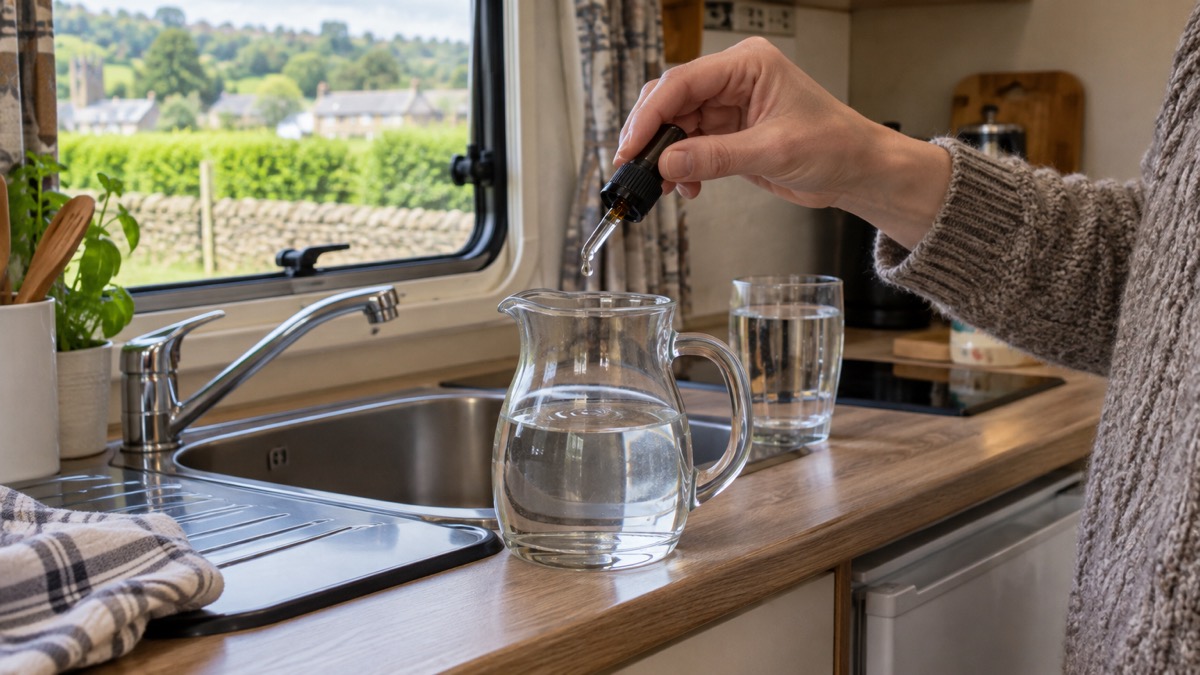
Allow 3 minutes of contact time before drinking1. One 10 ml bottle treats up to 100 L of water1.
The maker's instruction is to allow 3 minutes of contact time after adding it1. Stir or shake the water so the drops mix through, then give it those three minutes before you drink or use it. The maker describes it as fast acting, with a check after 3 minutes1.
A few practical points follow from those numbers. Because the dose is measured in drops, it suits small quantities: a glass, a jug, a kettle, a water bottle. For larger volumes, measure in millilitres rather than counting drops, since 1 ml per 10 litres is far easier to judge than 30 drops. And because one bottle covers 100 litres, a household will not run through it quickly; the constraint is the shelf life, not the volume.
Using it with chlorinated tap water and stored water
Antichlor's listed water source is tap water, and the maker says it is also suitable for preparing drinks with chlorinated tap water, giving isotonic drinks, coffee and tea as examples1. That is the everyday use: the water is already safe, it simply tastes of chlorine, and a few drops fix the taste before you make your drink.
If your water tastes or smells odd and you want to understand why before reaching for anything, our page on why your tap water tastes or smells different sets out the common causes. Chlorine is one of them, and it is the one Antichlor is designed for. Water companies themselves point out that the taste of chlorine can be removed using a water filter, following the manufacturer's instructions6; Antichlor is the drops-based alternative to that approach, and the choice between them is a matter of what you already have and how much water you are dealing with. A filter also removes other things; Antichlor removes only the chlorine taste.
For stored water, the logic is the same. Water you put aside in clean containers can pick up a flat or chlorinated taste, and a few drops before drinking will improve it. What Antichlor will not do is rescue stored water that has gone bad. If you are unsure whether stored water is still fit to drink, treat that as a treatment question, not a taste question, and see storing tap water safely at home for how to keep it good in the first place.
Storing the bottle and keeping it usable
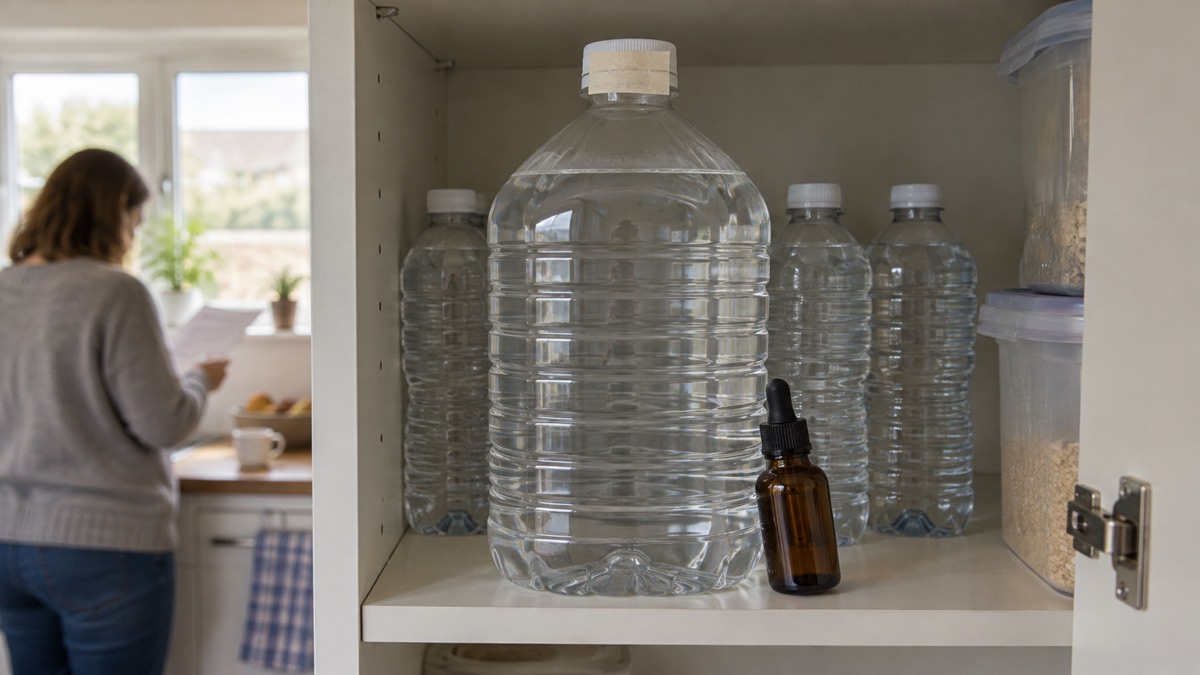
The maker gives the shelf life as 5 years1. Keep the bottle somewhere out of direct sunlight and away from children, as you would any household chemical, and keep the cap on so the liquid does not evaporate or become contaminated. Because usage is rare, the realistic risk is that a bottle sits at the back of a cupboard past its date; write the date you bought it on the bottle so you can check it.
The active ingredient is sodium thiosulfate at 6%1. That is the same family of chemical used to neutralise chlorine in aquariums and water treatment, and it is why the dose is so small. It is not a drink in itself: add it to water in the stated dose, do not drink it neat.
If you are building a water kit for the home, Antichlor belongs with the taste and convenience items rather than the treatment items. Our supply interruption checklist and home drinking supply storage checklist set out the wider kit, and the water section covers treatment, storage and what to do in an outage. Antichlor is a small addition to that kit, useful when the water is safe but unpleasant.
Disposing of the bottle and leftover liquid
The maker's disposal instruction is short and clear: "Dispose of contents/container in accordance with local legislation"1. In practice that means checking your council's rules for household chemical waste rather than pouring leftovers down the sink or into the garden. A nearly empty bottle with a little liquid left is a household chemical, and your local authority will tell you how it wants it handled.
Do not refill the bottle with anything else, and do not keep it once it is past its shelf life. If you are clearing out a cupboard and find an old bottle, treat it as you would any out-of-date household product and dispose of it through the proper route.
The specifications at a glance
| Specification | Detail |
|---|---|
| Product | Katadyn Micropur Antichlor MA 100F |
| Content | 10 ml1 |
| Active ingredient | Sodium thiosulfate 6%1 |
| Function | Neutralises chlorine and restores the natural taste of water1 |
| Water source | Tap water1 |
| Dose | 3 drops per 1 litre; 1 ml per 10 litres1 |
| Contact time | 3 minutes1 |
| Capacity | Up to 100 litres per bottle1 |
| Shelf life | 5 years1 |
| Group size | 1, 2 to 5 persons1 |
| Usage | Rare1 |
| Article number | 80137051 |
| Barcode | 76120131370502 |
| Disposal | In accordance with local legislation1 |
The maker, Katadyn, describes itself as developing Swiss-engineered water treatment, nutrition and cooking solutions and says it has been trusted since 19287. Antichlor sits in its Micropur range alongside purification products and filters; the Micropur collection page on this site explains how the chlorine, chlorine dioxide and silver products differ, which helps place Antichlor as the taste product rather than the treatment one.
Sources (7)
- Katadyn Micropur Antichlor MA 100F 10 ml, Katadyn, 2026-10-28
- Katadyn Micropur Antichlor MA 100F 10 ml (product number and barcode), Katadyn, 2026-10-28
- Katadyn Micropur Antichlor MA 100F 10 ml (dosage and disposal), Katadyn, 2026-10-28
- Water in the Home, SES Water, 2015
- Micropur Classic collection, Katadyn, 2026-10-28
- Tastes and smells, Wessex Water, 2026-10-28
- Katadyn, Katadyn, 2026-10-28