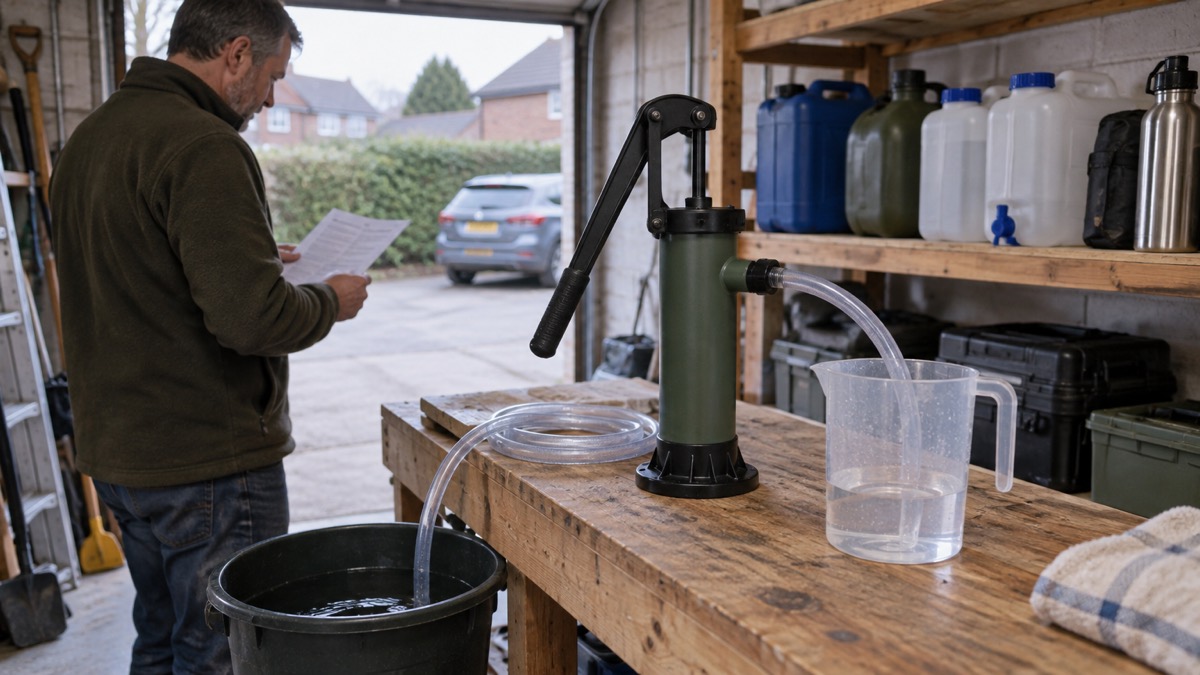
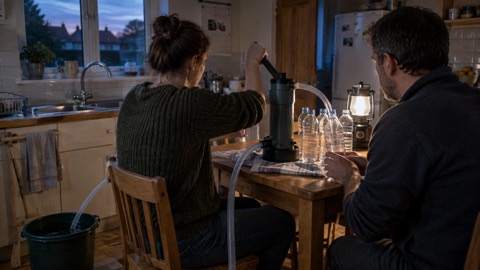
The Katadyn Explorer is a hand pump water filter built for a group of 2 to 5 people. You pump the handle, water is pushed through a ceramic cartridge and then an activated carbon cartridge, and it comes out at up to 1 litre per minute. The maker rates the ceramic stage for up to 20'000 litres depending on water quality and the carbon stage for up to 500 litres, and lists both muddy water and clear water as suitable sources1.
The thing to understand before you buy is the difference between the two versions. The standard Explorer has two stages, ceramic and carbon, and the maker states plainly that this version has no virus-removal stage2. The Explorer Pro adds a third stage, a hollow-fibre virus membrane, and the maker says virus protection requires that stage to be installed3. If you already own the standard model, an upgrade kit turns it into a Pro4.
For a UK household, that makes the Explorer a sensible store-cupboard or car-boot filter for treating collected water in an interruption, and the Pro the version to choose if the water you might collect could be contaminated with viruses as well as bacteria and protozoa. Both are Swiss Made, both can be stored dry between uses, and both are field cleanable when the flow slows1.
What the Katadyn Explorer does, and who it suits
The Explorer is a hand pump, not a gravity filter and not a bottle. The maker lists its product type as a hand pump and its group size as 2 to 5 people1. That group size is the clearest guide to what it is for: a household, a small group shelter, a caravan, or a kit kept in the car for the moment the mains supply stops or a do not drink notice arrives. It is not a one-person hiking filter, and it is not a whole-house system.
What it removes is set out by the maker as bacteria, protozoa, cysts, sediments, bad taste, chemicals and microplastics1. The ceramic stage is the workhorse: the maker states that ceramic microfiltration removes bacteria, protozoa and microplastics2. The carbon stage deals with taste and chemical odours. The maker describes the build as a rugged design with a steel pump piston that stands up to harsh environments and frequent use1, which is the sort of construction you want in something that may sit unused for a year and then be pumped hard for a week.
It suits households that want a filter they can operate without power, without plumbing and without a pressurised supply. You need a container of water to pump from and somewhere to put the treated water. It does not suit anyone who wants to filter water straight from a tap under pressure, and it does not suit a single person carrying it long distances, given the weight.
If you are still deciding what type of filter fits your household, the guide to hand pump filters for treating collected water sets the pump type against the alternatives, and Emergency Filters: Gravity, Pump, Bottle and Straw Types covers the whole field.
Explorer and Explorer Pro: how the versions differ
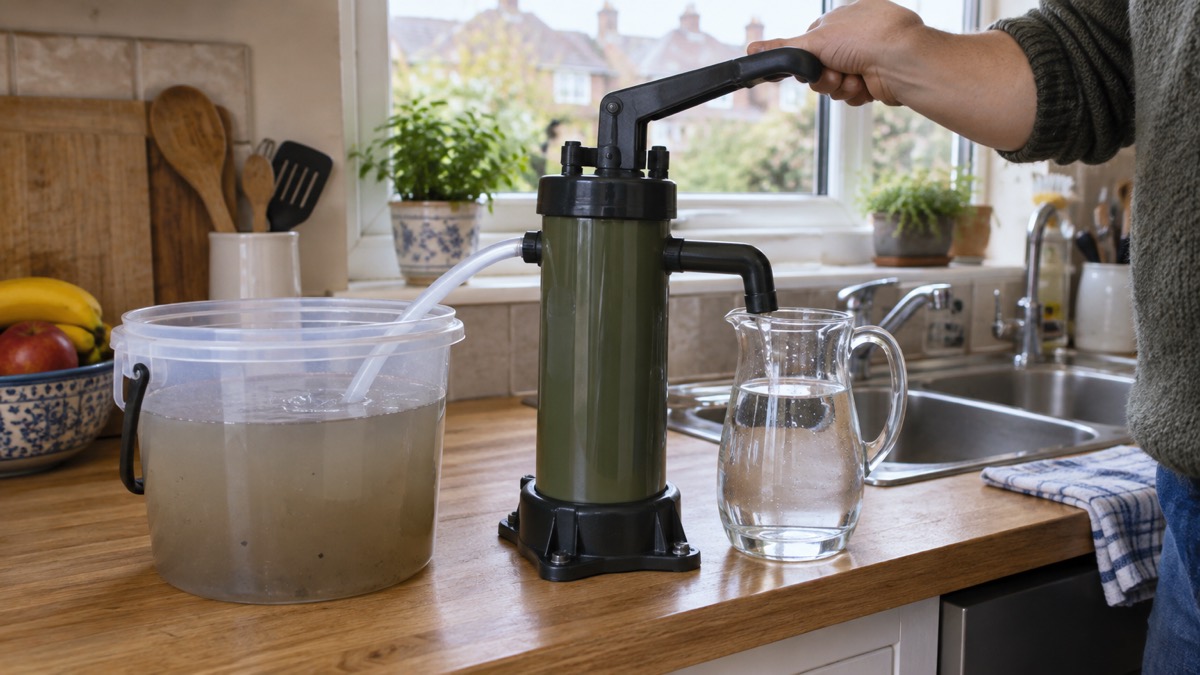
The two models share a body, a pump and a ceramic stage. The difference is what comes after the ceramic. The standard Explorer has two-stage filtration, ceramic microfiltration and activated carbon1. The Explorer Pro has three-stage filtration: ceramic microfiltration, activated carbon and a virus-removal stage6. The Pro's filter materials are listed as hollowfibre, ceramic and activated carbon3.
The Pro is also modular. The maker states that the activated-carbon and virus-removal stages can be included or omitted to suit the application3. That means you can run the Pro with the virus stage fitted when you need it and without it when you do not, which matters because the virus membrane is a separate replacement part in its own right7.
| Katadyn Explorer | Katadyn Explorer Pro | |
|---|---|---|
| Filtration stages | Two: ceramic and activated carbon1 | Three: ceramic, activated carbon and virus removal6 |
| Virus protection | None; the maker states this version has no virus-removal stage2 | Requires the virus-removal stage to be installed3 |
| Filter materials | Ceramic, activated carbon1 | Hollowfibre, ceramic, activated carbon3 |
| Output | Up to 1 litre per minute1 | Up to 1 litre per minute3 |
| Group size | 2 to 5 people1 | 2 to 5 people3 |
| Weight | 480 g1 | 630 g5 |
| Item number | 80212908 | 80212923 |
| Barcode | 06043752129098 | 06043752129233 |
The maker's own summary of the choice is direct: use ceramic only for moderate conditions, or upgrade to the Pro version for virus protection9. For a UK household storing a filter against an emergency, the question to ask is where the water would come from. Rainwater butts, stored tap water and clear surface water are one thing; water from a stream running through farmland or a flooded area is another. The guide to drinking from streams, rivers and other sources safely covers what those sources can carry.
Two-stage filtration: ceramic and activated carbon
The ceramic cartridge is a microfiltration stage. The maker lists it as an ultrafilter technology, effective against bacteria and protozoa, and field cleanable10. Field cleanable matters more than it sounds: it means a clogged cartridge can be cleaned where you are, rather than sent away or thrown out. The ceramic replacement cartridge is listed for muddy water as its source, and for a group of 2 to 5 people10.
The activated carbon cartridge is the second stage. On the standard Explorer the maker lists the taste improvement as reducing chlorine taste1. On the Pro, the maker states that activated carbon improves taste and reduces odours and chlorine taste3. That is the stage that makes stored or treated water palatable, which in a long interruption is not a luxury: water you do not want to drink is water you do not drink enough of.
The carbon stage is also the one that runs out first. The maker rates the ceramic stage at up to 20'000 litres depending on water quality and the activated carbon at up to 500 litres depending on water quality1. The carbon replacement is sold as a pack of two, each piece rated for up to 500 litres depending on water quality, and it fits both the Explorer and the Explorer Pro11.
If you want the wider picture of what each filter medium can and cannot take out, Ceramic, Carbon, Hollow-Fibre and RO: What Each Removes sets them side by side.
Flow rate: up to 1 litre per minute
The maker gives the Explorer an output of up to 1 litre per minute, and lists the flow rate as 1 litre per minute1. The Explorer Pro carries the same figure3. That is the headline rate with a clean cartridge and reasonable water. It will fall as the ceramic loads up with sediment, which is exactly why the cartridge is field cleanable.
For planning, think in terms of pumping time rather than litres. A group of 2 to 5 people will get through a few litres at a time for drinking, and rather more if you are using filtered water for food preparation. At the maker's rate, filling a container takes minutes of steady pumping, not seconds, and someone has to do it. That is the practical difference between a hand pump and a gravity filter that runs while you get on with something else.
The flow rate is also why the Explorer suits a household rather than a solo user. One person pumping for a family is a chore; a family taking turns is not. If you want a filter that produces water without anyone standing over it, a gravity system is the other route, and Gravity Filters and Ceramic Candles Explained covers how those work.
Filter life, and what shortens it
The maker's figures are up to 20'000 litres for the ceramic stage and up to 500 litres for the activated carbon, both depending on water quality1. The phrase "depending on water quality" is doing a lot of work. Silty, cloudy water will blind the ceramic surface far sooner than clear water, and the maker's own listing of muddy water as a suitable source does not mean muddy water costs nothing in cartridge life10.
The practical consequences are straightforward. Clean the ceramic when the flow drops, because a clean cartridge passes water faster and lasts longer between cleanings. Keep a spare carbon cartridge, since it is the stage that expires first, and note that the maker rates each piece for up to 500 liters depending on water quality12. And if you are drawing from a muddy source, let the water stand and pour off the clearer top before pumping, so the ceramic is dealing with less sediment.
The maker's care advice for the Explorer is to clean the ceramic cartridge and to follow the product instructions for care and dry storage between uses2. The Explorer Pro's ceramic can be cleaned and its filter stages stored dry according to the instructions6. Neither is a filter you have to keep wet and primed like some hollow-fibre bottles.
For the general principles of priming, cleaning, cartridges and frost, Looking After a Filter: Priming, Cleaning, Cartridges and Frost is the household guide.
The standard Explorer does not remove viruses
This is the single most important limitation on the page. The maker states that the standard Explorer has no virus-removal stage2. It is not a question of a worn cartridge or a dirty filter: the two-stage model simply does not have the stage that removes viruses. The Pro does, but only when the virus-removal stage is installed3.
Viruses are smaller than bacteria and protozoa, which is why a ceramic microfiltration stage catches the larger organisms and lets the smaller ones through. The maker's own manual for a different filter in its range makes the same point in plain words:
"The Katadyn BeFree™ does not remove viruses."
That warning is about the BeFree, not the Explorer, but it shows how the maker frames the limit of a filter without a virus stage. For the Explorer, the maker's own route is the upgrade: use ceramic only for moderate conditions, or upgrade to the Pro version for virus protection9.
What "moderate conditions" means in practice is a judgement about your source. Stored tap water, rainwater and clear water from an upland source are different from water downstream of livestock or a flooded field. The guide to how to make water safe to drink in an emergency sets out the treatment routes, and Boiling to Kill Germs: How to Do It Properly covers the method that needs no filter at all.
Cleaning the ceramic cartridge and storing it dry
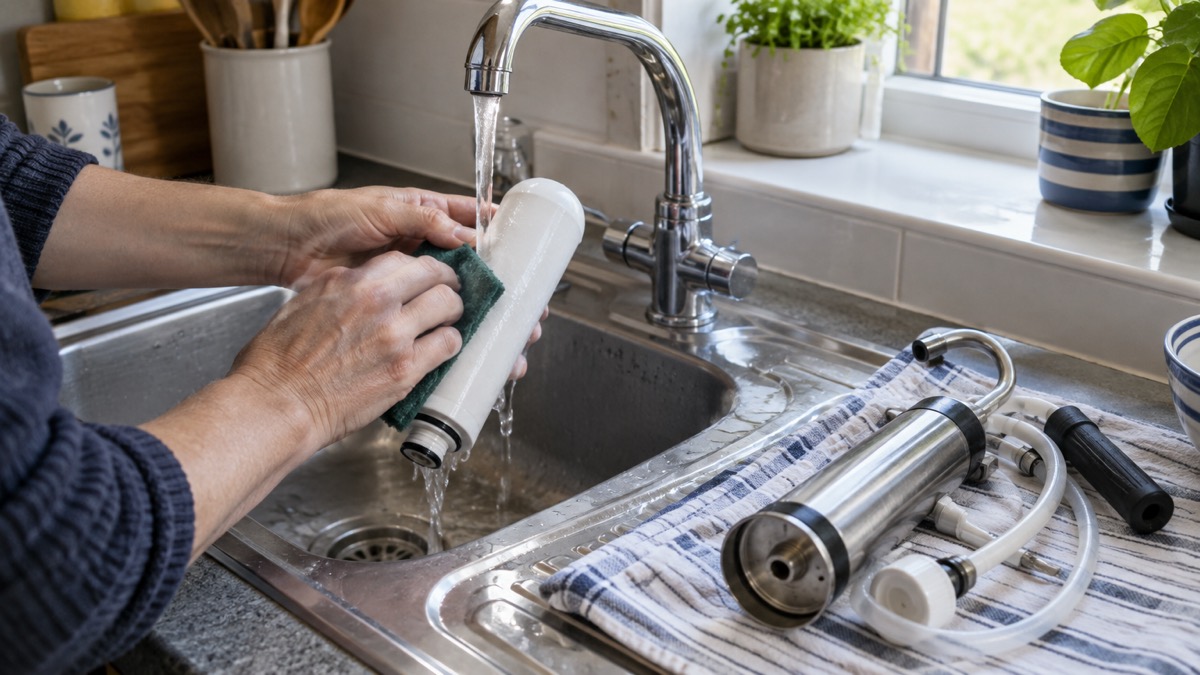
The Explorer is designed to be stored dry. The maker states that ceramic and virus filters can be stored dry, with no risk of mould, no maintenance required, and always ready to go2. The Pro carries the same statement3. That is unusual among filters and it is the reason the Explorer works as a kit item: you can pack it in a cupboard or a car boot and leave it, without a monthly routine to stop it going mouldy.
Cleaning is a field job. The maker states the ceramic cartridge can be cleaned and tells owners to follow the product instructions for care and dry storage between uses2. The Explorer Pro's ceramic can be cleaned and its stages stored dry according to the instructions6. The maker's manual for its Drip filter gives the method for a ceramic candle in plain terms:
"If the filtered water flow lessens, clean the ceramic filters with the cleaning pad supplied. Do not use soap or deterge"
The instruction not to use soap or detergent is the one to remember. A ceramic cartridge is porous, and soap left in the pores is soap you will taste later. Use the cleaning pad, rinse, and let it dry.
The Explorer Maintenance Kit carries spare parts for both the Explorer Pro and the Explorer6, which is the sensible thing to keep alongside the filter if you intend to rely on it. Store the whole unit dry, assembled or dismantled as the instructions say, and check it before the season when you might need it.
Upgrade kit and replacement filters
The Explorer range is built around replaceable stages, and the part numbers matter when you order. The ceramic replacement cartridge is item 8021287, barcode 0604375212879, and it fits both the Explorer Pro and the Explorer10. The activated carbon replacement comes as a pack of two, each piece rated for up to 500 litres depending on water quality, and it also fits both models11. The virus membrane replacement cartridge is for the Explorer Pro7.
The upgrade kit is the route from standard to Pro. The maker states that with this kit the Explorer can be upgraded to Explorer Pro12. It is listed as a spare part, item number 8021423, barcode 06043752142314. If you own the standard model and later decide you want virus protection, that is the part to ask for.
| Part | Item number | Barcode | Fits |
|---|---|---|---|
| Ceramic replacement filter | 802128710 | 060437521287915 | Explorer Pro and Explorer10 |
| Activated carbon replacement (2 pcs.) | Not listed | Not listed | Explorer Pro and Explorer11 |
| Virus membrane replacement cartridge | Not listed | Not listed | Explorer Pro7 |
| Explorer Pro upgrade kit | 80214234 | 06043752142314 | Upgrades the Explorer to Explorer Pro12 |
| Explorer Maintenance Kit | Not listed | Not listed | Explorer Pro and Explorer6 |
The Explorer Pro Upgrade Kit is a spare part, model number 8021423, and the maker states its purpose plainly: with this kit the Explorer can be upgraded to Explorer Pro16. Treat it as the part that turns a standard Explorer into the Pro version rather than something you need for filtration itself.
Support, spares and where it is made
Katadyn describes itself as trusted since 1928, developing Swiss-engineered water treatment, nutrition and cooking solutions for the world's toughest conditions17. The Explorer is described as Swiss Made1, and the Explorer Pro as Swiss Made with in-house production and strict quality control5. That in-house production claim is the maker's own, and it is the basis on which spares for the range are sold.
The practical support question for a UK household is spares availability. Because the ceramic, carbon, virus membrane, maintenance kit and upgrade kit are all sold as separate parts with their own item numbers, the filter can be kept running rather than replaced when a stage expires10. Keep a note of your model's item number, 8021290 for the standard Explorer or 8021292 for the Pro, so you order the right parts8.
The maker's own product pages are the reference for specifications, and the Katadyn brand page covers the rest of the range. If you are weighing a pump against other filter types for a household kit, Hand Pump Filters for Treating Collected Water and Emergency Filters: Gravity, Pump, Bottle and Straw Types put the choices side by side, and the Supply Interruption Checklist covers what else to have ready.
Sources (17)
- Katadyn Explorer Filter, Katadyn, 2026-10-28
- Katadyn Explorer Filter (German), Katadyn, 2026-10-28
- Katadyn Explorer Pro Purifier, Katadyn, 2026-10-28
- Katadyn Explorer Pro Upgrade Kit, Katadyn, 2026-10-28
- Katadyn Explorer Pro Purifier (French), Katadyn, 2026-10-28
- Explorer Maintenance Kit, Katadyn, 2026-10-28
- Explorer Virus Membrane Replacement Cartridge, Katadyn, 2026-10-28
- Katadyn Explorer Filter (French), Katadyn, 2026-10-28
- Katadyn Explorer Filter, Katadyn
- Katadyn Explorer Ceramic Replacement Filter, Katadyn, 2026-10-28
- Explorer Activated Carbon Replacement (2 pcs.), Katadyn, 2026-10-28
- Katadyn Explorer Pro Upgrade Kit (German), Katadyn, 2026-10-28
- Katadyn BeFree Manual, Katadyn, 2026
- Katadyn Drip Manual, Katadyn, 2013-10-04
- Katadyn Explorer Ceramic Replacement Filter (German), Katadyn, 2026-10-28
- Katadyn Explorer Pro Clip, Katadyn, 2026-10-28
- Katadyn, Katadyn, 2026-10-28
 Katadyn Pocket Filter
 Katadyn Vario