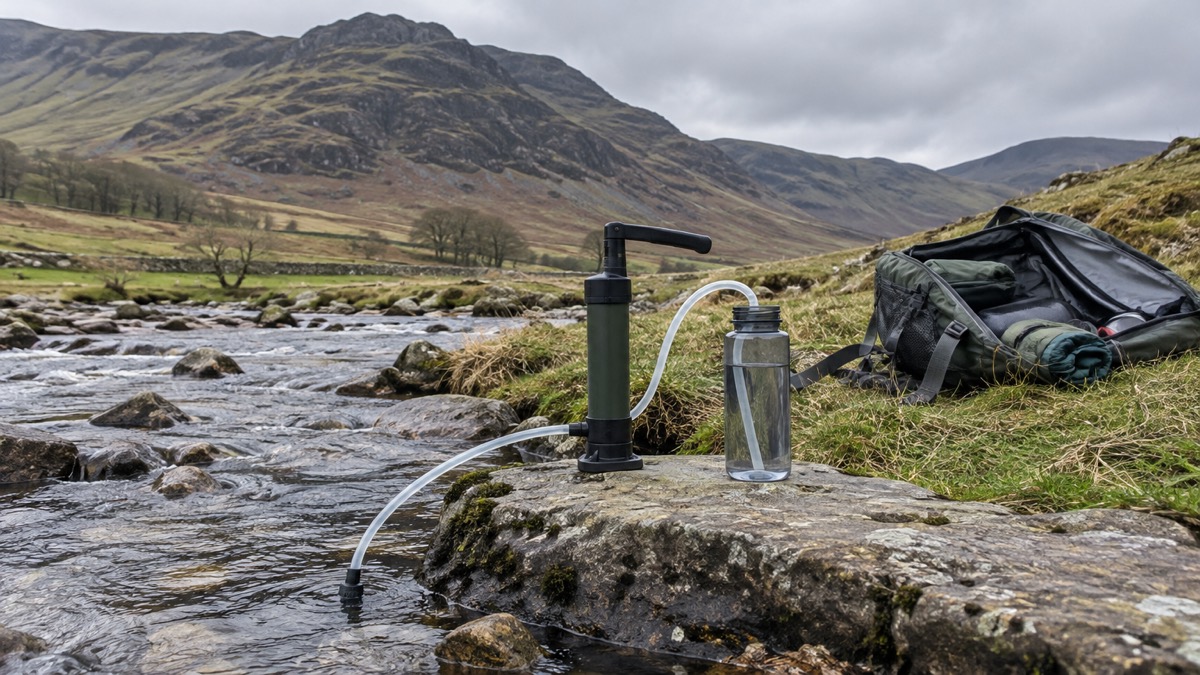
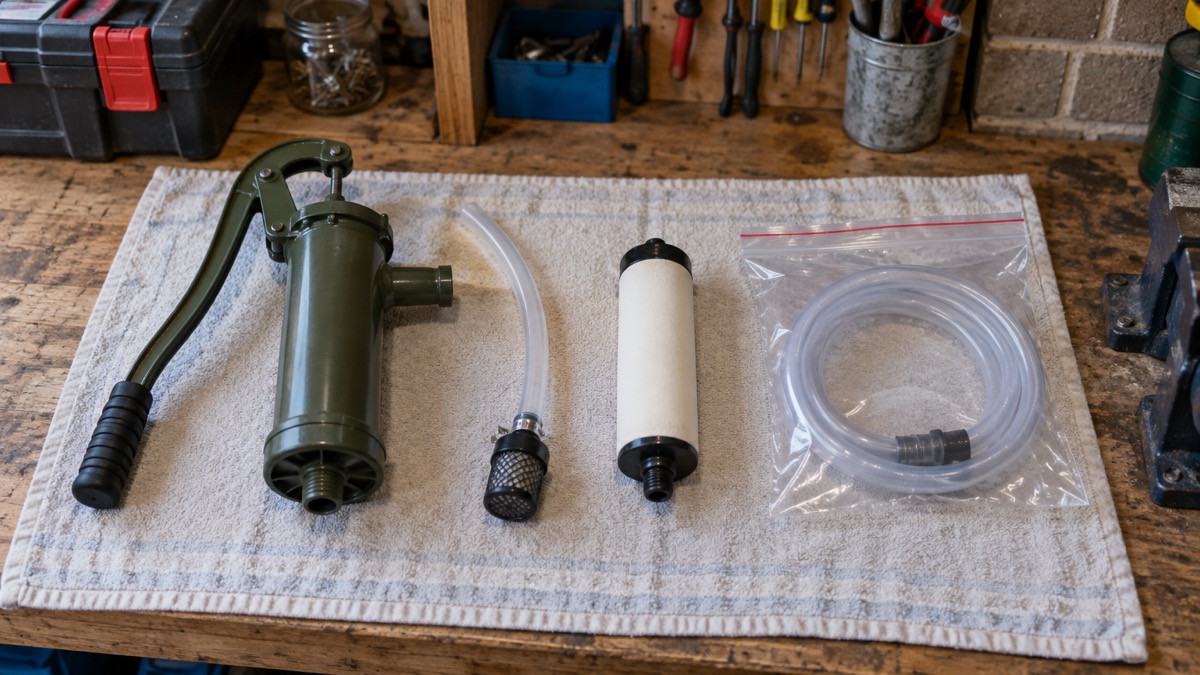
The Katadyn Pocket is a hand pump water filter: you put the intake hose in a source of water, pump the handle, and filtered water comes out of the outlet hose. It needs no electricity and no plumbing, which is why it matters to a household preparing for a supply interruption. The maker lists it as emergency ready, working when systems fail, and says it is effective against bacteria, protozoa, cysts and sediments1.
The numbers that decide whether it suits you are these. The ceramic element has pores of 0.2 microns, and the maker says microorganisms cannot pass through them because of their size1. Output is approximately 1 litre per minute, and the maker gives a group size of 2 to 5 people1. The unit weighs 550 g and is 60 mm in diameter1. Capacity is up to 50,000 litres, depending on the water quality1.
It is a pump filter, not a gravity filter, so it suits a household that wants water on demand from collected sources rather than a system that drips through overnight. If you are still deciding what kind of filter fits your home, the guide to emergency filters sets the types side by side, and hand pump filters covers this category in general.
What the Katadyn Pocket does when the mains water fails
When a supply interruption or a do not drink notice leaves you without safe tap water, the Pocket gives you a way to treat water you have collected, using your own effort rather than mains power. The maker describes it as a portable water microfiltration system and lists clear water and muddy water as suitable sources3. It is a hand pump microfilter with a ceramic depth filter4.
What it removes is set out by the maker as bacteria, protozoa, cysts and sediments1. The manual gives the performance figures behind that: a reduction of bacteria of 99.9999% for Klebsiella terrigena, and of protozoan cysts of 99.9% for Giardia and Cryptosporidium2. The prefilter blocks particles larger than 130 microns from entering the water system, which is what keeps the ceramic from loading up too quickly2.
The maker's own framing is that the Pocket is built for the toughest conditions and has been used by military and emergency professionals around the world5. That is the maker's description of its market, not an independent test result. What it means for a household is simpler: the design assumes rough sources and repeated cleaning, which is the situation a prolonged outage creates.
It is worth being clear about what the filter does not do. It is a microfilter, and the maker's claims are about microorganisms and sediment. If your water company has issued a do not drink notice, follow the notice first: it may call for boiling or an alternative supply, and a filter is not a substitute for that instruction. For the general question of which treatment suits which situation, see how to make water safe to drink in an emergency.
Specifications: 0.2 micron silver-impregnated ceramic, 550 g
The core of the unit is a silver-impregnated ceramic filter element6. The silver treatment is part of the maker's specification, and the pore size of 0.2 microns is what does the mechanical work: the maker states that microorganisms cannot pass through the pores of the filter ceramic because of their size, greater than 0.2 microns, which is 0.0002 mm5.
| Specification | Figure | Source |
|---|---|---|
| Filter type | Hand pump microfilter, ceramic depth filter | 4 |
| Filter material | Ceramic, silver-impregnated | 1 |
| Pore size | 0.2 microns | 1 |
| Output | Approximately 1 litre per minute | 1 |
| Group size | 2 to 5 people | 1 |
| Capacity | Up to 50,000 litres, depending on water quality | 1 |
| Weight | 550 g | 1 |
| Diameter | 60 mm | 1 |
| Field cleanable | Yes | 1 |
| Standard model number | 2010000 | 1 |
| Standard model EAN | 7612013201003 | 1 |
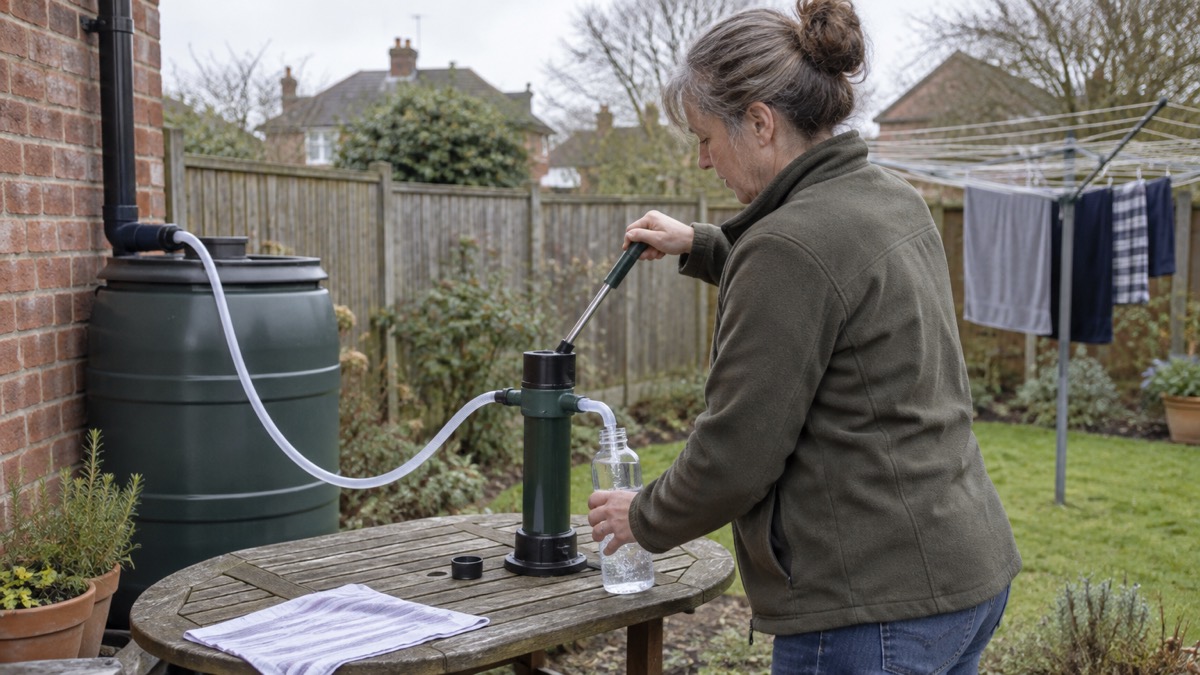
The capacity figure deserves a note. The manual explains that cleaning the ceramic in dirty water reduces the capacity of approximately 50,000 litres3. In other words, the headline capacity assumes a certain quality of source water; the dirtier the water and the more often you have to brush the element, the sooner the element wears out. Treat 50,000 litres as an upper figure for good conditions, not a promise.
The manual also gives a group size of 1 to 4 persons for trekking, journeys and expeditions3, while the product page gives 2 to 5 people1. The two documents give different ranges; for household planning, the product page figure is the one to work from, and the manual's figure suggests the unit is comfortable at the smaller end.
Output: about 1 litre a minute for 2 to 5 people
At approximately 1 litre per minute, the Pocket fills a one litre bottle in about a minute of steady pumping1. That is the figure to plan around. A household of four drinking the usual amount will need several litres a day, and the pumping is done by hand, so the practical question is who does it and when rather than whether the filter can keep up.
The maker's group size of 2 to 5 people1 puts the Pocket in the middle of the range: it is more than a personal filter bottle and less than a gravity system for a large household. If you are working out how much water your household actually needs, the guide to how much drinking water to store per person does that arithmetic, and the supply interruption checklist sets out what to have ready before you need it.
Two practical points follow from the flow rate. First, pumping is effort: the maker's manual says never use force when pumping2, so a slow stroke is normal and a stiff one is a signal to clean. Second, output falls as the ceramic loads with sediment, so the effective rate over a long outage depends on how well you prefilter and how often you clean.
For comparison within the maker's own range, the Katadyn BeFree is specified at up to 2 litres of water per minute7, but it is a different kind of product for a different job. The Pocket's advantage is not speed; it is the cleanable ceramic element and the hand pump that works from a container.
First use and flushing before each use
The maker's manual gives specific flushing volumes, and they are worth following because they deal with two different problems: ceramic dust on a new unit, and stale taste in a unit that has been sitting.
- Before first use: flush the system by pumping approximately 0.5 litres of water through the unit to remove harmless ceramic dust2.
- Before each use: flush and discard a small amount, 0.2 litres, to remove stale taste2.
- After fitting a new ceramic element: pump and discard the first litre3.
- Coming out of long-term storage: flush the system with one litre of water to remove any stale tasting water2.
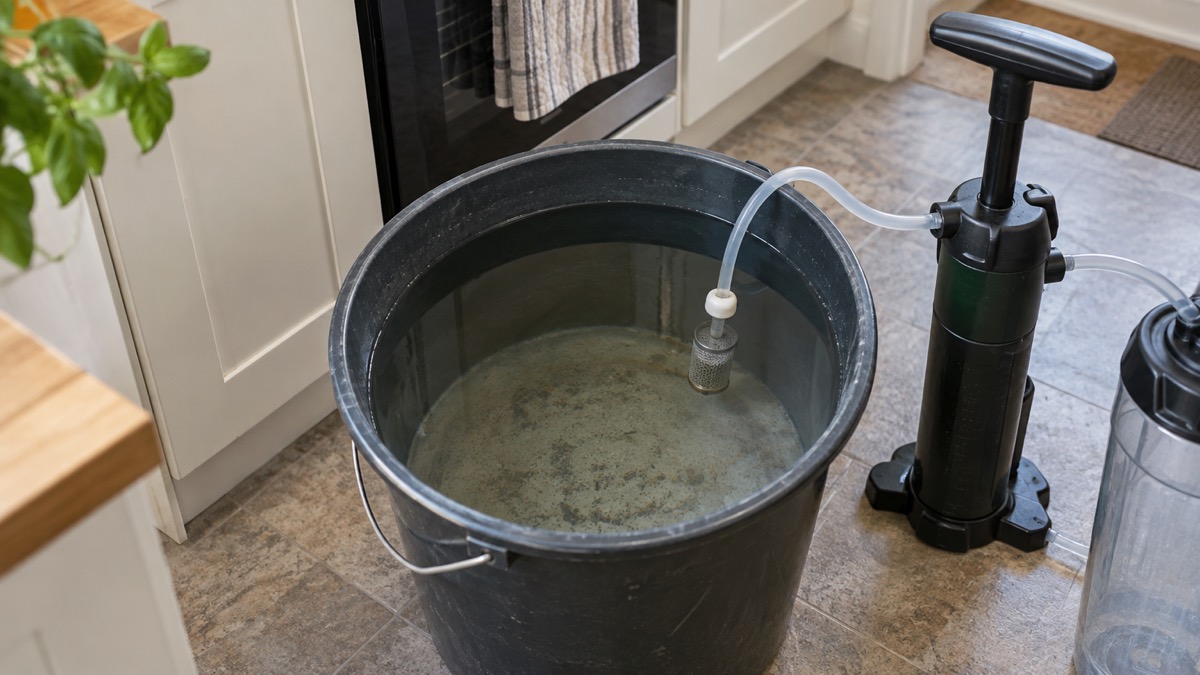
The manual also gives a preparation step that pays for itself in cleaning time: where possible, place untreated water in a container and wait for sediment to settle out until the water appears clear, then filter from the water above the sediment2. In heavy sediment conditions, wrap a coffee filter or bandanna around the input prefilter3. The prefilter blocks particles larger than 130 microns2, and the extra layer takes the mud before it reaches it.
Set the float up correctly before you start. The manual says to push the hose float onto the input hose, the one with the prefilter, and position it approximately 4 inches from the prefilter2. That keeps the intake near the surface rather than in the silt at the bottom of the container.
Cleaning the ceramic and when to replace it
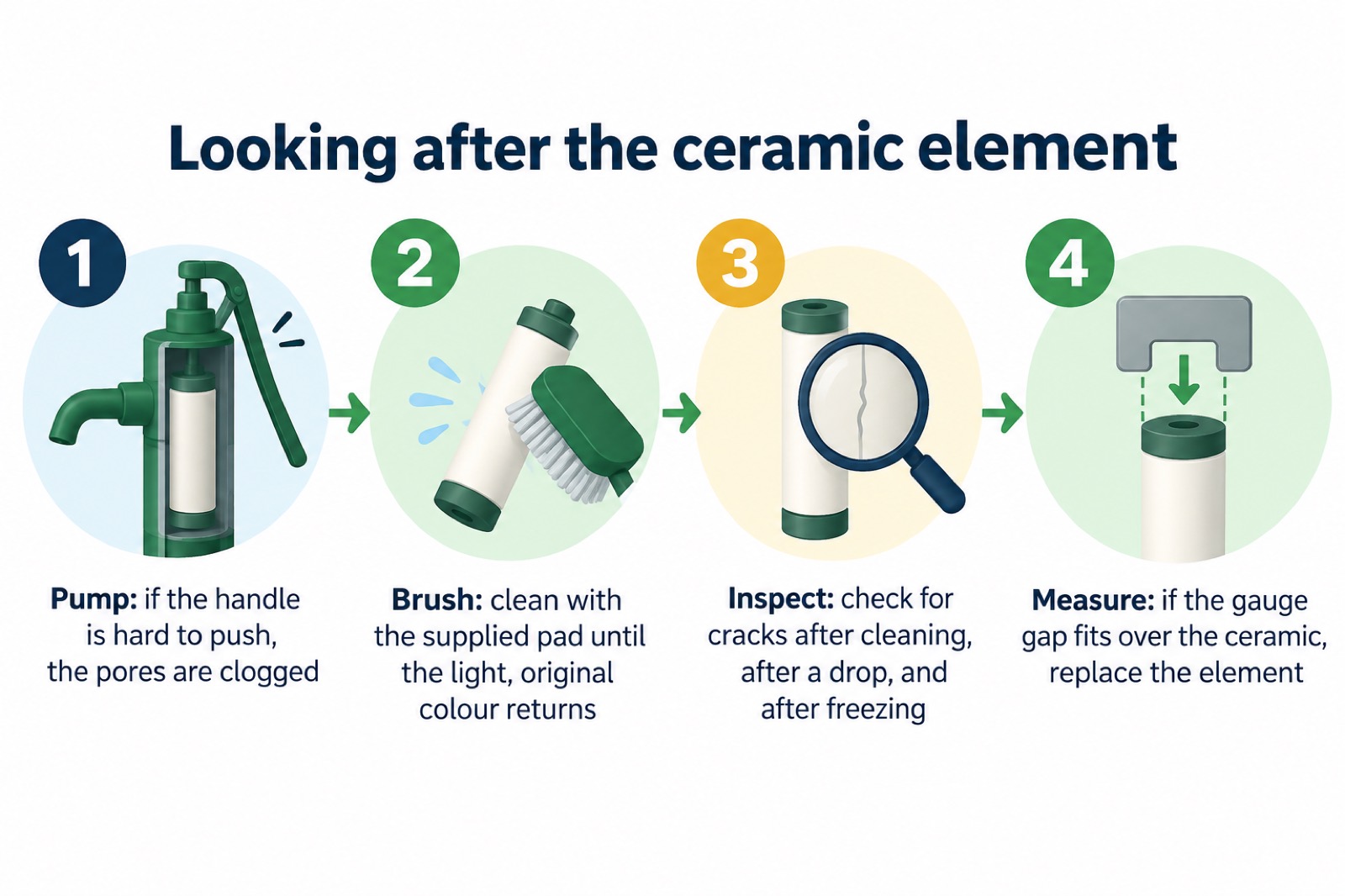
The ceramic element is the part that does the filtering, and it is designed to be cleaned rather than thrown away. The maker says the ceramic can be cleaned repeatedly, including in the field, and that you should follow the instructions for cleaning and checking the ceramic before reuse4. The manual's method is to clean the ceramic element by brushing it with the supplied cleaning pad until the light, original colour appears again2.
The symptom that tells you cleaning is due is a stiff handle. The manual's troubleshooting entry is direct: if the filter pores of the ceramic are clogged, the ceramic needs to be cleaned2. Do not respond by pushing harder. The same manual says never use force when pumping2.
Replacement is decided by a gauge, not by guesswork. The manual states that if the gap of the measuring gauge fits over the ceramic, it is time to replace the filter element2. The older manual gives the same rule3. Keep the gauge with the filter; it is the only reliable way to know when the element is worn out.
Freezing is a real risk for a filter kept in an unheated shed or a vehicle over winter. The manual's inspection list includes freezing temperatures for exactly that reason2. Store the unit where it will not freeze, and check the element before the next use if it might have.
Storing it so it works next time
Storage is where a filter that worked in October fails in March. The manual gives one instruction that matters: to prevent the possibility of cross contamination, remove the output hose with the clip and store it separately in the re-sealable bag inside the carry bag1.
The cross contamination point is easy to miss. The output hose is the clean side of the system; if it is coiled in the bag against the intake hose and the prefilter, the clean side picks up whatever the dirty side is carrying. Bagging it separately costs nothing and removes the risk.
Before you put it away, clean and check the ceramic as the maker instructs1. A unit stored dirty will be harder to clean later, and a unit stored without inspection may be stored with a crack you have not seen. Keep the measuring gauge, the cleaning pad and the manual together with the filter so that none of them goes missing between uses.
Warranty, registration and support
The maker's product page states a 20-year warranty1. The manual states a lifetime warranty from the date of purchase against defects in materials and workmanship2. The two documents give different descriptions of the cover, so check which applies to your purchase when you register it.
Registration is done online. The manual asks you to register your new Katadyn product by completing the short product registration form at www.katadyn.com/productregistration2. Registration is also how you will be reached if there is ever a safety notice for the product.
Keep the paperwork. The manual asks you to retain your purchase receipt as proof of date purchased, and says a defective item should be returned to the Katadyn retailer from whom it was purchased3. The same requirement appears in the maker's manual for its Drip filter8, so it is a standing condition rather than a quirk of this model.
For support, the manual gives contact numbers: in Europe +41 44 839 21 11, and in North America 1-800-755-67012. The maker, Katadyn, describes itself as developing Swiss-engineered water treatment solutions since 19289.
The Black Edition: what is different
The Black Edition is listed under its own article number, 8020425, with barcode 06043752042564. The standard Pocket is article 2010000, with EAN 76120132010031. Those identifiers are what you need when ordering a replacement element or making a warranty claim, so check which model you own before you contact anyone.
On the core specification, the maker's listings for the two models match. Both are hand pump microfilters with a silver-impregnated ceramic element, 0.2 micron pores, approximately 1 litre per minute output, 550 g weight, 60 mm diameter, a group size of 2 to 5 people and a capacity of up to 50,000 litres depending on water quality1. The Black Edition is listed as field cleanable and suitable for clear water and muddy water, the same as the standard model4.
The Black Edition page also states that the ceramic can be cleaned repeatedly, including in the field, and that you should follow the instructions for cleaning and checking the ceramic before reuse4. The care routine is therefore the same: brush, inspect, measure, and replace when the gauge says so.
If you are comparing the Pocket with the maker's other hand pump model, the Katadyn Vario is a separate product with its own specification. For the wider question of what different filter media remove, see ceramic, carbon, hollow-fibre and RO, and for care routines that apply to any filter, looking after a filter.
Sources (11)
- Katadyn Pocket Water Filter product page, Katadyn, 2026-10-28
- Katadyn Pocket Microfilter manual (2026), Katadyn, 2026
- Katadyn Pocket Microfilter manual (2012), Katadyn, 2012-09-19
- Katadyn Pocket Water Filter Black Edition product page, Katadyn, 2026-10-28
- Katadyn Pocket Water Filter Black Edition product page (US), Katadyn, 2026-10-28
- Katadyn Pocket Water Filter product page (German), Katadyn, 2026-10-28
- Katadyn BeFree manual, Katadyn, 2026
- Katadyn Drip manual, Katadyn, 2013-10-04
- Katadyn, Katadyn, 2026-10-28
- Katadyn Pocket Water Filter Black Edition product page (French), Katadyn, 2026-10-28
- Katadyn Pocket Water Filter Black Edition product page (German), Katadyn, 2026-10-28
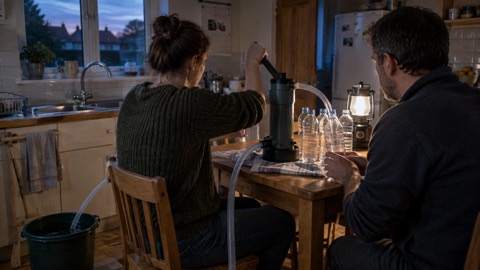 Katadyn Vario
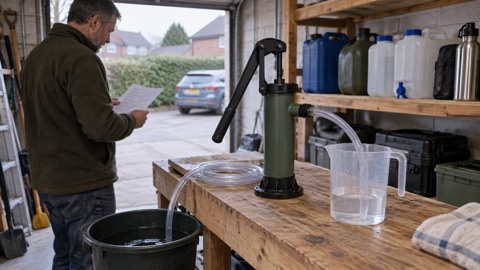 Katadyn Explorer Filter