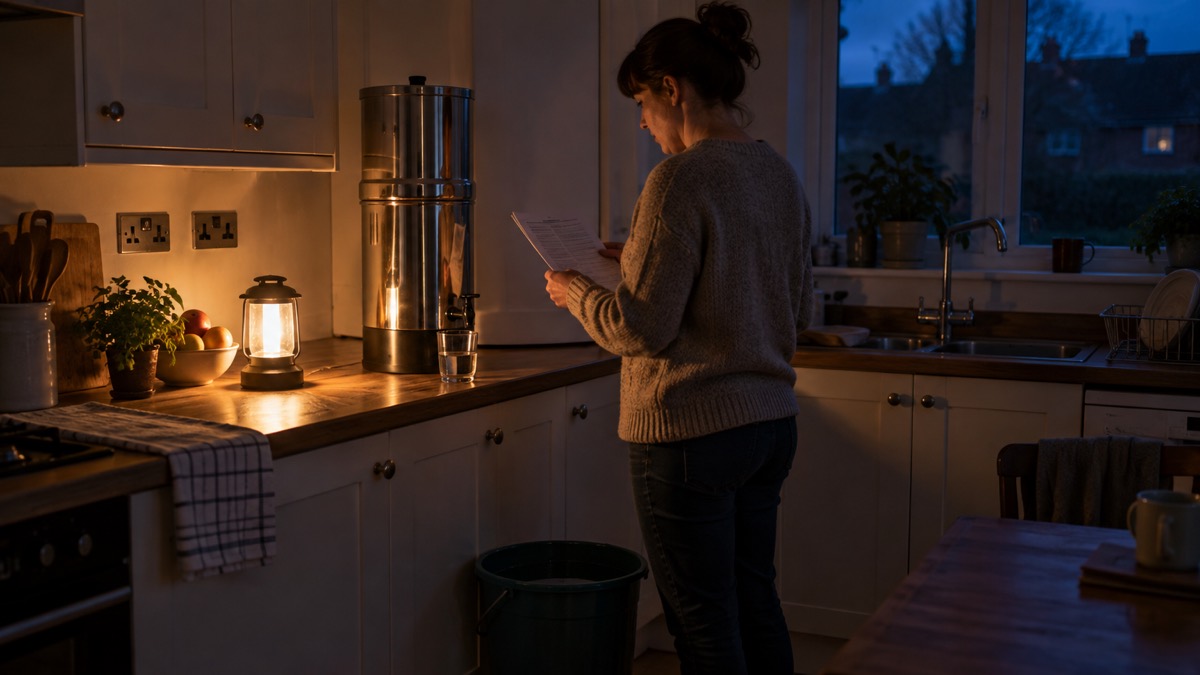
A gravity water filter is a standalone unit that sits on a counter and is fed with water by hand. It works by using gravity to pull water from an upper chamber, through specialist filter candles, into a lower chamber1. Nothing about it needs a power supply or a pipe: the maker states these systems require no plumbing and no electricity, and that they work during water or power outages2. That is the whole reason households keep one for emergencies: when the mains is off or under a boil notice, you pour water in the top and draw treated water from the tap on the bottom chamber.
The part that does the work is the ceramic candle, a cartridge of porous ceramic, sometimes with carbon and other media inside. Official guidance from the Drinking Water Quality Regulator for Scotland describes it plainly: the pores in the material allow water to pass through but trap impurities such as dirt and bacteria, and no electricity is needed because the water is filtered under gravity4. Candles can last for many months with proper care, but they need cleaning every few weeks and replacing roughly every 6 months4.
This page explains how the system fits together, what a candle does and does not remove, how to choose a size for your household, and how to set up, clean and maintain one safely.
How a gravity filter works: top chamber, candles, bottom chamber
A gravity system is two containers stacked one on top of the other. The maker describes the arrangement for its stainless steel systems: the upper container is filled with untreated water, which filters down through the filter elements into the bottom chamber9. Water moves because gravity does all the work: there is no pump, no pressure from the mains, nothing but the weight of the water itself10. The maker's guidance on choosing a filter puts it simply: gravity systems use natural pressure to move the water from the top chamber through to the bottom11.
The candles are mounted in the base of the top chamber, pointing downwards, so every drop leaving the top chamber has to pass through one. That has a useful consequence the maker highlights: with a gravity system, all water that comes into the bottom chamber will be filtered water12. Unlike a tap-mounted filter, where you can switch a valve between filtered and unfiltered water, there is no way to bypass the candles by accident13. What sits in the bottom chamber is what you drink.
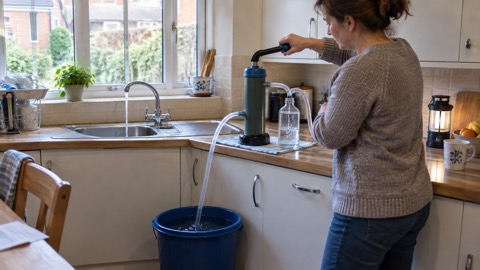
Day to day, operating one is straightforward. The maker's instructions for its SS gravity system tell you to mount the top chamber onto the bottom chamber, fill the upper chamber with cold water to just below the rim, place the lid in position and allow all the water to filter through, replenishing as required without overfilling14. One practical habit from the same manual: if you need to move or empty the system, remove the top chamber first and carefully empty any unfiltered water away, and clean away any unfiltered water spilt on the outside of the housing immediately14. Keeping unfiltered water out of the bottom chamber and off the tap protects the treated supply.
What a ceramic candle traps, and what decides the rest
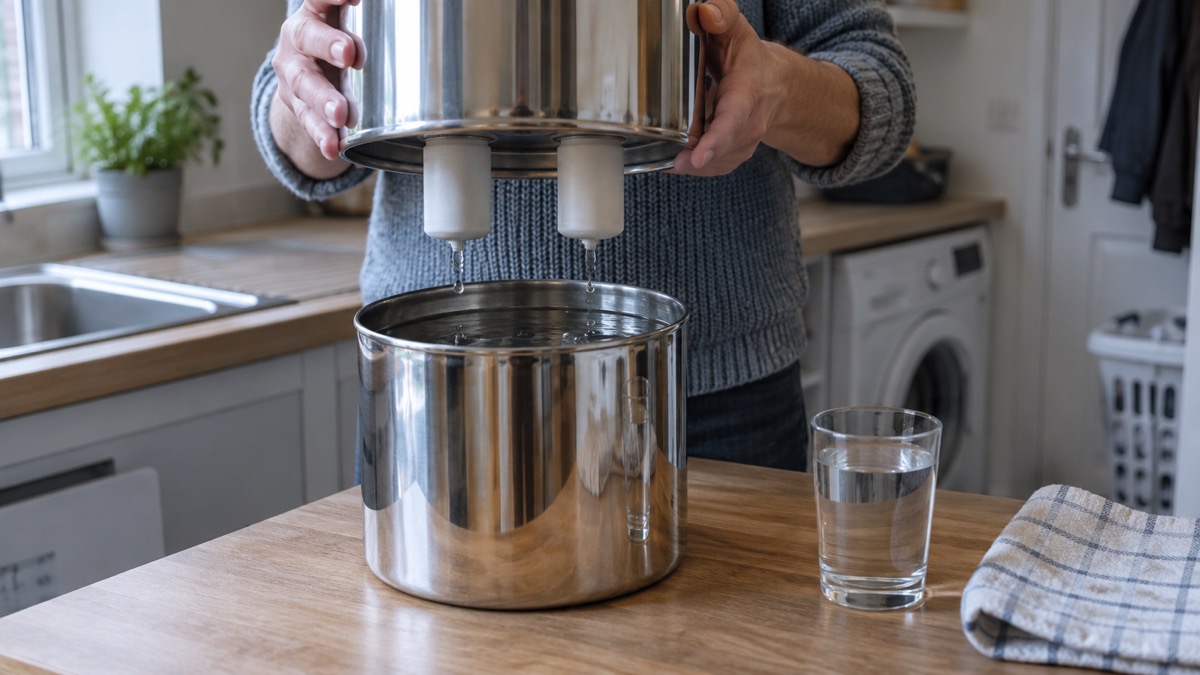
The ceramic itself is a physical barrier. The maker describes how the filter traps bacteria on the surface of the ceramic while allowing clear, mineral-rich water through15. Inside the ceramic, the structure does more of the same: water flowing through a ceramic filter encounters multiple twists, turns and sharp angles, and particles that penetrate the surface become trapped within the structure11. The regulator's guidance agrees on the mechanism: the pores allow water through but trap impurities such as dirt and bacteria4.
What a candle removes beyond dirt and bacteria depends on what is packed inside it. The maker's guidance on ceramic filters with an assortment of internal media notes a good balance of contaminant reduction for cysts, lead, asbestos and chemicals, dependent upon the internal treatment media, with no power needed and a cleanable surface that lets you restore the flow11. For example, the Doulton Ultracarb M15 candle is a ceramic shell fitted with an activated carbon block containing lead removal media16. If you want to compare what different filter types remove, see what each filter type removes.
There is a limit that matters for emergencies. The maker's manual for the SS gravity filter states the filter is designed to filter harmful bacteria out of the water, but must not be used on untreated raw water sources8. For a British household that means a gravity filter is for treating a mains supply that is under a boil notice, or stored tap water that has gone stale, not for making stream or pond water drinkable. If you need to treat water from an untreated source, read how to make water safe to drink in an emergency and drinking from streams, rivers and other sources safely.
Choosing a size for your household
British Berkefeld gravity systems come in four sizes. The smallest is designed to be taken with you and provides 750ml of filtered water; the other sizes are 6, 8.5 and 12 litres, and the maker advises choosing dependent on the size of your household and how often you want to be refilling5. A separate product page lists the same range: 1 litre, 6 litre, 8.5 litre and 12 litre systems17. The maker also notes these systems are available in a range of different capacities, perfect for personal or family use3.
| System size | Best suited to | What to expect |
|---|---|---|
| 750ml / 1 litre | One person, travel, taking away from home | Smallest and most portable; frequent refills5 |
| 6 litres | One to two people, or a worktop with little space | Fewer refills than the smallest system5 |
| 8.5 litres | A small family | A common middle choice; two candles fitted as standard9 |
| 12 litres | Larger households, or emergency storage | Fewest refills; takes the most counter space5 |
Two other figures help you judge how much use you will get. The maker's manual for the SS gravity filter gives a rated capacity of 1500 litres per filter element8, so a system with two candles has a good deal of treated water in it over its life. The same manual lists a 22.5 litre housing for one version of the SS system, though another manual for the same family lists 8.5 litres, so check the specific model's instructions before assuming the larger figure8. For how much water a household actually needs in an interruption, see how much drinking water to store per person.
Size has trade-offs beyond capacity. The maker's guidance lists the drawbacks plainly: a gravity system takes up counter space and needs manual intervention, with manual refilling required and slower filtration because gravity does all the work11. Against that, the same guidance notes a gravity system can be moved around and taken with you on house moves or holidays, and that if the number of users in your household varies, you have the flexibility to place it where needed and keep the water topped up accordingly11. For an emergency, a larger bottom chamber is a small buffer of ready-filtered drinking water; for everyday use, choose the size you will actually keep topped up.
Setting up a new gravity filter
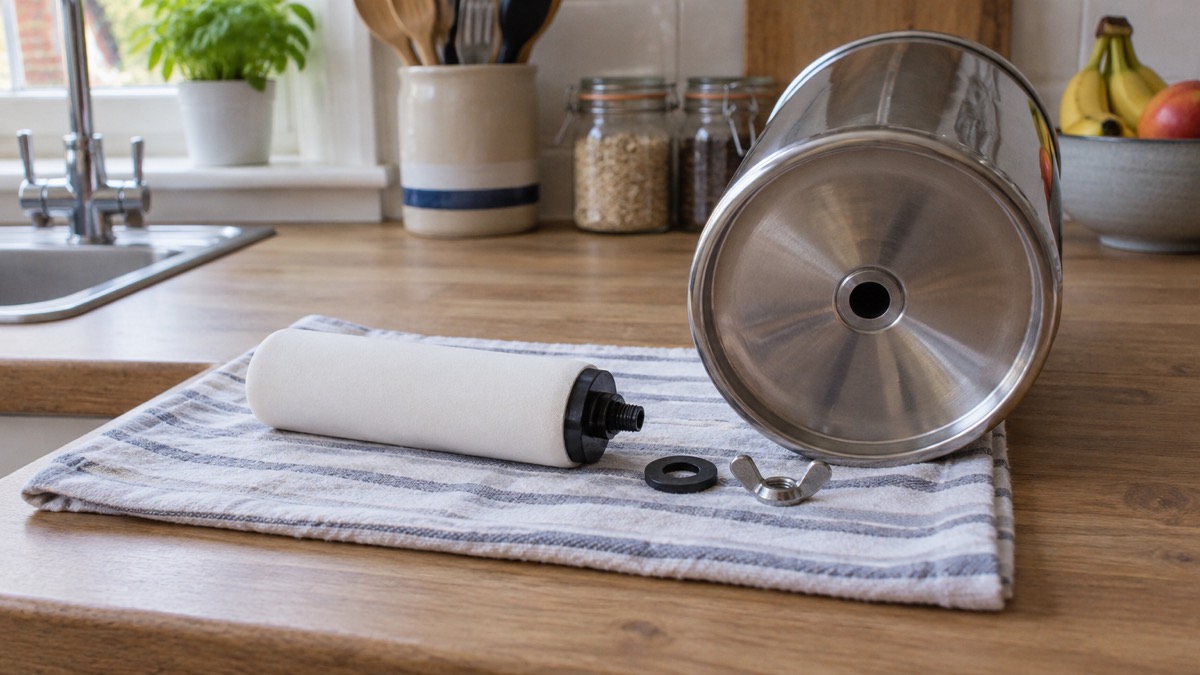
Set-up is deliberately simple because there is nothing to install. The maker describes it as simply a case of installing the filter elements inside the top chamber and placing this over the bottom chamber13. The instructions for the SS system break the candle fitting into steps: remove the protective packaging, place a sealing washer over the filter element mount stem, pass the stem through the hole in the base of the top chamber and secure it with the wing nut14. A poor seal there shows up as unfiltered water dripping past the candle, so seat the washer carefully.
Before the first proper use, the candles need priming. The maker's guidance says you will need to run water through the filters to wet and prime them5. The instructions for the Ultra Sterasyl candle are specific: ensure the gravity tap is closed, fill the upper chamber with cold water, and allow all of the water from the top chamber to filter through19. For the first few uses, the maker advises flushing the water through and discarding it2.
Do not be alarmed by the first run. The maker's manual notes that because the filter is made of ceramic and contains carbon, particles may be visible when water filters through for the first time8. That is why the first flushes are discarded. Once the system is running, day-to-day use is a matter of keeping the top chamber topped up: the maker notes manual refilling is required18, so build the refill into your routine rather than waiting for the bottom chamber to run dry.
Filter rate: slower than a tap filter, faster with more candles
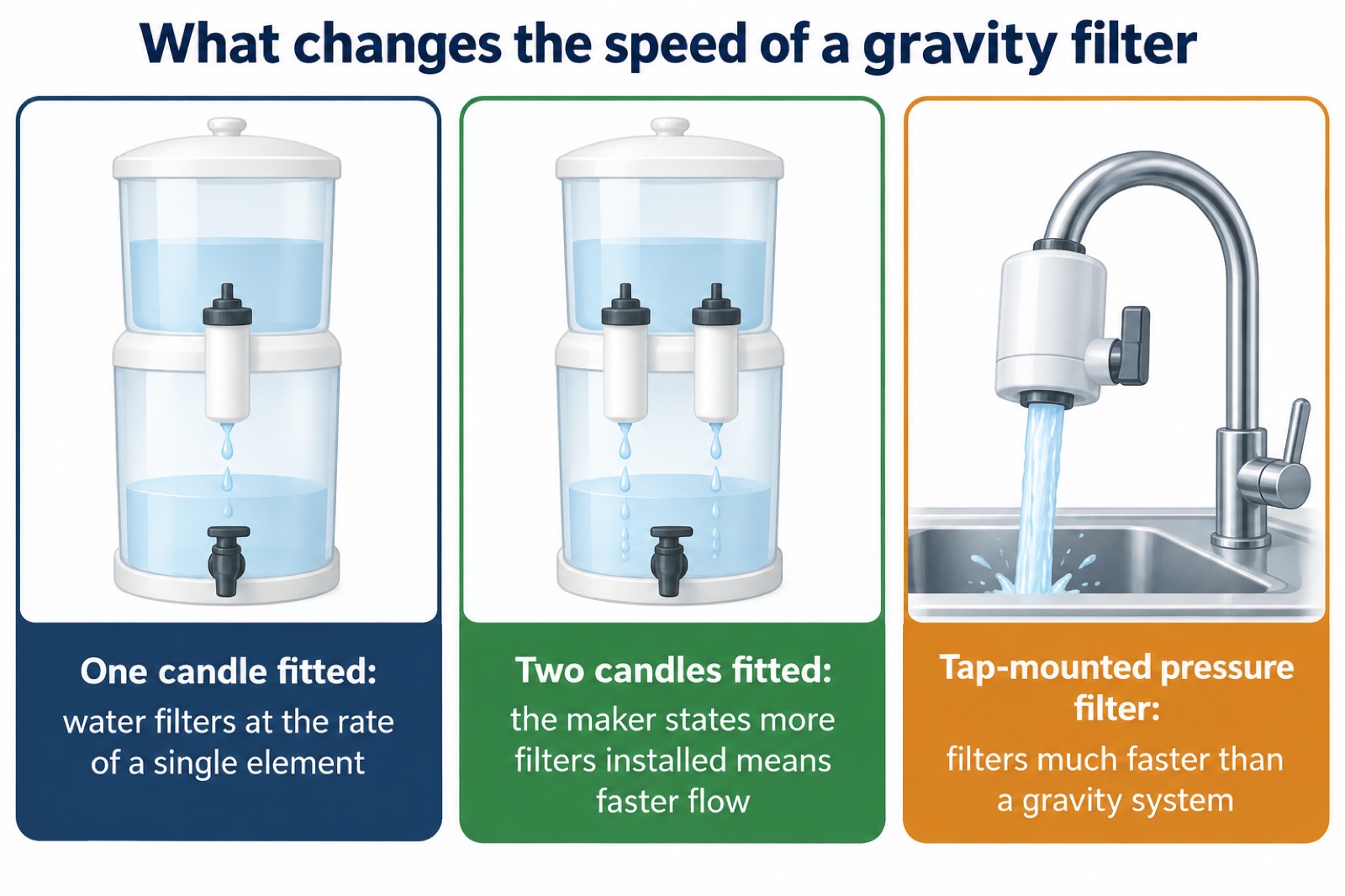
Gravity filters are not fast, and it helps to know that before you buy. The maker states a gravity system filters through much slower than a pressure system such as the tap-mounted water filter, because gravity is doing all the work12. Its product pages describe gravity water filters, especially using ceramic, as one of the slower methods of filtering water17. You cannot hurry it by squeezing or pumping; the water moves at the speed the candles allow.
The way to get more water through is more candles. The maker states plainly that the more filters that are installed, the faster the water will flow through17. A system fitted with two candles filters roughly twice as fast as one with a single candle, because each candle handles its own share of the top chamber. Some systems can be fitted with different numbers of elements: the manual for the 1 litre BB gravity system notes it can be fitted with 1 ceramic filter element14, while the 8.5 litre SS2 system comes as two stainless steel containers with two filter elements9. When you are choosing, check how many candles the system takes and how many are supplied.
Plan around the speed rather than fighting it. If you know you will need a full bottom chamber in the morning, fill the top chamber the night before. If the household drinks a lot, either move up a size or choose a system that takes more candles. And if the flow slows well before the six-month replacement point, that is usually the ceramic surface loading up, which is a cleaning job rather than a fault: the maker advises that if water flow is slow or stops, clean the ceramic filter candle first, and replace the filter only if cleaning does not restore the flow7.
Cleaning a ceramic candle without soap
Cleaning is what keeps a candle working for months instead of weeks. Official guidance from the Scottish regulator recommends candles are cleaned and inspected every few weeks, or when the water starts to percolate more slowly4. The cleaning itself is gentle: the maker says to gently scrub the surface of the ceramic filter under running water using a soft brush or sponge7.
The regulator gives the method for candles in housings: the filters can be unscrewed from their plastic casing, and it is recommended that rubber gloves are worn and the cleaning is done with clean warm water and a soft brush or damp cloth4. The maker's datasheet for the 8.5 litre system describes the technique in detail: take a soft bristle brush or lightly abrasive pad, cup it around the circumference of the filter element, apply gentle pressure and work down the length once, ensuring even cleaning over the whole surface9. One pass, lightly, is enough; scrubbing hard thins the ceramic and shortens the candle's life.
Hygiene around cleaning matters as much as the cleaning. The maker's manual for the Ultra Sterasyl candle says to wash and dry your hands, then remove, clean and replace the cartridge, taking care at all times not to contaminate the threaded part of the mount with unfiltered water19. The SS manual likewise says to wear rubber gloves or wash hands well before and after handling the product8. Unfiltered water on the mount or the tap can re-contaminate water you have already treated, so keep the two sides of the system separate in your routine.
Replace candles about every 6 months, or sooner if flow or taste changes
Every maker's page and the regulator's guidance converge on the same interval. The maker recommends replacing the filter every 6 months, and says a drop in water flow or a change in taste may mean it is time to replace it6. The same advice appears across the Doulton and British Berkefeld candle ranges16, and the regulator's guidance gives rough guidance that candles should be replaced every 6 months depending on usage4. One maker support article puts it slightly more broadly, saying replacements are typically required every 6 to 12 months depending on usage and water quality20; the documents differ a little, so treat 6 months as the safe planning figure and 12 as the outside edge.
The order of response matters when something changes. The maker's guidance for British Berkefeld systems says that if taste changes or flow slows, clean the filters first, and replace them if cleaning does not help5. The maker also states that if water flow lessens before 6 months, change the filter21. So the sequence is: flow drops or taste changes, clean the candle, and if that does not restore it, replace the candle rather than waiting out the interval.
Two signs mean replace immediately, without cleaning first. Water company guidance from United Utilities says to follow the manufacturer's instructions for installation, maintenance and use, change the filter cartridge at the recommended frequency, and change it immediately if beads or black particles appear22. The same guidance applies to any cartridge that becomes damaged or split: if tiny beads or small black particles appear in the filtered water, the cartridge should be changed straight away rather than cleaned and reused22.
Cracked or damaged candles, and filters unused for a while
A cracked candle is not a reduced filter; it is a bypassed one. The maker warns that if a candle is dropped you should inspect it for cracks, because even small cracks can affect the filter's performance and could allow contaminants to pass through; replace it if damaged7. The regulator's guidance is firmer still: cracks or damage reduce effectiveness and can lead to impurities leaching back and harmful bacterial growth4. If in doubt after a knock or a drop, replace the candle rather than relying on it.
A filter that has sat in a cupboard needs attention before its next use. The regulator advises running water through the filter for about 5 minutes after a period of non-use, and checking the filter for damage before use4. That flush clears anything that has settled in the candle and the bottom chamber while the system was dry. For storage itself, the maker advises that when the system is not in use you give the inside a light wipe with kitchen roll or a dry cloth to keep it dry, and use an anti-static cloth or dry kitchen roll on the stainless steel exterior23. Store it dry, with the chambers apart if you can, and prime the candles again when you bring it back into service.
Hygiene for immunocompromised users
If someone in the household has a weakened immune system, the handling routine matters more, not the filter itself. The regulator's guidance notes that filters can collect microbes, so it is recommended that you wash your hands after cleaning or replacing the filter, and that immunocompromised people should get someone else to replace filters if possible4. The SS manual likewise says to wear rubber gloves or wash hands well before and after handling the product8.
The practical version of that advice: let the healthiest person in the house do the candle changes and the cleaning, with gloves on, and wash hands afterwards. Keep the bottom chamber, the tap and the outside of the system clean, because the treated water can be recontaminated by a grubby tap or a hand that has just held an unfiltered top chamber. And observe the raw-water limit strictly: the maker states the filter is designed to remove harmful bacteria but must not be used on untreated raw water sources8. If your supply is under a boil notice and someone in the house is medically vulnerable, read extra help in an emergency and follow your water company's advice for vulnerable customers.
Recycling and disposing of old candles
Disposal depends on the manufacturer, so check with them first; the regulator notes some companies will recycle the plastic parts for you4. The maker's own guidance for British Berkefeld systems says any waste created by filtering your water can go straight back into the compost heap instead of the landfill24.
The SS manual gives the most detailed route: break the ceramic filters carefully to separate the plastic parts, and the ceramic and carbon elements can be crushed and reused as drainage material for plant pots; the stainless steel system itself is fully recyclable and can be offered at local collection8. So an old candle is not general rubbish by necessity: separate the plastic, compost or crush the ceramic and carbon, and recycle the housing when the system eventually reaches the end of its life.
Narrowboats, motorhomes and off-grid use
Gravity systems suit life away from the mains because they ask nothing of it. The maker describes them as fully portable, requiring no plumbing or electricity, making them ideal for home, travel or emergency use24. The same guidance says some people use their gravity filter system for off-grid living, whether in a narrowboat or a motorhome1, and the maker's pages list uses around the home, outdoors, on camping trips and on narrowboats17. British Berkefeld systems are also described as perfect for use in emergency situations, allowing larger capacities of water to be stored and filtered24.
On a boat or in a motorhome the same rules apply, with one worth repeating: the maker states the filter is designed to remove harmful bacteria but must not be used on untreated raw water sources8. A tank filled from a mains tap is one thing; a tank filled from a canal or a stream is another, and a gravity candle is not the tool for it. Also check headroom and securing: these are tall, heavy units when full, and the maker notes they take up counter space11. For treating collected water on the move, see hand pump filters and filter bottles and straw filters.
Filter jug or gravity filter
A jug filter and a gravity system are cousins, not rivals. The maker's guidance describes a pitcher or jug filter as a gravity-fed water filter inside a plastic pitcher container, where water slowly moves through the filter cartridge inside the jug11. The same physics, a much smaller body of water, and a cartridge that is generally not cleanable in the way a ceramic candle is.
| Jug filter | Gravity system | |
|---|---|---|
| How it works | Gravity-fed cartridge inside a plastic jug11 | Top chamber, candles, bottom chamber1 |
| Power and plumbing | None | None2 |
| Capacity | One jug at a time | 750ml up to 12 litres of filtered water5 |
| Cartridge | Not described as cleanable | Cleanable ceramic surface restores flow11 |
| Best suited to | Everyday taste and chlorine in one household | Emergency use and larger stored volumes24 |
For everyday use, Dŵr Cymru's household guidance notes there are two common types of domestic filter: an in-line filter usually fitted under the kitchen sink by a plumber, or a jug filter25. A jug is the cheap, familiar option for taste; a gravity system is the one that keeps working when the water is off, because the maker states these systems work during water or power outages3 and allow larger capacities of water to be stored and filtered in emergencies24. If you are weighing a gravity system against a plumbed-in filter instead, see gravity filter or under-sink filter, and for the tablet alternative see purification tablets or a gravity filter.
Whichever you choose, the maintenance habit is the same one the water companies stress: follow the manufacturer's instructions for installation, maintenance and use, and change the cartridge at the recommended frequency22. A filter that is not maintained does not just stop improving water; the regulator warns that if candles are not cleaned frequently and replaced when required, water quality is reduced4. For the wider routine, see looking after a filter.
Sources (25)
- Countertop water filter systems, Doulton, 2026
- Countertop water filter systems, Doulton, 2026
- Countertop water filter systems, Doulton, 2026
- Water filter candles: technical guidance, Drinking Water Quality Regulator for Scotland, 2026
- Ultimate guide to British Berkefeld, Doulton, 2026
- Doulton Ultracarb M15 filter, Doulton, 2026
- Doulton FAQs, Doulton, 2026
- SS Gravity Drinking Water Filter instructions, Doulton, 2025
- British Berkefeld SS2 Ultra Sterasyl 8.5L gravity system instructions, Doulton, 2024
- British Berkefeld, Doulton, 2026
- How do I choose a water filter, Doulton, 2026
- Countertop water filter systems, Doulton, 2026
- Countertop water filter systems, Doulton, 2026
- 1LT BB Gravity System instructions, Doulton, 2025
- Ultra Fluoride 8B76 filter, Doulton, 2026
- Doulton Ultracarb M15 filter, Doulton, 2026
- British Berkefeld, Doulton, 2026
- Countertop water filter systems, Doulton, 2026
- British Berkefeld Ultra Sterasyl 8674 filter instructions, Doulton, 2023
- Doulton FAQs, Doulton, 2026
- Doulton Ultracarb 9501, Doulton, 2026
- Understanding water in your home, United Utilities
- Ultimate guide to British Berkefeld, Doulton, 2026
- Portable water filters, Doulton, 2026
- Water quality in the home, Dŵr Cymru Welsh Water
 Supply Interruption Checklist
 Boil Notice Checklist
 Drinking Supply Checklist
 How Much Water to Store
 Storing Tap Water Safely
 Containers and Jerrycans
 Household Storage Tanks
 Water Already in Your Pipes
 Making Water Safe to Drink
 Boiling Water to Kill Germs
 Purification Tablets
 Emergency Filter Types
 What Water Filters Remove
 Hand Pump Filters
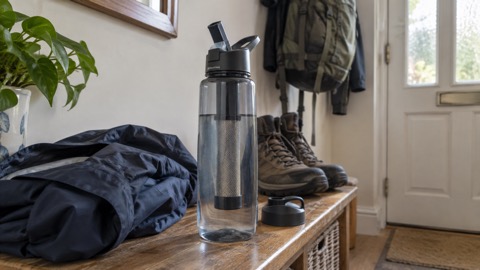 Filter Bottles and Straw Filters