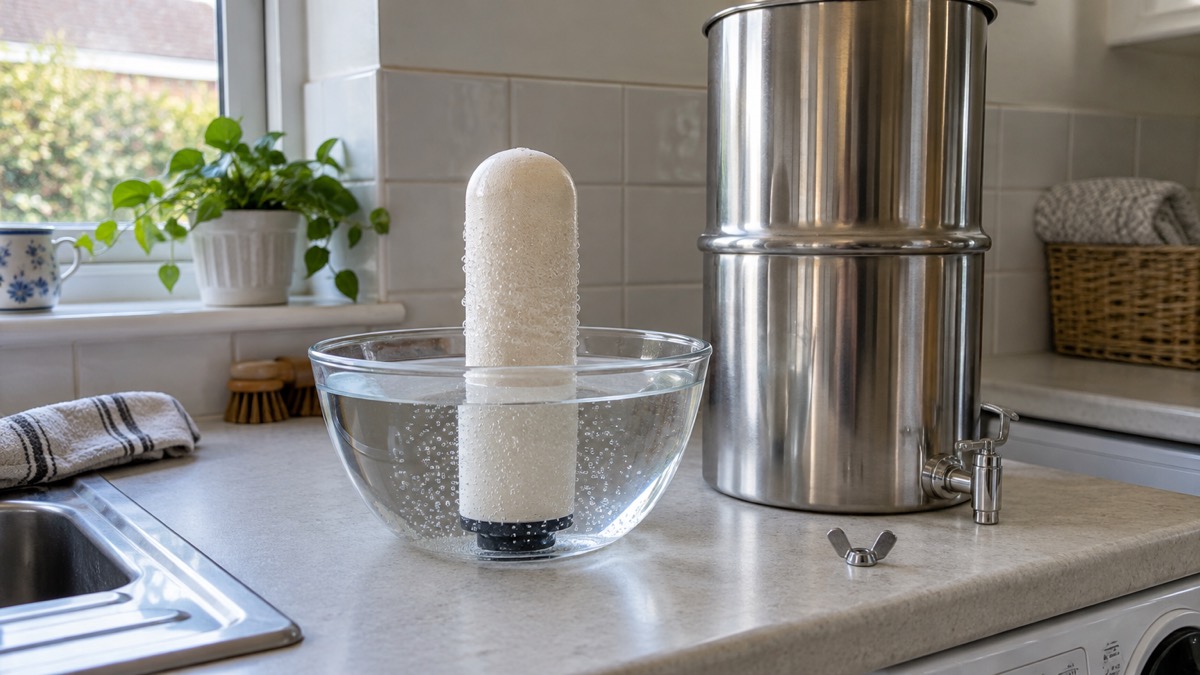
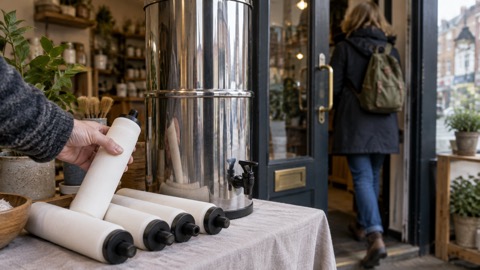
The British Berkefeld Ultra Sterasyl is a ceramic gravity filter candle: a hollow, porous ceramic element that sits in the upper chamber of a gravity system and lets water seep through it into the lower chamber. It is 7 inches (22cm) tall and 2 inches (5cm) wide, and it is sold as a replacement part rather than a complete system1. Water passes through the ceramic, which traps bacteria on its surface, and then through carbon and lead-removal media inside the candle3.
It is a sensible choice for a household that already owns a stainless-steel gravity filter and wants a candle that reduces bacteria, cysts, lead, chlorine and PFAS while leaving the minerals in the water. It is not a complete answer to unsafe water: British Berkefeld states plainly that its ceramic elements reduce cysts and bacteria but do not filter viruses4. Expect roughly 1 litre per hour per filter, so a system with more candles gives proportionally more, a plain sum of the maker's 1 litre per hour figure5.
Change it every six months, or sooner if the flow drops or the taste changes, and clean the ceramic when the flow slows rather than replacing it early6. The sections below set out what it removes, what it does not, which systems it fits, and how to prime, clean and replace it.
What the Ultra Sterasyl is and what it does
The Ultra Sterasyl is a ceramic drinking water filter candle made by British Berkefeld, model number 86743. It is built as a Sterasyl microfilter combined with granular activated carbon and lead removal media, so it does two jobs in one element: the ceramic does the physical filtration, and the carbon inside handles taste, odour and a range of chemical contaminants10. It is made in Britain3.
The way it works is mechanical rather than chemical. British Berkefeld describes the candle as forming a physical barrier for pathogens, trapping the bacteria in your water on the surface of the ceramic3. That is why cleaning the outside of the candle restores flow: the ceramic is doing the work at its surface, and the layer that builds up there is what eventually slows the water down.
It is designed for gravity systems, where water drips through under its own weight from an upper chamber to a lower one. That has two consequences a household should understand before buying. First, it is slow: there is no pump, so the flow rate is set by the ceramic and the head of water above it. Second, it needs no power, which is what makes it useful when the mains supply is off or a boil notice is in force and you want a supply of filtered water without electricity.
The Ultra Sterasyl replaces the ATC Super Sterasyl ceramic filter, and British Berkefeld describes it as formerly known as the ATC Super Sterasyl1. If you are searching for the older name, you are looking at the same product line under its current name.
What it removes, and what it leaves behind
British Berkefeld's claims for the Ultra Sterasyl are specific and worth reading closely, because a filter that removes some contaminants is not the same as one that makes any water safe. The maker states that the candle reduces PFAS, bacteria, cysts, microplastics and chlorine, among other things12. Its product pages list bacteria, sediment, rust particles, microplastics, heavy metals including lead, pharmaceuticals, oestrogen and chlorine1.
The test data behind those claims gives figures for individual contaminants. British Berkefeld reports more than 99.99% removal of E. coli, typhoid and Klebsiella terrigena, and more than 99.99% removal of Cryptosporidium and Giardia cysts, with the ceramics tested in filter housings at a minimum 5 log per 100mls influent challenge10. For PFAS it reports 95% combined PFOA and PFOS removal, from 1.5ppb to less than or equal to 0.07ppb, and for lead up to 95% at 150ppb presence at pH 6.5 to NSF Standard 5310.
| Contaminant | Maker's stated performance | Source |
|---|---|---|
| Bacteria (E. coli, typhoid, Klebsiella terrigena) | More than 99.99% | 10 |
| Cysts (Cryptosporidium, Giardia) | More than 99.99% | 10 |
| PFAS (combined PFOA and PFOS) | 95%, from 1.5ppb to 0.07ppb or less | 10 |
| Lead | Up to 95% at 150ppb, pH 6.5, to NSF Std 53 | 10 |
| Chlorine | Up to 99.9% (maker guidance); 99% (maker product page) | 9 |
| Microplastics | 99.9% reduction | 3 |
| Trace organics | Over 95% of certain trace organics | 5 |
Two of those figures are not settled. British Berkefeld gives chlorine reduction as up to 99.9% in one place and 99% in another, so treat the lower figure as the safe expectation9. The datasheet also notes that where test data shows as pending, the carbon supplier has confirmed the carbon will reduce the contaminant but it has not yet been tested to the current NSF protocol, so performance cannot be stated yet10.
What it leaves in matters too. British Berkefeld states that the Ultra Sterasyl filters retain essential minerals that benefit your health2. For a household used to the flat taste of distilled or reverse-osmosis water, that is the point: the candle takes out the things you do not want and leaves the mineral content alone.
What it does not remove
The limits of the Ultra Sterasyl are as important as its claims, and British Berkefeld is direct about them. Its ceramic elements reduce cysts and bacteria found in your water, but do not filter viruses4. That single sentence decides how far you can rely on the candle. Viruses are far smaller than bacteria and pass through the pores of a ceramic element, so a gravity filter of this kind is not a virus barrier.
The maker is equally clear on two other common questions. The Ultra Sterasyl and Ultra Fluoride filters do not directly remove limescale from your drinking water9. If hard water and kettle scale are your reason for filtering, this candle will not solve it. And the Ultra Sterasyl does not reduce fluoride; that is what the separate Ultra Fluoride candle is for4.
The practical rule is to match the filter to the water. For mains water that is already treated and safe, the Ultra Sterasyl improves taste and reduces a range of contaminants. For collected or suspect water, it is one layer among several, and the guide to what ceramic, carbon, hollow-fibre and reverse-osmosis filters each remove sets out where the gaps are.
Flow rate: about 1 litre per hour per filter
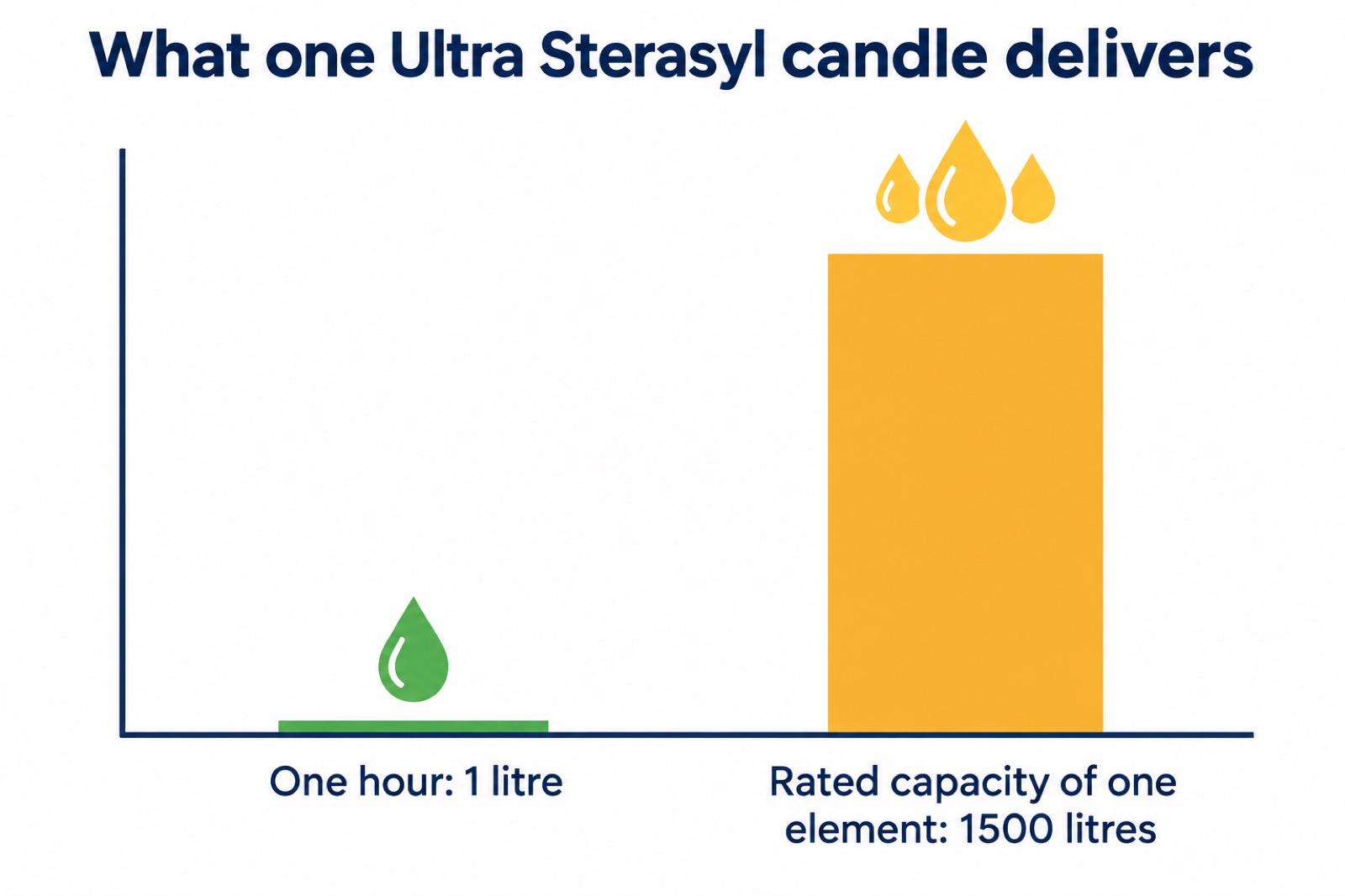
Gravity filtration is slow by design, and the Ultra Sterasyl's typical flow rate is 1 litre per hour per filter, or 0.26 US gallons per hour5. British Berkefeld notes that the figure may vary depending on the size of the housing and the number of filter elements5. A system with more candles fitted gives proportionally more, a plain sum of the maker's 1 litre per hour figure, though the maker's figure is per filter and the housing affects it.
That rate has real consequences for a household. At 1 litre per hour, a single candle produces a steady trickle rather than a flow, which is enough for drinking and cooking for one or two people but not for washing or flushing. Plan around it: fill the upper chamber before you go to bed and again in the morning, and keep a filled jug in the fridge rather than waiting at the tap.
Flow also falls as the ceramic loads up. British Berkefeld says the flow rate may decrease if the filter becomes clogged due to heavy usage, and that regular cleaning of the ceramic filter element helps maintain flow1. If you live in a cloudy water area, the maker suggests cleaning the Ultra Sterasyl filter to help restore its flow3. A drop in flow is not usually a sign the candle has failed; it is a sign the surface needs cleaning.
The rated capacity of one element is 1500 litres (400 USG)8. That is a ceiling, not a target: the six-month replacement interval is the maker's recommendation for an average household, and a household that filters heavily may reach the practical end of a candle sooner9.
Which gravity systems it fits
The Ultra Sterasyl is a replacement candle, so the first question is whether it fits what you own. British Berkefeld states that its Ultra Sterasyl and Ultra Fluoride cartridges will fit most stainless-steel gravity water filter systems on the market, and names a list of them5. The maker's product pages add that the filters are compatible for use in Berkey, Phoenix, Purewell, Newton and other gravity water filter systems13.
| System family | Models the maker names as compatible | Source |
|---|---|---|
| Berkey | Travel Berkey, Big Berkey, Berkey Light, Royal Berkey, Crown Berkey | 5 |
| Newton | 6 Litre, 8.5 Litre, 12 Litre | 5 |
| ProOne | Big+ and Big II | 5 |
| Phoenix | Gravity 8 Litre | 5 |
| Purewell | 1.5, 2.25 and 2.9 Gallons | 5 |
| British Berkefeld | Its own stainless-steel gravity systems | 14 |
British Berkefeld and Berkey are two separate brands, and the maker says so explicitly9. Fitting an Ultra Sterasyl to a Berkey housing does not make it a Berkey product, and the two brands' claims, warranties and support arrangements are separate. If you are buying a complete system rather than a candle, the British Berkefeld SS2 8.5L and the British Berkefeld 1 Litre Gravity System are the maker's own housings, and the guide to gravity filters and ceramic candles explains how the systems differ.
One combination the maker rules out: it is not recommended to combine Ultra Sterasyl and Ultra Fluoride filters together in your gravity system, as this will affect the performance of the filters13. If you want fluoride reduction, use a system built around the Ultra Fluoride candle rather than mixing the two in one housing.
Priming and flushing a new filter
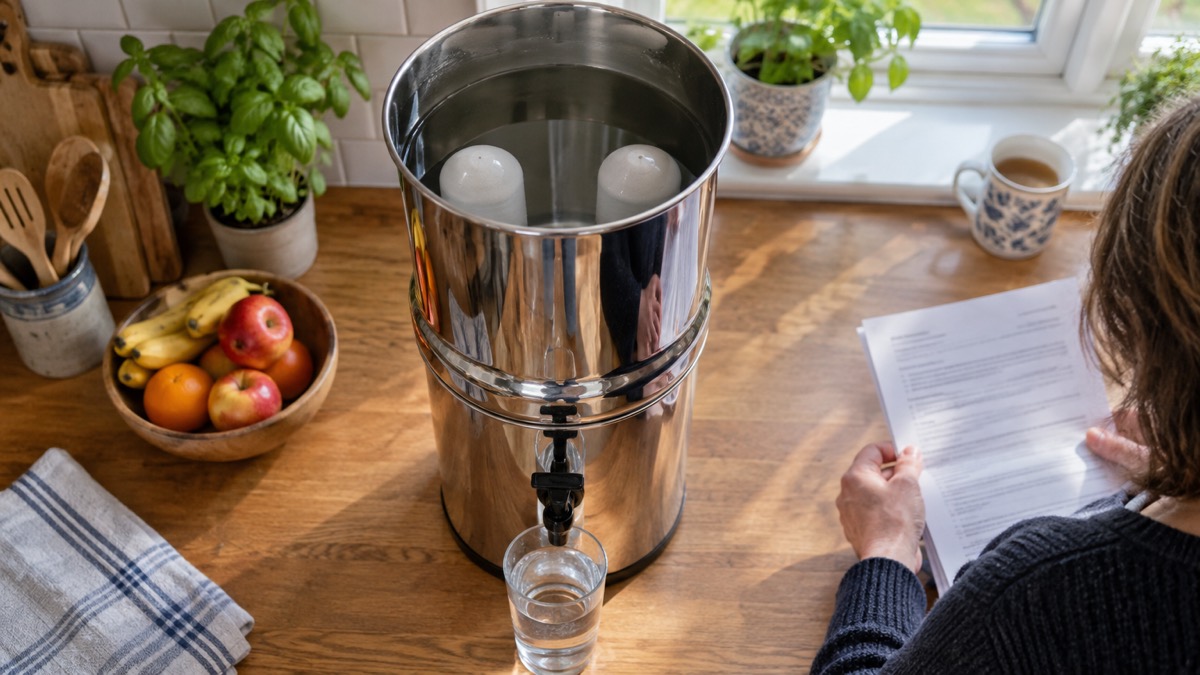
A new Ultra Sterasyl needs conditioning before you drink from it, and the maker's instructions are specific. Do not wash the ceramic filter elements before use15. Instead, fit the candle, fill the upper chamber and let it run, then discard the first filtered water, wipe the inside and outside of the lower chamber with a clean cloth to remove any dust, and run at least 1 litre of water to waste, continuing until the water runs clear15.
The 8.5 litre system manual sets out the same process in its own words: discard the first filtered water and rinse the bottom chamber with clean water and wipe with a clean cloth before refilling the top chamber, and repeat the process running at least 1 litre of water per fitted candle to waste16. British Berkefeld's general guidance is that you need to run water through the filters to wet and prime them before use9.
Handle the candle with care while fitting it. British Berkefeld advises wearing rubber gloves or washing hands well before and after handling the product15. Ceramic is brittle: tighten the wing nut enough to seal the candle against its mount, but not so hard that you crack the element.
Cleaning the ceramic when the flow slows
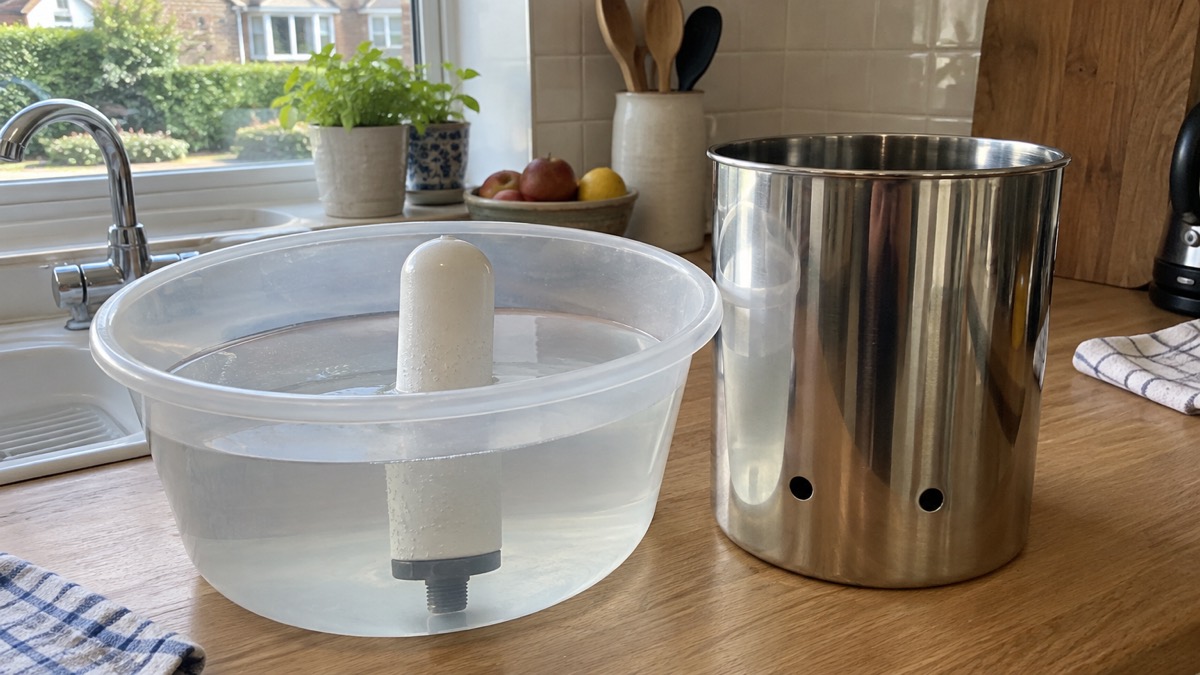
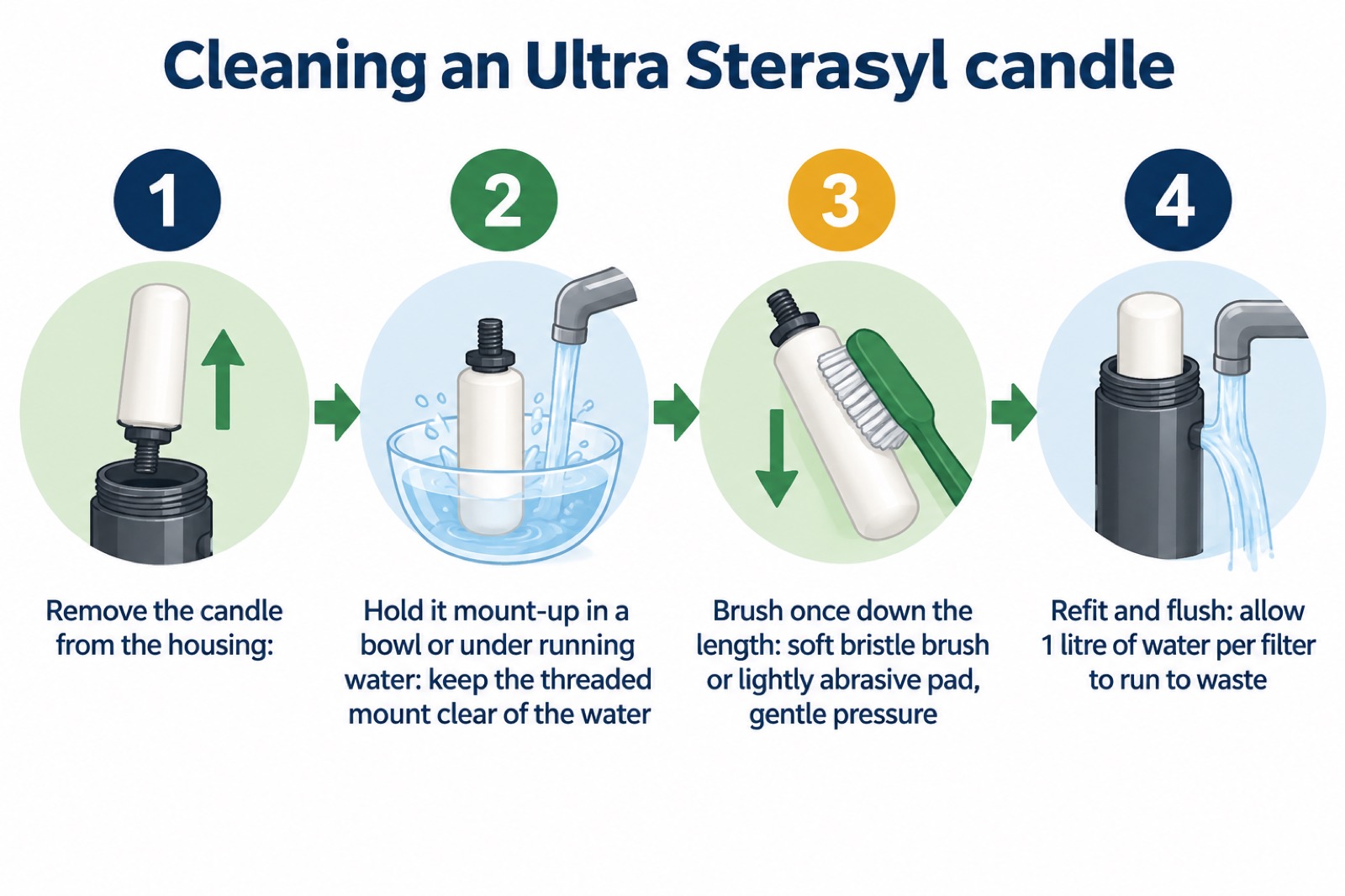
When the flow drops, clean the ceramic before you think about replacing it. British Berkefeld's advice is that if the flow seems to have substantially slowed, it is likely that the surface of the ceramic has become blocked, and providing the water is still tasting great you can improve the flow again by cleaning the ceramic filter9. The maker's method is to hold the element in a bowl of water or under running water, keep the open ended plastic threaded mount clear of the water, and gently brush once down the whole surface with a soft bristle brush or lightly abrasive pad15.
A few points decide whether cleaning works or ruins the candle:
- Keep the mount dry. The open ended plastic threaded mount must stay clear of the water, so hold the candle mount-up and work downwards15.
- Brush one way, gently. Cup the brush or pad around the circumference and apply gentle pressure once down the length, rather than scrubbing back and forth15.
- Do not scrub hard. The ceramic is the filter; taking the surface off takes the performance with it.
- Flush afterwards. If you are refitting a cleaned filter element, allow 1 litre of water to run to waste, then the filter is ready for use15.
Cleaning restores flow; it does not extend the candle's life indefinitely. The maker's replacement interval still applies, and a candle that has been cleaned repeatedly and still runs slowly is telling you something. The guide to looking after a filter covers priming, cleaning, cartridges and frost for gravity systems generally.
Replace it every six months, or sooner if flow or taste changes
British Berkefeld recommends replacing the Ultra Sterasyl every six months5. The datasheet puts it as after 6 months, before replacement to guarantee performance10. The maker also says both the Ultra Sterasyl and Ultra Fluoride filters last for 6 months if used in an average household setting9. Six months is the working rule, and it is a recommendation about performance rather than a hard failure point.
Bring the change forward if the candle tells you to. British Berkefeld advises that if you notice a drop in water flow or a change in taste, it may be time to replace the filter11, and that if your water flow lessens before 6 months, you should change the filter12. A candle that has been cleaned and still runs slowly, or that leaves an odd taste, has done its work.
| Signal | What it means | What to do |
|---|---|---|
| Six months since fitting | The maker's replacement interval has arrived | Replace the candle5 |
| Flow drops, cleaning does not restore it | The ceramic is loaded beyond cleaning | Replace early12 |
| Taste or odour changes | The carbon media is spent | Replace early11 |
| Heavy use or cloudy water | The candle works harder | Clean regularly and expect earlier replacement1 |
Keep a spare candle in the cupboard. Because the replacement interval is six months and the candle is a consumable, a household that waits until the flow drops is a household filtering water through a spent element. A spare also means a cracked candle during cleaning does not leave you without filtered water while you wait for a delivery.
Support, returns and what comes in the box
A replacement Ultra Sterasyl arrives as a ceramic water filter cartridge complete with wing nuts and washers11. It is not a complete gravity system: you need a compatible housing to fit it into, and the box does not include one. Check your system against the compatibility list before ordering.
British Berkefeld lists 14 day returns on the Ultra Sterasyl product page3. Check the terms that come with your order before you open and fit a candle, since a filter that has been primed and used may not be accepted back. The maker also states that next working day delivery is available for orders placed by 11:00, Monday to Friday, subject to the destination and courier availability3.
For questions about fit, priming, cleaning or an order, British Berkefeld's customer service is a UK based team, and the maker gives the address filtersales@doulton.com9. Have your order details and the model number, 8674, to hand when you write3.
If you are weighing up whether a gravity filter is the right approach at all, the comparison of purification tablets and a gravity filter and the comparison of gravity and under-sink filters set out the trade-offs. For the wider question of how much water to keep and how to store it, start with the household guide to water in an emergency and how much drinking water to store per person.
Sources (16)
- British Berkefeld Stainless Steel Gravity System with Ultra Sterasyl, Doulton, 2026
- British Berkefeld Stainless Steel Gravity System with Ultra Sterasyl, Doulton, 2026
- Ultra Sterasyl 8674 for British Berkefeld Stainless Steel Gravity System, Doulton, 2026
- Ultimate Guide to British Berkefeld, Doulton, 2026
- What's the Difference Between the Ultra Sterasyl and Ultra Fluoride Water Filters, Doulton, 2026
- Test Data, Doulton, 2026
- Test Data, Doulton, 2026
- Test Data, Doulton, 2026
- Ultimate Guide to British Berkefeld, Doulton, 2026
- Test Data, Doulton, 2026
- Ultra Sterasyl 8674 for British Berkefeld Stainless Steel Gravity System, Doulton, 2026
- Ultra Sterasyl 8674 for British Berkefeld Stainless Steel Gravity System, Doulton, 2026
- British Berkefeld Stainless Steel Gravity System with Ultra Sterasyl, Doulton, 2026
- Ultra Sterasyl 8674 for British Berkefeld Stainless Steel Gravity System, Doulton, 2026
- British Berkefeld Ultra Sterasyl 8674 Filter Instructions, Doulton, 2026
- BB Ultra Sterasyl 8.5L Gravity System Instructions, Doulton, 2025
 British Berkefeld Ultra Fluoride
 Doulton Ultracarb