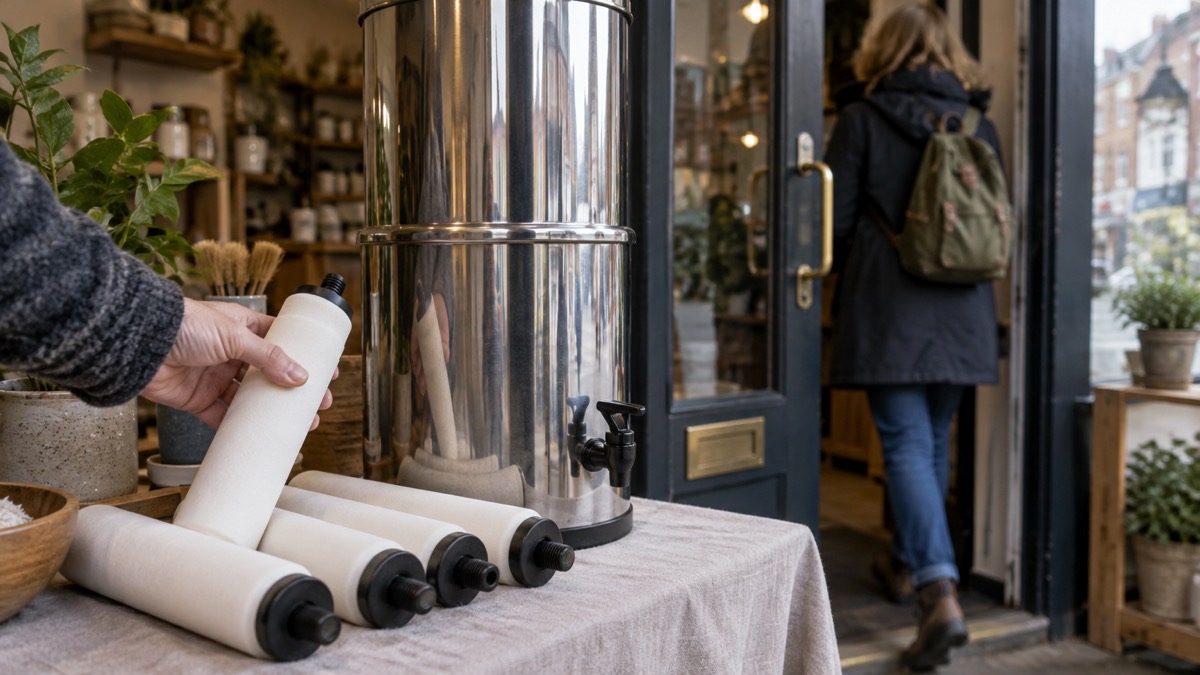
The British Berkefeld Ultra Fluoride is a replacement ceramic filter candle, model 8B76, made for British Berkefeld stainless steel gravity systems. It is the fluoride-reducing option in a two-filter range: the same systems take either an Ultra Sterasyl candle or an Ultra Fluoride one1. The maker says the element has been tested to reduce up to 98.9% of fluoride, tested in house with a 1 ppm nominal influent fluoride concentration1.
If you already own a gravity system and want to know whether this candle fits, what it will do and how often to change it, the short answer is: it fits British Berkefeld gravity systems and the maker also lists it for Berkey, Phoenix, Purewell, Newton and other gravity systems; it is rated for 1,950 litres before replacement if your water contains 1 ppm of fluoride; and the maker recommends changing it every six months1.
What it is not is a complete filter system. You are buying the candle and its fittings, not the stainless steel housing. The maker describes it as a replacement ceramic water filter cartridge, complete with wing nuts and washers1. If you are starting from nothing, read Gravity Filters and Ceramic Candles Explained first, then come back to the candle choice.
What the Ultra Fluoride (8B76) filter is
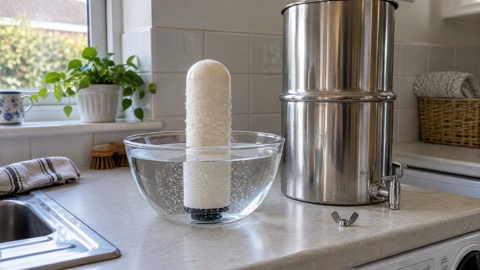
The Ultra Fluoride is a ceramic candle that sits inside a housing and screws into the upper chamber of a gravity system. Water passes through it under its own weight, with no pump, no electricity and no plumbing. The maker describes the candle as forming a physical barrier for pathogens, trapping bacteria on the surface of the ceramic4. That physical barrier is what does the work on bacteria and particles; the fluoride reduction comes from the treatment within the ceramic.
The maker sets out what the candle is designed to reduce: common contaminants, chlorine, heavy metals and fluoride within municipal water supplies8. Elsewhere the maker lists particles, pathogenic bacteria, cysts, chlorine, bacteria, heavy metals and fluoride, and says the candle improves taste and odour1. It also states that the filters retain the essential minerals your body needs8.
Two limits are worth knowing before you buy. The first is that the maker says its British Berkefeld ceramic elements reduce cysts and bacteria found in water but do not filter viruses9. The second is that the maker states the candle is not compatible with the Doulton HIS system8. If you are weighing up what different filter types can and cannot remove, Ceramic, Carbon, Hollow-Fibre and RO: What Each Removes sets the categories out side by side.
The brand has a long history: British Berkefeld traces back to the 1800s, when a German engineer, Wilhelm Berkefeld, developed the original version of these gravity filter systems to help tackle disease at the time2. The candle you buy today is a modern version of that idea.
Fluoride reduction: up to 98.9% in the maker's own test
The headline figure is up to 98.9% fluoride reduction, and it comes with conditions that matter. The maker states that the element has been tested to reduce up to 98.9% of fluoride, and the asterisk leads to the test condition: tested in house with a 1 ppm nominal influent fluoride concentration1. In other words, the figure describes performance against water containing 1 part per million of fluoride, measured by the maker rather than by an outside laboratory.
The maker's test data page gives the same figure in its summary table: fluoride at 1 ppm presence, up to 98.9%10. The same page gives a chlorine reduction figure for the Ultra Fluoride of up to 97.2%10. For comparison, the maker's general datasheet for British Berkefeld ceramic candles gives a chlorine reduction of up to 99%11. Those are different products and different tests, so do not read the 99% figure across to the Ultra Fluoride candle.
One point of uncertainty is worth flagging. The maker's own figures for the Ultra Fluoride candle include a chlorine reduction of up to 97.2%10, alongside the fluoride figure of up to 98.9% at 1 ppm presence10. The two figures measure different things and are not reconciled in the same place. Treat the fluoride reduction as "up to 98.9%" as the maker states, and understand that the real figure in your kitchen will depend on what is in your water and how worn the candle is.
What the candle does not do is remove everything. The maker is explicit that its ceramic elements do not filter viruses9. The maker also states that the Ultra Fluoride candle is not compatible with the Doulton HIS system8. If your supply is under a do not drink notice, follow the water company's instructions rather than assuming a filter solves it; Do Not Drink and Do Not Use Notices explains what those notices mean.
Filter life: about 1,950 litres at 1ppm fluoride
The capacity figure is stated in two ways, and both are useful. The maker says that if your water contains 1 ppm of fluoride, the Ultra Fluoride will effectively filter 1,950 litres before needing to be replaced4. It also expresses the same capacity as the candle adsorbing a total of 1,950 ppm of fluoride8. The first is the one to plan with: it tells you how much water you get at a given fluoride level.
The logic behind the two figures is that the candle has a fixed capacity for fluoride. At 1 ppm in the water, that capacity is used up over 1,950 litres. If your water carries less fluoride, the candle should last longer in litres; if it carries more, it will be used up sooner. The maker does not give a table of other concentrations, so treat 1,950 litres as the figure for water at 1 ppm and ask the maker if you need a figure for your own supply.
| What the maker states | Figure | Condition |
|---|---|---|
| Fluoride reduction | Up to 98.9% | Tested in house at 1 ppm nominal influent fluoride1 |
| Litres before replacement | 1,950 litres | Water containing 1 ppm of fluoride4 |
| Total fluoride adsorbed | 1,950 ppm | Over the life of the candle8 |
| Recommended change interval | Every 6 months | Regardless of litres used5 |
| Chlorine reduction | Up to 97.2% | Ultra Fluoride test data10 |
The six-month interval and the litre capacity work together as two separate limits. The maker recommends changing your filters every 6 months5. It also says that if your water flow lessens before 6 months, you should change the filter4. So the candle goes at whichever comes first: six months, a drop in flow, or the litre capacity being used up. If you want to understand how these intervals compare across filter types, Looking After a Filter: Priming, Cleaning, Cartridges and Frost covers the general principles.
Which gravity systems it fits, and which it does not
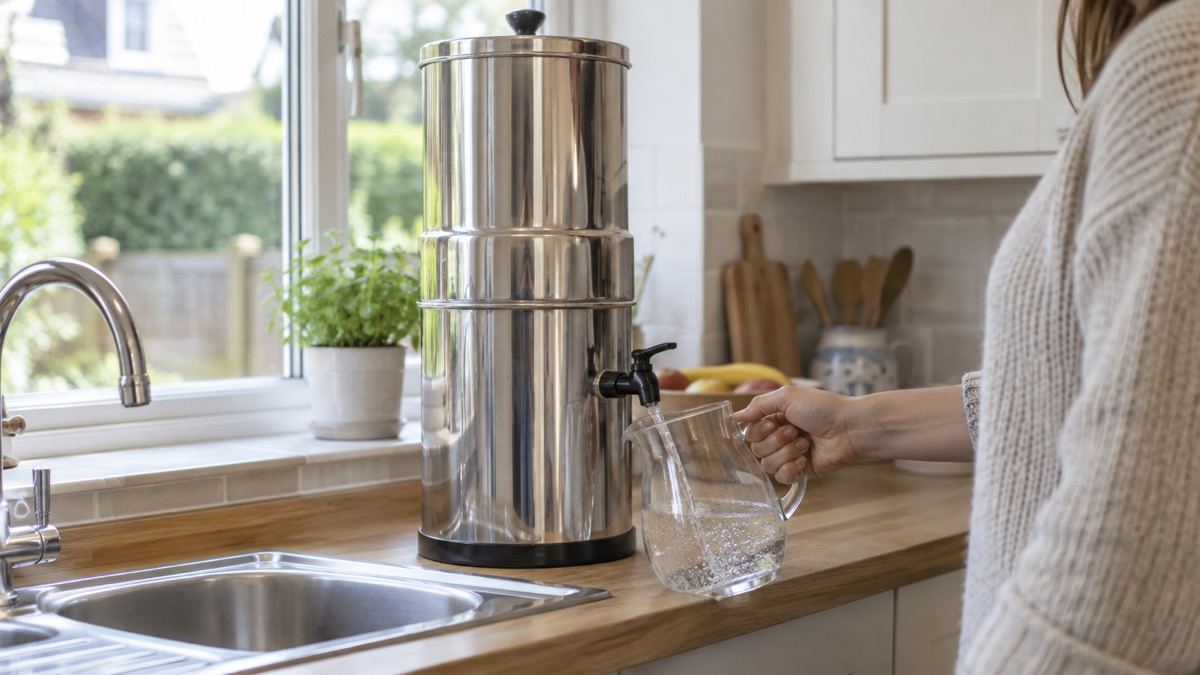
The Ultra Fluoride is made for British Berkefeld stainless steel gravity systems, and the maker lists it as suitable for use in Berkey, Phoenix, Purewell, Newton and other gravity water filter systems1. That breadth is useful if you already own a gravity system from another maker and want to add fluoride reduction, but check the housing dimensions before ordering, because the candle is a fixed size.
The maker's own gravity systems come in four sizes: 750ml, 6, 8.5 and 12 litres12. The smallest is designed to be taken with you and provides 750ml of filtered water13. All of them take either an Ultra Sterasyl or an Ultra Fluoride candle, so the choice of candle is yours at the point of purchase2.
| System or use | Fits Ultra Fluoride? | What the maker says |
|---|---|---|
| British Berkefeld stainless steel gravity system | Yes | Made for it3 |
| Berkey gravity systems | Yes | Listed as suitable3 |
| Phoenix gravity systems | Yes | Listed as suitable3 |
| Purewell gravity systems | Yes | Listed as suitable3 |
| Newton gravity systems | Yes | Listed as suitable3 |
| Doulton HIP DUO, HIP TRIO, Countertop and HIS Push-fit with Biotect Ultra | No | Not compatible5 |
The maker is clear that the candle is not compatible with Doulton HIP DUO, HIP TRIO, Countertop and HIS Push-fit systems with Biotect Ultra5. Those are under-sink and countertop systems rather than gravity systems, and they take a different filter. If you are deciding between a gravity system and an under-sink one, Gravity Filter or Under-Sink Filter? sets out the trade-offs.
If your system is not on the maker's list, the maker's guidance is to email filtersales@doulton.com with the make, model, filter housing dimensions and any other relevant specifications15. That is the reliable way to check before you buy, rather than guessing from a photograph.
Never pair it with Ultra Sterasyl in the same system
This is the one rule that matters most when you own a multi-candle system. The maker states that it is not recommended to combine Ultra Sterasyl and Ultra Fluoride filters together in your gravity system, as this will affect the performance of the filters16. The same warning appears across the maker's product pages: you cannot mix the Ultra Sterasyl filter elements with the Ultra Fluoride element17.
The reason is that the two candles are designed to do different jobs and to work as a set. A system fitted with a mix of the two will not perform as either was intended. If you want fluoride reduction, fit Ultra Fluoride candles throughout; if you do not, fit Ultra Sterasyl throughout. The maker states plainly that you cannot mix the Ultra Sterasyl filter elements with the Ultra Fluoride element14, and the British Berkefeld Ultra Sterasyl page covers the other candle.
If you are replacing candles one at a time, this is easy to get wrong: a system that came with Ultra Sterasyl candles and has one Ultra Fluoride added will be a mixed system. Replace the full set at the same time, and keep a note of which type your system takes.
Priming, cleaning and replacing the filter
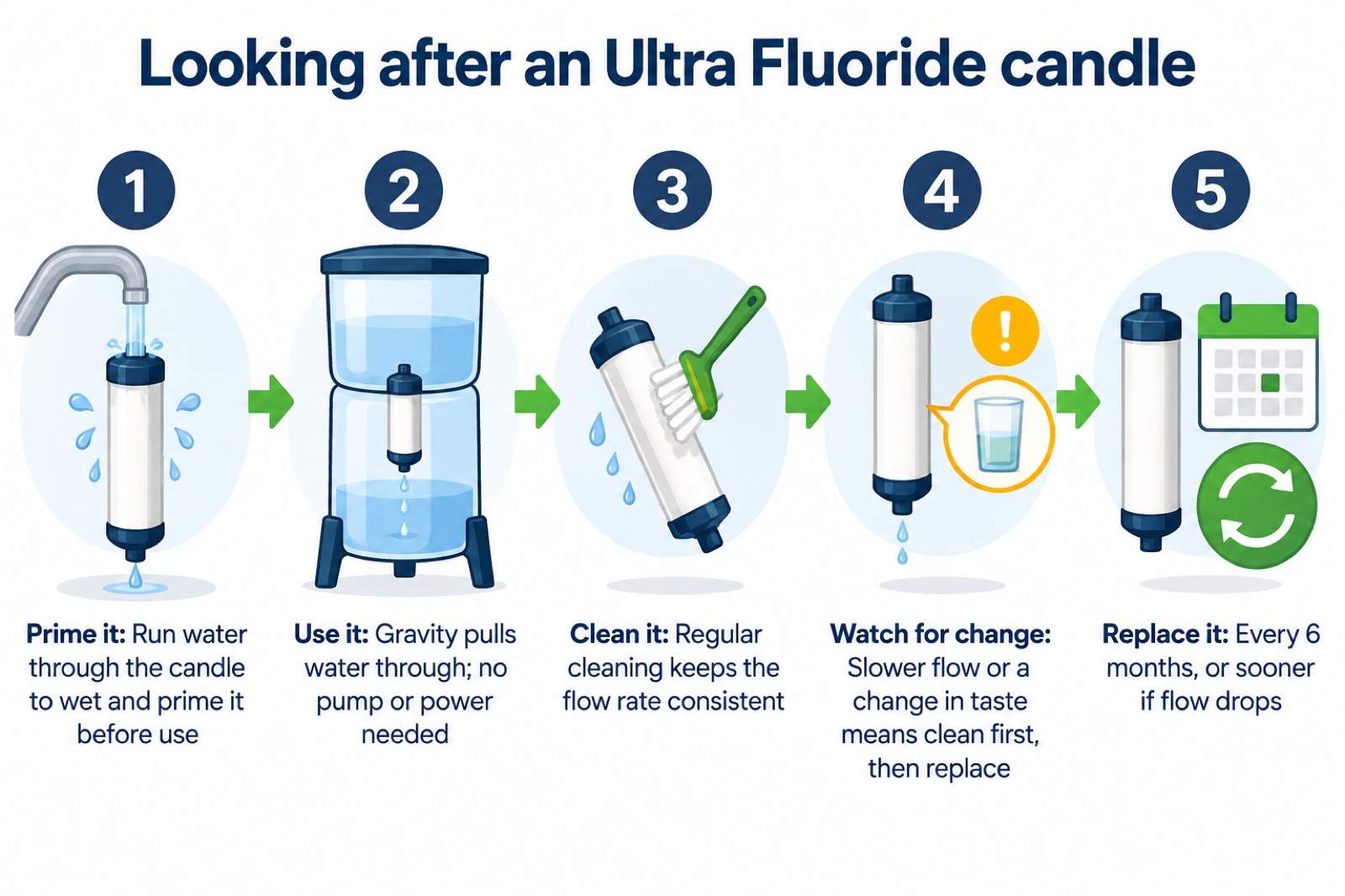
A new candle needs priming before it will work properly. The maker says you will need to run water through the filters to wet and prime them before use6. Do this before you assemble the system, and follow the maker's own instructions for your model. Priming wets the ceramic so that water can pass through it at the intended rate.
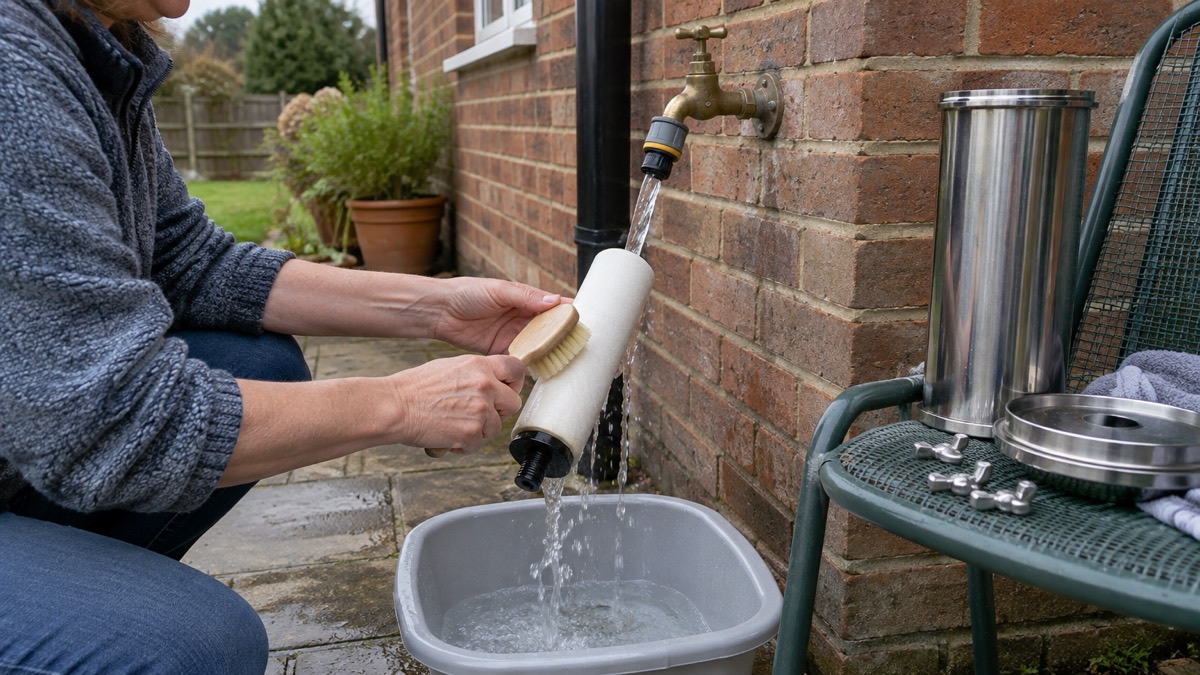
Cleaning is what keeps the flow up. The maker says regular cleaning of the ceramic filter element will help maintain a consistent flow rate even with frequent use5. It also advises cleaning the filter regularly and replacing it when you notice a decline in performance or after the recommended time period18. The maker's trigger for action is a change in taste or a slower flow rate: clean the filter first, and replace it if cleaning does not help13.
Replacement is straightforward. The maker recommends changing your filters every 6 months5, and says to replace every six months for best results1. You do not need a new housing: the maker states that you will not need to change the filter housing, and that all you need to change is the ceramic filter inside the housing16. The replacement candle comes complete with wing nuts and washers1.
The stainless steel housing around the candle has its own care. The maker advises wiping the inside with kitchen roll or a dry cloth when the system is not in use, to keep it dry for storage, and using an anti-static cloth or dry kitchen roll on the exterior13. That is about keeping the steel clean and dry rather than about the candle itself.
Support, returns and who to contact
The maker's support route is a UK-based customer service team, reachable at filtersales@doulton.com9. That is the address to use for questions about which candle fits your system, for the make, model and housing dimensions check, and for anything about the candle itself15. The maker also publishes a set of frequently asked questions covering the wider range19.
On returns, the maker's product page states a 14 day returns policy4. If you have bought from a retailer rather than directly, the retailer's own returns terms apply, so check them before ordering. If a product you have bought is subject to a recall, the UK Association of Fire Investigators provides information on product recalls from all manufacturers20. If a recall notice shows no details of what to do next, contact either the seller or Citizens Advice; if you bought from a UK seller and need further advice, Citizens Advice can help21.
| If you need to | Do this |
|---|---|
| Check whether the candle fits your system | Email filtersales@doulton.com with make, model and housing dimensions15 |
| Ask about the candle or the range | Email the UK-based customer service team9 |
| Return an item bought from the maker | The maker states a 14 day returns policy4 |
| Check for a product recall | The UK Association of Fire Investigators lists recalls from all manufacturers20 |
| Get advice after a recall with no instructions | Contact the seller or Citizens Advice21 |
For the wider question of how a gravity filter fits into a household's emergency water plan, start with Water in an Emergency: A Household Guide, and use the Supply Interruption Checklist to work out how much water you need to keep. A gravity filter is one part of a plan, not a substitute for stored water.
Sources (21)
- Ultra Fluoride 8B76 for British Berkefeld Stainless Steel Gravity System, Doulton, 2026-10-28
- British Berkefeld, Doulton, 2026-10-29
- British Berkefeld Stainless Steel Gravity System Ultra Fluoride, Doulton, 2026-10-28
- Ultra Fluoride 8B76 for British Berkefeld Stainless Steel Gravity System, Doulton, 2026-10-28
- Ultra Fluoride 8B76 for British Berkefeld Stainless Steel Gravity System, Doulton, 2026-10-28
- Ultimate Guide to British Berkefeld, Doulton, 2026-10-28
- British Berkefeld, Doulton, 2026-10-28
- Ultra Fluoride 8B76 for British Berkefeld Stainless Steel Gravity System, Doulton, 2026-10-28
- Ultimate Guide to British Berkefeld, Doulton, 2026-10-28
- Test Data, Doulton, 2026-10-28
- Test Data, Doulton, 2026-10-28
- Ultimate Guide to British Berkefeld, Doulton, 2026-10-28
- Ultimate Guide to British Berkefeld, Doulton, 2026-10-28
- What's the Difference Between the Ultra Sterasyl and Ultra Fluoride Water Filters, Doulton, 2026-10-28
- Test Data, Doulton, 2026-10-28
- British Berkefeld Stainless Steel Gravity System Ultra Fluoride, Doulton, 2026-10-28
- British Berkefeld Stainless Steel Gravity System Ultra Sterasyl, Doulton, 2026-10-28
- Ultra Fluoride 8B76 for British Berkefeld Stainless Steel Gravity System, Doulton, 2026-10-28
- FAQs, Doulton, 2026-10-28
- White Goods, Merseyside Fire and Rescue Service, 2026-10-29
- A Beginner's Guide to Product Registration, Electrical Safety First, 2026-10-25
 British Berkefeld Ultra Sterasyl
 Doulton Ultracarb