A British Berkefeld system is a stainless steel gravity water filter: you pour water into the top chamber, it seeps down through ceramic filters into the bottom chamber, and you draw drinking water from a tap. It needs no plumbing, no electricity and no water pressure, which is exactly why it matters to a household preparing for a power cut, a flood or a supply interruption1. The maker describes the systems as perfect for use in emergency situations, allowing larger capacities of water to be stored and filtered3.
The range runs from a 750ml travel filter you can carry with you to a 12 litre system for a family, and the maker lists 9 products in all4. Every system uses ceramic filter candles, which the maker says reduce cysts and bacteria but do not filter viruses6. Filters are changed every 6 months, or sooner if the flow drops or the taste changes and cleaning does not put it right7.
For a household getting ready, the practical question is which size to keep and how to keep it working. A 6 litre system suits a small household, the larger sizes hold more, and the whole thing stores on a shelf until the day the taps run dry or the water company says boil first. This page sets out what each size does, what the filters will and will not treat, and how to look after the system so it is ready when you need it.
What British Berkefeld makes for UK households
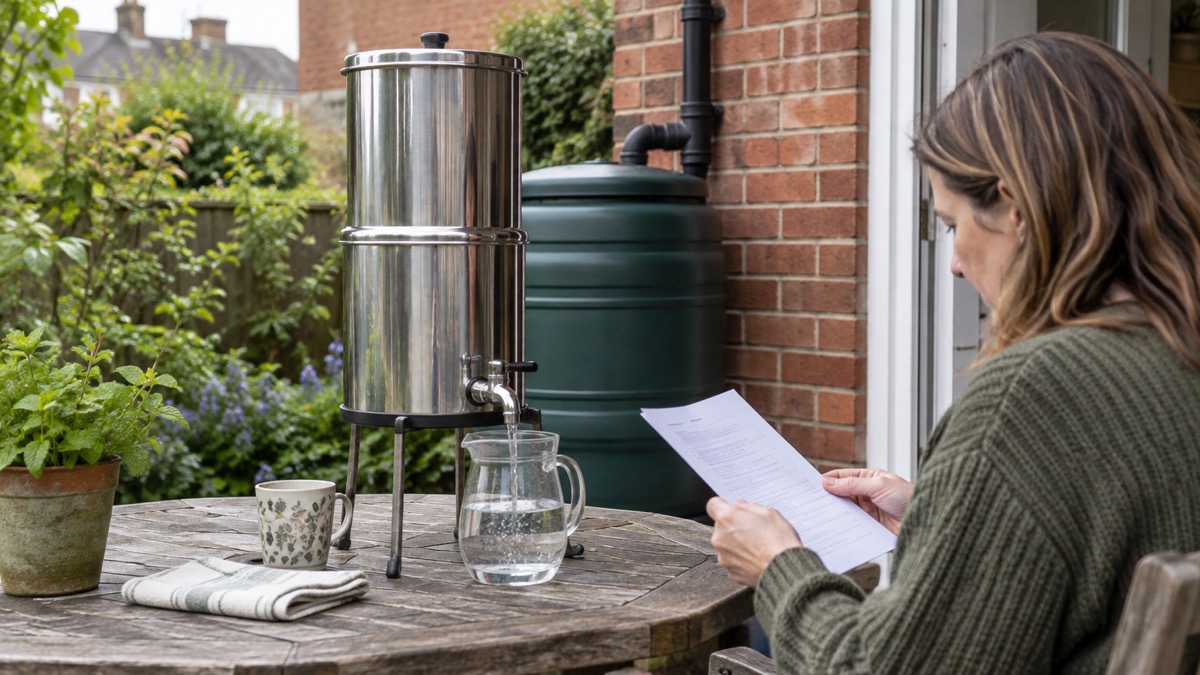
British Berkefeld specialises in gravity fed water filter systems2. The idea is old and simple: water passes through a ceramic candle that forms a physical barrier for pathogens, trapping bacteria on the surface of the ceramic while clear, mineral-rich water passes through9. Nothing is pumped, nothing is plumbed in, and nothing needs a plug. The maker says the systems are fully portable and require no plumbing or electricity, making them ideal for home, travel or emergency use3.
That combination is what makes the brand relevant to preparedness rather than just to everyday drinking water. A household that keeps a gravity system on the shelf has a way to make stored or collected water drinkable when the mains supply is interrupted, when a boil water notice is in force, or when the electricity is off and a pumped or filtered mains supply is not available. The maker states the system works where electricity, water pressure or treated water may not be available1.
The systems are built from high-quality stainless steel and are easy to assemble, delivering clean water in a few hours10. They are also designed for easy portability and use at home, outdoors or in an emergency11. For the wider picture of how water fits a household plan, including how much to store and how to treat it, see Water in an Emergency: A Household Guide.
System sizes: from a 750ml travel filter to 12 litres
The maker's guidance puts the range at four sizes: 750ml, 6, 8.5 and 12 litres4. Product pages describe the same range as 1 litre, 6 litre, 8.5 litre and 12 litre systems, because the 1 litre body yields 750ml of filtered water12. The smallest is designed to be taken with you, providing 750ml of filtered water6. The maker advises choosing by the size of your household and how often you want to be refilling13.
| Size | Filtered water | Filters fitted | Suits |
|---|---|---|---|
| 1 litre | 750ml | 1 Ultra Sterasyl12 | One person, travel, a lodge or holiday home14 |
| 6 litre | Not stated | 2 to 414 | A small household; the maker's listing pairs the 6L with 1 to 2 people8 |
| 8.5 litre | Not stated | 412 | A family; the maker's listing pairs the 8.5L with 3 to 4 people8 |
| 12 litre | 11.5 litres8 | 412 | A larger household wanting fewer refills |
The 1 litre system contains one filter, which the maker says is perfect for filtering in any location such as a lodge or holiday home14. The other systems contain anything from 2 filters to 4 filters to allow for enhanced filtration in larger capacities14. The 12 litre system holds 11.5 litres of filtered water once full8. The maker also notes that for larger capacities you can add additional filters to help speed up the filtering process8.
For a household plan, the size question is really about how many people you are keeping supplied and how often you are willing to fill the top chamber. A larger body of water with more filters gives more drinking water between refills, which matters in a long outage. The 6 litre system is described by the maker as able to be used on a kitchen counter, in a caravan, on a bedside table or outdoors10.
Works with no mains power, water pressure or installation
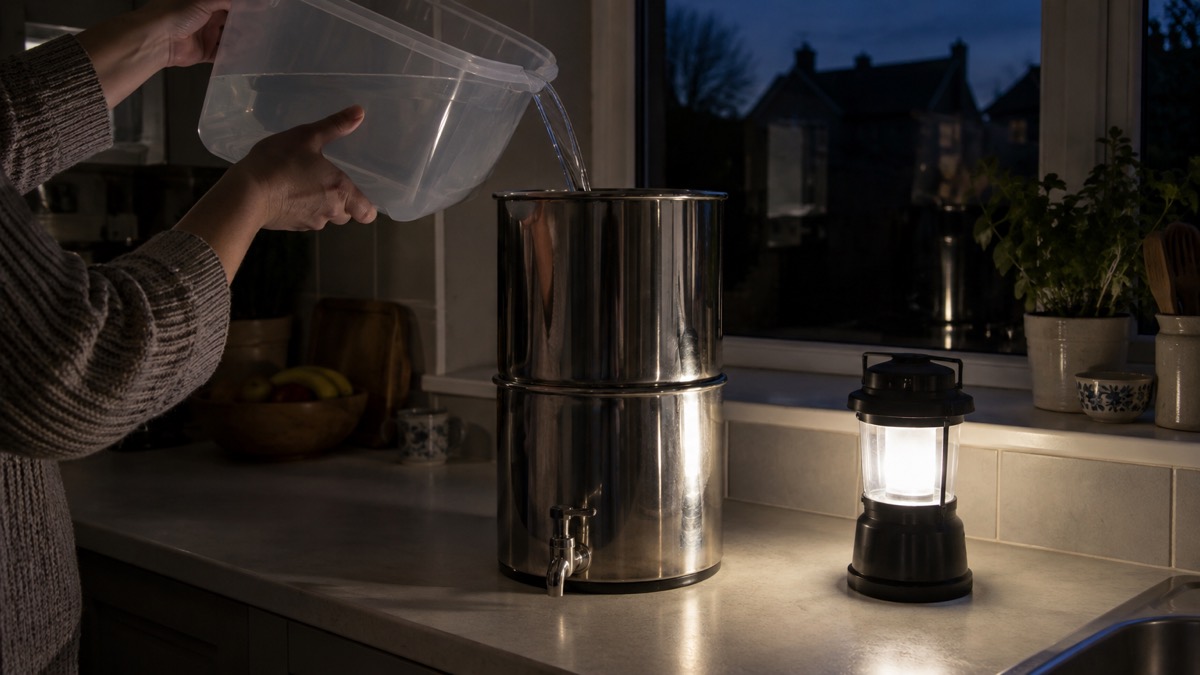
This is the feature that decides the brand's place in a preparedness kit. The systems require no plumbing or electricity, so they keep working when the power is off, when the water pressure drops, and when there is no installation to rely on2. The maker describes the range as fully portable and requiring no plumbing or electricity, making it ideal for home, travel or emergency use3. The 1 litre system is described as simple to operate with no plumbing required16.
What that means in practice is that the filter is not tied to the kitchen tap. You can fill it from a stored water container, from a butt, or from whatever source you have, and it will still work. The maker states the system filters both treated water and untreated raw water from sources such as remote lakes, streams, stagnant ponds and water supplies in foreign countries1. It also works where electricity, water pressure or treated water may not be available1.
The trade-off is speed. Gravity water filters, especially when using ceramic, are one of the slower methods of filtering water2. The maker says the systems are easy to assemble and deliver clean and tasty water in a few hours10. Plan for that: fill the top chamber in the evening and draw water the next morning, rather than expecting a glass the moment you pour.
What the ceramic filters remove from water
The ceramic candle is the heart of the system. The maker says it forms a physical barrier for pathogens, trapping bacteria on the surface of the ceramic while allowing clear, mineral-rich water through9. The Ultra Sterasyl ceramic filter is listed as filtering bacteria, sediment, rust particles, particles, microplastics, heavy metals including lead, pharmaceuticals, estrogen and chlorine8. The maker states the systems filter out up to 99.99% of common contaminants using ceramic filter candles12, and that a British Berkefeld ceramic candle will reduce up to 99% of chlorine17.
The limit matters as much as the capability. The maker is explicit: the British Berkefeld ceramic elements reduce cysts and bacteria found in your water, but do not filter viruses6. That is a statement to plan around, not to gloss over. If a supply is under a boil water notice because of a viral contamination, a gravity filter alone is not the answer; follow the water company's instruction. For the household guide to treating and storing water in an emergency, see Water in an Emergency: A Household Guide.
| Filter | What it is for | What the maker says it does |
|---|---|---|
| Ultra Sterasyl | The standard ceramic candle for the gravity systems | Filters bacteria, sediment, rust particles, microplastics, heavy metals including lead, pharmaceuticals, estrogen and chlorine8 |
| Ultra Fluoride | The variant for households wanting fluoride reduction | Reduces fluoride in drinking water6; also forms a physical barrier for pathogens, trapping bacteria on the surface of the ceramic11 |
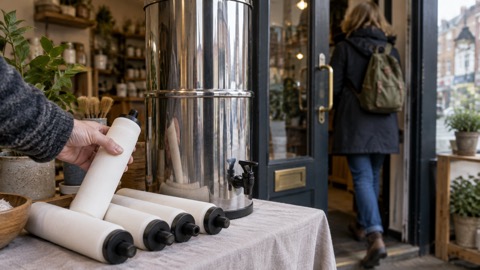
The Ultra Sterasyl replaced the ATC Super Sterasyl ceramic filter, so if you are matching an older system, that is the name to look for9. The Ultra Fluoride filter is suitable for use in British Berkefeld gravity systems and in Berkey, Phoenix, Purewell, Newton and other gravity water filter systems11.
Which water sources the filters can treat
The maker's own description is broad: the system filters both treated water and untreated raw water from sources such as remote lakes, streams, stagnant ponds and water supplies in foreign countries1. That is the claim to hold in mind when planning. It means the filter is designed for the situation where the tap water is not available or not trustworthy, and you are drawing from what you can find or what you have stored.
The maker also sets out what the systems reduce when paired with particular filters. They help improve water quality by reducing contaminants such as PFAS when paired with a filter such as the Ultra Sterasyl, and some can also reduce fluoride when used with the British Berkefeld Ultra Fluoride water filters18. The Ultra Sterasyl itself does not reduce fluoride; the Ultra Fluoride filter does6.
For a household in a flood, the practical point is that floodwater itself is not drinking water, whatever filter you own. Keep stored water separate from floodwater, and treat any water you collect with the caution the situation demands. The maker's claim about raw water sources is about the filter's capability, not a licence to drink any water you find.
Priming new filters before first use
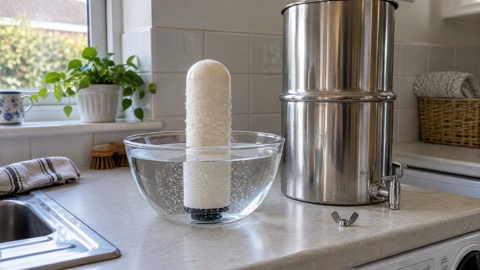
A new filter does not work straight out of the box. The maker says you will need to run water through the filters to wet and prime them before use6. Do this before you fill the system for the first time, and do it again whenever you fit a replacement filter. Priming wets the ceramic so water can pass through it, and it is the step people skip when they are in a hurry and then wonder why nothing comes out of the tap.
The maker's guidance is consistent across its pages: run water through the filters to wet and prime them13. Once primed, assemble the system and fill the upper chamber. The maker says the systems are easy to assemble and deliver clean and tasty water in a few hours10.
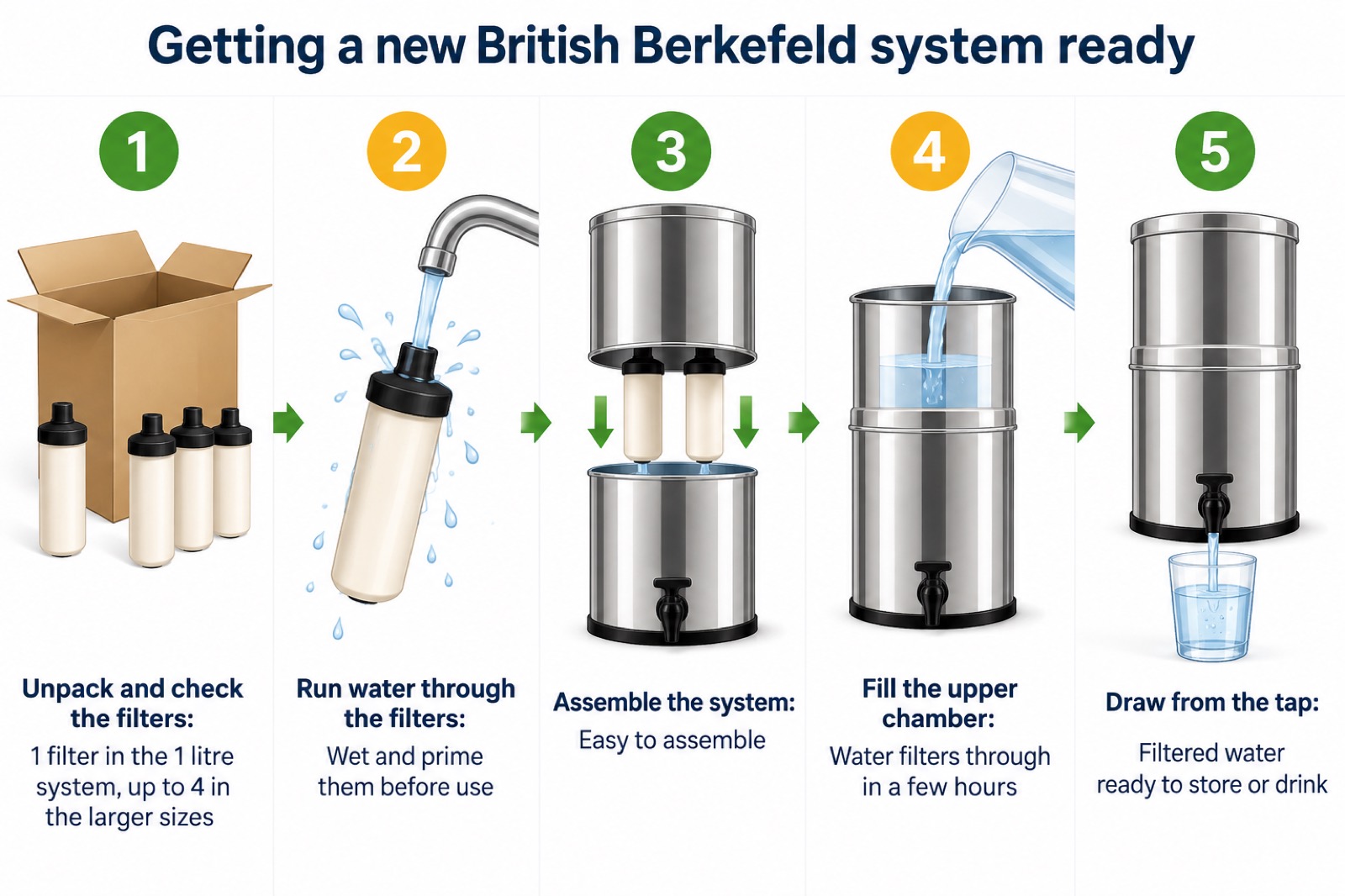
If you are setting the system up as part of a wider household kit, do it before you need it, not during the emergency. A trial run tells you how long a full chamber takes in your kitchen, and it gets the priming out of the way. For the wider kit list, see Emergency Kit: What a UK Household Should Keep Ready.
Flow rate: 20 to 24 gallons a day with the upper chamber full
The maker's figure is 20 to 24 gallons per day, calculated with the upper chamber full to the top1. The same page notes that the flow rate decreases as the water level declines1, which is the behaviour of any gravity system: the more water above the filter, the faster it passes through. The maker also states there is no strict limit to how much water you can filter in a day, but the flow rate may decrease if the filter becomes clogged due to heavy usage, and that regular cleaning of the ceramic filter element helps maintain flow rate8.
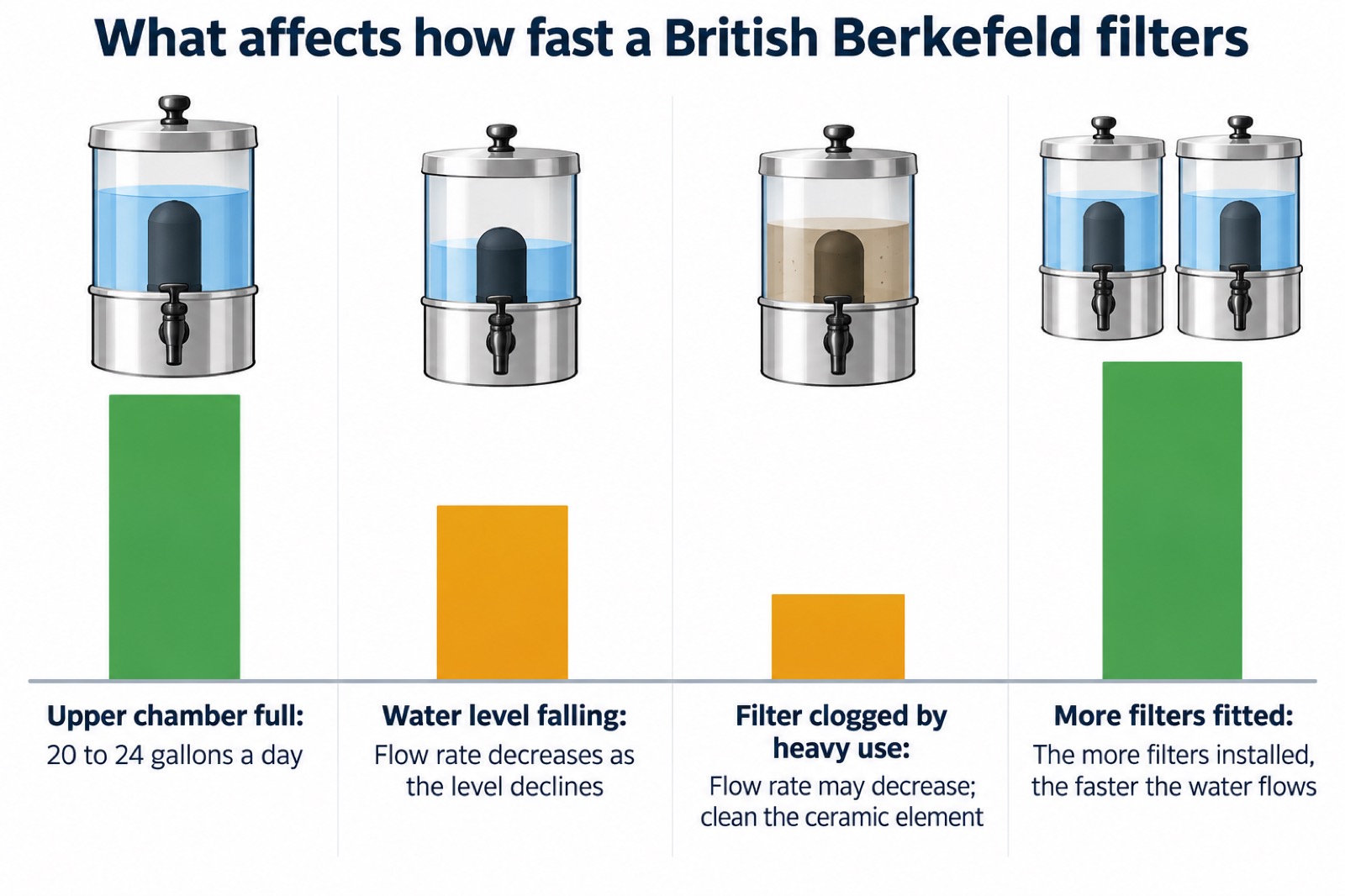
The maker is candid that this is not a fast method. Gravity water filters, especially when using ceramic, are one of the slower methods of filtering water2. The maker also notes that British Berkefeld systems can be slower to filter than the Berkey systems due to the nature of the filter technology4. That is a comparison of two separate brands, not a ranking; it simply tells you what to expect.
For planning, the flow rate tells you how much drinking water a full chamber will yield over a day, and therefore how often you need to refill. If you are filtering for several people over several days, a larger system with more filters is the sensible choice, and the maker says you can add additional filters to help speed up the filtering process8. If you want to understand how much water a household needs in an outage, see Water in an Emergency: A Household Guide.
Change the filters every 6 months
The maker's replacement interval is every 6 months7. That applies across the range: the Ultra Fluoride filter, the Ultra Sterasyl ceramic filter and the gravity systems generally are all listed with a 6 month change7. The maker's reasoning is simple: to keep your water in tip top condition you need to get that water filter changed every 6 months7.
There is a second trigger. If you notice a change in the taste of your water, or a slower flow rate, follow the instructions for cleaning your filter first, and replace it if cleaning does not help7. The maker adds that if your water flow lessens before 6 months, you should change the filter9. So the rule is: clean first, replace if that does not restore flow or taste, and in any case replace at 6 months.
| Filter | Change interval | Earlier change if |
|---|---|---|
| Ultra Sterasyl | Every 6 months19 | Flow drops or taste changes and cleaning does not help7 |
| Ultra Fluoride | Every 6 months11 | Flow drops or taste changes and cleaning does not help7 |
For a household keeping a system for emergencies, the 6 month clock is easy to forget because the system may sit unused for long stretches. Put a note in the calendar, or write the fit date on the filter housing, so a filter that has been sitting dry for a year is not pressed into service when you need it most. A spare set of filters kept with the system means you are never caught without one.
Cleaning and storing your system
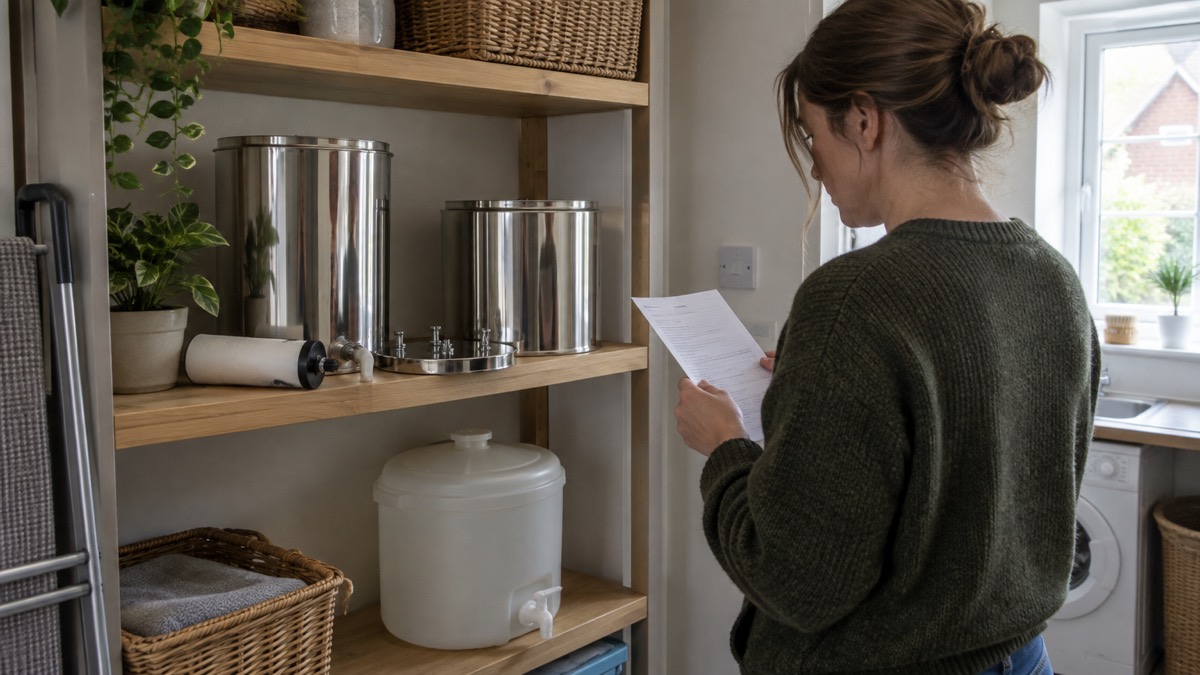
The maker's cleaning advice is deliberately light. When not in use, give the inside a light wipe with some kitchen roll or a dry cloth to keep it dry for storage6. For the exterior, use an anti-static cloth or dry kitchen roll to remove fingerprints6. There is no need for harsh cleaners, and the maker does not call for them.
The stainless steel body is what makes this easy. The systems are crafted from high-quality stainless steel20, which wipes clean and does not absorb odours the way plastic can. Store the system dry and assembled, with the chambers separated if that helps air circulate, and keep it somewhere it will not be knocked or filled with dust.
When you bring the system back into use, prime the filters again if they have dried out, and run the first batch through before drinking. If the system has been in storage for a long time, check the filter date and replace if it is due. For the wider question of storing water safely, see Water in an Emergency: A Household Guide.
Support, safety notices and who makes British Berkefeld
British Berkefeld is made in Britain. The maker states that each Doulton and British Berkefeld product is made in a manufacturing facility in Staffordshire and holds the Made in Britain badge2. Individual product pages repeat the claim for the gravity systems and for the Ultra Fluoride filter11. The brand traces back to the 1800s, when a German engineer, Wilhelm Berkefeld, developed the original Berkefeld filter systems to fight cholera4. The company describes over 200 years of innovation and expertise20.
The brand is separate from Berkey. The maker states plainly that British Berkefeld and Berkey are two separate brands, and that they are not associated in any other way4. Some British Berkefeld filters are made to fit Berkey, Phoenix, Purewell, Newton and other gravity systems9, which is why the names are often seen together, but that is a matter of fit, not ownership.
For support, the maker gives a UK based customer service team at filtersales@doulton.com13. Use it to check which filter suits your system, to ask about accessories, or to raise a problem. The maker lists a stainless steel tap, a stainless steel stand, a sight gauge and an insulated sleeve as accessories4, and the range runs to 9 products5. The Ultimate British Berkefeld Starter Bundle carries a 14 day returns policy10.
There is no recall or safety notice in the material available for this page. If one is issued, it would come from the maker or the retailer, and the customer service address above is the route to confirm whether your system is affected. For the household guide to water in an emergency, including how to store and treat it, see Water in an Emergency: A Household Guide. For the wider kit, see Emergency Kit: What a UK Household Should Keep Ready.
Sources (22)
- British Berkefeld system page, British Berkefeld, 2021
- Ultimate Guide to British Berkefeld, Doulton, 2026
- Portable Water Filters, Doulton, 2026
- What's the Difference Between Berkey and British Berkefeld, Doulton, 2026
- British Berkefeld Systems collection, Doulton, 2026
- British Berkefeld guide, Doulton, 2026
- Ultimate Guide to British Berkefeld, Doulton, 2026
- British Berkefeld Stainless Steel Gravity System Ultra Sterasyl, Doulton, 2026
- Ultra Sterasyl 8674 filter, Doulton, 2026
- The Ultimate British Berkefeld Starter Bundle, Doulton, 2026
- British Berkefeld Stainless Steel Gravity System Ultra Fluoride, Doulton, 2026
- British Berkefeld guide, Doulton, 2026
- Ultimate Guide to British Berkefeld, Doulton, 2026
- British Berkefeld guide, Doulton, 2026
- British Berkefeld Stainless Steel Gravity System Ultra Sterasyl, Doulton, 2026
- British Berkefeld 1 Litre Stainless Steel Gravity System, Doulton, 2026
- Test Data, Doulton, 2026
- Portable Water Filters, Doulton, 2026
- British Berkefeld Stainless Steel Gravity System Ultra Sterasyl, Doulton, 2026
- British Berkefeld Stainless Steel Gravity System Ultra Sterasyl, Doulton, 2026
- British Berkefeld Stainless Steel Gravity System Ultra Sterasyl, Doulton, 2026
- What's the Difference Between Berkey and British Berkefeld, Doulton, 2026
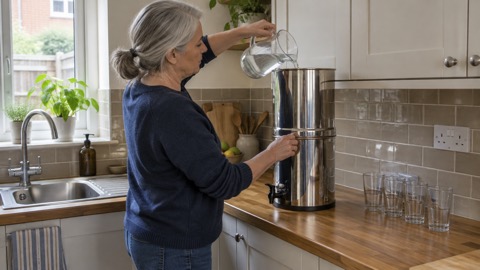 British Berkefeld SS2 8.5L
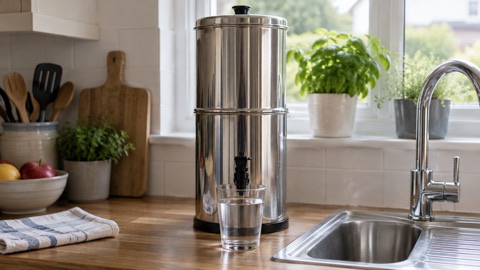 British Berkefeld 1 Litre Gravity System
 British Berkefeld Ultra Sterasyl
 British Berkefeld Ultra Fluoride