
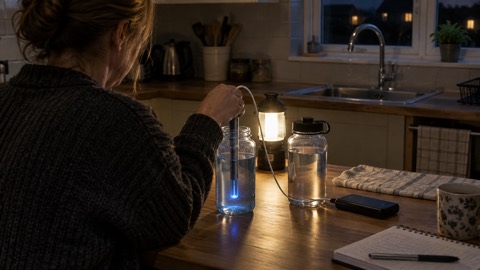
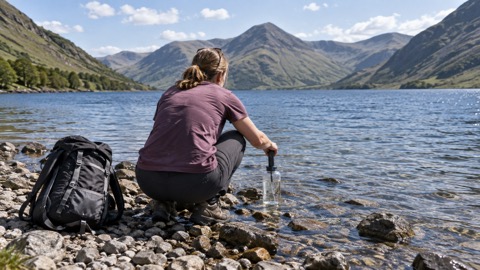
A SteriPEN is a handheld ultraviolet water purifier: you fill a bottle with clear water, put the lamp in, and it treats half a litre or one litre at a time. The maker says the UV-C light destroys 99.9% of protozoa (including Giardia and Cryptosporidia), bacteria and even viruses1. For a household preparing for a water supply interruption, it is a compact way to make clear water from a private supply, a stored container or another source you are unsure of safe to drink, without fuel, filters or chemicals.
It is not a do-everything device. It needs clear water, it needs batteries, and it does nothing about chemicals. Official guidance on private supplies after flooding is blunt that boiling kills pathogens but does not remove harmful chemicals2, and the same limit applies here. Where mains water is still running, you should not need it at all: official advice says mains tap water should not be contaminated after flooding, and that you should wash taps and let them run for a few minutes before use3.
This page covers what SteriPEN makes for UK households, the two models and their specifications, what UV treatment can and cannot make safe, how to treat water, what to do with cloudy water, how to keep it powered and stored, what can go wrong, and the support and warranty position. For the wider picture, start with Water in an Emergency: A Household Guide.
What a SteriPEN does for a household
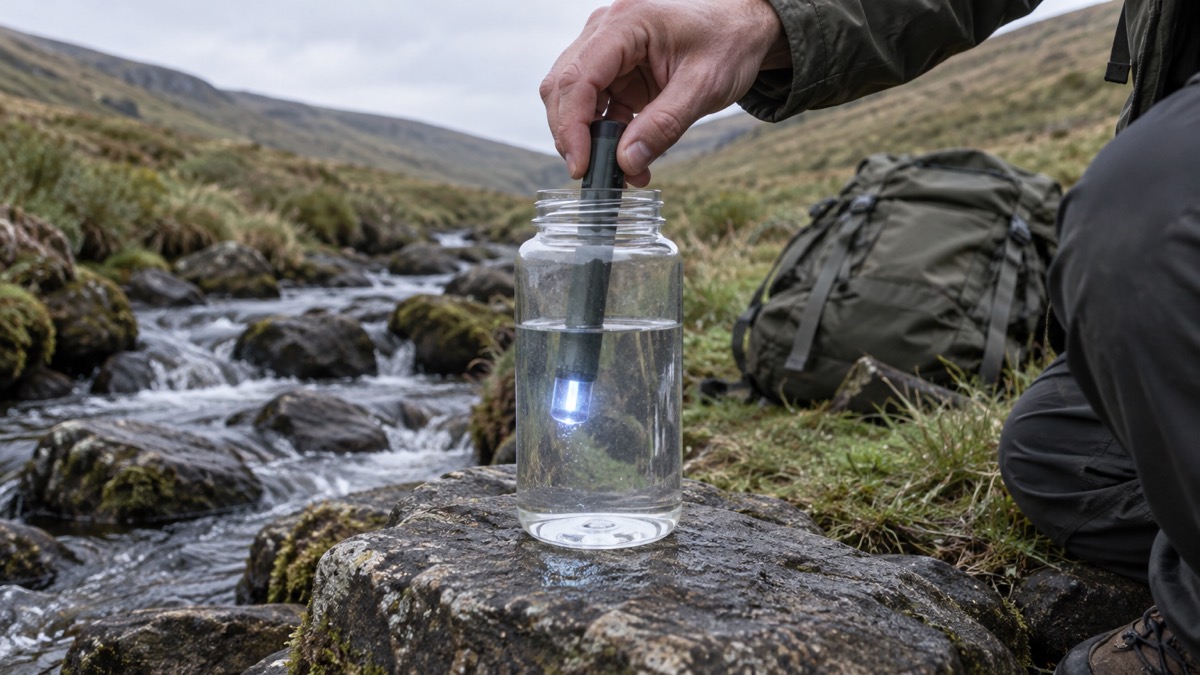
Think of a SteriPEN as a water tool for the gap between "the taps are off" and "the taps are back and confirmed safe". In a power cut, a burst main or a storm that takes out a private supply, a household with a SteriPEN and a few wide-mouth bottles can treat drinking water in small batches without boiling, which matters when the electricity is off and you are trying to avoid using gas or a camping stove indoors.
It suits a household that already stores water and wants a second way to make an uncertain source drinkable, or one on a private supply such as a well or spring, where the Drinking Water Inspectorate advises that water should get sufficient preliminary treatment to reach turbidity readings below 1 NTU before disinfection6. That is the key condition: UV works on clear water, so a SteriPEN is a disinfection step, not a complete treatment system.
It does not suit every household. If you have no stored water and no clear source, a SteriPEN has nothing to work on. If you are on mains water, your water company remains the source of truth: contact them if you notice a change in the colour, taste or smell of tap water7. And if anyone in the house is unwell, a SteriPEN is no substitute for medical advice; keep a home medicine kit with painkillers, upset stomach relievers, antihistamines, plasters and bandages as official guidance suggests8, and see Health Emergencies: A Household Guide to Outbreaks, Pandemics and Medicine Supplies for the wider plan.
SteriPEN models and specifications
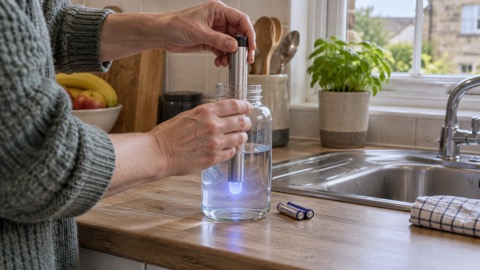
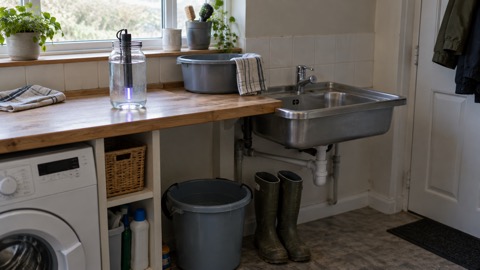
Two models appear in the maker's own documentation: the Classic 3 and the Adventurer Opti. They share the same treatment volumes and lamp life, and differ in power and form.
| Specification | SteriPEN Classic 3 | SteriPEN Adventurer Opti |
|---|---|---|
| Treatment size | half or 1 litre1 | half or 1 litre4 |
| Lamp life | 8,000 activations1 | 8,000 activations5 |
| Power | 4 AA batteries: alkaline, lithium or rechargeable NiMH1 | 6V, 5W5 |
| Activation | not given in the datasheet | 1 click for 1 litre, 2 clicks for 0.5 litre4 |
| Dimensions | 4.3 x 4.3 x 18.6 cm1 | not given in the manual |
| Warranty | 3 year limited warranty5 | 3 year limited warranty5 |
The Classic 3 runs on four AA cells, and the maker lists alkaline, lithium or rechargeable NiMH as acceptable types1. That flexibility matters in an emergency: AA batteries are the ones most households already keep as spares, and official emergency kit advice is to include spare batteries and a charged power bank with charging cables9. The Adventurer Opti's maker figure of 50 treatments per battery set4 is the number to plan around: a family of four drinking a litre each a day would use eight treatments a day, so a set lasts about six days of full household use, and you should hold several sets.
The Adventurer Opti's 48 or 90 second treatment time4 reflects the two volumes: the shorter cycle for half a litre, the longer for a full litre. The maker lists it for group sizes of 1 and 2 to 5 persons4, which is a fair description of who it is built for.
What UV treatment can and cannot make safe
The maker's claim is specific: UV-C light rays safely purify clear water by destroying 99.9% of protozoa (including Giardia and Cryptosporidia), bacteria and even viruses1. That is a strong claim for the biological side of water safety, and it is the reason a SteriPEN earns a place in an emergency kit.
It is equally specific about the limit: clear water. The word appears in the maker's own description1, and it is the condition that decides whether the device works at all. UV light has to reach the organisms in the water, and particles shield them. The Drinking Water Inspectorate's guidance for private supplies makes the same point from the regulatory side, requiring preliminary treatment to bring turbidity below 1 NTU before disinfection6.
What UV does not do is remove chemicals. Official guidance on private supplies after flooding states that boiling water kills pathogenic bacteria, viruses and parasites, but does not remove harmful chemicals2. UV treatment is a disinfection step like boiling in this respect: it deals with organisms, not dissolved contamination. If a supply may have been affected by floodwater carrying fuel, pesticides or other chemicals, assume the water is unsafe to drink and source an alternative supply, and ring the local authority for advice if a well or spring has been covered by floodwater2.
For context on what a water company does to mains water, Cambridge Water describes a process where water passes through sieves to remove large debris, chemicals make smaller particles settle as sludge, water filters through gravel and carbon which removes traces of pesticides, and finally it is disinfected with chlorine11. A SteriPEN replaces only the last of those steps, and only for clear water.
How to treat water with a SteriPEN
The routine is short, and the discipline is in the details: clear water, the right volume, a full cycle, and a clean bottle.
- Start with clear water. If it is cloudy, deal with that first (see the next section). The maker's claim is for clear water1.
- Fill a wide-mouth bottle to half a litre or one litre. The Adventurer Opti needs a minimum 1.75 inch diameter opening, such as a wide-mouth one litre bottle4.
- Insert the lamp and start the cycle. The Adventurer Opti runs 48 or 90 seconds depending on volume4.
- Stir gently during treatment so the light reaches all the water, following the maker's manual for your model5.
- Let the cycle finish. If it stops early, treat again or use another method.
- Use the water promptly and keep it covered.
"Do not use UV lamp as a light source."
That instruction is worth taking seriously: the lamp is for treating water, not for lighting a room, and using it as a torch exposes eyes and skin to ultraviolet light for no benefit. For lighting in a power cut, use a torch: official kit advice is a waterproof torch with spare batteries, checked regularly, and to consider a wind-up model10. See Emergency Lighting at Home: Torches, Lanterns and Candles.
Cloudy water: what to do before treating it
Cloudy water is the most common reason a UV treatment fails, and it is the one thing you can fix before you start. The maker's claim is for clear water1, and the Drinking Water Inspectorate requires turbidity below 1 NTU before disinfection on private supplies6. You will not be measuring NTU at the kitchen table, so use your eyes: if you cannot see through a glass of it, it is not ready for the lamp.
The practical answer is to let the water settle and to filter out the visible material before treating. Let a container stand so sediment drops, pour off the clearer water, and strain it through a clean cloth if you have nothing better. Then treat the cleared water with the SteriPEN. If it is still cloudy after settling, do not treat it and assume it is safe; find another source or use a method that copes with turbidity.
This is also where a household plan earns its keep. Store water before an emergency so you are not treating floodwater in a hurry, and keep containers clean and covered. Official guidance for private supplies after floods or storms includes cleaning taps and fittings, applying a mild disinfectant suitable for food contact or drinking water disinfection, rinsing, reassembling and running the tap for a few minutes before use12. That is about the supply, not the bottle, but the principle is the same: clean kit, clear water, then disinfect.
Batteries, charging and power during an emergency
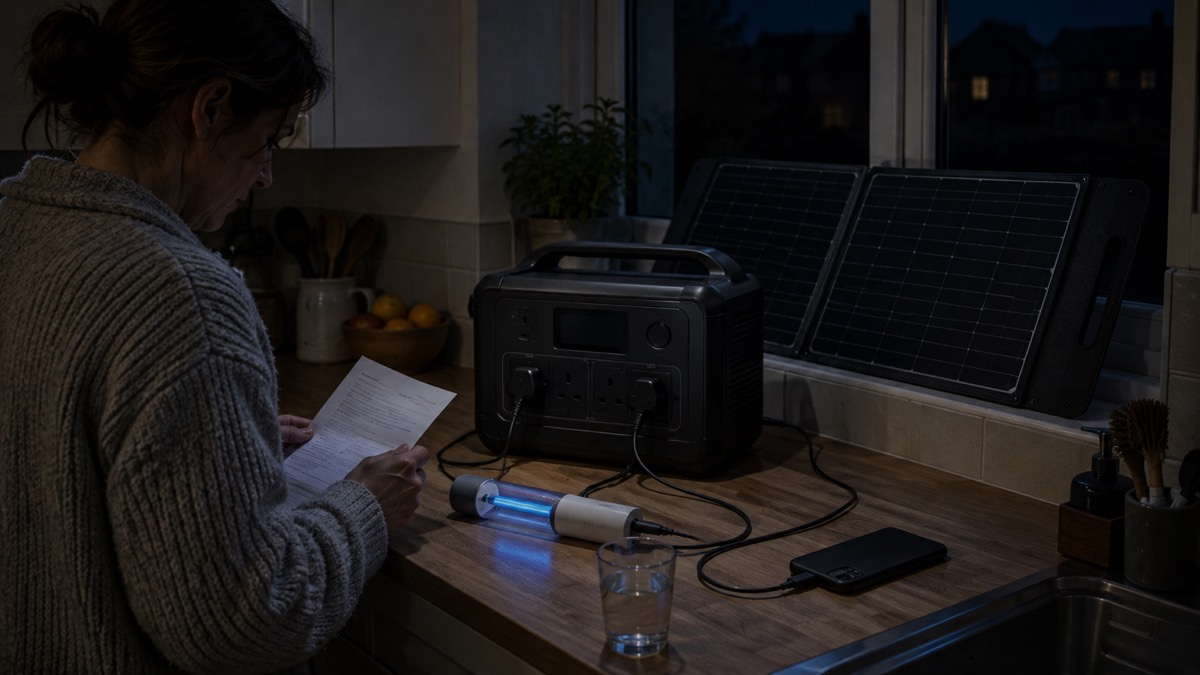
A SteriPEN is only as good as its batteries. The Classic 3 takes four AA cells, alkaline, lithium or rechargeable NiMH1, and the Adventurer Opti gives 50 treatments per battery set4. Plan for both: a stock of AA cells in the emergency kit, and a way to recharge NiMH cells if you use them.
Official emergency kit advice across the UK is consistent on this. Lancashire Prepared advises a waterproof torch and spare batteries, checked regularly, and to consider a wind-up model10. North Devon Council advises a charged portable power bank and charging cables9. Dumfries and Galloway advises including spare batteries13. None of these is about water treatment specifically, but they are the same supplies a SteriPEN depends on, so build one power plan that covers the torch, the radio, the phone and the purifier.
For the wider picture on keeping devices running, see Backup Power at Home: A Household Guide and Power Cuts: A Household Guide. If you are charging from a plug-in solar panel or a power station, follow the safety advice that comes with it: the London Fire Brigade says to stop using a system immediately if you notice burning smells, overheating, buzzing noises, visible damage or repeated electrical tripping14.
Safe storage between emergencies
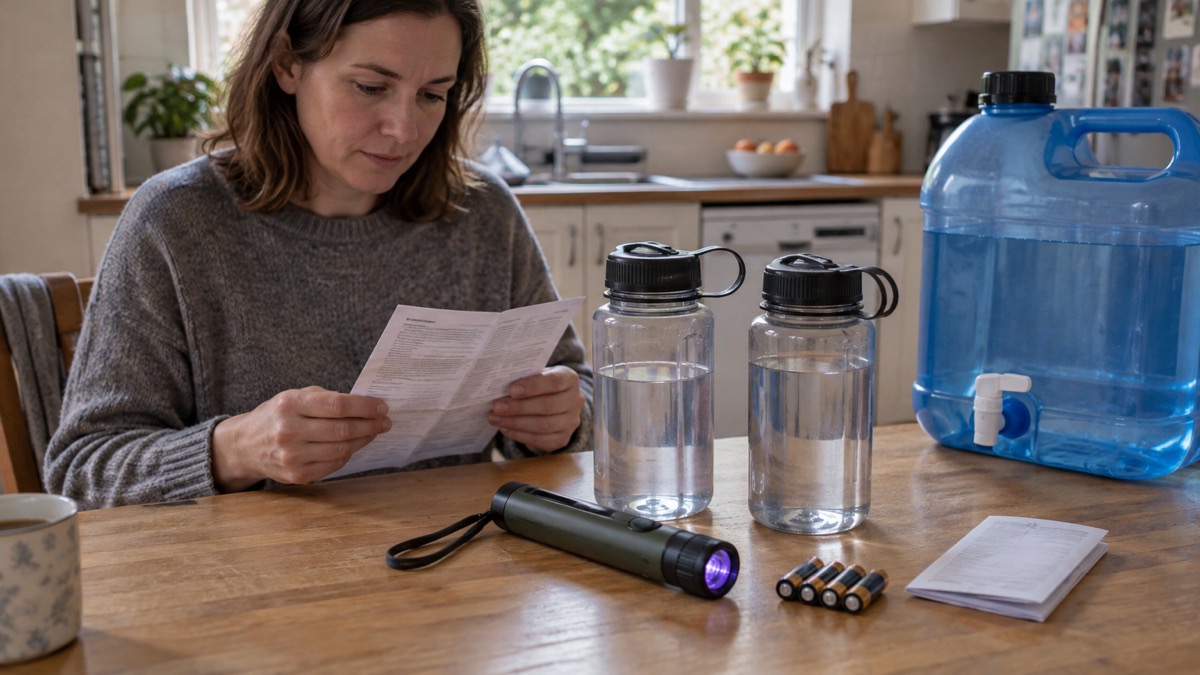
Between emergencies, a SteriPEN should live with the rest of your water kit, not in a shed or a vehicle where damp and cold can get at it. Keep it dry, keep the batteries out of the device if it will sit for months, and keep the manual with it so the treatment times and warnings are to hand.
The same discipline applies to the water side. The Drinking Water Inspectorate's guidance on water storage for private supplies describes commissioning disinfection by filling the system with a 20 mg/L solution of chlorine and leaving it to stand for several hours, preferably overnight, then draining it off and rinsing thoroughly using treated water15. That is for supply systems rather than bottles, but it shows the standard: stored water and the containers that hold it need cleaning and maintenance, not just filling.
Official kit lists give the shape of a household water and medicine store: spare medication16, a charged power bank9, spare batteries13, and a home medicine kit with painkillers, upset stomach relievers, antihistamines, plasters and bandages8. A SteriPEN sits alongside those as one tool among several. For the full list, see Emergency Kit: What a UK Household Should Keep Ready.
What can go wrong and how to spot it
Most failures with a SteriPEN are not dramatic. They are a flat battery, a cloudy bottle, a cycle that did not finish, or a lamp at the end of its life. The maker gives a lamp life of 8,000 activations for both models1, so keep a rough count if you use it often, and treat a device that stops completing cycles as due for attention rather than as working.
Electrical faults are worth knowing about in any household kit. The fire and rescue service advises keeping your eyes peeled for signs of dangerous or loose wiring such as scorch marks, hot plugs and sockets, blown fuses, tripped circuit-breakers and flickering lights17. That applies to chargers and power banks as much as to anything else: if a charger or battery pack shows those signs, stop using it.
If someone becomes unwell after drinking water you are unsure of, do not try to diagnose it yourself. The NHS says sepsis can be hard to spot, and at the start you may look okay but feel really bad19, with signs including feeling or acting confused or not wanting to do things you usually do19. Get medical help through the usual routes; see First Aid at Home: A Household Guide and Health Emergencies: A Household Guide to Outbreaks, Pandemics and Medicine Supplies.
Support, warranty and safety notices
The Adventurer Opti carries a 3 year limited warranty, and the maker's manual states that product registration is required for the warranty, at www.katadyn.com5. Register the product when you buy it and keep the receipt with your household paperwork, so a failure during an emergency is a support call rather than a loss.
The safety notices that matter are the maker's own. The manual warns not to use the UV lamp as a light source5. The maker's product page gives the treatment times, volumes and container requirements that decide whether the device works4, and the Classic 3 datasheet gives the battery types and dimensions1. Read both before you rely on the device.
For anything else, approach the maker directly for parts and warranty claims: product registration is required for the warranty on the SteriPEN Classic 3 and the SteriPEN Adventurer Opti, and both carry a 3 year limited warranty1. If you are building a household plan around water, read Water in an Emergency: A Household Guide and Getting Started: Preparing Your Household for an Emergency next.
Sources (19)
- SteriPEN Classic 3 datasheet, Katadyn, 2023-04-28
- How to recover from flooding, UK Government, 2023-12-19
- Flooding advice, Belfast City Council, 2026-10-29
- Katadyn SteriPEN Adventurer Opti UV Water Purifier product page, Katadyn, 2026-10-28
- SteriPEN Adventurer Opti manual, Katadyn, 2020
- Protecting your private water supply, Drinking Water Inspectorate, 2026-10-28
- After a flood, UK Government, 2026-10-25
- Use the right service this winter, Hampshire Hospitals NHS Foundation Trust, 2026-10-29
- Be prepared for emergencies, North Devon Council, 2026-10-29
- Emergency pack, Lancashire Prepared, 2026-10-29
- Water quality FAQs, Cambridge Water, 2026-10-28
- Private water supplies after floods or storms, Argyll and Bute Council, 2026
- Prepare for emergencies, Dumfries and Galloway Council, 2026
- Plug-in solar panels: safety advice for residents and homeowners, London Fire Brigade, 2026-10-25
- Water storage, Drinking Water Inspectorate, 2025-11-05
- Planning for an emergency kit, Wiltshire Council, 2026-10-29
- Stay safe in the home, Mid and West Wales Fire and Rescue Service, 2019
- Stay safe in the home, North Wales Fire and Rescue Service, 2016
- Easy read: signs of sepsis and what to do, NHS England, 2020
 SteriPEN Ultra
 SteriPEN UltraLight
 SteriPEN Adventurer Opti
 SteriPEN Classic 3