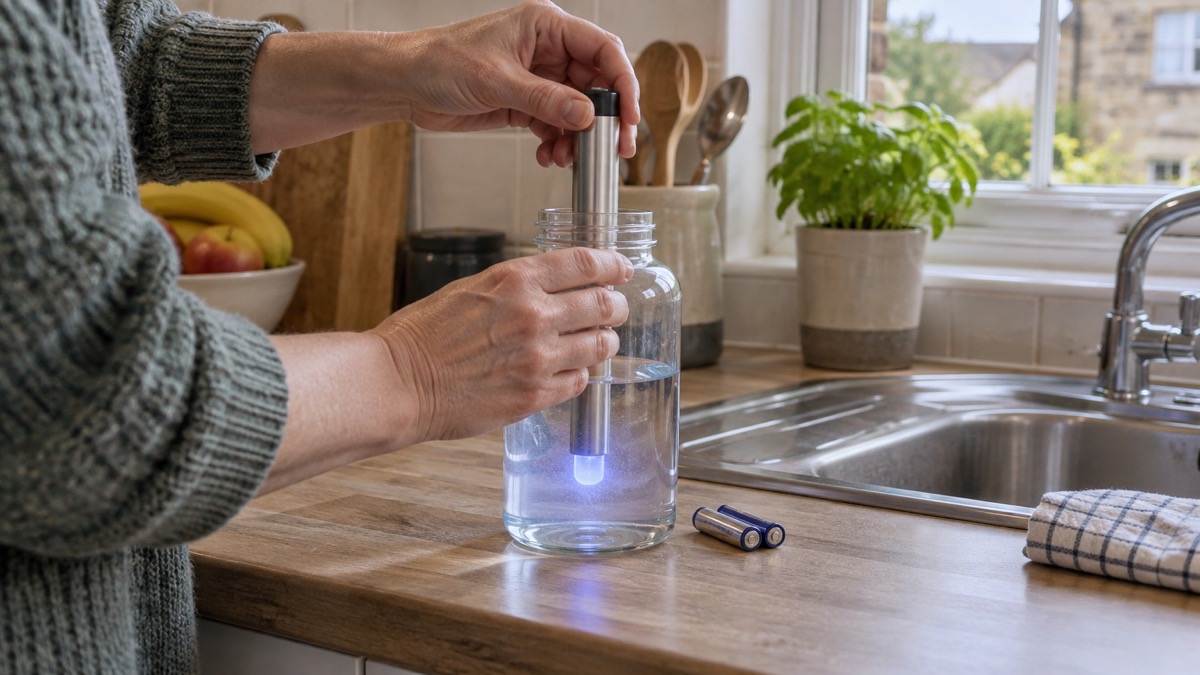
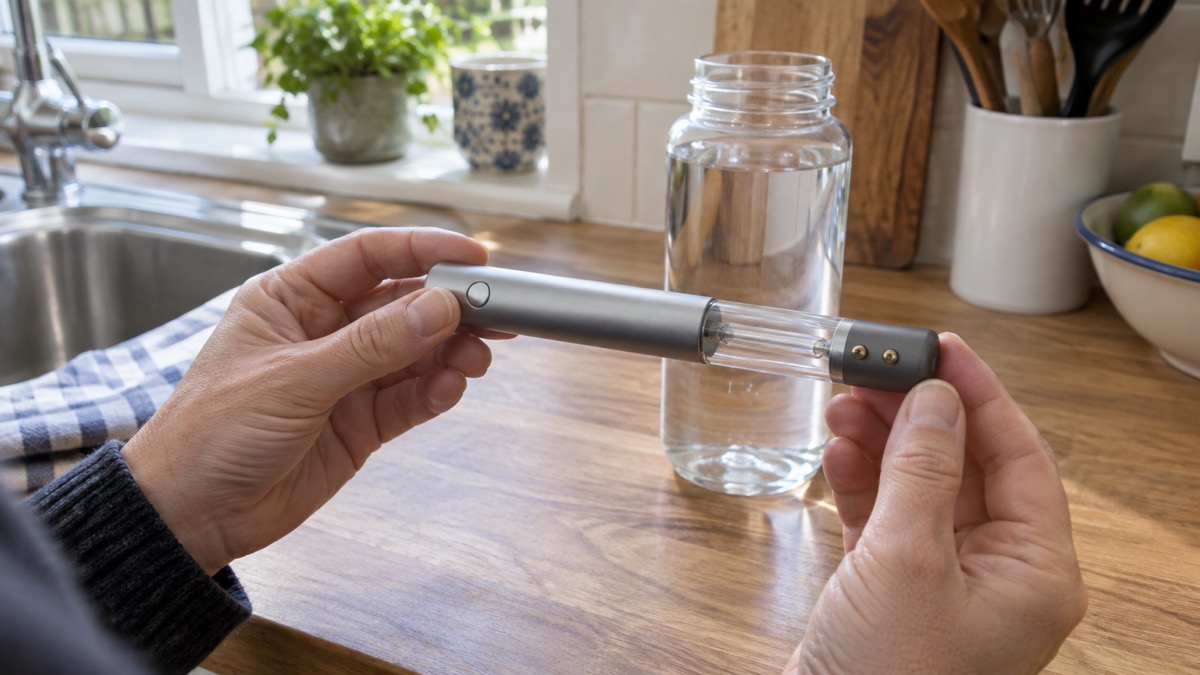
The SteriPEN Adventurer Opti is a battery-powered ultraviolet water purifier, a pen-shaped device you dip into a bottle of clear water and stir while it shines UV light through the water. The maker, Katadyn, lists it as eliminating bacteria, protozoa and viruses, treating half a litre or a litre at a time in 48 or 90 seconds1. It weighs 103 g, runs on two CR123 batteries and is built for camping, backpacking and hiking when you will not have access to the power grid for several days2.
For a UK household it is a small, light, battery-dependent tool for making clear water safer when you are away from a reliable supply. It is not a filter and it does not clean water: it treats water that is already clear. If you are weighing up how to make water safe at home, read it alongside our guide to how to make water safe to drink in an emergency and to UV purifier pens generally.
What the SteriPEN Adventurer Opti is and what it does to water
The Adventurer Opti is a UV pen: a sealed tube with a UV lamp at one end and an optical water sensor that checks the water during use1. The sensor is there for safe operation, so the pen knows it is in water rather than in air4. The same sensor doubles as an integrated LED light, which you switch on by holding down the activation button for three seconds1.
What it does to water is a matter of light rather than chemistry. The maker states that it eliminates bacteria, protozoa and viruses1. That is the claim to hold on to, and the limit that comes with it: UV light has to reach the organisms, which is why the maker lists tap water and clear water as the suitable sources and nothing else1. It is not a filter, so it does not take out sediment, and it is not a way of making dirty water clean.
The maker positions it for camping, backpacking and hiking when you will not have access to the power grid for several days2. That tells you what it suits: a light, compact device for one person or a small group, carried in a pack, used bottle by bottle. It is not a household treatment system and it will not treat a bathtub of stored water in one go.
The maker's own description of the company is that Katadyn has been trusted since 1928 and develops Swiss-engineered water treatment, nutrition and cooking solutions6. The Adventurer Opti sits in its SteriPEN range of UV purifiers7.
Specifications: 103 g, two CR123 batteries, 6V 5W
The figures that decide whether this pen suits you are its weight, its power supply and the size of bottle it fits. The maker's product page and manual agree on the essentials.
| Specification | Figure | Source |
|---|---|---|
| Weight | 103 g | 1 |
| Power | 6V, 5W, 0.83A | 3 |
| Batteries | two CR123, not included | 1 |
| Treatments per battery set | up to 50 | 3 |
| Treatment size | 0.5 or 1 litre | 1 |
| Treatment time | 48 or 90 seconds | 1 |
| Minimum container opening | 1.75 inches diameter | 4 |
| Lamp life | 8,000 activations, up to 8,000 litres | 1 |
| Group size | 1, or 2 to 5 people | 1 |
| Item code | ADO-MP-EFG | 4 |
| Barcode | 0899321000857 | 1 |

Two things in that table matter more than the rest for a household. The first is the battery: the maker's product page lists battery included as no, and the manual tells you to install two CR123 batteries with the polarities as shown1. The second is the opening size. The pen works in containers with a minimum 1.75 inch diameter opening, such as a wide-mouth one litre bottle4. A narrow-necked bottle will not take it.
The maker also notes that it works in cold environments, though battery performance can decline in extreme cold1. If you keep it in a cold porch or a vehicle over winter, expect fewer treatments from a set.
Treating water
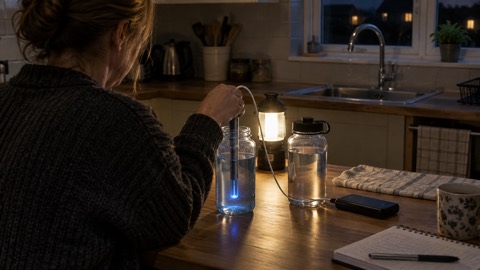
Using the pen is a short, fixed sequence, and the maker's manual sets it out plainly: click the activation button once for 1 litre and twice for 0.5 litre, then, while the green LED flashes, submerge it in clear water and stir3. The product page gives the treatment time as 48 or 90 seconds, matching the two volumes1.
- Fill a wide-mouth container with clear water, leaving room to stir.
- Click once for a litre, twice for half a litre3.
- While the green LED flashes, submerge the pen and stir3.
- Keep stirring until the treatment finishes, then use the water.
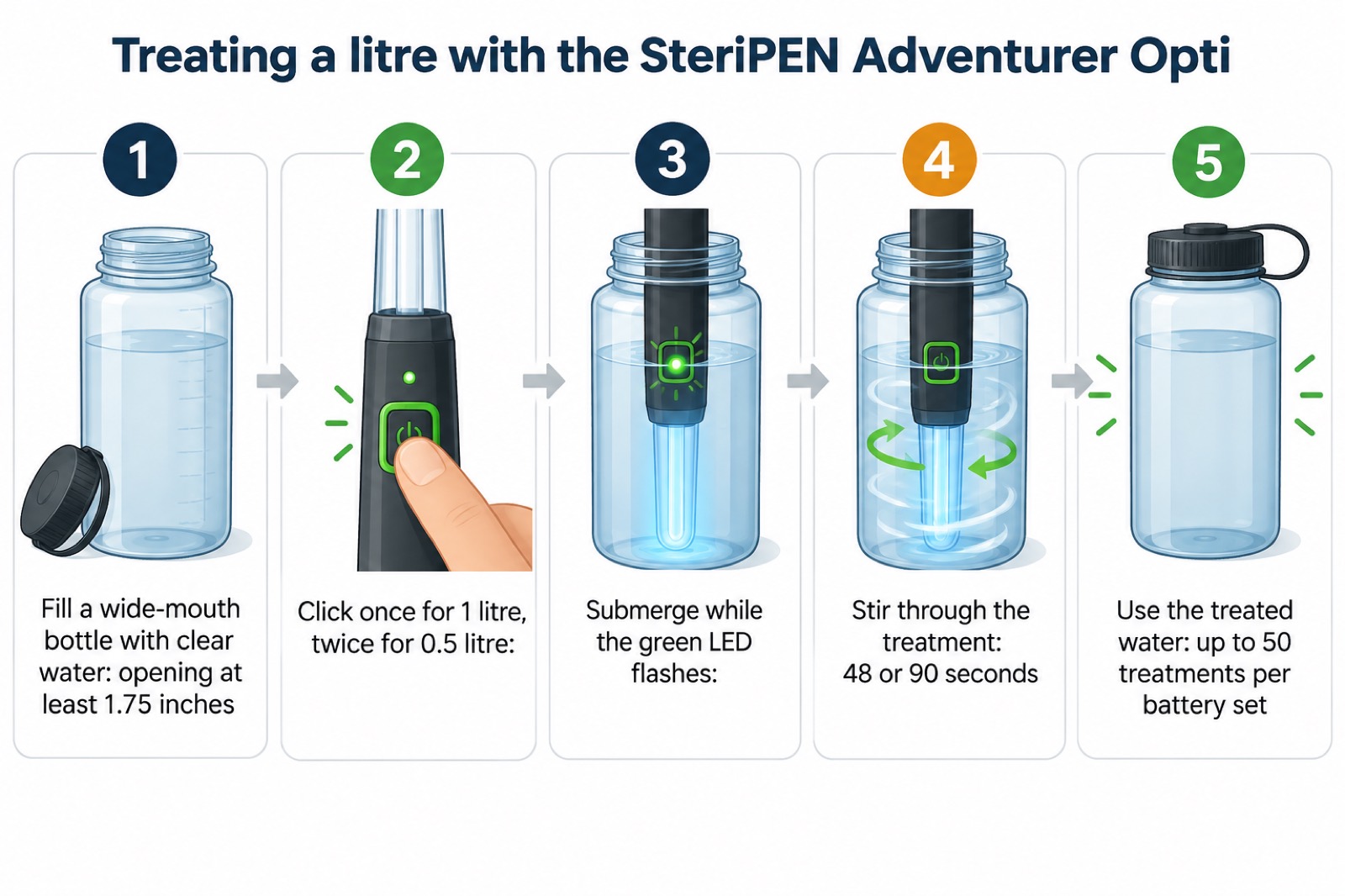
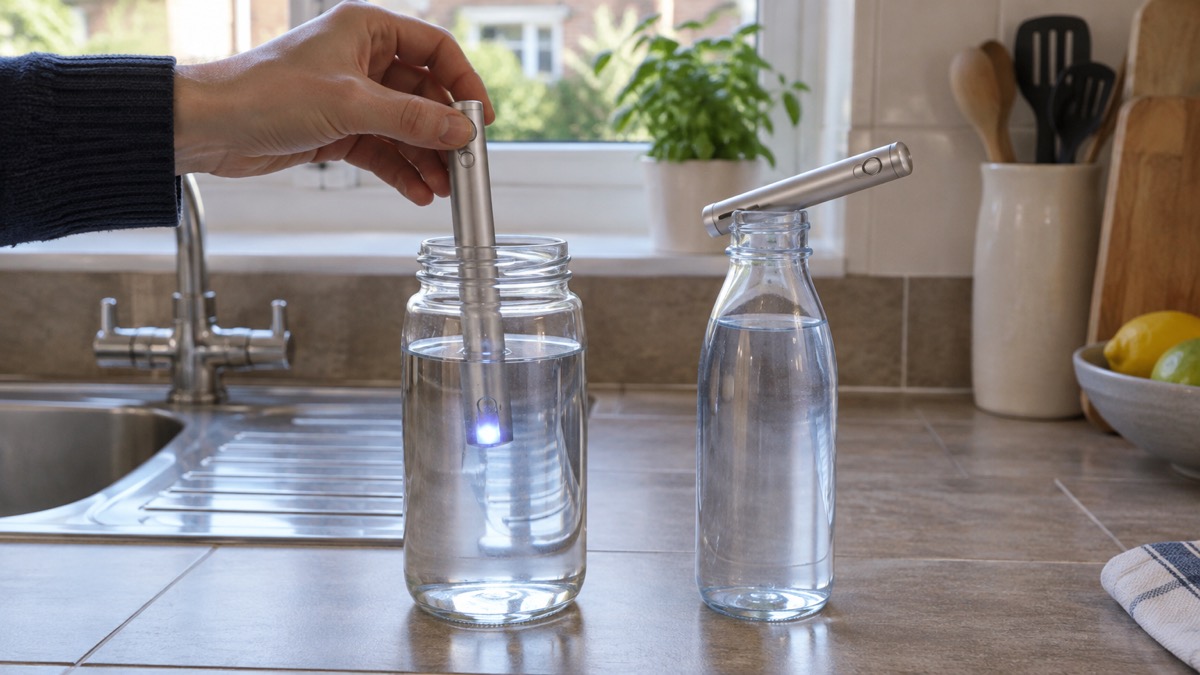
The dose is small, so plan the round. A set of batteries gives up to 50 treatments3, and each treatment is half a litre or a litre. For one walker that is plenty. For a household treating drinking water for several people over several days, the arithmetic runs out quickly, and you would be better served by a method built for volume, such as boiling or a gravity filter.
The maker lists tap water among the suitable sources1, which matters during a supply interruption. If you have stored tap water and it is clear, the pen can treat it. What it cannot do is overrule your water company: if you have been sent a do not drink notice, follow the notice, and see our guide to do not drink and do not use notices. If your supply has come back discoloured, the official advice is to run the cold tap nearest your stopcock for a while to see if it clears, and contact your water provider if problems continue8.
Use it only in clear water and wide-mouth containers
The two conditions the maker sets are not optional extras. The pen is listed for tap water and clear water1, and the manual's instruction is to submerge it in clear water and stir5. Cloudy or murky water defeats the method: the light has to reach through the water to work, and suspended dirt gets in the way.
If the water in front of you is not clear, do not treat it with the pen and drink it. Let it stand and settle, or put it through a filter first, then treat the clearer water. Our pages on what filters remove and on drinking from streams, rivers and other sources safely set out the options.
The container condition is just as firm. The pen works in containers with a minimum 1.75 inch diameter opening, such as a wide-mouth one litre bottle4. Check your bottles before you rely on them: a standard narrow-necked bottle will not let the pen in far enough to treat the water properly.
Lamp life: up to 8,000 activations and the warning light
The UV lamp is the part that wears out, and the maker gives it a long but finite life: 8,000 activations3. The product page puts the same figure in litres, saying the lamp purifies up to 8,000 litres1. For a household using it occasionally, that is far more than you are likely to use. For a group treating water daily over seasons of trips, it is a number worth knowing.
The pen tells you when the end is near. The maker's manual describes an indicator meaning the UV lamp is good for less than 100 uses remaining3. Treat that light as a prompt to order a replacement rather than a warning to ignore: 100 uses is not many if you are treating for several people.
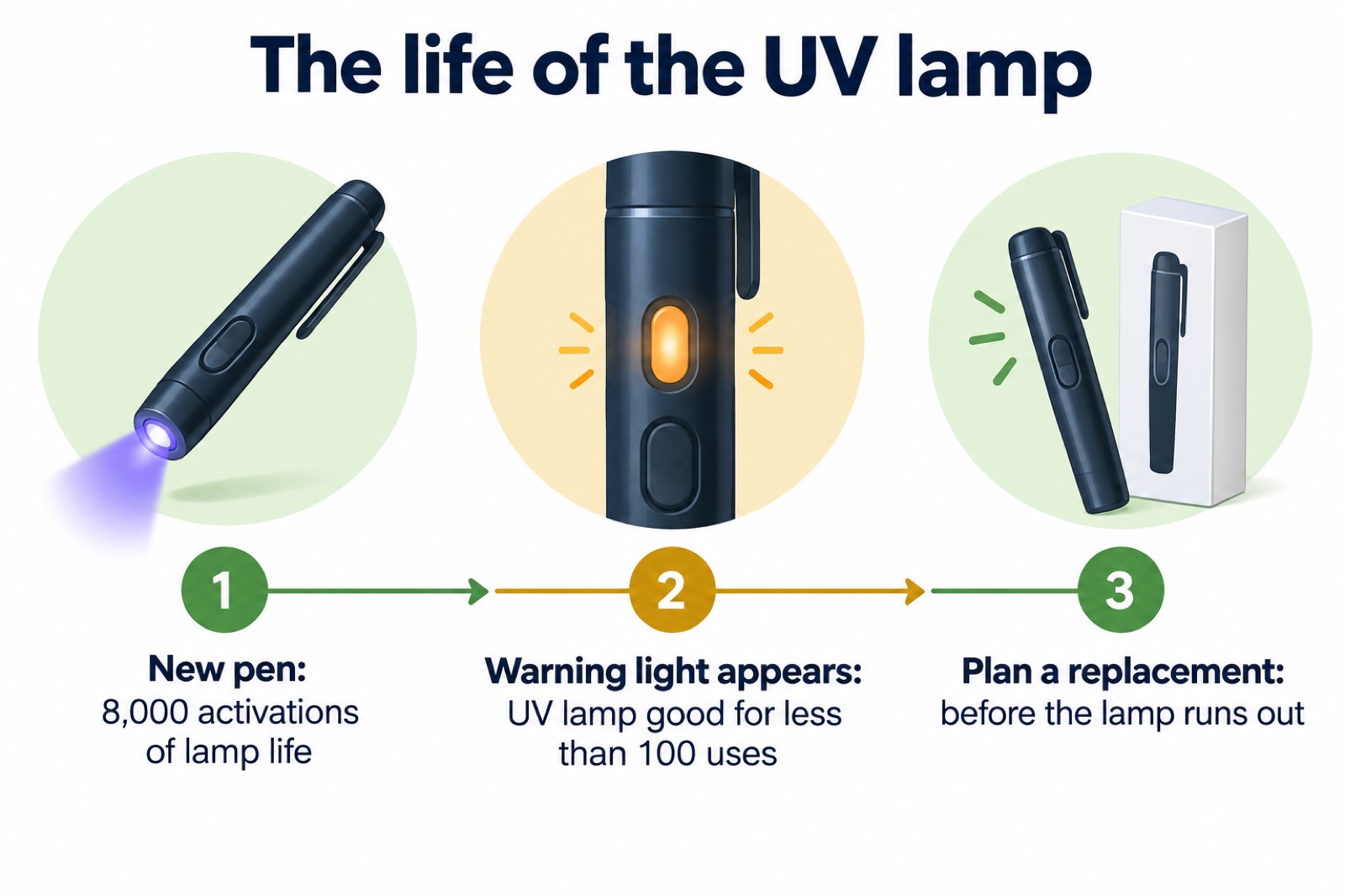
There is no reset and no repair for a spent lamp that the maker describes. The practical habit is to check the indicator before a trip, the same way you would check the batteries, and to keep a second method of treating water in your kit so a failing lamp never leaves you without a way to make water safe.
Handling it safely
The pen is electrical and it goes near water, so the maker's handling rules are the ones to follow. The manual says: do not handle Steripen with wet hands; do not touch water sensor pins with wet fingers3. Dry your hands before you pick it up, and keep your fingers off the sensor pins at the end.
"Do not handle Steripen® with wet hands; do not touch water sensor pins with wet fingers."
The manual also carries a legal notice: it is a violation of Federal law to use this product in a manner inconsistent with its labeling3. That is a United States notice, but the principle holds here: use it as the maker's instructions describe and no other way.
The LED light is the safe way to use the pen as a lamp: hold down the activation button for three seconds to illuminate the darkness1. For household lighting in a power cut, a battery-powered torch is the tool the fire and rescue service expects to see in a grab bag11, and our guide to emergency lighting covers the rest.
One more caution for households where someone has epilepsy. Official NHS guidance for someone having a seizure is to protect them from injury by removing any dangerous or potentially harmful objects nearby12. A flashing green LED is a small thing, but if you know flashing lights affect someone in the house, treat the pen as something to use away from them.
Warranty, registration and support
The pen carries a 3 year limited warranty3. The condition attached to it is registration: the manual lists product registration as required for the warranty, done at the Katadyn website3. Register it when it arrives, not when it fails.
Registration has a second purpose that fire and rescue services recommend for electrical products generally: register your product with the manufacturer for safety updates, recalls and warranties13. That advice is given for e-bikes and e-scooters, but the habit applies to anything you rely on in an emergency.
For support, the maker's manual gives customer service at cs@katadyn.com and www.katadyn.com3. Keep the item code ADO-MP-EFG and the barcode 0899321000857 to hand when you contact them, so they can identify the model4.
The manual also notes that the device complies with part 15 of the FCC Rules3, a United States certification. It tells you the maker has tested the electronics, not that the pen is certified for UK drinking water treatment. No certification for that purpose appears in the maker's material, so treat the pen as a personal water treatment tool used to the maker's instructions, not as a household purifier with an approval behind it.
Where it fits in a household water plan
The Adventurer Opti is a good fit for one person or a small group who want a light, battery-powered way to treat clear water on the move. It is a poor fit as the only way a household makes water safe at home: the dose is half a litre or a litre, the batteries are not included, and it needs clear water and a wide-mouth bottle every time.
Build it into a plan rather than relying on it alone. Store water in advance, following our guide to how much drinking water to store per person and to storing tap water safely at home. Keep a method that works on cloudy water, such as boiling or a filter. Keep spare CR123 batteries with the pen, and check the lamp indicator before each trip.
If you are comparing UV pens, our pages on the SteriPEN Ultra, the SteriPEN UltraLight and the SteriPEN Classic 3 set out what each does. For the wider picture of preparing a household for a supply interruption, start with our supply interruption checklist.
Sources (13)
- SteriPEN Adventurer Opti product page (Germany), Katadyn, 2026
- UV disinfection collection, Katadyn, 2026
- SteriPEN Adventurer Opti manual, Katadyn, 2020
- SteriPEN Adventurer Opti product page (Switzerland), Katadyn, 2026
- SteriPEN Adventurer Opti manual (alternate file), Katadyn, 2020
- Katadyn, Katadyn, 2026
- SteriPEN collection, Katadyn, 2026
- Water supply interruptions or outages, Prepare campaign, 2026
- Water supply interruptions or outages, Be Ready campaign, 2026
- Loss of essential services, Greater Manchester Combined Authority, 2026
- Reduce the risk of wildfire damage to your property, Hampshire and Isle of Wight Fire and Rescue Service, 2026
- Epilepsy, NHS Inform, 2026
- Stay safe at home: e-bikes, Cheshire Fire and Rescue Service, 2026
 Katadyn SteriPEN Ultra
 Katadyn SteriPEN UltraLight
 Katadyn SteriPEN Classic 3