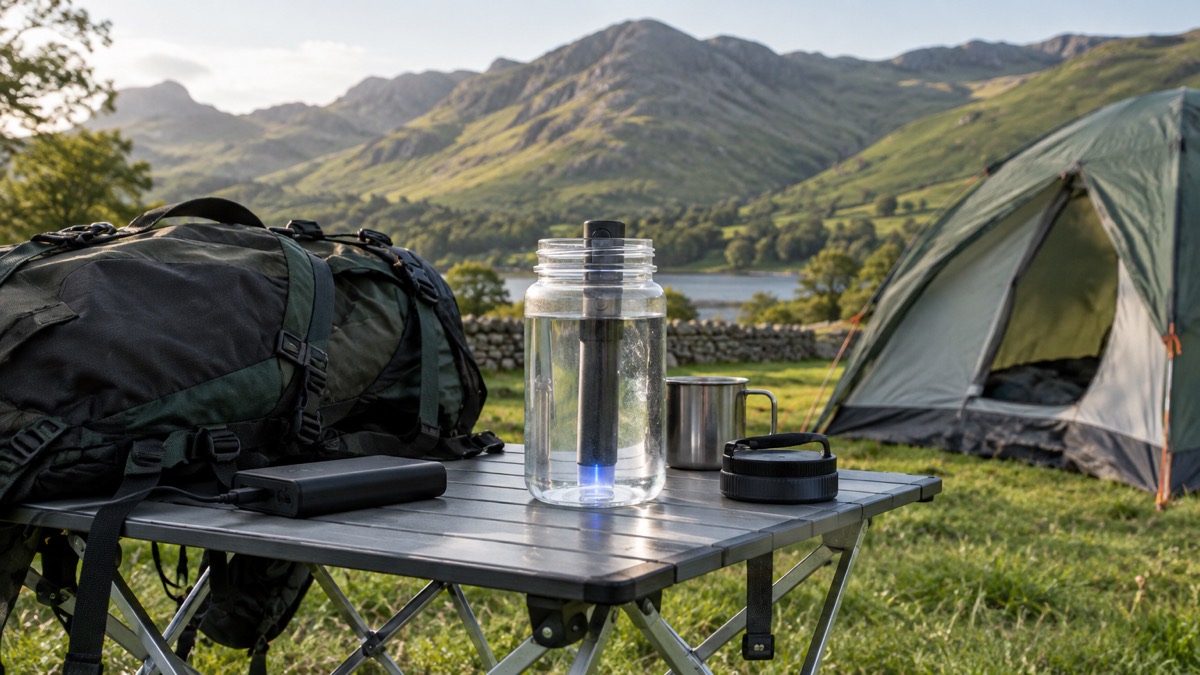
A UV purifier pen is a slim, battery-powered wand that you dip into a glass or bottle of water and stir. Ultraviolet light passes through the water as you stir, and that light destroys the ability of bacteria, protozoa and viruses to cause illness. Katadyn, the maker of the SteriPEN range, states that its pens eliminate bacteria, protozoa and viruses1, and the Classic 3 does its work in 48 or 90 seconds depending on the volume being treated2.
The catch is that the water must be clear. The maker's own safety warning on the SteriPEN Ultra is blunt: "Use only on clear water, as cloudy, sediment-laden water hinders effectiveness."1 A UV pen also removes nothing that is not alive. It does not take out chemicals, nitrates or heavy metals, because it disinfects rather than filters. And it depends entirely on batteries: without power, it is a plastic stick.
For a UK household preparing for a supply interruption, a UV pen sits alongside boiling, purification tablets and filters as one option among several. This page explains how the pens work, what they do and do not do, and when one is worth having in your emergency kit.
How a UV pen treats water
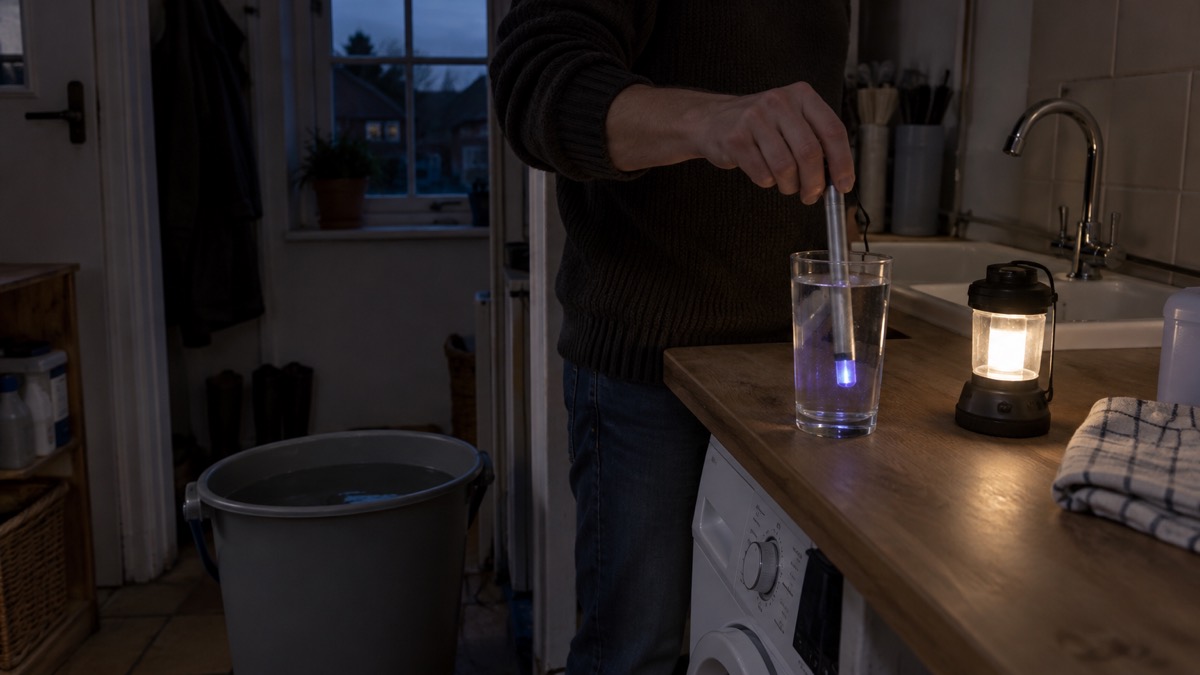
A UV pen works by exposure, not by trapping anything. You fill a container with clear water, press the pen's button, dip the lamp end into the water and stir. The ultraviolet light from the lamp passes through the water as it circulates around the lamp, and the dose of light damages the organisms in it so that they can no longer multiply or infect. Nothing is added to the water and nothing is taken out.
The principle is the same one used in fixed household UV treatment systems on private water supplies. The Drinking Water Inspectorate, which regulates drinking water in England and Wales, advises anyone installing UV disinfection to "Ensure any UV disinfection treatment is designed for drinking water, and maintain availability and continuity of spare parts such as UV bulbs in accordance with the manufacturer's instructions."3 A handheld pen is the portable version of the same idea, and the same rule applies: buy a product actually intended for drinking water, and follow the maker's instructions on lamp life and use.
The pens are built to make a correct dose hard to mess up. On the SteriPEN Adventurer Opti, "an optical eye senses water to ensure safe use and effective treatments"5: the pen knows when the lamp is actually in water and times the dose from there. The Adventurer Opti also uses a simple button code for volume, with one click treating one litre and two clicks treating half a litre5. The Classic 3 gives you a choice of 48 or 90 second treatment times depending on how much water you are treating2.
One habit worth forming is to treat water in a wide-mouthed container where you can stir freely. The dose depends on the light reaching the water, and stirring is what carries every part of the volume past the lamp. Treat the volume the pen is set for, not a larger one, and treat each container separately.
What a UV pen kills, and what it leaves in the water
The maker's claim for the range is consistent across models: the pens "Eliminate bacteria, protozoa and viruses"1 and the Classic 3 "Inactivates bacteria, protozoa and viruses"2. Those three groups cover the waterborne germs that cause most illness: bacteria such as E. coli, protozoa such as cryptosporidium and giardia, and viruses. Somerset Council, advising private supply owners, lists "Ultraviolet (UV) filters to remove bacteria (E. coli)" among the treatments for private supplies6, which reflects the same understanding: UV is a disinfection method aimed at living organisms.
What a UV pen does not do is remove anything. There is no filter medium, no carbon and no membrane. Anything dissolved in the water stays there: chemicals, nitrates, heavy metals, pesticides, salt. The Drinking Water Inspectorate's guidance on protecting private supplies makes the distinction clear by listing UV for bacteria and separate "filters to remove Nitrates and other chemicals" as different treatments for different problems3, and Somerset Council likewise lists UV for E. coli alongside other treatments for other contaminants6.
This matters most if you are on a private supply or drawing from an unfamiliar source. If the risk is germs in otherwise clean-looking water, a UV pen addresses it. If the risk is chemical run-off, flooding near farmland, or anything you can smell or taste that should not be there, a UV pen does nothing about it, and you need a treatment suited to that contaminant. When in doubt about a private supply, ask your local authority, which has duties over private water supplies.
Cloudy water shields germs: filter or settle it first
The single most important limit on a UV pen is water clarity. The maker states it plainly on the Ultra: "Use only on clear water, as cloudy, sediment-laden water hinders effectiveness."1 The reason is physical. UV light only works on what it can reach, and particles in the water shade the germs clinging to them or hiding inside them. A germ behind a speck of sediment never receives a full dose, and the treatment fails even though the pen completed its cycle and showed success.
The fix is to get the water clear before it reaches the pen. Two options work:
- Filter first. Pass the water through a filter that removes particles, then treat the filtered water with the pen. Independent guidance on UV treatment is explicit that prefiltration is needed to stop particles shielding organisms from the rays3. The government's emergency water guidance makes the same point about alternative sources generally: "Most alternative water sources will need to be filtered before using" treatment tablets4, and the logic is identical for UV.
- Let it settle. Stand the water in a container until the sediment drops, then pour or siphon the clear water off the top without disturbing what has settled.
If you cannot get the water clear, do not use the pen on it. Boil it instead. Argyll and Bute Council, advising on private supplies after floods and storms, warns that "the usual treatment processes may not provide adequate treatment, particularly if water is coloured or cloudy, and water may need to be filtered and boiled before use"7. That is official guidance for exactly the situation where a UV pen's limit bites.
It is worth knowing how to tell harmless cloudiness from a real problem in tap water, because the test is the same one you would use before treating. The advice is the same whoever gives it: pour a glass and watch it. The Drinking Water Inspectorate says "This can be easily checked by pouring water into a glass and watching it clear from the bottom up"8. United Utilities adds that if the cloudiness clears from the bottom to the top over a few minutes, "it is just trapped air and nothing to worry about"9. Air bubbles clear; sediment does not. Water that stays cloudy or coloured fails the UV pen's own requirement, and should be filtered or boiled rather than treated with UV alone. Our page on cloudy tap water covers the tap-water side in more detail.
No filter, so no loss of water pressure
Because a UV pen contains no filter, it imposes no resistance on the water passing through it, and this is a genuine practical difference from filter-based treatment. A gravity filter or pump filter works by forcing water through a medium that traps particles and organisms, and that medium slows the flow, clogs over time and needs cleaning or replacing. A UV pen has none of that. You dip, stir and drink; there is nothing to clog and no pumping effort.
The contrast is easiest to see against ceramic filter candles, the traditional treatment on many private supplies. The Drinking Water Quality Regulator for Scotland notes of these that "They do not require electricity to run as the water is filtered under gravity"10: no power, but a filter medium that must be maintained. Scottish Borders Council likewise advises that "UV treatment should be regularly checked to ensure that it is operating correctly and the pre-filter replaced, as required, dependent on the quality of the source water"11. Note that even fixed UV systems usually pair with a pre-filter for exactly the clarity problem above, and the pre-filter is the part that needs replacing.
So the trade is straightforward. A filter gives you treatment that works on cloudy water and needs no electricity, at the cost of flow, effort and cartridge maintenance. A UV pen gives you fast, effortless treatment of clear water, at the cost of a battery and a strict clarity requirement. Many prepared households keep both: a filter to clarify, a pen or tablets to disinfect. Our comparison of tablets or a gravity filter works through a similar choice.
A UV pen needs electricity to work, and the batteries that power it
Everything a UV pen does depends on its battery. There is no hand-pumped, gravity-fed or chemical fallback inside the pen: if the battery is flat, the lamp does not light and no water gets treated. Before you rely on one, know exactly which battery your model takes and have a plan for keeping it fed during a multi-day interruption.
The two battery designs in the range suit different households:
| Model | Battery | What that means for you |
|---|---|---|
| SteriPEN Classic 3 | 4 AA batteries, lithium or rechargeable NiMH2 | Batteries not included2; carry spares or a charger and cells |
| SteriPEN Ultra | Internal USB rechargeable lithium-ion1 | No separate cells to buy, but you need a USB power source to refill it |
For the Classic 3, the maker gives real numbers on how far a set of batteries goes, and they vary enormously with the cells you choose. The treatment count per battery set is 20, 80 to 100, or 150 depending on battery type2, and the maker spells out one case: "NiMH performance varies by mAh rating: 2300 provides about 100 liters."2 In other words, cheap alkaline cells may treat as few as 20 times, while good rechargeables treat several times that. Buy the pen with that in mind: the running cost and reliability sit in the batteries, not the wand.
For the Ultra, the question becomes how you will recharge it away from the mains. A USB power bank is the obvious answer, and the same bank can serve your emergency lighting and phone. If you are preparing for longer interruptions, our backup power guide covers the options. One point from the Caravan and Motorhome Club's solar guidance is worth knowing if you plan to recharge from a panel: "The power generated by a solar panel is direct current (DC), so if you want to use it to power something that uses a three-pin 230V socket" you need an inverter12. A pen that charges over USB can take DC directly, which makes solar recharging simpler than it would be for anything needing a mains socket.
Katadyn positions the Adventurer Opti for exactly this off-grid scenario: it is intended for "camping, backpacking & hiking, if you won't have access to the power grid for several days"13. That positioning is honest about the pen's dependence: several days without the grid is the design case, and beyond that you need a recharging plan or a different method.
Whatever model you hold, carry a fallback. Boiling needs only a heat source and fuel, and purification tablets weigh nothing and never run out of charge. The government's emergency water guidance notes that "boiling or adding water purification tablets to alternative sources of water can help make it safer to drink in an emergency", always following the product label as tablets come in different strengths4.
The Katadyn SteriPEN range at a glance
Katadyn's SteriPEN line covers several models with the same core function and different bodies, batteries and interfaces. The maker describes the Classic 3 as "the latest, most versatile model in our award winning Classic line"14 and the Ultra as "our flagship model with our most advanced user interface featuring a user-friendly" OLED display14. The UltraLight is "the smallest and lightest model of the Steripen series", treating one litre per application14.
| Model | Battery | Weight | Water sources | Treatments per set |
|---|---|---|---|---|
| Classic 3 | 4 AA, lithium or NiMH2 | 178 g2 | Clear water, tap water2 | 20 / 80 to 100 / 1502 |
| Ultra | Internal USB rechargeable lithium-ion1 | not stated in the material here | Clear water1 | not stated in the material here |
| Adventurer Opti | battery required, not included5 | 103 g5 | Tap water, clear water5 | 505 |
| UltraLight | not stated in the material here | not stated in the material here | clear water | not stated in the material here |
Where the table shows a figure as not stated in the material here, treat that as a gap rather than an absence: check the maker's current product page before packing, because specifications can change between product revisions and between markets.
A few features distinguish the models beyond the battery. The Adventurer Opti's optical sensor doubles as a torch: "hold down the activation button for three seconds to illuminate"5, which is a genuine convenience in a power cut. The Ultra's OLED display tells you the treatment status and battery state at a glance14. The Classic 3's virtue is simplicity and swappable AA cells2. All of them share the same core claim against bacteria, protozoa and viruses1 and the same clear-water requirement1.
We have separate pages with fuller detail on the SteriPEN Ultra, SteriPEN UltraLight, SteriPEN Adventurer Opti and SteriPEN Classic 3.
When a UV pen is the right choice for your household
A UV pen earns its place in specific circumstances, and it is honest to name them. It suits a household that wants a fast way to disinfect clear water for drinking and cooking, treated in 48 or 90 seconds with the Classic 32, with no fuel burned and no chemical treatment added3. It suits people who already have, or will add, a way to clarify water, since UV treatment requires prefiltration to stop particles shielding organisms3. And it suits anyone comfortable managing its battery, because the method requires electricity3, whether that means spare AAs or a USB power bank.
It is the wrong primary tool if your likely problem is cloudy or silty water, because the maker's own warning rules that out1. It is the wrong tool if your concern is chemical contamination, because UV removes nothing that is not alive3. And it is a fragile single point of failure if you have no plan for recharging or replacing its battery, since a flat pen treats nothing.
For most UK households the sensible structure is layered, and the pen is one layer:
- Store water first. Stored tap water and bottled supplies need no treatment at all and cover the first hours and days of any interruption. Work out how much to store per person.
- Keep a no-power method. UV treatment requires electricity3, and official emergency guidance says boiling or adding water purification tablets to alternative water sources can help make it safer to drink4.
- Add the pen for speed and volume. If you expect to treat repeated litres of clear water, a pen beats boiling for convenience and beats tablets for speed.
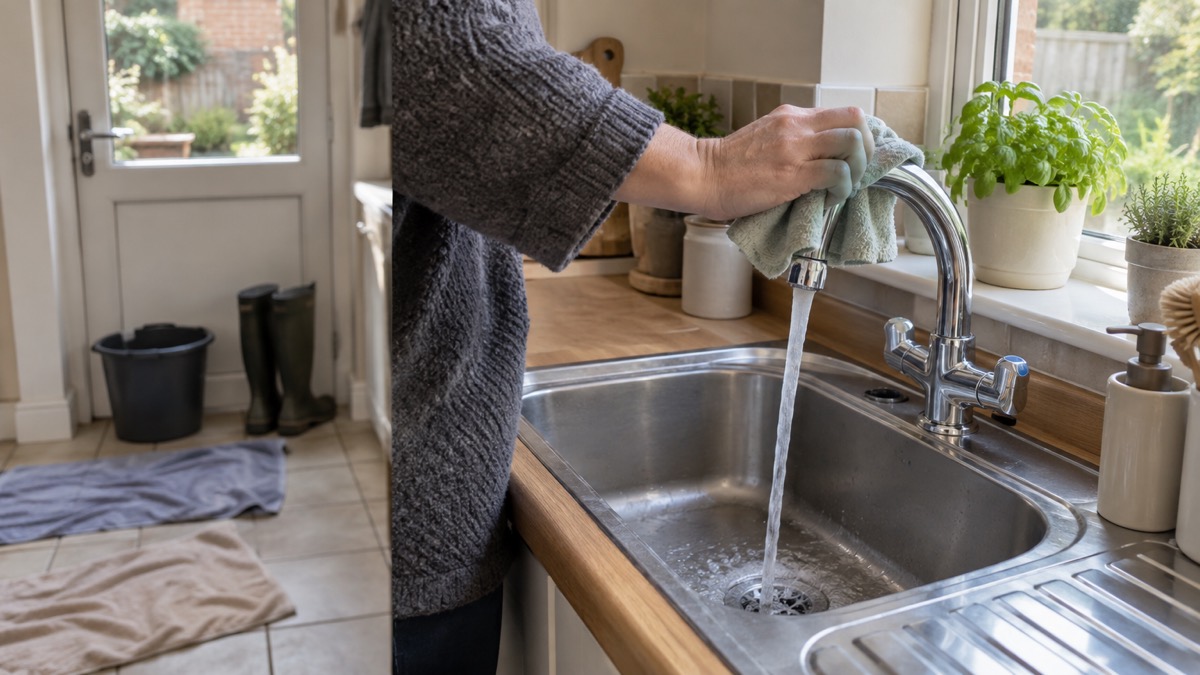
One scenario deserves special care: using any treatment on tap water after a flood. The reassuring headline from official guidance is that mains tap water should not be contaminated after flooding. Belfast City Council's advice is to "Wash taps and let them run for a few minutes before use. Mains tap water should not be contaminated after flooding."15 The London Fire Brigade says the same: "Give your taps a good clean, and run the water for a while before using."16 So for a mains-connected home, the answer after a flood is cleaning and flushing the tap, not treating the water.
The warnings come in two forms. First, do not use tap water that has changed: gov.uk advises "not using tap water if you notice a change in the colour, taste or smell" and contacting your water company if this happens17. Second, if you are on a private supply, the position is different: Argyll and Bute Council warns that after floods or storms the usual treatment may not be adequate, "particularly if water is coloured or cloudy", and that water "may need to be filtered and boiled before use"7. That is the case where a UV pen alone is not enough, and where boiling is the official recommendation. Our flooding guide covers the wider clean-up.
"Wash taps and let them run for a few minutes before use. Mains tap water should not be contaminated after flooding."
Sources (16)
- SteriPEN Ultra UV Water Purifier product page, Katadyn, 2026-10-28
- SteriPEN Classic 3 UV Water Purifier product page, Katadyn, 2026-10-28
- Protecting your private water supply, Drinking Water Inspectorate, 2026-10-28
- Water supply interruptions or outages, beready.campaign.gov.uk, 2026-10-12
- SteriPEN Adventurer Opti UV Water Purifier product page, Katadyn, 2026-10-28
- Private water supplies, Somerset Council, 2026-08-12
- Private water supplies after floods or storms, Argyll and Bute Council, 2026
- White or cloudy water, Drinking Water Inspectorate, 2026
- White water, United Utilities, 2026-10-28
- Water filter candles technical guidance, Drinking Water Quality Regulator for Scotland, 2026-10-28
- Private water supplies, Scottish Borders Council, 2026-10-29
- Solar power technical advice, The Caravan and Motorhome Club, 2026-10-25
- SteriPEN collection, Katadyn, 2026-10-28
- Flooding advice, Belfast City Council, 2026-10-29
- After a flood, London Fire Brigade, 2026-10-25
- After a flood, GOV.UK, 2026-10-25
 Supply Interruption Checklist
 Boil Notice Checklist
 Drinking Supply Checklist
 How Much Water to Store
 Storing Tap Water Safely
 Containers and Jerrycans
 Household Storage Tanks
 Water Already in Your Pipes
 Making Water Safe to Drink
 Boiling Water to Kill Germs
 Purification Tablets
 Emergency Filter Types
 What Water Filters Remove
 Gravity Filters Explained
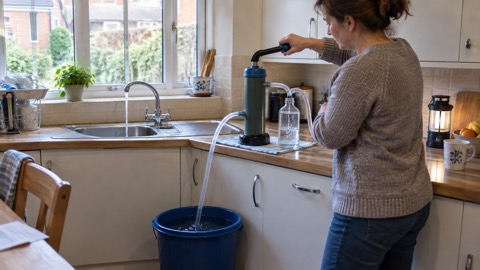 Hand Pump Filters