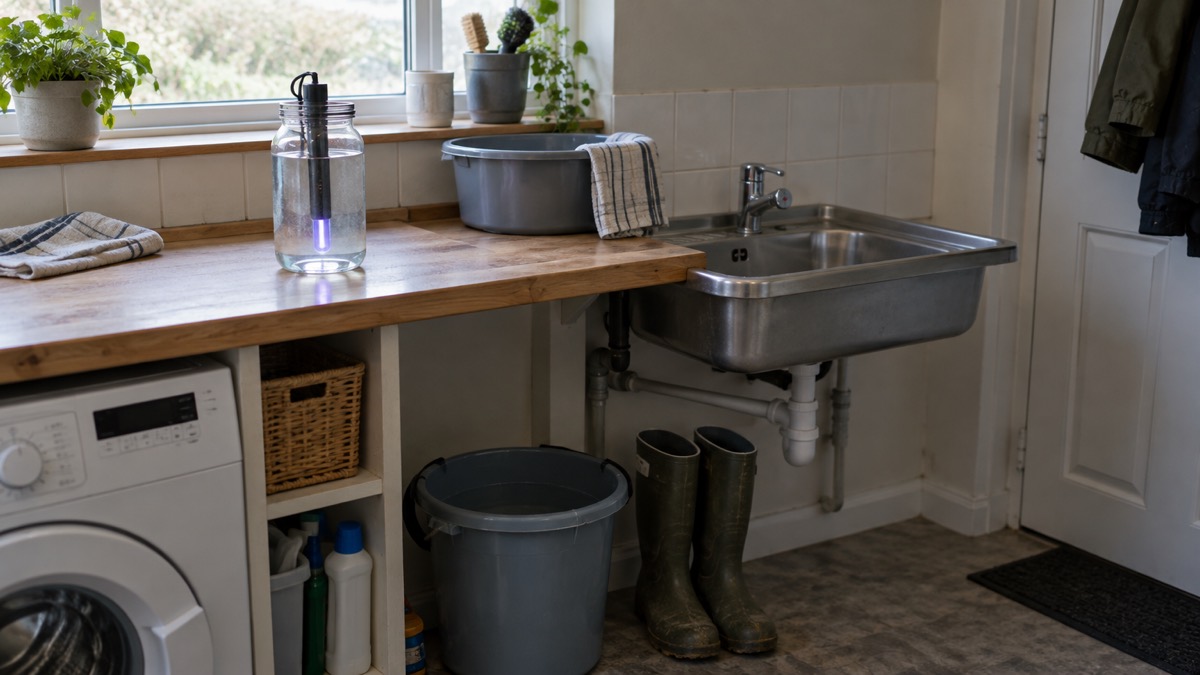
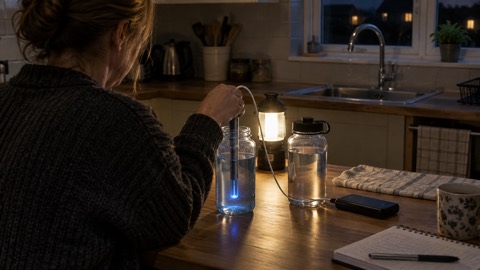
The SteriPEN Classic 3 is a battery-powered UV water purifier: a pen-shaped device you put into a bottle of clear water, press a button, and stir for a set time while ultraviolet light inactivates bacteria, protozoa and viruses1. It treats half a litre in 48 seconds or a litre in 90 seconds, and it runs on 4 AA batteries, which are not included2. It is made by Katadyn, the Swiss water treatment company, and the maker describes it as the latest, most versatile model in its Classic line1.
What it does well is make clear water microbiologically safe, quickly, without pumping or chemicals. What it cannot do is clear dirty water or remove chemical contamination: the maker lists clear water and tap water as the suitable sources, and the UV treatment is microbiological only1. That single limit decides how you use it. If your water is cloudy, you need to settle or filter it first, and the maker sells a pre-filter for exactly that job6.
This page sets out what the pen does, how to treat water with it, which batteries to fit and how many treatments each set gives, what the LED indicators tell you, how to handle it safely, and what the warranty covers. For the wider picture of making water safe in an emergency, see how to make water safe to drink.
What the SteriPEN Classic 3 does, and what it does not
The pen uses ultraviolet light in the UV-C range. The maker states that these rays "safely purify clear water by destroying 99.9% of protozoa (including Giardia and Cryptosporidia), bacteria and even viruses"2. That is a broad claim by water treatment standards: many filters catch bacteria and protozoa but not viruses, because viruses are too small, whereas UV light inactivates all three by damaging their genetic material5. The maker's product page summarises the effect as inactivating bacteria, protozoa and viruses1.
The word that matters most in that sentence is "clear". UV light has to reach the organisms to damage them, and suspended particles can shield them from the light. The maker's own comparison of treatment methods puts it plainly: UV is "Microbiological treatment only, requires electricity & prefiltration to prevent particulate shielding of organisms. No chemical treatment"5. In other words, the pen is not a filter and not a chemical treatment. It does not remove sediment, it does not remove dissolved chemicals, and it does not improve the appearance, taste or smell of water.
That makes it a good fit for some situations and a poor fit for others. It suits a household with a supply of water that is already clear but not trusted microbiologically, such as water from a private supply after a problem, or tap water under a do-not-drink notice where the reason is microbial. It suits a camper or boater treating clear water from a tap or a clean source. It does not suit muddy floodwater, peaty river water or anything you would not want to look at, unless you clear it first.
The pen is part of a long line: the maker notes that the Classic line won Time Magazine's Best Invention of 20011. The current model is the third in that line, and the maker describes it as the latest, most versatile model in the Classic line1. What it does is destroy 99.9% of protozoa (including Giardia and Cryptosporidia), bacteria and even viruses, using UV-C light to purify clear water2. What it does not do is treat water that is not clear: the maker's own wording is that UV-C light rays safely purify clear water, so cloudy or particle-heavy water needs the particles taken out first2.
Treating water: 48 seconds for half a litre, 90 seconds for a litre
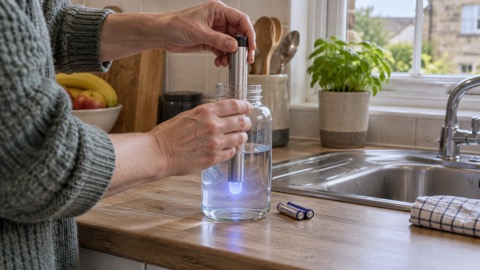
Treatment is simple and timed by the pen itself. The maker's manual sets out the sequence: fill a bottle with clear water, insert the pen so the lamp and sensor are in the water, then "Click the activation button. 1x for 0.5 liter, and 2 x for 1 liter of water"3. The pen then runs for 48 seconds for half a litre or 90 seconds for a litre, and you stir gently while it works1. The maker's product page puts the same figures as "Treats 0.5 L in 48 seconds" and "1 L in 90 seconds"7.
The treatment size is fixed at half a litre or a litre, so the bottle you use should hold one of those amounts2. The maker gives a minimum bottle diameter of 22 mm, which is the width the lamp and sensor need to pass through2. Most wide-mouth bottles clear this comfortably; a narrow-necked bottle may not.
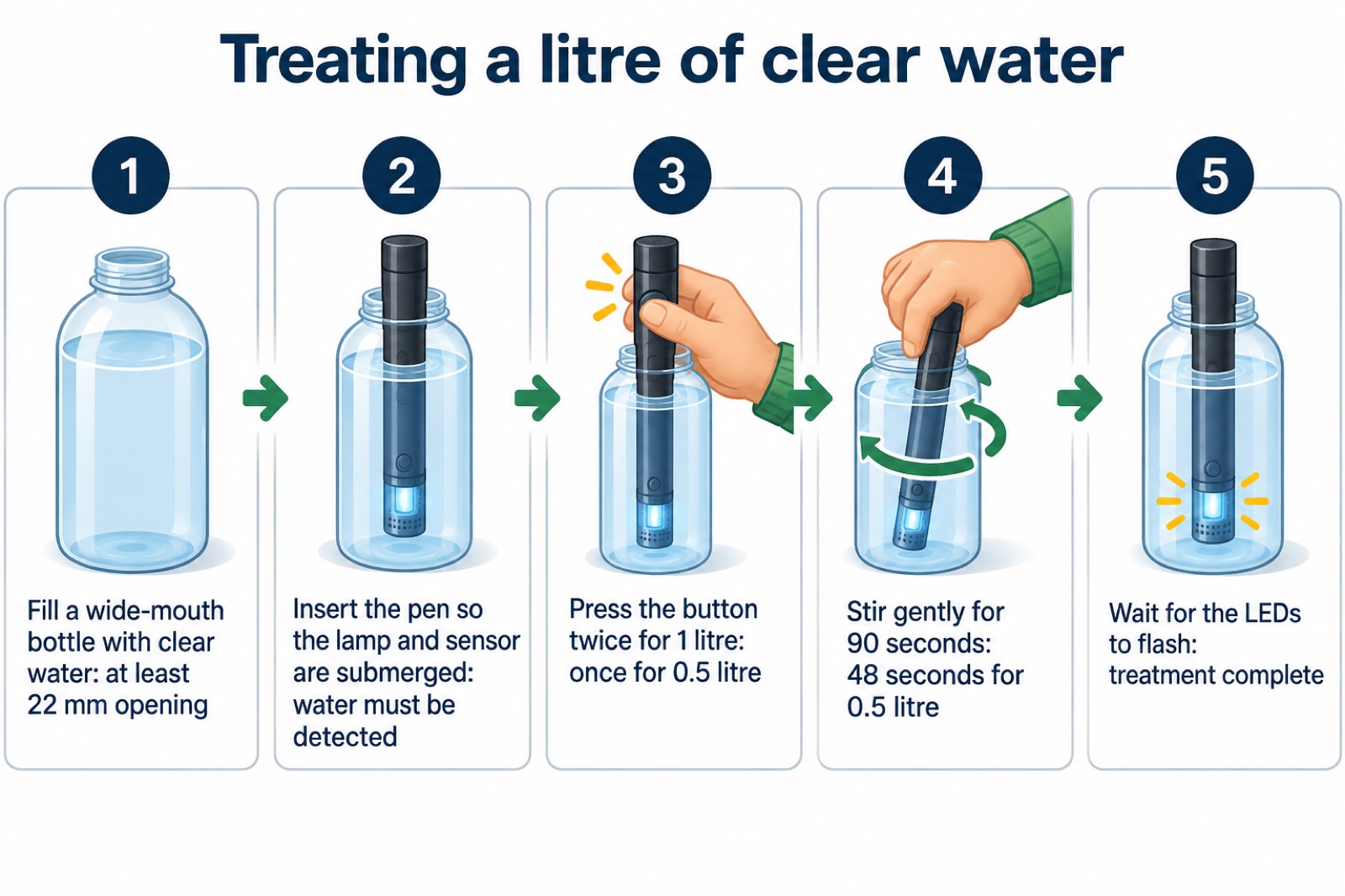
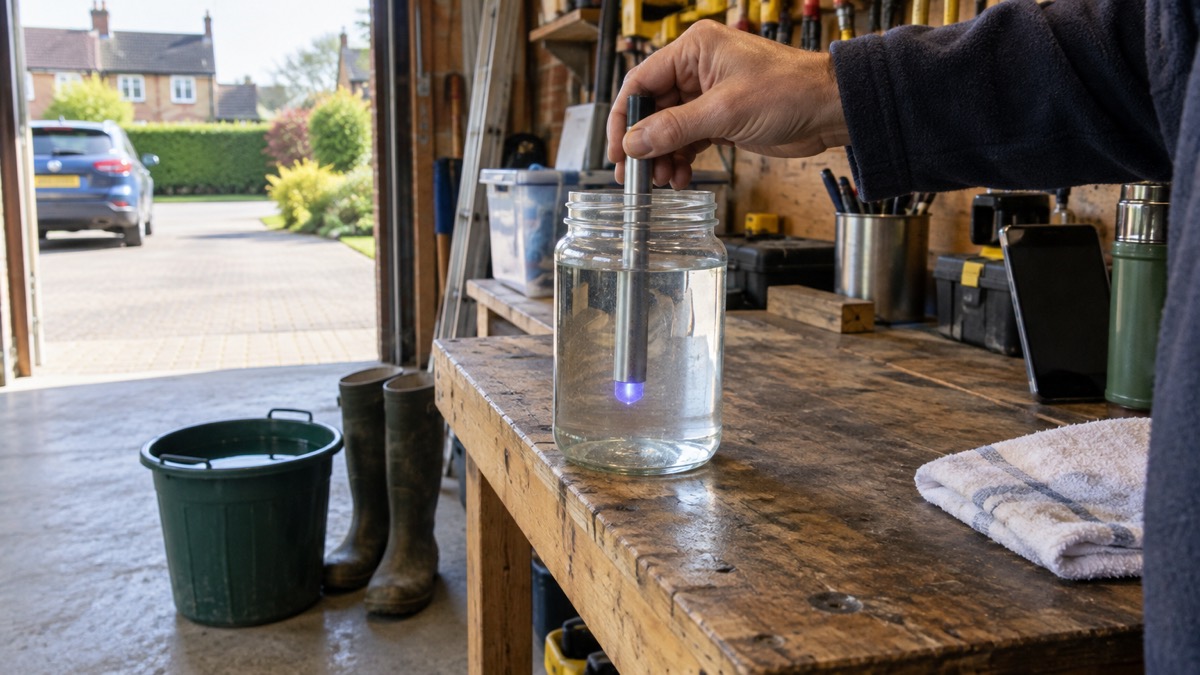
A few practical points follow from those figures. Because the pen treats in fixed amounts, do not half-fill a litre bottle and press twice; measure the water to match the button presses. Because the treatment is timed, do not lift the pen out early: the light needs the full period in the water. And because the pen is stirred by hand, keep the lamp end below the surface throughout, not resting against the side of the bottle.
If you are treating water for a household rather than one person, the pen's group size is listed as one person or two to five people, so it is a personal or small-group tool rather than a bulk treatment method1. For larger volumes, a gravity filter or a store of bottled water will serve you better; see emergency filters and how much drinking water to store per person.
Clear water only: when to use the pre-filter
The maker lists the pen's suitable water sources as clear water and tap water1. That is a narrow brief, and it is the limit most likely to catch a household out. River water, standing water after a flood, water from a roof butt or a peaty stream will usually carry particles that both look unpleasant and shield organisms from the UV light5.
The maker's answer is the SteriPEN Pre-Filter, a particle pre-filter with a 40x40 micron screen cartridge8. You pour water through the screen to fill the bottle, then treat the water with the pen9. The maker is clear about what the pre-filter does and does not do: it "Removes coarse particles; does not remove microorganisms or chemical contaminants"6. So it makes cloudy water clear enough for the UV treatment to work, but it is not itself a purifier, and it will not make chemically contaminated water safe.
| Situation | What to do |
|---|---|
| Clear tap water, or clear water from a trusted source | Treat directly with the pen1 |
| Cloudy or particle-laden water | Pour through the pre-filter, then treat9 |
| Water with a chemical smell or suspected fuel or pesticide | Do not rely on UV; follow your water company's advice |
| Water you cannot clear | Use another method, such as boiling or a filter rated for the job |
If your water is cloudy because of air in the pipes rather than dirt, that is a different problem: run the tap for 5 minutes and, if it does not clear, run it again while turning the internal stop tap on and off to release air10. Cloudy tap water from air is not the same as dirty water, and the pen will treat it once the air clears. For more on reading your supply, see why is my tap water cloudy or milky.
Batteries: about 150 treatments on lithium, 100 on NiMH, 25 on alkaline
The pen takes 4 AA batteries, and the maker lists the options as alkaline, lithium or rechargeable NiMH2. Batteries are not included, so buy a set before you need the pen1. The choice of chemistry changes how many treatments you get, and by a wide margin.
The maker calls lithium the most economical choice, and the figures show why: one set of lithium batteries gives six times the treatments of a set of alkaline1. For a pen kept in an emergency kit and used rarely, that matters, because alkaline cells lose their charge over time and a set that has sat in a drawer may be flat when you reach for it. The maker also notes that NiMH performance varies with capacity: 2300 mAh cells provide about 100 litres of treated water1.
A few rules keep the pen ready. Store it with the batteries out if it will sit unused for a long period, and keep a spare set of the same chemistry with it. Do not mix old and new cells or different types in the same set. And do not attempt to recharge alkaline cells: the maker of one common brand states plainly that alkaline batteries cannot be recharged, and doing so risks leakage or fire11. If a cell does leak, the maker's guidance for cleaning alkaline, NiCAD and NiMH leakage is to use either one tablespoon of boric acid in one gallon of water or a mixture of equal amounts of diluted vinegar or lemon juice with water in a 50/50 ratio11.
Reading the LED indicators
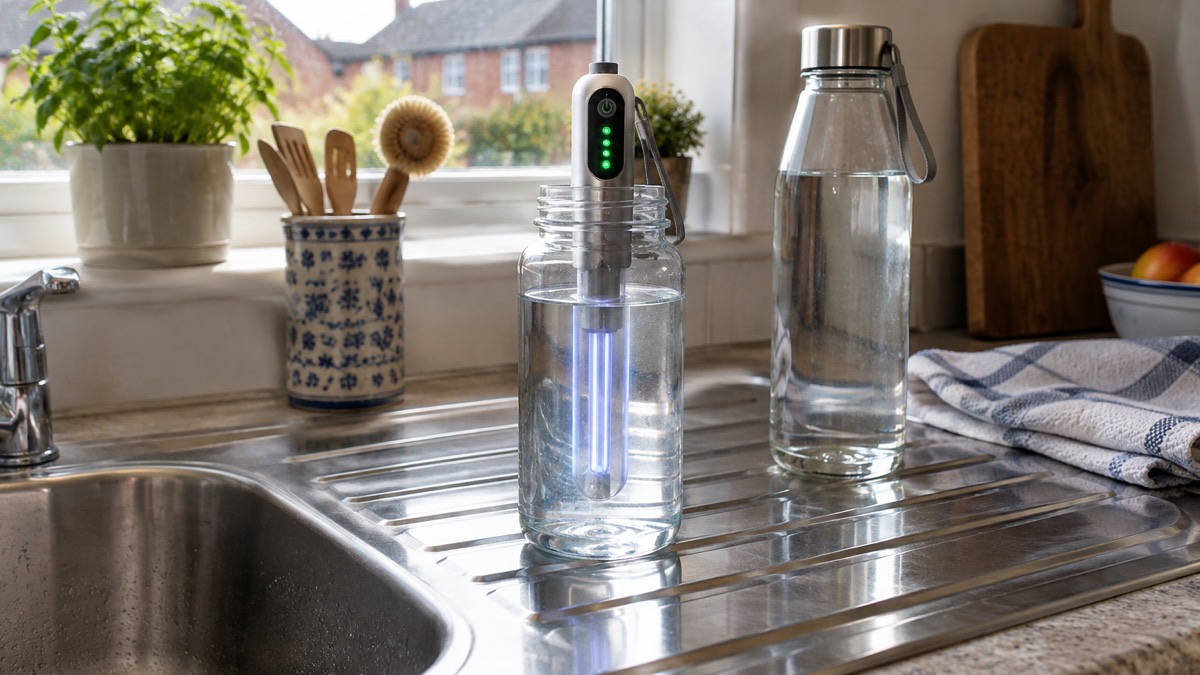
The pen's indicator panel is its main way of talking to you. The maker describes an "enhanced LED indicator panel" that lets you know the treatment size and the status of the batteries and the UV lamp2. When a treatment finishes, the LEDs flash to tell you the water is safe to drink2. The manual adds the detail: one litre shows two green LEDs and half a litre shows one green LED3.
The same panel warns you when things are wrong. A low battery shows as "Batteries low, few doses remain; replace or recharge batteries"3. A lamp nearing the end of its life shows as "UV lamp good for less than 100 uses"3. And if the pen is not properly in the water, it reports "Not submerged in water in time", meaning the water sensor has not detected water3.
| Indicator | What it means | What to do |
|---|---|---|
| One green LED | Half-litre treatment selected or complete | Treat 0.5 litre3 |
| Two green LEDs | One-litre treatment selected or complete | Treat 1 litre3 |
| Flashing LEDs | Treatment complete, water safe to drink | Use the water2 |
| Low battery warning | Few doses remain | Replace or recharge the batteries3 |
| Lamp warning | UV lamp good for less than 100 uses | Plan for a replacement pen or lamp service3 |
| Water not detected | Pen not submerged in time | Re-insert fully in the water and start again3 |
The water-not-detected warning is the one most likely to appear in a hurry. It usually means the pen was switched on before it went into the water, or the sensor pins are not wet. The maker's safety instruction is relevant here: "Do not handle Steripen with wet hands; do not touch water sensor pins with wet fingers"3. Dry your hands before you start, insert the pen fully, then press the button.
Safe handling and lamp life of 8,000 activations
The lamp has a finite life: the maker gives it as 8,000 activations1. Each treatment counts as an activation, so a household treating a litre a day would use the lamp up over years, while a heavy user on a long trip would use it faster. The pen warns you when the lamp is good for less than 100 uses, which gives you time to arrange a replacement before it fails3.
Safe handling is mostly about water and electricity. The maker's instruction is to keep your hands dry and to keep wet fingers off the water sensor pins3. Do not immerse the pen beyond the marked lamp and sensor area, and do not use it with a damaged body or a cracked lamp window. The pen runs on 4 AA batteries, lithium or rechargeable NiMH, and the maker states that lithium are the most economical choice3.
Store the pen clean and dry, with the batteries removed if it will be idle for a long time, and away from frost and damp. The maker's certifications note that the device complies with part 15 of the FCC Rules and with Canadian interference rules, which tells you it is an electronic device built to those standards rather than a passive tool3.
Warranty, registration and support
The pen carries a 3 year limited warranty3. The maker's manual states that product registration is required for the warranty, so register the pen with Katadyn when you buy it and keep your proof of purchase3. Registration also means the maker can reach you if there is safety or recall information about the product, which is the same reason fire services advise registering appliances and batteries12.
If you need support, quote the article number SP-MP-EFG, or the EU number 60110077, and the model code SP-MP-EFG2. The barcode is 06043752102571. The kit contains the SteriPEN Classic 3 itself, so check what is in the box before you assume a bottle or batteries are included2.
For the wider question of which treatment method suits your household, see UV purifier pens: how they work and their limits, and for the alternatives, purification tablets and boiling to kill germs. If your water comes from a well, borehole or spring rather than the mains, the official guidance on private supplies is a useful starting point: ultraviolet filters are one of the treatment options listed for removing bacteria such as E. coli13, and the Drinking Water Inspectorate advises that any UV disinfection treatment should be designed for drinking water and maintained with spare parts such as UV bulbs in line with the manufacturer's instructions14.
Sources (14)
- Katadyn SteriPEN Classic 3 UV Water Purifier, Katadyn, 2026-10-28
- SteriPEN Classic 3 datasheet, Katadyn, 2023-04-28
- SteriPEN Classic manual, Katadyn, 2020
- Katadyn, Katadyn, 2026-10-28
- How do I choose a water filter, Doulton, 2026-10-28
- Katadyn SteriPEN Pre-Filter (DE), Katadyn, 2026-10-28
- Katadyn SteriPEN Classic 3 UV Water Purifier (DE), Katadyn, 2026-10-28
- Katadyn SteriPEN Pre-Filter (FR), Katadyn, 2026-10-28
- SteriPEN collection, Katadyn, 2026-10-28
- My water is milky or cloudy, Yorkshire Water, 2026-10-28
- Can alkaline batteries be recharged?, Duracell, 2026-10-26
- E-bikes and e-scooters fire safety guidance, National Fire Chiefs Council, 2025-01-21
- Private water supplies, Somerset Council, 2026-08-12
- Protecting your private water supply, Drinking Water Inspectorate, 2026-10-28
 Katadyn SteriPEN Ultra
 Katadyn SteriPEN UltraLight
 Katadyn SteriPEN Adventurer Opti