
Berkey is a make of stainless steel gravity water filter: you pour water into an upper chamber, it passes through carbon block filter elements, and it collects in a lower chamber with a tap. Nothing is plumbed in and nothing is powered, which is the whole reason it turns up in household emergency plans. When the mains stop, or when a boil water notice is in force, a filter you can fill by hand and draw from by gravity is still usable.
The things a UK household most needs to know before relying on one are these. Berkey is made by New Millennium Concepts Ltd and was launched in America in the 90s1. The maker suggests 12 months between filter changes1. Berkey systems hold no official NSF/ANSI certifications, and the maker says this has led to regulatory and legal issues in some jurisdictions, including a stop-sale order in the United States and a requirement in California for NSF or equivalent certification before water treatment systems can be sold1. Berkey is a separate company from British Berkefeld, which is NSF/ANSI certified for turbidity, taste, odour and lead reduction1.
What a gravity filter does for a household in an emergency
A Berkey system is a container, a filter and a tap. You fill the top, gravity pulls the water through the carbon block elements, and it arrives in the bottom chamber ready to draw off. There is no pump, no cartridge housing to pressurise and no electricity, so a power cut does not interrupt it. That matters because the moments you most want treated water, a burst main, a flood affecting supply, a storm knocking out the local treatment works, are the same moments the grid may be down.
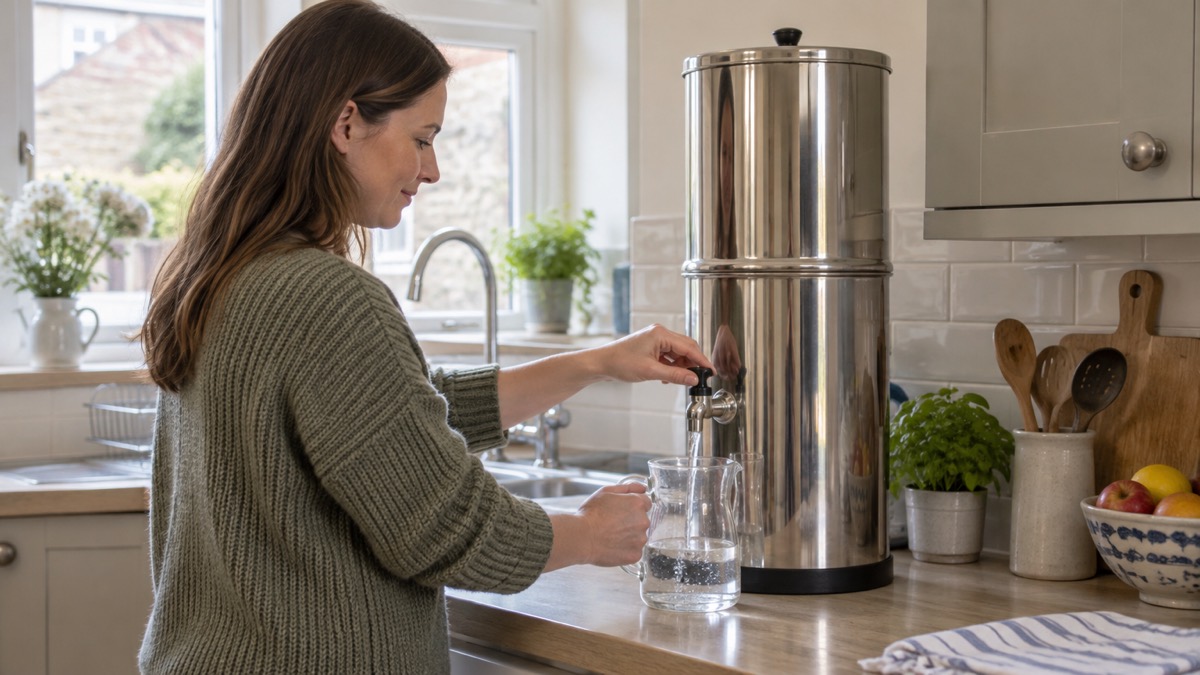
The practical consequence for planning is that a gravity filter belongs with your stored water, not instead of it. It treats water you have; it does not create it. A household should still hold a store of drinking water, and the water section sets out how much and how to keep it fresh. The filter's job is to extend what you have and to give you a way of making stored or collected water more palatable when normal supply is disrupted.
Two limits are worth stating plainly at the outset. First, the maker's own account says Berkey holds no official NSF/ANSI certifications1. Certification is how a filter's claims are independently checked against a standard, and a household deciding what to trust should know that this one is not certified in that way. Second, a gravity filter is a batch process: you fill it, you wait, you draw off. It is not a tap. In a household of several people, plan on filling it ahead of need rather than at the moment someone wants a drink.
What Berkey makes
Berkey's product is the stainless steel gravity filter system, built around carbon block filtration technology1. The maker's account of the range describes the format rather than a long list of models: a stainless steel body in two chambers, filter elements seated between them, and a tap at the base of the lower chamber. The same maker's description of the competing British Berkefeld range lists the kind of accessories that go with this style of filter, including a stainless steel tap, a stainless steel stand, a sight gauge and an insulated sleeve1. Those are the components that matter to an emergency household: a stand raises the tap above a jug, a sight gauge lets you see how much is left without lifting the lid, and an insulated sleeve slows heat loss or gain.
For prepping purposes, judge the kit by what it does when the mains fail:
- No power draw. Gravity does the work, so it keeps functioning through a power cut.
- No plumbing. It can be filled from bottles, containers or a stored supply.
- Batch capacity. You treat what you pour in, so keep a jug and a spare container beside it.
- Stainless steel body. A rigid body that will not crack like glass and can be carried between rooms or packed for a trip.
If you are building the water side of a household plan from scratch, start with the water guide for quantities and storage, then decide whether a gravity filter earns its place alongside your containers. The wider emergency kit guide shows where water treatment sits among the other things a home should hold.
How the filter works and how fast it runs
Berkey's filtration technology is carbon blocks1. The maker's account describes the filter as reportedly made of a carbon composite containing coconut shell carbon combined with a blend of unspecified media1. The word reportedly is the maker's own hedge: the full composition is not published in the detail you would get from a certified cartridge, and a household should treat the material description as the maker's statement rather than an independently verified specification.
Flow rate is the other thing that decides whether a filter suits your household. The maker says water will pass through Berkey's filters much quicker than with the British Berkefeld ceramic filter systems1. That is a comparative statement from a competing maker, not a figure, and no litres-per-hour rating for Berkey appears in the material here. What can be said is the shape of the trade-off: faster passage through a carbon block means you refill and draw off more often in a day, while slower ceramic filtration means more waiting per batch. For a household treating a few litres at a time during a supply interruption, either pattern works if you start early.
To put flow in context, ordinary mains supply is generous by comparison. Water companies must provide a minimum pressure of 10 meters head (1 bar) and a flow rate of at least 9 litres a minute at the property boundary2, and tap water pressure should be powerful enough to fill a 1 litre jug within 7 seconds3. A gravity filter will not match that, and it is not meant to. Plan on filling it before you need the water, not when the kettle is already on.
Filter changes and keeping it ready
The maker suggests 12 months between filter changes for Berkey1. That is the single maintenance fact that decides whether the filter is ready when you need it, and it is easy to let slip because a gravity filter sits quietly in a cupboard for most of the year. Set a reminder when you install it, and note the date on the body or in your household plan.
The comparison with the other brand is instructive: British Berkefeld recommends filter changes every 6 months1. If you have owned both, or read about both, do not carry the six-month habit across to a Berkey without checking, and do not assume a yearly habit suits the other. Follow the maker's interval for the filter you actually own.
A short readiness routine keeps a gravity filter usable in an emergency:
- Record the install date and diarise the 12-month change1.
- Keep spare elements in the house so a change is not delayed by an order.
- Fill and test the system occasionally, so you know the tap and seals are sound before a crisis.
- Store it assembled with a jug and a spare container beside it, ready to fill from your stored water.
- Check your water store at the same time, since the filter treats stored water rather than replacing it.
Certification, regulation and the US stop-sale order
This is the part of the Berkey story a UK household should understand before buying, and it is best stated in the maker's own terms. Berkey holds no official NSF/ANSI certifications1. The maker says the company does claim that its independent lab testing meets or exceeds those benchmarks1. Independent lab testing and third-party certification are not the same thing: certification means an outside body has tested the product against a published standard and lists it, while a maker's own commissioned testing is the maker's evidence.
The maker also records the regulatory consequences. Berkey has been under an EPA stop-sale order in the U.S.1. The lack of official certification has led to regulatory and legal issues in certain jurisdictions, such as California, where NSF or equivalent third-party certification is required to sell water treatment systems1. Those are American arrangements. Nothing in the material here describes a UK sales restriction on Berkey, and the California rule is a condition of sale in that state, not a statement about the safety of the product.
Set that against the other brand for contrast, because the two are so often mentioned together. British Berkefeld's filters are NSF/ANSI certified for turbidity, taste, odour and lead reduction, and the maker records no known regulatory issues for that brand1. If certification against a recognised standard is a condition of what you will rely on, that difference is the one to weigh.
| Berkey | British Berkefeld | |
|---|---|---|
| Certification | No official NSF/ANSI certifications1 | NSF/ANSI certified for turbidity, taste, odour and lead reduction1 |
| Testing claim | Maker says independent lab testing meets or exceeds those benchmarks1 | Not stated in this material |
| Regulatory status | Has been under an EPA stop-sale order in the U.S.; sales restricted in some jurisdictions such as California1 | No known regulatory issues1 |
| Filter change interval | 12 months, maker suggests1 | Every 6 months, maker recommends1 |
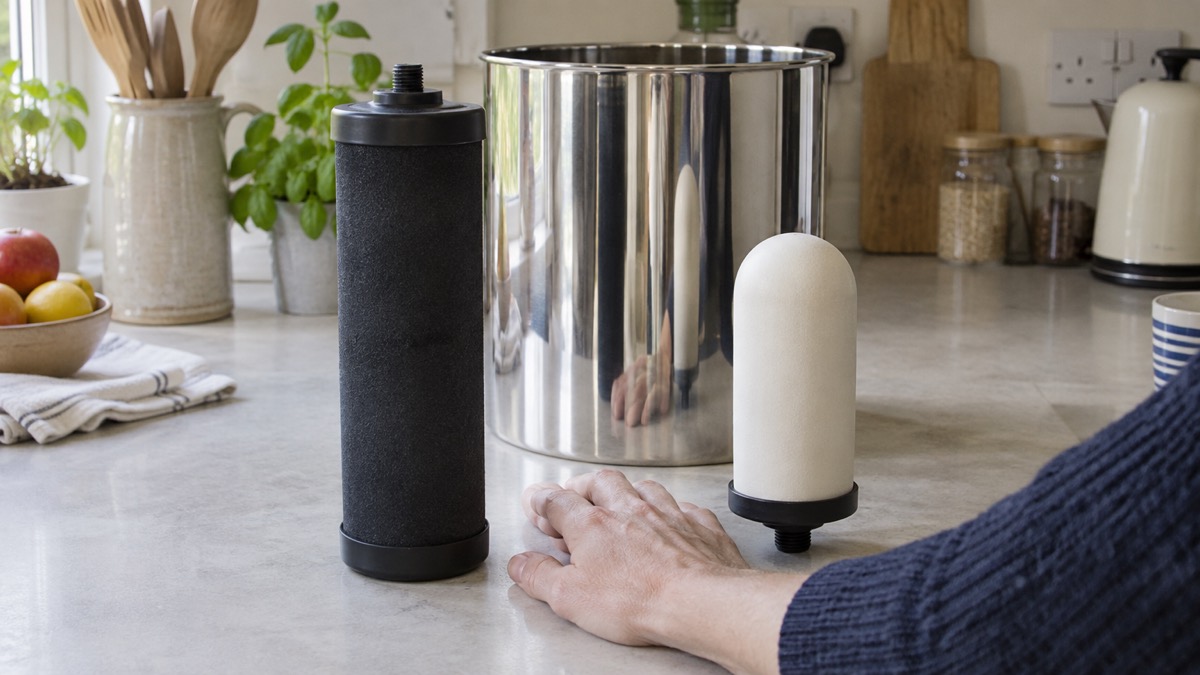
| Filter construction | Carbon composite with coconut shell carbon and a blend of unspecified media, reportedly1 | Ceramic outer shell with carbon block core1 |
Berkey and British Berkefeld are separate brands
The two names get used interchangeably, and they should not be. British Berkefeld and Berkey are not associated in any other way, in the maker's words1. The confusion has a history: Berkey originally distributed British Berkefeld filters before developing its own water filtering element1. That origin story explains why older households may remember a Berkey as a Berkefeld, and why second-hand listings blur the two.
For a household, the practical points are these. The filter change interval differs, 12 months for Berkey against 6 for British Berkefeld1. The certification position differs sharply1. The filter construction differs, a carbon composite for Berkey against a ceramic outer shell with a carbon block core for British Berkefeld1. And the flow behaves differently, with water passing through Berkey's filters much quicker than through the ceramic systems1. Buying spares or a replacement element means knowing which brand you actually own.
Who makes Berkey, and where it came from
Berkey is made by New Millennium Concepts Ltd and was launched in America in the 90s1. The company's route into water filtration ran through another brand: it originally distributed British Berkefeld filters before developing its own water filtering element1. That is the whole of the corporate history in the material here, and it is enough to place the product: an American maker, a 1990s launch, and a filter of its own design that grew out of selling someone else's.
For a UK household the maker's identity matters mainly for support. Spares, replacement elements and warranty questions go back to the company that made the system, through the seller or distributor you bought from. Keep your proof of purchase with the filter's paperwork, note the date you installed the elements, and record the model so that a replacement order is straightforward. The getting started guide is the place to work out how a filter fits the rest of a household plan, and the self-reliance guide covers the wider question of treating and storing water when mains supply is not available.
Where a gravity filter fits a household plan
A Berkey earns its place in a plan when three conditions hold: you have water stored to put through it, you have recorded when the elements were last changed, and you understand that it is not certified to NSF/ANSI standards1. If any of those is missing, fix that first. The filter is a tool for making stored water drinkable and palatable during a disruption, not a substitute for having water in the house.
The disruptions it is built for are ordinary ones. Supply can be interrupted by a burst main, by flooding, by storm damage, or by a treatment failure, and the power cuts guide and flooding guide set out how those events unfold for a household. A gravity filter keeps working through all of them because it asks nothing of the grid. Keep it clean, keep spares, keep the date, and it will be ready when the tap runs dry.
Sources (3)
- What's the difference between Berkey and British Berkefeld, Doulton, 2026-10-28
- Water pressure, Essex & Suffolk Water, 2026-10-28
- Customer guide to our water pressure policy, Severn Trent, 2026