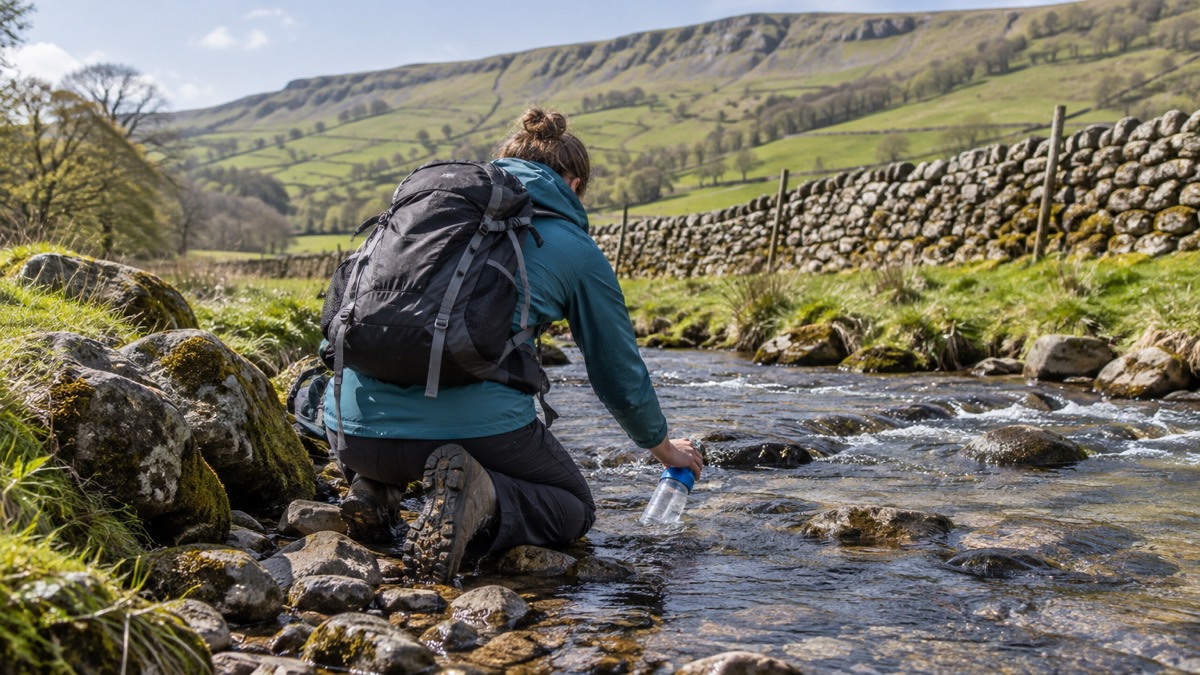
The Katadyn BeFree is a squeezable filter bottle: a soft flask with a hollow-fibre membrane and an activated carbon pad in the neck, so you fill it from a tap or a clear stream, screw the cap on and drink through the nozzle. Katadyn rates the membrane at up to 1000 litres depending on water quality and the carbon at up to 200 litres, with a flow rate of up to 2 litres a minute1.
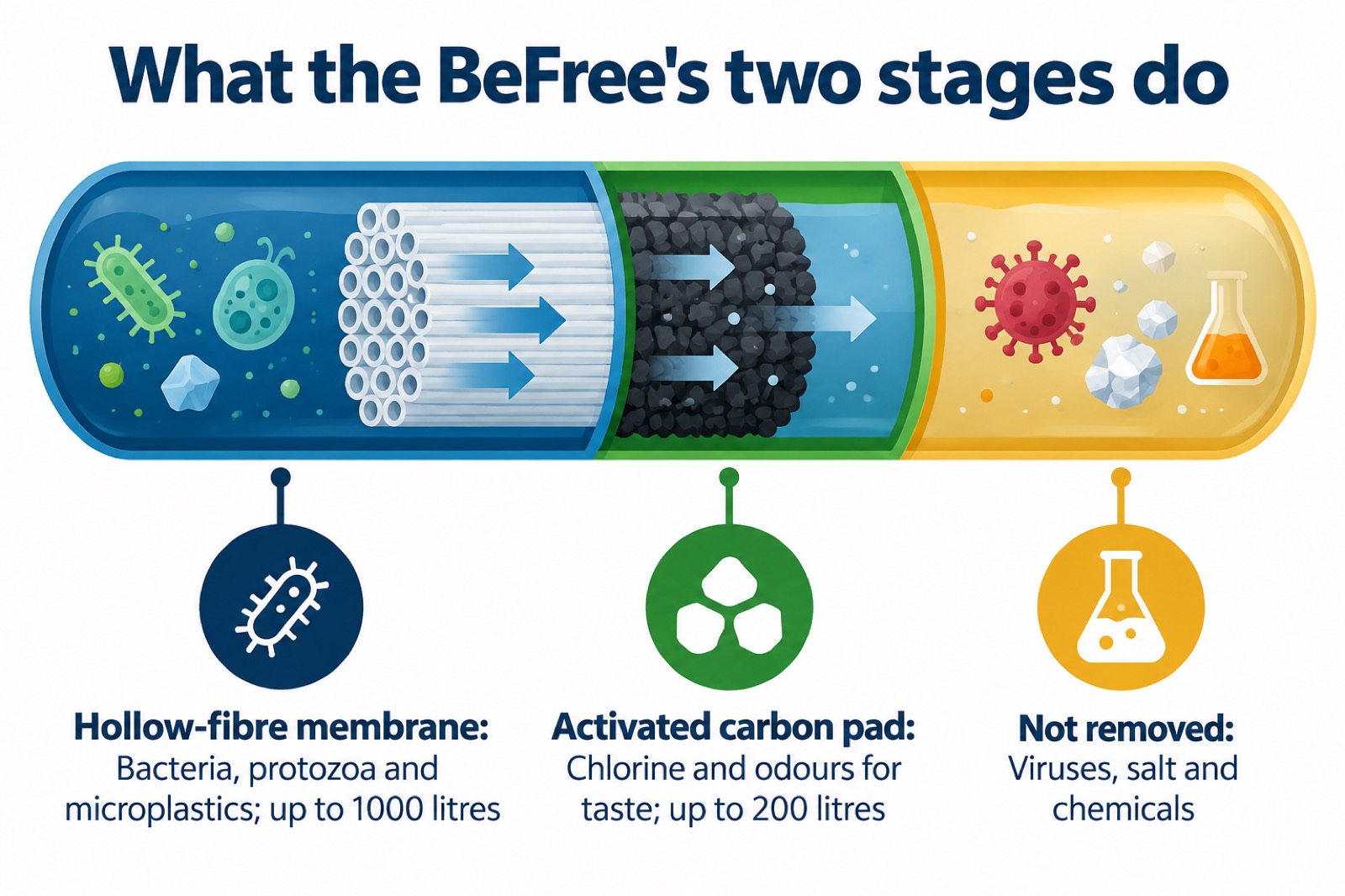
It is a one-person piece of kit, and the maker is clear about its limits. The membrane removes bacteria, protozoa and microplastics, and Katadyn says the filter meets the U.S. Environmental Protection Agency's microbiological water purifier standards, with reduction of 99.9999% of Klebsiella terrigena bacteria and 99.9% of Giardia and Cryptosporidium1. It does not remove viruses, and it must never be used on seawater, brackish water or chemically contaminated water1.
For a UK household, that makes it a light, fast way to make clear fresh water safer to drink when you are out and about, or to keep a bottle of decent-tasting water to hand. It is not a household treatment system, and it is not a substitute for a boil water notice or a Do Not Drink notice. This page sets out what it does, how the range differs, how long it lasts, how to clean and store it, and how to get support if something goes wrong.
What the BeFree removes, and the four things it cannot do
The BeFree is a microfilter with two stages. The hollow-fibre membrane is the barrier: Katadyn says it removes bacteria, protozoa and microplastics, and lists it as effective against cysts, bacteria, protozoa, sediments and bad taste3. The activated carbon pad behind it reduces chlorine and unpleasant odours to improve the taste of drinking water3. Katadyn describes the combination as a two-stage filter that delivers clean, great-tasting water4.
The manual sets out the intended use plainly: the product is designed to reduce the levels of bacteria and protozoan cysts commonly found in fresh water sources to make it safer for drinking1. It meets the U.S. Environmental Protection Agency's microbiological water purifier standards for reduction of bacteria and protozoan cysts1. Those are the maker's claims, and they are worth reading alongside our guide to what different filter types remove and to filter claims and certification.
Then come the limits, and they matter more than the claims:
- Viruses. The manual states that the BeFree does not remove viruses1. That is the standard limit of a hollow-fibre microfilter, and it is why filters of this type are aimed at clear fresh water rather than sewage or floodwater.
- Salt water. Never use it to filter seawater or brackish water1. The membrane does not take salt out, and the effort of pushing water through it is wasted.
- Chemicals. Never use it on chemically contaminated water, such as water from a source the manual describes as contaminated1. The carbon pad improves taste; it is not a chemical treatment stage.
- Cloudy or dirty water. Katadyn lists clear water as the source for the range, and tap water as well for the bottles3. Sediment clogs a membrane quickly, so let muddy water settle or strain it through cloth first.
The BeFree range: soft flasks from 0.5 litres and bottles from 0.7 litres
Katadyn sells the BeFree in two families. The AC bottles come in 0.7 litres, with the 0.7 litre listed in smoke, blue, green and red6. The bottles are listed as bottle filters rather than soft flasks, and the 1.0 litre black is described as having a double-layer flask designed for durability4.
| Model | Type | Weight | Flow rate | Membrane life | Carbon life |
|---|---|---|---|---|---|
| BeFree Filter AC 0.5L | Soft flask | 72 g3 | 2 L/min3 | Up to 1000 litres3 | Up to 200 litres5 |
| BeFree Filter AC 1.0L | Soft flask | 85 g4 | 2 L/min4 | Up to 1000 litres4 | Up to 200 litres4 |
| BeFree AC Bottle 0.7L | Bottle | Not listed | 2 L/min8 | Up to 1000 litres8 | Up to 200 litres8 |
The weights run from 72 g to 104 g across the range, and every model is rated at up to 2 litres a minute1. The 0.5 litre flask is the lightest and packs smallest. All of them have an integrated rugged handle for hanging from a pack with a carabiner or a rope, or carrying by hand, and the 1.0 litre black has a flip cap that Katadyn says will not spill4.
Specifications: up to 2 litres a minute, 72 g to 104 g
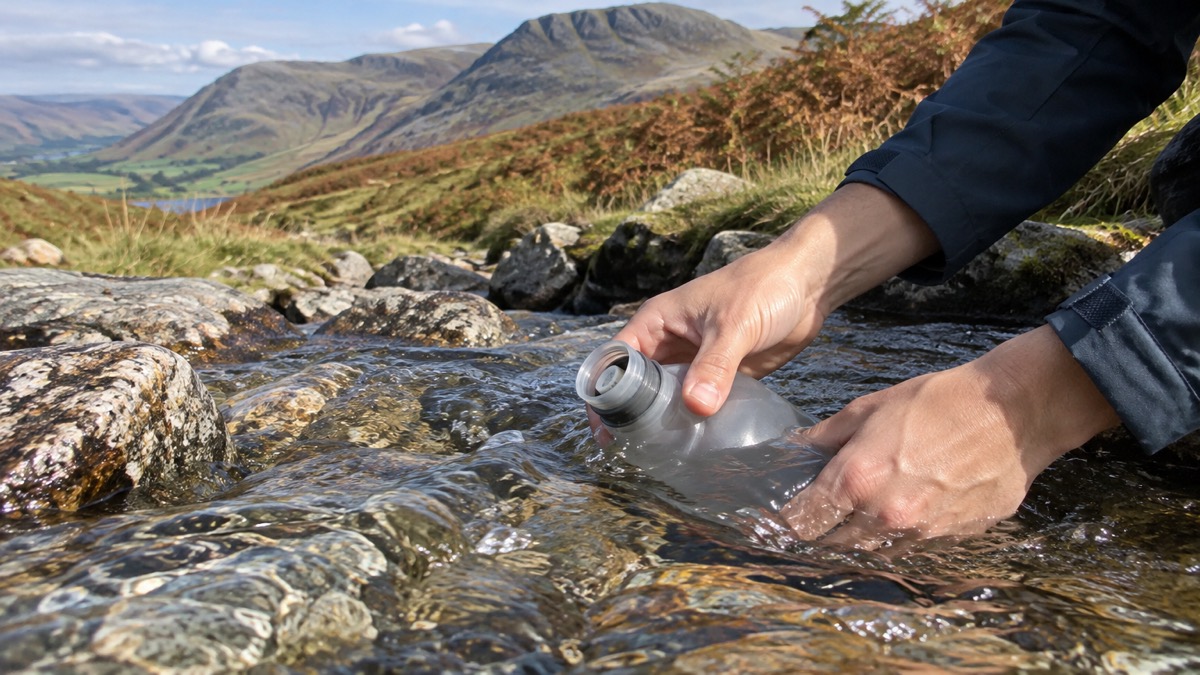
The headline figures are simple. Katadyn's manual gives a flow rate of up to 2 litres of water per minute, and the product pages repeat it as 2 L/min across the range1. Do that once when the filter is new, and again after long storage.
The filter itself is a two-stage unit: hollow fibre plus activated carbon, listed as the filter material on every model3. Where a page lists a broader set of contaminants than the manual's own wording, treat the manual as the controlling statement: it is the document that sets out what the filter is designed to do and what it must not be used for1.
The carbon pad is optional in one specific sense. Katadyn says that if you have access to a fresh mountain stream that is already delicious, you can leave out the activated carbon and enjoy the pure taste4. The pad is there for taste, so leaving it out does not change the membrane's job. If you do leave it out, keep it clean and dry for refitting.
Filter life: up to 1000 litres for the membrane, 200 for the carbon
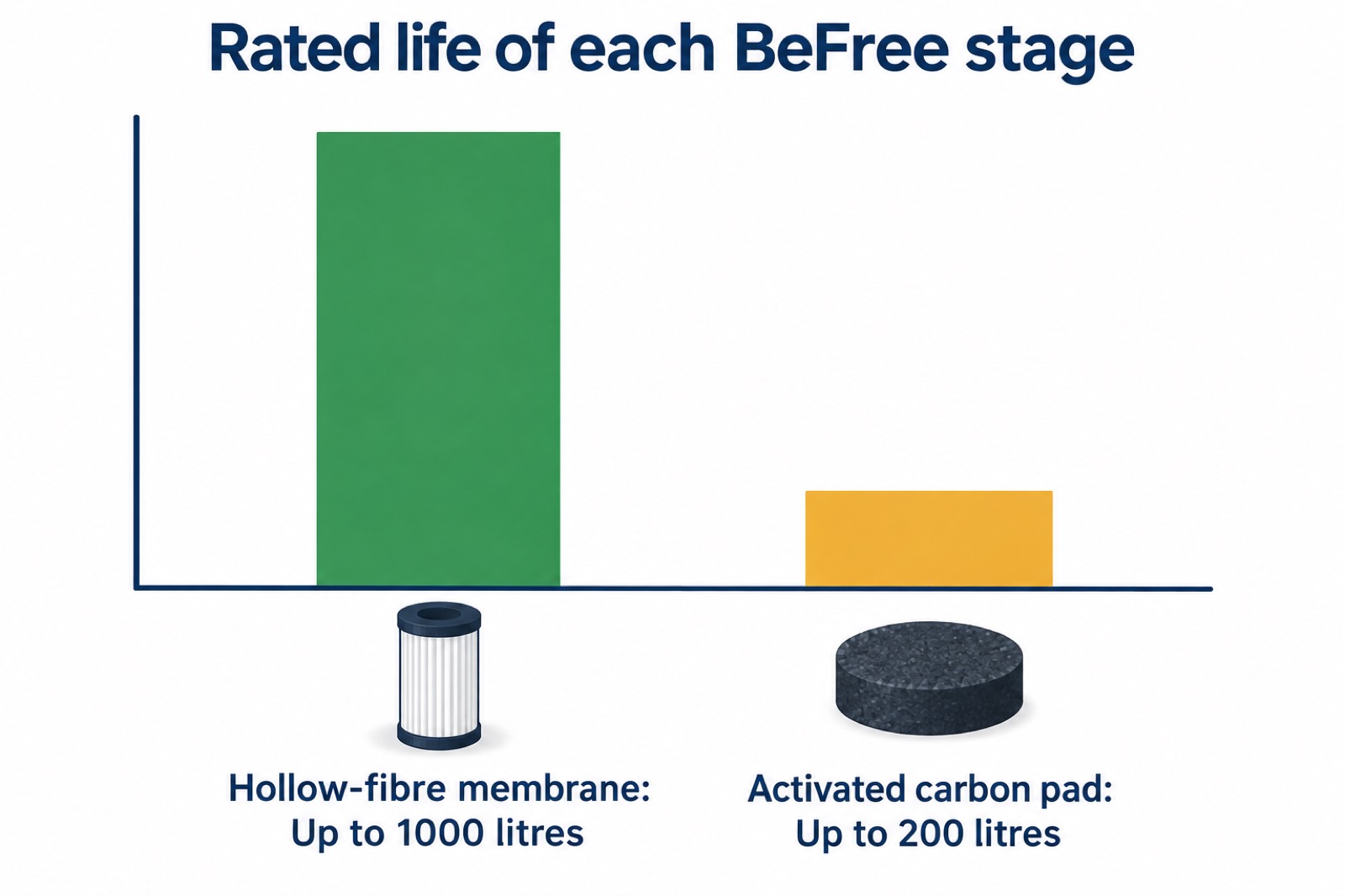
Katadyn rates the hollow-fibre membrane at up to 1000 litres depending on water quality, and the activated carbon at up to 200 litres depending on water quality2. The phrase "depending on water quality" is doing real work: cloudy, silty or heavily organic water will clog the membrane and exhaust the carbon sooner than clean tap water will. The manual simply says filter capacity depends on water quality1.
The two lives are separate, and that is the point most owners miss. The membrane is the safety barrier and lasts roughly five times as long as the carbon. The carbon is the taste stage. So a filter that still flows well but makes water taste flat or odd is telling you the carbon is tired, not that the membrane has failed. Katadyn's instruction is to replace the activated carbon according to the product instructions4.
In household terms, a family using a BeFree for days out will take years to reach 1000 litres through one membrane. Someone using it daily for drinking water will get through the carbon much faster. Keep a note of roughly how much has gone through it, and replace the carbon when taste changes or when you approach the rated figure, whichever comes first.
Cleaning the membrane
Cleaning a BeFree takes seconds and needs no tools. Every product page repeats the same instruction: clean the EZ-Clean Membrane by shaking or swishing it in water, and no cleaning tools are needed3.
The routine is:
- Fill the flask or bottle with water.
- Shake it, or swish the filter in water, to dislodge debris from the membrane.
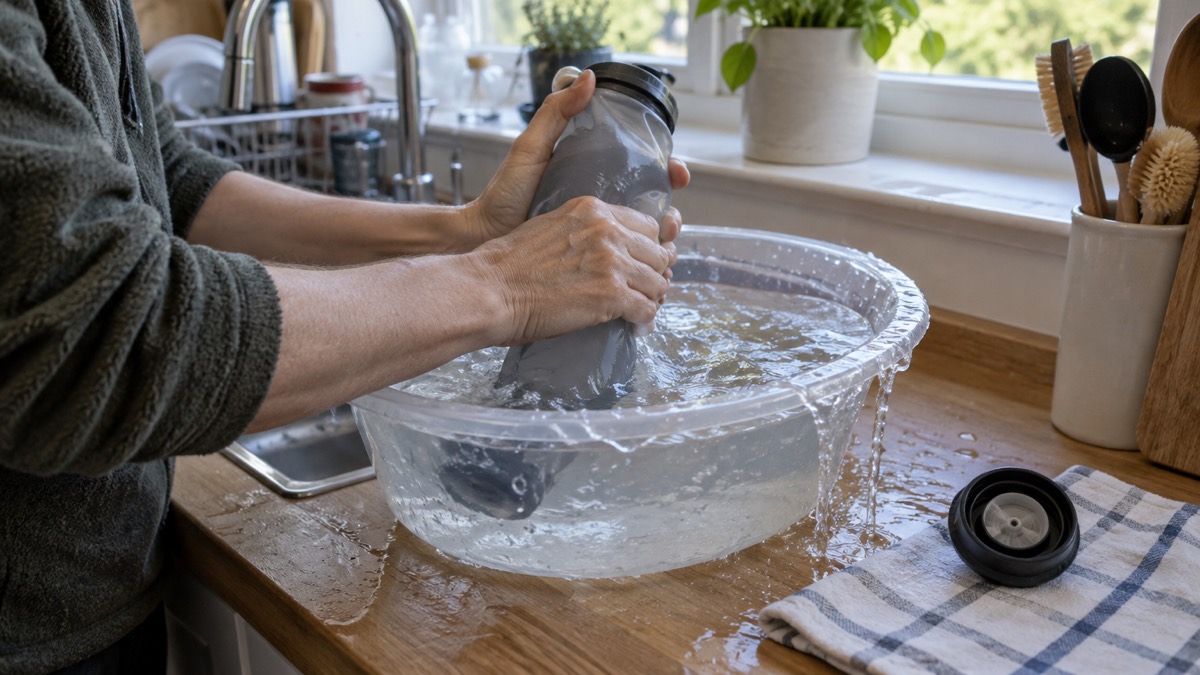
Do not scrub the membrane or push anything into the fibres. The maker's method is mechanical agitation in water, and that is all it needs. If flow slows noticeably and shaking no longer restores it, the membrane is likely clogged beyond field cleaning, and it is time to think about a replacement cartridge. Our general guide to looking after a filter covers priming, frost and cartridge changes for other types too.
If the filter is dropped, or stored for a long time
Two accidents matter. If the BeFree is dropped hard, Katadyn says to check the hollow fibres visually and perform the filter integrity test to make sure it is still sound1. If it is dropped into a fresh water source, follow the long-term storage instructions to completely disinfect the filter before use1. The manual that comes with your filter sets out both procedures in full.
For storage, the maker's guidance is to let the filter dry. Katadyn's Drip manual, for a different filter in its range, states the principle plainly: if you will not be using your filter for an extended amount of time, longer than 2 days, let the filter elements dry completely in the air11. That is the Drip's instruction rather than the BeFree's, so treat it as the maker's general practice for its filters rather than a BeFree-specific rule. The BeFree manual's own long-term storage section is the one to follow for the BeFree, and it is also the procedure to use after the filter has been dropped into a stream1.
Before you put a stored filter away, flush it, shake it out and let it air dry with the cap off.
Sharing the nozzle, and using the BeFree in a family
Katadyn's manual is direct: do not share the drink nozzle with others, and it notes that illness can be spread by sharing a drink nozzle with other people1. The product pages list a group size of one person for the range3. That is not a marketing quirk; it follows from the design, because the nozzle is what goes in your mouth.
For a household, that shapes how you use it:
- One filter per person. Several BeFree flasks or bottles, each labelled, avoids the shared-nozzle problem entirely.
- Pour, do not pass. Filter into a cup or pan and let others drink from that, rather than handing the bottle round.
- Keep it for outings. For treating water for cooking or for several people at home, a gravity or pump filter is the better shape. Our guide to filter bottles and straw filters sets out where these fit, and emergency filters compared by type covers the alternatives.
If you are building a household water kit, read how much drinking water to store per person alongside this page.
Warranty, registration and spare parts
Katadyn warrants the BeFree to be free from defects in materials and workmanship, and says it will repair or replace at its sole discretion1. The warranty lasts two years from the date of purchase1. To receive coverage, return the product to the retailer where you purchased it for repair or replacement1. Katadyn also asks owners to register the product online at katadyn.com under the service section1.
Spare parts are listed for the range. For the 0.5 litre flask, Katadyn lists a BeFree AC Replacement Cartridge in slate blue, a BeFree AC Flip Cap, BeFree AC Carbon Replacement in packs of three, and BeFree AC Silicone Mouth Piece in packs of three5. The carbon replacement pack is listed as compatible with the Katadyn BeFree AC Filter12. If you need a replacement, the model number on the product page is the thing to quote: the 0.5 litre flask is 8021401, and the 1.0 litre slate blue is 80214025.
Where the BeFree fits in a household water plan
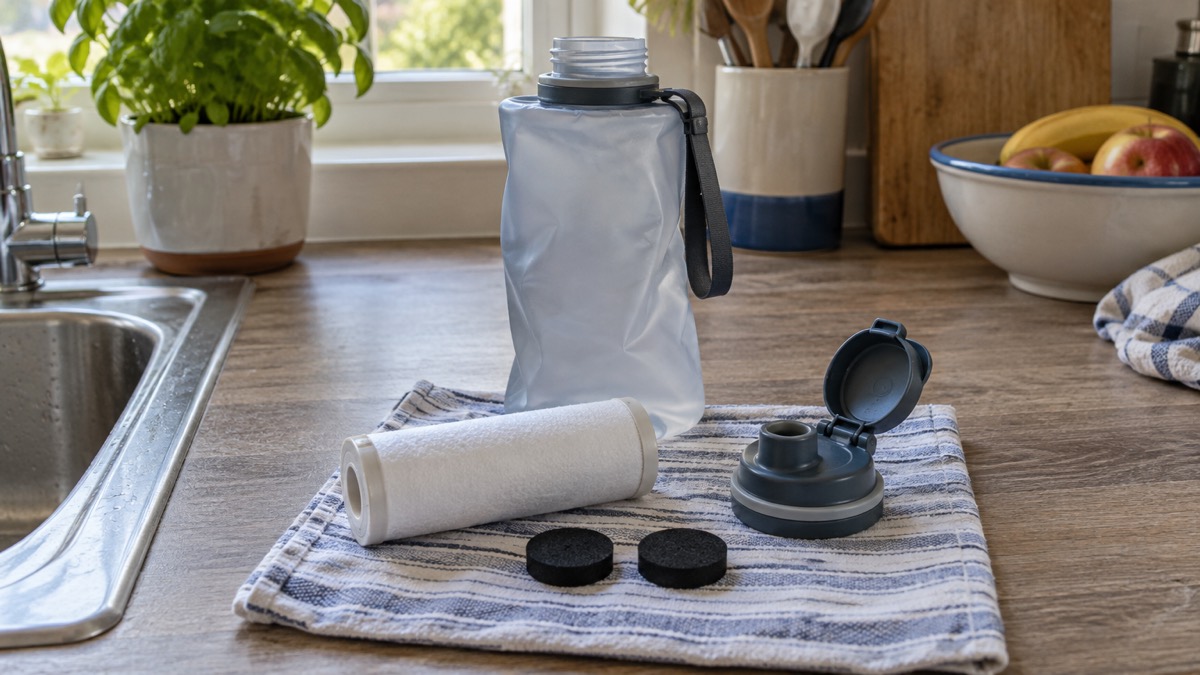
The BeFree is at its best as a personal filter for clear fresh water: a walk, a day out, a journey, or a bottle of better-tasting tap water at home. It is light, it flows fast, and it cleans in seconds. It is at its weakest where a household most needs certainty: a supply interruption, a boil notice, floodwater or any source you cannot vouch for. For those, use the methods in our guide to making water safe to drink, keep stored tap water and bottled supplies ready, and follow your water company's instructions.
If you are travelling abroad, Katadyn suggests consulting your physician, state health department or travel clinic four to six weeks before you depart1. That is the maker's travel advice, and it sits alongside official UK guidance rather than replacing it. St John Ambulance's fever guidance also says to beware of recent overseas travel when assessing a fever, so mention where you have been if you become unwell13.
Sources (13)
- Katadyn BeFree EU Manual, Katadyn, 2026
- Katadyn BeFree Filter AC 0.5L Slate Blue, Katadyn, 2026-10-28
- Katadyn BeFree AC Bottle 0.9L Smoke, Katadyn, 2026-10-28
- Katadyn BeFree Filter AC 1.0L Slate Blue, Katadyn, 2026-10-28
- Katadyn BeFree Filter AC 0.5L Slate Blue, Katadyn, 2026-10-28
- Katadyn BeFree Filter AC 0.5L Slate Blue (DE), Katadyn, 2026-10-28
- Katadyn BeFree Filter AC 1.0L Black (DE), Katadyn, 2026-10-28
- Katadyn BeFree AC Bottle 0.7L Blue, Katadyn, 2026-10-28
- Katadyn Bottle Filter Collection, Katadyn, 2026-10-28
- Katadyn BeFree AC Bottle 0.7L Green, Katadyn, 2026-10-28
- Katadyn BeFree AC Bottle 0.7L Smoke, Katadyn, 2026-10-28
- Katadyn BeFree AC Bottle 0.7L Red, Katadyn, 2026-10-28
- Katadyn Drip Manual, Katadyn, 2013-10-04
 LifeSaver Bottle
 LifeSaver Liberty