
The LifeSaver Liberty is a 400ml water bottle with a purifier built into it. You fill it with dirty water and drink through the filter, or you use it as a hand pump to push filtered water into another container. The maker, Icon LifeSaver, describes it as a bottle and inline pump combined, and says one ultra-filtration cartridge purifies up to 2,000 litres1.
That capacity is the reason it earns a place in a household's emergency kit. A family that loses its mains supply, or draws from a stream or a stored butt, gets a large volume of drinking water from one small object that needs no chemicals and no electricity2. It is made in the UK and carries a 2-year limited warranty3.
The catch is that it must be primed before its first use, and once primed it must never be allowed to dry out. Get those two things right and the rest is straightforward maintenance. Get them wrong and the cartridge blocks, which the maker says is not covered by the warranty4.
What the LifeSaver Liberty is and who it suits
The Liberty is a single object that does two jobs. In bottle mode you fill it with water from whatever source you have and drink through the filter as you go. In pump mode you use the handle to push water through the cartridge and out into a bottle, pan or bladder, which is how you treat a larger volume in one sitting6. The maker's own reviewers describe the second method as their preferred one6.
It suits a household that wants a compact purifier for one or two people on the move, or a backup for a supply interruption where you may need to collect water from outside the home. The 400ml capacity is small: the maker's own product page notes that 400ml means more frequent refills on longer days7. If you are treating water for a whole family at home, a larger gravity or pump system will do the volume more comfortably, and the emergency filters guide sets the types side by side.
The maker's specification is a useful reality check on what it is for. It is a personal purifier with a genuinely long cartridge life, not a household treatment plant. For the wider question of what to keep at home, see filter bottles and straw filters for one person.
What it removes from the water
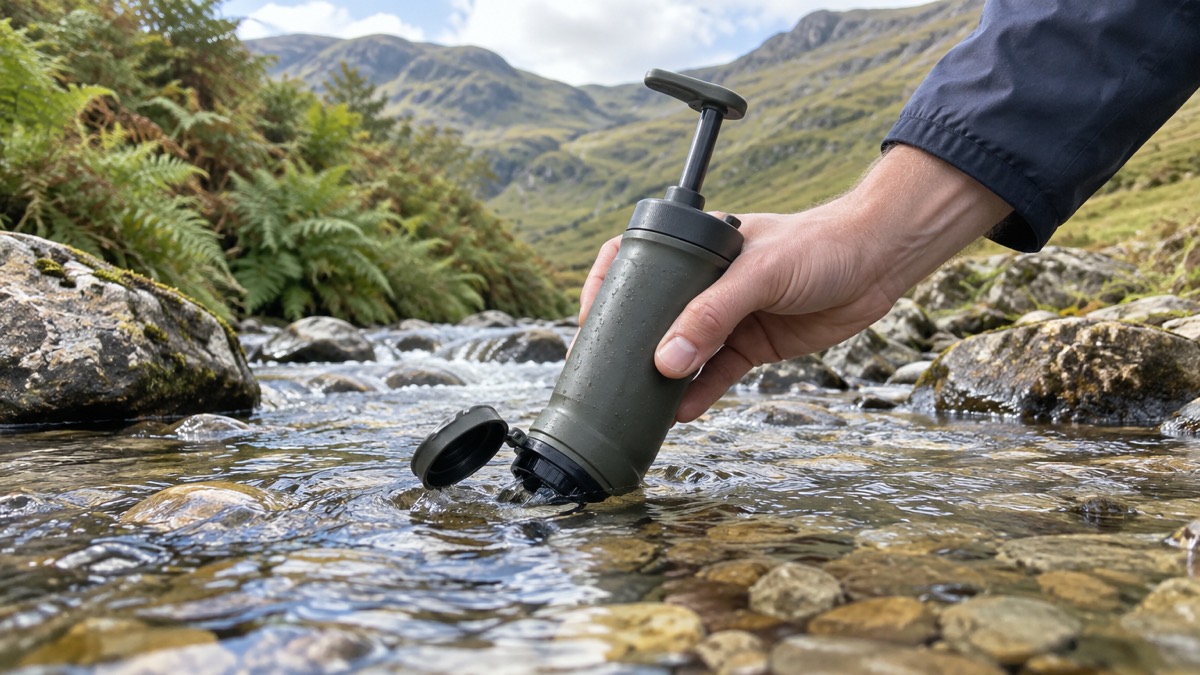
The maker states the Liberty removes 99.99% of viruses, bacteria, parasites and microplastics1. Its published reduction figures are more specific: more than 99.999% of viruses (Log 5), more than 99.9999% of bacteria (Log 6), more than 99.99% of cysts (Log 4) and 99.99% of microplastics3. The filter medium is ultra-filtration, with a stated pore size of approximately 15 micron3.
The maker explains the principle plainly: its purification technology provides a physical barrier against viruses, bacteria and cysts8. That is why the Liberty is chosen by people travelling to remote areas, where the ability to remove viruses and not just bacteria matters9. Some of the maker's other pages give a lower headline figure of 99.9% for bacteria and viruses7; the detailed specification above is the one to rely on.
The activated carbon disc is a separate stage. It reduces chlorine, taste and odour, chloramines, lead, nickel and chromium among other chemical and heavy metal contamination2. The maker says its standard carbon discs have been tested to show consistent heavy metal and chemical reduction over their stated life, across contaminants such as chlorine, lead, nickel and cadmium7.
| What you are dealing with | Does the Liberty remove it? | Where the answer comes from |
|---|---|---|
| Viruses | Yes, more than 99.999% (Log 5) | Maker specification3 |
| Bacteria | Yes, more than 99.9999% (Log 6) | Maker specification3 |
| Cysts and parasites | Yes, more than 99.99% (Log 4) | Maker specification3 |
| Microplastics | Yes, 99.99% | Maker specification3 |
| Chlorine, taste and odour | Yes, with a carbon disc fitted | Maker product page2 |
| Lead, nickel, chromium and similar | Reduced, with a carbon disc fitted | Maker product page2 |
For how these log figures translate into plain claims, and what certification does and does not prove, see filter claims and certification. For the wider comparison of media types, what each filter removes is the companion page.
Specifications
The maker publishes a full specification for the Liberty. The figures below are the maker's own, from its product page and manual1.
| Specification | Figure |
|---|---|
| Bottle capacity | 400ml (14 fl oz)1 |
| Dry weight | 425g (15oz)1 |
| Dimensions | 80 x 80 x 254mm (3.15 x 3.15 x 10 inches)1 |
| Filter media | Ultra Filtration (UF)3 |
| Pore size | Approximately 15 micron3 |
| Volume filtered per cartridge | 2,000 litres (530 gallons)1 |
| Initial flow rate | 1.2 litres per minute2 |
| Replaceable cartridge | Yes1 |
| Materials | BPA and BPS free3 |
| Warranty | 2 years1 |
| Made in | UK1 |
Two caveats belong with those numbers. The maker states that the volume of water filtered and the flow rates depend on the composition and turbidity of the water you put in1, so a silty stream will slow the flow and shorten effective life compared with clear water. The manual adds that flow rate increases if the bottle is full4.
The maker also states the product is tested to exceed the toughest NSF drinking water standards1. Treat that as the maker's claim about its own testing rather than a certificate you can check against a register, and read filter claims and certification before you rely on any certification wording.
Priming before first use
Priming is not optional. The maker's manual states it plainly: "Priming is an essential step that must be performed before you start to use the bottle"4. The maker's support article says it is vital that a new Liberty bottle is primed ready for use before you head out10. Once primed, the maker says there are no wait times11.
The manual's priming sequence runs like this12:
- Remove the base and fill the bottle with clean water.
- Replace the base and leave it full for 5 minutes.
- Discard the water and refill.
- Pump three times.
- Open the lid and turn the water flow valve to release water.
- Pump to sustain the flow until the bottle is empty.
- Repeat steps 4, 5 and 6.
The maker's product page warns that you have to do this a couple of times before use, so do it at home rather than at the water's edge5. Priming wets the membranes inside the cartridge; until they are wet, the filter will not pass water properly.
Bottle or pump: two ways to get clean water
The Liberty gives you a choice of method, and the right one depends on what you are doing.
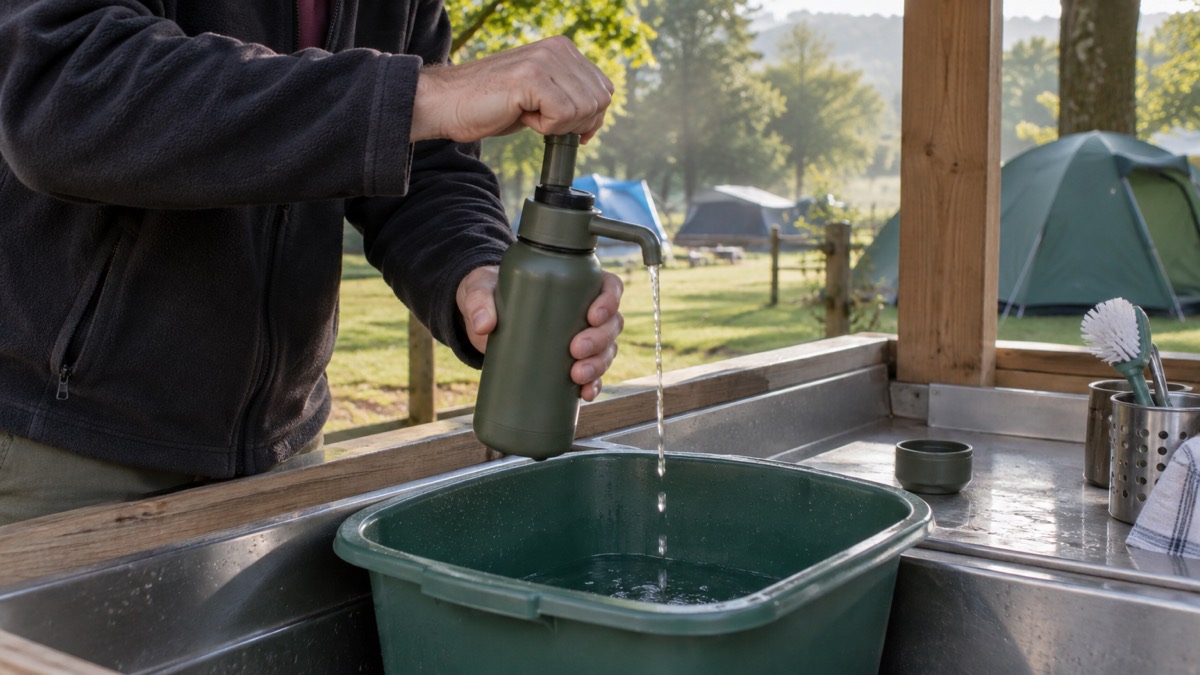
Bottle mode is for drinking as you go. Remove the bottom screw lid and scoop or pour water in, filling to around half an inch below the brim12. Replace the base, open the lid and pump two or three times to start the flow4. You then drink through the spout, and the water is filtered on the way.
Pump mode is for filling something else. Open the top cap and turn the water flow valve 90 degrees to on12, then pump. The maker describes this as using the bottle as a pump to fill a secondary container6, and says it is how you purify larger volumes in one go, including into hydration bladders2.
There are also two ways to fill it. You can remove the bottom screw lid and scoop or pour water in, or connect the included hose to the bottom of the bottle and pump water in6. The hose is the answer when the water is shallow, awkward to reach or uninviting to touch.
To release pressure, unscrew the pump base slowly by a quarter turn until you hear a hiss, holding the pump firmly4. Do this before air travel too: release all pressure, keep only the minimum 1cm of water in the bottle and pack it securely in hold luggage12.
Keep at least 1cm of water in it once primed
This is the single rule that decides whether the Liberty still works in two years' time. The manual says: "Once primed, ALWAYS KEEP AT LEAST 1 CM / ½ INCH OF WATER IN THE BOTTLE"4. Keep the bottle sealed with the pump tightened and the water flow valve closed4.
The reason is the membranes. The manual explains that you keep them hydrated by storing at least 1cm of water in the bottle at all times, with the pump, flow nozzle and top cap in place12. If they dry out, they shut down and block, letting no water through, and the manual states this is not covered by the warranty, so you would need to buy a replacement cartridge4.
Practical storage follows from that12:
- Before first use, keep the bottle in a dry place out of direct sunlight.
- After first use, protect it against extreme temperatures.
- Refresh the stored water regularly so it does not stagnate.
- If you are storing it for a season, clean it first, as below.
The maker describes the cartridge as having a shelf life of 3 to 5 years from purchase, and indefinite once primed and stored correctly5. That is the payoff for the 1cm rule: a primed, kept-wet cartridge does not expire on you.
The filter stops at 2,000 litres or when it blocks
One cartridge purifies up to 2,000 litres, or 528 US gallons13. The maker's Advanced Pack includes a spare cartridge for a further 2,000 litres, giving up to 4,000 litres across the pack13.
You do not have to count litres to know when it is done. The maker builds in a failsafe: when the service life of the cartridge is fulfilled, the pores in the membranes are blocked by contaminants and the filter stops passing water, which takes away the guesswork about whether it is still effective12. The product page states it simply: it stops working when the filter needs replacing1. At that point you replace or clean the cartridge12.
The signs to watch for before that point are slower flow and more pumping. If the bottle needs more pumping than expected, the manual says it may need cleaning, or the filter may be near the end of its life4. The maker also warns against letting grit, sand or other abrasive matter into the bottle; if it gets in, rinse it out, because abrasive matter left inside will wear the seals prematurely and could make the bottle leak4.
A replacement cartridge comes with a plug seal to protect the end of the filter when it is out of the bottle for cleaning and maintenance15. The maker says cartridges are manufactured in the UK and hand tested before leaving the factory15.
Cleaning the bottle and its seals
Clean the Liberty periodically, and always before it goes into storage if it will not be used for a while16. The maker publishes a walkthrough in which its technical director, Joe LoveGrove, shows how to take the Liberty apart, clean the components and put it back together16.
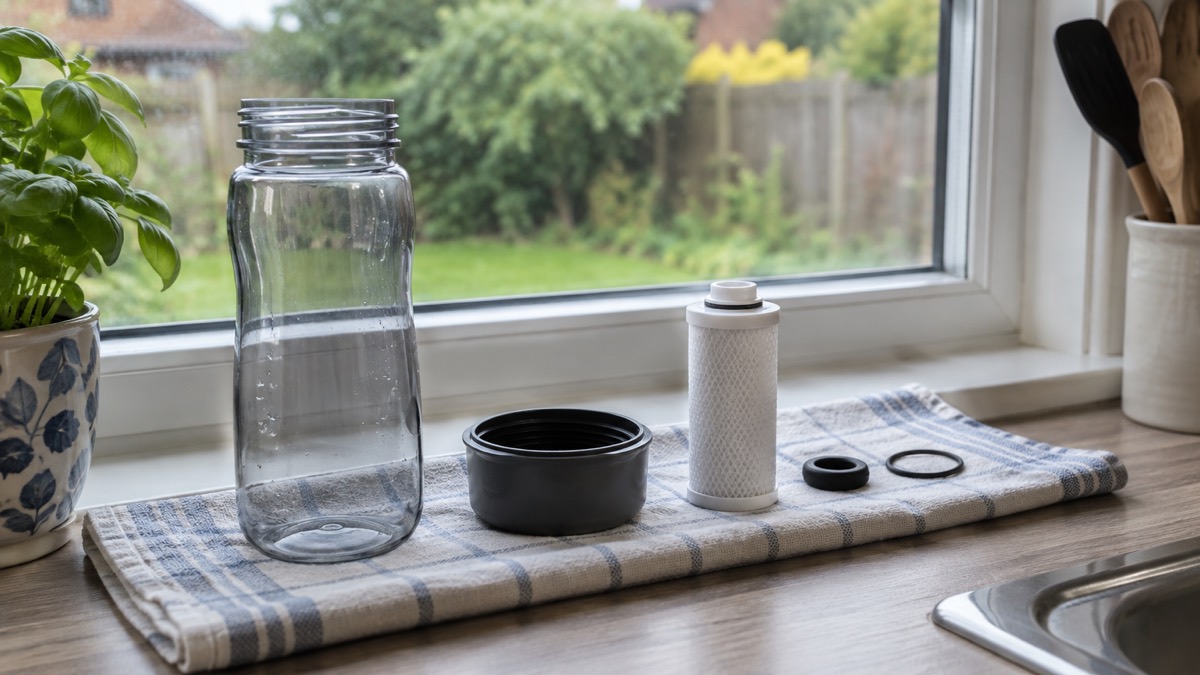
For routine cleaning, all the plastics except the filter can be cleaned with normal washing up liquid and tepid water, but rinse and dry every part afterwards12. The wide mouth fits a standard bottle brush, and the maker says the cartridge swaps out in seconds6.
For a deeper clean of the filter itself, the manual gives this method12:
- Remove the filter from the bottle and fit the flush cap over the clean face of the filter.
- Soak the filter in a basin of tepid water for around half an hour.
- Add a small amount of sterilising solution to kill any pathogens left on the filter surfaces or in the basin; a dissolved chlorine tablet or liquid sterilising solution will do, following the manufacturer's dilution instructions.
- Rinse the filter with clean water, remove the flush cap and refit it into the bottle.
If the pumping action becomes stiff over time, the manual describes servicing the pump: remove the pump base, unscrew the pump tube from the pump shaft, clean debris or old grease from the shaft O-ring and tube, check the O-ring for wear, apply a small amount of silicone grease around the black pump rod and O-ring, check the tube base O-ring is seated, and re-screw without over-tightening12.
The scavenger hose and wide-mouth fittings
The scavenger hose is included with the bottle and is packed in the bottom of the packaging, so check the box before you throw it away4. It is 5ft (1.3m) long and flexible enough to reach water in hidden places6. It has an adjustable float that keeps the inlet off the river or lake bed so it does not suck up silt6.
The maker describes the hose as being for hard-to-reach water sources, and adds that it is also good if there are creatures in the water that might bite17. With the hose fitted you can pump straight into additional containers, including hydration bladders, to purify a larger volume in one go2.
The top of the bottle takes standard wide-mouthed bottles directly, which the manual says gives additional water storage12. The maker names Nalgene and Hydro Flask as examples that screw right in1. The Advanced Pack adds two replacement drinking spouts and a hydration bladder connector for this kind of use14.
Support, warranty and where it is made
The Liberty carries a 2-year limited warranty for defects in materials and workmanship on products bought directly or through authorised partners4. The maker's support pages put it as a 2-year manufacturer warranty from new when bought from Icon LifeSaver or an approved reseller, covering manufacturing defects18.
To claim, return the product with proof of purchase to the original retailer, and the maker will repair, replace or refund at its discretion4. Customers bear the initial transport or shipping cost to the UK factory, and the maker covers return shipping4. The warranty excludes normal wear and tear, unauthorised opening or repairs, accidental or misuse damage, failure to follow the instructions, and lack of proof of purchase; it is not transferable and does not apply to second-hand purchases4.
The maker's contact website is www.iconlifesaver.com19. The Liberty is made in the UK3. If you are weighing it against other ways of treating water at home, the water treatment guide and the filter care guide cover the wider picture, and the LifeSaver Bottle page covers the smaller sibling product.
Sources (19)
- LifeSaver Liberty Bottle (Liberty collection), Icon LifeSaver, 2026-10-29
- LifeSaver Liberty Bottle, Icon LifeSaver, 2026-10-28
- LifeSaver Liberty Bottle specification, Icon LifeSaver, 2026-10-29
- LifeSaver Liberty User Manual, Icon LifeSaver, 2026
- LifeSaver Liberty Bottle, Icon LifeSaver, 2026-10-28
- LifeSaver Liberty Replacement Scavenger Hose, Icon LifeSaver, 2026-10-28
- LifeSaver Liberty Carbon Discs (3 pack), Icon LifeSaver, 2026-10-28
- Independently Tested, Icon LifeSaver, 2026-10-28
- LifeSaver Liberty Protective Silicone Sleeve, Icon LifeSaver, 2026-10-28
- How to Prime Your LifeSaver Liberty Bottle, Icon LifeSaver, 2026-10-28
- LifeSaver FAQs, Icon LifeSaver, 2026-10-28
- LifeSaver Liberty Product Manual, Icon LifeSaver, 2020
- LifeSaver Liberty Advanced Pack, Icon LifeSaver, 2026-10-28
- LifeSaver Liberty Advanced Pack, Icon LifeSaver, 2026-10-28
- LifeSaver Liberty Replacement Cartridge, Icon LifeSaver, 2026-10-28
- How to Clean Your LifeSaver Liberty, Icon LifeSaver, 2026-10-28
- LifeSaver Liberty Soft Pouch, Icon LifeSaver, 2026-10-28
- LifeSaver FAQs, Icon LifeSaver, 2026-10-28
- LifeSaver Wayfarer User Manual, Icon LifeSaver, 2026
 LifeSaver Bottle
 Katadyn BeFree