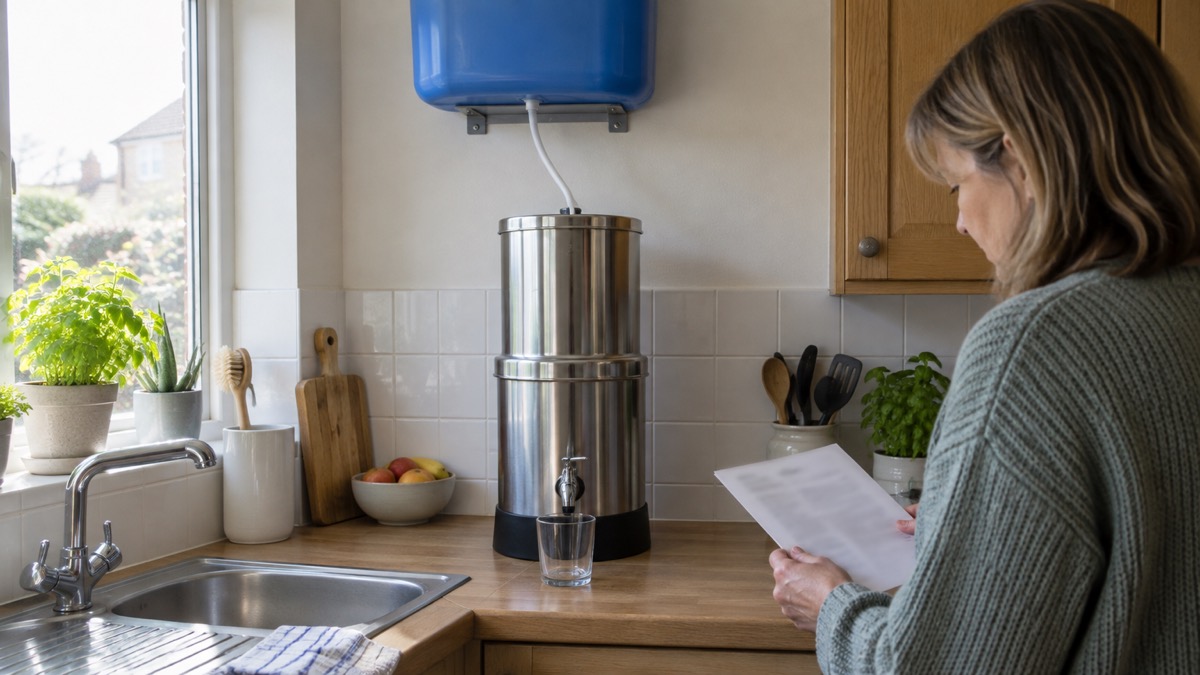
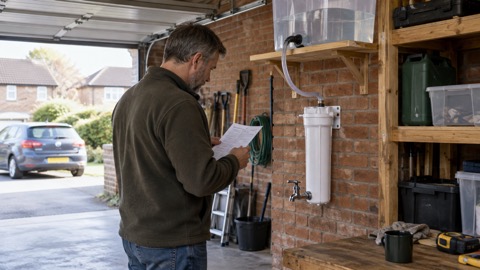
The LifeSaver C2 is a gravity-fed water purifier built for groups rather than single households: a 750-litre tank feeding ultra filtration cartridges, with a stated flow rate of 12 litres a minute at 0.2 bar and a cartridge set rated for up to 1,000,000 litres1. It needs no chemicals and no electricity, which is what makes it interesting to a household planning for a supply interruption1. What it does need is pressure: either a water tank stored at least 2 metres above it, or a pressurised mains supply2.
If you are thinking about one, the practical questions are where it will stand, how the water gets into it, and what you put in front of the cartridges. The maker's own instruction is to fit a sediment pre-filter of at least 50 microns as a minimum, with wound PP cartridges and carbon filters also possible2. The unit weighs 60 kg dry, so it is sited once and left, not carried about1. Assembly is stated at 1 hour1.
This page sets out what the C2 does and does not do, the specifications in the maker's own terms, how to set it up safely, and what support comes with it. It is one option among several for treating water at home; if you are still deciding what kind of filter suits your household, start with Emergency Filters: Gravity, Pump, Bottle and Straw Types and What Each Type Removes.
Specifications at a glance
The C2 sits at the top of the range in capacity terms. The maker states that it provides 300 people with drinking water for up to six years, and that the volume of water filtered and the flow rates depend on the composition and turbidity of the feed water1.
| Specification | Figure |
|---|---|
| Tank capacity | 750 litres (200 US gallons)1 |
| Total purification per set of cartridges | up to 1,000,000 litres (264,170 US gallons)1 |
| Initial flow rate | 12 litres a minute at 0.2 bar1 |
| Filter media | Ultra Filtration (UF)1 |
| Pore size | approximately 15 micron1 |
| Dry weight | 60 kg (132 lb)1 |
| Assembly time | 1 hour1 |
| Replaceable cartridge | Yes1 |
| Warranty | 2 years1 |
Two of these figures deserve a second look. The first is the flow rate: 12 litres a minute is stated at 0.2 bar, so the pressure you give it decides whether you get that. The second is the pore size, which the maker lists as approximately 15 micron1. That is a coarse-sounding number next to the log reductions below, and it is worth reading the two together rather than treating either as the whole story.
The 750-litre tank is the working capacity: it is what you fill, and it is what determines how often someone has to climb a ladder or open a valve. For a household of four, that is a very large buffer. For a village hall, a school or a community group, it is a day's supply.
What it removes, and how it was tested
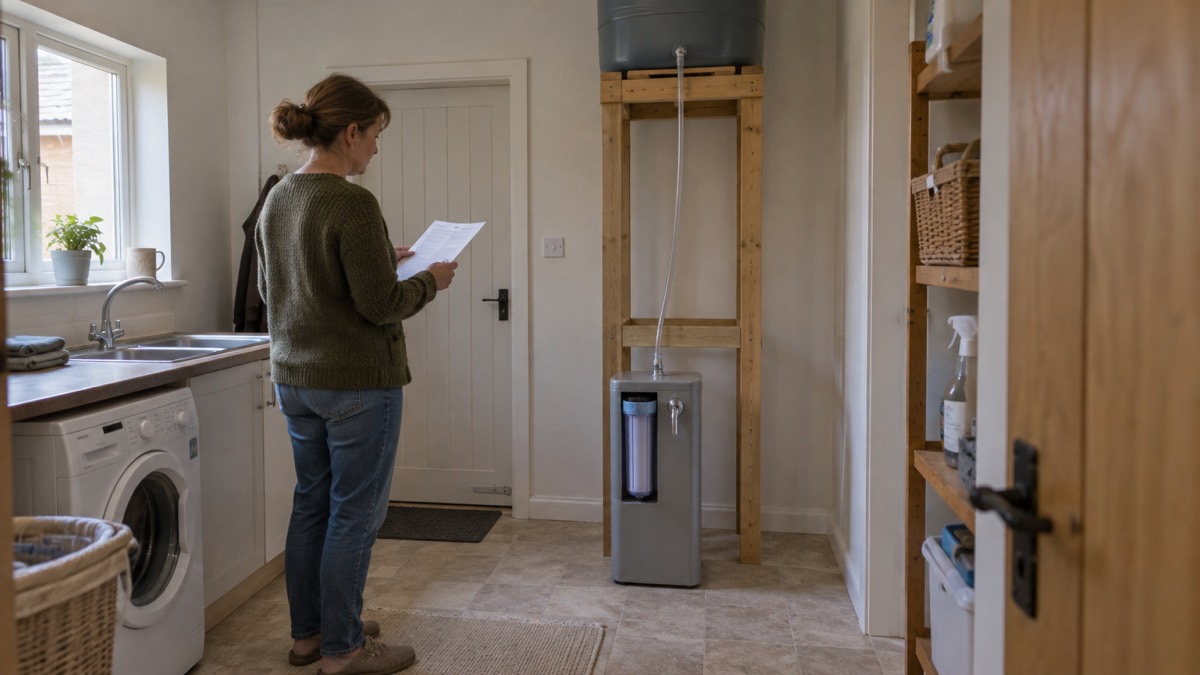
The maker publishes reduction figures for three groups of organisms: bacteria at more than 99.9999% (Log 6), viruses at more than 99.99% (Log 4), and cysts at more than 99.99% (Log 4)1. It also states a 99.99% reduction in microplastics1. Those are the numbers to compare against any other purifier's claims, and the place to understand what a log reduction actually means is Filter Claims and Certification: NSF Standards and Log Reduction.
On testing, the maker states the C2 has been independently tested to meet an adaptation of the NSF/ANSI P231 water purification drinking water standards1. Note the word adaptation: this is the maker's description of its own testing, not a claim of full certification to the standard as written. If certification is central to your decision, ask the supplier for the test report itself.
The maker also addresses a common misunderstanding about water testers. Total dissolved solids meters measure dissolved solids only, not microbiological contamination; the filters remove suspended contaminants and do not de-mineralise water2. Small rises in TDS over the first few hundred litres come from traces of glycerine (about 10%) dissolving after priming, and priming washes out about 90% of it2. In other words, a TDS pen reading is not evidence that the purifier has failed.
How it works without chemicals or electricity
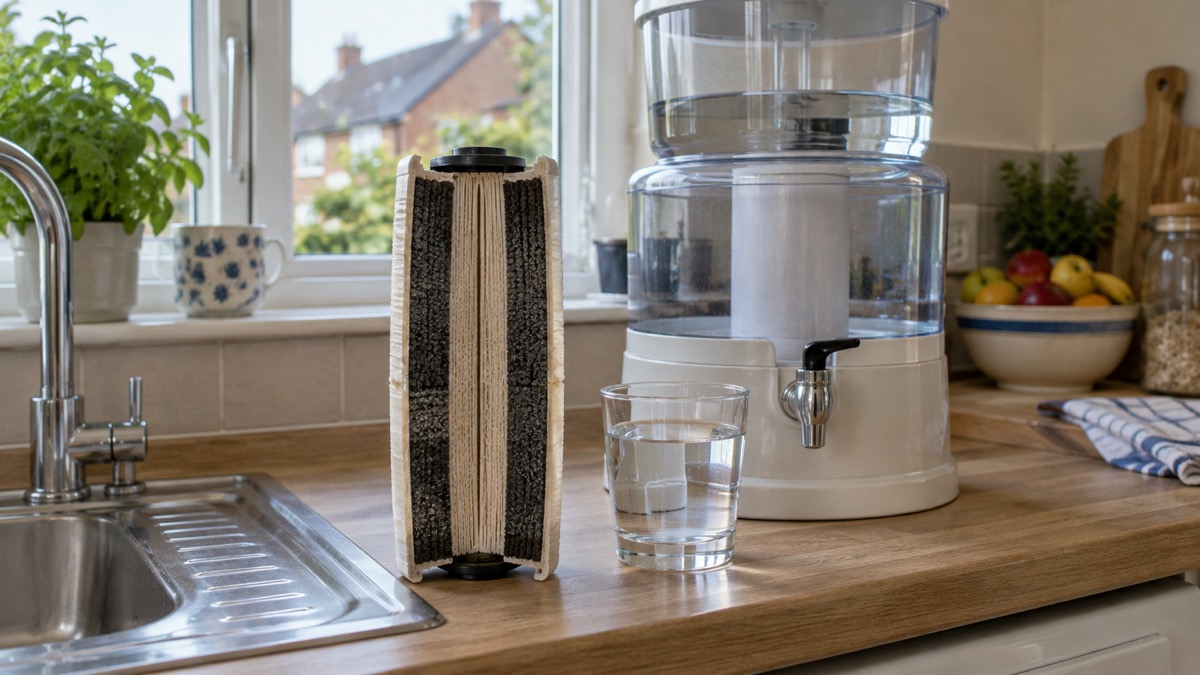
The C2 uses ultra filtration through hollow-fibre style membranes rather than chemical dosing or a pump1. Water passes through the membrane under pressure, and organisms larger than the pore structure are held back. There is nothing to dose, nothing to plug in, and nothing to run flat. That is the appeal for an emergency: a power cut does not stop it, and you do not have to calculate a chlorine dose for a 750-litre tank.
The safety feature worth knowing is what happens when the membranes block. The maker states that once the filter membranes are blocked, water cannot pass through, keeping users safe1. A blocked purifier stops delivering water rather than passing untreated water through. The failure mode is a loss of supply, not a loss of protection, which is the right way round for a household.
The trade-off is that it needs pressure to push water through the membrane. That pressure comes from height or from the mains, and the next section deals with both.
Setting it up: height, pressure and a pre-filter
The C2 needs one of two things to work: gravity from a water tank stored at least 2 metres above it, or a pressurised municipal water supply2. Everything else about installation follows from that choice.
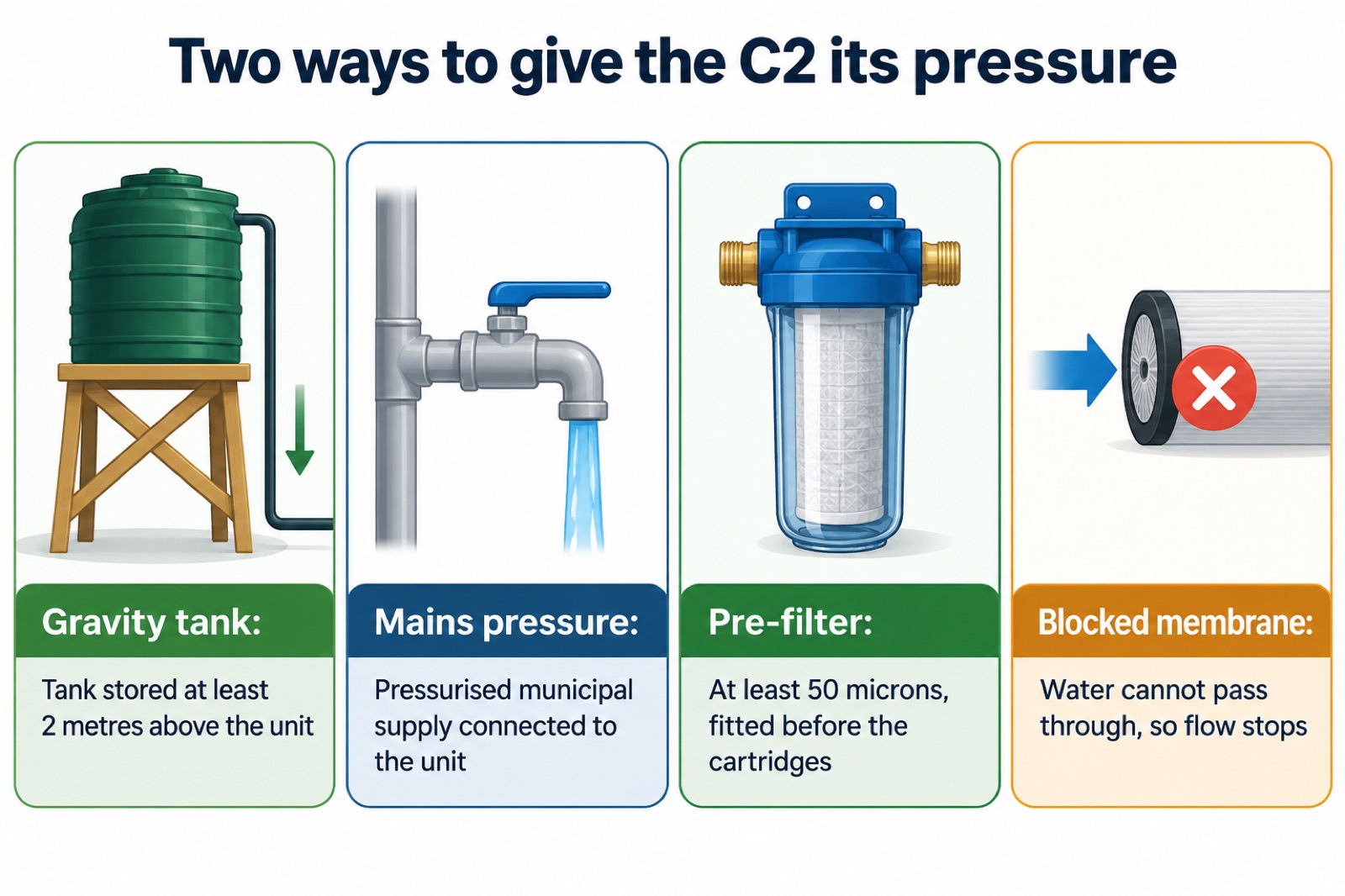
If you go the gravity route, the tank is the engineering problem, not the purifier. Two metres of head is roughly the height of a domestic ceiling plus a bit, and a full tank at that height is heavy. The maker states the stand has been designed to exceed UK Health and Safety and Working from Height Regulation Inspection Standards1, which is the assurance to ask about if the installation is somewhere with staff, volunteers or children around. Site it where filling the tank is safe, and where a spill will not reach electrics.
If you go the mains route, the pressure you actually receive is the variable. Water companies publish their obligations in terms of head at the boundary: Affinity Water states a legal minimum of 7 metres head (0.7 bar) at the boundary stop tap3, while Northumbrian Water and Essex & Suffolk Water describe a standard of ten metres head at the boundary, a flow of nine litres a minute, enough to fill a 4.5 litre container in 30 seconds from a ground floor kitchen cold tap4. The C2's 12 litres a minute is quoted at 0.2 bar1, well below either figure, but pressure varies through the day and with your plumbing. If yours is poor, see What to Do About Low Pressure.
Whichever route you take, fit a pre-filter. The maker's instruction is explicit: as a minimum fit a 50-micron sediment filter, and wound PP cartridges and carbon filters can also be fitted2. The pre-filter catches silt and sediment before it reaches the membrane, which is what protects the cartridge life.
"As a minimum you should fit a 50-micron sediment filter."
Murky, cloudy or coloured water
Source water quality decides how hard the pre-filter has to work. The maker's answer to murky water is the sediment filter above, and it is worth understanding why cloudy water is not always what it looks like.
Most cloudy or milky tap water in the UK is air, not contamination. The Drinking Water Inspectorate states that white or cloudy water is likely to be caused by air trapped in the water and is not harmful to health6. United Utilities explains the mechanism: pockets of air trapped in the main get compressed after the main is refilled following a burst7. Bournemouth Water gives a simple test, that a glass of aerated water will clear from the bottom upwards in about 30 seconds8. Scottish Water says milky or cloudy water is caused by air trapped in the pipe dissolving into the supply and is safe to drink, and asks customers to contact it if it continues9.
Discoloured water is different. Yorkshire Water states that cloudy, brown or yellow water is caused by disturbance of natural sediment within the main, and while not harmful it is not recommended for drinking10. That is exactly the kind of water a purifier with a pre-filter is for: let the sediment settle or filter it out first, then purify.
Who it suits, and what it cannot do
The C2 is a group-scale purifier. The maker's planning figure is 300 people with drinking water for up to six years1, which tells you the cartridge set is sized for a community, not a kitchen. For a single household, the same money and floor space might be better spent on a smaller gravity system; the comparison pages will help you weigh it up.
| If your situation is... | What matters about the C2 |
|---|---|
| A household wanting a few days' drinking water | Far larger than needed; a smaller gravity filter or stored water may suit better |
| A village hall, school or community group | The 750-litre tank and 1,000,000-litre cartridge life match group use1 |
| A site with a rainwater harvesting system | The maker states it can be connected to one for a constant clean supply1 |
| A home with weak mains pressure | Needs the gravity tank route, or a check on your pressure first2 |
| Anyone who cannot lift 60 kg | Plan the siting and get help; the dry weight is 60 kg1 |
What it cannot do is worth stating plainly. It does not de-mineralise water, and a TDS reading is not a measure of microbiological safety2. The maker states that the volume of water filtered and the flow rates depend on the composition and turbidity of the feed water2. And it does not replace the instructions on a boil notice. For the wider picture of what different filter types can and cannot remove, see Ceramic, Carbon, Hollow-Fibre and RO: What Each Removes, and for keeping cartridges in good order, Looking After a Filter: Priming, Cleaning, Cartridges and Frost.
If you are storing water as well as treating it, the household guides on How Much Drinking Water to Store per Person and Household Storage Tanks for Drinking Supplies set out the volumes and the containers.
Warranty, support and the name clash
The C2 carries a 2-year warranty and a replaceable cartridge1. The maker lists it as price on application, so ask the supplier directly for a quotation and for the current cartridge price; there is no published figure to plan against1. Keep the installation documentation, particularly for the stand, and register the purchase with the supplier so the warranty is straightforward to claim.
One practical warning about searching. "Lifesaver" is also the name of an interactive game by the Resuscitation Council, made with the production company UNIT9, first launched in 2013 with updates in 2017 and 202011. It teaches CPR and emergency decision-making through four scenarios covering calling an ambulance, CPR, using a defibrillator, choking and the recovery position11. It is free, runs in a browser or as an iPhone and Android app, and completing all four scenarios lets anyone sign up as a GoodSAM cardiac responder11. It is a genuinely useful thing to do with an evening, and it has nothing to do with water.
If you want the CPR side rather than the purifier, the Resuscitation Council's page on Lifesaver is the place to start11. Lifesaver is a collaboration between Resuscitation Council UK and award-winning production company UNIT9, first launched in 2013 with updates released in 2017 and 2020, and available online on desktop and mobile11. Anyone can sign up to be a GoodSAM cardiac responder once they have completed all 4 Lifesaver scenarios, which are free11. None of that belongs on a water purifier page, but it is the other thing people find when they search the name.
Sources (12)
- LifeSaver C2 product page, Icon LifeSaver, 2026-10-28
- LifeSaver FAQs and support articles, Icon LifeSaver, 2026-10-28
- Low pressure, Affinity Water, 2026-10-28
- Getting water to your home, Northumbrian Water, 2024-01
- Getting water to your home, Essex & Suffolk Water, 2024-01
- White or cloudy water, Drinking Water Inspectorate, 2026
- Understanding water, United Utilities, 2022
- Drinking water FAQs, Bournemouth Water, 2026-10-28
- Water supply FAQs, Scottish Water, 2026-10-29
- How we manage incidents, Yorkshire Water, 2026-10-28
- Lifesaver, Resuscitation Council UK, 2026
- Lifesaver learning, Resuscitation Council UK, 2026
 LifeSaver C1