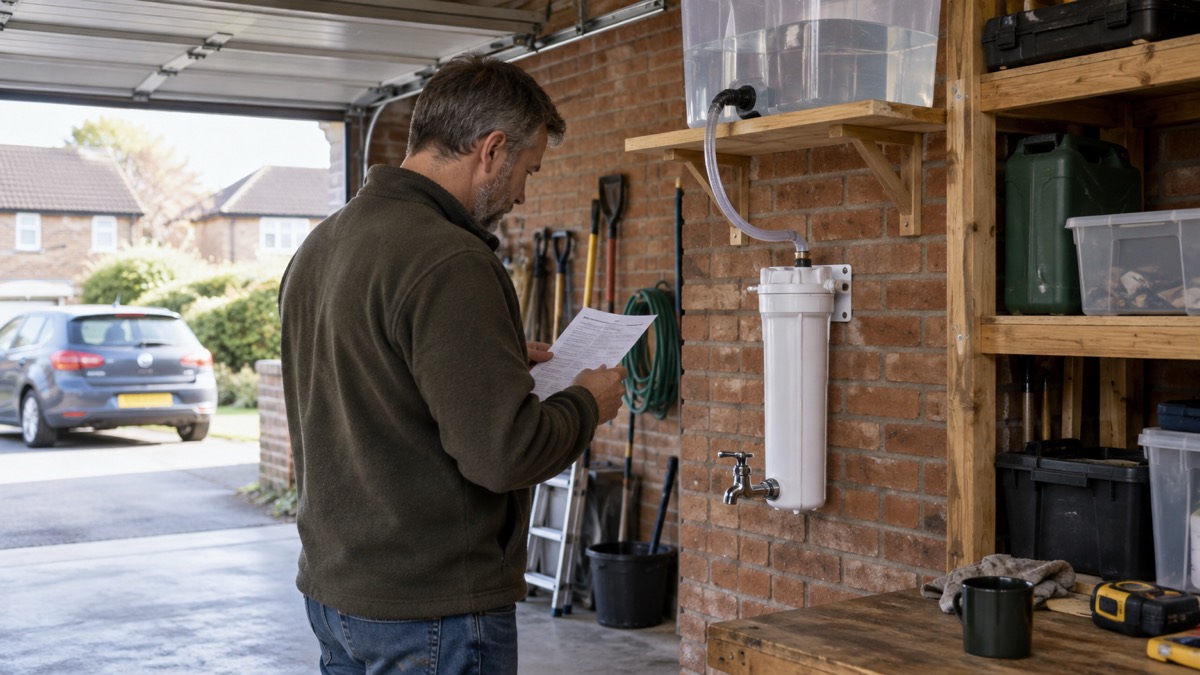
The LifeSaver C1 is a gravity-fed, in-line water filter for a property rather than a person. You connect it between a water source held at least 2 metres above it, such as an overhead tank or a water butt, and a tap, and it purifies the water as it flows through. It needs no electricity and no chemicals, and it produces no wastewater1. The maker rates it to remove 99.9999% of bacteria and 99.99% of viruses and cysts, and to pass 5 litres a minute from a tank 2 metres above it1.
That flow rate is the number to hold on to. At 5 litres a minute the C1 can fill a large container in a couple of minutes, which is a different order of supply from a jug filter or a filter bottle. The trade is that it is a fixed installation: 920mm long, 6kg dry, and dependent on a head of water to push water through the membrane3. It suits a household on a private supply, a smallholding, or anyone who wants a treated supply from stored rainwater rather than a bottle in a rucksack.
This page sets out what the C1 does and does not remove, how to install it so it works and stays safe, where it must never be left, and how to tell when the cartridge is coming to the end of its life. It is the maker's own specification and instructions throughout, because for a named product that is the right source for what it can do.
What the C1 is, and the household it suits
The C1 is an in-line microbiological filter, not a storage tank. The maker describes it as suitable for any off-grid property that relies on a private water supply, from family homes and farmhouses to smallholdings and communities3. It is designed to treat harvested rainwater, water from boreholes, wells, springs and rivers, and untrustworthy municipal piped supplies1. If your water comes from a well, a spring or a borehole, this is the class of kit that stands between that supply and a glass.
It works on pressure, not on a pump you crank. The maker's support pages explain that the larger purifiers, the C1 and the C2, use either the force of gravity, by connecting to a water tank stored at least 2 metres above the unit, or a pressurised municipal water supply5. That 2 metre head is the minimum: the manual gives a minimum delivery pressure of 0.2 bar and a maximum of 1.5 bar1. Below the minimum, water will not pass properly; above the maximum, you risk damaging the unit.
Because it holds no water of its own, the C1 does not extend how long your supply lasts. It treats what you already have stored or can collect. If your concern is how much water to keep, that is a separate question, covered in how much drinking water to store per person. If you are weighing a fixed gravity filter against other approaches, gravity filters and ceramic candles explained sets the types side by side.
What it removes, and what it leaves behind
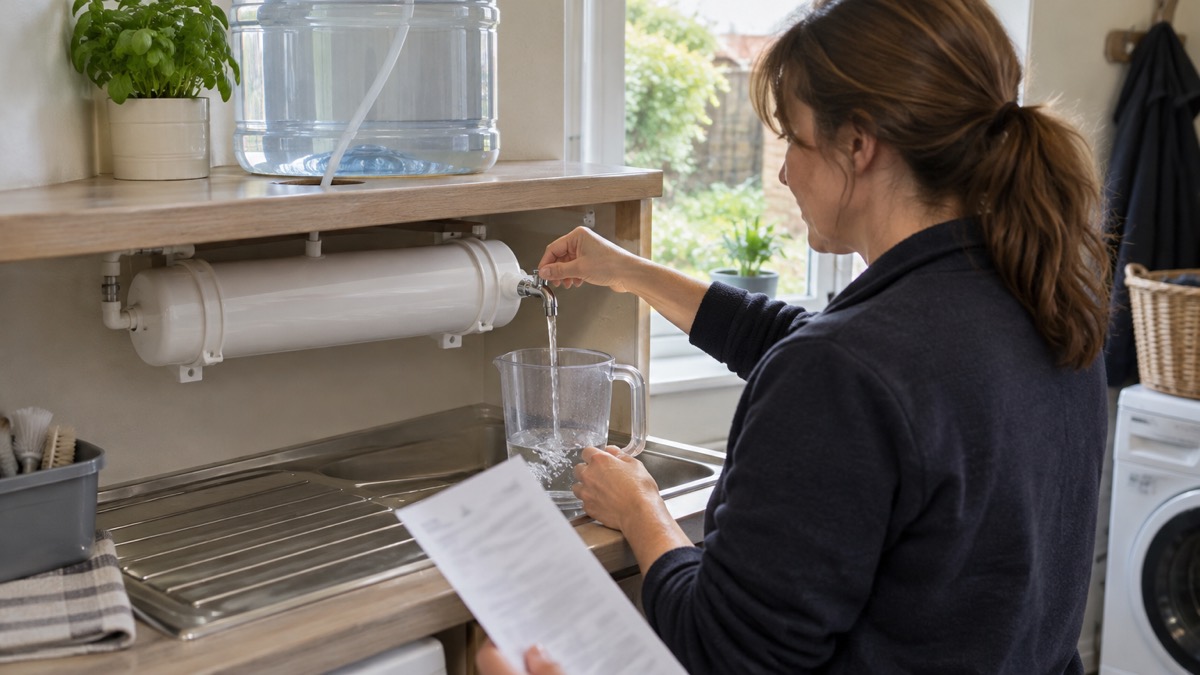
The maker's manual gives the retention figures as log reductions: bacteria above 99.9999% (Log 6), viruses above 99.99% (Log 4), and cysts above 99.99% (Log 4)1. The same manual puts sediment, microplastics and organic matter removal at 99%1. The maker's wider filtration technology is described as removing a minimum of 99.99% of all viruses, bacteria, cysts and microplastics6.
Those are the microbiological numbers, and they are the ones that matter for making collected water safe to drink. What the C1 does not do is remove dissolved chemicals. The manual is explicit that chemical contamination needs further removal technology, such as carbon treatment or ion exchange resins used as pre-filters, before water is treated as a long-term drinking supply1. It also advises getting your water tested each year for heavy metals, chemicals and nitrates, and adding specialist pre-filters if the results call for them1.
| What the C1 targets | Removal rate | Source |
|---|---|---|
| Bacteria | above 99.9999% (Log 6) | Maker manual1 |
| Viruses | above 99.99% (Log 4) | Maker manual1 |
| Cysts and parasites | above 99.99% (Log 4) | Maker manual1 |
| Sediment, microplastics, organic matter | 99% | Maker manual1 |
One point of honesty about the paperwork: the maker's product pages describe the C1 as independently tested and certified to NSF Protocol P231, and elsewhere as tested to an adaptation of that protocol7. Treat the P231 claim as the maker's stated certification and check the certificate with the maker if it matters to your decision. How filter claims and certification work explains what these standards mean in practice.
Flow rate: what 5 litres a minute depends on
The flow rate is not fixed. It rises with the height of water above the unit, because that height is what creates the pressure. The maker's manual gives a table of flow against head1:
| Height of tank above the C1 | Pressure | Flow rate |
|---|---|---|
| 2m / 6 ft | 0.2 bar / 2.85 PSI | 5 litres a minute |
| 3m / 9.5 ft | 0.3 bar / 4.3 PSI | 5.5 litres a minute |
| 4m / 13 ft | 0.4 bar / 5.7 PSI | 6 litres a minute |
| 5m / 16.5 ft | 0.5 bar / 7.1 PSI | 6.5 litres a minute |
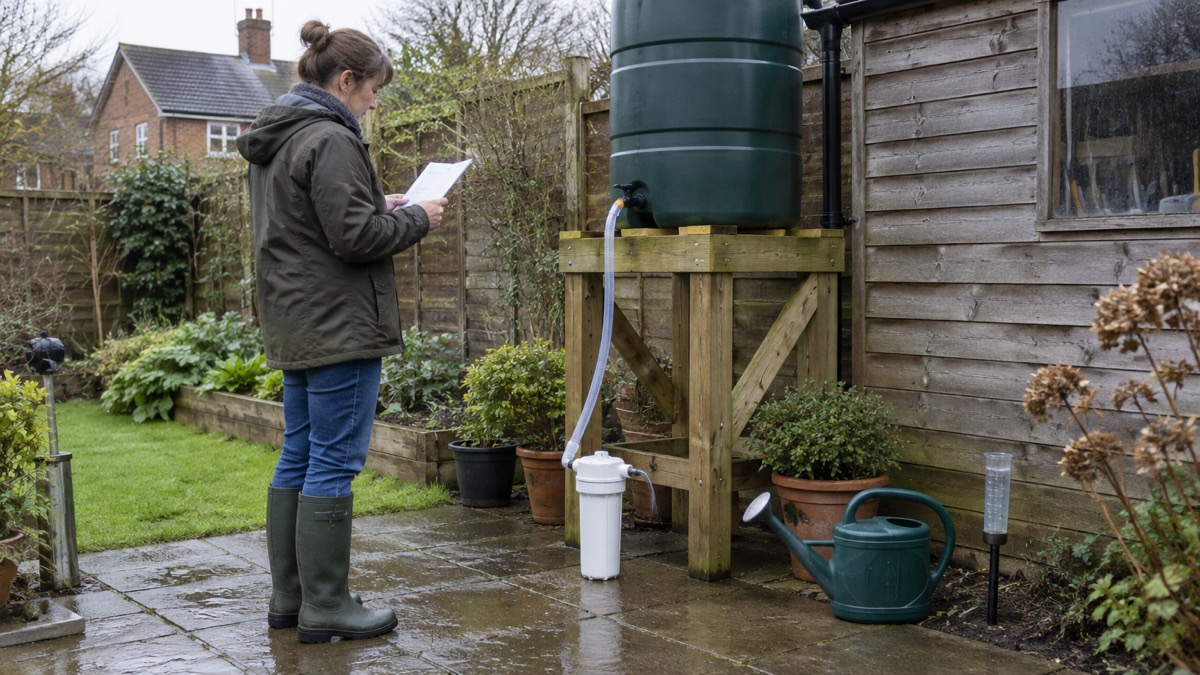
So the headline 5 litres a minute is the figure at the minimum 2 metre head2. Raise the tank and you get more, up to 6.5 litres a minute at 5 metres1. Lower it and you get less, or nothing. This is why siting matters more than any other decision: a butt standing on the ground next to a bench will not do it, but a butt raised on a sturdy platform, or a header tank in a loft, will.
If a raised header tank is impractical, the maker says similar pressures can be achieved by adding a hand pump or a small electric pump1. That opens up installations where height is not available, at the cost of a pump to maintain. Where the source is pumped or comes from the mains and is not routed through an accumulator tank, the manual recommends fitting a pressure limiting valve before the C1, to stop surges damaging the system, and keeping delivery pressure below 1.5 bar1.
Installing the C1 safely
The C1 arrives pre-assembled and pressure tested from the factory1. The maker supplies a 3 metre length of drinking water hose, a screw-in pre-filter for the top of the unit, a push-fit connector with a shut-off valve, two push-fit hose fittings, a tank connector, silicone grease and a flush cap1. The inlet is a ¾ inch BSP female connection1.
The installation rules are short and worth following exactly:
- Mount it horizontally and level. The maker says the C1 should only be used in horizontal orientation, with the tank level1.
- Fix it down with four M10 bolts. The feet have M10 fastening nuts, and the maker says to use four M10 bolt fixings in all circumstances, long enough to go through the counter or bench the unit sits on1.
- Fit an in-line shut-off valve. The manual states that all installations must include an in-line shut-off valve in the feed pipework1.
- Do not load the top. Nothing should be placed on top of the C1 or fixed to it, because it is not a load-bearing object1.
- Keep the pressure relief valve connected. Never operate the C1 with the pressure relief valve disconnected, isolated or removed1.
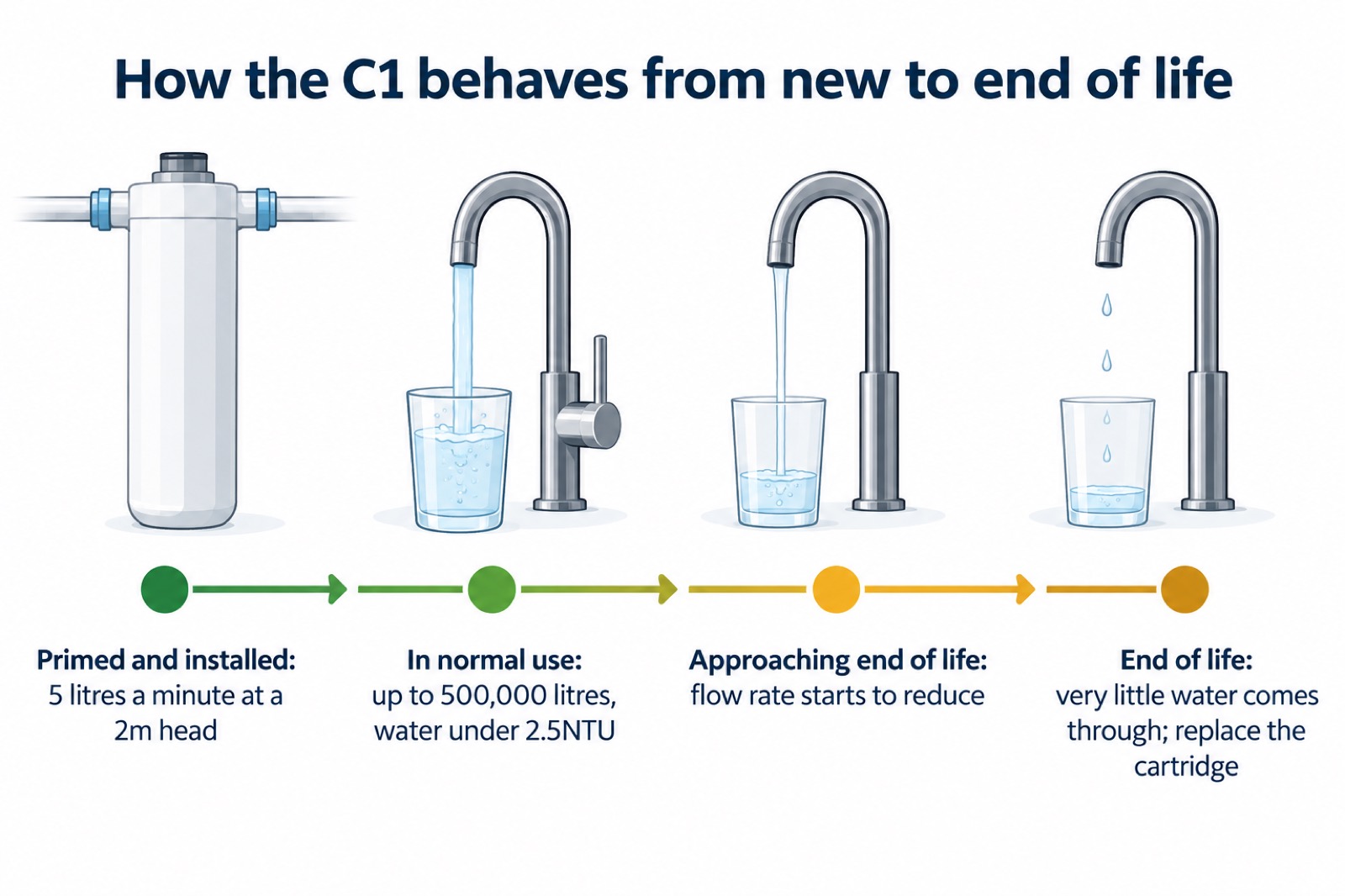
Before first use the filter must be primed. The manual says to let the filter sit for 5 minutes to soak up water, then allow the first approximately 50 litres, about 10 minutes at 5 litres a minute, to flow freely to drain1. Do not drink that priming water: the maker says it will taste sweet from the glycerine, which is not harmful but is not for drinking1. Priming should ideally be done within three years of purchase1.
Where a C1 must never be left
Three conditions will shorten the life of the filter or spoil the water, and the maker names all three.
Dry. Once primed, the filter must never dry out. The manual says that whether it is disconnected for maintenance or disassembled for cleaning, it must never sit more than an hour outside a submerged state1. The maker's product page puts it bluntly: "DO NOT ALLOW THE FILTER TO DRY OUT."8 If the supply is interrupted and the C1 runs dry, shut off the in-line supply valve and close the tap, which seals the filter and keeps it hydrated1.
Frozen. The maker's storage advice for a primed unit that will go unused for a month or more is to discard the activated carbon filter if one is fitted, clean the product, put a little clean water back in, and store it cool and dry away from direct sunlight, replacing the clean water every couple of months5. A filter left full of water in a freezing shed is the risk to avoid; looking after a filter covers frost and cartridge care in more detail.
In direct sunlight. The manual says the C1 should be sited indoors or in shade, away from direct sunlight whenever possible, to inhibit bacterial growth, protect the plastics and keep the water palatable1.
Pre-filters and testing for what it cannot remove
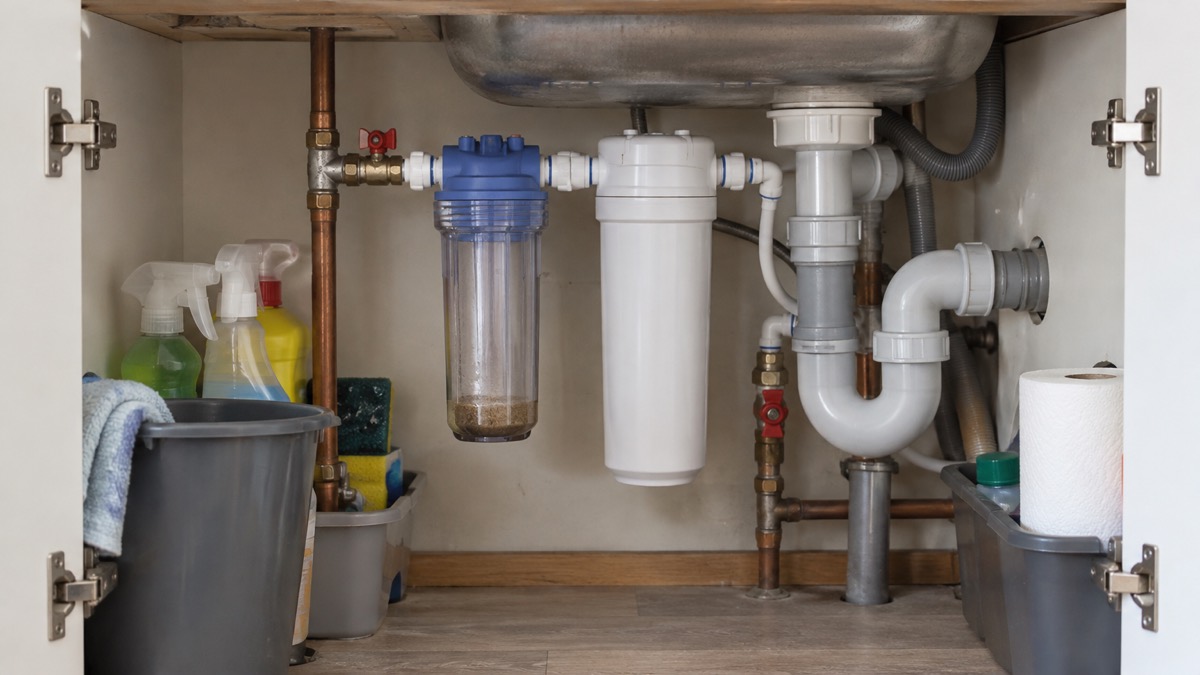
The C1 is a microbiological filter. Dirt, silt and chemical contamination are a separate job, and the maker is clear that pre-filtration protects the cartridge. A sediment pre-filter removes sand, silt and organic matter and extends the life of the C1 filter, while an activated carbon filter improves the taste and smell of the water2. The maker recommends getting your water tested so you can decide exactly which pre-filters are needed3.
The manual adds a firmer instruction for anyone relying on a source long term: get your water tested each year for heavy metals, chemicals and nitrates, and add specialist pre-filters if required1. If a test reveals significant chemical or heavy metal content, the maker says it will be necessary to remove any that can be harmful after long-term exposure8. That is the limit of what a filter of this type can promise on its own.
For a household on a private supply, this is where local guidance helps. Scottish private supply guidance advises reducing usage to conserve a supply that is running low and thinking about where you could get drinking water if it stopped11. Your water company may also re-route water in its network during an interruption12. Private supplies: wells, boreholes and springs covers the testing and treatment picture for households off the mains.
Filter life: up to 500,000 litres, and the slowing flow that warns you
The maker rates the cartridge at up to 500,000 litres, based on water under 2.5NTU1. To put that in household terms, the maker says each C1 can purify enough drinking water for 100 people for four years, and that in a whole-house system for a family of four using 500 litres a day it could last as long as three years8. Those are the maker's own illustrations, not a guarantee for your water: turbid or dirty water will use the cartridge up faster, which is the argument for the sediment pre-filter.
You do not need to count litres to know when it is finished. The maker builds in a failsafe: as the filter approaches end of life, the flow rate starts to reduce until very little water comes through1. The product page says the same: as the filter approaches end of life the water flow starts to reduce and you know it is time to replace it8. A slowing tap is the signal, not a fault.
The replacement cartridge is foil sealed and fits either the C1 or the C27. It is manufactured in the UK and carries a 2 year warranty7. When you change it, the maker says to dispose of the old filter at a recycling centre1. An unused foil-wrapped filter will last up to ten years before it should be primed1, so a spare kept sealed and dry is a sensible thing to hold.
Support, warranty and getting in touch
The C1 carries a 2 year warranty3, and the maker describes a comprehensive warranty covering all manufacturing defects and material failures8. The maker also offers a 30 day money back guarantee, with a full refund if you return the unit within 30 days8. Keep your proof of purchase and the cartridge packaging.
For advice on using or caring for the unit, the maker says to contact Icon Lifesaver directly13. The maker's website is www.iconlifesaver.com14. Have the unit and cartridge details to hand when you call.
If you are comparing the C1 with the rest of the range, the LifeSaver C2 is the larger sibling, and the LifeSaver Jerrycan and LifeSaver Wayfarer are portable alternatives. For the wider question of treating water in an emergency, start with how to make water safe to drink in an emergency.
Sources (14)
- C1 Instruction Manual 2026, Icon LifeSaver, 2026
- LifeSaver C1 product page (EU), Icon LifeSaver, 2026
- LifeSaver C1 product page (NA), Icon LifeSaver, 2026
- C1 User Manual 2026, Icon LifeSaver, 2026
- LifeSaver FAQs (EU), Icon LifeSaver, 2026
- Features and Benefits, Icon LifeSaver, 2026
- LifeSaver C1 Replacement Cartridge Foil Sealed (EU), Icon LifeSaver, 2026
- Large Scale Water Purifiers, Icon LifeSaver, 2026
- First aid kit advice, Collingwood Surgery, 2026
- Use of oxygen at home, Dorset and Wiltshire Fire and Rescue Service, 2025
- Private water supplies, Scottish Borders Council, 2026
- Supply interruptions, Severn Trent Water, 2026
- LifeSaver Wayfarer overview, Icon LifeSaver, 2026
- SLI0100-2 WAYFARER™ User Manual - Multilingual (No Japanese & Chinese) (8 x 16 cm), LifeSaver (iconlifesaver.com)
 LifeSaver C2