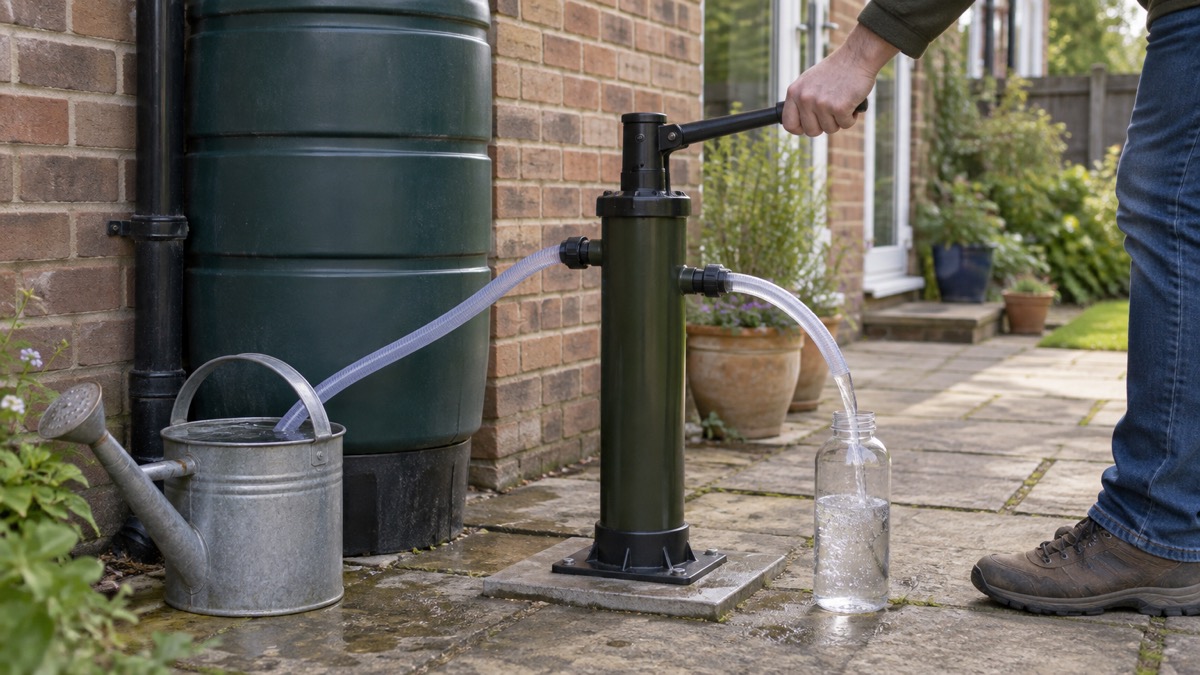
The LifeSaver Wayfarer is a hand-pumped water purifier for one person or a small group. You fill its hose from a river, stream, lake or water butt, pump the handle, and clean water comes out of a second hose into a bottle or hydration pack. It needs no chemicals and no electricity, so it keeps working when the mains are off1. The maker says one cartridge purifies up to 5,000 litres, at an initial flow rate of 1.4 litres a minute, and the unit weighs 323g dry2.
For a UK household, that makes it a backstop rather than a first choice. Your first supplies should be stored tap water and bottled water, and the household guide to water in an emergency sets out how much to keep. The Wayfarer earns its place when stored supplies run low and you need to make collected water drinkable, or when you are away from home and the taps are not an option. It is made in the UK, and the maker sells it as a compact water solution for preppers' go bags3.
Before you rely on it, know three things. It must be primed before first use, with 4 pumps and a 2 minute wait, then about 8 litres of clean water pumped through4. Once used, the membrane must stay wet to remain effective, so it has to be stored with water in it2. And it must never be pumped without its pre-filter attached4. Get those three right and the rest is straightforward maintenance.
What the Wayfarer is and who it suits
The Wayfarer is a pressure vessel water purifier with a pump4. That description matters more than it sounds. Pumping pressurises the system, and the maker says this means it requires very little effort to pump the water through, filtering unlimited amounts of water as long as you pump5. It is not a squeeze bottle and it is not a gravity filter: you are the power source, and the effort per litre is low because the pressure does the work.
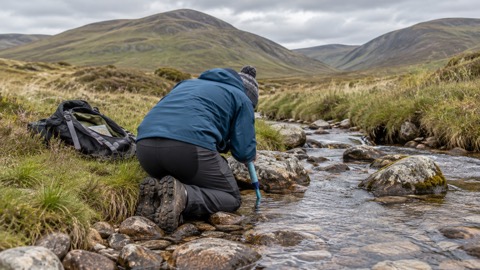
The maker lists it for solo and group activities including hiking, rambling, walking, backpacking and travelling, and says one Wayfarer per group will keep everyone safely hydrated6. It also describes it as a compact and lightweight water solution for preppers' go bags, taking up very little space3. In a household setting, that translates to three realistic uses:
- A backstop during a supply interruption. If a do not drink notice or a long outage leaves you short, it lets you treat water you collect rather than depend on deliveries.
- Away from home. Camping, a caravan, a bothy or a long walk where you would otherwise carry every litre.
- A shared resource for a street or group. One unit can fill bottles for several people in turn, and the maker says one Wayfarer per group will keep everyone safely hydrated6.
It is not a substitute for stored water. Treating water takes time and a source, and in a flood or a drought the nearest safe-looking source may be neither safe nor near. Store water first, then add a purifier. If you are weighing up types, the guide to hand pump filters sets the Wayfarer alongside other pump designs, and emergency filters covers gravity, bottle and straw types.
What it removes from water
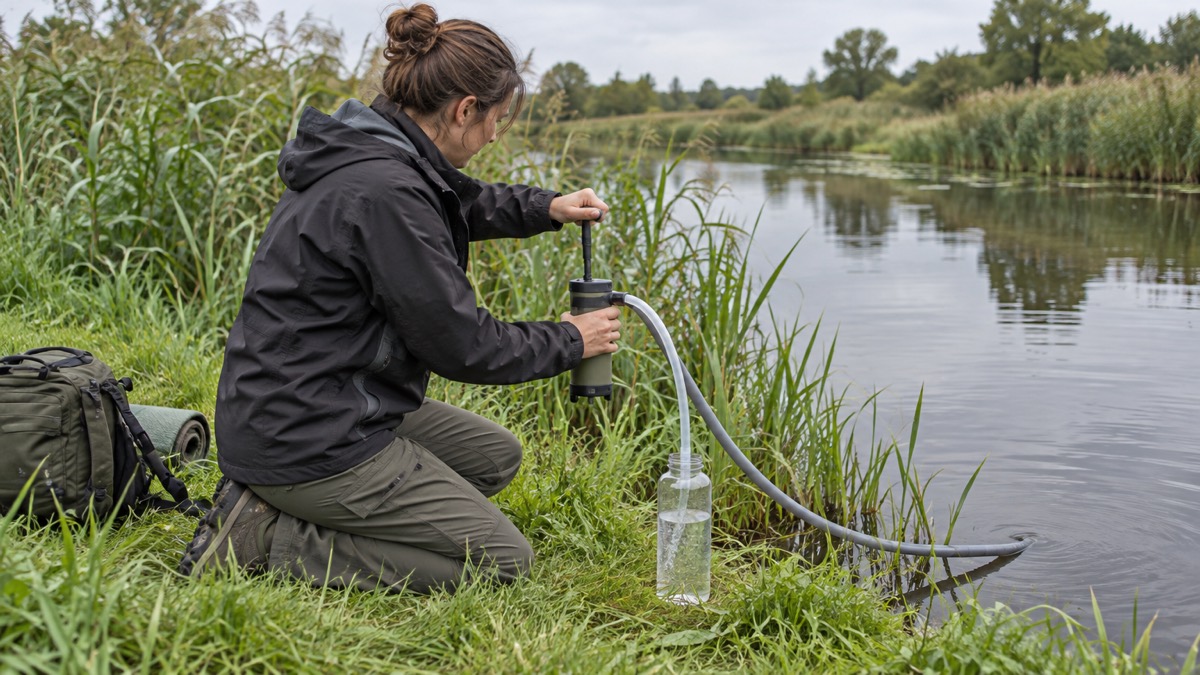
The maker states that the Wayfarer removes 99.99% of viruses, bacteria, parasites and microplastics1. Broken down by category on the maker's specification sheet, that is bacteria at 99.9999%, viruses at 99.999%, cysts at 99.99% and microplastics at 99.99%2. The maker describes the technology as a physical barrier against viruses, bacteria and cysts, and lists among the organisms it covers rotavirus, norovirus, E. coli, listeria, cryptosporidium, salmonella, hepatitis A, cholera, typhoid and leptospirosis7.
The maker says the unit is independently tested to exceed full NSF/ANSI P231 and WHO2011 "Highly protective tier" drinking water standards2. One caution sits on the same specification sheet: a footnote reads "*Testing by BCS laboratories to be confirmed"8. Treat the headline certification claim as the maker's stated position rather than a settled third-party result, and if certification is what decides your purchase, read the guide to filter claims and certification and ask the maker directly.
What the ultrafiltration membrane does not do is remove dissolved chemicals. That is the job of the activated carbon disc, which the maker says reduces chemicals and heavy metals as well as improving taste and odour2. So the unit has two stages with two different jobs: the membrane deals with the microbiological risk, the carbon disc deals with taste and chemical reduction. Neither is a licence to drink from any source without thought. If a source may be contaminated with fuel, pesticide or industrial discharge, a purifier of this kind is not the answer, and the guide to drinking from streams, rivers and other sources explains why.
| What it targets | Reduction stated by the maker |
|---|---|
| Bacteria | 99.9999%2 |
| Viruses | 99.999%2 |
| Cysts and parasites | 99.99%2 |
| Microplastics | 99.99%2 |
| Chemicals, heavy metals, taste and odour | Reduced by the activated carbon disc2 |
Specifications
The figures below are the maker's own, from its product pages and manual. Where the maker's pages give a figure in more than one form, the fuller version is used.
| Specification | Figure |
|---|---|
| Type | Pressure vessel water purifier with pump4 |
| Filter media | Ultra Filtration (UF)2 |
| Pore size | Approximately 15 micron (0.015 nanometres)2 |
| Volume of water filtered | 5,000 litres / 1,320 US gallons per cartridge2 |
| Initial flow rate | 1.4 litres a minute at 1.0 bar1 |
| Dry weight | 323g (11.4 oz)2 |
| Dimensions, closed | 90mm x 75mm x 155mm9 |
| Storage capacity | Not applicable: it purifies, it does not store2 |
| Replaceable cartridge | Yes2 |
| Materials | BPA and BPS free2 |
| Cartridge shelf life | 3 to 5 years from date of purchase2 |
| Warranty | 2 years2 |
| Made in | UK2 |
Two of those rows deserve a word. The pore size figure is quoted by the maker as approximately 15 micron (0.015 nanometres), which is how the maker writes it; the important point for a household is that the membrane is fine enough to act as a barrier to viruses and bacteria, which is what the reduction figures describe2. And the storage capacity is listed as not applicable because the Wayfarer is a pass-through device: water goes in one hose and out the other, and whatever you want to keep you put in a bottle2.
The Advanced Pack changes the arithmetic rather than the unit. It contains a pre-installed cartridge plus a spare, giving up to 10,000 litres in total, along with seven activated carbon discs, a 600ml Nalgene water bottle with OTF cap, a hydration bladder connector, a cartridge removal tool, spare valves, a travel pouch and a paper manual3. The standard unit ships with one pre-installed cartridge, one activated carbon disc, a set of hoses, a silicone dust cap, a cartridge removal tool, a travel pouch and a paper manual10.
Priming before first use: 4 pumps, 2 minutes, about 8 litres
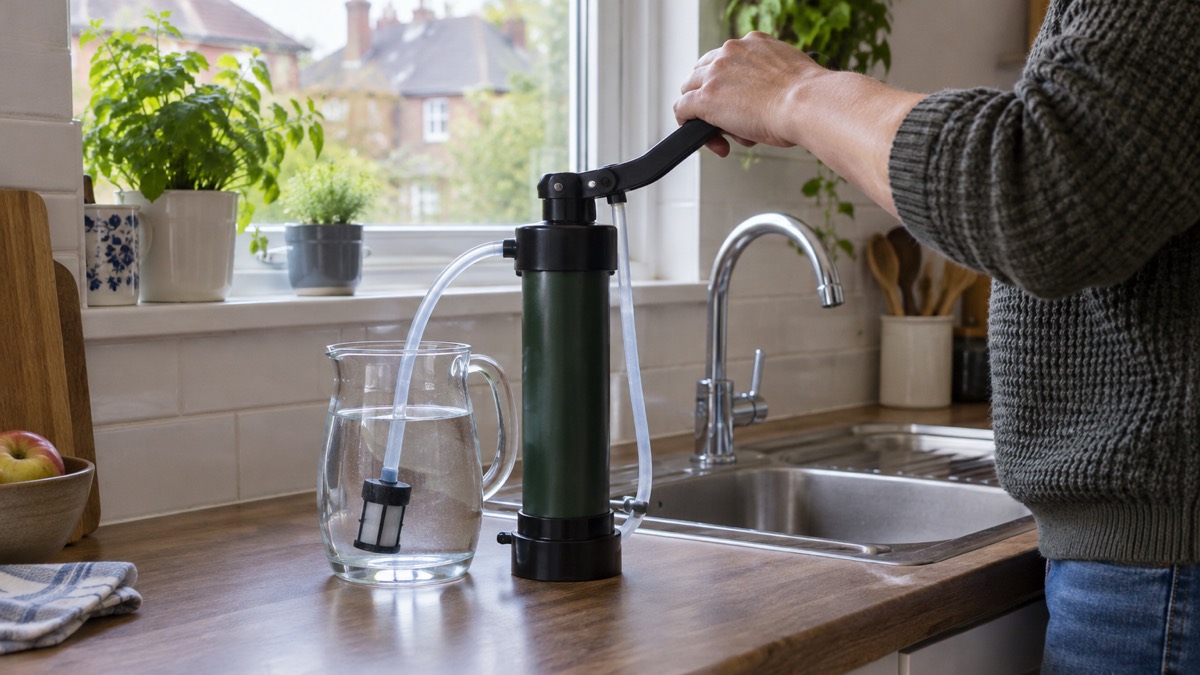
A new Wayfarer will not purify properly until it is primed, and the maker is direct about it: before you hit the trail, it is vital that your new LifeSaver Wayfarer water purifier is primed ready for use. Priming wets the membrane and flushes the new cartridge: pump approximately 8 litres of water through the filter during priming11. Do it at home, with a tap, before you need the unit in earnest.
The maker's manual gives the sequence4:
- Drop the Scavenger In Hose into clean water, tap water preferably, ensuring the pre-filter is fully submerged.
- Pump 4 times and leave it for 2 minutes.
- Pump around 8 litres of water through the filter.
Use clean water for this, not river water. The point of priming is to prepare the membrane, not to test it on the worst source you can find. Once primed, the maker says the unit should not require more than 4 pumps to work effectively in normal use4; if you find yourself pumping far more than that, something is wrong, and the section on reduced flow below explains what.
Drawing water with the Scavenger hose and pre-filter
The Wayfarer comes with two hoses, and their colours tell you which is which. The grey Scavenger In Hose is for dirty water and attaches to the IN spigot; the clear Out Hose is for clean water11. The Scavenger hose is 1.3m (4.2 ft) long for drawing water directly from source, and the Out Hose is 0.5m (1.6 ft) for filling a container10. The maker describes the grey hose as being for dropping into your water source, whether that is a river, stream, lake or bucket12.
The pre-filter is the foam swimmer on the end of the long hose. The maker calls it a prefilter that makes it possible to collect water from below the surface without worrying about clogging5. That is the practical trick: drop the weighted end so the foam sits under the surface, away from the leaves, silt and scum that gather on top, and the cartridge has less to deal with.
That warning is worth taking literally. The pre-filter is not an accessory you can leave in the bag to save weight; it is part of the filtration train, and the warranty depends on it being fitted. If you lose or damage a hose, the maker sells a replacement hose kit for hoses that are lost, damaged or starting to look worse for wear12.
To fill a hydration pack, use the optional bladder connector, which the maker lists for filling your hydration pack8. The Advanced Pack includes one as standard3. Connect the clear Out Hose to the pack and pump as normal.
Once used, the membrane must stay wet
This is the single most important habit with a Wayfarer. The maker states that once you use it, the membrane must stay wet to remain effective, so you need to store it with water in it2. A unit that has been primed and then left to dry out is a unit you cannot trust, because the maker says that if left to dry out after priming, or if dropped, it is possible that the filter membranes in the Wayfarer filter cartridge can split13.
The manual adds practical detail: keep the membranes of the UF cartridge hydrated by ensuring you do not drain the filter after disconnecting the Scavenger hose, refresh the water regularly to avoid stagnation, and protect the unit against extreme temperatures after first use4. For storage, the maker says to keep it in a cool, dry place when not in use, ideally between 5 and 20°C4.
For a UK household, that has two consequences. First, a Wayfarer is not a set-and-forget item for a cupboard under the stairs: once it has been used, it becomes a piece of kit that needs water in it and a reasonable place to live. Second, frost is a real risk in an unheated garage or shed in winter, so store it somewhere that stays within the maker's range. The general guide to looking after a filter covers priming, cleaning, cartridges and frost for other types too.
The maker also builds in a fail-safe. Once the filter membranes are blocked, water cannot pass through, keeping users safe8. In other words, the failure mode at end of life is no water rather than untreated water, which is the behaviour you want from a purifier you are relying on.
Cleaning, storage and cartridge shelf life
Clean the unit periodically, and before it goes into storage if it will not be used for a while; the maker says this is what ensures its longevity14. Icon LifeSaver's Technical Director, Joe LoveGrove, shows how to take the Wayfarer apart, clean the components and put it back together in a video on the maker's cleaning page14. If you are unsure, watch that before you start, and contact Icon LifeSaver for further advice on using or caring for LifeSaver products if anything is unclear14.
On shelf life, the maker's pages do not all say the same thing, and it is worth knowing that before you buy a spare. The product pages for the Wayfarer and its replacement cartridge state that the filter cartridge has a shelf life of 3 to 5 years from date of purchase2. The replacement cartridge product pages separately list a shelf life of 2 to 3 years9.
| Item | What the maker says |
|---|---|
| Cleaning | Clean periodically and before storage if not used for a while14 |
| Storage place | Cool, dry place, ideally 5 to 20°C4 |
| Storage state once used | Keep water in it; do not drain the filter4 |
| Water refresh | Refresh regularly to avoid stagnation4 |
| Cartridge shelf life | 3 to 5 years from purchase2; the replacement cartridge pages list 2 to 3 years9 |
| Cartridge warranty | 2 years9 |
When to replace the cartridge and the carbon disc
The cartridge tells you when it is tiring. As it approaches end of life, the flow reduces and pumping becomes harder, which indicates that the pores in the membrane are becoming blocked and the FailSafe technology is starting to work15. The maker's advice is to replace the cartridge before water flow stops altogether16. Do not wait for the unit to seize up mid-trip; if pumping has become noticeably harder, plan the replacement.
A replacement cartridge delivers another 5,000 litres of purified water and is only compatible with the LifeSaver Wayfarer9. The maker states that replacement cartridges are manufactured in the UK and hand tested before leaving the factory9.
The carbon disc is a separate matter. The maker says that if the carbon disc needs changing, it is still safe to drink, because the ultrafiltration cartridge will carry on working, but for the best taste and for the comfort of knowing any non microbiological contaminants are being reduced, you should replace the carbon filter17. So the disc is about taste and chemical reduction, not about safety from germs, and running it a little long is not an emergency.
Safety: pressure, damage and what to do if it goes wrong
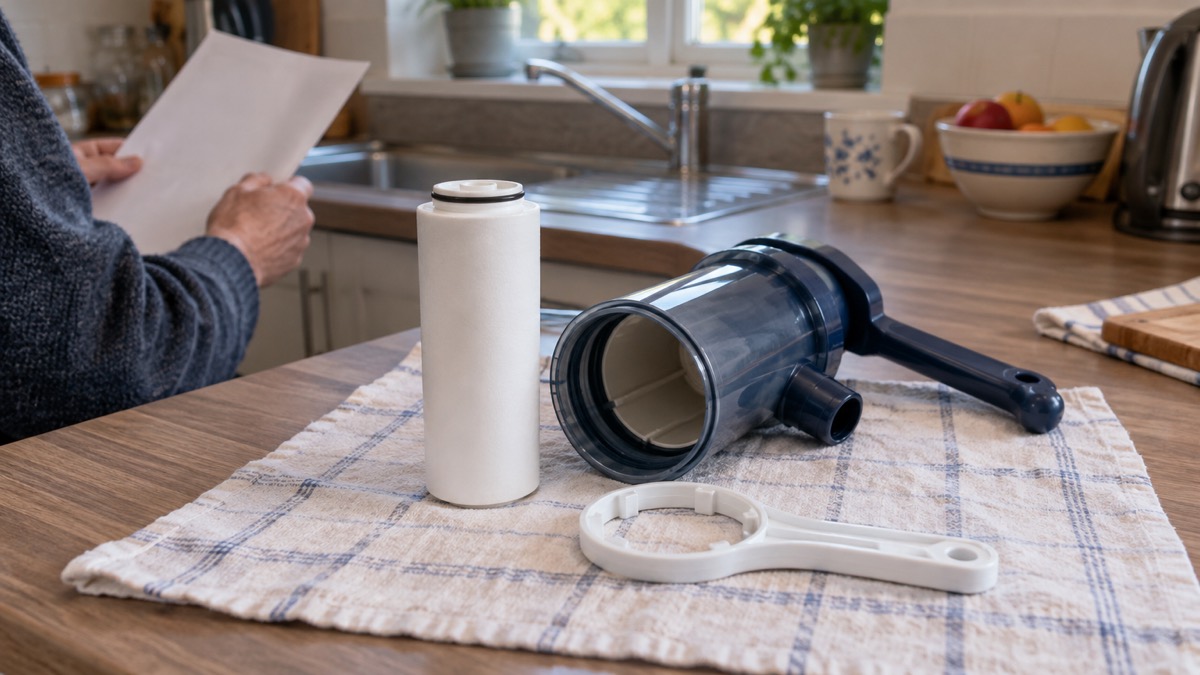
The maker's manual opens with a plain statement: caution, this is a pressure vessel4. That is not a warning against using it, it is a description of how it works, and it tells you what to avoid. Do not over-pressurise it, do not force the pump beyond what the maker describes, and do not open the unit while it is under pressure. The maker says the unit should not require more than 4 pumps to work effectively4; if it is fighting you, stop and investigate rather than forcing it.
Damage is the other risk. The maker says that if the unit is left to dry out after priming, or if it is dropped, it is possible that the filter membranes in the Wayfarer filter cartridge can split13. A membrane integrity check should be performed every time the Wayfarer has been subjected to shock or when you suspect damage11. The Technical Director explains how to check for damage in a video on the maker's page13. If you have dropped it and cannot satisfy yourself that it is sound, stop using it for drinking water and contact Icon LifeSaver.
For a household, the sensible routine is simple: check the unit before each season, keep it wet once used, keep it out of frost, and treat a drop onto a hard surface as a reason to check the filter rather than a reason to worry.
Support, warranty and where it is made
The Wayfarer carries a 2-year limited warranty for defects in materials and workmanship on products purchased directly or through authorised partners4. If a defect appears within that period, return the product with proof of purchase to the original retailer; LifeSaver will at its discretion repair, replace or refund4. Customers bear the initial transport and shipping costs to the UK factory, and LifeSaver covers return shipping4.
The exclusions are worth reading before you rely on the warranty: normal wear and tear, unauthorised opening or repairs, accidental or misuse damage, non-compliance with the instructions, and lack of purchase proof are excluded, and the warranty is not transferable or applicable to second-hand purchases4. Pumping without the pre-filter falls squarely within that last category, which is another reason to keep it fitted4.
The maker states that the Wayfarer is manufactured in the UK10, and that replacement cartridges are manufactured in the UK and hand tested before leaving the factory9. For support, the maker's guidance is to get in touch if you need further advice on how to use or care for your LifeSaver products, and the manual gives www.iconlifesaver.com as the contact address4. The maker also has videos on how to change the Filter Cartridge and the Activated Carbon Filter7.
If you are building a water plan around a purifier, the supply interruption checklist is the place to start, and the guide to how much drinking water to store per person tells you how much to keep before a filter is needed at all.
Sources (12)
- LifeSaver Wayfarer Advanced Pack, Icon LifeSaver, 2026-10-28
- LifeSaver Wayfarer, Icon LifeSaver, 2026-10-28
- LifeSaver Wayfarer Advanced Pack, Icon LifeSaver, 2026-10-29
- LifeSaver Wayfarer User Manual, Icon LifeSaver, 2026
- Independently Tested, Icon LifeSaver, 2026-10-28
- LifeSaver Wayfarer, Icon LifeSaver, 2026-10-29
- LifeSaver Wayfarer Replacement Cartridge, Icon LifeSaver, 2026-10-28
- LifeSaver Wayfarer, Icon LifeSaver, 2026-10-28
- LifeSaver Wayfarer Product Manual, Icon LifeSaver, 2022
- LifeSaver Wayfarer Replacement Hose Kit, Icon LifeSaver, 2026-10-28
- How to Clean Your LifeSaver Wayfarer, Icon LifeSaver, 2026-10-28
- LifeSaver Wayfarer Carbon Discs, Icon LifeSaver, 2026-10-28
 LifeSaver Lifeline