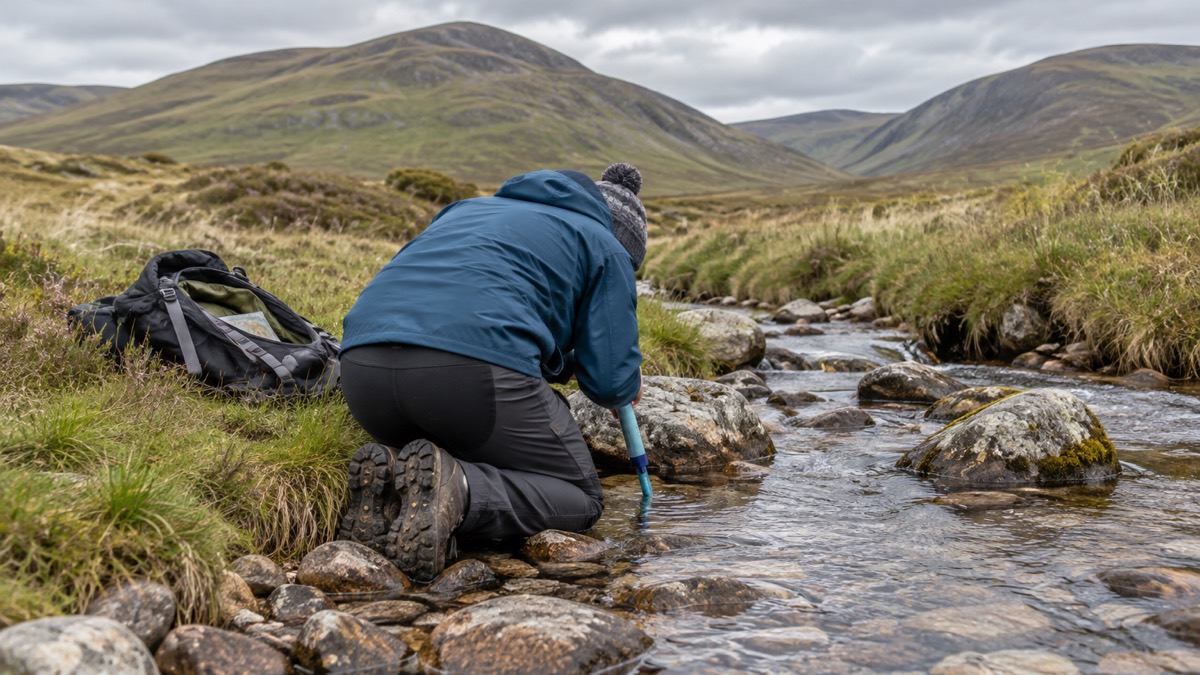
The LifeSaver Lifeline is a straw-style water filter: you put one end in untreated water, suck, and drink through it. It is made by LifeSaver and is designed for one person to drink from a river, lake, stream or ditch without a pump, power supply or plumbing. The maker rates the filter cartridge for up to 5,000 litres of water at an initial flow rate of 0.5 litres a minute1.
For a UK household it is a backup, not a mains supply. It earns its place in an emergency kit because it weighs 85 grams, needs no electricity and keeps working when the taps do not. What it will not do is remove viruses, and it needs preparing at home before an emergency rather than being used straight from the box2.
This page sets out what the Lifeline removes and what it does not, its specifications, how to prepare and store it, the ways to use it including with the Gravity Bag, and how to tell when the cartridge needs replacing.
What the LifeSaver Lifeline is and who it suits
The Lifeline is a straw-style filter, and the maker describes it as the only straw-style filter to be NSF certified1. You drink through it directly, or connect it to a bag or pouch so that water flows through under gravity or a squeeze. It transforms cloudy or muddy water into clear drinking water, and the maker says it reduces the turbidity of glacial, cloudy or muddy water4.
It suits a household that wants a compact, power-free way for one person at a time to drink from collected water: a stream at the end of the garden, a water butt, or a container filled during an interruption. It is light enough to live in a grab bag, and the maker describes a robust outer shell and carry strap for demanding environments4. It is not a household-scale purifier and it does not store water; the maker lists storage capacity as not applicable3.
The maker's own guidance on where it is appropriate is worth reading carefully. It states that in general a Lifeline will keep you safe in the UK, Europe, Australia, New Zealand, Canada and the US, but that for Africa, Asia, South America or any country with poor sanitation a more robust solution such as the Liberty or Wayfarer is recommended2. For a UK household that means the Lifeline is intended for exactly the kind of water you are likely to meet here.
If you are weighing up filter types for a household rather than one person, our guide to emergency filters: gravity, pump, bottle and straw types sets them side by side, and filter bottles and straw filters for one person covers the straw category in more depth.
Specifications
The figures below are the maker's own, from its product pages. Where the maker gives a range or two forms of the same figure, both are shown.
| Specification | Figure |
|---|---|
| Filter cartridge capacity | Up to 5,000 litres (1,320 US gallons)4 |
| Initial flow rate | 0.5 litres a minute3 |
| Filter media | Ultra Filtration (UF)3 |
| Pore size | Approximately 100 micron (0.1 nanometres)2 |
| Dry weight | 85 grams / 3 oz4 |
| Dimensions | 220mm x 50mm x 50mm (8 x 2 x 2 inches)2 |
| Case | BPA-free4 |
| Warranty | 2 years3 |
| Carbon filter life | Up to 100 litres each5 |
The maker notes that the volume of water filtered and the flow rates depend on the composition and turbidity of the water you put in3. Very cloudy or silty water will slow the flow and can shorten cartridge life, so letting sediment settle before filtering is sensible where you can.
What it removes, and the virus gap
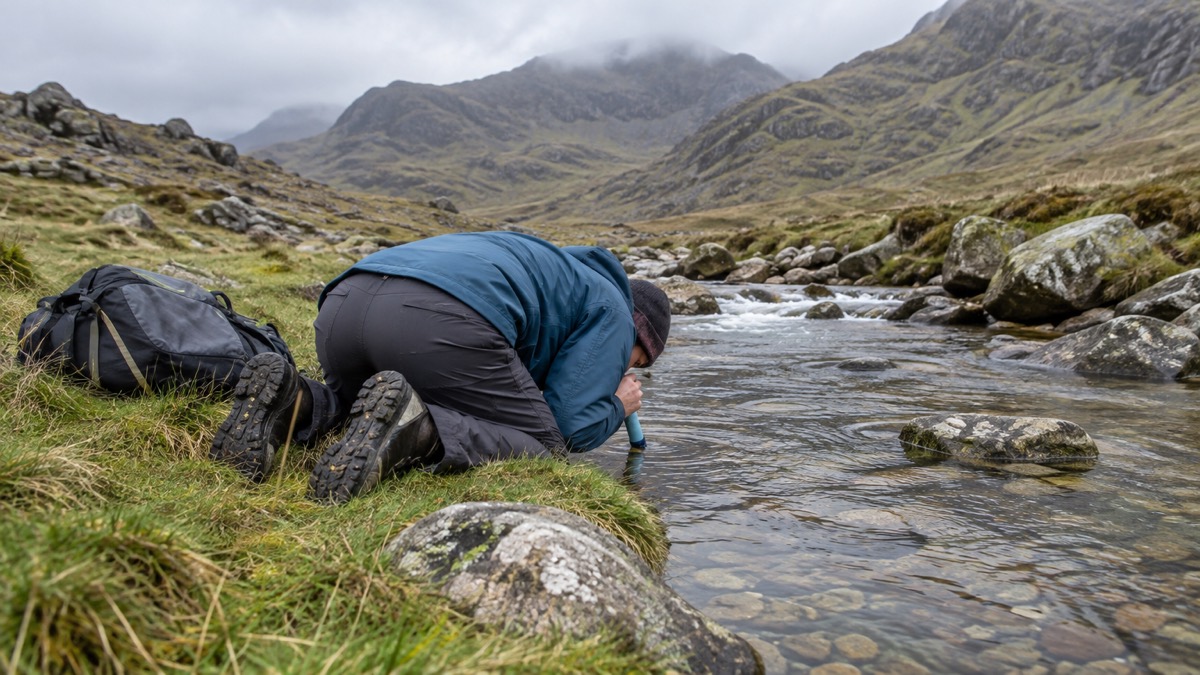
The maker states that the replaceable ultrafiltration filter keeps you safe from bacteria, parasites and microplastics, whether a carbon filter is installed or not5. Its product pages quote 99.99% removal of bacteria, parasites and microplastics4, and the specification table gives bacteria reduction as more than 99.99999% (Log 6), microplastics as more than 99.999%, and cyst reduction as more than 99.999% (Log 4)2. The maker's figures for bacteria and microplastics are not identical across its pages, so treat the headline as "over 99.99%" rather than a single precise number.
The important limit is viruses. The maker is explicit that the Lifeline does not remove viruses, and explains why: the pores in the ultrafiltration filters in its other products are small enough to catch viruses, but you need a pump to force water through, whereas the Lifeline relies on the user sucking water up through the filter with their mouth2. That is a design trade-off, not a fault, and it is the reason the maker steers users in some parts of the world towards its pump-driven products.
NSF testing and certification
The maker states that the Lifeline has been tested and certified by NSF International against NSF/ANSI Standards, and describes it as the only water straw system so certified1. The specific certifications it lists are:
- NSF/ANSI P231 Reduction of Bacteria and Protozoan Cysts, more than 99.9999%2
- NSF/ANSI 42 Class 1 Particulates, 0.5 to 1 micron, for fine sediment reduction6
- NSF/ANSI 401 Emerging compounds and incidental contaminants, microplastics 99.99%2
- NSF/ANSI 372 Lead-free content compliance6
The activated carbon filter is separately tested and certified by NSF International for heavy metal and chemical reduction across contaminants such as chlorine, lead, nickel and cadmium4. Certification matters because it is an independent check on the maker's claims rather than a marketing statement. Our guide to filter claims and certification: NSF standards and log reduction explains what these standards mean and how to read a log reduction figure.
Preparing it at home before an emergency
The Lifeline is not a use-it-straight-from-the-box item. The maker states that you need to prepare it at home by soaking it in clean water first, so you cannot use it straight out of the box in a sudden pinch2. That single fact changes how you should keep it: prepare it now, while the taps work, rather than discovering the need during an interruption.
A sensible routine, following the maker's instructions:
- Soak the filter in clean water at home before storing it for emergencies2. A reviewer reports that you need to prep it this way, so you cannot use it straight out of the box in a sudden pinch2.
- Fit the activated carbon filter if you want better tasting water and reduction of chlorine and heavy metals4.
- Keep the lanyard and manual with it so it is ready to grab2.
- Store it dry and clean, away from frost and dirt, and rinse and dry it fully after any use2.
The wider household context matters too. Councils across the UK advise households to keep an emergency kit ready in advance, including a supply of bottled water and ready-to-eat food7, and to gather essential items before leaving home if an emergency happens8. A filter is a complement to stored water, not a substitute for it. Work out your baseline with our guide to how much drinking water to store per person, and keep the filter as the way to extend supplies from other sources.
Ways to use it, including with the Gravity Bag
The maker lists several modes of use: drinking directly from a water source as a straw, drawing water from a container, pouch or bottle, running water through it to fill a container, or connecting it to a hydration bag system2. The bundles add two of these.
| Set-up | What it is for | What is included |
|---|---|---|
| Lifeline on its own | One person drinking directly or from a container | Filter with cartridge, carbon filter, lanyard, paper manual2 |
| Lifeline with Gravity Bag | Water on tap for a group or a base | Lifeline, carbon filter, lanyard, Gravity Bag with storage pouch, connector hose with cut-off clip, manual4 |
| Lifeline with Squeeze Pouches | Drinking on the move, squeezing water through | Lifeline, carbon filter, lanyard, two Squeeze Pouches, manual3 |
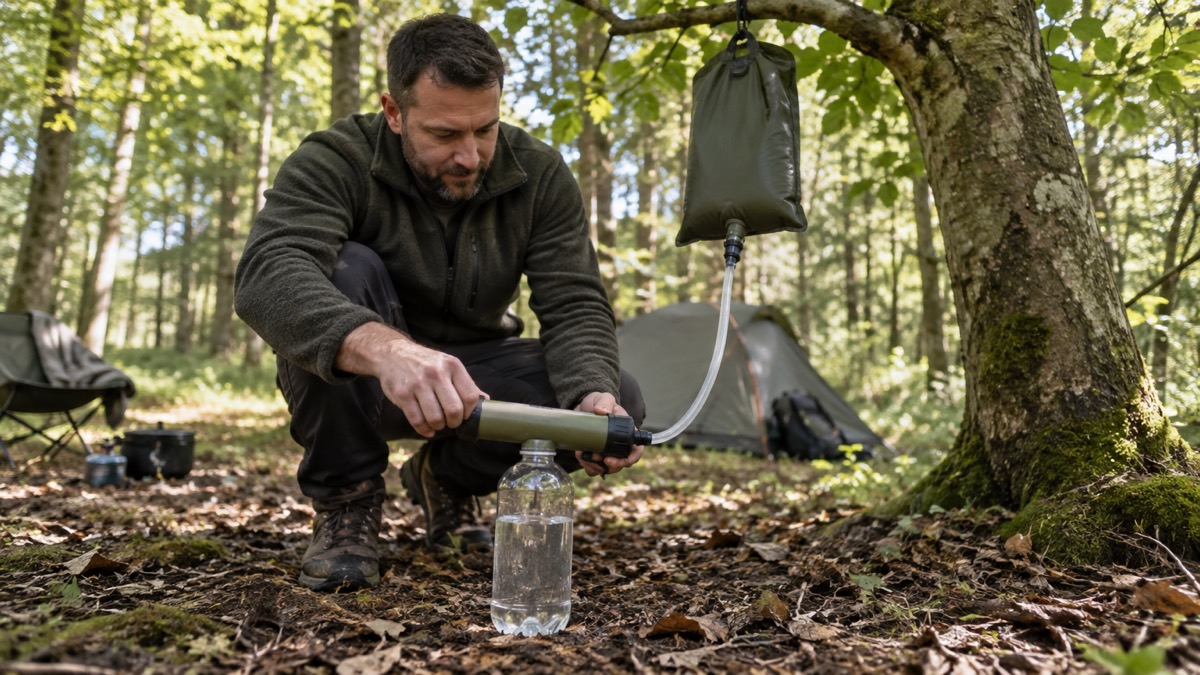
The Gravity Bag holds one gallon (3.8 litres) and can be filled from a river, lake or stream and hung from a tree, or from your vehicle, caravan or tent pole9. Once connected to the Lifeline with the hose and clip provided, water flows down through the filter, giving safe drinking water on tap9. It folds down small and travels with the hose and clips in a waterproof drawstring bag9. After use, rinse the bag and hoses in clean water and let them dry out completely before storing9.
When the cartridge needs replacing
The Lifeline has a failsafe: it stops working when the filter needs replacing, and the flow rate reduces as the cartridge reaches the end of its life2. The maker's replacement guidance is straightforward: when it becomes difficult to draw or squeeze water through your Lifeline, it is time to replace the filter cartridge6. The maker also states that the last drop is as clean as the first drop, so you are not drinking progressively worse water as the cartridge ages6.
A replacement cartridge delivers up to 5,000 litres of clean drinking water when used with your Lifeline6. The activated carbon filter is a separate consumable, effective for up to 100 litres each, and is there to improve palatability by removing chlorine, taste and odour and to reduce chemical and heavy metal content5. If the carbon filter is exhausted you can still use the Lifeline to filter water safely, because the carbon is simply there to improve taste2.
Support, warranty and where to get help
The maker gives a 2 year warranty on the Lifeline3, and its support pages state that all products come with a 2 year manufacturer warranty from new, when purchased from Icon LifeSaver or an Approved Reseller, covering manufacturing defects10. The manual gives the maker's website as www.iconlifesaver.com for support11. There is no telephone number for the maker in the material available here.
For the household side of an emergency, the help you need is usually local. Your council's emergency planning pages set out what to keep ready and how to stay in contact8, and Northern Ireland households can use the nidirect household emergency kit guidance12. If your water supply itself is interrupted, contact your water company rather than the filter maker.
One confusion worth clearing up: searching for "Lifesaver" also brings up a CPR training game. Lifesaver is an interactive game by the Resuscitation Council UK for learning CPR and what to do in an emergency, with four scenarios covering calling an ambulance, CPR, using a defibrillator, choking and the recovery position13. It has nothing to do with water filters, but it is worth the time.
Sources (13)
- LifeSaver home page, Icon LifeSaver, 2026
- LifeSaver Lifeline, Icon LifeSaver, 2026
- LifeSaver Lifeline Squeeze Pouches Bundle, Icon LifeSaver, 2026
- LifeSaver Lifeline Gravity Bag Bundle, Icon LifeSaver, 2026
- LifeSaver Lifeline Replacement Carbon Filters 2-pack, Icon LifeSaver, 2026
- LifeSaver Lifeline Replacement Filter Cartridge, Icon LifeSaver, 2026
- Preparing for an emergency, Nottinghamshire County Council, 2026
- Preparing for emergencies, Somerset Council, 2026
- LifeSaver Lifeline Gravity Pouch, Icon LifeSaver, 2026
- LifeSaver FAQs, Icon LifeSaver, 2026
- LifeSaver Wayfarer User Manual, Icon LifeSaver, 2026
- Household emergency kit, nidirect, 2026
- Lifesaver, Resuscitation Council UK, 2026
 LifeSaver Wayfarer