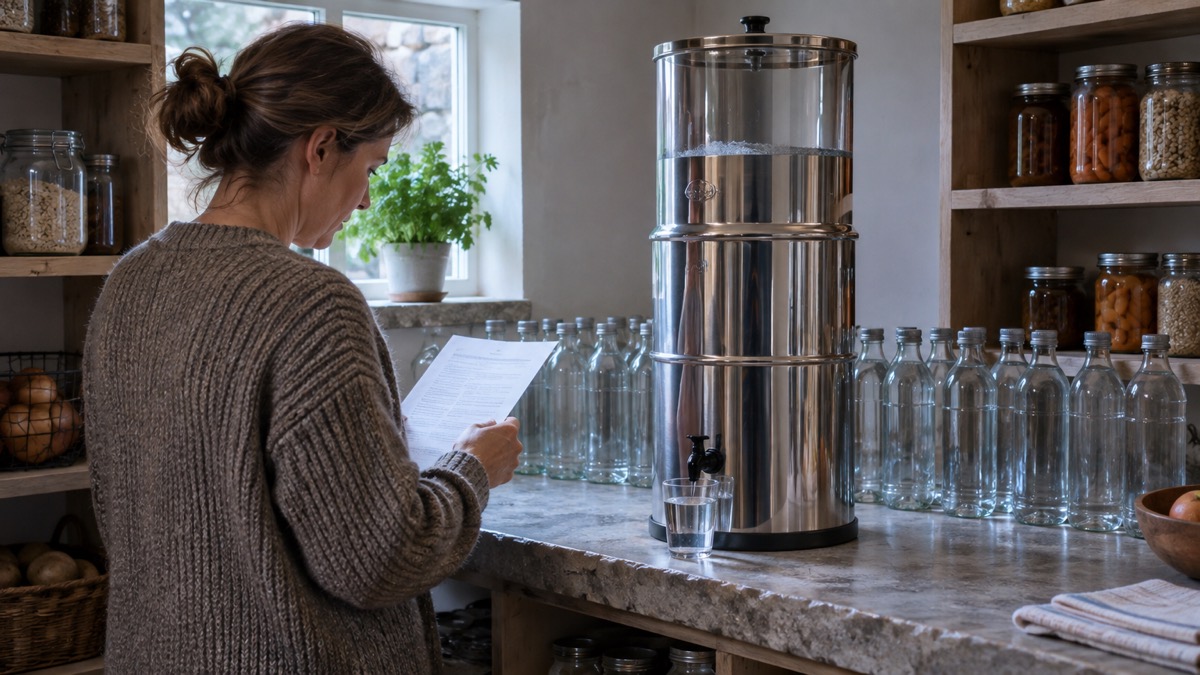
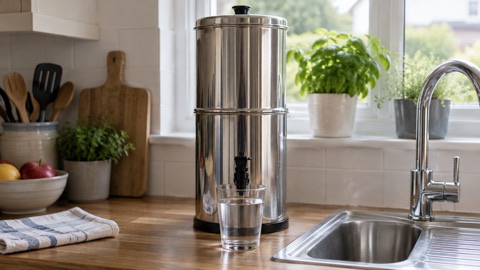
The Katadyn Drip Ceradyn is a free-standing gravity water filter: you fill a 10 litre container at the top, and water works its way down through three silver-impregnated ceramic elements into a container below. It needs no electricity, no pumping, no moving parts and no connection to a tap1. For a household facing a supply interruption, a boil notice or a stretch of discoloured water, that means it keeps working when the power does not.
Its pace is the thing to plan around. The maker gives a filtration output of approximately 4 litres per hour, and lists the group size it is built for as more than 10 people2. That is a filter for a household filling bottles and jugs through the day, not for drawing a glass on demand. The maker's manual describes it as ideal for large quantities of water1.
The ceramic elements have pores of 0.2 microns, small enough that micro-organisms cannot pass through because of their size3. The maker rates it effective against bacteria, protozoa, cysts and sediments, and states that the capacity is up to 150,000 litres, depending on the water quality2. This page sets out what it does, which water it can take, how to keep it working and what to check before you rely on it.
What the Drip Ceradyn is, and who it suits
This is a gravity system in the plainest sense. The maker's manual calls it a free-standing gravity filter with a 10 litre water container, ideal for large quantities of water1. You pour water into the top, gravity pulls it through the ceramic, and filtered water collects below. There is nothing to charge, prime with a pump or plug in.
That matters most in the situations where a household loses its normal supply. A power cut takes out pumped and under-sink systems that depend on mains pressure or electricity. The Drinking Water Quality Regulator for Scotland, which oversees private supplies north of the border, notes that filter candles do not require electricity to run because the water is filtered under gravity5. Gravity filters more generally are sold on the same basis: no plumbing and no electricity, so they can be packed up and placed wherever they are needed6.
The trade-off is speed and effort. At approximately 4 litres per hour2, a household that wants several litres for drinking, cooking and brushing teeth will be filling the top container in the morning and drawing off through the day. The maker's stated group size of more than 10 people2 tells you the intended scale: this is a base-camp and large-household filter, not a personal bottle. If you want water in seconds for one person on the move, a filter bottle is the wrong comparison to make here; if you want a supply that keeps running while the kettle, the boiler and the taps are off, this is the shape of kit that does it.
It is also a daily-use filter, not an emergency-only one. The maker lists the usage as daily2. Running it routinely means you know how it behaves, you notice when the flow slows, and you are not learning a new piece of kit in the middle of an interruption. The emergency filters guide sets this type beside pump, bottle and straw filters if you are still deciding which shape suits your household.
Specifications
The maker's figures for the Drip Filter Ceradyn are set out below. Where a retailer or regional page lists something different, the maker's figure is the one to use.
| Specification | Figure |
|---|---|
| Product type | Gravity system, water line installation2 |
| Filter elements | 3 silver-impregnated ceramic elements3 |
| Filter material | Ceramic2 |
| Pore size | 0.2 microns (0.0002 mm)3 |
| Technology | Microfilter2 |
| Output | Approximately 4 litres per hour2 |
| Group size | More than 10 people2 |
| Capacity | Up to 150,000 litres, depending on the water quality2 |
| Weight | 3,300 g2 |
| Diameter | 250 mm2 |
| Water sources | Clear water, muddy water2 |
| Field cleanable | Yes2 |
| Article number | 21100702 |
| Item number | 21100708 |
| GTIN | 76120132110712 |
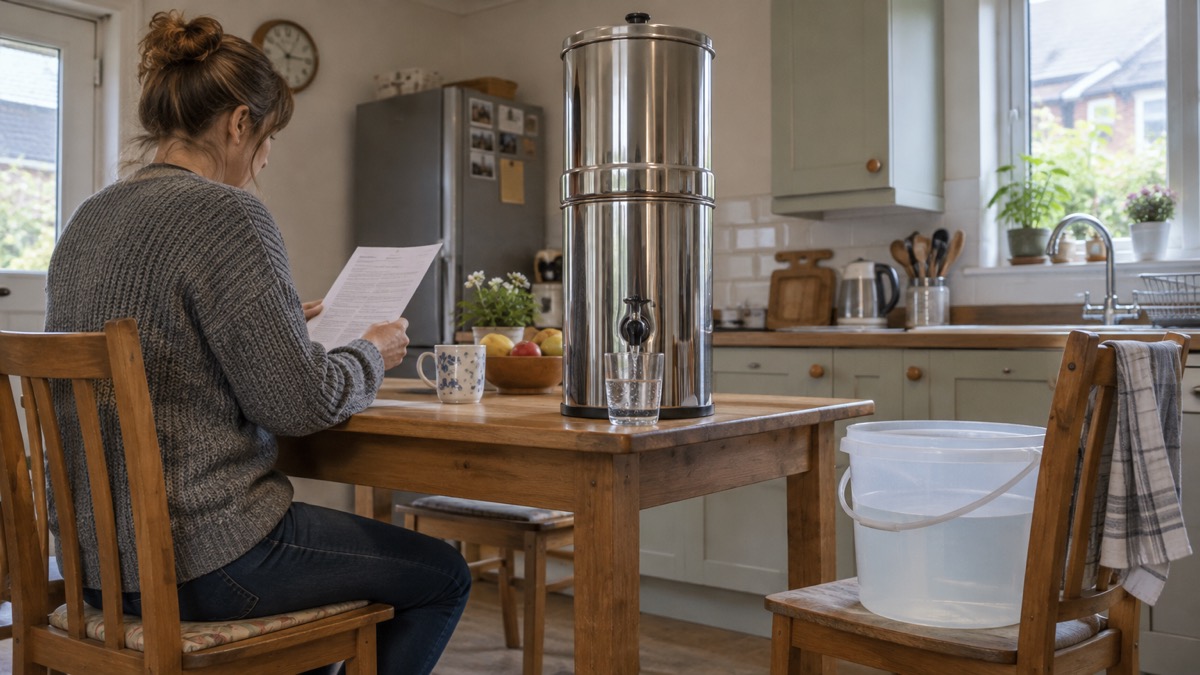
Two points on the numbers. First, the capacity is a maker's maximum, not a promise: the same page says "up to 150'000L, depending on the water quality"2, and the manual gives the same figure as up to 150,000 L (40,000 gallons) on the same condition1. Silty or muddy water will use up that life faster than clear water, because the ceramic is catching more. Second, the weight of 3,300 g2 is the whole unit, so treat it as something you set up and leave in place rather than carry to a stream.
The maker's product pages for this model in different regions do not all agree on every field. One lists the group size as more than 10 people2. Plan on the more conservative reading: a large household filter with a long but water-quality-dependent life, and check the figure on the page for the region you are buying in.
Output: about 4 litres an hour, and what that means for a household
Four litres an hour is the number to build your routine around2. It is not a trickle, but it is not a tap either. In practice it means filling the top container and coming back, rather than standing over it.
For scale, a family of four generates around 570 litres of wastewater per day9. That is everything that goes down the drain, not drinking water, but it shows how far a household's daily water use sits above what a gravity filter delivers in an hour. Drinking and cooking needs are a small fraction of that total, which is why a filter of this output can carry a household through an interruption if it is run steadily through the day.
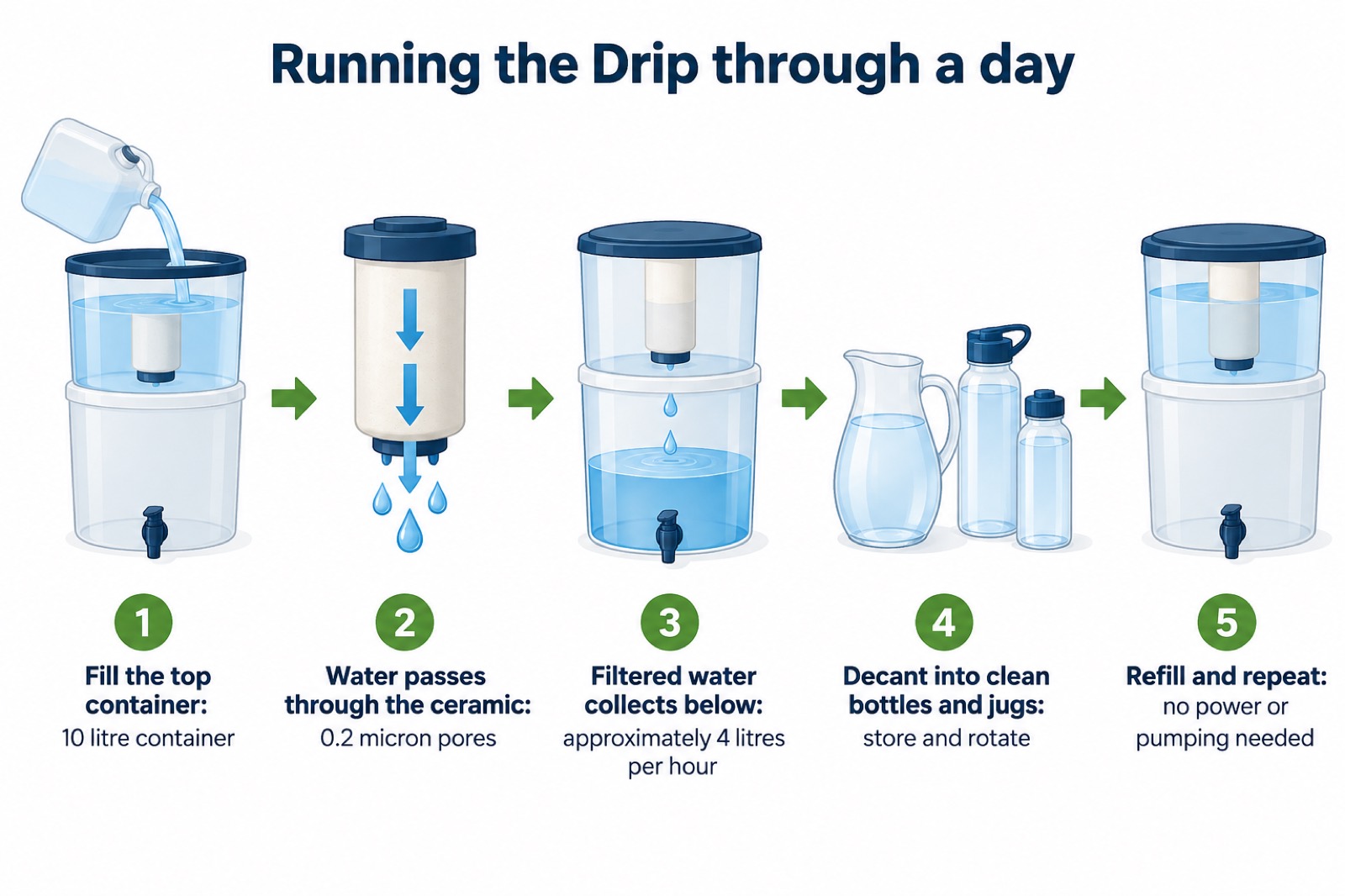
The practical pattern is a rotation. Fill the top in the morning, draw off what has passed through into clean containers, refill, and repeat. The page on how much drinking water to store per person helps you work out the volume to aim for, and the containers guide covers what to store it in. The maker lists the filter as field cleanable3, so the rotation can be kept going by hand, cleaning the elements as they load up.
If your household includes a baby on formula feeds, or someone with medical needs, the filter is one part of a plan rather than the whole of it. The pages on babies and formula feeds and home dialysis and medical needs set out what else to arrange.
What the ceramic removes, and what it does not
The maker's claim is specific. The Drip Ceradyn uses three silver-impregnated ceramic elements to clean out bacteria and protozoa3, and the maker rates it effective against bacteria, protozoa, cysts and sediments2. The micro-organisms cannot pass through the mini pores of the filter ceramic, at 0.2 microns, because of their size3. The silver is incorporated into the ceramic, and the maker says the ceramic can be cleaned many times, even in the field, giving longer use than disposable filters2.
The Gravidyn replacement cartridge, which uses the same ceramic technology, states the mechanism plainly: a microporous, silver-incorporated ceramic filters out particles, all harmful bacteria and parasites such as Cryptosporidium and Giardia, while essential minerals remain in the water4. That is the clearest statement in the maker's material of what the ceramic is for, and it applies to the ceramic stage of the Drip.
What it does not do is equally important. The standard Ceradyn elements are ceramic: they trap by pore size. They are not described as removing dissolved chemicals or improving taste. That job belongs to the activated carbon in the Gravidyn cartridge, which the maker says removes unpleasant taste and odour such as chlorine and hazardous chemicals10. If your reason for filtering is the taste of chlorine rather than the risk of germs, the carbon cartridge is the part doing the work.
For a fuller account of how ceramic, carbon, hollow-fibre and reverse-osmosis filters differ in what they remove, see what each type removes, and for the certification language behind filter claims, see filter claims and certification.
Clear or muddy water: which sources it can take
The maker lists the water source for the Drip Ceradyn as clear water and muddy water2. That is a wider brief than many filters, which ask for settled, clear water to avoid clogging. It does not mean any water is fine to put in.
Muddy water carries more suspended sediment, and sediment is what the ceramic catches. The maker lists both clear water and muddy water as suitable sources2, so the filter is built to take the muddier source, but the sediment still has to go somewhere. Letting cloudy water stand so the worst of the grit settles before it goes into the top container is a sensible habit, and it keeps the ceramic working at its stated pace rather than slowing to a stop.
The other limit is what the filter is for. It is a household drinking-water filter, not a treatment works. If your supply has been subject to a do not drink notice, follow the notice: the guide to do not drink and do not use notices explains what those instructions mean and when they lift. If you are drawing from a stream, river or other untreated source, read drinking from streams, rivers and other sources safely before you do, and if a boil notice is in force, what to do if you get a boil water notice sets out the official steps.
Brown or discoloured water from the mains is a separate question from untreated water. The Drinking Water Inspectorate explains that some ground waters and soft surface water sources contain naturally occurring iron and manganese, and that in very hard water areas there can be a build-up of chalk in the mains13. That is a reason to let the taps run clear, not a reason to assume the water is contaminated. The page on brown or discoloured tap water covers when it is safe and how long it takes to clear.
Filter life: up to 150,000 litres, depending on the water quality
The headline figure is up to 150,000 litres2, which the manual gives as up to 150,000 L (40,000 gallons), depending on the water quality1. Read the condition as part of the figure. A household filtering clear mains water will get far closer to that maximum than one filtering muddy water from a flooded stream, because the ceramic is doing more work and clogging sooner.
The maker's answer to clogging is cleaning rather than replacement. The Drip is listed as field cleanable2, and the maker says the ceramic can be cleaned many times, even in the field, giving longer use and lower operating costs than disposable filters2. Cleaning restores flow. It does not restore capacity that has already been used, so keep an eye on how the filter performs and clean it when the output drops below the pace you need.
The replacement interval for the Gravidyn cartridge is the maker's own instruction: replace according to the measuring gauge or every 6 months, whichever is sooner4. The gauge is the more important of the two, because it reflects actual use. The six month point is a backstop for households that filter little and would otherwise never think about it.
For the general routine of priming, cleaning, storing cartridges and protecting a filter from frost, see looking after a filter. Frost matters for ceramic: a wet element that freezes can crack, and a cracked element lets water past unfiltered.
The Gravidyn replacement cartridge: ceramic with activated carbon
The Drip Ceramic Replacement Cartridge Gravidyn is the maker's spare part for this family of filters. It is listed as a spare part, technology microfilter, product type gravity system, with filter material given as ceramic and activated carbon4. Its item number is 207208, its GTIN is 06043752072028, it weighs 300 g and measures 55 mm in diameter4. It is field cleanable4.
The two materials do two jobs. The ceramic is the barrier: a microporous, silver-incorporated ceramic that filters out particles, all harmful bacteria and parasites such as Cryptosporidium and Giardia, while essential minerals remain in the water4. The activated carbon is the polisher: the maker says the high performance activated carbon removes unpleasant taste and odour such as chlorine and hazardous chemicals10. The maker rates the cartridge effective against bacteria, protozoa, cysts, sediments, bad taste and chemicals4.
| Gravidyn cartridge | Figure |
|---|---|
| Item number | 207208 |
| GTIN | 06043752072028 |
| Filter material | Ceramic, activated carbon4 |
| Technology | Microfilter4 |
| Product type | Spare part, gravity system4 |
| Weight | 300 g4 |
| Diameter | 55 mm4 |
| Water source | Clear water, muddy water4 |
| Field cleanable | Yes4 |
| Replacement interval | According to the measuring gauge or every 6 months, whichever is sooner4 |
If chlorine or chemical taste is your reason for filtering, this is the cartridge that addresses it. If you only need the ceramic barrier, the standard elements do that job. Either way, the maker's replacement instruction is the one to follow, and the gauge is the trigger.
Using and storing it safely
The maker's own instructions are the ones to follow for this product. Set the unit up level and free-standing so the top container sits squarely and the filtered water below cannot be tipped or contaminated. Keep the lower container covered and decant into clean, lidded bottles rather than leaving filtered water open to dust and flies.
Clean the ceramic when the flow slows, following the maker's cleaning method, and replace the cartridge on the gauge or the six month interval4. Do not let a wet element freeze. Do not put water you would not otherwise handle into the top container on the assumption that the filter fixes everything: the maker's claim is for particles, bacteria and parasites, with carbon for taste and chemicals4, not for every possible contaminant.
Storage between uses is simple: keep it assembled, keep it clean, and keep it out of freezing conditions. The maker lists the filter as field cleanable3, so routine cleaning can be done by hand wherever the unit is standing. The gravity filters and ceramic candles guide explains the wider family of filters built this way, and the comparison of purification tablets and a gravity filter helps if you are weighing up which approach to keep at home.
Where to get help and support
Katadyn describes itself as trusted since 1928, developing Swiss-engineered water treatment, nutrition and cooking solutions for the world's toughest conditions14. Its German arm, Katadyn Deutschland GmbH, is at Hessenring 23, 64546 Mörfelden-Walldorf, Germany, telephone +49 6105 45 67 89, fax +49 6105 458 77, email order@katadyn.de, with the group site at www.katadyngroup.com15. The maker's Emergency Series lists 58 items16. The Katadyn brand page gathers the maker's products covered on this site.
For the wider household picture, the water section covers storage, treatment and what to do during an interruption, and the supply interruption checklist is a practical list to work through. If your supply has failed, the guide to checking for an outage in your area and the guide to reporting no water or a burst pipe tell you who to contact. Households with older, disabled or medically dependent members should also look at extra help in an emergency, which covers the Priority Services Register and other support.
Sources (16)
- Katadyn Drip manual, Katadyn, 2013-10-04
- Katadyn Drip Filter Ceradyn product page, Katadyn, 2026-10-28
- Katadyn Drip Filter Ceradyn product page (France), Katadyn, 2026-10-28
- Drip Ceramic Replacement Cartridge Gravidyn product page (Switzerland), Katadyn, 2026-10-28
- Water filter candles, Drinking Water Quality Regulator for Scotland, 2026-10-28
- Countertop water filter systems, Doulton, 2026-10-28
- Portable water filters, Doulton, 2026-10-28
- Drip Ceramic Replacement Cartridge Gravidyn product page, Katadyn, 2026-10-28
- Hydraulic flooding | Sewer flooding | Thames Water, Thames Water
- Drip Ceramic Replacement Cartridge Gravidyn product page (Germany), Katadyn, 2026-10-28
- Chlorine, Drinking Water Quality Regulator for Scotland, 2026-10-28
- Bacteria in water, United Utilities, 2026-10-28
- Brown, black or orange water, Drinking Water Inspectorate, 2026-10-28
- Katadyn, Katadyn, 2026-10-28
- Katadyn NRG-5 ZERO datasheet, Katadyn Deutschland GmbH, 2024-07-18
- Katadyn Emergency Series, Katadyn, 2026-10-28
 British Berkefeld SS2 8.5L
 British Berkefeld 1 Litre