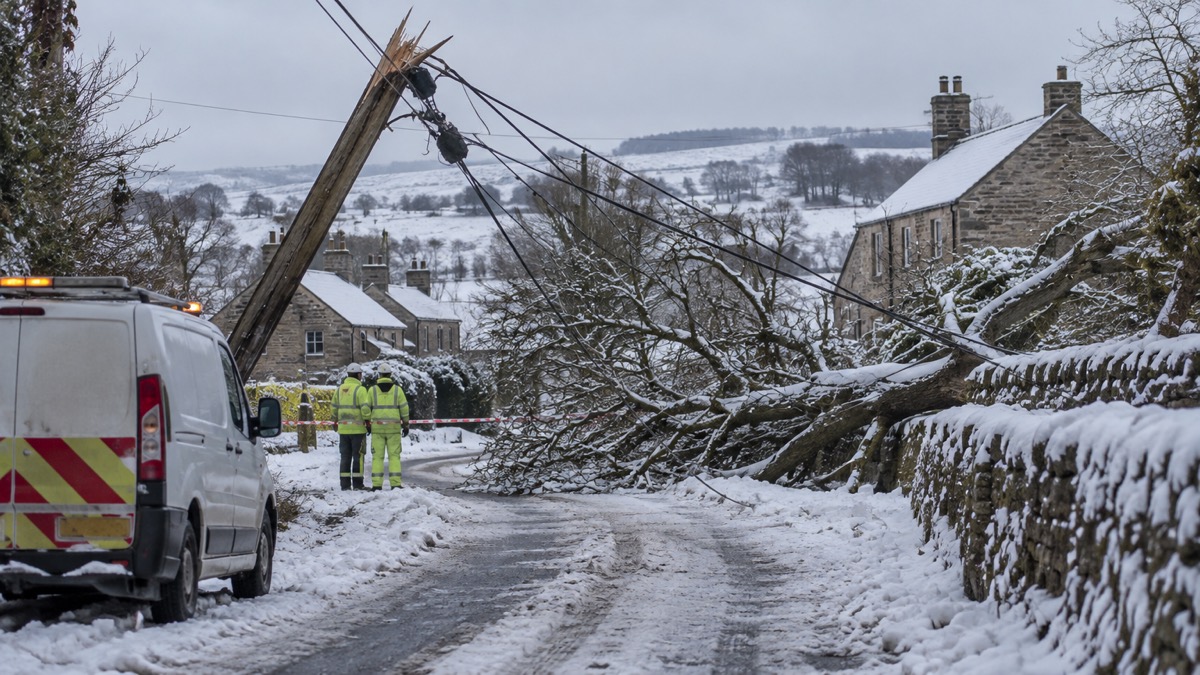
Storm Arwen struck the UK on 26 and 27 November 2021, bringing a rare red warning for wind to coastal areas on the east coast of Scotland and the northeast of England1. The highest gust recorded at a lowland site was 98mph at Brizlee Wood in Northumberland1. Over 950,000 customers lost power, and while most were reconnected quickly, around 40,000 were without supply for more than three days, nearly 4,000 were off for over a week, and the last customers were not restored until 13 days after the storm2.
The storm is remembered less for the number of homes cut off than for how long some of them waited, in freezing temperatures and snow, with no heating, no hot water and in some cases no water at all. Ofgem, the energy regulator, carried out a review of how the network operators responded, and its findings changed what operators must now do, and what households should expect. This page sets out what happened, why the repairs took so long, how communities coped, and what you can do now, before the next winter storm, including joining the Priority Services Register and knowing who your network operator is.
What Storm Arwen was: a red wind warning and gusts of 98mph
Storm Arwen was named on 25 November 2021, and the Met Office issued a red warning for wind, the highest level of warning, for coastal areas on the east coast of Scotland and the northeast of England1. Red warnings are rare, and this one meant danger to life from flying debris, damage to buildings and power cuts. If you want to understand what each warning level means and how to react to one, see our guide to Met Office weather warnings.
The storm's strength came partly from its unusual direction. The wind was generally from the north, which is relatively unusual for the UK, and it meant the full force of the storm struck coastlines and networks that do not normally face the strongest gusts4. Sustained winds above 60mph blew for approximately 24 hours, which is the period during which network operators would expect network damage to occur4. Wind speeds were widely reported to reach over 69mph, with gusts of 109mph recorded in the northern parts of Scotland on the afternoon of Friday 26 November, and speeds reaching the high 90s in miles per hour in areas of eastern Scotland that morning2.
The highest lowland gust was 98mph, recorded at Brizlee Wood in Northumberland1. The Met Office later judged Storm Arwen one of the most powerful and damaging winter storms of the last decade3. The red warning for wind covered the east coast of Scotland and the north-east of England, and was issued on 26 November5.
Over 950,000 customers lost power, some for up to 13 days
The total number of customers affected was over 950,0002. Northern Powergrid and Western Power Distribution together accounted for approximately 55 per cent of the customers interrupted, at 280,867 and 243,930 respectively2. Electricity North West reported 74,983 interrupted customers over the duration of the storm, dropping to 443 customers off supply by 1 December2. The greatest impact was in the northern parts of the UK: the North East and North West of England and both northern and southern Scotland2.
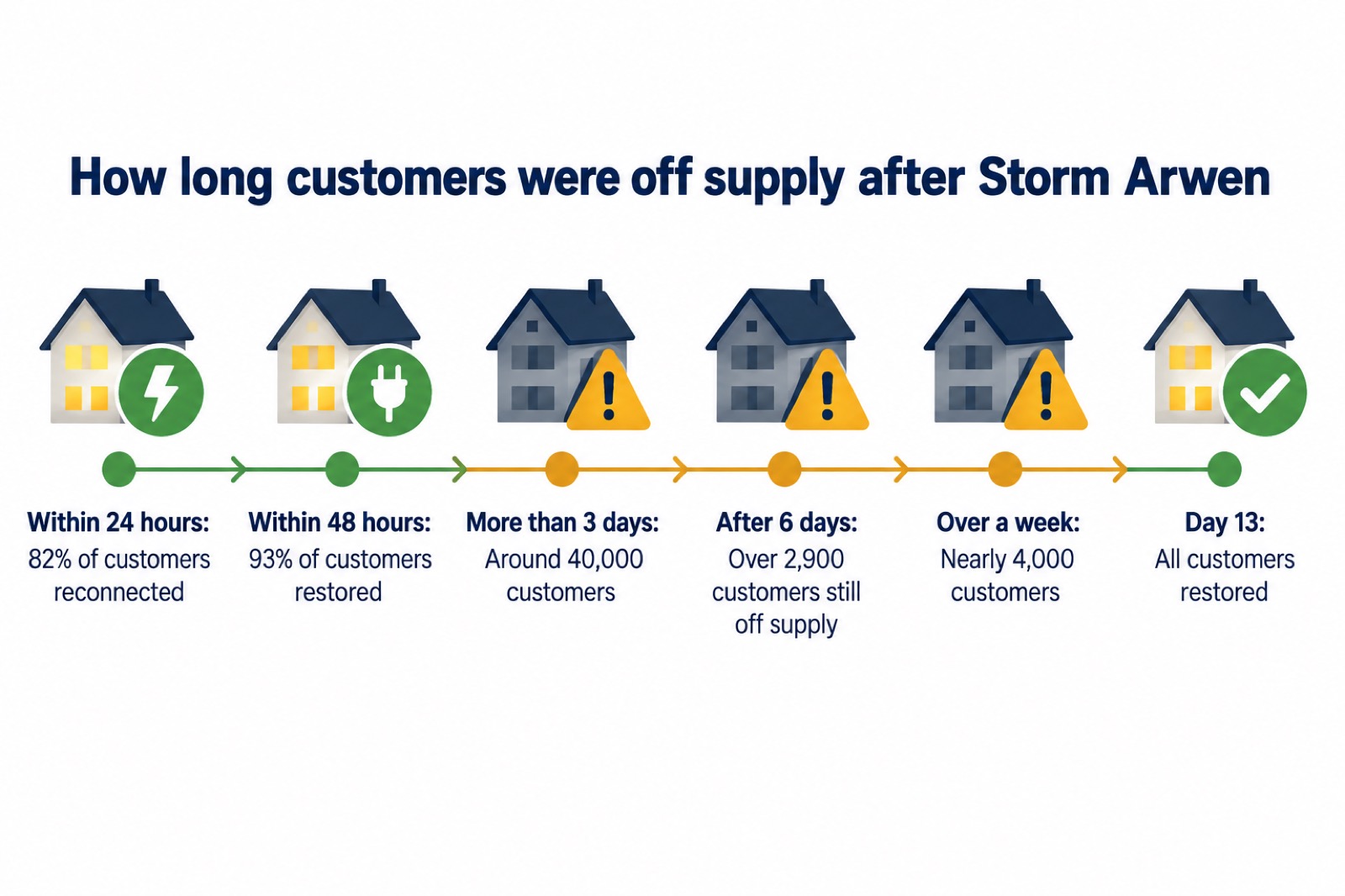
Most customers were restored reasonably quickly. 82 per cent were reconnected within 24 hours, and 93 per cent within 48 hours3. But the tail was long, and it is the tail that made Storm Arwen notorious:
| Time off supply | Customers |
|---|---|
| Restored within 24 hours | 82% of customers3 |
| Restored within 48 hours | 93% of customers3 |
| Off supply for more than 3 days | Around 40,000 customers3 |
| Off supply after 6 days | Over 2,900 customers7 |
| Off supply for over a week | Nearly 4,000 customers3 |
| Full restoration | All customers restored within 13 days3 |
For comparison, the December 2013 storms, which had until then been the benchmark for storm damage to the networks, saw over 95 per cent of customers restored within 24 hours8. Storm Eunice in February 2022 affected more customers, 1.7 million compared to around 1 million affected by Storm Arwen, but power was restored faster3. Storm Arwen's distinguishing feature was the extended, 48-hour-plus outage for some customers, longer than for previous storms, especially in the north of England and Scotland6.
Why the power stayed off so long: fallen trees, snow and 9,700 faults
The damage to the electricity network resulted in over 9,700 faults, primarily caused by strong winds and fallen or broken trees3. Thousands of trees were felled across the north of the UK, including large mature trees, leading to major disruption2. In Scotland alone, the damage to vegetation was estimated at around 16 million trees, affecting the overhead network and shutting off roads9. The majority of faults, 68 per cent, occurred on the high voltage network, the larger wires that feed whole areas rather than individual streets, which meant each fault could cut off large numbers of customers at once3.
Falling trees and poles brought down power lines, and more than one million homes lost power, with over 100,000 homes experiencing several days without power10. The storm was followed immediately by a period of cold weather with freezing temperatures and snow in the high Pennine areas, and then by a second, though less severe, storm, Storm Barra, five days later10. In villages near Sutton Bank in North Yorkshire, heavy snow on the second day cut off the roads for many hours, further hampering utility repair efforts11. Transport was disrupted more widely, with rail services cancelled, roads blocked by fallen trees and overturned vehicles, and snow accumulations across the Pennines10.
One practical problem delayed the operators' understanding of the damage: aerial surveillance, helicopters and drones used to inspect damaged networks, only became effective once wind speeds had reduced, three days into the storm3. Until then, crews were working from customer reports and ground inspection, which is slow when thousands of separate faults are spread across rural areas. In County Durham, the local resilience forum's strategic and tactical command groups spent 24 hours after declaring a major incident on 1 December simply trying to develop an accurate picture of the scale and likely duration of the incident10.
Living through a long power cut: no heating, no water and long drives for food
Ofgem's qualitative research into customer experiences, based on 22 in-depth interviews with people who had been without power from 2.5 days to more than 10 days across four regions, gives the clearest picture of what a long outage is actually like6. The practical impacts included no or reduced heating, which resulted in very cold homes, and no water for households relying on electric water pumps3. Some households that require electricity to power water pumps had no water supply for drinking, bathing or washing dishes for as long as they were off supply7. If your home depends on an electric pump, this is the single most important thing to prepare for; see our water in an emergency guide.
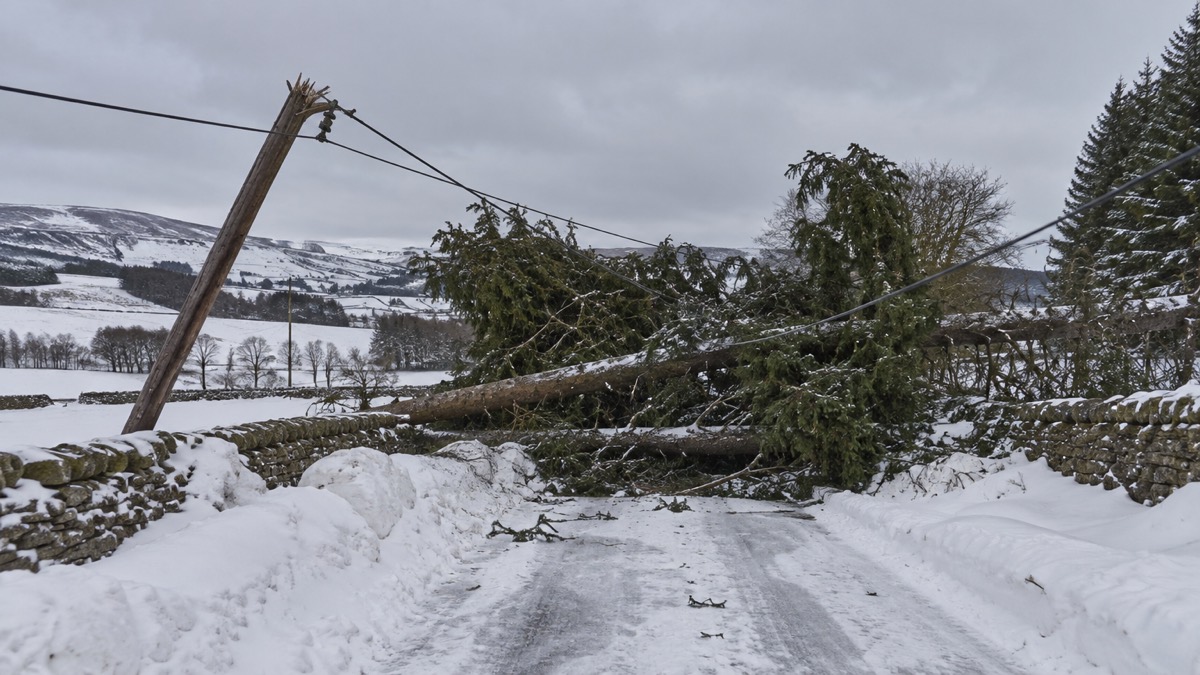
In Low Row in Swaledale, temperatures plunged below minus six degrees centigrade and heavy snowfall coated the hills, leaving residents without power and roads inaccessible to seek help12. Villages near Sutton Bank were left without power or water for four days12. Examples of customer experiences recorded afterwards include a 2.5-day outage, a 6-day outage, a 4-day outage for a customer eligible for the Priority Services Register, and a 5-day outage for a customer on the PSR9.
There were cases where emergency generators provided by the network operators ran out of fuel or failed due to mechanical issues3. And there were a few cases where customers, including those on the Priority Services Register, had to drive long distances in poor weather conditions to reach food trucks provided by the operators3. The research found that affected customers did not feel it was possible to be fully prepared for an outage as lengthy as the one some people experienced in Storm Arwen6, but the practical steps in our power cuts, heating and cooking without mains power and emergency kit guides cover what a household can realistically do.
Restoration times were often wrong for more than a quarter of customers
One of the most damaging findings of the Ofgem review concerned communication. 28 per cent of customers were given a restoration time that was not within 24 hours of their actual restoration time, and the worst affected customers were restored 12 days after their estimated restoration time3. For a household planning around an estimate, cooking food before it spoils, deciding whether to leave and stay with relatives, rationing phone battery, a wrong estimate is not a minor inconvenience. It changes decisions.
The operators' communication channels were also strained. Many customers tried to access information about their power supply via the network operators' websites, with over 2.5 million unique visitors over the storm period7. All operators' phone lines were available for the duration of the storm, excluding Northern Powergrid's service, which experienced a three-hour interruption, and on 29 November customers calling Northern Powergrid had an average actual wait time of approximately 3 minutes between 09:00 and 23:007. There were customers who were on the Priority Services Register but received no contact from their operator, Northern Powergrid, other than automated SMS messages3.
The lesson for households is to treat any estimated restoration time as an estimate, not a promise, and to keep checking for updates rather than planning around a single figure. Later storms show the same pattern can recur: during Storm Bert, all but 690 SSEN customers were back on within 24 hours of losing supply13, but the estimates given during a storm depend on damage that has often not yet been fully surveyed. Our staying informed guide covers how to keep up to date when the usual channels are under strain.
How network operators shared crews, and where mutual aid fell short
The UK's network operators have a formal mutual aid scheme, the Northern, Eastern, Western and Southern Area Consortium agreement, known as NEWSAC, which details the application and co-ordination of mutual aid between network operators in the United Kingdom, Ireland and the Isle of Man during and after network electricity supply emergencies, such as major storms2. Under NEWSAC, resources such as manpower, vehicles and materials can be provided by any of the operators where one or more are impacted by an extreme event4. The scheme was triggered by SSEN on 23 November, before the storm arrived, given the potential requirement for resources4.
Ofgem found that the NEWSAC agreement worked well during Storm Arwen, with the less affected operators, UK Power Networks and Western Power Distribution, sending resources to other operators at an early stage of the storm response7. But the scale of the damage stretched what was available. Northern Powergrid and Electricity North West had fewer than 55 linesmen and field engineers available on the first day of the storm, 26 November; Electricity North West had all available internal teams and contractors deployed on the first day and requested external aid the same day3. All companies initiated their emergency plans several days before the storm hit, but these were not sufficient to deal with the scale of damage3.
This is a known limit of mutual aid: in the December 2013 storms, during the early stages of the events, operators were only prepared to share a small amount of resources through NEWSAC, largely because the impact was widespread across Great Britain, and the scheme did not produce the additional resource when it was most needed8. When every operator is dealing with its own damage at once, there are simply fewer spare crews to send. SSEN deployed 72 generators at the peak on its network in the north of Scotland, the fewest of the affected operators7, and as noted above some of the generators provided ran out of fuel or failed mechanically3.
Community help: warm spaces, hot food and charging points
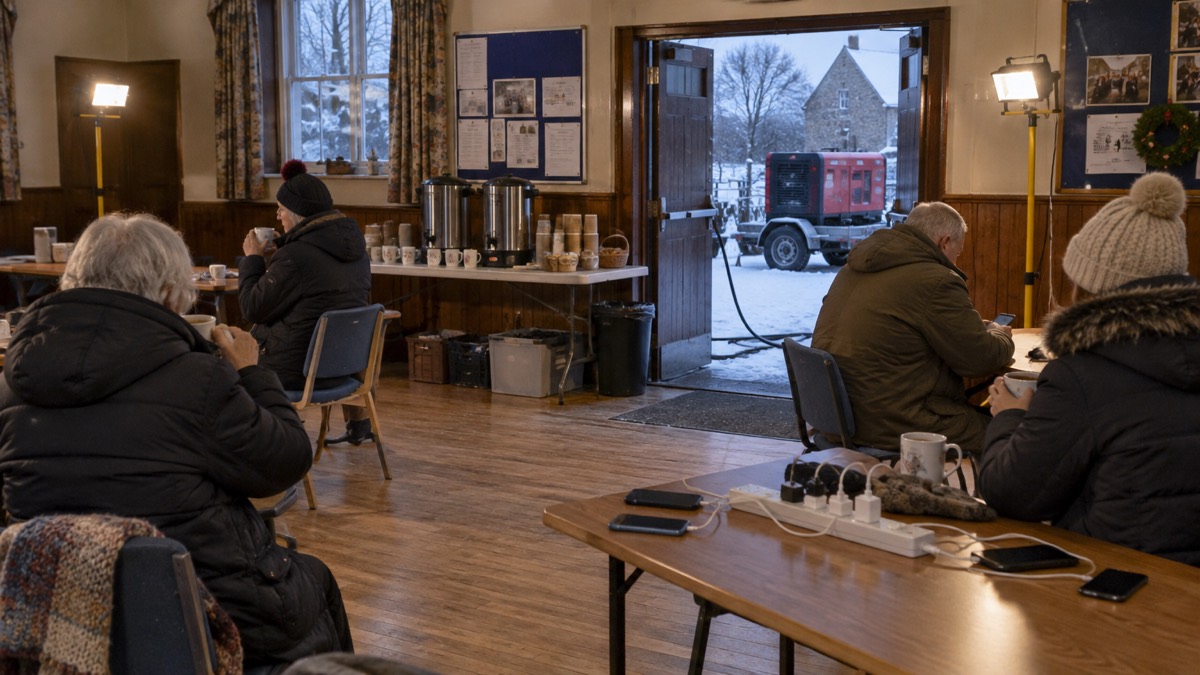
Community response was one of the strongest features of Storm Arwen. In County Durham, numerous community facilities opened to support their local communities with a range of services such as hot water, hot food, electrical item charging, laundrette facilities and information services10. In total, 60 voluntary groups and town and parish councils aided the response across the county10. ScottishPower Energy Networks worked with Local Resilience Forums to open rest centres across the impacted areas, providing customers with warm space, showers, hot water, food and drinks, and also provided generators, accommodation, hot food and vouchers9.
This pattern has continued in storms since. Community hubs offering a warm place to go, with hot food or drink in many locations, are now a standard part of winter support in many areas14. Warm Welcomes are places to get warm, have a free hot drink and socialise with others15, and in Norfolk and Suffolk, warm hubs provide a safe, heated place to spend time, meet others and access local support during periods of cold weather16.
Some communities plan this in advance. Wiltshire and Swindon's Emergency Contact Hub model sets out what a community can do in a power outage: use the hub to help identify and assist vulnerable people, share out any torches and lights to the most vulnerable, use any heating resources to keep as many people warm as possible, work together to solve local issues, and liaise with the power company and responders on site17. Scottish Borders Council's Resilient Communities approach asks communities to provide information to the council in an emergency18. If you want to build something similar where you live, our community resilience guide is the place to start.
What changed after Storm Arwen
Ofgem's review, published in June 2022, drew a clear conclusion about the future: severe weather events are likely to become more common as the effects of climate change are felt, so all network operators must be well prepared19. The review found that whilst all companies initiated their emergency plans several days before the storm hit, these were not sufficient to deal with the scale of damage3, and that aerial surveillance only became effective three days into the storm, once wind speeds had reduced3. Both findings pushed operators to plan for faster damage assessment and larger-scale responses.
Compensation rules were also tested and changed in practice. Under the standard licence conditions, for severe storms such as Arwen, if the networks do not restore power to a consumer within 48 hours, they must pay £70 in compensation, increasing to £140 per day for each successive day, with a cap of £7004. During Storm Arwen, the operators agreed to lift the £700 cap so that customers could be adequately compensated for the outages they endured3. Ofgem found that lifting the cap enabled customers who were off supply for long periods to receive payments that reflected the greater level of inconvenience experienced over time7. Northern Powergrid, SSEN and Electricity North West also agreed to alternative action to ensure that customers who were off supply for long periods received additional compensation and benefits7. Some payments took longer because the operators are reliant on energy suppliers for accurate customer data7.
Operators' own reports point to lasting changes in how they work with councils and communities. The current compensation framework for severe weather, as set out in Ofgem's consumer advice, is £85 for domestic customers if the power is off for 24 hours in Storm Category 1 weather or 48 hours in Storm Category 2 weather, plus £40 for each additional 6 hours20.
Getting ready for the next winter storm: the Priority Services Register and your network operator
Two preparations matter more than any other for a storm like Arwen: being on the Priority Services Register, and knowing who your network operator is.
The Priority Services Register is a free service for households that may need extra help during a power cut, including older people, disabled people and those with medical dependencies. Registration brings advance notice of power cuts21, and if you are registered, your supplier or network operator will message you when there is an interruption to the supply in your area22. If you are on the register, your water company will arrange alternative supplies for you during an outage23, which matters greatly if your home relies on an electric pump. To register, get in touch with your supplier or network operator directly and give them as much information as you can about your needs; you can contact them online, in writing or by phone, with details on their website or on your energy bills24. You can also register through the network operator's website or by phone25. Our extra help in an emergency guide covers who qualifies and how the register works across gas, electricity and water.
Your network operator, or DNO, is the company that owns the wires bringing electricity into your home; a simple way of thinking of it is that the transmission networks are the motorways and the DNOs are the A and B roads that branch off to localised areas26. There are 14 licensed areas across England, Wales and Scotland, owned by six companies2. DNOs deal with the supply of electricity, so you will need to contact them directly about power cuts25. Ofgem's advice on planning for a power cut explains the restoration targets operators must meet: 12 hours for interruptions outside of severe weather, 24 hours in severe Storm Category 1 weather, and 48 hours in severe Storm Category 2 weather27. Northern Ireland has a separate operator, Northern Ireland Electricity Distribution, which was not affected by Storm Arwen2.
Network operators have specific obligations to registered customers: giving customers information about what to do in the event of an interruption to their electricity supply, providing information ahead of planned interruptions, and informing Priority Services Register customers during unplanned interruptions when supply will be restored and what help is available; they must also share their register with electricity suppliers and gas transporters28. One finding from Arwen is worth remembering: Northern Powergrid did not contact any Priority Services Register customers directly as part of planned winter preparedness campaigns before the storm7, so do not assume registration alone guarantees a phone call. Check your details are current each year.
Beyond those two steps, the ordinary winter preparations in our storms and snow guide apply: securing loose items before high winds, as covered in preparing your home and garden for high winds, and knowing how to report a fallen tree, as covered in dangerous trees.
Storms since Storm Arwen: has anything like it happened again?
Storm Arwen was not the last storm to cut power to large numbers of UK households, and the comparison is instructive. Storm Darragh in December 2024 brought very strong winds to western England and Wales, with a red warning for wind and gusts of 60 to 70 knots, or 69 to 81mph, or higher in the red warning areas29. Our Storm Darragh page covers that storm in detail.
Storm Éowyn in January 2025 impacted the UK and Ireland on 24 January 2025, bringing red warnings, severe impacts and fatalities, and was judged the UK's most powerful windstorm in over a decade30. The Met Office issued a red warning for wind, meaning danger to life, with a wider amber warning area covering the northern half of the UK30.
The pattern across these storms is consistent: most customers are restored within 24 to 48 hours, but a rural minority, often the same communities each time, wait far longer. That is the practical lesson of Storm Arwen for a household. If you live in a rural or upland area of northern England or Scotland, plan for the long tail, not the average.
Sources (30)
- UK Storm Season 2021-22: Storm Arwen, Met Office
- Storm Arwen Review Main Report, Ofgem, June 2022
- Final report on the review into the networks' response to Storm Arwen, Ofgem, June 2022
- Interim report on the review into the networks' response to Storm Arwen, Ofgem, February 2022
- Storms Dudley, Eunice and Franklin, January 2022, Met Office
- Customer Experiences of Storm Arwen, Ofgem, June 2022
- Final report on the review into the networks' response to Storm Arwen, Ofgem, June 2022
- December 2013 storms review, Ofgem, March 2014
- ScottishPower Energy Networks evidence to the Senedd, ScottishPower Energy Networks, 2025
- Storm Arwen review, Durham County Council, 2022
- Community Risk Register 2025, North Yorkshire Local Resilience Forum, 2025
- Advice for those who take medications that need refrigerating, NHS Lancashire and South Cumbria ICB
- Spotlight on SSEN: Storm Bert, Wiltshire and Swindon Prepared
- Winter support, Cornwall Council
- Keeping safe in winter weather, Surrey County Council
- Stay warm and nourished, NHS Norfolk and Suffolk ICB
- Emergency Contact Hub Leaflet, Wiltshire and Swindon Prepared, 2025
- Resilient Communities, Scottish Borders Council
- Storm Arwen report, Ofgem
- Energy consumer advice for Autumn/ Winter 2022 England and Wales, Energy UK, Department for Energy Security and Net Zero (DESNZ) and Ofgem
- Priority Services Register, Derbyshire County Council
- Protect yourself and your family, Dorset Prepared
- Water supply interruptions or outages, Be Ready campaign
- Join your supplier's Priority Services Register, Ofgem
- Help from your energy supplier, Buckinghamshire Council
- How the power system works in the UK, Wiltshire and Swindon Prepared
- Plan for a power cut, Ofgem
- Identifying and supporting persons who are vulnerable in an emergency, UK Government
- Storm Darragh, December 2024, Met Office, December 2024
- Storm Éowyn, January 2025, Met Office, February 2025
 Flood Warning Checklist
 First Steps After a Flood
 Insurance Claim Records
 Storm Boelo
 Coastal Safety in Gales
 Council Help in Severe Weather
 Dangerous Trees
 Storm Darragh 2024
 Landslips After Heavy Rain
 Lightning Safety
 How Storms Are Named
 Travel Disruption in Bad Weather