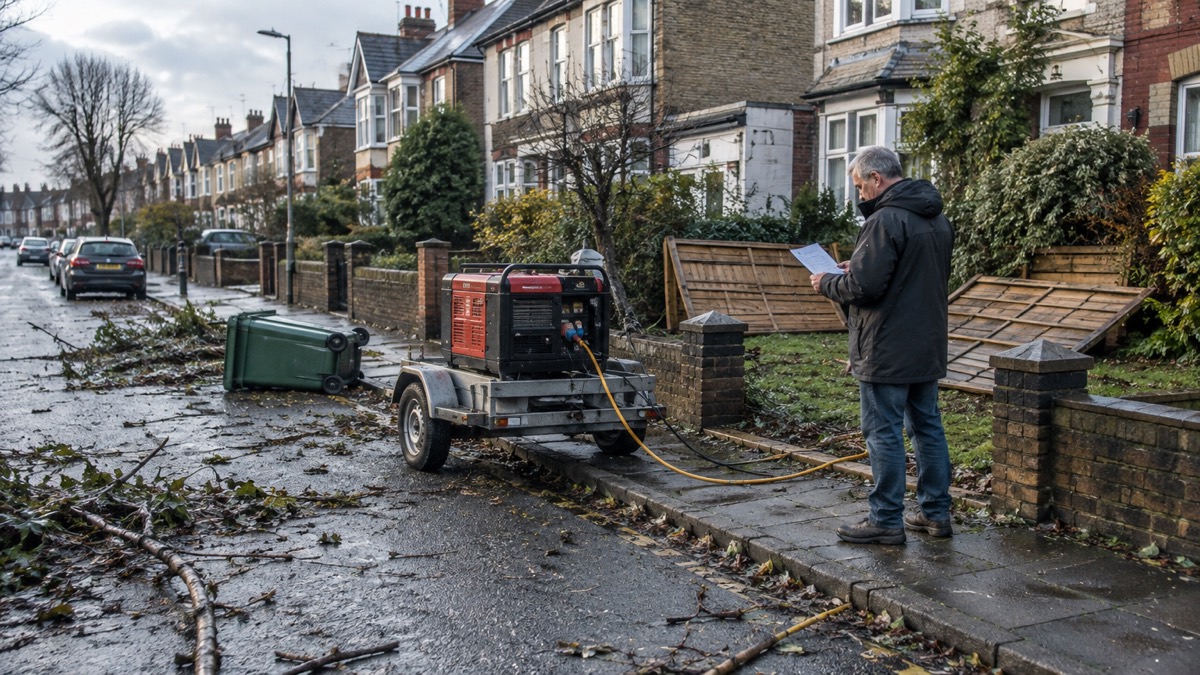
Storm Darragh struck the UK on 6 and 7 December 2024, the fourth named storm of the season, and brought significant disruption from the 6th through to the 8th1. The Met Office issued a rare red warning for wind covering west Wales and both coasts of the Bristol Channel, and for the first time since the system was introduced in 2023 the UK Government sent an emergency alert to mobile phones in the danger zone3. Over 2.3 million customers lost power during the storm, and two people were killed by falling trees on the day itself4.
For most households the storm passed in a frightening but short burst: winds gusting 70 to 80mph widely across south and west Wales, southwest England, northeast England and Northumberland, with a peak gust of 96mph at Berry Head in Devon5. Most of those cut off were reconnected quickly, with 89% of customers in one badly hit network area restored within 24 hours and 95% within 48 hours6. But the storm left clear lessons: trees cause most of the damage, phones fail when masts lose power, and the help available from network operators is real but only reaches you if you know how to ask for it.
What happened when Storm Darragh hit
Storm Darragh was named on 5 December 2024 and struck the following day, with recorded windspeeds peaking at 93mph1. The Met Office's assessment is blunt about the scale: the storm brought very strong winds to western England and Wales, a red warning for wind, and over 2.3 million customers losing power4. A number of deaths were reported over the weekend as the storm impacted the UK4.
The strongest winds arrived overnight and into the morning of Saturday 7 December. The red warning ran from 0300 UTC to 1100 UTC that day4. Before it was escalated to red, the Met Office had already issued a more extensive amber warning covering Northern Ireland, the Irish Sea coasts of Scotland and north-west England, most of Wales and south-west England4. So even households outside the red zone were under an official warning, and the disruption was not confined to the coast. Both Severn bridges were reportedly closed for several hours5.
Dyfed-Powys Police declared a major incident covering Carmarthenshire, Ceredigion, Pembrokeshire and Powys, with many fallen trees across the region4. Cardiff Council reported more trees downed as a result of Storm Darragh than in the previous 20 years2. The National Grid reported that in excess of three quarters of a million domestic and business premises lost power for a time as a result of the winds2.
The red warning and the Emergency Alert
The red warning itself covered west Wales and the Bristol Channel area of south Wales and southwest England, the first red warning since Storm Isha in January2. Red is the Met Office's highest level of wind warning and means dangerous weather is expected, not just possible. If you want the full meaning of each warning level, our page on Met Office weather warnings explains the yellow, amber and red system.
What made Darragh unusual was the emergency alert. Several million people received a government emergency alert on their mobile phones on the evening of Friday 6 December giving advice about the storm4. It was the first time the system had been used since its introduction in 20233.
The way the system works matters for how you prepare. Emergency Alerts are messages sent to compatible 4G and 5G mobile phones and tablets when there is a danger to life8. They are sent to compatible 4G and 5G mobile phones within an area of risk, and they do not need your location or your phone number; only the government and emergency services can send them9. You do not have to sign up, and you cannot be missed by it because you moved house or changed provider. The alert arrives with an audio and vibration attention signal so you notice it even in a noisy room10.
The practical lesson from Darragh is to treat an alert as an instruction to act, not just information. When the alert arrived on the Friday evening, the red warning was still hours away, which gave people time to charge devices, check torches and decide whether to travel on the Saturday morning. Households that ignored it faced the worst of the wind on the road or at home without preparations.
How strong the winds were: 96mph on the coast, 70mph far inland
The headline figure is the gust of 96mph recorded at Berry Head, Devon2. The Met Office's storm report gives the same figure as 83Kt, alongside the other highest gusts of the storm4:
| Station | Highest gust |
|---|---|
| Berry Head, Devon | 83Kt (96mph) |
| Capel Curig, Conwy | 81Kt (93mph) |
| Aberdaron, Gwynedd | 80Kt (92mph) |
| Aberporth, Ceredigion | 74Kt (85mph) |
| Valley, Anglesey | 69Kt (79mph) |
| Orlock Head, County Down | 68Kt (78mph) |
All figures from the Met Office storm report for 7 December 20244.
Two things stand out for an ordinary household. First, the wind was not a coastal-only problem. Gusts reached 70 to 80mph widely across south and west Wales, southwest England, northeast England and Northumberland5. In the red warning areas themselves, winds gusted at 60 to 70Kt (69 to 81mph) or higher4. Second, the direction was unusual: the rain and wind came from a north-westerly or northerly direction rather than the UK's prevailing westerly or south-westerly flow4, which is one reason so many trees that had stood through decades of ordinary storms came down.
If you live anywhere in the amber or red warning footprint of a future storm, treat the forecast gusts as a guide to what your garden, fence and local trees will face, and see our advice on preparing your home and garden for high winds.
Falling trees caused most of the damage
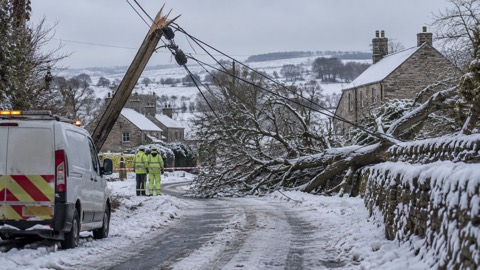
The clearest finding from the network operators' own review is that falling trees and branches caused 85% to 90% of damage during Storm Darragh, predominantly softwood trees and forestry plantations6. This matches the pattern of previous storms: after Storm Arwen in 2021 the primary causes of damage were flying debris, falling trees, and strong winds snapping poles and bringing down overhead lines11, and after the December 2013 storms the damage to the distribution network was largely due to fallen trees and wind blowing debris onto overhead lines12.
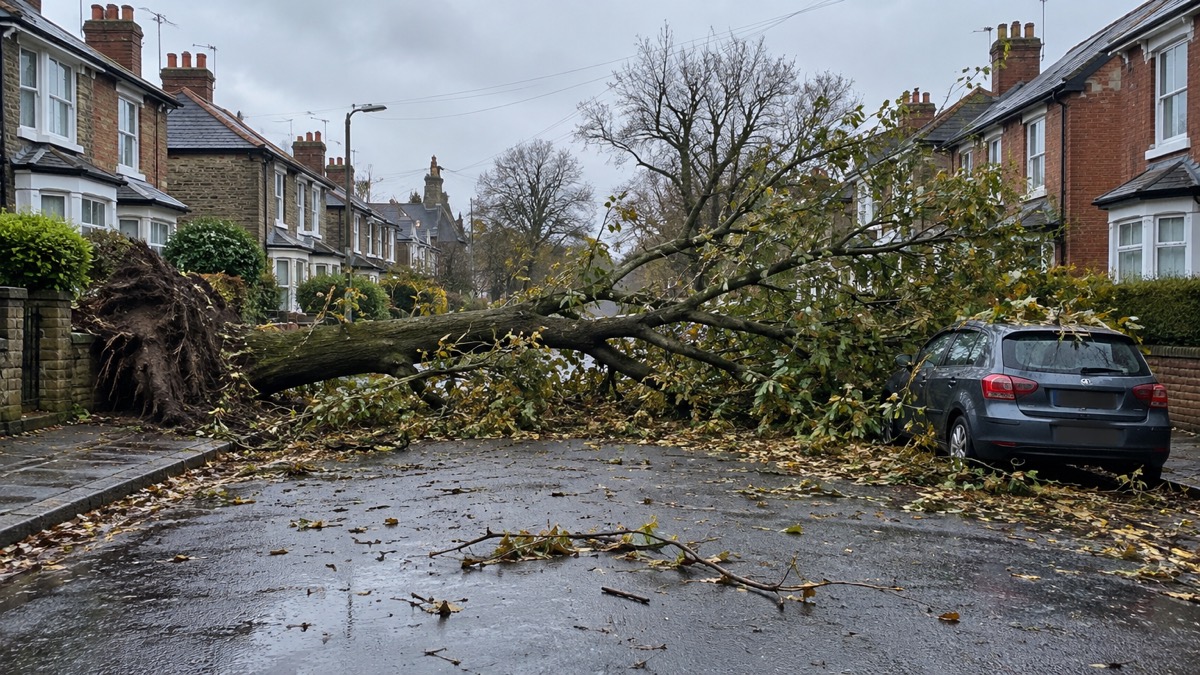
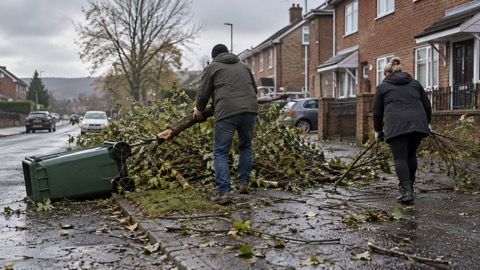
Two fatalities were reported on the day of the storm, one in Longton, Lancashire and another in Birmingham, both the result of falling trees impacting vehicles2.
The household lessons are practical. Before storm season, look at the trees near your home, your route to work and your children's school, and report any that look damaged or unstable. Our page on dangerous trees explains who is responsible for them and how to report one, and how to report a fallen tree blocking a road covers the aftermath. During the storm itself, the safest place is inside, in a room away from the side of the house facing the wind.
Over 2.3 million customers lost power
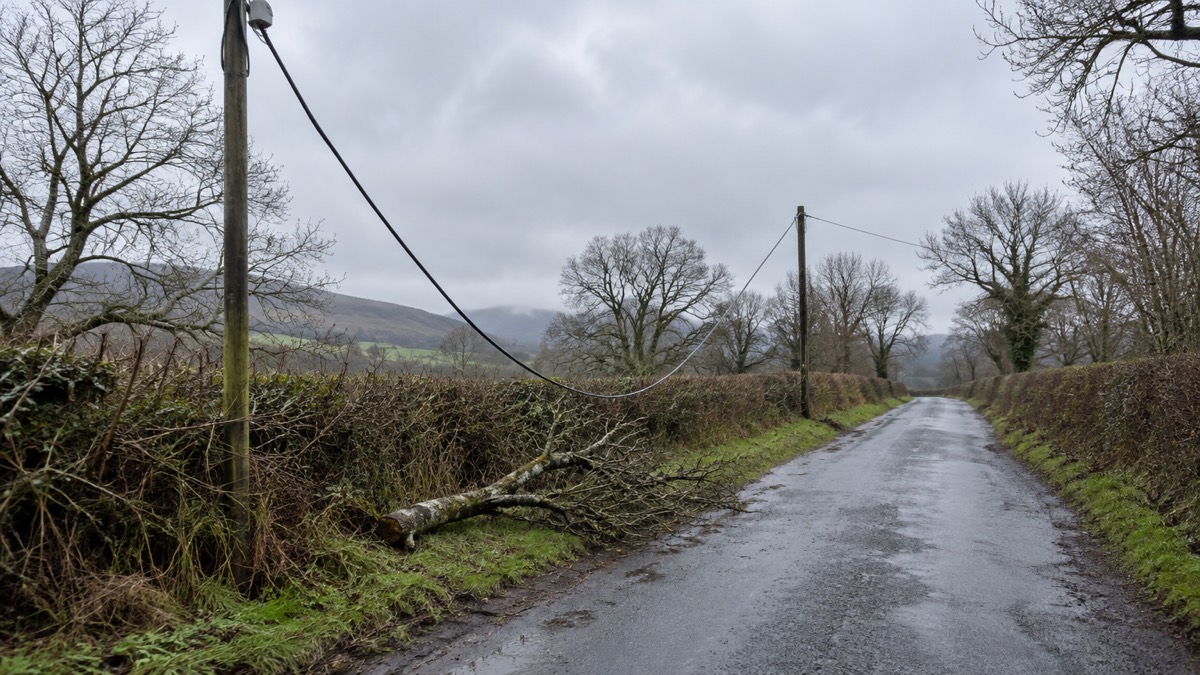
The power cut figures for Darragh are the largest of any recent named storm. Over 2.3 million customers lost power during the storm4. The impact was unevenly spread: across the SP Manweb area, 181,059 customers were impacted, the majority in Wales, with the worst hit areas being Mid Wales, North Wales and the Dee Valley6. In Wales as a whole, more than 259,000 homes were without power at the peak of the disruption3. In Northern Powergrid's regions the storm caused 120,000 power cuts for around 80,000 customers13.
The scale reflects how much of the UK's electricity network runs on overhead lines through wooded countryside. When trees fall, they take lines with them, and a single fault can cut off a whole valley. That is why the restoration figures matter more than the outage figures: the network operators' job is to reconnect people safely, and in a storm of fallen trees across whole regions that takes time.
How long the power cuts lasted
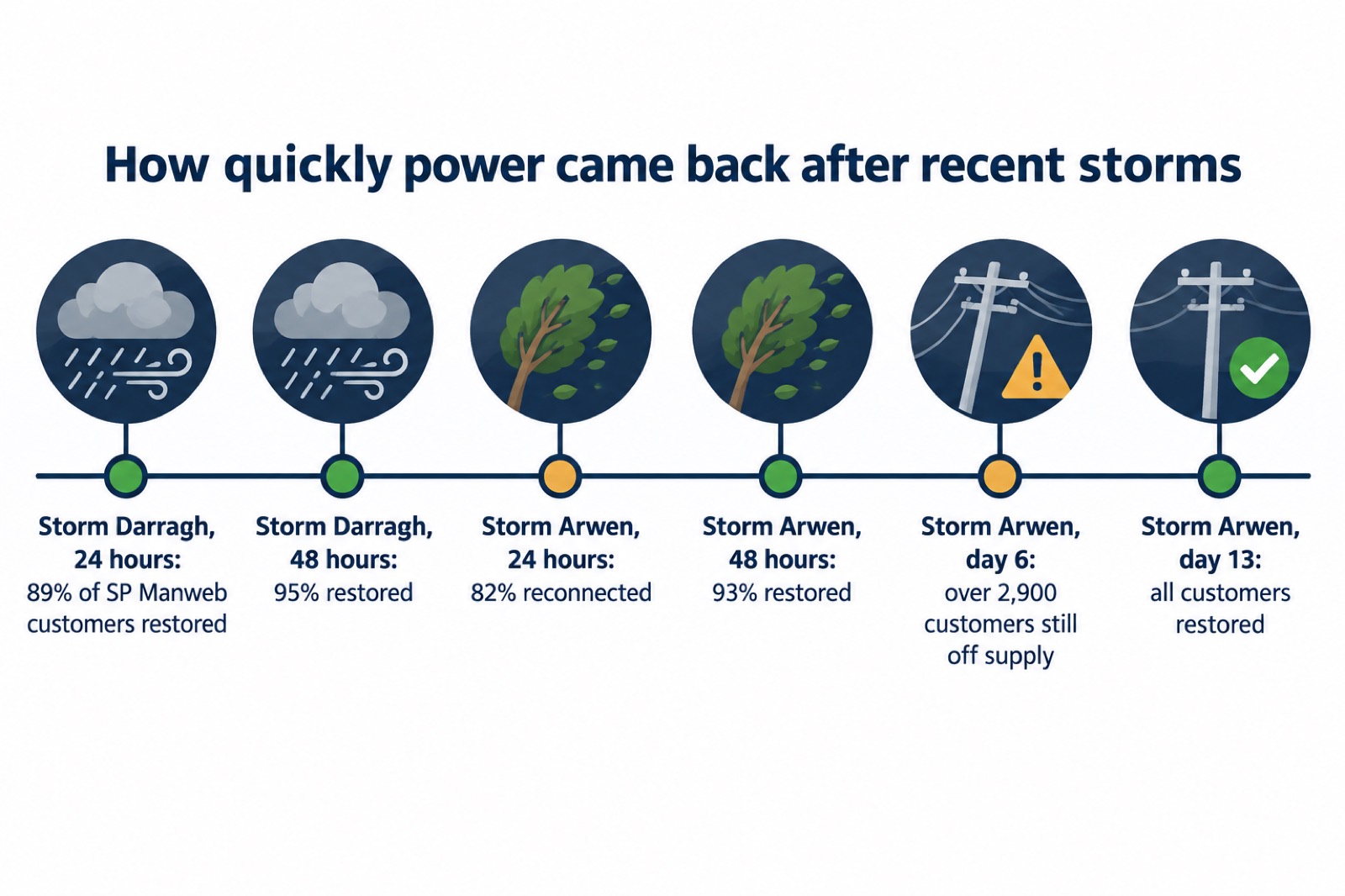
Most households did not wait long. In the SP Manweb area, 89% of customers were restored in the first 24 hours and 95% within 48 hours6. Northern Powergrid reported over 120,000 power cuts restored since the storm hit by 9 December, with 1,154 customers still without power at 11:30am that morning, and extra teams assisting in North Yorkshire and Humberside to boost restoration efforts13.
The comparison with Storm Arwen in 2021 shows how much worse it can be. After Arwen, 82% of customers were reconnected within 24 hours and 93% within the first 48 hours, but over 2,900 customers were still off supply after 6 days, and all customers were restored within 13 days11. The recovery time from Storm Arwen was longer for some customers than it had been for previous storms, especially in the north of England and Scotland, where some experienced extended outages of 48 hours or more12. Our page on Storm Arwen 2021 covers that storm and what changed afterwards.
For your own planning, assume that a winter storm power cut will most likely last under 48 hours, but prepare for the possibility of longer. That means enough torches, batteries, water and food for at least two days without mains power, and a plan for keeping warm. Our guides on power cuts, backup power at home, heating and cooking without mains power and emergency lighting set out the options.
Help from network operators: hot meals, warm hubs and £150 towards accommodation
Network operators did not just reconnect lines after Darragh; they provided direct help to households stuck without power. Northern Powergrid offered a £150 contribution to overnight accommodation and further financial support where appropriate for customers without power for more than 24 hours13. Its welfare support teams were out in the communities most affected, providing hot meals and additional support, going door to door in the worst-hit areas, and keeping customers updated on open warm hubs in their community, working with Local Resilience Forum partners13.
ScottishPower Energy Networks, whose SP Manweb area covered the worst-hit parts of Wales, took around 77,000 calls during the storm, around 65,000 of them for SP Manweb, prioritising vulnerable customers who were on the Priority Services Register6. It began proactively processing compensation payments for eligible customers on 13 December, with 9,500 eligible in total6.
What this means for you is that help exists but is not always advertised. If your power is off for more than 24 hours in a storm:
- Ask your network operator about a contribution towards overnight accommodation, as Northern Powergrid offered £150 to eligible customers after Darragh13
- Ask where the nearest warm hub or customer support vehicle is; operators work with local resilience partners to open them13
- Check whether you are due compensation under Ofgem's severe weather rules (see below)
- If you or someone in your home needs extra support, ask to join the Priority Services Register before the next storm
Phones and mobile signal failed as masts lost power
One of the most important findings from the operators' review of Darragh is that field communication was challenging because many areas had 4G masts off supply, Airwave devices were limited, and satellite phones were working intermittently, which delayed contact with control rooms and slowed restoration6. If the professionals struggled to communicate, households did too.
This is a known pattern from previous storms. Ofgem's review of customer experiences after Storm Arwen found that during extended power outages there was no electricity to power fixed broadband and typically no or very low mobile signal due to storm damage to telecoms networks, and that a number of people with landlines also lost the use of these because they had been transferred from analogue to digital networks, which rely on electricity12. In Lancaster during Storm Desmond in 2015, for over a day the city was without electricity, mobile phone signal, internet and digital radio, with transport and water supplies also disrupted14.
The lesson is simple and cheap: do not assume your mobile phone will work in a power cut, and do not assume your landline will either if it has been moved to a digital voice service. Before a storm:
- Charge phones, power banks and any battery-powered radio before the wind arrives
- Write down the numbers you would need: 105 for power cuts, 999 for emergencies, and your network operator's own number
- Keep a battery or wind-up radio so you can receive local news and official advice
- Tell a neighbour or family member outside the affected area that you may be out of contact
Our page on staying informed and in touch in an emergency goes through the options in full.
Holyhead Port and travel disruption
Storm Darragh's effects lasted well beyond the wind. Holyhead Port, the main ferry terminal for Ireland from northwest Wales, was damaged in the storm, and ten days later, on 17 December 2024, it was announced that the ferry terminal would remain closed until at least 15 January, with serious knock-on effects for the diversion ports of Cairnryan in southwest Scotland and Fishguard in southwest Wales2.
For households, Holyhead is a reminder that storm disruption does not end when the wind drops. Bridge closures, rail disruption and port closures can continue for days or weeks. Both Severn bridges were reportedly closed for several hours during the storm itself5. If you have travel planned around a named storm, check before you set out and be ready to change plans; our page on travel disruption in bad weather covers trains, buses and bridge closures.
Flooding in Wales: heavy rain but limited flood damage
Darragh was a wind storm first, but it also brought serious rain. The storm brought 50 to 100mm of rain to upland areas of Wales on catchments that were already saturated3, and the Met Office storm report records a further 50 to 100mm falling across upland areas of Wales from the 6th to the 7th4. Some parts of the UK experienced over 50mm of rain in a 24-hour period15.
Despite that, flooding impacts were not widespread. Natural Resources Wales issued 110 flood alerts and 41 flood warnings throughout the duration of the storm, but the damage came from the wind rather than the water3. For comparison, the Met Office notes that Storm Bert in November 2024 brought much higher rainfall totals overall4.
That is not a reason to relax about flooding in Wales. The Welsh Government's resilience assessment states that over 91,100 residential properties are at risk from river flooding in Wales, and almost 2,000 key services are at risk from coastal flooding16. If you live in a flood risk area, sign up for flood warnings from Natural Resources Wales or, in England, the Environment Agency, and see our guide to flooding.
How Darragh compares with Storm Eunice
The Met Office's own comparison is that Darragh's wind gusts were broadly comparable with Storm Isha on 21 January 2024 but overall slightly less severe than Storm Eunice on 18 February 20224. It also notes that the storm of 12 February 2014 was much more severe4.
| Storm Darragh, Dec 2024 | Storm Eunice, Feb 2022 | |
|---|---|---|
| Highest gust | 96mph at Berry Head, Devon2 | 90mph at Isle of Portland, Dorset17 |
| Other notable gusts | 93mph at Capel Curig, 92mph at Aberdaron4 | 84mph at Aberdaron, 83mph at Pembrey Sands and Chivenor17 |
| Customers losing power | over 2.3 million4 | 1.7 million11 |
| Standing | slightly less severe than Eunice overall4 | the most severe and damaging storm to affect England and Wales since February 201417 |
Storm Eunice, named on 14 February 2022 at the same time as Storm Dudley, set a new England gust speed record17. The Met Office's report on Eunice and Dudley records gusts of 50 to 60Kt (58 to 69mph) in coastal locations and 40 to 50Kt (46 to 58mph) widely inland during Dudley, with Capel Curig recording 70Kt (81mph)17, and during Eunice itself 78Kt (90mph) at the Isle of Portland, 73Kt (84mph) at Aberdaron and 68Kt (78mph) at Charlwood in Surrey17.
The interesting contrast for households is in the power figures. Darragh cut power to more customers than Eunice, 2.3 million against 1.7 million, yet the Met Office judged Darragh the less severe storm overall4. Wind speed is not the only factor: the direction of the wind, how wet the ground is, and where the strongest gusts fall relative to the electricity network all matter. Prepare on the basis of the warning level where you live, not on comparisons with past storms.
What to do before the next named storm
Everything Darragh did to the UK in December 2024 will happen again. The practical preparations fall into a short list, and each one is backed by what went wrong during this storm and the storms before it.
- Sign up for warnings. Met Office warnings gave days of notice before Darragh, and the emergency alert gave hours of specific warning to those in the red zone4. Our page on how to sign up for Met Office weather alerts explains the options.
- Join the Priority Services Register if you are eligible. You qualify if you have a disability18, or if you temporarily need extra support19. The register brings priority fault repairs20 and prioritised contact during outages, which is exactly what ScottishPower Energy Networks did for registered customers during Darragh6. Contact your supplier or network operator to join.
- Write down 105. The power cut helpline is 105, free, wherever you are in the UK7. It connects you to your local network operator. Do not ring your electricity supplier to report a power cut; the network operator owns the wires.
- Prepare for at least 48 hours without power. Most Darragh customers were back within 48 hours6, but Arwen showed outages can run to days11. Torch, batteries, battery radio, water, food that needs no cooking, and a plan for warmth.
- Expect phones to fail. Mobile masts lost power during Darragh and digital landlines stopped working in previous storms6. Charge everything before the wind arrives and keep written numbers.
- Check the trees around you. Falling trees and branches caused 85% to 90% of the damage during Darragh6. Report dangerous trees before the storm, and report fallen trees and damaged lines after it.
- Know your compensation rights. For a storm classified as category 2, you can get £90 for the first 48 hours without power and an extra £45 for every 6 hours after, with a maximum of £2,235 for both storm categories21.
For a fuller run-through of household preparations across all hazards, see getting started: preparing your household for an emergency, and for the wider picture of storms, snow and ice, our storms and snow section.
Sources (22)
- UK Storm Season 2024-25, Met Office
- Monthly Weather Report, December 2024, Met Office, December 2024
- Flood Risk Management Annual Report 2024-2025, Natural Resources Wales, 2024
- Storm Darragh storm report, Met Office, December 2024
- Monthly Weather Report December 2024 (print version), Met Office, December 2024
- ScottishPower Energy Networks paper on Storm Darragh, Senedd Business Committee, 2025
- Make an emergency plan, Ready Scotland, 29 October 2026
- Emergency Alerts System factsheet, Prepare campaign, August 2025
- National Emergency Alert System: What Is It?, Essex Prepared
- Advice for disabled persons and carers, Be Ready campaign, 20 October 2026
- Final report on the review into the networks' response to Storm Arwen, Ofgem, 9 June 2022
- Customer Experiences of Storm Arwen, Ofgem, 9 June 2022
- Northern Powergrid focused final push to reconnect remaining customers, Northern Powergrid, 9 December 2024
- Written evidence on Storm Desmond and the Lancaster power outage, UK Parliament Committees, December 2015
- Flood and Coastal Erosion Risk Management Report, 1 April 2024 to 31 March 2025, UK Government, 31 March 2025
- Resilience and risks in Wales, Welsh Government, 7 September 2026
- Storms Dudley, Eunice and Franklin report, Met Office, 2022
- Keeping safe: Priority Services Register eligibility, Surrey County Council, 28 October 2026
- Priority Services Register Scotland, Scottish Borders Council, 29 October 2026
- Help from your energy supplier, Buckinghamshire Council, 29 October 2026
- Plan for a power cut, Ofgem, 2026
- Check if you can get a payment for a power cut, Ofgem, 2026
 Flood Warning Checklist
 First Steps After a Flood
 Insurance Claim Records
 Storm Arwen 2021
 Storm Boelo
 Coastal Safety in Gales
 Council Help in Severe Weather
 Dangerous Trees
 Landslips After Heavy Rain
 Lightning Safety
 How Storms Are Named
 Travel Disruption in Bad Weather