When a storm brings down lines or a power cut silences your router, the networks do not simply wait for calm weather. Providers have obligations set by Ofcom, the communications regulator, to keep vulnerable customers connected, to repair faults in priority order, and in some cases to pay compensation. Understanding what the system is doing, and what you are entitled to ask for, changes how you get through the wait.
The headline rules are these. If you depend on your landline, your provider must make sure you can contact the emergency services during a power cut, and any back-up solution they provide must last for at least one hour1. Phone and broadband outages are usually short and localised, but after severe weather disruption can last for a number of days2. And in a genuine emergency, a mobile phone can often reach 999 even when your own network appears dead, because emergency calls automatically roam onto any available network1.
This page explains how networks are repaired after storms, what priority help exists for disabled and vulnerable households, what the digital switchover means for alarms, and how to claim what you are owed. For what to do in the moment, see What to Do When Phones and the Internet Go Down.
How storms damage phone and broadband networks
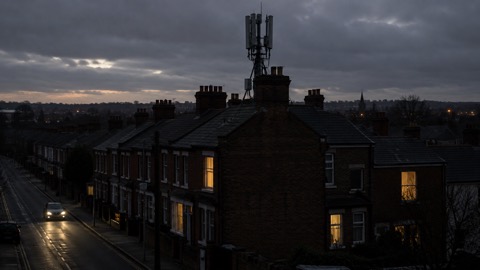
Severe weather damages networks in physical ways: extreme heat and floods can damage mobile masts and broadband networks, and undersea internet and phone cables can be damaged too1. Storm damage to telephone masts and fibre-optic cables is a recognised cause of telecommunications failures, alongside damage to power lines from high winds, lightning and flooding4. Many outages are really power outages in disguise: your line may be intact, but the mast, the street cabinet or your own router has no electricity. The mobile network may still work temporarily in specific regions where masts have back-up power5.
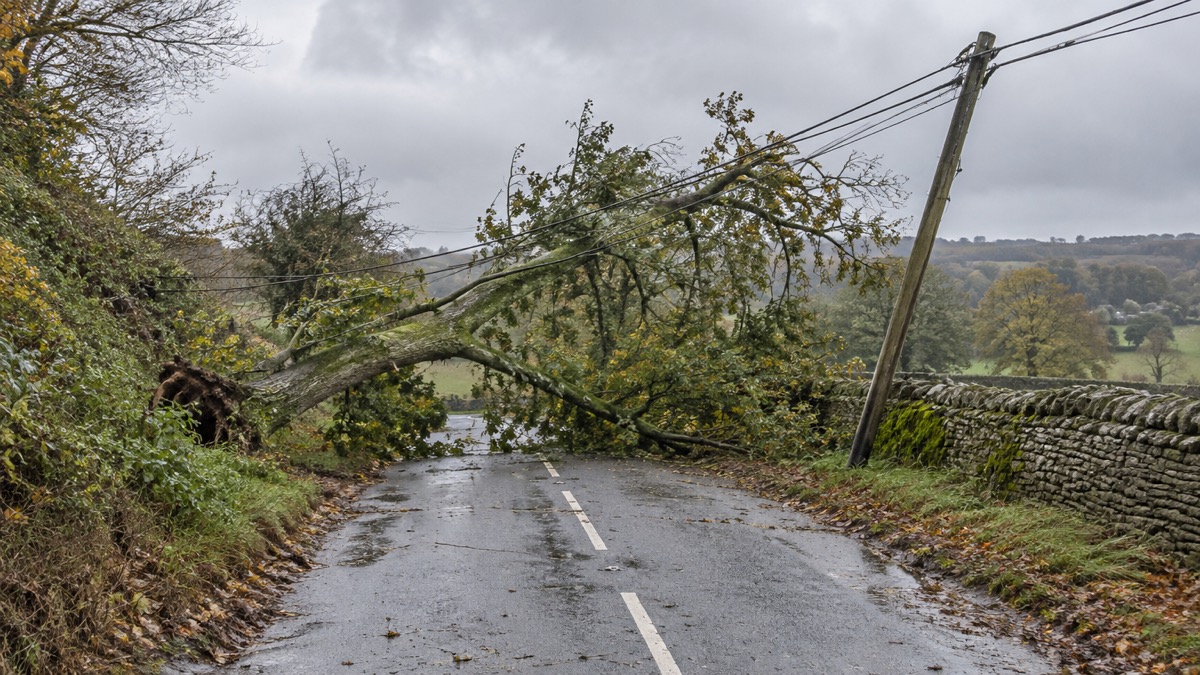
Where you live matters. The impact of severe weather on phone and broadband services differs by location, with rural areas more likely to be affected1. Rural lines are longer, more of them run overhead on poles rather than underground, and a single fallen tree can take out a whole village. The causes are broader than storms alone: disruption can occur from severe weather, power cuts or a provider outage2.
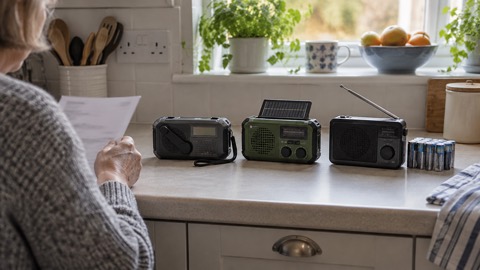
Most of these outages are short. They are usually short or localised, but in some instances, such as following severe weather, disruption can last for a number of days2. That is the realistic planning window for a household: assume you may be without your usual phone and broadband for several days after a major storm, and prepare accordingly. A wind-up or battery radio keeps you connected to official news, and a household contact plan agreed in advance means family members know how to reach each other when mobile networks are jammed.
The one-hour rule: landlines in a power cut
The old copper telephone network carried its own power, so a simple corded phone kept working through a power cut. Digital landlines are different: they need mains electricity and will not work in a power cut unless there is a battery back-up6. This is the single most important change for households to understand, and it is why the rules around back-up exist.
If your landline will not work during a power cut, your landline provider might offer you a free solution, such as a back-up battery unit, for a minimum of one hour, that would enable you to call the emergency services during a power cut if you needed to7. The requirement is firmer for those who rely on the line: if you depend on your landline, your provider must make sure you can contact the emergency services during a power cut1. The back-up must last for at least one hour in a power cut, but some providers have back-ups that last up to seven hours1.
If you do not have a working mobile phone or a reliable mobile signal, your landline provider must offer you a free solution such as a battery back-up unit1. The practical steps are straightforward:
- Contact your landline provider to check whether your phone will work during a power cut, especially if it is your only way of making emergency calls or you have telecare connected to the line5
- Ask what back-up they provide and how long it lasts
- If you depend on the landline and have no reliable mobile, ask for the free back-up unit you are entitled to
- Keep a corded phone as a spare if your set-up allows, and see Corded or Cordless Home Phones in a Power Cut
For more detail, see Will Your Landline Work in a Power Cut? and Getting a Free Battery Backup for a Digital Landline.
Priority fault repair and getting on your provider's list
When many faults are reported at once, networks do not repair them in the order the calls came in. Ofcom requires communications providers to offer a number of services to disabled people, including priority fault repairs and offering different methods of communication3. Registering your needs with your provider can enable practical help such as tailored communications, priority fault repair and additional support during service disruptions2. Surrey County Council lists priority fault repair among the services available through the Priority Services Register8.
This matters most in a widespread emergency. If the emergency is widespread, such as flooding, heavy snow or a power outage, priority will be given to the most vulnerable, so there may be a delay in support reaching your community9. Being on the right register is how the system knows you exist. The Priority Services Register is a free support service that helps people in vulnerable situations; contact your water and power suppliers to see if you can be on it10. If you or someone you care for might need help during a power cut or water outage, check if you can join the free Priority Services Register11.
What registration can bring:
- Priority fault repair on your phone and broadband line when you are registered as a disabled or vulnerable customer3
- Tailored communications and additional support during service disruptions from your communications provider2
- Advance notice and messages when there is an interruption to your supply, if you are registered with your gas, electricity or water supplier12
- Extra help in power cuts, including battery packs to charge phones or medical equipment; what each network operator offers differs, so ask yours directly13
To get on the list, contact your phone and broadband provider and explain your circumstances, and do the same with your electricity and water suppliers3. Being on the register does not necessarily mean faster power restoration, but your provider will understand your needs and support you during a power cut, and you should be told about planned power cuts in advance. See also Extra Help From Phone and Broadband Providers and Extra Help in an Emergency.
How Openreach's Storm Response Unit prepares for extreme weather
Openreach, the company that runs most of the UK's fixed telephone and broadband network, learned hard lessons from the storms of February 2022. Three named storms hit in six days that month, prompting Openreach to set up a new Storm Response Unit14. The unit uses the learnings from previous storm responses to develop new processes that help Openreach respond to extreme weather events in an even quicker and safer way than before14.
Power cuts and phone faults go together. Openreach has backup plans in the event of local power cuts to keep its network running, but warns that you might find it hard to connect if your own power is disrupted14. A digital landline and a router both need mains power in your home, so a power cut on your street can take your phone with it even when the network outside is still working. That is why planning for a power cut and planning for a phone outage are, in practice, the same job.
What this history means for a household is a realistic expectation of timescales. A dedicated storm response capability exists and service is often restored within days, as with Eunice's 19,000 customers14, but a major storm can leave some customers waiting far longer, and the most vulnerable are prioritised first9. The Met Office's WeatherReady advice is to prepare before the weather arrives: consider a separate battery charger, and store key information such as the power cut helpline number, 105, on your phone15. Nottinghamshire County Council adds a point many households miss: consider how your family will stay in touch in an emergency, as mobile networks may be jammed and cordless telephones need power to work16.
The digital switchover: telecare and alarms
The digital switchover is the process of upgrading home phone services across the UK, changing from older, less reliable copper wires to fibre ones17. Between now and January 2027, most telephone providers will be moving their customers from old analogue landlines over to digital services18. This means services that rely on the old landline system, such as home phones, telecare and health devices, will need to be adapted18. Digital landlines do not work during power cuts19, which is why the one-hour back-up rule in the section above exists.
For telecare users the stakes are higher than a missed call. Some analogue telecare devices are not digitally compatible or do not perform as reliably on digital networks and may need to be upgraded20. Ofcom, the industry regulator, provides more information on the landline switchover17. The NHS telecare information page warns plainly:
There are two things to do, and both should happen before your line is changed. First, tell your landline provider and your device supplier before your landline is changed to digital if you, or someone in your household, has a telecare alarm, health pendant, personal alarm or any other device that uses your phone line6. Second, check with the alarm supplier: most telecare alarm providers will have upgrade plans, so let your communication provider know if your phone line has been or is due to be upgraded18. Your telephone provider can offer a free solution such as a battery back-up unit that lets you contact emergency services if you depend on your landline, have additional needs, or cannot use a mobile21.
Ofcom has worked with network providers to make sure vulnerable people are not put at risk; providers need to take steps to identify people at risk and ensure they are protected throughout the upgrade process17. If someone in your household uses telecare, read Telecare and Personal Alarms When Phone Lines Go Digital and work through the switchover checklist.
Compensation when broadband or a landline stays down
The first step is always the same: report the fault, keep a note of when it started, and ask your provider about compensation. If your broadband or phone service is not working because of storm damage, contact your service provider, who will raise a repair with Openreach. Keep your own record of when you reported the fault and what your provider told you, so you have it to hand if you need to pursue the matter later.
Where the outage is a power cut rather than a phone fault, separate payments apply to your electricity. Network operators pay compensation to domestic customers in severe weather if the power was off for 24 hours in Storm Category 1 weather or 48 hours in Storm Category 2 weather, with further payments for each additional 6 hours without power, up to a capped total22. Outside severe weather, the threshold is 12 hours for interruptions13. Payment is normally sent within 10 working days of the operator becoming aware of the failure in normal weather, and within up to 3 months in severe weather22. If you did not receive a payment automatically and it has been a few months, contact your network operator directly13.
| Situation | Threshold | Payment |
|---|---|---|
| Broadband or landline not fixed (provider in Ofcom scheme) | 2 working days | Automatic compensation may be due6 |
| Power off in Storm Category 1 weather | 24 hours | Compensation due, with further payments per additional 6 hours, up to a capped total22 |
| Power off in Storm Category 2 weather | 48 hours | Compensation due, with further payments per additional 6 hours, up to a capped total22 |
| Power off outside severe weather | 12 hours | Payment may be due13 |
Note that these electricity payments compensate for loss of power, not directly for the broadband that died with it, but the two schemes together cover most of what a storm takes away. For the phone side, see Broadband Outages: Checking, Reporting and Getting Back Online.
Calling 999 when networks are disrupted
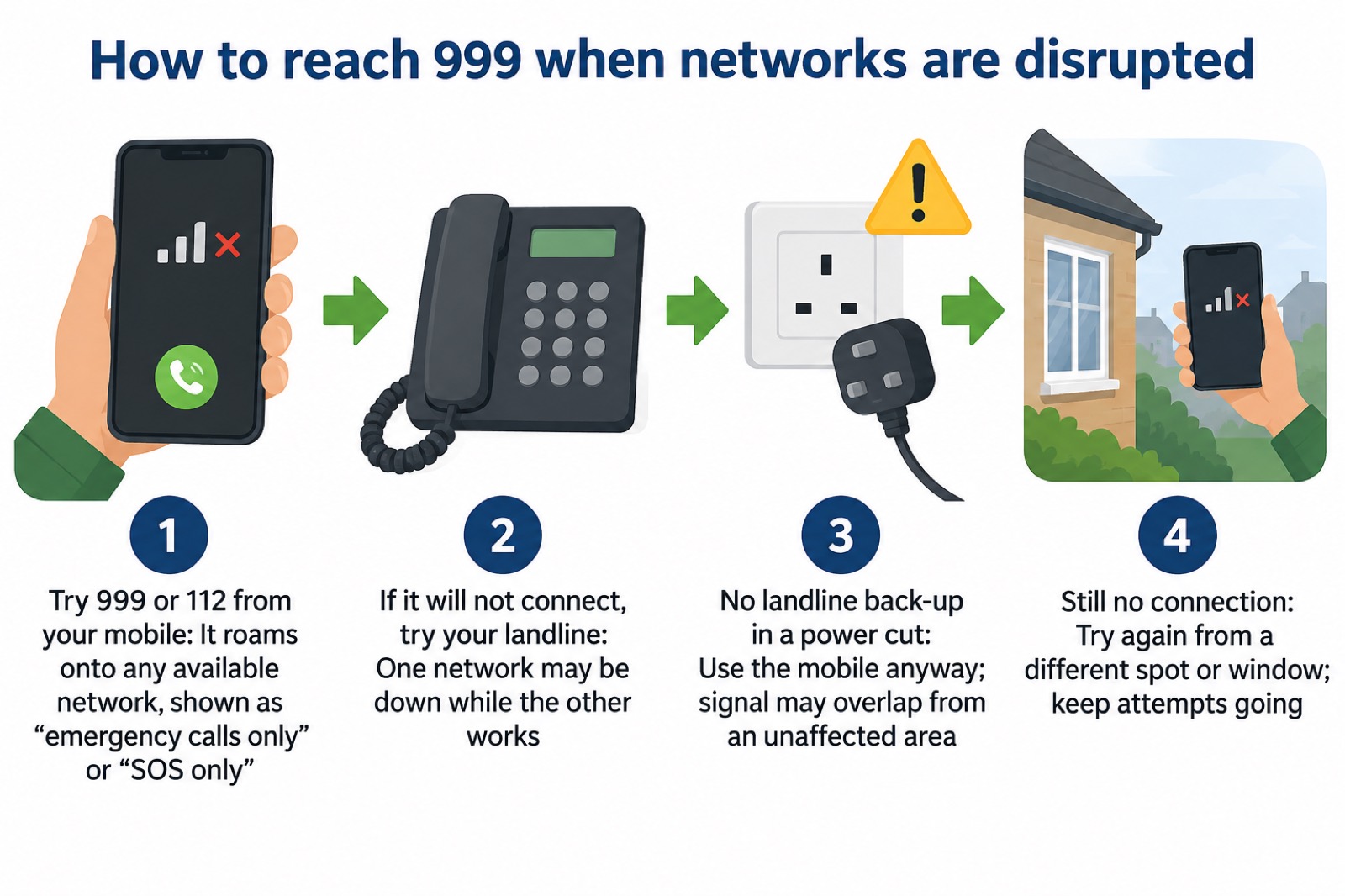
An emergency call is treated differently from every other call on the network. If your mobile provider is experiencing an outage, you will be able to automatically use another provider's network to call 999 or 112 free of charge; this is displayed as "emergency calls only" on Android or "SOS only" on iOS1. Even if you have no signal on your usual mobile network, calling 999 will automatically connect through another mobile network if one is available6.
If you cannot reach 999 or 112, try calling from both a mobile and a landline, as if one is disrupted then the other may be available2. If you have no back-up power to your landline and have a life-threatening emergency, attempt to call 999 or 112 using a mobile: you might receive overlapping signal from a nearby area that is unaffected, as emergency calls automatically roam onto all available networks7. The same advice appears in guidance for power cuts: with no landline back-up and a life-threatening emergency, use a mobile, because emergency calls automatically roam onto all available networks5.
For deaf households, 999 BSL is the name of the UK's first Emergency Video Relay Service in British Sign Language, an emergency video relay service for deaf people23. Registering in advance for emergencySMS gives a text route to 999, and 999 BSL and Relay UK explains the relay options. If you can reach 999 but cannot speak, see What to Do If You Dial 999 but Cannot Speak.
After the storm: reporting faults and staying clear of danger
Once the weather passes, your job is to report, and to stay away from what the storm left behind. If your mobile, broadband or landline is unavailable after a severe weather event, report this to your provider if you can; this helps make sure any faults are fixed as soon as possible1. Do not assume the provider already knows: a fault on your individual line may not show up in their area-level monitoring, and every report helps build the repair queue.
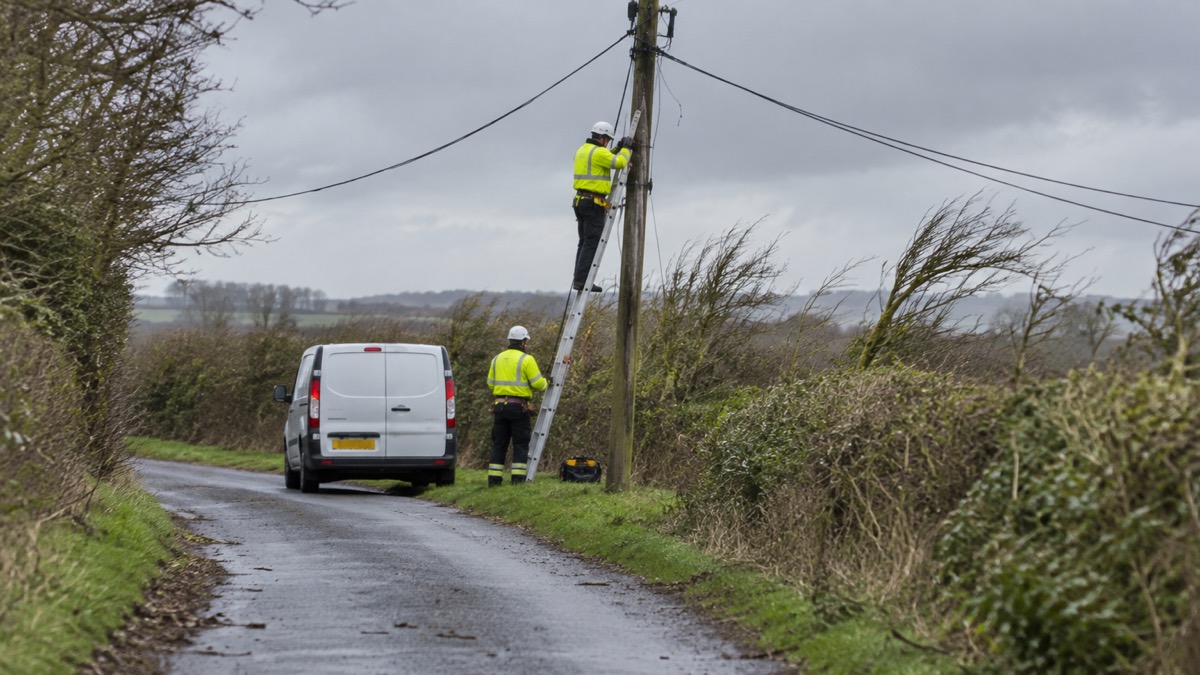
There is a specific danger to respect. After strong winds, be careful not to touch any electrical or telephone cables that have been blown down or are still hanging24. In Northern Ireland, report anything that looks dangerous to NIE Networks on 03457 64364324. Downed lines can stay live, and a hanging telephone cable may be tangled with a power cable, so treat every one as dangerous and keep children and pets away.
A community can speed its own recovery. In a power outage, a community hub can help identify and assist vulnerable people, share out torches and lights to the most vulnerable, use heating resources to keep as many people warm as possible, and liaise with the power company and responders on site25. If your street or village has such a hub, reporting your fault through it as well as to your provider helps direct help to those who need it first. See Community Resilience: A Guide for Neighbours and Local Groups.
Scam calls claiming to be from Ofcom
Outages and confusion are exactly what scammers exploit. Ofcom has published guidance on scam calls and texts, some of which claimed to be from official bodies26. In one pattern, a recorded message or caller claims that, because more people are working from home, your broadband needs slowing down or switching off, then tries to get you to speak to an operator or press a button26.
The rule is simple: Ofcom does not phone households to slow down or switch off their broadband, and no legitimate body will ask you to press a button or speak to an operator to "protect" your line. If you receive such a call during or after an outage, hang up. If you want to check anything, contact your provider using the number on your bill or their website, never a number the caller gives you. Similar frauds surround the digital switchover itself, covered in How to Spot Digital Switchover Scams, and general guidance is in How to Avoid False Information in an Emergency.
Getting ready before the next storm
The best time to deal with a network outage is before it happens. The steps below come from official guidance and take an hour or two in total.
- Contact your landline provider and ask whether your phone will work in a power cut, and what back-up they provide5
- Register with your providers if you are disabled, older, or rely on your line for telecare, so you get priority fault repair and tailored support3
- Tell your provider and device supplier about any telecare alarm before your line is moved to digital6
- Store key numbers on paper and on your phone, including the power cut helpline, 10515
- Keep a separate battery charger ready so a mobile can be topped up when the mains fails15
- Plan how your family will stay in touch, remembering that mobile networks may be jammed and cordless telephones need power16
- Keep a battery or wind-up radio for official news when broadband is down, and see Which Radio Stations to Tune Into During a Power Cut
A non-mains powered landline telephone will help you stay in touch during any disruptions to your power supply27, and a corded handset remains a useful spare. For the wider picture of what to keep ready, see What to Keep Charged Before a Power Cut and Getting Your Mobile Phone Ready for an Emergency.
Sources (27)
- Stay connected in severe weather, Ofcom
- Phone and broadband outages, prepare.campaign.gov.uk
- Help from energy supplier, Buckinghamshire Council
- Utility failure, Essex Prepared
- Power cuts, beready.campaign.gov.uk
- Future of landline calls, Ofcom
- Be ready for emergencies: power cuts, prepare.campaign.gov.uk
- Priority Services Register, Surrey County Council
- Community response planning, West Yorkshire Prepared
- Winter leaflet, GOV.UK, 2023-08
- Be ready for emergencies, Cheshire Fire and Rescue Service
- Protect yourself and your family, Dorset Prepared
- Check if you can get payment for a power cut, Ofgem
- Extreme weather, Openreach, 2022-02
- Top tips to be WeatherReady, Met Office
- Preparing for an emergency, Nottinghamshire County Council
- The digital switchover, Suffolk County Council
- Digital phone switchover, Argyll and Bute Council
- Switchover to digital landlines, South Gloucestershire Council
- Find a telecare provider, GOV.UK, 2025-05-13
- Digital switchover telecare guide, Suffolk County Council
- Energy domestic consumer advice, England and Wales, Ofgem, 2024-11
- Information for sign language users, North Yorkshire Fire and Rescue Service, 2026-03-11
- Strong winds weather warning information and advice, nidirect, 2026-10-24
- Emergency-Contact-Hub-Leaflet.pdf, Wiltshire and Swindon Prepared
- Coronavirus scam calls and texts, Ofcom, 2024-02-07
- Get prepared, Carmarthenshire County Council
 Free Alert Services
 Emergency Apps
 Digital Switchover Checklist
 When Phones and Internet Fail
 Official Warnings and News
 Emergency Radios
 Telecare on Digital Phone Lines
 Mobile Networks in Power Cuts
 Broadband Outages
 Router and Hub Power Cuts
 Wi-Fi Calling
 Satellite Messaging and SOS
 Satellite Messengers
 Calling 999 and 112
 Non-Emergency Numbers