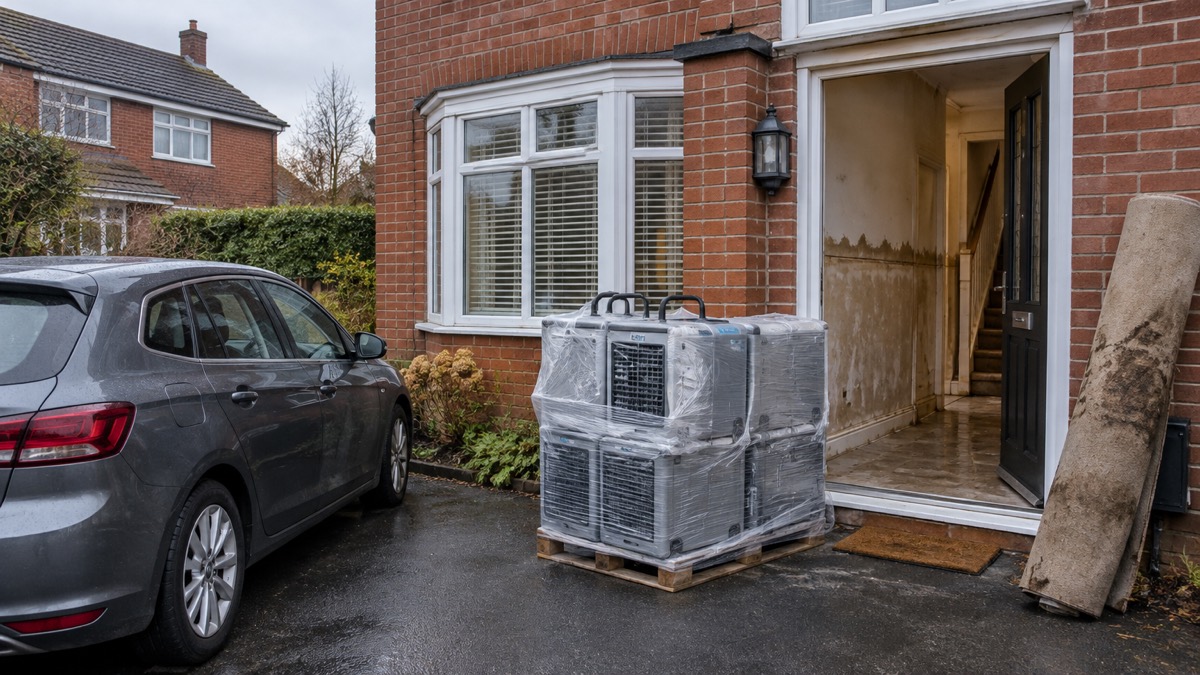
If floodwater gets into your home, the evidence you gather in the first hours is what your insurance claim will rest on. The single most important thing is to record the damage before you clean up: take photographs or video of all damage and the flood water line, and mark the water levels on the wall before they recede1. Contact your insurer as soon as possible, because they will tell you what to do next and may need evidence of damage before clean up begins1.
Then keep everything. Do not throw damaged items away until your insurers have inspected them, with ruined food the one exception4. Keep receipts for any emergency repairs, keep a written list of damaged or lost items, and keep a record of every conversation you have with your insurer, loss adjuster or council6.
This checklist sets out what to record, in the order you will need it, and what to keep safe before a flood ever happens so that the claim is easier if the worst occurs.
Insurance claim records checklist
Work through this list as soon as it is safe to be in the property. Each item exists because an insurer, a loss adjuster or a recovery team has asked for it.
Photograph and film flood damage before you clean up
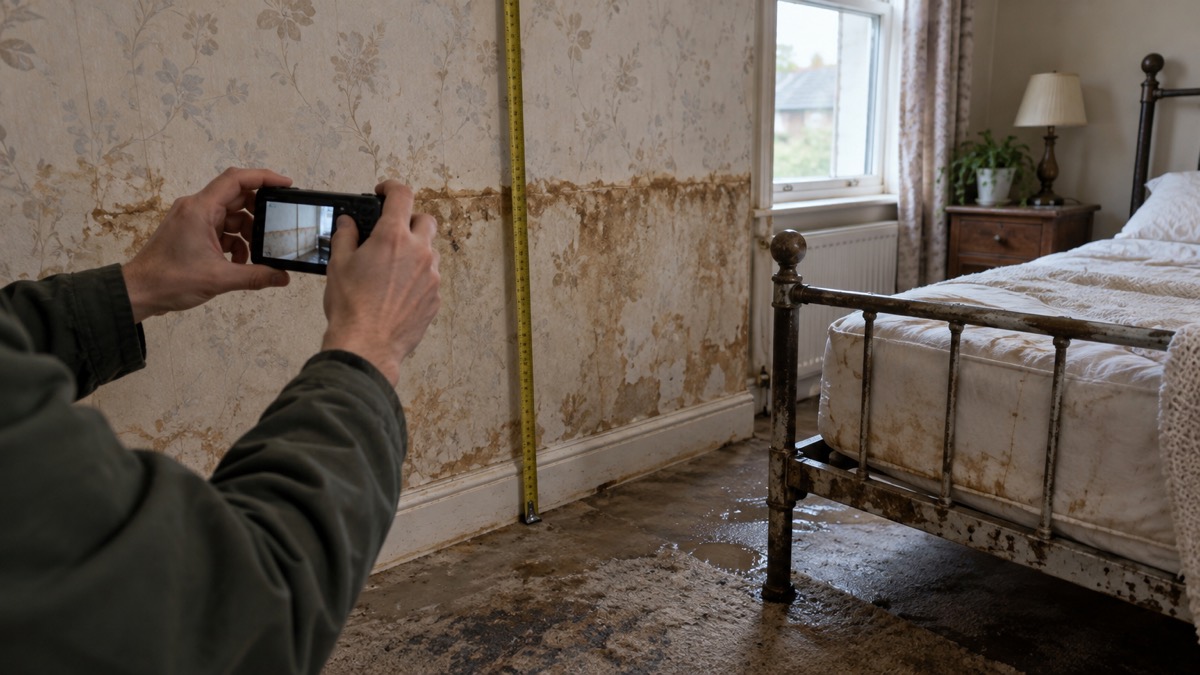
The order matters more than the equipment. Take photos of any damage before you start to tidy and clean up, because this is important for insurance purposes16. Record details of damage with photographs and video, which will be useful when making an insurance claim17. Take photographs or video footage of all damage, and mark the water levels on the wall before they recede2.
Marking the height is not a detail. Guidance for households is to use a permanent ink pen to mark on the wall the height the flood water got to, in every room affected by flooding5. A photograph of a marked wall shows the depth of the water in a way a picture of a damp patch cannot.
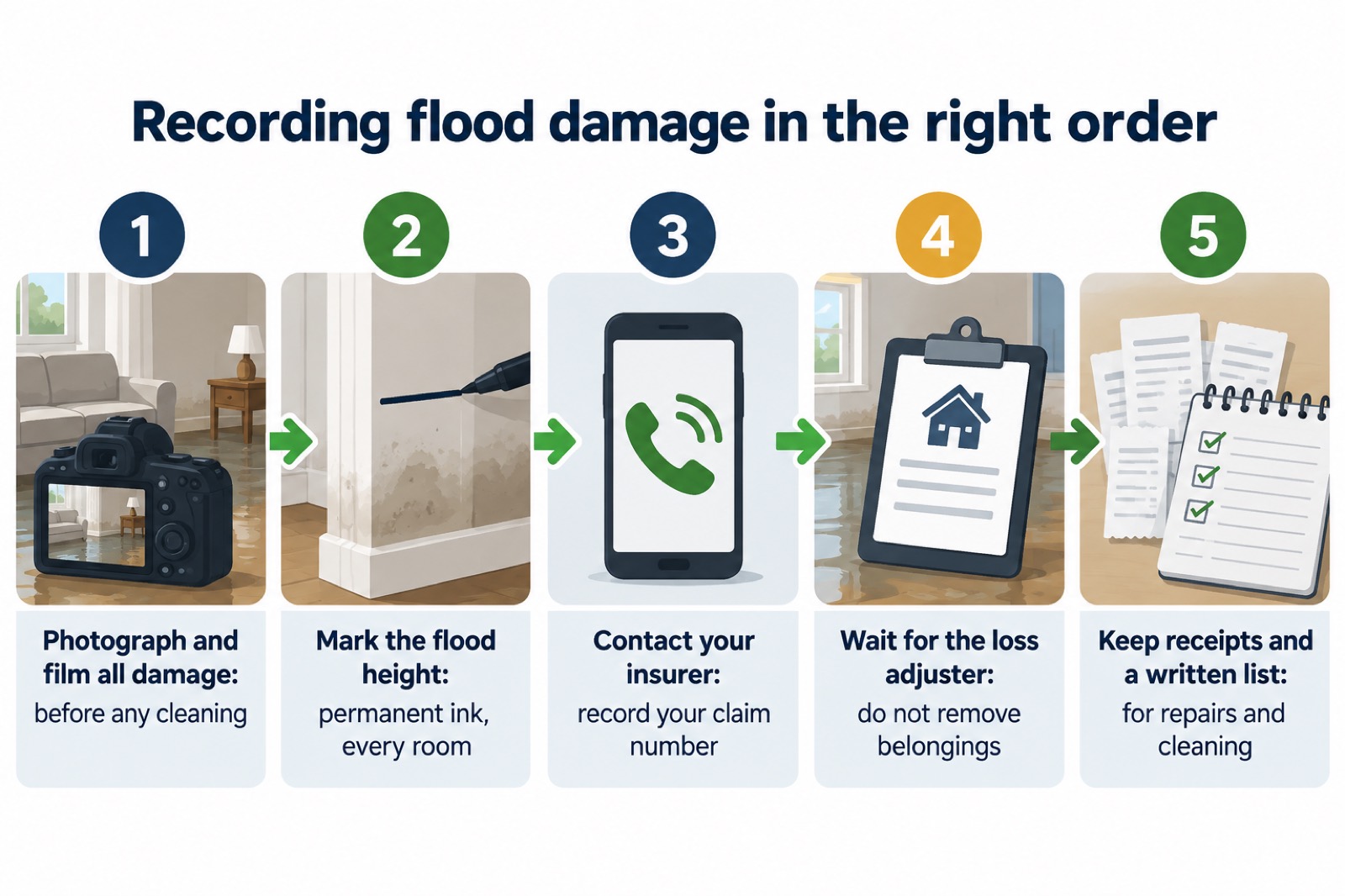
Do not let the recording delay safety. Only assess damage when it is safe to do so, and gather evidence such as photos at that point4. If you rent, contact your landlord as well as your insurer, and get approval before carrying out any repairs19. The same principle applies across the UK: in Scotland, official advice is to contact your insurer as soon as possible and take photos of any damage to your home20.
Keep damaged items, receipts and a written list
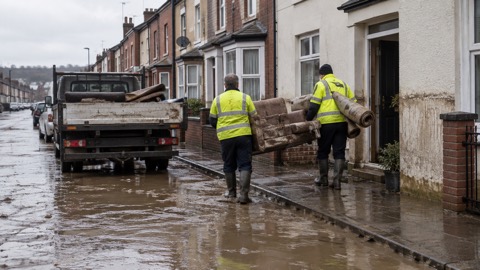
The most common way a claim is weakened is by clearing up too thoroughly, too early. Do not discard any property until instructed by your insurer4. Contact your insurers as soon as possible, and do not throw damaged items away until your insurers have inspected them4. Where a claim is to be made, it may be necessary for loss adjusters to visit prior to removal of damaged belongings18.
There are two narrow exceptions. Ruined food should go, and if you are covered for loss of perishable goods you should list everything you throw away14. Flood damaged carpets can be removed, but cut off and keep samples, which will speed up the settlement of your claim14. When you do dispose of contaminated or flood-damaged property, use your council's bulky waste collection service or speak to customer services rather than leaving it on the street21.
Receipts carry weight beyond the obvious. If you must arrange emergency repairs, tell your insurer and keep receipts, as you will need these in any claim after storm or flood damage9. Insurers may also be able to provide financial assistance for blowers and skips, and recommend reputable contractors, so ask before you hire22. Keep records of repairs and cleaning costs, as this may help your insurance claim11.
Records to keep safe before a flood
Gather your insurance evidence on a dry day. Take detailed photos of your home before any flooding happens, and make sure your buildings and contents insurance covers flood damage20. Check that your insurance provides cover against flood damage to property6. If you live in an area at risk of flooding, check your insurance policy for your property, or speak to your landlord25.
Keep the documents themselves where water cannot reach them. Make sure important documents are safe and will stay dry, including details of your home insurance15. A household flood plan should list the documents worth protecting: passport, driving licence, medical cards, insurance documents, computers or laptops, mobile phones and chargers, important photos and papers, and items of sentimental value26. Copies of important documents, including your passport, insurance certificates and your flood plan, belong in a flood pack you can pick up and carry27.
| Record | Why it matters | Where to keep it |
|---|---|---|
| Insurance policy and certificates | Proves cover and starts the claim27 | Dry, safe place plus a copy in your flood pack15 |
| Photographs of each room before any flood | Shows the property's condition beforehand20 | With your insurance documents26 |
| List of valuables and documents | Speeds up a claim if items are lost26 | In your flood plan26 |
| Contact details for your insurer | Lets you start the claim immediately10 | In your flood pack27 |
For the wider preparation, see Making a Household Flood Plan and Emergency Kit: What a UK Household Should Keep Ready.
Flood Re: insurance for homes in flood risk areas
If your home is in a flood risk area and cover is hard to find or expensive, Flood Re is the scheme to know about. It helps homeowners in need of insurance in flood risk areas. It was launched as a joint government and insurance industry initiative to help provide affordable insurance to households at highest risk of flooding28. The scheme began in April 2016, enabling participating insurers to pass the flood risk element of home insurance policies to Flood Re29.
One point of confusion is worth clearing up. Some documents give the launch as April 2017 rather than April 2016, so the two dates disagree; the 2016 date appears in more than one account28. What matters for a household is simpler: ask your insurer whether your policy includes Flood Re cover, and check that your buildings and contents insurance covers flood damage before you need it20.
Flood Re does not replace the records. Whatever the policy, the claim still depends on the evidence you gathered: the photographs, the marked water line, the list of damaged items and the receipts. If you are uninsured or underinsured, help exists elsewhere; see Recovery Grants and Help If You Are Not Insured. For the policy side in more depth, read Home Insurance in a Flood Risk Area and Flood Re and Making an Insurance Claim After a Flood.
Sources (29)
- After a flood, GOV.UK, 2026-10-25
- Advice for those at risk of flooding, North Yorkshire Fire and Rescue Service
- After a flood, Surrey County Council
- Flooding advice: after a flood, London Fire Brigade
- Preparing your home for flooding, Cotswold District Council
- Thunderstorms: weather warning advice and information, nidirect, 2026-08-30
- Advice for homeowners affected by flooding, Nottinghamshire County Council
- Flood recovery leaflet, Nottinghamshire Local Resilience Forum
- Emergency planning advice, Belfast City Council
- Flood recovery information, Devon County Council
- Preparing yourself for emergencies, London.gov.uk
- London Resilience Partnership: preparing yourself, London Resilience Partnership
- Housing help if your home is flooded, Somerset Council, 2026-06-04
- What to do after a flood, Natural Resources Wales
- Flooding during a flood: easy read, Nottinghamshire County Council
- Emergency advice, Basingstoke and Deane Borough Council
- Flooding, Prepare campaign, GOV.UK
- Derby and Derbyshire flood warden handbook, Parwich Parish Council
- Cleaning up and returning home after flooding, Derbyshire County Council
- Flooding, Ready Scotland
- Clearing up after a flood, Oxford City Council
- Flooding: cleaning up, Lancaster City Council
- Prepare yourself, Greater Manchester Combined Authority
- During a flood, Nottinghamshire County Council
- Types of risk: flooding, Dorset Prepared
- Personal flood plan, GOV.UK
- Create a flood pack, Bradford Council
- Flooding FAQs, Scottish Environment Protection Agency
- Insurance for properties at risk of flooding, Cornwall Council
 Flood Warning Checklist
 First Steps After a Flood
 Storing and Checking Barriers