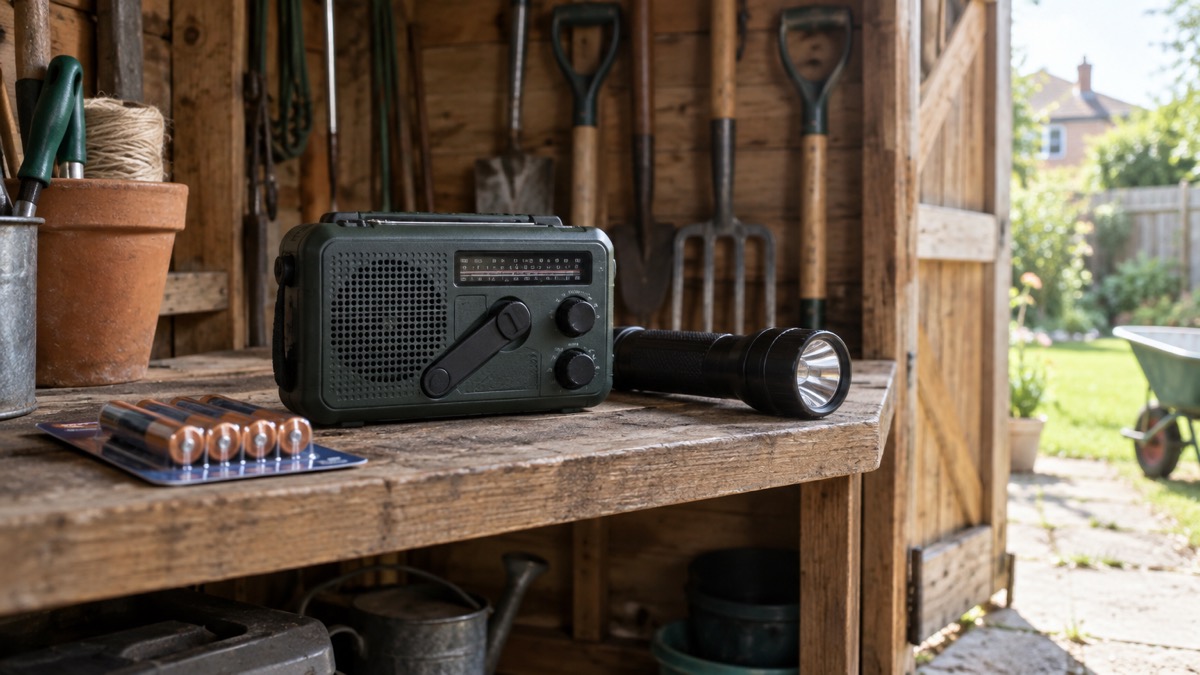
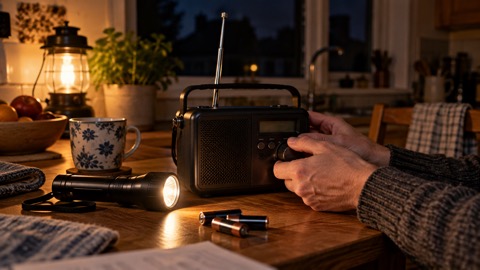
If the power goes off, your phone, broadband and smart speaker may go with it. A wind-up or battery radio is the one piece of kit that keeps working when the mains does not, and councils across the UK put it on their household emergency kit lists for exactly that reason. The advice is consistent: keep a battery or wind-up radio at home, with spare batteries, and know how to tune it to your local stations1.
The choice between the two is simpler than it looks. A battery radio is the standard recommendation, and a wind-up radio is a good backup if the power outage is prolonged1. A wind-up radio needs no batteries at all, and often has a point where you can plug in a mobile phone to keep its battery topped up2. Many households keep both, or a single unit that does both.
Whichever you choose, the radio is only useful if it is charged, tuned and to hand. That means writing your local frequencies on paper, storing the radio with its batteries in your emergency kit or grab bag, and checking the batteries regularly rather than discovering them flat in the dark1.
Official advice: keep a battery or wind-up radio in your emergency kit
The recommendation appears, in almost identical words, on council and government pages from England, Scotland and Wales. North Tyneside's emergency kit checklist asks for a "radio (battery or wind-up)"4. Lincolnshire asks for a "battery-powered radio and extra batteries or wind-up radio"5. Wiltshire's list reads "a wind-up radio (or battery powered, don't forget spare batteries!)"9. Dumfries and Galloway, in Scotland, asks for "a wind-up radio or a battery-operated radio"10.
The reason is practical. Nottinghamshire's advice is to keep a battery-powered or wind-up radio in your emergency kit and tune in to local stations during disruption or emergencies11. The government's power cuts page adds the detail that matters most: keep a battery or wind-up radio and spare batteries, and write down radio station frequencies on paper1. Greater Manchester explains why the radio matters when other things fail: during a power cut, updates may be communicated by BBC Radio Manchester and by Radio 2 and Radio 4 in the event of a national power outage2.
The same item appears in kit lists for every kind of household. Northern Ireland's household emergency kit includes a battery or wind-up radio and spare batteries12. Renfrewshire's list of supplies to keep at home includes "radio (and spare batteries) or wind-up radio"13. Argyll and Bute's winter kit list includes a battery or wind-up radio and spare batteries14. The message does not vary by nation: this is a standard item, not an optional extra.
Wind-up or battery radio: how each one keeps working
A battery radio runs on standard cells, so its working life is set by the batteries you keep and how fresh they are. That is why official lists pair the radio with spare batteries and a reminder to check them5. The advantage is simplicity: no winding, no sunlight, no charging routine. The disadvantage is that a flat battery with no spare leaves you with nothing, which is why the checking habit matters as much as the radio itself.
A wind-up radio generates its own power from a handle, so it works with no batteries at all. Wiltshire and Swindon Prepared notes that if a power outage is prolonged, a wind-up radio is a good purchase, and that these often have a point where you can plug your mobile phone in to keep the battery topped up16. Scotland's home emergency plan makes the same point more broadly: if there is no power, an FM radio powered by battery, solar or wind-up will keep you informed, including car radios17.
| Type | How it keeps working | What it suits | What to watch |
|---|---|---|---|
| Battery radio | Runs on standard cells; keep spares and check them5 | Households that will check and rotate batteries | Flat batteries with no spare9 |
| Wind-up radio | Wound by hand; no batteries needed16 | Long outages, and households that want a no-battery fallback16 | Winding effort; some models also top up a phone16 |
| Solar or USB charging | Charged from light or a USB source17 | Topping up between uses, where light is available | Keep a battery set as the reliable fallback17 |
A car radio is a useful third option. Scotland's guidance names car radios explicitly as a way to stay informed if there is no power17. It is not a substitute for a radio in the house, but if you are in the car during an outage it will do the job.
Spare batteries: check them regularly
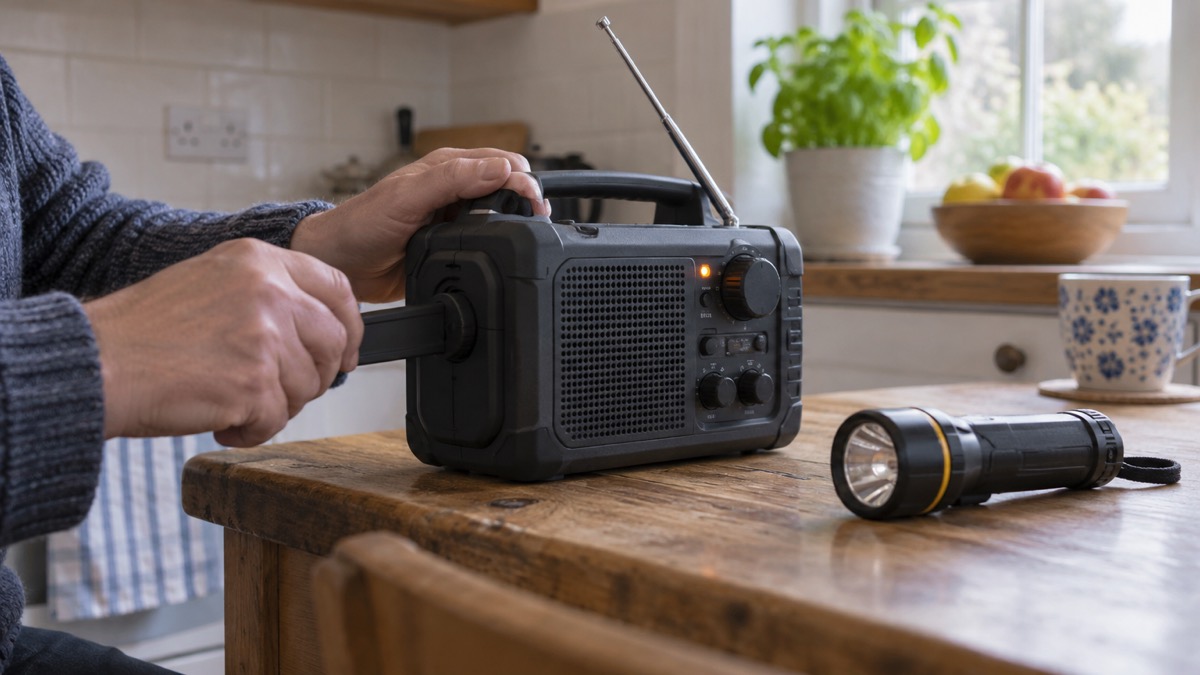
If you have a battery radio, check it and ensure you have spare batteries1. The point is not to buy more batteries than you need, but to know that the ones you have will work when you reach for them. Check items for hidden batteries before recycling them2.
Checking means looking, not just testing. The fire and rescue services advise regularly checking for signs of damage like swelling, leaks or strange smells, and stopping use of damaged batteries immediately4. Surrey Fire and Rescue Service says to check batteries for any damage or wear and tear9. Scottish Fire and Rescue Service adds that a battery you suspect is damaged should be recycled and should not be used or charged16. Battery-operated alarms need their batteries replacing every year, so set yourself reminders to change them3.
- Keep spare batteries for the radio, checked regularly1.
- Check for swelling, leaks or a strange smell, and stop using any battery that shows them4.
- Recycle a suspect battery rather than using or charging it16.
- Check items for hidden batteries before recycling them2.
- Set a reminder to change alarm batteries every year3.
A wind-up radio as your backup
A wind-up radio earns its place as the backup that cannot be left flat. The official case for it is straightforward: if the power outage is prolonged, a wind-up radio is a good purchase, often with a point to plug your mobile phone in to keep the battery topped up16. That combination, radio plus a small phone top-up, is what makes it worth considering even if you already own a battery radio.
The phone top-up is a bonus, not a charging station. If you use it, follow the fire and rescue service's charging advice: always charge your phone or laptop on a hard surface like a table or worktop, never on a soft surface like a bed or carpet, as it can easily overheat and catch fire1. Keep the radio and phone on a hard surface while charging, and do not leave them under a cushion or on bedding.
A wind-up radio also suits a grab bag, because it removes the need to remember batteries at the moment you leave. The Met Office suggests a grab bag with bottled water, medicines, a torch, radio and batteries, copies of important documents and a change of clothes, for when you have to leave home quickly or your power and water are disrupted3. A wind-up model means one less thing to check in that bag, though a spare battery set is still worth keeping for the torch.
Solar, USB and internal battery charging
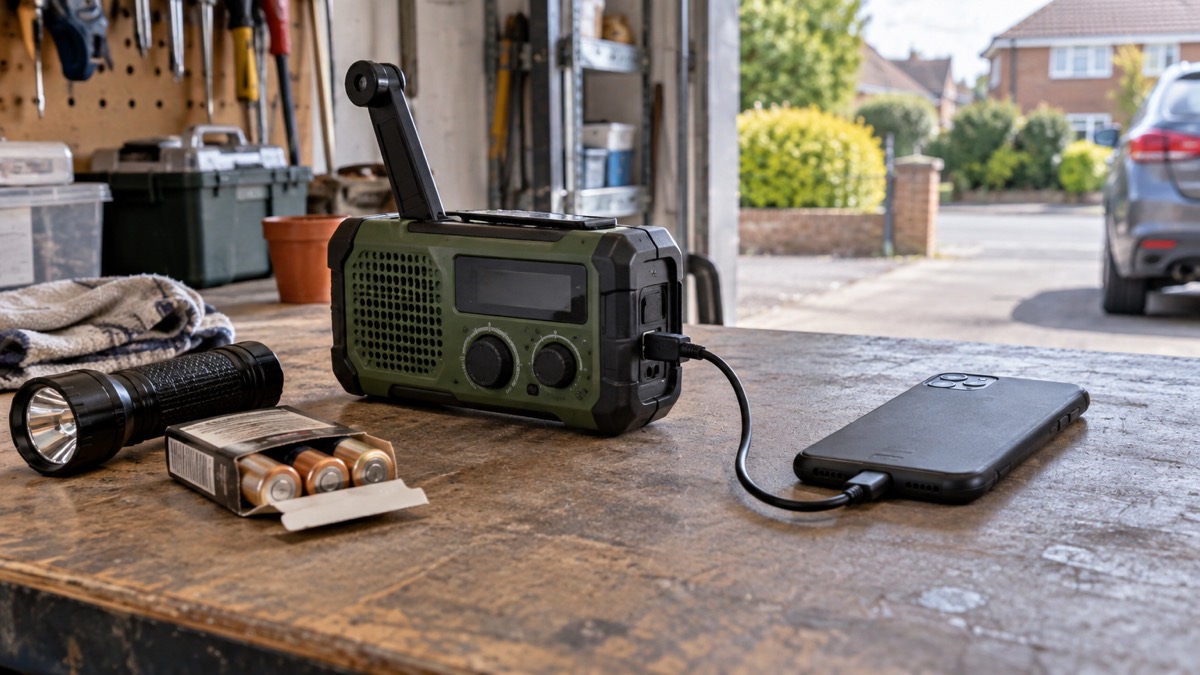
Radios that charge from solar, USB or an internal battery are covered by the same official advice: an FM radio powered by battery, solar or wind-up will keep you informed if there is no power17. The charging method changes how you look after it, not whether it works. Devices with internal batteries need charging periodically, usually via a USB-C cable or a specialised charging base or dock18.
The practical points are about routine. Charge the radio before winter, when storms are more likely, and again when a warning is issued. Treat the radio the same way: a charged radio before a storm is worth more than a flat one during it.
Solar charging is the least predictable of the methods. The guidance does not give a figure for how well a solar radio charges in cloud, so do not rely on it as your only source of power. Keep a spare battery set as the fallback, and use solar or USB charging to top up between uses rather than as the main plan1.
Where the radio goes: emergency kit, storm kit, flood kit and grab bag
The radio belongs in the kit you would actually reach for, and most households need it in more than one place. The main home emergency kit is the first. Northern Ireland's household emergency kit list includes a battery or wind-up radio, a battery or wind-up torch, spare batteries, candles and matches, a first aid kit, spare keys, spare glasses, a spare phone charger, toiletries and special equipment for children and people with special needs12. Keep the radio with those items, not in a drawer in another room.
The grab bag is the second. The Met Office's grab bag list includes a torch, radio and batteries alongside water, medicines, documents and a change of clothes3. If you keep a separate bag for leaving home quickly, put a radio in it, or use a wind-up model so the bag is never dependent on batteries.
The seasonal kits are the third. Argyll and Bute's winter weather kit includes a battery or wind-up radio and spare batteries14. Cornwall's snow and ice advice says to check your battery radio and ensure you have spare batteries7. If you keep a storm or winter box, the radio belongs in it, checked at the start of the season.
- Home emergency kit: radio, spare batteries, torch, first aid, documents, phone charger12.
- Grab bag: radio and batteries, water, medicines, documents, change of clothes3.
- Winter or storm kit: radio and spare batteries, checked before the season14.
- Car: a car radio can keep you informed if there is no power at home17.
Wherever it goes, write the local frequencies on a card and keep it with the radio1. A radio you cannot tune is only half the kit.
Sources (20)
- Power cuts, UK Government, 2026-10-21
- Loss of essential services, Greater Manchester Combined Authority, 2026-10-29
- 10 things you should do now to prepare for winter, Met Office, 2026-02-16
- Emergency kit checklist, North Tyneside Council, 2026-10-29
- Get help and advice in an emergency, Lincolnshire County Council, 2026-10-29
- Stay connected in severe weather, Ofcom, 2026-10-13
- Snow and ice in Cornwall, Cornwall Fire and Rescue Service, 2025-10-01
- Battery safety, Greater Manchester Fire and Rescue Service, 2026-10-29
- Planning for an emergency: kit, Wiltshire Council, 2026-10-29
- Create a household emergency plan, Dumfries and Galloway Council, 2026
- What to do in an emergency, Nottinghamshire County Council, 2026-10-29
- Household emergency kit, nidirect, 2026-07-06
- Prepare your home for emergencies, Renfrewshire Council, 2025-10-09
- Winter weather: be prepared, Argyll and Bute Council, 2026
- Preparing for an emergency, Nottinghamshire County Council, 2026-10-29
- Failure of national electricity, Wiltshire and Swindon Prepared, 2026-10-25
- Home emergency plan, Ready Scotland, 2026
- Smart speakers, Electrical Safety First, 2026-10-25
- Electrical fire safety leaflet, Greater Manchester Fire and Rescue Service, 2026
- Lithium-ion batteries, Scottish Fire and Rescue Service, 2025-11-27
 Satellite Messenger vs Phone SOS
 Corded or Cordless Phones
 DAB or FM Radios