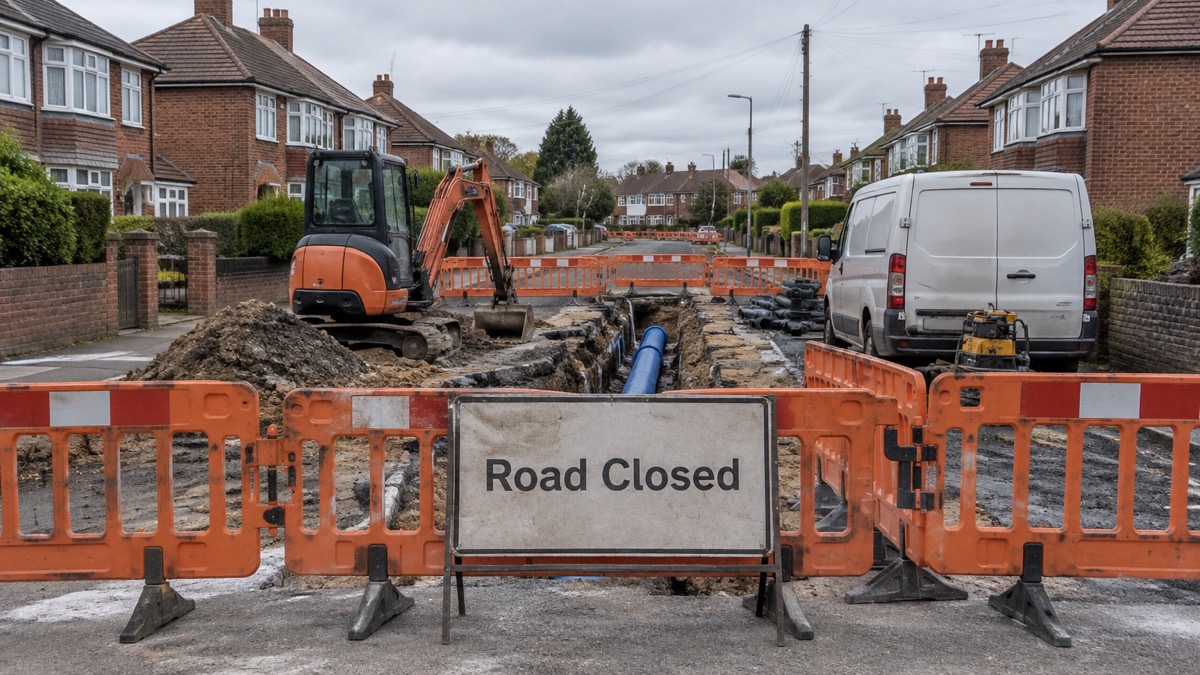
Most water supply interruptions in the UK are unplanned: a burst main, a pump failure, a pollution incident. But a significant number are deliberate. Water companies switch off sections of the mains network to carry out essential maintenance, to replace ageing pipes, or to connect new supplies, and when they do this they are working to a set of guaranteed standards that govern how much notice you get and how long your water can be off.
The headline rules are straightforward. For a planned interruption, the company must inform you in writing at least 48 hours in advance in England, or 24 hours in advance in Wales1. One water company carrying out pipe upgrades states it always aims for your water to be off for a maximum of three hours2. If the company fails to give the required notice, or fails to restore your supply on time, you may be entitled to a payment under the Guaranteed Standards Scheme, and this page explains how that works and how to claim it.
What planned work means: notice and duration
A planned water supply interruption is one the company has scheduled in advance, as opposed to an emergency shutdown after a burst main or a contamination incident. Interruptions occur for many reasons, "ranging from scheduled maintenance to burst water mains", according to official UK preparedness guidance5. The planned kind is the one you can prepare for, because the company has to tell you it is coming.
The notice requirement comes from the Guaranteed Standards Scheme, the set of minimum service standards that water and sewerage companies in England and Wales must meet. The scheme is explained by the Consumer Council for Water (CCW), the independent body that represents water customers. When there is a planned interruption to your water supply, the company must inform you in writing at least 48 hours in advance in England, and at least 24 hours in advance in Wales1. Water companies repeat this in their own customer information: United Utilities, which runs pipe upgrade programmes, says "Whenever we need to switch off your water, we'll let you know 48 hours in advance"2, and South Staffs Water says that if it plans to interrupt your supply for more than four hours to do essential maintenance work, it will always give at least 48 hours' written notice6.
Notice is normally given in writing, which in practice means a card or letter through your door, and increasingly an email or text message if you have registered those details with your company. Ofwat, the economic regulator of water services in England and Wales, provides information on what communication you should expect to receive from your water company in the case of an interruption to supply5. If plans change, United Utilities says it will let you know as soon as it can2.
How long the water is actually off depends on the job. United Utilities states a working target: "We always aim for your water to be off for a maximum of three hours"2. That is an aim rather than a legal ceiling, and more complex connections can run longer, which is why the notice should state the expected duration. The formal restoration standard applies to the moment the supply must be back: the company must restore the water supply by the time stated in the notice, or within 12 hours if the interruption was an emergency caused by a leak or burst on a water main1.
Getting ready before the water goes off
Because you know the water is going off, preparation is simple and cheap. The general principle from official guidance on private supplies applies just as well to mains customers: consider how you would deal with any disruption to your drinking water now, and not wait until it runs out7. Birmingham City Council's preparedness advice puts it plainly: "You should plan for situations where your electricity, gas or water supply is cut off"8.
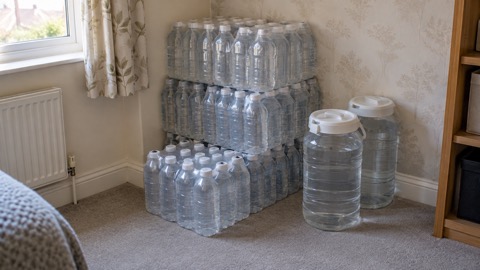
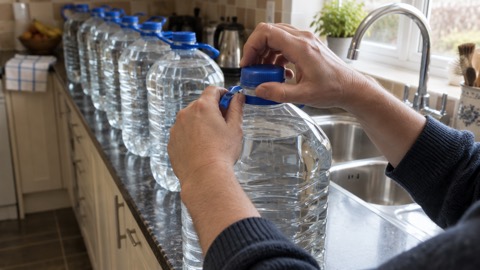
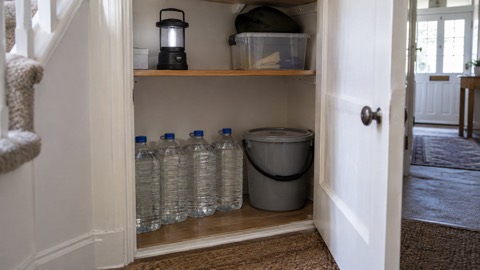
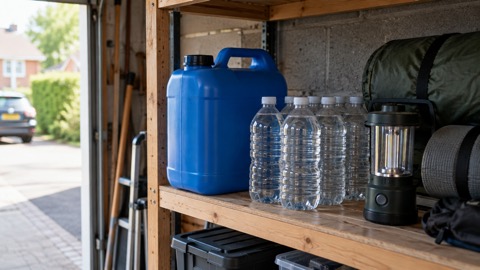
Start with drinking water. Official guidance says additional water might be needed to make up baby formula, for medical devices and for pets5, and Wiltshire and Swindon's local resilience work notes that keeping some water readily available is essential for families feeding a baby formula milk9. Our pages on how much drinking water to store per person, storing tap water safely at home and containers and jerrycans cover this in detail; for a planned interruption of a few hours, filling covered containers from the tap before the stated time is usually enough.
Then think about everything else in the house that needs water:
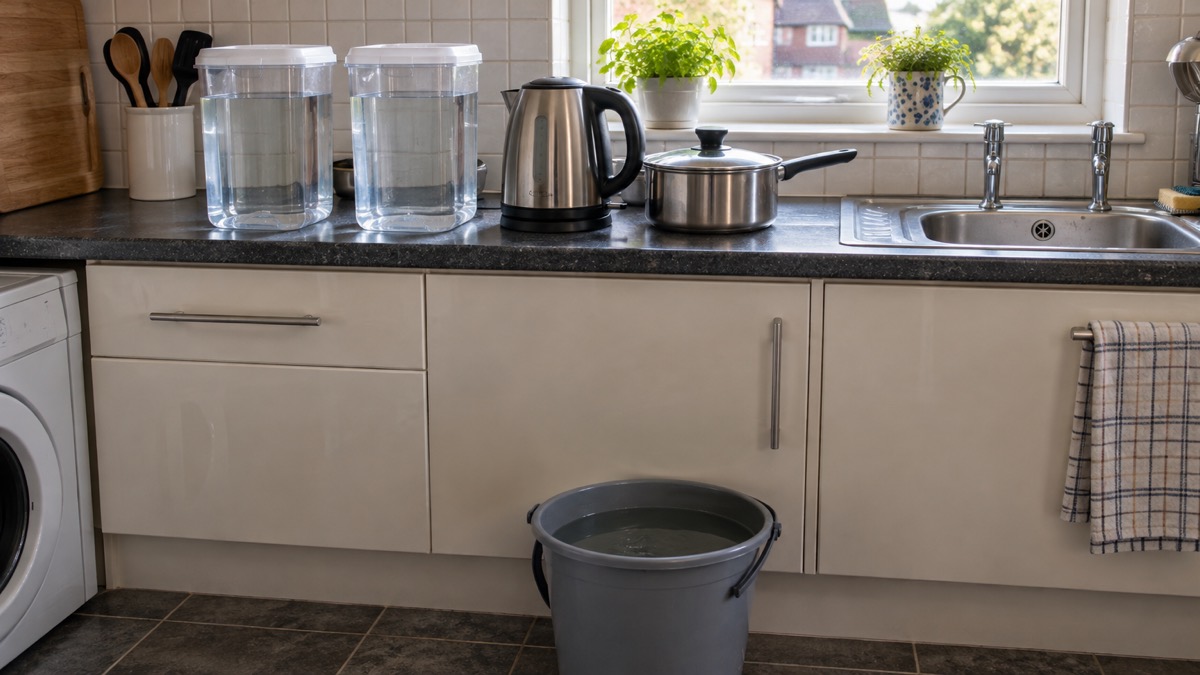
- Fill the kettle and a covered pan for hot drinks and basic cooking before the water goes off.
- Fill a bucket or two so you can flush the toilet during the interruption.
- Know where your stopcock is. Flooding advice from the fire service in Mid and West Wales says: "Make sure you know how to turn off your gas, electricity and water if necessary"10.
- Check your household's medical needs. Official guidance says that if you or a member of your household rely on a medical device that needs water to function, talk to your care team to make a plan for what to do if there is a water outage4. Our page on home dialysis and medical needs covers this.
- Wash up and run the washing machine beforehand if the timing allows.
- Keep basic supplies to hand generally. The Met Office's WeatherReady campaign advises: "Make sure you have basic supplies in case you have to leave home quickly, or your power and water are disrupted"11.
If you have a combination boiler, be aware that running hot water with the mains off can cause problems; our page on combi boilers during an outage explains what to check. And remember there is water already stored in your home: the pipes, the loft cistern and the hot water cylinder hold usable supplies, which our page on supplies already in your pipes, cistern and cylinder explains how to use safely.
Extra help during planned work: the Priority Services Register
If someone in your household needs extra support, join the Priority Services Register before the work starts, not during it. The register helps electricity, gas and water companies know if someone requires extra support, including during an interruption to supply12. It is free to join and covers a wide range of circumstances: North Devon Council notes that you or someone you know may be eligible for extra support in the event of interruptions to power, gas or water supplies12.
What the register delivers during a water interruption is concrete. Official guidance states that if you are on the Priority Services Register, your water company will arrange alternative supplies for you4. Surrey County Council describes the kind of support available, which may include access to bottled water during a water supply interruption, priority assistance, and tailored support if there is a power or gas outage13. In Scotland, the Priority Services Register works on the same principle, providing extra help during power cuts or when there is an interruption to your electricity, gas or water supply14. The Greater London Authority's cold weather advice makes the benefit plain: if you are eligible to join and your gas, electricity or water supply is cut off, your suppliers will know you need extra support15.
Water companies check the register before planned work begins. United Utilities says of its upgrade programme: "If you are registered as a Priority Services customer, our team will check this before we start on site and do everything we can to help minimise any inconvenience"2. Surrey's Priority Services Register also commits that companies will tell you if they are going to turn off your water16.
To join, contact your water company directly, or ask your electricity or gas supplier, as many share registration across utilities. Our extra help in an emergency page sets out who qualifies and how to apply across the UK.
What happens on the street during pipe work
Understanding what the work involves helps you plan around it. Before major work begins, the water company may visit your street to check ground conditions, locate other underground pipes and cables, and install valves or equipment needed for the upgrade2. This survey activity can happen days or weeks before the supply is actually switched off.
The replacement itself is done by one of several methods, each with different implications for disruption:
| Method | What it involves |
|---|---|
| Sliplining | Inserting a new pipe inside the old one2 |
| Open cut | Traditional trenching along the pipe route2 |
| Directional drilling | Drilling a new underground route without a continuous trench2 |
| Pipe bursting | Breaking the old pipe outward while pulling a new pipe through2 |
The existing pipes may be made of iron or plastic and must be removed carefully by hand2. Where possible, companies coordinate their work so that water and other utility upgrades take place together, which reduces the number of times your street is dug up over the years2.
Expect some disruption to the street itself. Work is completed in phases to reduce disruption, temporary parking restrictions or road closures may be required, and where access needs to be temporarily restricted, the company says it will let you know in advance2. Reinstatement of the road surface usually follows quickly, but some finishes take longer: "Some reinstatements (such as printed concrete or specialist finishes) may take a little longer, but we'll keep you informed about our progress"2.
The wider context for this work is worth knowing. Essex Prepared, a local resilience partnership, notes that pipe bursts and contamination, infrastructure failures and pollution incidents can disrupt supply, and that business closures due to lack of water supply are a real consequence of infrastructure failure17. Wiltshire and Swindon's risk work explains why pipes fail in the first place: the land around us contracts and expands during droughts and heavy rainfall, and this movement can cause pipe breakages, while winter frosts cause bursts where the ground freezes and then warms up9. Much of the planned work you see on your street is replacing old mains before they fail in this way.
When the water comes back: discoloured or different-tasting water
After the supply is restored, the water may look or taste different for a short while. This is a normal result of work on the mains: disturbing the pipes stirs up sediment that has settled in them. United Utilities prepares customers for this: "You may notice the water looks slightly discoloured at first - this is temporary, harmless and will clear quickly"2. The company also pre-chlorinates new pipe before it is brought into service, to ensure water quality and help return the supply as quickly as possible2.
What to do when the water comes back on:
- Run the cold tap nearest to your stopcock, which is usually under your kitchen sink, for a while to see if it clears the discolouration5.
- Check the colour. Brown, black or orange water is usually disturbed sediment; the Drinking Water Inspectorate, the regulator for drinking water quality in England and Wales, has specific guidance on these colours18.
- Contact your water provider if problems continue5.
There are points at which you should contact your supplier rather than simply running the tap. The Drinking Water Inspectorate says to make contact if the water also has an unusual taste or odour, if it has been discoloured for more than 24 hours and is not clearing, or if it is not brown, black or orange in colour18. The safety rule in the meantime is consistent across official sources: check with your water supply company before drinking the water or using it to make baby formula or brush your teeth, as it may be contaminated19. Greater Manchester's resilience guidance gives the same warning: "If your water is discoloured, cloudy or smells - check with your water supply company before drinking it or using it for baby formula or brushing teeth"20.
Our pages on brown or discoloured tap water, cloudy or milky tap water and taste and smell changes go into each of these in more detail, and what to do when your supply comes back on covers the full return-to-service routine, including clearing air locks.
If the supply is not back when promised
The restoration standard is firm. The company must restore the water supply by the time stated in the notice, or within 12 hours if the interruption was an emergency due to a leak or burst on a water main1. If that deadline passes, the Guaranteed Standards Scheme payments described in the next section begin to apply.
If the interruption stretches on, the company's obligations escalate. Southern Water's household code of practice states: "If the interruption lasts for more than 24 hours, we're required to provide an alternative water supply"3. In practice this means bottled water, tanks or bowsers. Wiltshire and Swindon's water supply disruption plan describes how this works: water providers keep households in supply or make alternative arrangements, such as water distribution points where people collect bottled water at a designated local area9. South Staffs Water says that if an interruption is likely to be longer than four hours in peak times, it always tries to provide an emergency supply from standpipes, water bowsers or tankers6.
It is worth knowing the limit of this obligation for planned work specifically. Guidance from the Drinking Water Inspectorate on alternative supplies notes that where no agreement is in place, the provision of alternative supplies by a water company, meaning bottles, tanks or bowsers, should be limited to short term unplanned emergencies21. That is why a short planned interruption usually comes with no water station: the company expects the supply to be back within hours. Our page on bottled supplies, tankers and bowsers from your water company explains what to expect when they are deployed, and where bottled water stations are set up covers collection points.
Your water company is your main source of information during any interruption4. Check its website for service updates in your area and for whether you can pick up alternative sources of water5. Our page on how to check if there is an outage in your area lists the main companies' incident pages.
Guaranteed Standards Scheme payments for planned interruptions
The Guaranteed Standards Scheme (GSS) is the safety net when a company misses its promises. CCW explains that the scheme covers a defined list of standards, including making and keeping appointments, account queries and payment arrangement requests, low water pressure, notice of supply interruption, supply restoration, complaints, and sewer flooding inside and outside your property1. As of 1 October 2025, additional standards have been introduced as part of a GSS review, covering core priority services, domestic customers in debt, meter readings, meter installation and water quality notices1.
If your company fails to keep to a standard, it must make you a fixed payment or credit that amounts to your water services account1. For planned interruptions, the payments that matter are:
| What the company failed to do | Payment |
|---|---|
| Failed to give the required written notice of a planned interruption (Wales) | A fixed payment for households, with a larger one for business customers; you must claim the payment1 |
| Failed to give 48 hours' written notice of a planned interruption over four hours (South Staffs Water's stated standard) | A fixed payment, paid automatically6 |
| Failed to restore the supply within 24 hours (South Staffs Water's stated standard) | A fixed payment, paid automatically6 |
| Supply interrupted or cut off beyond the restoration standard (England) | An extra payment for households, with a larger one for business customers, for each full 12-hour period, up to a cap of twice the value of your annual water supply charges1 |
Note the difference in how payments arrive. Some are automatic and some must be claimed, and the position differs between England and Wales: CCW's guidance states that in Wales you must claim the payment yourself1. Check your company's guaranteed standards page, or ask CCW, to confirm which applies to you.
There is a further backstop. CCW advises that if the company fails to make a GSS payment within a specified period, unless it is one where you are required to claim and you have not done so, you are entitled to an extra payment, and you should contact your water company if you feel this applies to you1.
When the scheme does not pay out, and how to claim
The scheme does not pay out in every situation. The most common reason is simply that the company met its standards: if it gave the required notice and restored the supply by the stated time, no payment is due, however inconvenient the interruption was. Payments tied to claiming also lapse if you do not claim them, as CCW's guidance on the Welsh notice payment makes clear1. The same principle appears elsewhere in the scheme: for sewer flooding payments, the customer must claim within three months of the incident, and a claim made after that deadline is not paid22.
To claim, contact your water company in the first instance, quoting the date and time of the interruption and the notice you received, or did not receive. If you continue to have problems with your water supply after an outage, official guidance is to contact your water provider4. If the company refuses a payment you believe you are owed, or fails to make it within the specified period, CCW is the independent body to turn to; it represents water customers in England and Wales and publishes the standards in full1. Our page on who checks drinking supplies explains the roles of the Drinking Water Inspectorate, Ofwat, CCW and the Drinking Water Quality Regulator for Scotland.
The arrangements differ outside England and Wales. In Northern Ireland, NI Water operates under a separate system: for compensation claims about water or sewerage, ask NI Water for a claim form on 0845 744 008823. In Scotland, water services are provided publicly through Scottish Water and the Guaranteed Standards Scheme as described by CCW does not apply in the same form.
One further point for households on private supplies: the help described on this page does not extend to you. If your water comes from a well, borehole or spring rather than the mains, planned interruptions by a water company are not your issue, but disruption of your own supply is. Argyll and Bute Council advises private supply users to consider how they would deal with disruption to their drinking water before it runs out, and notes that where the council provides emergency water, provision is a chargeable service and the supply user may also be expected to make improvements to prevent future supply failure24. Our private supplies page covers this in full.
Sources (24)
- What standards are guaranteed by water and sewerage companies?, Consumer Council for Water, 2026-09-22
- New water pipes, United Utilities, 2026-10-28
- Southern Water household code of practice, Ofwat, 2022-11
- Water supply interruptions or outages, Prepare Campaign, 2026-10-12
- Water supply interruptions or outages, Be Ready Campaign, 2026-10-12
- No water FAQs, South Staffs Water, 2026-10-28
- Loss of supply: private water supply users, Argyll and Bute Council, 2026
- Are you ready?, Birmingham City Council, 2026-05-06
- Failure of water infrastructure or loss of drinking water, Wiltshire and Swindon Prepared, 2026-10-25
- Flooding advice, Mid and West Wales Fire and Rescue Service, 2026-10-29
- Top tips to be WeatherReady, Met Office, 2026-10-25
- Be prepared for emergencies, North Devon Council, 2026-10-29
- Wellbeing and safety, Surrey County Council, 2026-10-28
- Priority Services Register Scotland, Scottish Borders Council, 2026-10-29
- Keeping warm, healthy and safe in cold weather, Greater London Authority, 2026-10-25
- Priority Services Register, Surrey County Council, 2026-10-28
- Ongoing risks: utility failure, Essex Prepared, 2026-10-29
- Brown, black or orange water, Drinking Water Inspectorate, 2026-10-28
- Are you ready: emergencies, Greater London Authority, 2026-10-26
- Prepare yourself, Greater Manchester Combined Authority, 2026-10-29
- Alternative supplies for private water supplies, Drinking Water Inspectorate, 2017-11
- Customer experiences of sewer flooding: update report, Ofwat and CCW, 2024-11
- What to do if a flood happens, nidirect, 2025-10-24
- Private Water Supplies - | Argyll and Bute Council, Argyll and Bute Council
 Supply Interruption Checklist
 Boil Notice Checklist
 Drinking Supply Checklist
 How Much Water to Store
 Storing Tap Water Safely
 Containers and Jerrycans
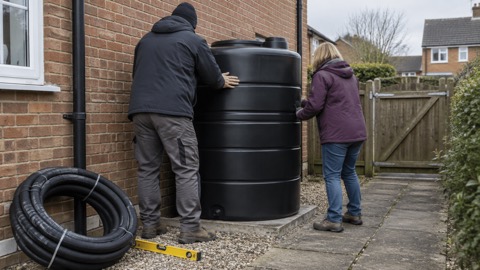 Household Storage Tanks
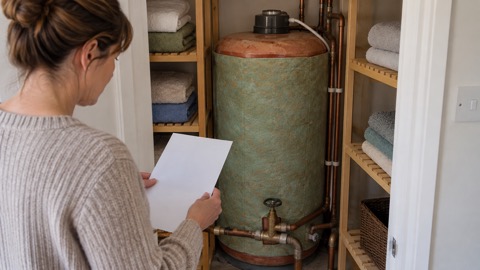 Water Already in Your Pipes
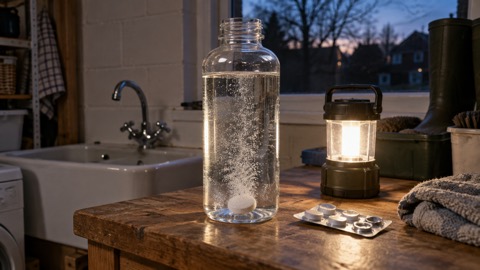 Making Water Safe to Drink
 Boiling Water to Kill Germs
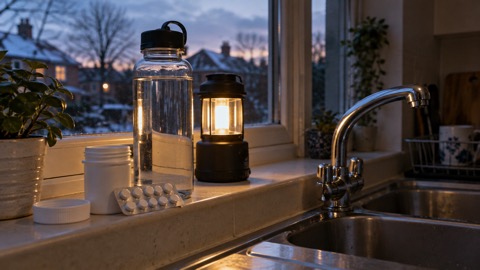 Purification Tablets
 Emergency Filter Types
 What Water Filters Remove
 Gravity Filters Explained
 Hand Pump Filters