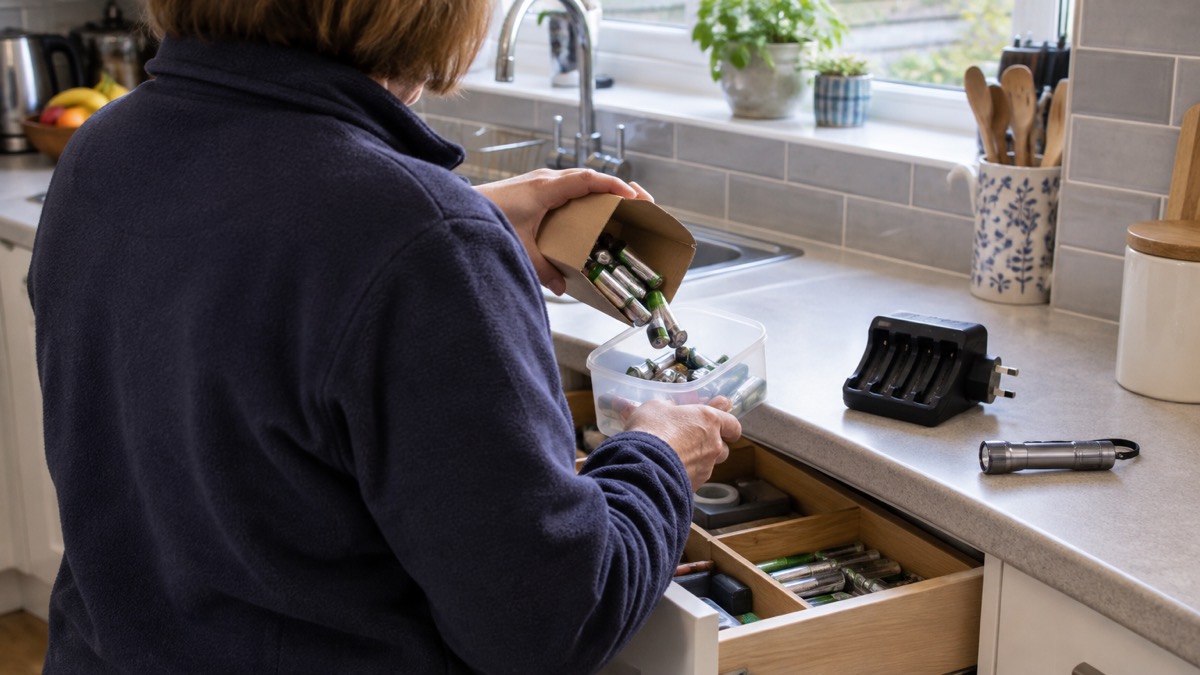
Panasonic eneloop are rechargeable AA and AAA batteries sold pre-charged, so they can go straight from the packet into a torch or radio. The maker quotes a minimum capacity of 1900 mAh for AA and 750 mAh for AAA, a storage claim of 70% capacity retained after ten years at 20 °C, and a working temperature range of -20 °C to 50 °C1. For a household kit that means a set of cells you can leave in a drawer for years, pick up in a cold snap, and recharge hundreds of times instead of buying disposables.
They are not a universal replacement for every battery in the house. Panasonic states that eneloop cannot be used in devices with airtight battery compartments, such as waterproof torches, because gas released during over-discharge cannot escape1. They are also a 1.2 V cell rather than the 1.5 V of an alkaline, which matters for a few fussy devices. Used within those limits, they are one of the simplest ways to keep torches, radios and small chargers running through a power cut.
This page sets out what the batteries are, what the figures mean in practice, how to charge and store them, where they must never go, and how to recycle them when they finally wear out. It covers the standard eneloop range; the maker also sells higher-capacity eneloop pro and lower-capacity eneloop lite cells, and their figures are given where they differ.
What eneloop batteries are and why they suit an emergency kit
eneloop is Panasonic's brand of nickel-metal hydride rechargeable cell, sold in AA and AAA sizes and pre-charged at the factory using solar energy before shipping, so the batteries are ready to use immediately after purchase1. The maker positions the standard cell for multi-use, the higher-capacity eneloop pro for professional use and the lower-capacity eneloop lite for daily use in low-drain items such as clocks, computer mice and remote controls2.
That mix matters for an emergency kit. Official guidance on preparing for severe weather tells households to include a battery powered torch or battery powered candles, a portable charger and a charged mobile phone4. Independent storm advice lists a torch and spare batteries, or a wind-up torch, as kit5. A power cut guide adds the obvious point: make sure you have spare batteries if the torch is battery operated6. Rechargeable cells answer the "spare batteries" line without a cupboard full of disposables that quietly go flat.
The case for eneloop in that role rests on three maker figures. They arrive charged, so they work on day one. They keep most of their charge in storage, so a set forgotten in a drawer is still useful years later. And they can be recharged many times, so one purchase covers repeated short outages rather than one. The trade-off is that they need a charger and a little management, covered below.
Capacity: at least 1900 mAh in AA and 750 mAh in AAA
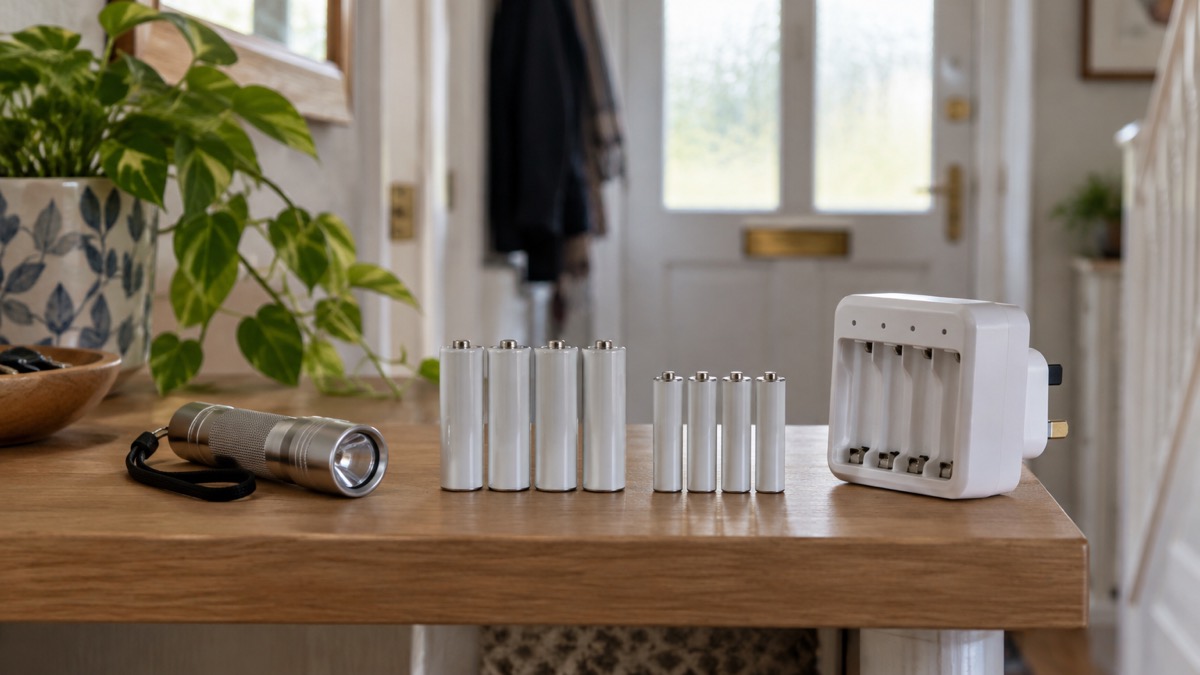
Capacity is the figure that decides how long a battery runs a device, and Panasonic quotes it two ways. The product page gives a minimum of 1900 mAh for AA and 750 mAh for AAA2. The detailed specification page gives up to 2000 mAh for AA and up to 800 mAh for AAA, with the minimum figures of 1900 mAh and 750 mAh measured to the IEC 61951-2 2017 standard1. The maker notes that capacity may vary by shipping area, which is why both a higher and a lower figure appear3.
In plain terms, the minimum is the number to plan on. A cell rated at least 1900 mAh will run a small LED torch or a portable radio for a useful stretch, and the maker publishes indicative run times for its AA cell: approximately 5 hours, 7 hours or 2.5 hours in an LED light depending on the device tested1. Those are maker test figures, not a promise for your particular torch, but they show the order of magnitude.
The range also includes cells with different capacities, and the differences are worth knowing when you are choosing what to keep:
| Cell | AA capacity | AAA capacity | Best suited to |
|---|---|---|---|
| eneloop (standard) | min. 1900 mAh, up to 2000 mAh2 | min. 750 mAh, up to 800 mAh2 | General kit: torches, radios, remotes |
| eneloop pro | 2500 mAh, min. 2450 mAh2 | min. 930 mAh / min. 900 mAh2 | High-drain devices used hard |
| eneloop lite | min. 950 mAh2 | min. 550 mAh2 | Clocks, mice, remote controls |
The maker states that eneloop pro lasts about 1.3 times longer per use than standard eneloop, though this varies with the device and how it is used3. Higher capacity generally means fewer recharge cycles before the cell wears out, which is why the pro and lite ranges carry different cycle figures.
They hold 70% of their charge after ten years in storage
A rechargeable battery is only useful in an emergency if it still has power when you reach for it. Panasonic states that standard eneloop retains 70% of its capacity after ten years in storage at 20 °C2. The maker also states that fully charged eneloop batteries can be used after several years in storage, depending on the storage environment3.
The storage claims differ across the range, and the differences are large enough to affect how you keep a kit:
| Cell | Storage claim | Condition |
|---|---|---|
| eneloop (standard) | 70% capacity after ten years2 | Stored at 20 °C |
| eneloop lite | 70% capacity after five years2 | Stored at 20 °C |
| eneloop pro | 85% capacity after one year2 | Stored at 20 °C |
The lesson for a household is straightforward. Standard eneloop is the range to leave in a drawer as a long-term reserve, because its retention figure is measured over the longest period. The pro cell holds a higher proportion but for a much shorter time, so it suits a device in regular use rather than a box in the loft. The lite cell sits in between and is aimed at low-drain items.
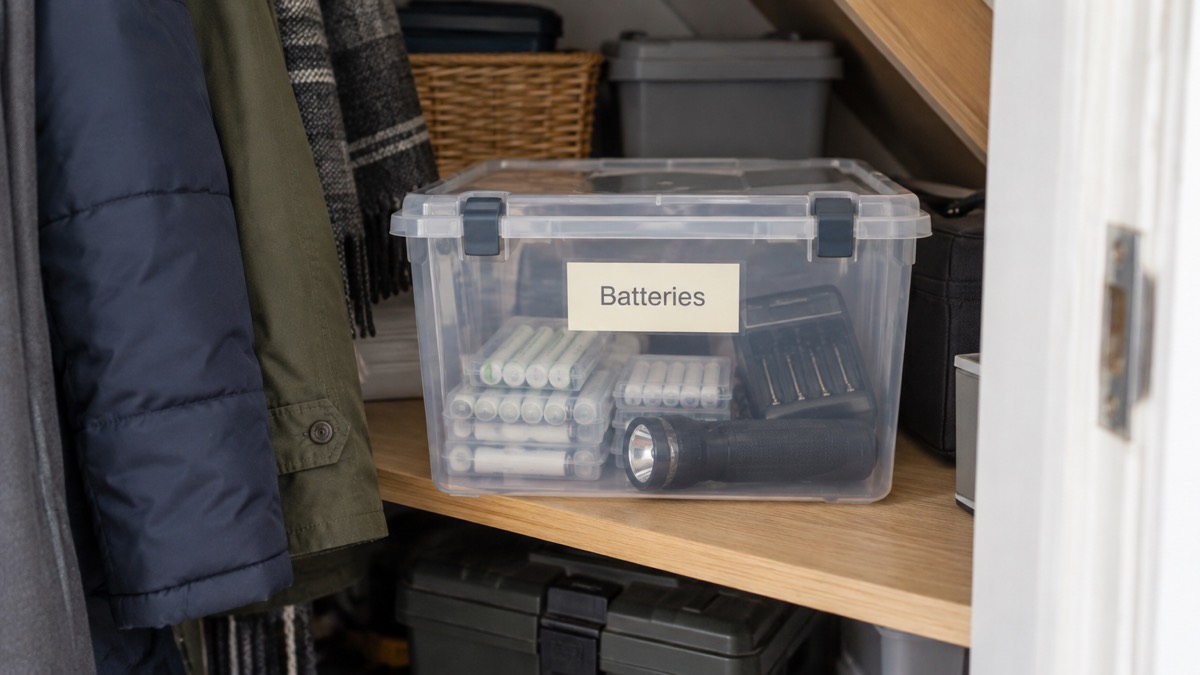
Temperature is part of the claim: the ten-year figure is given for storage at 20 °C2. A loft that swings from freezing to very hot is not that environment, so a cupboard inside the house is a better home for a reserve set. The maker's working range of -20 °C to 50 °C tells you the cells will still operate in a cold car or a hot shed, but it does not promise the same retention over a decade1.
Cycle life: up to 2,100 charges, or about 600 under the stricter test
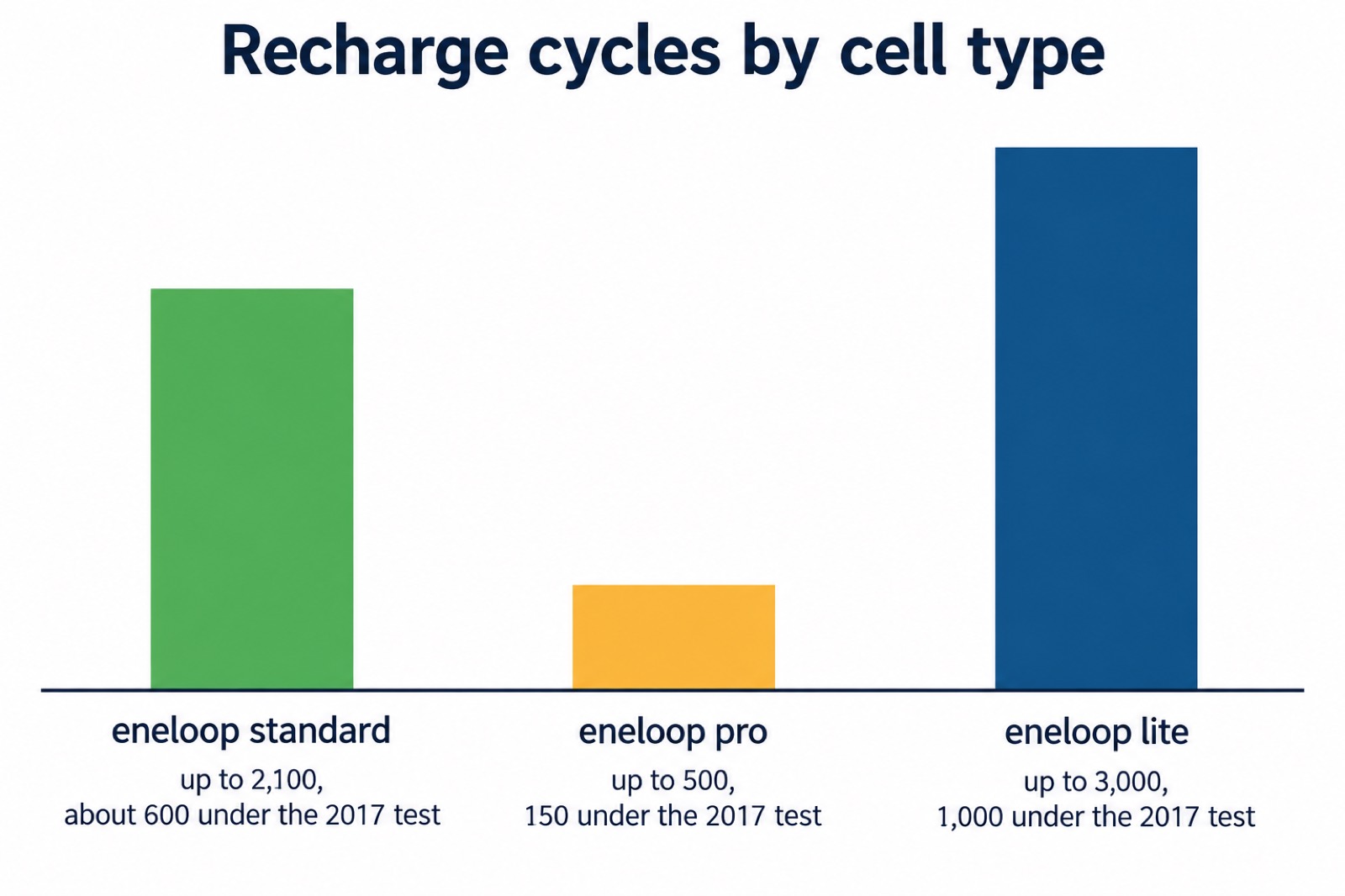
How many times a cell can be recharged before it fades is quoted by Panasonic in two ways, and the gap between them is worth understanding. The maker states that eneloop can be recharged up to 2,100 times, a figure based on testing to the earlier IEC 61951-2 2011 standard2. It also states that under the 2017 revision of that standard, which uses more stringent conditions intended to reflect real-world use, the number of cycles is approximately 6003.
Both figures come from the same maker and describe the same cell under different test regimes. The 2017 revision lowered the estimate from up to 2,100 to approximately 6003. Neither is a guarantee for your usage; they are laboratory results. For planning, the lower figure is the safer assumption: a set charged once a week would still last years at 600 cycles.
The other cells in the range carry their own figures:
| Cell | Cycle life (earlier test) | Cycle life (2017 test) |
|---|---|---|
| eneloop (standard) | Up to 2,1002 | Approximately 6003 |
| eneloop pro | Up to 5002 | 1502 |
| eneloop lite | Up to 3,0002 | 1,0002 |
The pattern is consistent: the higher the capacity, the fewer the cycles. A pro cell stores more energy but wears out sooner, while a lite cell trades capacity for a very long service life. For an emergency kit used occasionally, any of these figures is generous. For a device charged every day, the cycle count becomes the deciding number.
Working temperatures from -20 °C to 50 °C
Panasonic states that eneloop batteries are rated for use in temperatures between -20 °C and 50 °C, and that the cell is more resistant to the effects of cold and can work in temperatures as low as -20 °C1. That range covers a British winter night in an unheated car, a cold porch or a garage, and the heat of a summer glovebox, which is more than can be said for many disposable cells.
The practical point is that a torch left in the car or a radio kept in a shed should still work when you need it. Cold slows the chemistry of most batteries and reduces the voltage they deliver, so a cell that performs at -20 °C is a sensible choice for a kit stored outside the heated part of the house. The maker states that eneloop is more resistant to the effects of cold and can work in temperatures as low as -20 °C2.
Heat is the other end of the range. A cell rated to 50 °C will survive a hot day, but sustained heat is not kind to any battery, and the maker's storage claim is measured at 20 °C2. Keep a reserve set out of direct sun and away from radiators, and the cells will hold their charge closer to the published figure.
For households in Scotland, Wales and Northern Ireland the advice is the same as in England: the temperature range is a property of the cell, not of where you live. What differs is the weather the kit has to cope with, and a battery that works at -20 °C covers the coldest conditions any part of the UK is likely to see in a domestic setting.
Charging and replacing batteries as a set
Panasonic's own instructions for charging are simple and worth following exactly. The maker states that when using eneloop batteries you should ensure you charge them all together at the same time, and replace all the batteries used for the device at the same time3. It also advises buying a set of eneloop batteries for use exclusively in a device that takes multiple cells, for best performance3.
The reason is balance. Cells in a device work as a team, and a weak or part-charged cell drags the others down and can be driven into reverse by them. The maker warns that incorrect insertion of one battery may cause others in the series to charge it, leading to heat generation, leakage or battery rupture3. Matching cells and replacing them as a set avoids that.
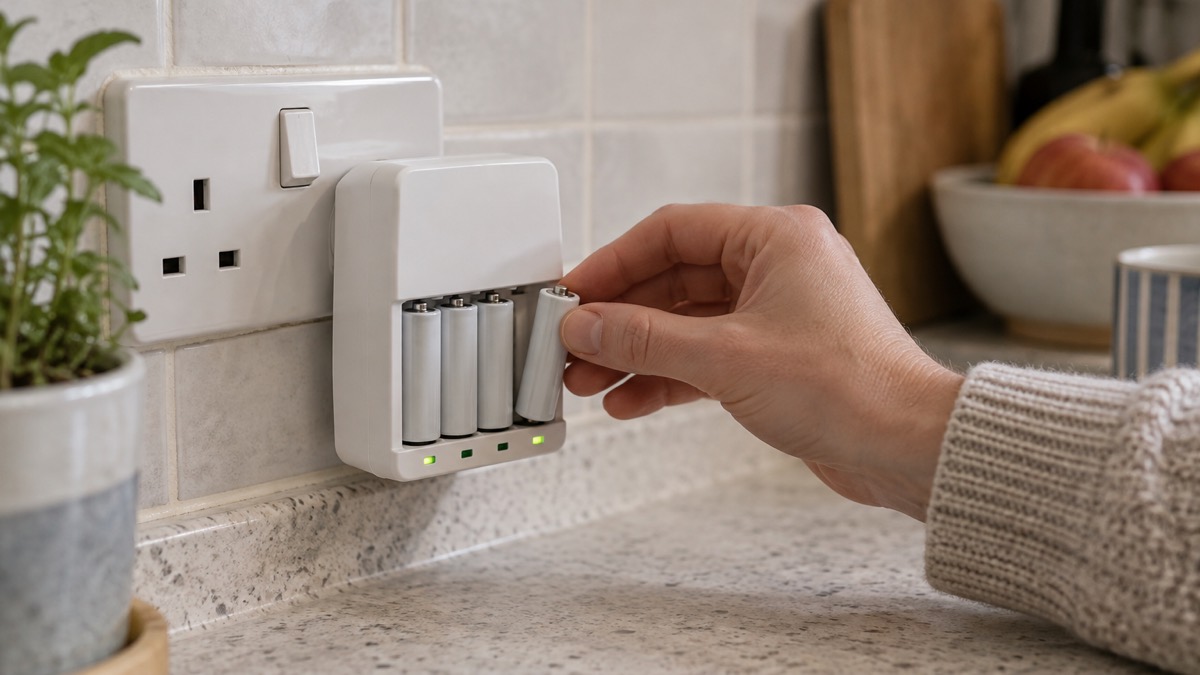
On topping up, the maker states that its battery and charger technology suppresses the memory effect, so batteries can be topped up at any time without reducing capacity1. You do not need to run a cell flat before recharging it. A sensible routine for a kit is to charge the whole set together before winter, then top up any set that has been used.
If you use eneloop AA cells in a spacer to fit a C or D-size device, the maker gives a specific instruction: only use eneloop in the spacer, do not use alkaline batteries, and when using two or more spacers ensure the inserted batteries have the same capacity, date of manufacture and remaining capacity3.
Where eneloop must never go: airtight and waterproof devices
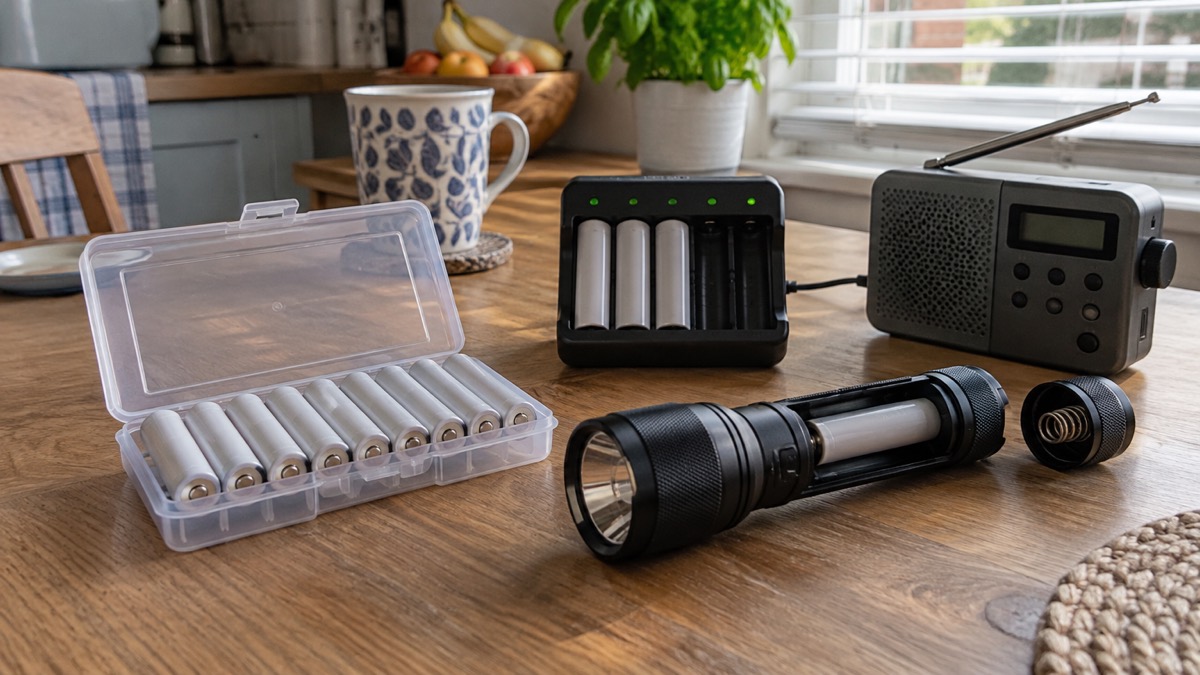
This is the one hard limit on where eneloop can be used, and it is easy to overlook. Panasonic states that eneloop cannot be used in devices with airtight battery compartments, such as waterproof torches1. The maker's explanation is that over-discharge releases hydrogen gas which cannot diffuse away in a sealed compartment and creates a risk of explosion if ignited3.
A waterproof torch is exactly the sort of thing a household might buy for an emergency kit, so check before you load one. If the battery compartment seals with an O-ring or a screw cap and the maker describes the torch as waterproof or submersible, it is not the place for an eneloop cell. Use the battery type the torch maker specifies instead.
The same caution applies to any device with a sealed battery bay: some waterproof radios, marine equipment and sealed garden lights. If you cannot see how gas would escape, treat it as unsuitable. The maker's instruction is specific to eneloop, but the underlying chemistry applies to sealed nickel-metal hydride cells generally.
Away from that limit, the maker's other handling instructions are ordinary good practice: do not disassemble a cell, and keep batteries out of reach of children1. If a child does swallow a battery, the NHS advises seeking help urgently; button batteries are a particular hazard7.
Recycling worn-out batteries
When a cell finally stops holding charge, it does not go in the household bin. Fire and rescue services warn that batteries thrown into general waste can cause fires in bin lorries and at recycling centres when they are punctured or crushed8. The advice is to recycle them at a designated recycling point8.
There are several easy routes, and they apply to eneloop just as they do to any other household battery:
- Shops that sell batteries. The NHS advises that anywhere selling batteries, such as a supermarket, should offer a collection point for old ones7.
- Electrical recycling points. Fire services advise using a recycling locator to find your nearest electrical recycling point, often in supermarkets and shops, or checking your council website to see whether it collects batteries9.
- Household waste recycling centres. For devices with a battery that cannot be removed, the advice is to recycle the whole item at a household waste recycling centre or through a WEEE collection point10.
Panasonic notes that in the EU, for example, stores selling over 35 kg of batteries a year must have a designated recycling point3. UK shops commonly offer the same service even where the rule differs, so the simplest habit is to keep a small tub for spent cells and drop them off with the weekly shop.
Specifications at a glance
| Specification | AA | AAA |
|---|---|---|
| Rated voltage | 1.2 V1 | 1.2 V1 |
| Capacity | min. 1900 mAh, up to 2000 mAh2 | min. 750 mAh, up to 800 mAh2 |
| Diameter | 14.5 mm1 | 10.5 mm1 |
| Height | 50.5 mm1 | 44.5 mm1 |
| Operating temperature | -20 °C to 50 °C1 | -20 °C to 50 °C1 |
| Storage retention | 70% after ten years at 20 °C2 | 70% after ten years at 20 °C2 |
| Cycle life | up to 2,100, about 600 under the 2017 test2 | up to 2,100, about 600 under the 2017 test2 |
| Made in | Japan1 | Japan1 |
The maker states that a digital camera equipped with eneloop AA cells can take 4.4 times as many shots before running out as one equipped with standard alkaline cells1. That is a maker comparison for one device type, but it illustrates the general point: a rechargeable cell holds its voltage better under load than an alkaline that sags as it drains.
Where to get help and what to do next
For a household building a kit, the practical steps are short. Buy a set of standard eneloop AA and AAA cells and a charger, charge the whole set together, and keep it in a dry cupboard indoors with a torch and a radio. Check that none of your devices has a sealed, waterproof battery compartment before you load a cell into it. Before winter, top up the set and test the torch.
If you are widening the kit beyond batteries, the rechargeable AA and AAA batteries and chargers guide sets the options side by side, and the power cut backup power checklist lists what to have ready. For lighting specifically, emergency lighting at home covers torches, lanterns and candles, and power cuts: a household guide explains what happens and for how long.
Panasonic's own product and support pages carry the full range, the detailed test conditions behind each figure and the maker's handling instructions2. Where a retailer lists a different capacity from the maker, the maker's figure is the one to rely on, and the maker notes that capacity can vary by shipping area3.
Sources (10)
- eneloop product specifications, Panasonic, 2026
- eneloop lineup, Panasonic, 2026
- eneloop FAQ, Panasonic, 2026
- Emergency kit, Scottish Government Ready Scotland
- Safety in severe weather conditions, Devon and Somerset Fire and Rescue Service
- Storm damage: how to protect your home from a thunderstorm, Which?, 2026-10-21
- Swallowed something, Alder Hey Children's NHS Foundation Trust, 2025-09-25
- Recycle your batteries to prevent fires, Devon and Somerset Fire and Rescue Service, 2024-03-15
- Recycle your electricals campaign, North Yorkshire Fire and Rescue Service, 2024-05-01
- Lithium battery fire safety, Mid and West Wales Fire and Rescue Service, 2026-10-26