
Panasonic is one of the names most UK households already have in a drawer, usually without thinking about it: the AA and AAA cells in the torch, the radio, the smoke alarm. For emergency preparedness, that is exactly where the maker matters. When the power goes off, the kit that carries you through the first hours, a torch, a battery radio, a working smoke alarm, runs on batteries, and the quality and condition of those cells decides whether it works when you reach for it.
This page sets out what Panasonic makes that bears on a household emergency plan, chiefly its EVOLTA alkaline batteries, and how to choose, store, charge, recycle and check them. It also covers the safety rules that apply to any battery in your emergency kit, from the fire and rescue services, and how to register products and check for recalls. For the wider picture of what to keep ready, start with the emergency kit guide, and for the moment the lights go out, the power cuts guide.
What Panasonic makes for UK households
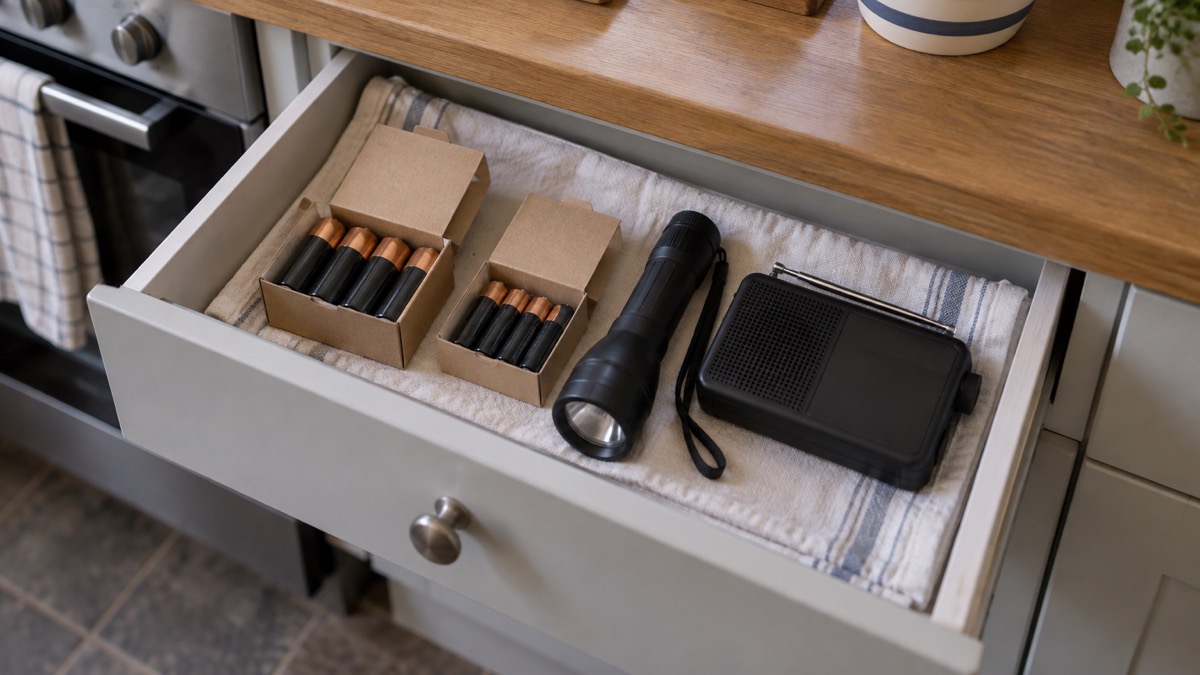
For a household building an emergency kit, Panasonic's relevant product line is its batteries: the EVOLTA range of alkaline cells in the familiar sizes, AA, AAA and the rest, that power torches, radios, remote controls and smoke alarms. The maker describes EVOLTA as its No.1 longest-lasting alkaline battery among Panasonic batteries, based on IEC discharge test results on Panasonic batteries sold in your country5.
The engineering behind that claim matters for prepping because it is about two things a stored battery needs: lasting power in use, and staying usable after years in a drawer. Panasonic says the EVOLTA can is an ultra-thin can with varying wall thickness and a strengthened gasket structure, creating space for more active ingredients, and that a homogenous fill process fits more active ingredient inside5. The cathode uses high-purity manganese dioxide with a titanium additive, which the maker says gives smooth discharge and extended storage life; the titanium additive is added to all sizes excluding 9 V batteries and AA/AAA sizes in some countries or regions5. A strengthened internal structure and a tough outer coating, using a nickel-iron alloy Panasonic calls Special Tough Coating to reduce contact resistance, are said to significantly improve impact resistance5.
Alongside single-use alkaline cells, many UK households own devices with rechargeable lithium-ion batteries, in mobile phones, vaping devices, e-bikes and scooters, vacuum cleaners, tablets and ear pods8. Those batteries are usually made by the device maker rather than bought separately, but the same household often charges and stores them, and the safety rules in the later sections of this page apply to them. If your preparedness plan includes a backup power arrangement or a home emergencies kit, batteries of both kinds are part of it.
Batteries for torches, radios and alarms
Single-use alkaline batteries are the quiet backbone of an emergency kit. Fire service guidance notes they are used in items like watches, remotes, toys and smoke alarms6, and every UK emergency kit list includes spare batteries alongside the torch: the Scottish Ready campaign's home emergency plan lists light as "Torch. Batteries."1, the UK Be Ready checklist includes a torch and spare batteries2, and local authority guidance across England, Scotland and Wales says the same, whether it recommends a wind-up torch or a battery powered one9.
For a prepping household, three things decide which batteries to buy and how many:
- What they must power. Torch, radio and smoke alarm are the core three. A torch left on for an evening during a power cut uses far more battery than a radio, so spare cells for the torch matter most.
- How long they store. Panasonic states its EVOLTA batteries are designed for extended storage life when unused and properly stored, with 9 V batteries excluded from that claim5. That is the maker's own statement for its own product, and it is the figure to plan around when you date-stamp a kit.
- How they behave in the device. The maker's claim of smooth discharge from the titanium additive cathode5 is relevant to a smoke alarm or a torch, where you want steady output rather than a sudden fade.
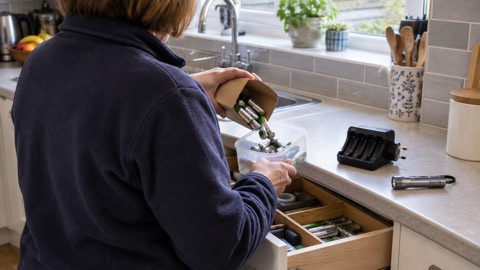
Keep batteries in their original packaging until use, somewhere you can find them in the dark, and check them when you refresh the rest of your kit. Fire service guidance is to regularly check for signs of damage like swelling, leaks or strange smells, and to stop using damaged batteries immediately6. For the full kit list and how to store it, see the emergency kit guide.
One battery type deserves special care with children in the house: button batteries, the small round cells in car key fobs, small remote controls, gaming headsets, kitchen and bathroom scales, calculators, children's toys, thermometers and musical books and cards12. NHS guidance treats them as a swallowing hazard for small children, so keep spare button batteries and the devices that use them out of reach, and check that battery compartments are screwed or firmly closed12.
Rechargeable batteries and chargers
Rechargeable batteries are a different animal from alkaline cells, and they suit a different part of your plan. Fire service guidance lists them in phones, e-bikes, e-scooters, mobility scooters, laptops, vapes and power tools6, and notes that lithium-ion rechargeable batteries are found in household electrical items such as mobile phones, tablets, laptops, mobility scooters, e-bikes, e-scooters, vapes, hover boards, electric toothbrushes and some children's toys and books14. Other fire and rescue services add laptop computers, mobile phones, children's toys, e-scooters and e-cigarettes to that list15.
For prepping, rechargeables have a clear strength and a clear limit. The strength: a set of rechargeable AA cells plus a charger, or the lithium-ion pack inside a power station, can be topped up repeatedly, so you are not counting down a finite store. The limit: they need a source of power to recharge, so during a long outage they eventually run down like everything else. That is why official kit lists pair a wind-up or battery option with spares rather than relying on one technology9.
The single most important instruction, from several fire and rescue services, applies to every rechargeable battery and charger you own: always follow the manufacturer's instructions for using, charging, storing and disposing of rechargeable batteries6. That means the maker's own instructions for its own product, and for batteries you buy separately, the charger maker's instructions. Charge the device on a flat, solid and stable surface, such as a kitchen worktop17. The detailed charging and storage rules are in the safe charging section below.
If your plan includes a rechargeable torch or a power station, read the backup power guide for how these fit a household plan, and the lighting guide for how torches and lanterns compare.
Torches and emergency lighting
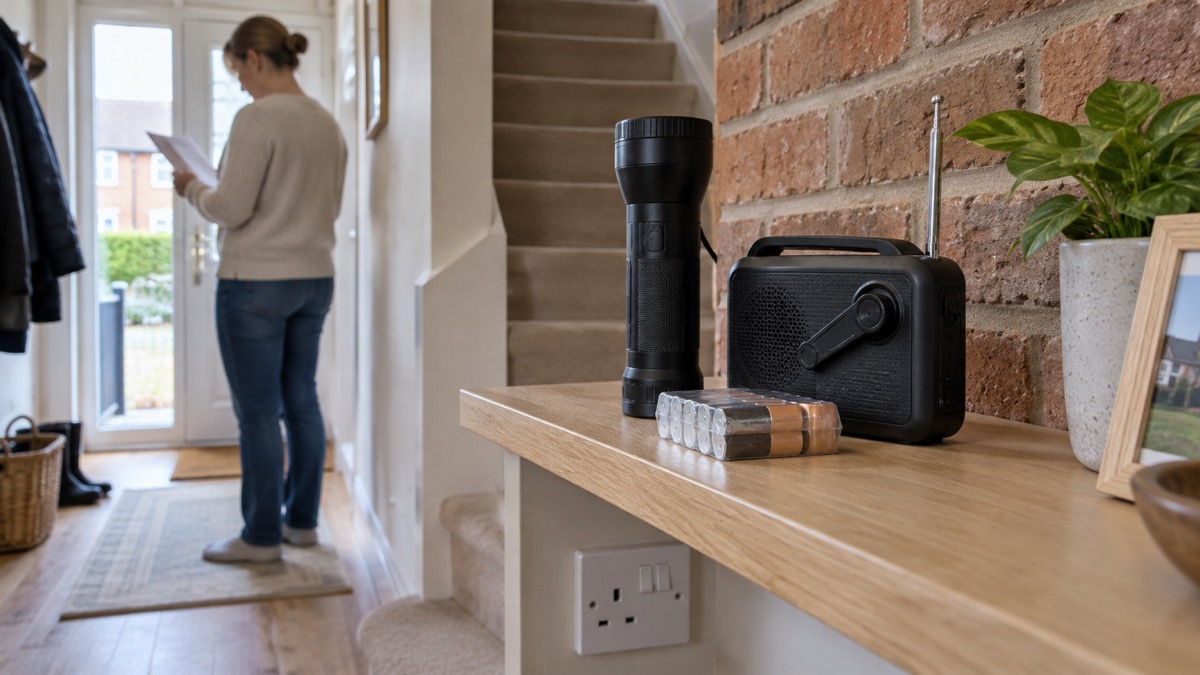
Every official UK source agrees on the core item: a torch, with spare batteries if it is not a wind-up model. Nottinghamshire's guidance is typical: a torch with spare batteries if not wind up, kept in the home, with candles and matches kept out of reach of children9. Dumfries and Galloway recommends a wind-up torch or a battery powered torch10, Wiltshire and Swindon Prepared a battery-operated torch or a wind-up one11, and Cornwall's advice for snow and ice is to keep torches and any batteries to hand in case lighting fails or you need to switch off power18.
The consistent message across these sources is that torches are safer than candles. The UK government's Household Emergency Plan says plainly that torches are safer3, Cheshire Fire and Rescue Service says a battery or wind-up torch is safer than candles19, and Sussex resilience guidance says to use torches or battery-powered lights instead of candles, which can be a fire risk20. If you do keep candles as a back-up, keep them out of reach of children9, and see the lighting guide for the full picture.
Where do Panasonic batteries fit? A battery-powered torch takes standard cells, and the battery you choose decides how long it runs and how well it runs after months in a drawer. Panasonic's EVOLTA claims, longest-lasting among its own alkaline range and extended storage life when unused and properly stored5, are the maker's own statements, and they are the right things to look at when choosing cells for the torch that lives in the emergency kit. Buy enough spare cells for several evenings of light, store them with the torch, and rotate them into everyday use when you refresh the kit.
For households with a caravan, motor home, campervan or tent, Humberside Fire and Rescue Service advises keeping a working torch or battery-operated lamp easily accessible to avoid using candles during power outages21. The same rule applies at home.
Radios for power cuts
After light, the next thing a power cut takes is information. Official guidance is to keep a battery or wind-up radio, with spare batteries, at home, because updates may be communicated by radio during a power cut22. The Scottish Ready campaign adds practical detail: if the power is out, use a battery-powered or wind-up radio, try both digital and FM stations, and while you can also use a car radio, in severe weather it might be safer to stay indoors23. Welsh community guidance recommends a wind-up, battery or solar radio so you can listen to local radio updates24.
A battery radio runs on the same standard cells as your torch, so the same battery choice applies. Keep spare batteries dedicated to the radio as well as the torch, and write down radio station frequencies on paper, as official power cut guidance suggests22, because you will not be able to look them up online. The staying informed guide covers how to keep in touch more broadly, including mobile phones and the 105 power cut number4.
A wind-up radio removes the battery question altogether, and several official kit lists offer wind-up as an alternative to battery power for both torch and radio9. A sensible household plan uses both: a wind-up radio for indefinite listening, and a battery radio with fresh Panasonic cells as the effortless option for the first hours, when you want news without cranking.
Safe charging and battery storage
Most battery fires are preventable, and the rules come from the fire and rescue services. Mid and West Wales Fire and Rescue Service states that covering devices while charging traps heat and increases fire risk and can cause overheating25. Manchester Fire and Rescue Service puts the charging rule directly: charge on a hard, flat, heat-resistant surface, away from extreme heat, cold, direct sunlight and flammable materials, and never cover batteries while charging, as this can cause overheating and start a fire6. Devon and Somerset Fire and Rescue Service adds: do not cover chargers or battery packs when charging, as this could lead to overheating or even a fire26.
The full set of habits for a household that keeps rechargeable batteries in its kit:
- Charge in a safe, visible location, away from flammable materials or escape routes, on a flat, solid surface such as a kitchen worktop16.
- Never charge unattended overnight or while you are out, and never cover a charging device or charger6.
- Keep batteries and devices at room temperature, away from extreme heat, cold and direct sunlight6.
- Check regularly for swelling, leaks or strange smells, and stop using damaged batteries immediately6.
- Follow the maker's instructions for using, charging, storing and disposing of every rechargeable battery you own6.
West Yorkshire Fire and Rescue Service summarises the same rules: don't cover devices while charging and always place them on a flat, solid surface27. The national picture is serious enough that Devon and Somerset Fire and Rescue Service runs a "Charge Safely, Sleep Soundly" campaign to encourage safe charging and storage, raise awareness of lithium-ion battery fire risks, and reduce fires and injuries caused by lithium-ion batteries28.
For households with e-bikes, e-scooters or mobility scooters in their preparedness thinking, the same rules apply with more force, because the batteries are larger. Cheshire Fire and Rescue Service advises using manufacturer take-back schemes or checking your local authority recycling services for battery disposal, and checking whether products are subject to a recall29. Devon and Somerset Fire and Rescue Service also advises registering your product with the manufacturer to validate warranties, noting batteries are usually included in warranties26.
Replacing and recycling used batteries
Batteries do not last forever, and an emergency kit with dead cells is worse than no kit, because it creates false confidence. Two rhythms matter: replacing cells before they fade, and recycling them properly afterwards.
For replacement, date your kit. When you add batteries, write the month and year on the packaging, and swap them into everyday use and replace the spares on a schedule you will actually keep. Panasonic's storage life claim for EVOLTA, when unused and properly stored, with 9 V excluded5, gives you the maker's own horizon for how long spares can sit. Check stored batteries for swelling, leaks or strange smells each time you review the kit, and stop using any damaged battery immediately6.
For disposal, never put batteries in the household bin. West Yorkshire Fire and Rescue Service advises using official recycling points: drop off batteries at designated collection points in shops and supermarkets, or check with your local authority27. Lincolnshire guidance adds that removable batteries should be recycled separately from the device, and can be disposed of at a battery recycling point or household waste recycling centre15. For larger lithium-ion packs, such as those in e-bikes, use manufacturer take-back schemes or your local authority's recycling services29.
A household battery recycling routine looks like this:
- Keep a small container for used batteries, out of reach of children, and take it to a shop or supermarket collection point when it fills27.
- Remove removable batteries from a device before recycling the device, and recycle each separately15.
- Tape over the terminals of used lithium-ion cells if the recycling point asks for it, and follow that point's instructions.
- Take damaged or swollen batteries to a recycling point promptly rather than storing them; stop using them immediately6.
Panasonic support and warranty in the UK
Support for batteries and small electrical items works through registration and proof of purchase, and the official advice is to register. Peterborough Trading Standards strongly recommends registering your appliances, so that if a safety issue comes to light the company can contact you30. Manchester Fire and Rescue Service says the same: register your electrical items with the manufacturer to be informed of any safety recalls31, and North Yorkshire Fire and Rescue Service points households to registermyappliance.org.uk to receive updates on faults and recalls7.
To register an appliance you typically need the model name or number, the serial number and the purchase date32. Keep your receipt or order confirmation with those details, and write the whole set into your household emergency plan so it survives a house move or a lost drawer. The getting started guide shows how a household plan holds this kind of information.
For the batteries themselves, the maker's performance claims are stated as IEC discharge test results on Panasonic batteries sold in your country5, so claims you see in UK retail should reflect UK-tested product. If you have a problem with a product, the route is the retailer or manufacturer: Scottish Fire and Rescue Service guidance on recalls notes that if you have concerns about an appliance's safety, contact the retailer or manufacturer32.
Safety notices and recalls: how to check your product
Recalls of battery-powered kit do happen, and two recent examples show the pattern. A YIYUANJI rechargeable torch sold with four 18650 rechargeable batteries and a four-slot USB charger was made subject to a product safety report; the batch number is Torch FL06 - C218 - T122, with PSD notification number 2408-0050, and the report found the instructions supplied with the product were inadequate because they did not contain adequate safety information and details to ensure correct and safe use33. The official advice to owners is blunt: stop using the product immediately and contact the distributor you purchased from to request redress33.
More recently, a Valiant radiator fan sold via Amazon, eBay, Temu, B&Q, Debenhams, The Range and TikTok Shop was recalled, covering batches 967, 968 and 970, located on the packaging next to the bar code and on the label on the base of the product, with PSD notification number 2510-023835. Neither notice involves Panasonic products, but both show why the checking habit matters for anything battery-powered or electrical in your kit.
How to check your own products:
- Register them. Register appliances at registermyappliance.org.uk so the maker can contact you about faults and recalls7.
- Check the recall lists. Cheshire Fire and Rescue Service advises checking whether products are subject to a product recall on the Electrical Safety First website or the government website29.
- Check the marks. Only buy electrical items from reputable sellers and check they display a UKCA or CE safety mark31. For power tool batteries, always source a battery from the same manufacturer as your power tool and make sure the battery has a CE or UKCA mark30.
- Act on a match. If an appliance is not listed as recalled it should be safe to use; if you have concerns about its safety, contact the retailer or manufacturer32. If it is listed, stop using it and contact the distributor for redress33.
Where this fits your household plan
Panasonic's contribution to a prepared household is deliberately unglamorous: reliable cells for the torch, the radio and the smoke alarm, with a storage life that lets a kit sit ready for years. Build the kit around that. A torch and spare batteries, a battery or wind-up radio, spare cells for both, and a written note of radio frequencies and the 105 power cut number4 cover the first evening of almost any outage. Add the charging habits from the fire and rescue services for everything rechargeable in the house, registration for anything electrical, and a recycling routine for what you replace.
The guides that take this further are the emergency kit page for the full list, lighting for torches, lanterns and candles, staying informed for radios and communications, and power cuts for what to do the moment the lights go out.
Sources (35)
- Home emergency plan, Ready Scotland
- Be Ready checklist, UK government Be Ready campaign, 2026
- Household Emergency Plan, UK government Be Ready campaign, 2026
- Emergency home emergency plan, Royal Borough of Windsor and Maidenhead, 2026
- EVOLTA technologies, Panasonic, 2026
- Battery safety, Manchester Fire and Rescue Service
- Stay safe in the kitchen this autumn, North Yorkshire Fire and Rescue Service
- Lithium-ion batteries, South Wales Fire and Rescue Service, 2026
- Preparing for an emergency, Nottinghamshire County Council
- Prepare for emergencies, Dumfries and Galloway Council
- Personal resilience at home, Wiltshire and Swindon Prepared
- Button batteries, NHS South Yorkshire
- Early Years home safety, Carmarthenshire Family Information Service, 2024
- Stay safe with lithium batteries, Suffolk Fire and Rescue Service
- Electrical safety, Lincolnshire County Council
- Lithium battery fire safety, Torfaen County Borough Council
- Batteries, Humberside Fire and Rescue Service
- Snow and ice in Cornwall, Cornwall Council, 2025
- Be ready for emergencies, Cheshire Fire and Rescue Service, 2026
- Be ready, stay safe, act now, Sussex Resilience Forum, 2025
- Caravan, motor home and campervan safety, Humberside Fire and Rescue Service
- Power cuts, UK government Be Ready campaign, 2026
- Emergency plan, Ready Scotland, 2026
- Adverse weather events, Llangattock Community Council, 2026
- Lithium battery fire safety, Mid and West Wales Fire and Rescue Service, 2026
- E-bikes and e-scooters, Devon and Somerset Fire and Rescue Service, 2026
- Battery safety, West Yorkshire Fire and Rescue Service
- Charge Safely, Sleep Soundly campaign, Devon and Somerset Fire and Rescue Service, 2025
- Stay safe at home: e-bikes, Cheshire Fire and Rescue Service, 2026
- Product safety campaigns, Peterborough City Council Trading Standards
- Electrical safety, Manchester Fire and Rescue Service
- Electrical safety at home, Scottish Fire and Rescue Service, 2025
- Product safety report: YIYUANJI rechargeable torch, UK government, 2025
- Product safety report: YIYUANJI rechargeable torch sold via Amazon, UK government, 2025
- Product recall: Valiant radiator fan, UK government, 2025
 Panasonic eneloop Rechargeable Batteries