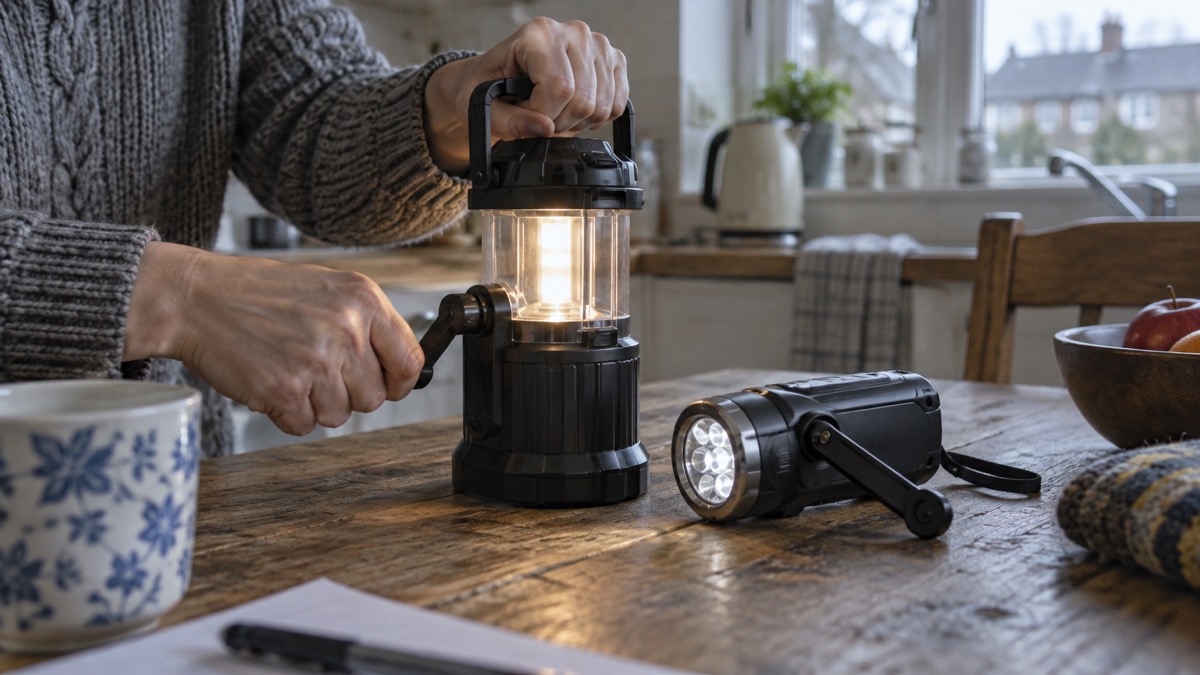
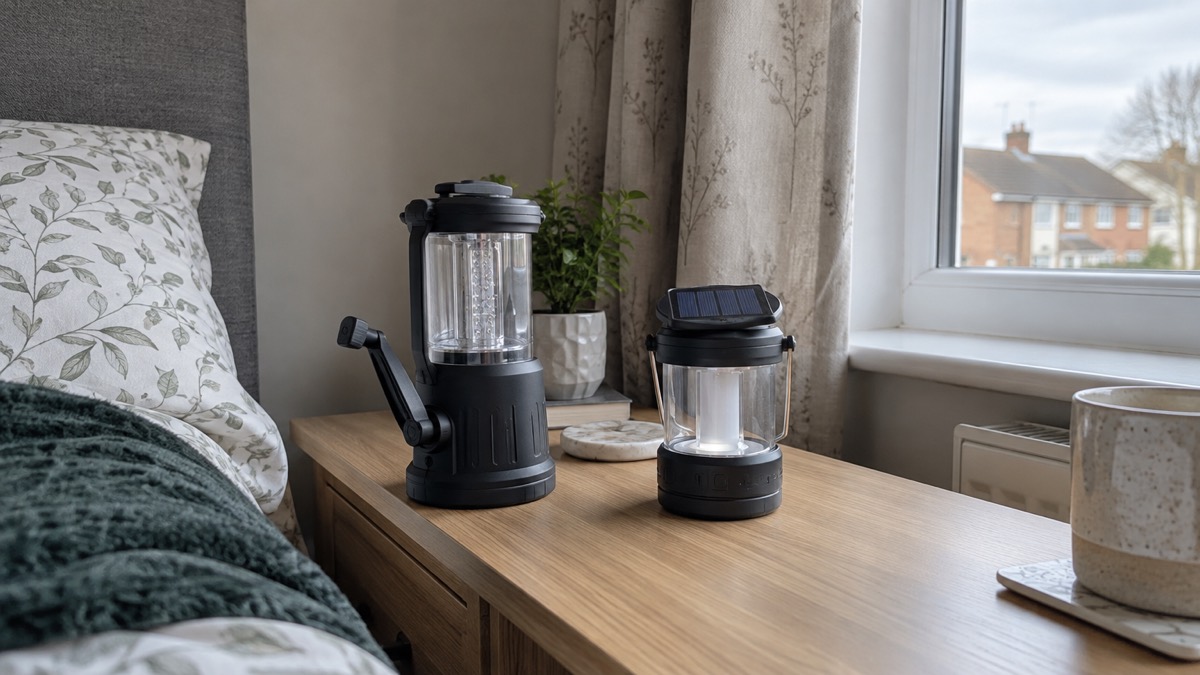
A light that never needs batteries is an attractive idea when the power goes off. Wind-up torches and lanterns are available which require no batteries at all: you turn a handle for a short while and the lamp gives you light1. Solar lanterns work the other way round, charging a small internal battery from daylight during the day and giving that light back at night. Both types mean you are not hunting for spare batteries in a dark cupboard, and official kit lists such as nidirect's household emergency kit for Northern Ireland include a battery or wind-up torch among the essentials2.
The fire and rescue services are clear about why this matters. During a power cut, firefighters can be called to fires started by candles or portable heaters, and the Scottish Fire and Rescue Service advises using battery-operated lights or torches as your alternative light source3. Devon and Somerset Fire and Rescue Service puts it more bluntly still: use a standing electric torch or battery-powered lights, because candles are a fire risk4. A wind-up or solar lamp gives you that light without depending on batteries you may have forgotten to replace.
This page covers what wind-up and solar lamps can and cannot do, how they fit into your household emergency kit, how to use and place any lamp safely, and how to make sure you hear about it if a lamp you own is ever recalled for a safety fault.
Wind-up torches and lanterns: light without batteries
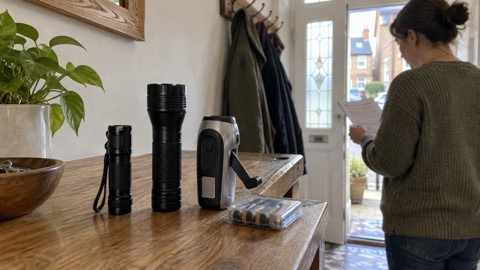
A wind-up torch, sometimes called a dynamo torch, has a small generator inside that is driven by a hand crank. Turning the handle charges an internal battery or capacitor, and that stored energy then powers the LED. The practical benefit is spelled out in official guidance on preparing for a loss of electricity: "Better still, wind up torches or lanterns are available which require no batteries at all"1. The same advice applies away from home. The Met Office's winter car kit guidance says a large torch with spare batteries, or a wind-up torch which does not require battery power, is essential for your vehicle9.
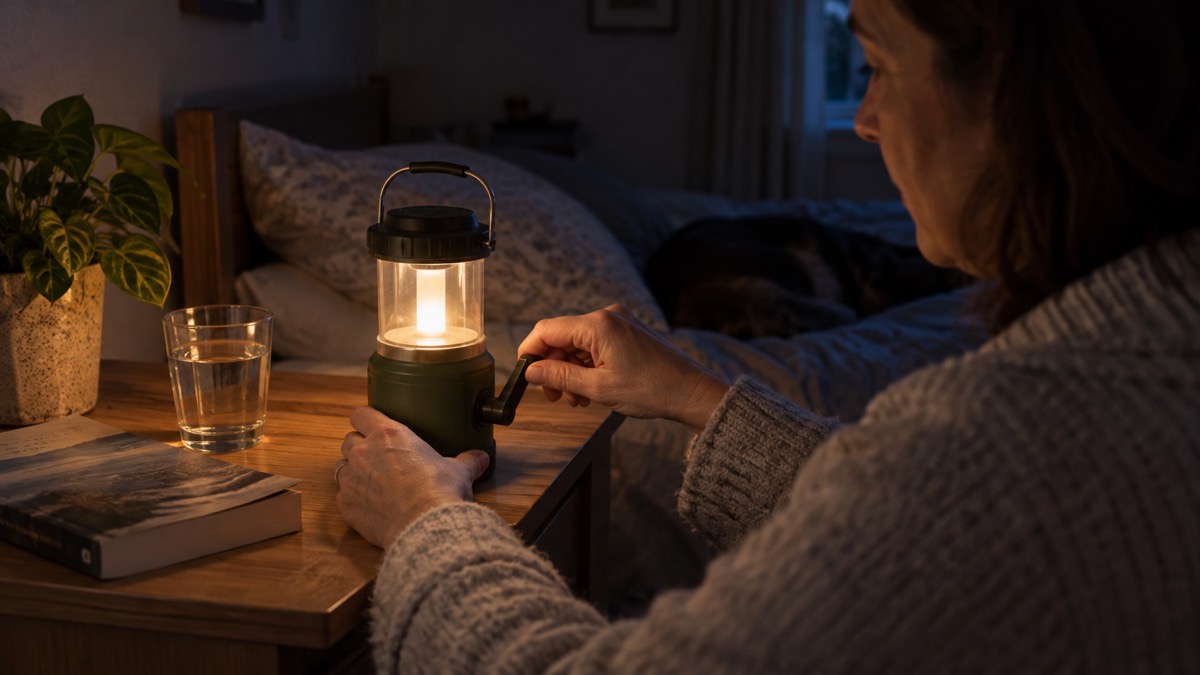
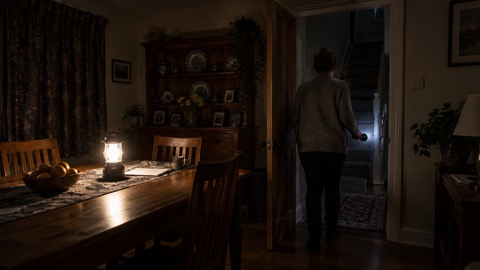
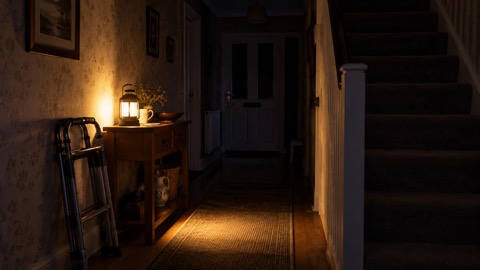
Wind-up lanterns, the larger room-lighting versions, work on the same principle and are a good choice for a hallway, landing or bedside. The NHS community equipment service advice for power cuts is to keep a battery-operated or wind-up torch somewhere easy to find5, and that applies equally to a lantern: the light is only useful if you can reach it without stumbling round a dark house. Our page on where to keep torches so you can find them in the dark covers this in detail.
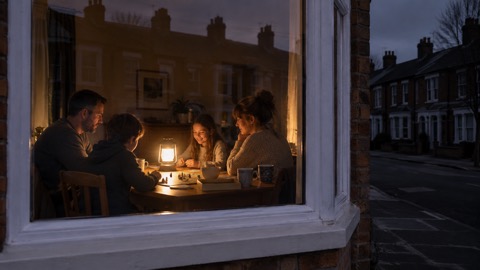
What a wind-up lamp will not do is give you hours of bright light from a few seconds of cranking. The energy you put in with your hand is small compared with what a set of batteries holds, so wind-up lamps suit short tasks, moving between rooms, and as a backstop when everything else has run flat. For lighting a whole room for an evening, a battery or rechargeable lantern holds more energy; see our guide to battery and rechargeable lanterns. The strongest position for most households is the one official kit lists take: a battery or wind-up torch, plus spare batteries, so one covers the other's weakness2.
Why a battery-free lamp helps in a power cut
The case for a light that needs no batteries rests on two things: batteries run down or sit unused until they are flat, and candles, the traditional fallback, are a genuine fire risk.
On the first point, official emergency kit lists treat wind-up items as the dependable option. The nidirect household emergency kit for Northern Ireland includes a battery or wind-up radio, a battery or wind-up torch and spare batteries2. Wiltshire and Swindon Prepared's at-home emergency kit is similar: a battery-operated or wind-up torch, a battery-operated or wind-up radio, emergency contact numbers on paper, a small first aid kit, bottled water, long-lasting snacks, copies of key documents and spare glasses10. A wind-up torch in that kit still works years after you packed it, whatever has happened to the batteries beside it.
On the second point, the fire services are consistent. The Scottish Fire and Rescue Service states: "During a power cut use battery-operated lights or torches as an alternative light source", and notes that during a power cut its firefighters can be called to fires started by candles or portable heaters3. Devon and Somerset Fire and Rescue Service advises a standing electric torch or battery-powered lights in severe weather "because candles are a fire risk"4. North Yorkshire Fire and Rescue Service, writing for camping, goes furthest: "Always keep a torch handy for emergencies and never use lighted candles"11.
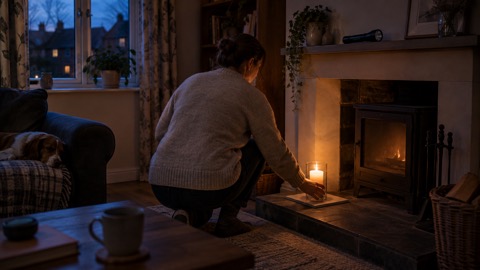
If you keep candles, treat them as a last resort behind torches and lanterns, and follow the candle safety advice on our candle fire safety page. The Northern Ireland Fire & Rescue Service advises keeping candles away from curtains and decorations, and recommends that when possible you opt for battery-operated candles instead of real ones12.
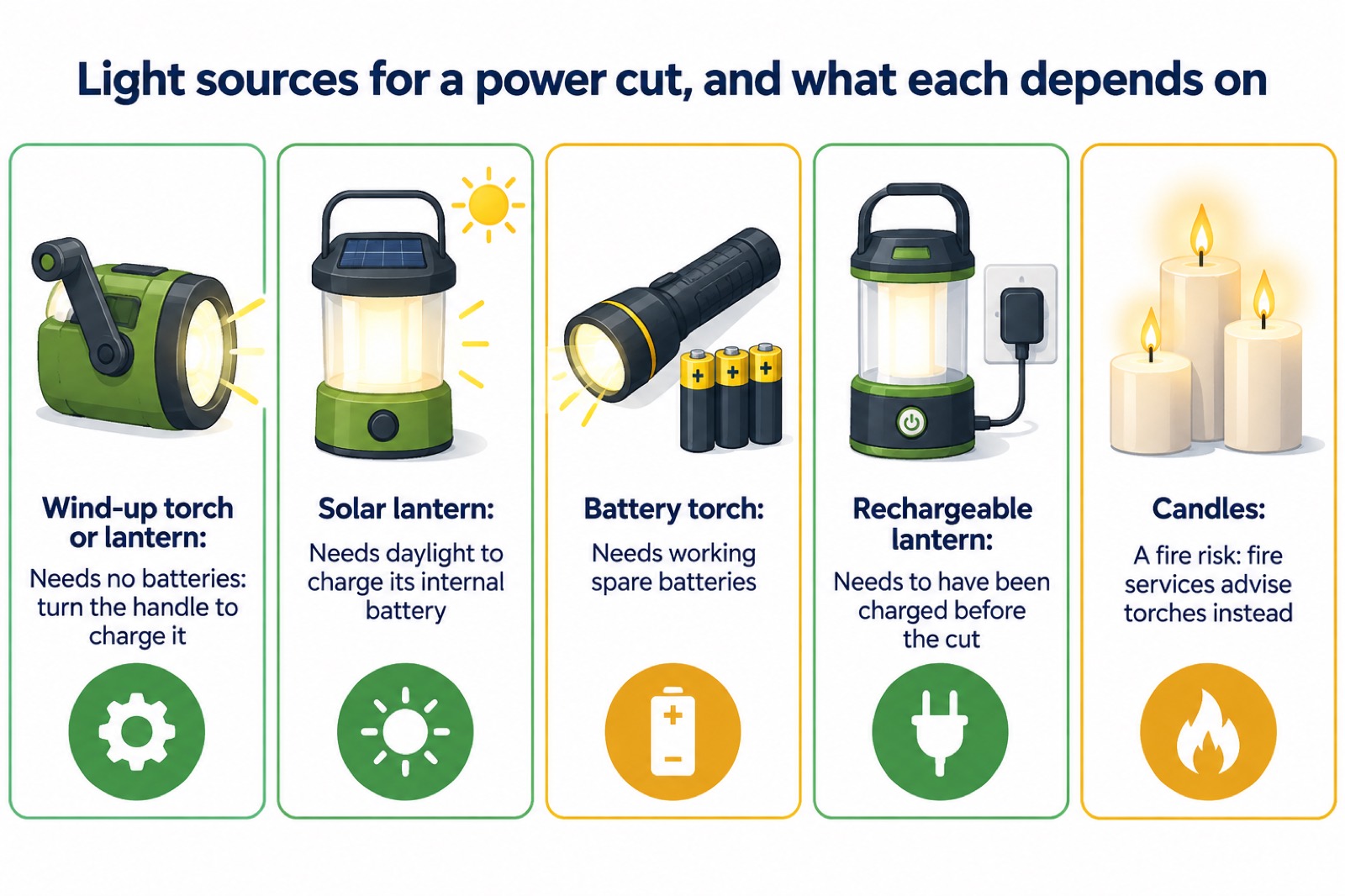
One point that catches many households out: rooftop solar panels will not normally power your home during a power cut. A parliamentary report on domestic micro-generation notes that householders might expect rooftop solar to provide electricity during a power cut, but this would not normally be possible without the installation of costly supplemental equipment such as batteries6. The government's power cut guidance adds that if you have solar panels and a battery storage system with power backup capability, some installations can continue to provide power during a power cut if they are designed and configured to operate independently of the grid13. A small solar lantern, by contrast, is entirely self-contained and unaffected by any of this.
Solar lanterns and solar torches in the UK
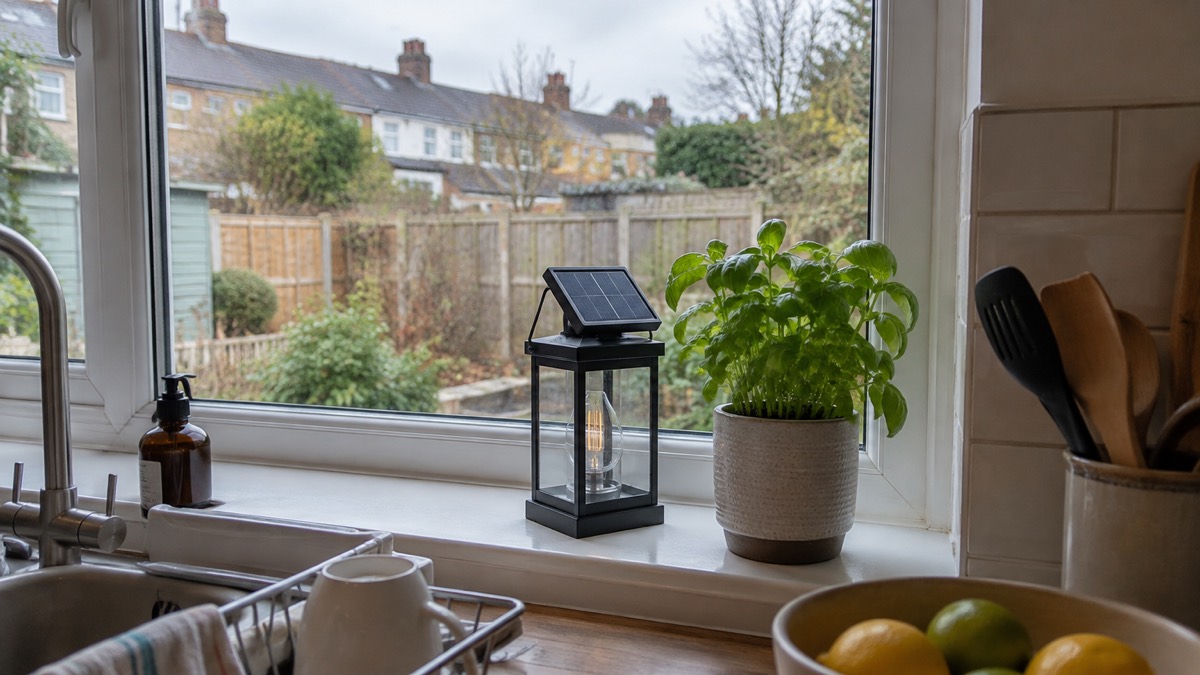
A solar lantern or solar torch has a photovoltaic panel on its top or side. Left near a window or outdoors in daylight, it trickle-charges its own internal battery, and that battery then powers the lamp after dark. Because the battery is built in, there is nothing to replace and nothing to forget, which is exactly what you want in an emergency light that sits in a drawer for months.
Solar camping lanterns are a well-established category, sold by camping equipment makers for use on the campsite. Lanterns of this kind are designed to be charged on a tent table or hanging outside during the day and used in the tent at night, which is the same pattern that suits a windowsill at home.
The honest limitation for UK households is daylight itself, and in winter there is less of it. A solar lantern left on a north-facing windowsill in December will charge far more slowly than the same lantern on a garden table in June. The pack of facts behind this page does not include measured UK winter charging figures, so no specific charging time is given here; treat solar as a top-up light that works best when it has had a good stretch of daylight, and keep a wind-up or battery torch as the light you can rely on instantly. For what the numbers on the box mean, see lumens, beam distance and run time explained.
Wind-up and solar chargers for phones and radios
The same two ideas, hand-crank power and solar power, extend beyond lighting to keeping information flowing. Official emergency kit lists include a battery or wind-up radio: nidirect's household emergency kit for Northern Ireland names one2, and Wiltshire and Swindon Prepared's at-home emergency kit includes a battery-operated or wind-up radio10. A wind-up radio means you can receive news and weather broadcasts through a long outage without worrying about battery stocks.
For phones, the picture is more mixed. The nidirect household emergency kit includes a spare charger for a mobile phone2. A wind-up or small solar charger can top a phone up, but a solar charger depends on the same daylight as a solar lantern. Treat them as a way to keep a phone alive for essential calls rather than to keep it fully charged. Our backup power at home guide covers the larger options, including power stations and solar panels.
Two related points from official guidance are worth knowing. First, your landline may fail in a power cut: a cordless landline may not work because the base station needs power and may not have a back-up battery, so a non-mains-powered landline telephone will help you stay in touch14. If your landline will not work during a power cut, your landline provider might offer you a free solution, such as a back-up battery unit, for a minimum of one hour, to enable emergency calls13. For vulnerable customers with an analogue landline, the communication provider must provide a free back-up battery unit, meaning the landline would work for at least an hour, and many batteries now last much longer15. Second, keep your phone with you when you go out: the RNLI advises taking a phone in a waterproof pouch at the coast, where you can call 999 for the Coastguard in an emergency16.
Plug-in lamps: the UK 3-pin plug and fuse
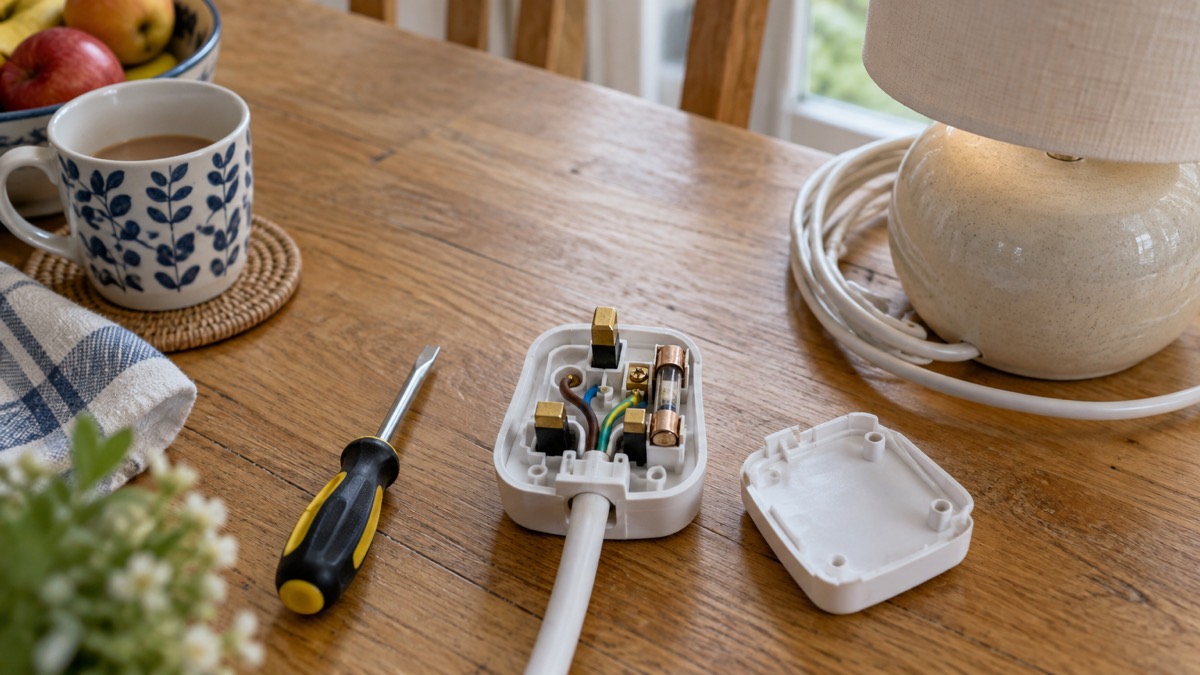
Rechargeable lanterns and some emergency lights come with a UK 3-pin plug for charging or mains use, and it is worth knowing what should be inside that plug. Fire and rescue service guidance is specific about fuses: a 3 amp fuse is the right one for lamps and bed lights, televisions and radios, electric blankets, hi-fi and DVD players, docking stations, clocks, computers and games consoles8. London Fire Brigade's fuse guidance lists the 3A fuse for table lamps and standard lamps, along with televisions, computers, fridges and freezers7.
| Fuse | What official guidance says it suits |
|---|---|
| 3 amp / 3A | Lamps and bed lights, table and standard lamps, televisions and radios, electric blankets, hi-fi and DVD players, docking stations, clocks, computers, games consoles7 |
If you are replacing a plug or a fuse on a lamp, use a 3 amp fuse and check the plug and cable at the same time. London Fire Brigade's electrical safety advice for the home is to look out for scorch marks, flickering lights, hot plugs and sockets, and fuses that blow or circuit-breakers that trip for no obvious reason, as these could all be signs of loose or dangerous wiring18.
Never fit a bulb above the lamp's rated power
If your emergency lighting includes a mains lamp, the bulb must match what the lamp was built for. The Scottish Fire and Rescue Service's guide to fire safety states: "All lamp shades advise the maximum wattage of light bulb that can be safely fitted; always check this before fitting as higher watt bulbs can cause the shade to overheat and catch fire"8. The same guide is equally firm in the other direction: "Never cover lightbulbs or lampshades as they can quickly overheat and catch fire"8.
London Fire Brigade's easy-read fire safety booklet adds the practical detail: use bulbs that are the right size and wattage recommended by the appliance, make sure bulbs are fitted correctly because loose bulbs may get too hot, and do not put anything over the bulb as it can get very hot and cause a fire19. So the routine for any mains lamp is simple:
- Find the maximum wattage marked on the lamp shade or lamp holder.
- Check the bulb you are fitting does not exceed it.
- Fit the bulb firmly so it is not loose.
- Never drape anything over the bulb or shade.
One further habit from fire service bedtime advice: never leave electrical items charging overnight20. That applies to rechargeable torches and lanterns as much as to anything else, and our page on charging and storing rechargeable torches safely covers it in full.
Keep lamps away from curtains, paper and bedding
Where you put a lamp at night matters as much as what is in it. The fire services' placement advice, written for candles but applying to any lamp that can get hot, is remarkably consistent across the UK:
- Keep them away from curtains, clothing and furniture, and stay in the room while a flame is lit (London Fire Brigade)19
- Keep candles away from flammable objects like curtains, furniture, bedding and books (Merseyside Fire and Rescue Service)21
- Keep them away from anything that may catch fire such as curtains, furniture, papers and clothes (London Fire Brigade's winter guide)22
- Keep tea-lights away from flammable objects such as curtains and paper, and keep incense away from curtains or papers and out of reach of children and pets (Scottish Fire and Rescue Service)23
- Keep candles away from soft furnishings, decorations, Christmas trees and wrapping paper, and out of reach of pets and children (Northern Ireland Fire and Rescue Service)24
- Keep candles and tealights away from flammable surfaces or textiles such as curtains, televisions and bath tubs, never leave them unattended and use a proper holder (NIFRS advice to students)25
The same rules protect a lamp: a bedside lamp pushed against a curtain, a lamp with paper or clothing draped over it, or a lantern left on bedding can all end the way a candle does. Fire safety advice on candles gives the closing rule for every night: make sure the flame is out before you go to bed20. If you have children, our page on torches, candles and children covers placement from their point of view.
Register your lamp in case of a safety recall
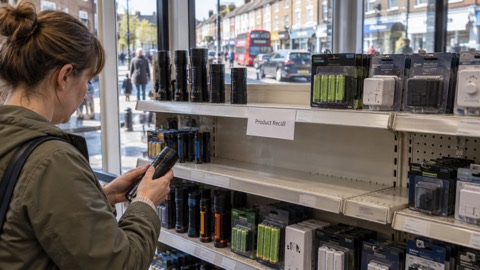
Electrical products are sometimes recalled for safety faults, and a lamp sitting in a drawer is easy to miss a recall notice for. Fire and rescue service guidance explains that manufacturers issue product recall notices if an electrical appliance could develop a fault, including a risk of electric shock or fire17. Devon and Somerset Fire and Rescue Service gives the practical answer: use the Register My Appliance service to register your appliances and get a notification if a product gets recalled26.
To check a lamp you already own:
- Check the government's product safety alerts and recalls on GOV.UK, as North Yorkshire Fire and Rescue Service advises for costumes and decorations27.
- Check for product recalls at the Electrical Safety First product recalls pages, as the Scottish Fire and Rescue Service's guide recommends8.
- If the appliance is not listed as recalled it should be safe to use; if you have concerns about its safety, contact the retailer or manufacturer17.
Our page on recalled and unsafe torches and chargers goes through this step by step, including how to report a product you think is dangerous.
Keeping your wind-up or solar lamp ready
A wind-up or solar lamp earns its place by being ready when everything else has failed, so give it a permanent home and a quick check before winter. The core habits come straight from the official guidance gathered on this page:
- Keep a battery-operated or wind-up torch somewhere easy to find, so you are not searching in the dark5
- Pack it in your household emergency kit alongside a battery or wind-up radio, spare batteries, a first aid kit, a list of useful phone numbers, spare keys, a spare phone charger, and special equipment for children and anyone with particular needs2
- Check elderly relatives know where they could find their torch or wind-up lantern so they can move around safely1
- Leave one light switched on during a power cut so you know when the supply returns28
- Never touch damaged electricity equipment28
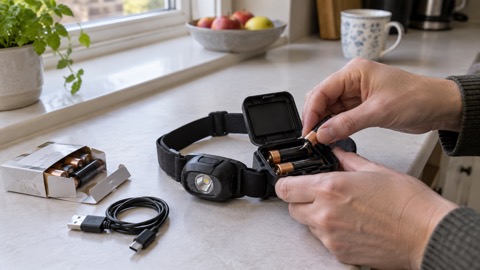
Before winter each year, give the lamp a minute of cranking or a day on the windowsill, confirm it lights, and put it back in its place. Our lighting checks before winter checklist and the power cut checklist cover the rest of the household's readiness, and our spare batteries to keep for your lights page covers the battery side of the kit.
A wind-up or solar lamp is not the brightest light you can own, and it is not the only light you should own. What it is, is the one that still works when the batteries are flat, the charger is useless and the shops are shut. That is why every official emergency kit list in these sources includes a wind-up torch and a wind-up radio, and why the fire services prefer any of them to a candle.
Sources (28)
- How to prepare for the loss of electricity, Wiltshire and Swindon Prepared, 2026-10-25
- Household emergency kit, nidirect, 2026-07-06
- Power cuts, Scottish Fire and Rescue Service, 2026-10-25
- Safety in severe weather conditions, Devon and Somerset Fire and Rescue Service, 2026
- What to do in a power cut, Mersey Care NHS Foundation Trust, 2026-10-25
- Written evidence on domestic micro-generation, UK Parliament Committee, 2022-01-13
- Cables, fuses and leads, London Fire Brigade, 2026-10-25
- Your guide to fire safety, Scottish Fire and Rescue Service, 2023-11-03
- Winter car kit, Met Office, 2026-10-25
- At home: emergency kit, Wiltshire and Swindon Prepared, 2026-01-28
- Caravans and camping safety, North Yorkshire Fire and Rescue Service, 2026-05-13
- At home for the holidays: safe for the season, Northern Ireland Fire and Rescue Service, 2025-12-01
- Be informed about hazards: power cuts, Be Ready (UK Government campaign), 2026-10-21
- Keep Safe Keep Well Winter Safety Campaign 2024-2025, NHS Western Isles Health Board, 2024-10
- Phone and broadband outages, Prepare (UK Government campaign), 2026-10-12
- WeatherReady weather hacks, Met Office, 2026-10-25
- Electrical safety at home, Scottish Fire and Rescue Service, 2025-02-27
- Electrical items in the home, London Fire Brigade, 2026-10-25
- Digital easy read fire safety booklet, London Fire Brigade, 2026
- Bedtime routine and escape plan, North Yorkshire Fire and Rescue Service, 2026-03-27
- Candle safety advice, Merseyside Fire and Rescue Service, 2026-10-26
- Extreme weather winter guide, London Fire Brigade, 2026
- Candle safety, Scottish Fire and Rescue Service, 2024-06-12
- NIFRS safety plea following two house fire fatalities in one day, Northern Ireland Fire and Rescue Service, 2025-12-12
- Charge safely for your own safety, Northern Ireland Fire and Rescue Service, 2026-09-21
- Top ways to reduce your risk of having a fire at home, Devon and Somerset Fire and Rescue Service, 2026
- Halloween safety tips, North Yorkshire Fire and Rescue Service, 2025-10-24
- Strong winds weather warning information and advice, nidirect, 2026-10-24
 Spare Batteries for Lights
 Candle Safety Checklist
 Lighting Checks Before Winter
 Lighting Home in a Power Cut
 Choosing a Torch for Home
 Head Torches for Power Cuts
 Lanterns for Lighting a Room
 Emergency Bulbs
 Lumens and Beam Distance
 Torch Batteries Explained
 Charging and Storing Torches
 Candle Fire Safety at Home
 Lights for Disabled People
 Torches, Candles and Children
 Recalled Torches and Chargers