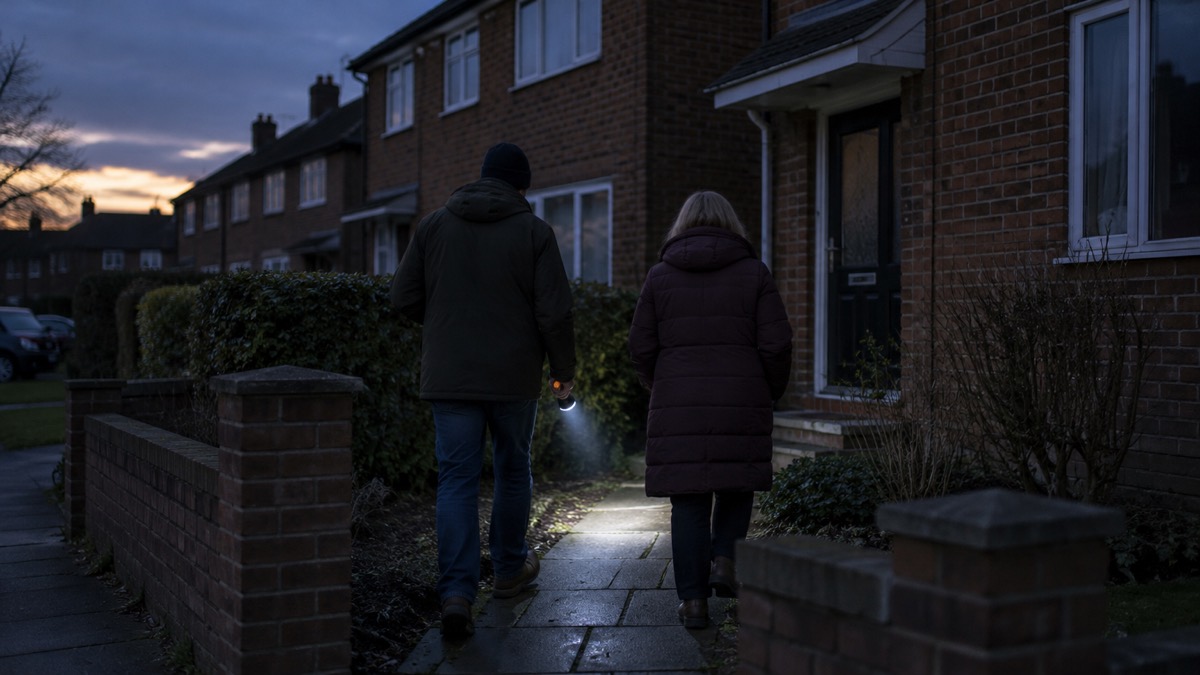
The Ledlenser P7R Core is a rechargeable torch that the maker lists at 1400 lumens at its brightest, launched in 2020 as part of its Core series1. For a household getting ready for a power cut, a storm or a flood, the useful part is not the peak figure but the range underneath it: the same torch will run at 15 lumens for 90 hours on its lowest setting, and it carries SOS and position signals built in2. One torch, kept charged, covers finding your way round a dark house, signalling for help and lighting a small area for days.
It is charged through a magnetic cable rather than a plug, and the maker gives a full charge time of 270 minutes2. It is rated IP68 for dust and water and has a stated working temperature range of -20 to +40 degrees Celsius, so it suits a cold night and a wet walk to the meter cupboard2. The maker's UK product page currently shows it as sold out, so if you are buying rather than using one you already own, check availability before you count on it2.
This page sets out what the torch does in an emergency, what its specifications mean for a household, how to charge and store it safely, and how the maker's warranty works. It does not compare it with other torches; for that, start with Torches: Types and How to Choose One for Home.
What the P7R Core does for a household in an emergency
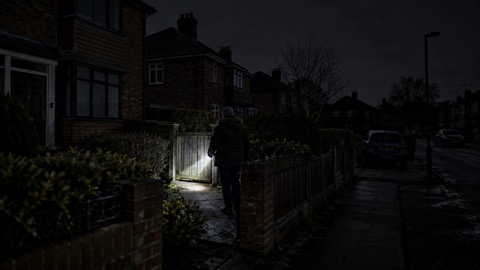
The torch is a single-LED rechargeable model with a white LED and a colour rendering index of 702. In practice it does three jobs in a household emergency. The first is moving safely: a focused spot at 1000 lumens on Standard Power reaches 210 metres for 2 hours, which is enough to check a garden, a driveway or a route to the car after dark2. The second is lighting a space: on Mid Power it gives 440 lumens at 130 metres for 4 hours, and on Low Power 15 lumens at 15 metres for 90 hours, which is the setting to use when you are sitting out a long cut and want the battery to last2.
The third is being found. The maker builds in SOS, which emits the distress signal in Morse code as three short, three long and three short flashes, and a Position mode of two short pulses repeated three times to alert others to your location2. Both are covered in more detail in How to Use SOS and Strobe Modes on a Torch.
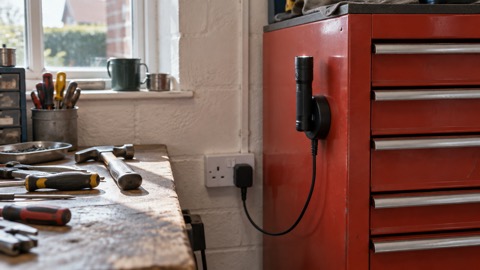
The maker also states an Emergency Light feature: if the power goes out while the torch is charging, it turns on automatically to give you light2. That makes a socket in a hallway or by the stairs a sensible charging spot, because a cut at night then leaves you with a light already on rather than a hunt in the dark. Where to keep it is covered in Where to Keep Torches So You Can Find Them in the Dark.
| Job in an emergency | Setting | Output and reach | Run time |
|---|---|---|---|
| Checking outside, signalling | Boost | 1400 lumens, 300 metres | Short burst2 |
| Moving round the house, checking a route | Standard Power | 1000 lumens, 210 metres | 2 hrs2 |
| Lighting a room or a task | Mid Power | 440 lumens, 130 metres | 4 hrs2 |
| Sitting out a long cut | Low Power | 15 lumens, 15 metres | 90 hrs2 |
The torch can put out anything between 15 and 1400 lumens, so the setting you choose decides how long it lasts2. For how output and reach relate across all torches, see Lumens, Beam Distance and Run Time Explained.
Specifications: size, weight and battery
The P7R Core weighs 202 grams and measures 158mm with the beam defocused and 165mm focused, with a 35mm head and a 27mm tube2. That is light enough to hold in your teeth for a moment and small enough for a coat pocket or a kitchen drawer, though a torch you can put down and leave shining upwards is often more use in a cut than one you have to hold. The maker rates it to survive a drop of 2 metres2.
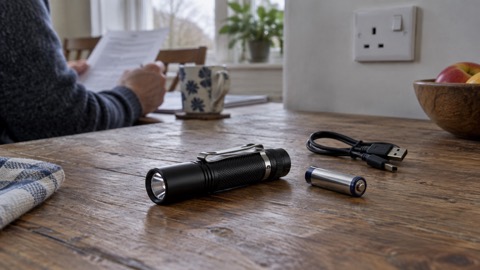
It runs on a single 21700 lithium-ion rechargeable battery at 3.7 volts with a capacity of 4800mAh2. A removable cell of this kind means the torch's working life is not tied to a sealed pack, and the battery type is the same family covered in Torch Batteries: AA, AAA, 18650 and Built-In Packs. The maker does not list a spare battery in the box contents, so a household that wants a second cell should check with the maker what is compatible rather than assume.
| Specification | Maker's figure |
|---|---|
| Model number | 5021812 |
| Weight | 202g2 |
| Length, defocused | 158mm2 |
| Length, focused | 165mm2 |
| Head diameter | 35mm2 |
| Tube diameter | 27mm2 |
| Battery | 1 x 21700 Li-ion rechargeable, 3.7v, 4800mAh2 |
| LEDs | 1, white, colour rendering index 702 |
| Colour temperature | 6000k to 7500k2 |
| Drop test | 2 metres2 |
| IP rating | IP682 |
The colour temperature of 6000k to 7500k is a cool white, which reads as bright and slightly blue rather than warm2. That suits picking out detail and judging distance; it is not the warm glow of a lantern for a room you are sitting in. For that job, see Battery and Rechargeable Lanterns for Lighting a Room.
SOS, position signal and the other modes
The maker lists eight modes: Low Power, Mid Power, Standard Power, Boost, Blink, Position, S.O.S and Strobe2. Blink gives automatic impulses of light at regular intervals, and Strobe is the fast flashing mode2. For a household, the two that matter in an emergency are S.O.S and Position, because they are the ones another person or a rescue team will recognise as a call for help rather than an ordinary light.
"S.O.S - the distress signal the light emits is SOS in Morse code (3 short, 3 long, 3 short)"
Use them deliberately. An SOS is a distress signal, so set it going only when you actually need help and leave it running where it can be seen, rather than flashing it while you walk about. Position mode is the quieter option: two short pulses repeated three times tells someone looking for you where you are without claiming an emergency you are not in2. Both draw attention, so think about who else can see the light before you use them.
The torch also has a Memory Function, which sets it to start in the last mode or brightness level you used when you switch it on2. That is convenient day to day, but it means a torch left on Boost will come back on Boost. Before an expected storm, set it to a low mode and check it starts there, so a single press in the dark does not burn through the battery. A Transport Lock stops it turning on accidentally and using up the battery in a bag or drawer2.
Magnetic charging: 270 minutes from the supplied cable
The torch charges through the maker's Magnetic Charge System, which it describes as safe, reliable charging that is quick and easy to use2. A full charge takes 270 minutes, and the same figure is given for the combo set that pairs the torch with a P3 Core2. The maker also states that if the power goes out while your Ledlenser is charging, it will automatically turn on to give you light2.
A 270 minute charge is a long one to start at the wrong moment. Charge it before a forecast storm rather than during it, and charge it before you go to bed if a cut is expected overnight. The Emergency Light feature means a torch left charging will come on if the power fails, which is useful, but it also means the torch is only as ready as the socket it is plugged into. For the general principles, see Charging and Storing Rechargeable Torches Safely.
Keeping it ready: battery warning, cold and water
The torch has a battery status and charge indicator and a low battery warning, so you can see where you stand on power2. More useful in a long cut is Backup Mode: the charge level is monitored continuously and, when it runs low, the torch drops to a low-power mode giving about 1 hour of remaining light2. That hour is your warning to stop what you are doing and get the torch onto the charger, or to switch to a second light.
The maker rates the torch IP68, with Flex Sealing Technology for protection against dust and water2. The P7R range page adds that every P7R is sealed against rain and dust for outdoor and on-site use, and that the exact level of protection depends on the model4. For this model the maker's own figure is IP682. Keep the charging contacts dry before you connect the cable, and do not assume the rating covers a depth or a duration the maker has not stated. What IPX Ratings Mean for Torches and Lanterns explains the scale.
The stated working temperature range is -20 to +40 degrees Celsius2. A torch kept in a cold porch or a shed is within that range, but cold reduces what a lithium-ion cell will give, so a torch you may need at night is better kept indoors where it is dry and moderate. The maker fits a Temperature Control System, which it says keeps the light from overheating so it can run brighter and longer2. Boost is described as a short burst of maximum power, so treat it as one: use it to identify something, then drop to a lower mode. Never cover the head while the torch is on.
Support, warranty and where it fits your plan
The maker gives a standard warranty of 2 years, which can be extended by a further 5 years with online registration, up to 7 years2. Register the torch when it arrives and keep the model number, 502181, to hand for any claim2. The maker's own product page is the place to check current specifications, box contents and availability, since these can change2.
In a household plan, the P7R Core is the torch you carry and point: it throws a beam a long way, it signals, and it recharges rather than needing a drawer of cells. It is not a room light and it is not a lantern, and a 270 minute charge means it is not the light you reach for last. Pair it with a light that runs on ordinary batteries or a lantern for the room, as set out in Rechargeable or Battery Torches for Emergencies and the Power Cut Checklist. For the wider kit it belongs in, see Emergency Kit: What a UK Household Should Keep Ready.
Sources (4)
- 2020 Core Series, Ledlenser, 2026
- P7R Core, Ledlenser, 2026
- P7R Core and P3 Core Combo Set, Ledlenser, 2026
- P7R Collection, Ledlenser, 2026

 NEBO Galileo Tempest 350
 NEBO Newton 500 Torch
 NEBO Davinci 800L
 NEBO Luxtreme SL25R
 NEBO Master Series SL25
 NEBO 8K Flood Light
 NEBO 5K Floodlight
 NEBO Torchy 2K Torch
 NEBO Torchy 600 Flex
 NEBO Tac Slyde Torch
 NEBO Slyde King 4K
 NEBO Mycro 900+ Headlamp