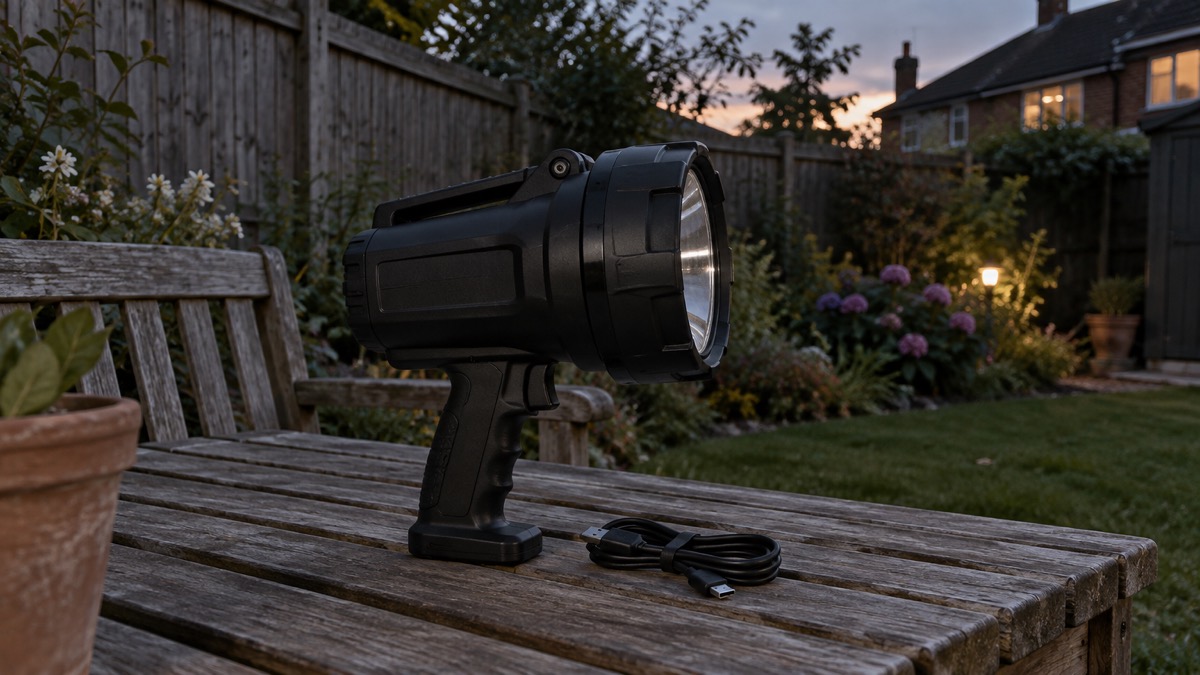
The NEBO Luxtreme SL25R is a rechargeable LED spotlight rated at 500 lumens in spot mode, with a beam the maker gives as 400 metres and a run time of 2 hours on that setting1. The maker describes it as a compact, rugged, rechargeable spotlight with a long 1/4 mile beam distance2. For a household, the appeal is simple: a bright, focused light that recharges from a USB cable or a 12V car socket, so it does not depend on a drawer of disposable batteries when the power goes off.
What you need to know before you rely on one is less about brightness and more about habits. The maker ships these lights with a battery spacer fitted, and says to remove it before use3. The SL25R arrives with its battery in a spare compartment rather than the main one, and the maker says to move it before first operation2. Run times vary enormously with the setting you choose: 2 hours on the SL25R's spot mode, but 30 hours on the SL75's low mode1. And like any bright light, it has to be handled with care around eyes2.
This page sets out what each model does, how long it runs, how to charge it, how to fit and check the battery, and how to use it safely. It is written for someone who wants a dependable light for a power cut, a dark lane or a job in the loft, not for someone comparing specifications for their own sake.
What the Luxtreme range is and which one suits you
The Luxtreme is a spotlight rather than a lantern or a general purpose torch. The maker describes the SL line as offering "extraordinary beam distance and close range flood pattern in an ergonomic and durable design"1. In practice that means a light you point at something specific: a path, a fence line, a fuse box, the far end of a garden. It is not designed to light a whole room softly, which is a job for a lantern or a ceiling bounce.
The four models differ mainly in how far they throw and how long they run. The SL25R is the smallest, described by the maker as a compact, rugged, rechargeable spotlight with a long 1/4 mile beam distance2. The SL50 is listed at 450 lumens on high, with a beam of 800 metres and a run time of 8 hours on that setting3. Those descriptions are the maker's own, and the beam distances in metres are set out in the table below.
| Model | Spot or high output | Beam distance | Run time on that setting | Weight |
|---|---|---|---|---|
| SL25R | 500 lumens | 400 metres | 2 hours | 365g2 |
| SL50 | 450 lumens | 800 metres | 8 hours | 681g6 |
| SL75 | 780 lumens | 1200 metres | 5 hours | 667g4 |
| SL100 | 525 lumens (LEP + COB) | 1496 metres | 10h 16m | 653g7 |
Which one suits you depends on where you will use it. For a flat or a house in a town, where the furthest thing you need to see is the end of a drive, the SL25R's 400 metres is already far more than the eye can use in most streets1. For a smallholding, a boat or a rural property with outbuildings, the longer throw of the SL75 or SL100 earns its place4. The trade-off is weight: the SL25R at 365g is a coat pocket light, while the SL50 at 681g is better carried in a bag or on a belt2.
Run time: 2 hours on the SL25R, 30 hours on the SL75
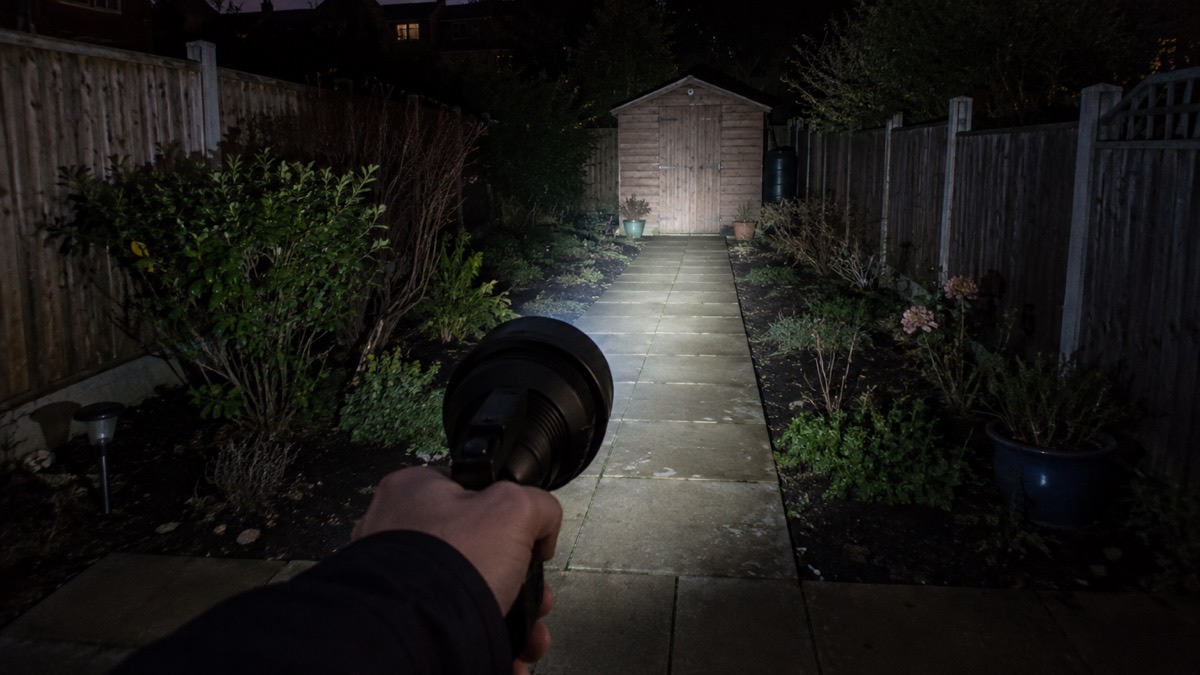
Run time is the figure that decides whether a light is useful in a long power cut, and it is the figure most easily misread. A spotlight's headline brightness and its headline run time are almost never on the same setting. The SL25R gives 2 hours on spot mode at 500 lumens, but the maker's mode table shows other settings with their own figures1. The SL50 gives 40 hours on low at 50 lumens, 18 hours 50 minutes on medium at 250 lumens, and 8 hours on high at 450 lumens6.
The lesson for a household is to plan on the low or medium setting for anything long. A light left on high will flatten in an evening; the same light on low will last several nights of short use. The maker's Smart Power Control feature reinforces this: as the battery depletes, it gradually reduces brightness to extend runtime1. That means the beam dims rather than cutting out, which is gentler on the user but can catch you out if you are relying on a set brightness for a task.
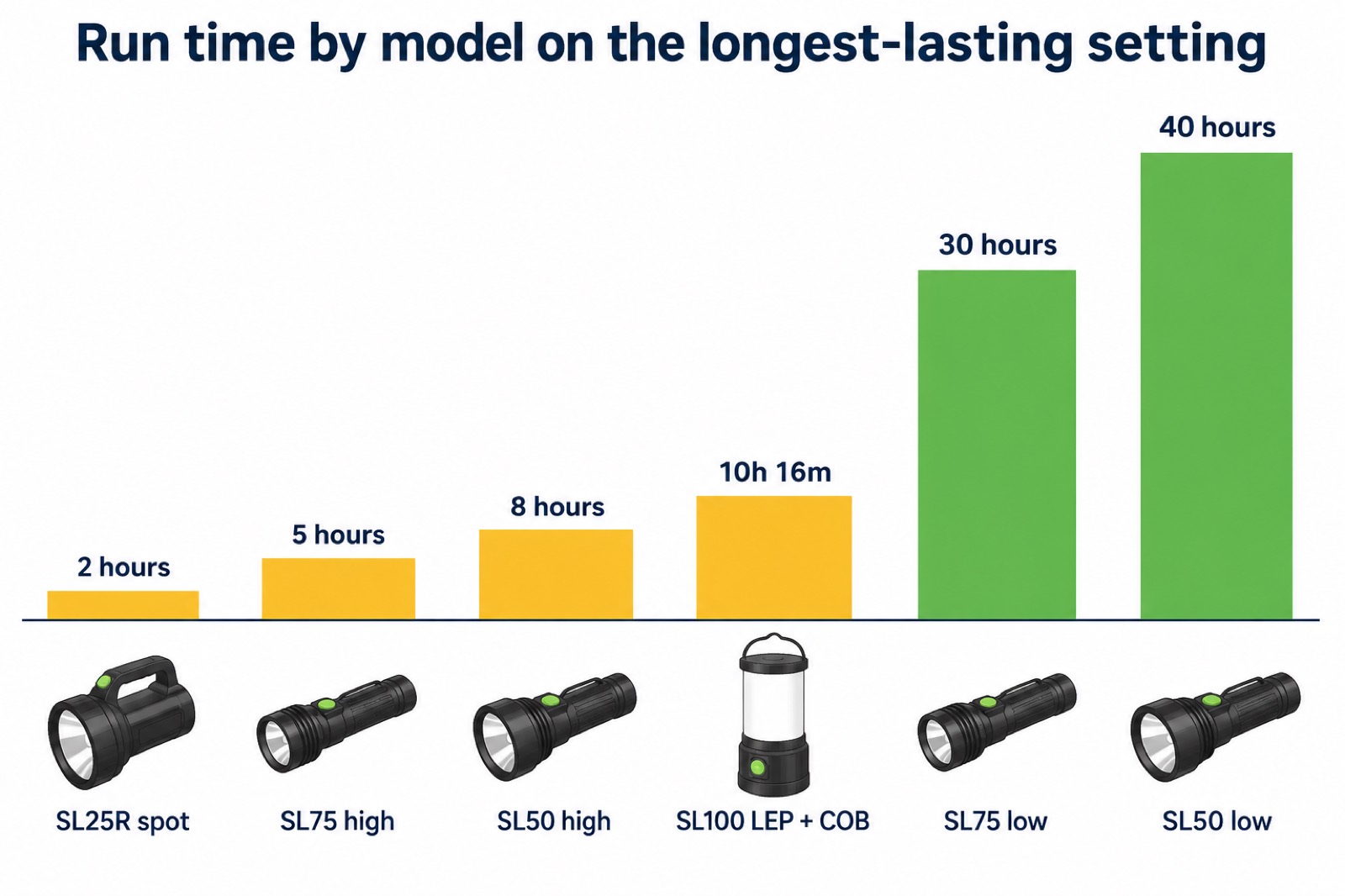
Two cautions on the figures. First, the maker's own documents give more than one figure for some settings: the SL25R is listed at both 500 and 300 lumens, and at both 2 and 3.5 hours, in different maker pages, and the SL50 at both 450 and 250 lumens and at both 8 and 19 hours1. Where the maker's figures disagree, treat the lower figure as the safer planning assumption. Second, run times are measured on a fresh battery at room temperature; cold weather reduces the capacity of lithium-ion cells, so a light left in a cold car or shed will not last as long as the table suggests.
Light modes and the Mode Select Dial
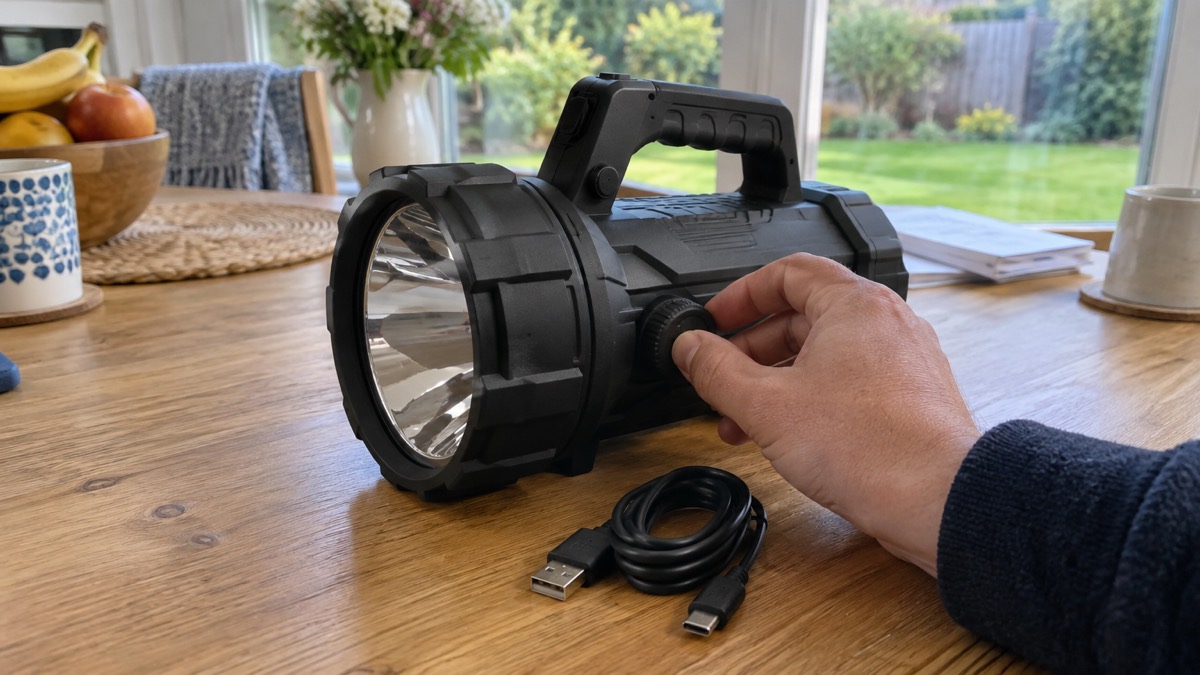
All four models use a rotating dial on the body to choose the mode, rather than a single button you click through. On the SL25R, SL50 and SL75 the sequence is Off, then Red COB, then White COB, then Spot1. The SL100 differs: its dial runs Off, White COB, LEP, then White COB plus LEP, and you press and hold the trigger button to bring up Red COB5. The trigger button turns the light on and off once the dial is set3.
The two kinds of emitter do different jobs. COB, or chip on board, is a panel of LEDs that gives a broad, even flood of light for close work: reading a meter, changing a fuse, lighting a doorway. Spot is the focused beam that reaches distance. Red COB preserves night vision and is less dazzling to others, which is why it is often the first mode on the dial. If you want to understand why a red setting exists at all, our page on red light mode explains it.
The dial also has an Off position that matters for a second reason: it is how you check the battery. The maker says to press the trigger button while the Mode Select Dial is in the Off position to show battery life1. That is the check to make before you put the light away, so you know whether it needs charging before the next time you need it.
Built for rough use: IP67, aluminium body and 1-metre drop rating
These are working lights, and the maker's specifications reflect that. All four carry an IP67 rating, which the maker explains as complete dust-tightness and water resistance up to 1 metre depth for 30 minutes1. That is enough to survive being dropped in a puddle, used in heavy rain or left out on a wet night, but it is not a diving rating and it does not mean you should submerge the light deliberately.
The bodies are aluminium. The SL25R, SL50 and SL75 are described as aircraft grade aluminium, and the SL50 and SL75 carry a rubberised body design that the maker says takes durability to the next level1. The SL100 adds a rubberised body to its aluminium construction5. The SL25R and SL75 are both listed with a 1-metre impact resistance rating, which covers the everyday knocks of a light dropped from waist height onto a hard floor2.
| Feature | What it means in practice |
|---|---|
| IP67 | Dust-tight; survives 1 metre of water for 30 minutes1 |
| Aircraft grade aluminium | Rigid body that resists bending and crushing1 |
| Rubberised body | Grip in wet or cold conditions6 |
| 1-metre impact rating | Survives a drop from waist height2 |
What this does not cover is the battery. A light that survives a drop can still have a damaged cell inside, and the official advice on lithium-ion batteries is to inspect them regularly for any signs of damage8. If a light has had a hard knock, check the battery for swelling, dents or a damaged wrapper before charging it, and stop using it if anything looks wrong.
Charging by USB-C or 12V car socket
The maker lists a USB charging cable and a 12V car charger among the accessories for the SL25R, SL50, SL75 and SL1001. The SL25R is described as USB-C rechargeable, and the maker's general instruction is to uncover the USB-C port and plug in the included USB-C cable1. The SL100 adds a useful option: the maker lists continuous run with a 12V adaptor, so it can be run from a car socket rather than only charged from one5.
Charging behaviour is shown by the four indicator lights above the dial. The maker says the last indicator light will flash while the unit is charging, and when charging is complete all indicators will light continuously1. That is your cue to unplug: a light left on charge long after the indicators go steady is not doing anything useful, and the fire service's general advice on charging is to inspect the battery regularly for signs of damage and to follow the maker's instructions8.
For a household preparing for a power cut, the 12V car charger is the more valuable of the two cables. A car socket can top up a spotlight during a journey or from a vehicle parked outside, which matters if the mains is off for a long period. If you are thinking about how charging fits into a wider plan, our page on charging and storing rechargeable torches safely covers the storage side.
Checking the battery and swapping in the spare
The SL25R has two battery compartments: the main compartment towards the back of the unit, and a spare compartment on the trigger side1. The maker ships the light with the battery in the spare compartment and says to move it to the main compartment before first operation2. That is not a fault; it is how the light is packed, and it is the single most common reason a new SL25R appears not to work.
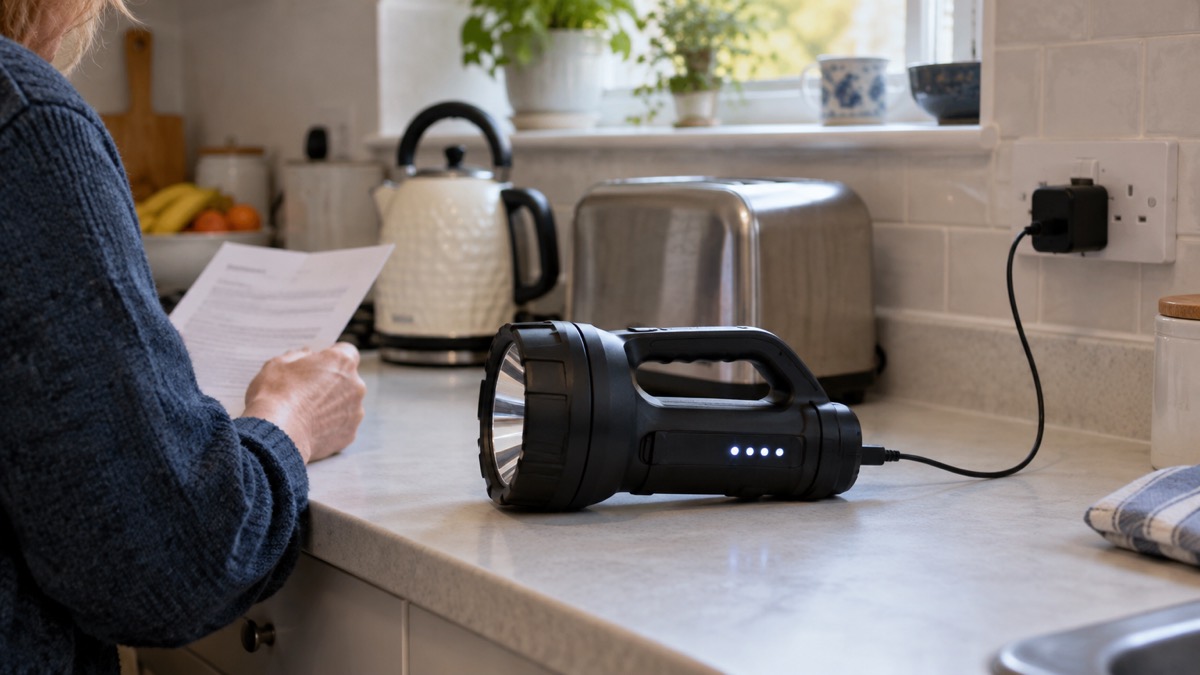
To check the battery at any time, press the trigger button while the dial is in the Off position1. The four indicator lights above the dial then show the charge: at 100 per cent you see three green and one red, at 75 per cent two green and one red, at 50 per cent one green and one red, and at 25 per cent a single red light1. The same scheme applies across the range6.
For the other models, the battery sits behind a latched cover. The maker's instruction is to unlatch the battery cover, remove the spacer, and insert the battery positive (+) side first3. Getting the polarity wrong is the other common first-use problem, so check the markings on the battery against the diagram in the manual before closing the cover.
On battery care more generally, the Caravan and Motorhome Club's guidance on leisure batteries is a useful habit to borrow: check the battery every two months and recharge if necessary1. That advice is written for lead-acid leisure batteries rather than lithium-ion cells, so treat it as a prompt to check rather than a procedure to follow exactly. For the lithium cells in a Luxtreme, the maker's own charging instructions and the fire service's damage check are the ones that apply2.
Safe use: never shine it into someone's eyes
A spotlight of this brightness is not a toy, and the maker's warnings are consistent across the range. The instruction is: "Do not shine the light directly in someone's eyes"2. If the beam does shine directly in your eye, the maker says to look away immediately, and not to use any magnifying instruments that could concentrate the light beam2. The lights should also be kept away from heat, hot surfaces, sparks and open flames, and never incinerated2.
The practical rules for a household are straightforward. Point the beam at the ground or at the object you are working on, not at face height. Warn anyone nearby before you switch to spot mode, particularly children, who are at the right height to catch a beam aimed ahead. Do not use the light to inspect anything through a magnifying glass or a camera lens, because the concentrated beam can be harmful. And keep the light away from a fire, a hob or a hot exhaust.
For a wider look at the question of looking into a bright beam, our page on whether it is safe to look into a bright torch sets out the risks. And if you are choosing between a handheld light and one you wear, our comparison of torch or head torch may help.
Adjusting the zoom beam
The Luxtreme's beam is adjustable. The maker says the light "allows you to effortlessly adjust the beam from a wide flood to a focused spot, simply by sliding the lens housing or twisting the lens sleeve"5. The same guidance is given for the SL100 and across the NEBO range9. Slide or twist one way for a broad pool of light for close work, the other for a tight beam that reaches further.
The zoom is most useful when you match it to the job. A wide flood is right for walking around a dark house, reading a meter or checking a fuse board, because it lights the area rather than a single point. A focused spot is right for looking down a garden, along a lane or at a distant building. Adjust it before you point the light anywhere near people, and keep your fingers clear of the lens housing while you do it.
What comes in the box, and what to check
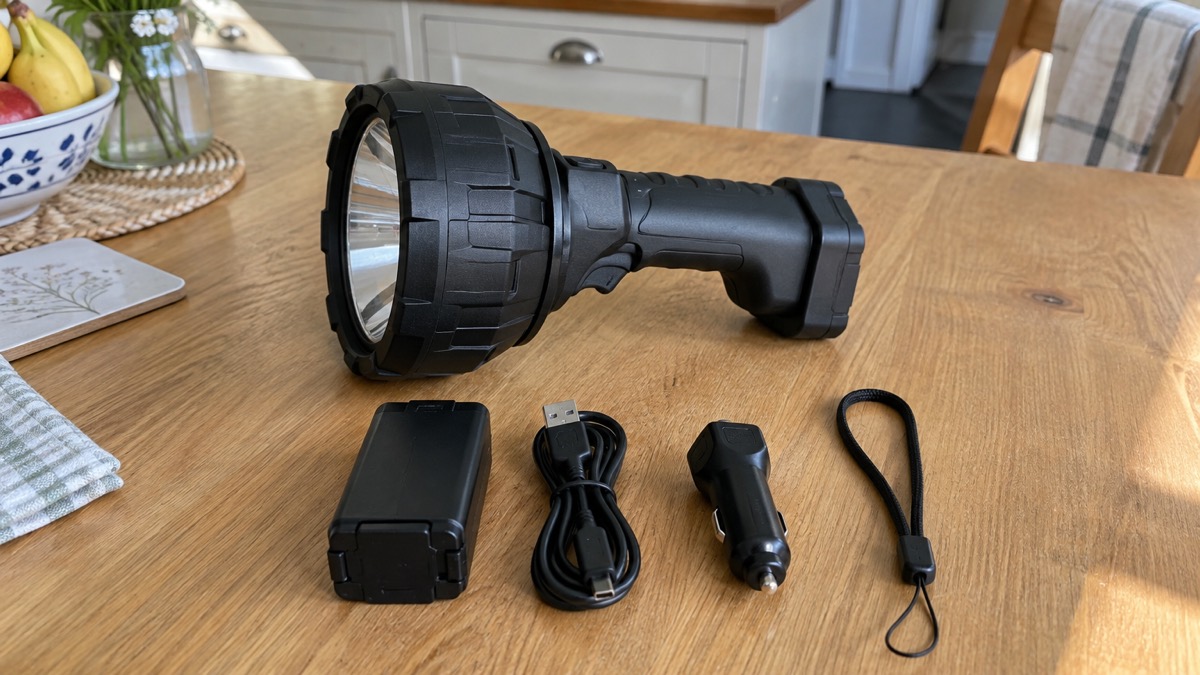
The maker lists the same contents for the SL25R, SL50, SL75 and SL100: a USB charging cable, a 12V car charger, a user manual, a gift box, a rechargeable battery and a lanyard1. The SL25R is described as USB-C rechargeable, and the general NEBO Luxtreme page lists a USB-C charging cable, user manual, gift box and rechargeable battery5.
When the light arrives, check three things before you rely on it. First, that the battery is present and undamaged. Second, that the battery spacer has been removed, since the maker ships the SL75 with one fitted and says to remove it before operation1. Third, that the light charges and that the indicator lights behave as described, with the last light flashing during charging and all four steady when full2. If anything is missing or does not work, contact the retailer or the maker before the return window closes.
Where to get help and support
NEBO sells the Luxtreme range in the UK through its own site, and the maker's page states that orders are available from nebotools.co.uk in the UK, with international shipping not available1. Stock moves, so check the maker's own page before ordering.
For support, the user manual that comes in the box is the first place to look for battery fitting, charging and mode instructions3. The maker's product pages carry the same information and the safety warnings2. If you are buying a light as part of a wider household plan, our guides to torches and to lighting your home safely when the power goes off set the Luxtreme in context alongside lanterns, head torches and emergency bulbs.
If you have a disability or rely on powered equipment, ask your electricity supplier about the Priority Services Register, which can give you extra help during a power cut. And if a light or its charger is damaged, stop using it and check our page on recalled and unsafe torches and chargers for how to check and report a product.
Sources (10)
- Luxtreme SL25R manual, NEBO, 2026-10-25
- Luxtreme SL25R product page, NEBO, 2026-10-26
- Luxtreme SL75 manual, NEBO, 2026-10-25
- Luxtreme SL75 product page, NEBO, 2026-10-25
- Luxtreme SL50 manual, NEBO, 2026-10-25
- Luxtreme SL50 product page, NEBO, 2026-10-26
- Luxtreme SL100 product page, NEBO, 2026-10-26
- Charging safety, Oxfordshire County Council, 2026
- Luxtreme SL100 manual, NEBO, 2026-10-25
- Luxtreme instruction manual, NEBO, 2026-10-25

 NEBO Master Series SL25