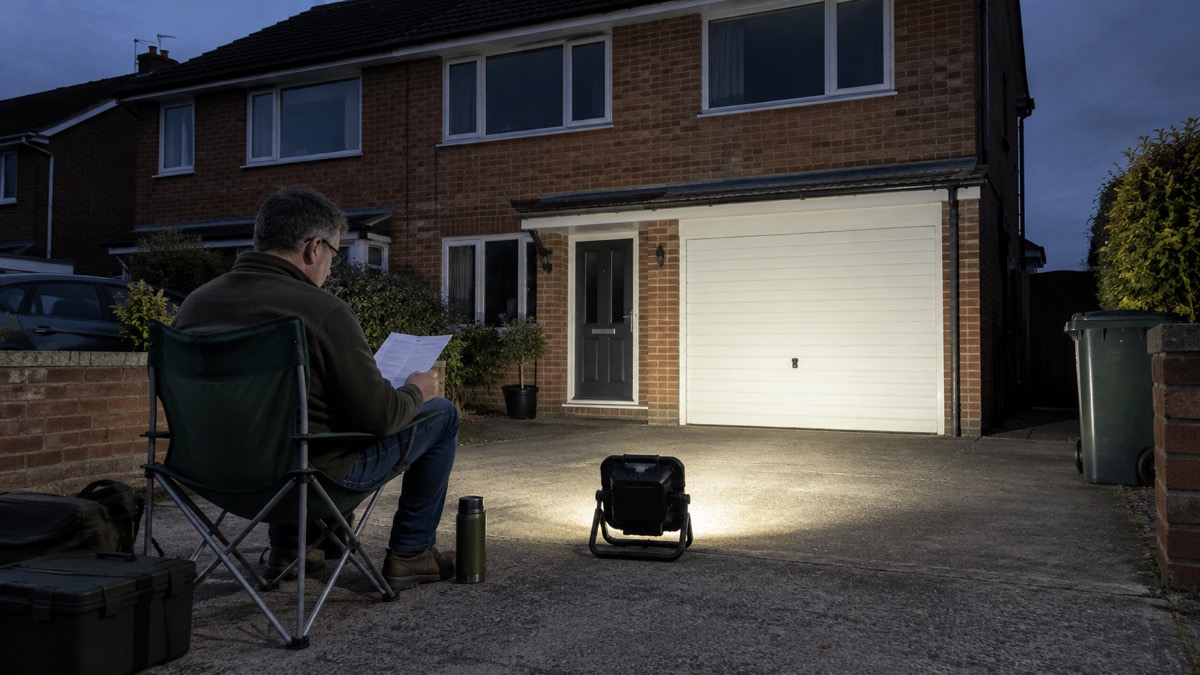
The NEBO 5K Floodlight is a rechargeable work light that can light a room, a stairwell or a garden at up to 5,000 lumens, and can also top up a phone from its USB port. The maker's own figures set the limits: 2 hours at 5,000 lumens on MAX, 4 hours at 2,500 lumens on MEDIUM, and 6 hours at 1,250 lumens on LOW1. It is a heavy, bright, mains-rechargeable light rather than a torch you carry in a pocket, and it is at its best standing on a surface, aimed at a ceiling or a wall.
For a household preparing for a power cut, the practical points are simple. Charge it fully before you first need it, because the maker says a full charge from the mains can take up to 3.5 hours and by USB-C up to 8 hours1. Keep it somewhere you can find in the dark, and know which mode you will use: LOW gives you the longest run for the least light, and MAX is for short bursts when you need to see a lot.
This page sets out what the floodlight does, how long it runs, how to charge and store it, where the maker says it must never be used, and how to use it as a power bank. It does not cover price, and it does not compare it with other lights.
What the NEBO 5K Floodlight does in a power cut
In a power cut the floodlight is a room light, not a personal torch. Its job is to put a lot of light into one place: a kitchen, a hallway, a bathroom, or the area where the family is sitting. The maker lists five modes, MAX at 5,000 lumens, HIGH at 3,750, MEDIUM at 2,500, LOW at 1,250 and AC PLUG IN at 3,500, and the brightness can also be set in steps of 100%, 75%, 50% and 25% using the -/+ buttons1. That range matters because the brightest setting is the one that drains the battery fastest.
The light is built for work sites as well as homes. The maker gives it an impact resistance rating of IK07 and a protection class of III, and supplies three mains adapters: a 220v domestic EU adapter, a 240v domestic UK adapter and a 110v site UK adapter1. For a UK household the 240v adapter is the one you will use at the wall. The others are there because the same light is sold for use on site and abroad.
It is not a substitute for a torch you can hold. At 2175g it is heavy enough that you will want to set it down, and the maker's design assumes that: a swing handle that locks into 7 positions and a tripod mounting kit for standing it at height1. If you want a light to carry from room to room, a torch or a head torch is the better tool, and a lantern is easier to move around a room. The floodlight earns its place when you need a lot of light in one spot for a short time, or when you are working on something and need both hands free.
Run time: 2 hours at 5,000 lumens, up to 6 hours on LOW
The maker's run times are the figures to plan around, and they fall steeply as brightness rises. The table below is the maker's own specification1.
| Mode | Brightness | Run time |
|---|---|---|
| MAX | 5,000 lumens | 2 hours |
| HIGH | 3,750 lumens | 3 hours |
| MEDIUM | 2,500 lumens | 4 hours |
| LOW | 1,250 lumens | 6 hours |
| AC PLUG IN | 3,500 lumens | Continuous |
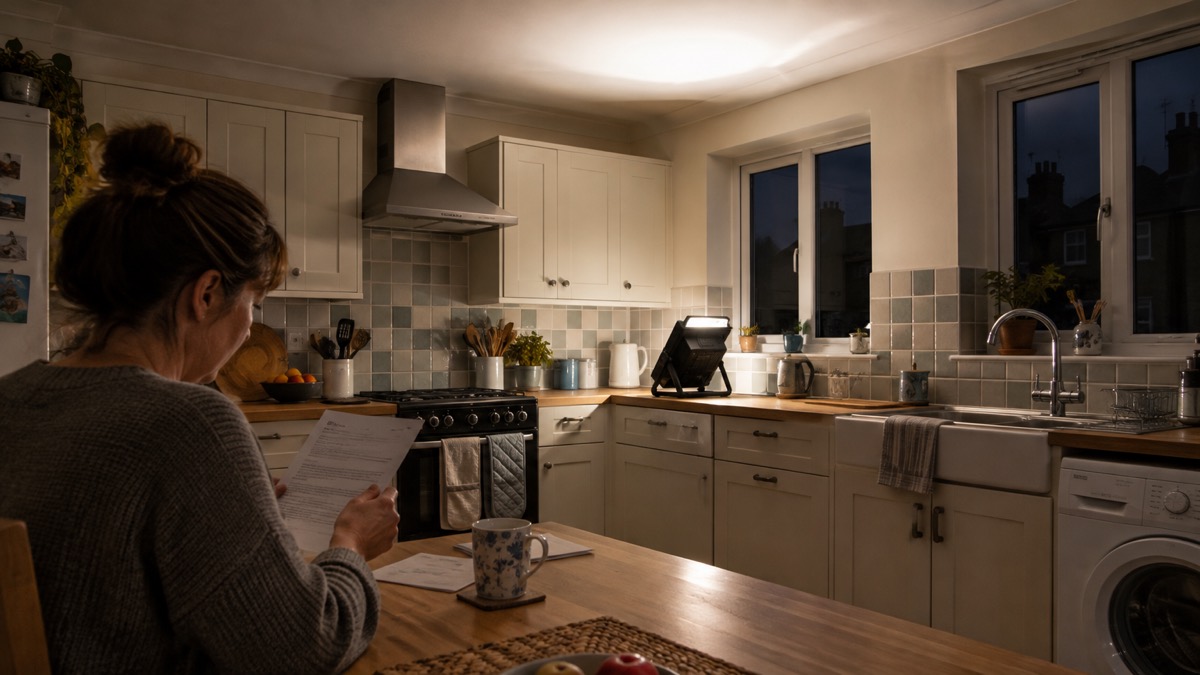
The pattern is worth understanding before an emergency, not during one. Going from LOW to MAX gives you four times the light but a third of the run time. In a power cut that lasts an evening, LOW is usually the sensible setting for general lighting, with short bursts of MAX when someone needs to see something properly. The maker also gives an overall operating time of 2 hours approximately, which reflects the top end of the range1.
The AC PLUG IN mode is different: it runs continuously at 3,500 lumens while the light is connected to the mains through the supplied power transformer1. That is useful for a long job in a loft, garage or garden when the power is on, but it is no help during an outage, when the battery modes are all you have. Plan your battery use on the assumption that the mains will not be there.
If you want to understand how lumens translate into useful light, and why a brighter setting is not always the better one, our guide to lumens, beam distance and run time explains the trade-off. For a wider look at how long different lights last in an outage, see how long a camping lantern runs in a power cut.
Charging: about 3 hours from the mains, up to 8 hours by USB-C
There are two ways to charge the floodlight, and they are very different in speed. The maker gives a charging time of 3 hours approximately from the mains, with a full charge taking up to 3.5 hours, and 8 hours approximately by USB-C, with a full charge taking up to 8 hours1. The mains route uses the power transformer with its 4m cable and the appropriate adapter; the USB-C route uses the 1m USB-C to USB-C cable supplied in the box1.
The mains input is rated at 15V, 3.4A / 50W, and the battery is a lithium ion pack rated at 11.1V, 4500mAh1. Those are the maker's figures for its own product. What matters for a household is the planning: if you leave charging to the last minute, the USB-C route may not finish before the power goes off. Charge from the mains when you can, and keep the USB-C cable as a backup for charging from a power bank or a car.
Charging safely is as important as charging fully. The London Fire Brigade's fire safety guidance says to unplug the charger once the battery is full, and to put your device on a hard surface like a table before you start to charge it up2. Electrical Safety First's guidance on chargers covers the same ground for the chargers themselves3. The maker's own manual warns that failure to follow its instructions may result in electrical shock, explosion, fire which may result in serious injuries, death or property damage1. That is standard wording for a lithium battery product, and the practical response is simple: charge it on a hard surface, not on a bed or sofa, unplug it when the indicator shows full, and do not leave it charging unattended for long periods.
Fully charge it before you first need it
The single most useful thing you can do with this light is to have it charged before the power goes off. The maker's manual is explicit: fully charge your NEBO 5,000 Lumen Rechargeable Flood Light before using it for the first time1. The same principle applies to any rechargeable item you rely on in an outage. Mersey Care NHS's Community Equipment Service, which advises people who depend on powered equipment at home, tells users to prepare in advance of any pre-planned outages by fully charging their item for usage4. The advice is written for hoists, bath lifts and powered wheelchairs, but the logic holds for a floodlight.
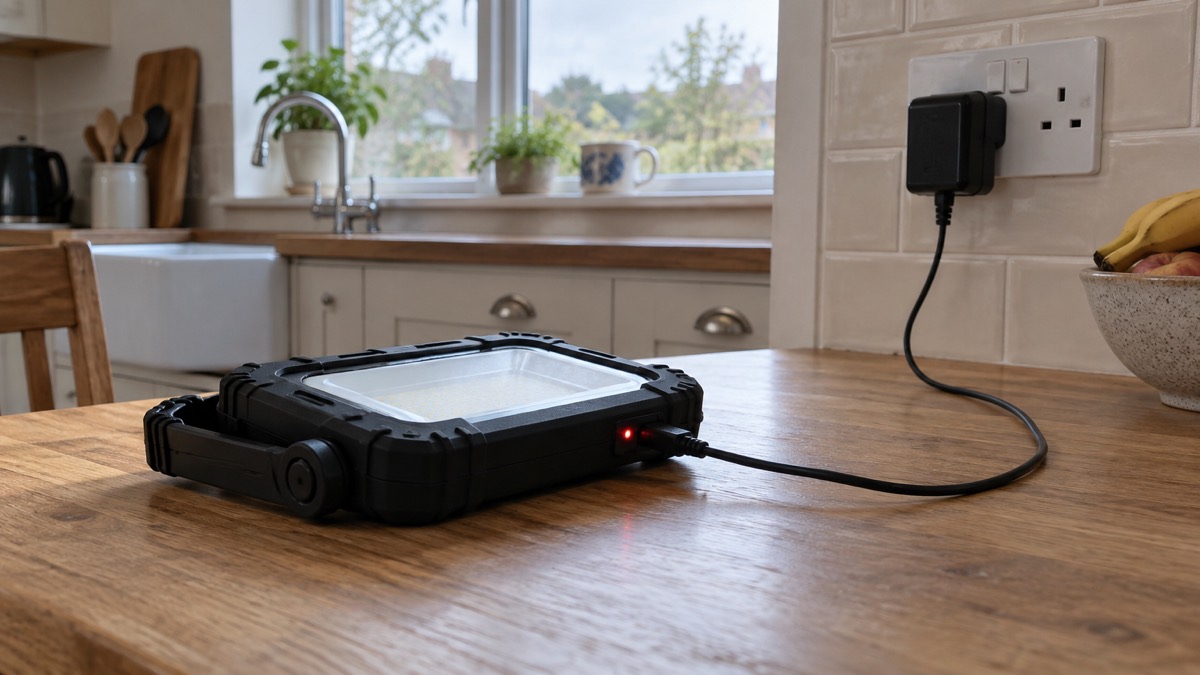
A useful routine is to charge it on a fixed date each year, before the winter storm season, and again if a weather warning is issued. The Met Office's travel advice for storms, rain and wind is a reminder that severe weather is forecast in advance, which gives you time to top up batteries before it arrives5. If you have a power cut checklist, add the floodlight to it.
The charge indicator is your check. The maker says the charging indicator LED indicates 100% when fully charged, and that the indicator shifts from green to red, signalling when it is time to recharge1. Read it before you put the light away, not when you get it out in the dark.
Using it as a power bank for phones and other USB devices
The floodlight has a USB-A output port that lets it charge USB-powered devices, which makes it a backup for a phone when the mains is off. The maker's steps are to plug a USB-A cable (not included) into the USB output port, connect the other end to a USB powered device, and press the Charge Switch1. The cable is the one thing you need to add yourself, so put a spare USB-A cable in the bag with the light.
How much charge you get depends on the device and the floodlight's remaining battery, and the maker gives no figure for the number of phone charges. What the maker does give is the battery capacity, 11.1V, 4500mAh1, which is the pool you are drawing from. Treat phone charging as a secondary job: a phone topped up to make a call or check an update is worth more than a phone charged to full while the light itself runs flat.
Electrical Safety First's guidance on power banks says to use the power bank only for its intended use, for example to recharge a mobile phone or other USB-powered mobile devices6. The floodlight's USB port is intended for exactly that. For general preparedness, having a fully-charged power bank available in case you need to charge your phone, tablet or other devices is standard advice7, and Electricity North West's summer guidance says to fully charge phones and power banks when hot weather is forecast8. The floodlight can serve as that backup, but a dedicated power bank is lighter to carry and can be charged separately.
Setting it up: swing handle, tripod mount and the mains adapters in the box
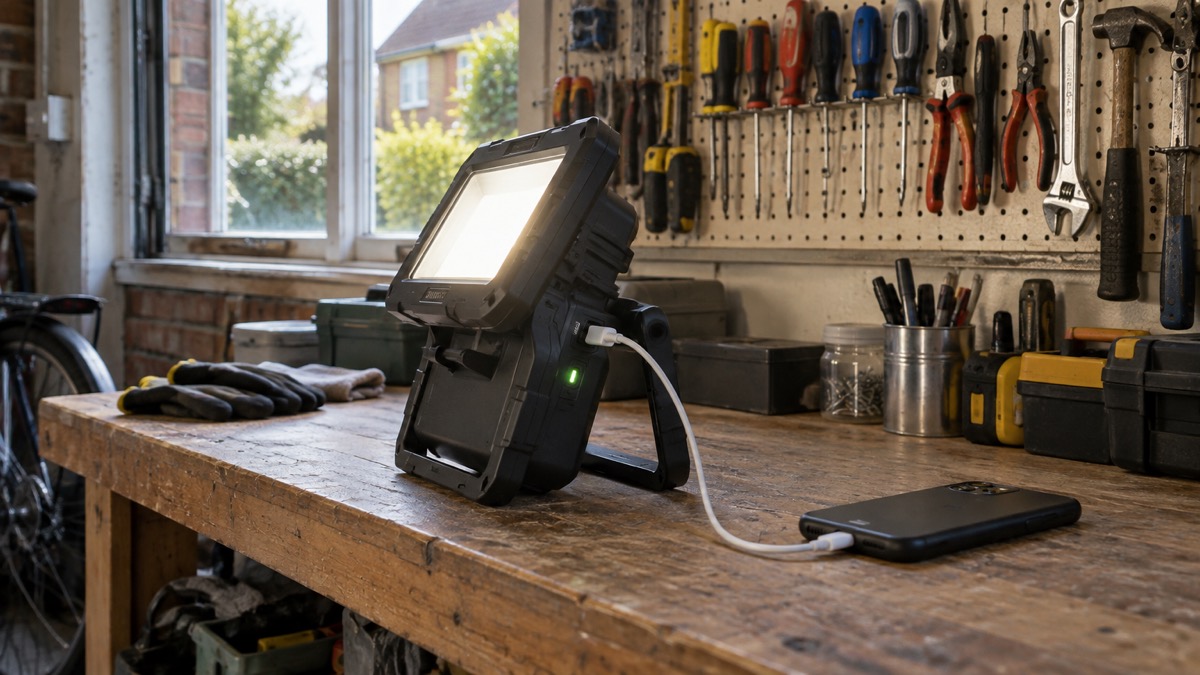
The floodlight is designed to be stood up and aimed, not held. The maker lists a swing handle that rotates from bottom to top and locks into 7 varying positions, and a tripod mounting kit that attaches to the handle with a securing nut screwed tightly around the bolt, with a quick release bolt inside the tripod base plate and a quick release to release the light1. In practice that means you can set the light on a table, angle it at a ceiling, or mount it on a tripod to raise it above eye level.
The box contents are worth knowing before you buy, because one item is missing. The maker lists the 5,000 lumen flood light, a carry bag, a power transformer with a 4m cable, a tripod mounting kit, a 220v domestic EU adapter, a 240v domestic UK adapter, a 110v site UK adapter and a 1m USB-C to USB-C charging cable1. There is no USB-A cable for phone charging, so add one.
| Item in the box | What it is for |
|---|---|
| 5,000 lumen flood light | The light itself |
| Carry bag | Storage and transport1 |
| Power transformer (4m cable) | Mains charging1 |
| Tripod mounting kit | Standing the light at height1 |
| 220v domestic EU adapter | Mains charging abroad1 |
| 240v domestic UK adapter | Mains charging at home1 |
| 110v site UK adapter | Mains charging on site1 |
| 1m USB-C to USB-C charging cable | USB-C charging1 |
The dimensions are 262 x 129 x 202mm (length, width, height) and the weight is 2175g1. Check that the surface you plan to stand it on is stable and that the cable run from the socket to the light is not a trip hazard. The 4m cable gives you some flexibility, but it is still a cable across a floor in the dark.
Where the floodlight must never be used
The maker's manual sets out a list of places and conditions where the light must not be used, and they are worth taking literally. Do not use the light in explosive environments in which flammable liquids, gases or dusts are present; do not fully immerse the light in water; do not look directly at the lamp; do not attempt to dismantle or repair the light; never use the light if you find damage1. The IP54 rating covers dust particles larger than 1mm and water spray up to 10 litres per minute, which is rain and splashes, not immersion1.
The explosive atmosphere warning matters in a garage, shed or workshop where paint, solvent, petrol or gas cylinders are stored. Use the light elsewhere, or ventilate the space fully before you switch it on. The immersion warning matters in a flood: do not wade into flood water carrying the light, and do not leave it standing in water. Government flood advice is blunt on the point: do not walk, cycle or drive through flood water9, and never drive through flood water10. If your home is flooding, the light belongs on a high, dry surface, not in the water.
There is a wider safety point about looking into bright lights. The maker says do not look directly at the lamp1, and at 5,000 lumens that is sensible advice for adults and essential for children. Our guide to looking into a torch beam explains why. If you are using the light around children, keep it aimed away from faces and at a wall or ceiling.
Storing it between emergencies
The maker's storage instruction is simple: store the light inside the supplied carry bag whenever possible1. Beyond that, the sensible routine is to keep it charged, keep it dry, and keep it where you can find it. A light that is buried at the back of a cupboard is no use in a power cut, and a light that has been left flat for months may not hold its charge when you need it.
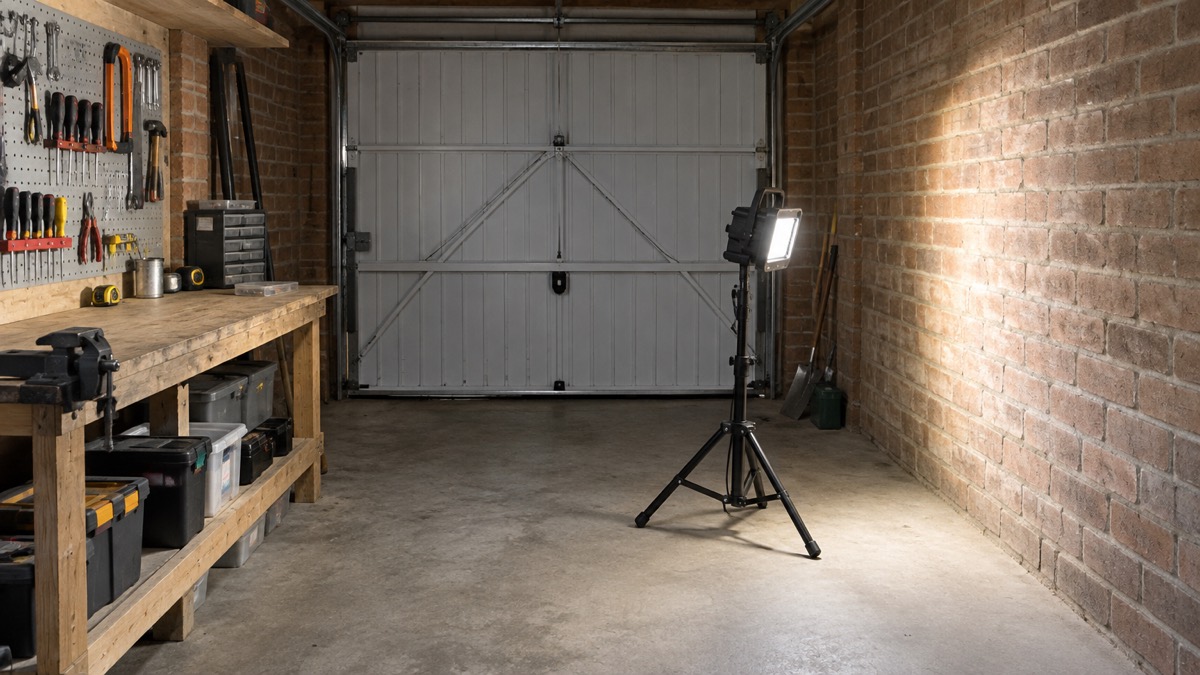
Where you store it matters as much as how. Fire and rescue services advise against storing combustible materials close to your service head, electricity meter or fusebox, particularly under the stairs, which is a means of escape from upper levels in an emergency11. A lithium battery light is not a combustible material in the same sense as clothes or papers, but the principle of keeping the escape route clear applies. Store the light somewhere you can reach without climbing, and somewhere it will not be knocked into water.
For households at risk of flooding, the light belongs in the flood kit or grab bag. Official flood advice is to include a torch with spare batteries in an emergency flood kit12, and to consider packing a grab bag of essentials including a torch, bottled water, warm waterproof clothing and important documents, stored somewhere you can easily get to13. The floodlight is a room light rather than a grab bag item, but a small torch in the bag and the floodlight in the cupboard is a sensible division. Make sure everyone in your home knows where the kit is stored and what to do if flooding happens14.
If you have a winter checks routine, add the floodlight to it: charge it, check the indicator, check the cable and adapters for damage, and put it back in the bag. For more on charging and storing rechargeable lights safely, see charging and storing rechargeable torches safely.
Support, spares and where to get help
The floodlight is made by NEBO, and the maker's product page carries the manual and the specifications quoted on this page1. If your light is damaged, the maker's instruction is not to attempt to dismantle or repair it and never to use it if you find damage1. Check the maker's page for the current manual and any safety notices before you use a light that has been dropped or stored for a long time.
If a rechargeable battery swells, the fire service advice is to stop charging immediately15. Do not puncture, crush or bin a swollen battery; take it to a household waste recycling centre that accepts batteries, and replace the light rather than risk a fire. For removable batteries, fire services advise charging on a hard flat surface where heat can disperse and in an area with good ventilation16.
For help in a power cut, your first point of contact is your electricity network operator, and for vulnerable household members the Priority Services Register is the route to extra support. If you rely on powered medical equipment, Mersey Care NHS's Community Equipment Service advises preparing in advance of any pre-planned outages by fully charging your item4. For a wider look at what to do when the power goes off, see lighting your home safely when the power goes off and the power cuts section.
Sources (16)
- NEBO 5K Flood Light, NEBO, 2026-10-25
- Chargers, Electrical Safety First, 2026-10-26
- USB chargers, Electrical Safety First, 2026-10-25
- Equipment services: what to do in a power cut, Mersey Care NHS, 2026-10-25
- Other safety, Northern Ireland Fire and Rescue Service, 2026-10-22
- Power banks, Electrical Safety First, 2026-10-26
- 12 tips to prepare for a power cut, Horsted Keynes Parish Council, 2026
- Travelling in storms, rain and wind, Met Office, 2026-10-25
- Be summer ready, Electricity North West, 2026-10-25
- Preparing yourself for flooding incidents, London Resilience Partnership, 2026-10-25
- Help during a flood, GOV.UK, 2026-10-25
- How to prepare for flash flooding, London.gov.uk, 2026-10-25
- Keeping safe during high winds and heavy rain, North Yorkshire Fire and Rescue Service, 2024-01-22
- Looking after the electrics, North Wales Fire and Rescue Service, 2026-10-25
- Batteries and chargers, London Fire Brigade, 2026-10-25
- ChargeSafe: safety tips for e-bikes and e-scooters, North Yorkshire Fire and Rescue Service, 2024-11-12

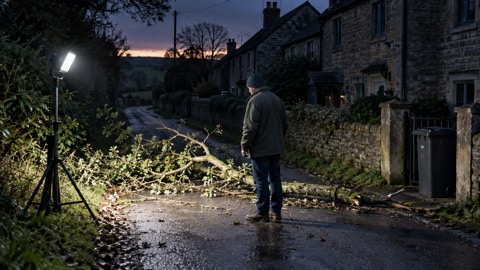 NEBO 8K Flood Light
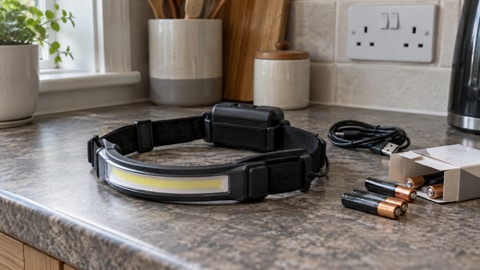 NEBO Curvbeam 600 Flex