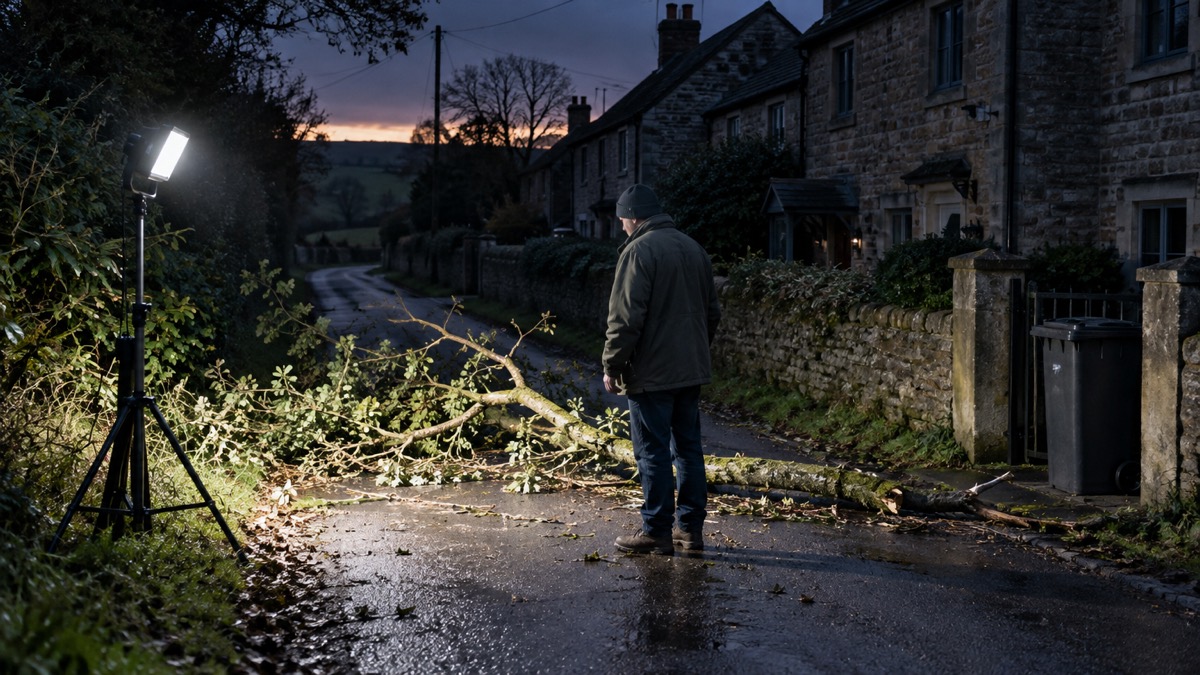
The NEBO 8K Flood Light is a rechargeable work light that puts out 8,000 lumens at its top setting and runs for 1.5 hours there, or continuously if you plug it into the mains1. It is built for lighting a whole area rather than a single path: a garage, a loft, a garden, a room during a power cut, or a job outdoors after dark. It weighs 2962g and measures 246 x 241 x 158mm, so it is a light you set down or hang up, not one you carry in a pocket1.
The practical decision with this light is how you run it. On its internal battery you get 1.5 hours at MAX, 2 hours at HIGH, 3 hours at MEDIUM and 5 hours at LOW, and if you can reach a socket the AC PLUG IN mode gives 5600 lumens continuously1. It also has a USB-A port so it can top up a phone, which matters in a power cut when your phone is your link to updates and to help2.
Before you rely on it, charge it fully, learn the four brightness steps set by the -/+ buttons, and decide where it will hang. This page sets out what the light does, how long each setting lasts, how to charge it by mains or USB-C, how to use it as a power bank, how to set it up on its tripod or hook, and the places and conditions where the maker says it must not be used.
What the NEBO 8K Flood Light is and what it is for
This is a flood light, which means it spreads light across an area rather than throwing a narrow beam down a path. The maker lists five light modes and an 8,000 lumen maximum, with a lithium ion battery of 11V, 4500mAh made up of three 21700 cells1. It is rated IK07 for impact resistance and Protection Class III, and it carries an IP54 protection degree1. In plain terms it is a rugged, splash-resistant area light with its own battery, supplied with a carry bag, a power transformer on a 4 metre cable, a tripod mounting kit, domestic UK and EU adapters, a 110v UK site adapter and a 1m USB-C to USB-C charging cable1.
For a household, that combination suits three jobs. The first is a planned job in the dark: working in a loft, clearing a garage, digging in the garden in winter. The second is an unplanned outage: one bright light in a room, hung from its hook, so a family is not moving around by phone torch. The third is outdoor work where you need both hands free and a wide pool of light.
It is not the right light for everything. At 2962g it is heavy to carry any distance, and its 1.5 hour run time at full power means it is not a light you leave on all night at maximum. If you want a small torch for a bedside drawer or a head torch for hands-free work, those are different tools; our pages on torches and head torches cover them. The 8K is the light you bring out when you need to light a space.
Run time: 1.5 hours on MAX, 5 hours on LOW, or continuous on mains
The maker's manual gives a run time for each mode, and the differences are large enough to plan around1. The table below sets them out as the maker states them.
| Mode | Output | Run time |
|---|---|---|
| MAX | 8000 lumens | 1.5 hours |
| HIGH | 6000 lumens | 2 hours |
| MEDIUM | 4000 lumens | 3 hours |
| LOW | 2000 lumens | 5 hours |
| AC PLUG IN | 5600 lumens | Continuous |
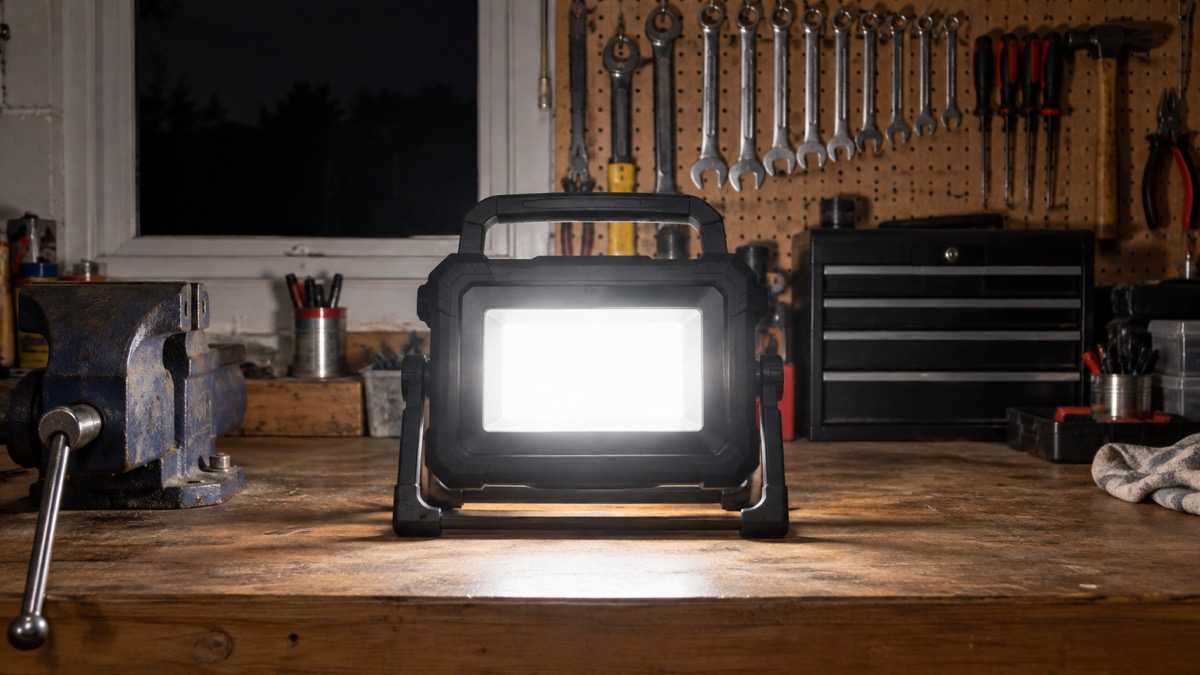
The pattern is simple: the brighter the setting, the shorter the run. MAX gives you the most light for an hour and a half, which is enough to get a job done or to set up a room at the start of an outage. LOW gives you five hours at a quarter of the output, which is the setting to choose if the light needs to last an evening. The maker's manual also lists an operating time of 1.5 hours (approx) in its summary specifications, which matches the MAX figure1.
The AC PLUG IN mode is the one to remember if you have a working socket. At 5600 lumens it runs continuously while plugged in, so during a power cut it is no use, but for planned work it removes the battery question entirely1. If you want to understand how lumens translate into how bright a room feels, our page on lumens, beam distance and run time explains the terms.
Charging by mains or USB-C
There are two ways to charge the light, and they take different times. The maker's product page gives a charging time of about 4.5 hours by AC and about 8 hours by USB-C2. The manual gives the USB-C figure as 8 hours (approx) and adds that a full charge at home using the power adapter could take up to 3.5 hours1. The maker's own figures for mains charging therefore differ between its manual and its product page; allow for either and charge well ahead rather than on the night.
To charge by USB-C, the manual says to plug the USB-C cable into a USB-C power outlet and the other end into the USB-C charging port on the light1. To charge from the mains, use the power transformer and the domestic adapter for your supply: the 240v UK adapter for a UK home socket, the 220v EU adapter for European sockets, and the 110v UK site adapter for site supplies1. The maker states the light is compliant with UK site standards and includes the 110v plug for building site use2.
The maker's first instruction is to fully charge the light before using it for the first time1. Do that indoors, where you can see the charging indicator, and keep the transformer, cable and adapters dry. The Electrical Safety First guidance on chargers is a sensible backdrop: use the charger supplied for the product and check leads and plugs for damage before use3. If you are charging from a USB-C outlet, the same body notes that USB-C Power Delivery is now the common standard for modern devices and can deliver enough power even for demanding equipment4.
Using it as a power bank for phones
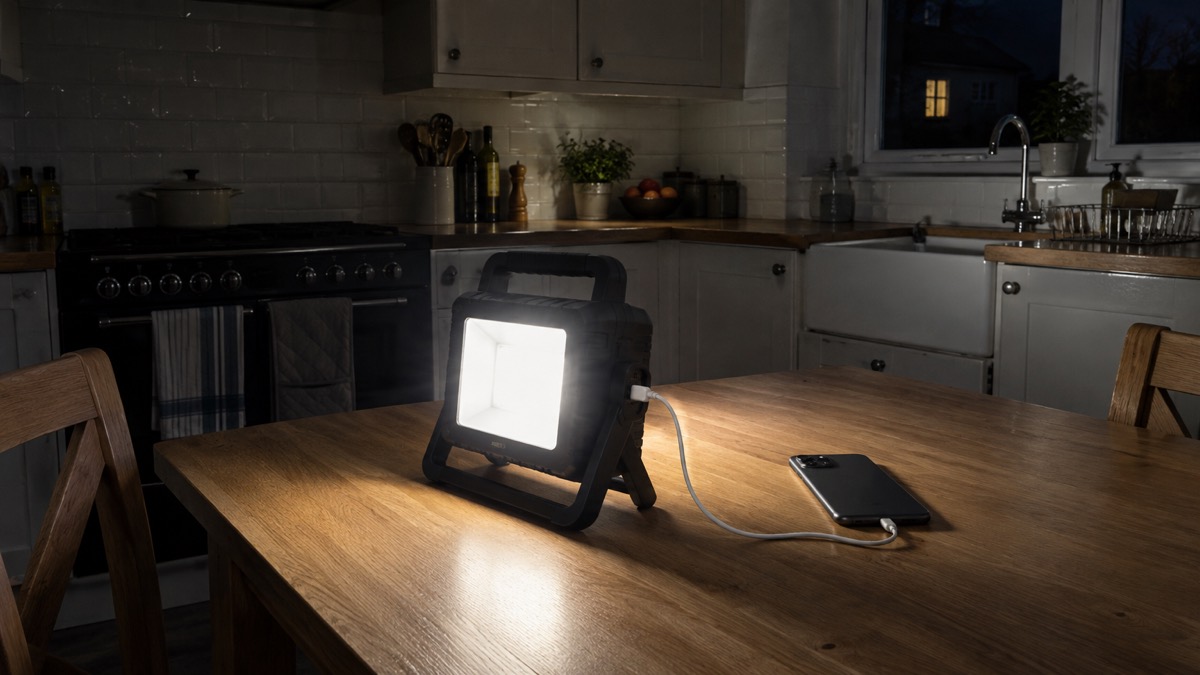
The light has a USB-A power bank feature, and the maker says to press the Charge Switch to enable charging of USB-powered devices2. The manual describes it as compatible with smartphones and other USB-powered gadgets1. NEBO's own guidance on its lighting range describes torches and jump starters that act as a power source for smartphones, tablets and other USB-chargeable gadgets5.
That matters most in a power cut, when a charged phone is how you follow updates and reach people. Official and network advice is consistent on this: have a fully charged power bank available in case you need to charge your phone, tablet or other devices6; a portable power bank can recharge your phone or hearing aids7; and when a storm is forecast, charge your mobile phone and laptop8. One network also advises fully charging phones and power banks ahead of hot weather9. A high-capacity light with a discharge function lets you keep a phone charged to receive emergency updates or contact emergency services10.
Use the power bank function for its intended purpose, which Electrical Safety First describes as recharging a mobile phone or other USB-powered mobile devices11. Do not treat the light as a general-purpose power supply for mains appliances; it is a light with a phone top-up, not a home backup battery. If you want to know how much a phone charge takes out of the light's own battery, watch the charge indicator and recharge the light before it drops to red.
Setting it up: tripod, handle and hanging hook
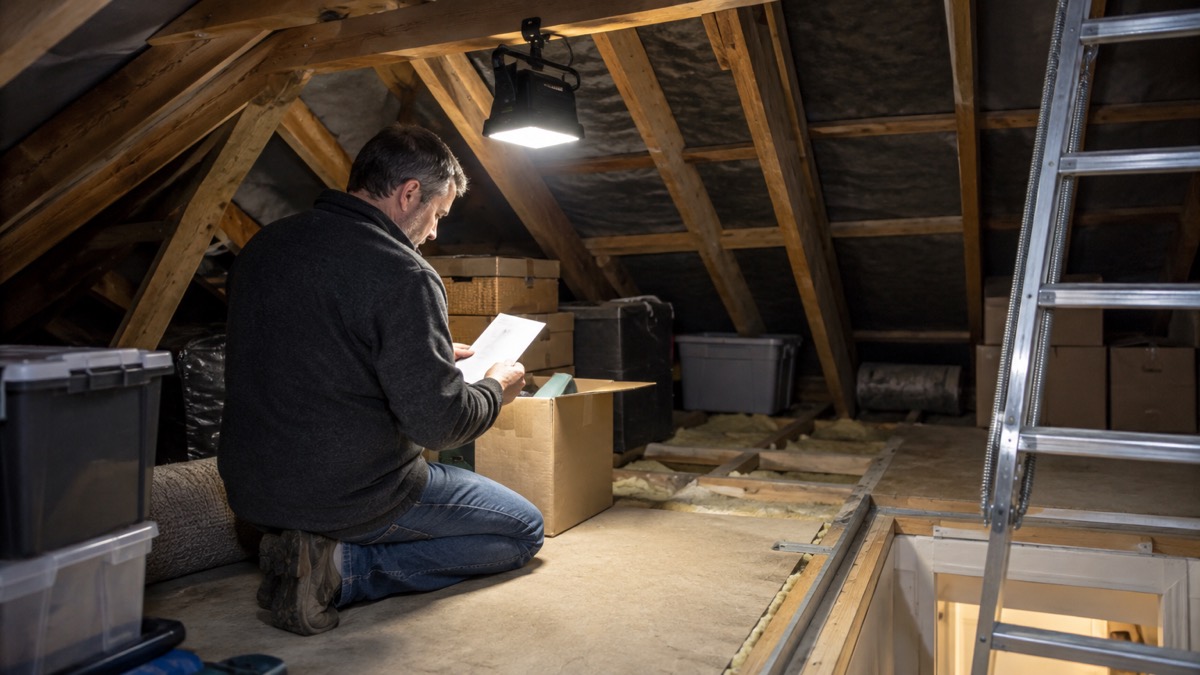
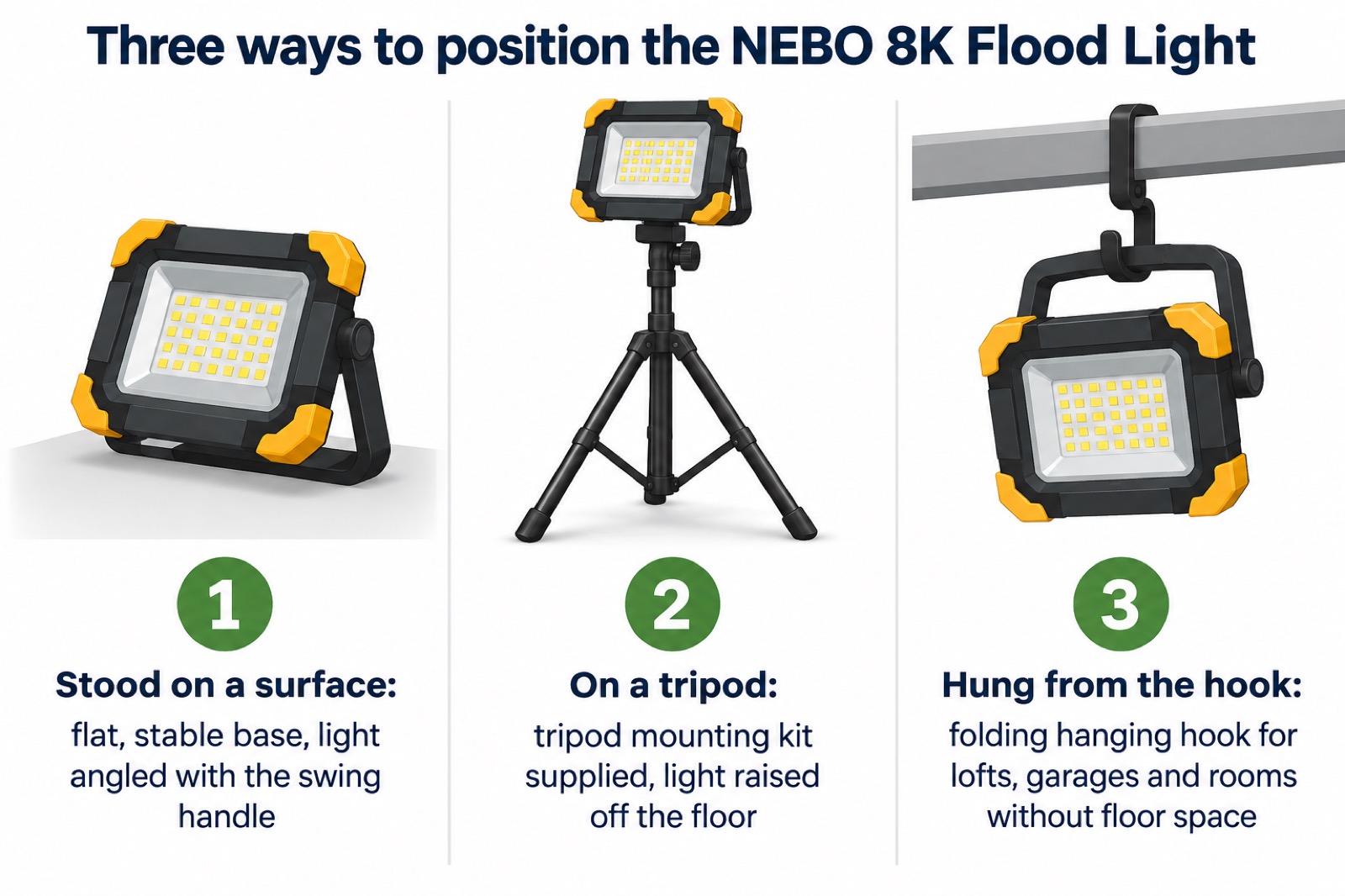
The light is designed to be positioned rather than held. The maker lists a tripod mount, a swing handle that locks into 7 varying positions, and a folding hanging hook2. The manual's box contents include a tripod mounting kit and a carry bag1. Between them you have three ways to place it: stood on a flat surface, mounted on a tripod, or hung from the hook.
A few practical points follow from the specifications. At 2962g the light is heavy enough that you want it supported, not balanced1. The swing handle rotating through 7 positions lets you angle the light without moving the base2. The folding hanging hook is the option for a room with no clear floor space, such as a loft or a garage with stored items. The 4 metre cable on the power transformer gives you reach from a socket when using AC PLUG IN mode1.
Where the light must not be used and how to keep it safe
The maker's manual opens with a warning that failure to follow its safety instructions may result in electrical shock, explosion, fire which may result in serious injuries, death or property damage1. The specific prohibition is clear: do not use the light in explosive environments in which flammable liquids, gases or dusts are present1. That rules out areas where you can smell petrol, gas or solvent vapour, and any space where flammable dust is present.
The IP54 rating is often misunderstood. The maker describes it as protection against dust particles larger than 1mm and water spray up to 10 litres per minute2. That is splash and spray protection, not waterproofing. Do not submerge the light, do not leave it standing in water, and keep the charging port, transformer and adapters dry. Electrical Safety First's guidance on outdoor lighting makes the general point that outdoor lights should be weatherproof and that fittings used in water features must be waterproof and suitable for submersion12; the 8K is not that kind of fitting.
The maker gives an operating temperature range of -10 to 40°C1. Outside that range the light is beyond its stated conditions, so bring it indoors rather than leaving it in a cold shed or a hot vehicle. In winter, charge it indoors where you can see the indicator. If you are working outside in poor visibility, remember that a bright flood light is for lighting your work area, not for replacing vehicle lights: fire and rescue services advise using dipped headlights when visibility is reduced, and fog lights only when visibility drops below 100m, turning them off when it improves13.
Keeping it ready for a power cut
A flood light is only useful in an outage if it is charged and findable. The same official advice that applies to power banks applies here: have a fully charged power bank available, and charge phones and power banks ahead of forecast disruption6. Treat the 8K the same way. Charge it after every use, check the indicator, and store it with its carry bag, transformer and adapters together so nothing is missing when you need it.
Store it somewhere you can reach in the dark, not at the back of a locked shed. Our page on where to keep torches so you can find them in the dark covers the principle. If you have older or disabled people in the household, a bright area light hung in a hallway or living room can make a real difference to confidence during an outage; our page on lights for older and disabled people in a power cut sets out the options.
For a wider look at how this light fits alongside lanterns, torches and emergency bulbs, start with our emergency lighting at home section, and for the sequence of what to do when the power fails, see lighting your home safely when the power goes off. If you are weighing a rechargeable light against battery-powered ones, our comparison of rechargeable or battery torches for emergencies covers the trade-offs, and our guide to charging and storing rechargeable torches safely covers the storage side in more detail.
Support, spares and the rest of the NEBO range
The box includes the carry bag, tripod mounting kit, power transformer with 4 metre cable, the three adapters and the USB-C cable1. If one goes missing, check what should be there against the maker's own list of contents1. The maker warns that failure to follow its safety instructions may result in electrical shock, explosion, fire which may result in serious injuries, death or property damage, so keep those instructions with the light1.
NEBO makes a range of lighting products, and the maker describes its torches and head torches as using Smart Power Control that automatically adjusts light output based on remaining battery charge18. If you are comparing this flood light with the rest of the range, our NEBO brand page gathers the models, and the NEBO 5K Floodlight page covers the smaller flood light in the same family. For a lantern-style light that sits on a table rather than lighting a whole area, see the NEBO Galileo Tempest 350.
If you need help during a flood, the government's flood help page sets out where to get it19, and Northern Ireland's flood preparation guidance covers the same ground for households there20. For winter readiness more generally, the ambulance service's winter preparedness advice and the fire service's winter safety tips are useful starting points13.
Sources (20)
- NEBO 8K Flood Light manual, NEBO, 2026-10-25
- NEBO 8K Flood Light product page, NEBO, 2026-10-25
- Chargers product safety guidance, Electrical Safety First, 2026-10-26
- USB chargers safety advice, Electrical Safety First, 2026-10-25
- NEBO lighting technology, NEBO, 2026-10-25
- 12 tips to prepare for a power cut, Horsted Keynes Parish Council, 2026
- Power cut plan, Northern Powergrid, 2026-10-26
- What to do in a power cut, SP Energy Networks, 2026-10-26
- Be summer ready, Electricity North West, 2026-10-25
- Power cut preparedness: essential torches for the UK home, Olight UK, 2026-06-04
- Power banks safety guidance, Electrical Safety First, 2026-10-26
- Outdoor lighting safety, Electrical Safety First, 2026-10-25
- Winter preparedness, South East Coast Ambulance Service, 2025-10-22
- Ice weather warning: information and advice, nidirect, 2026-02-16
- Adverse driving conditions, South Wales Fire and Rescue Service, 2026-08-28
- Keeping safe during high winds and heavy rain, North Yorkshire Fire and Rescue Service, 2024-01-22
- Top tips for keeping warm and safe this winter, North Yorkshire Fire and Rescue Service, 2023-11-29
- NEBO Galileo Tempest 350, NEBO, 2026-10-25
- Help during a flood, GOV.UK, 2026-10-25
- Preparing for a flood, nidirect, 2025-09-11

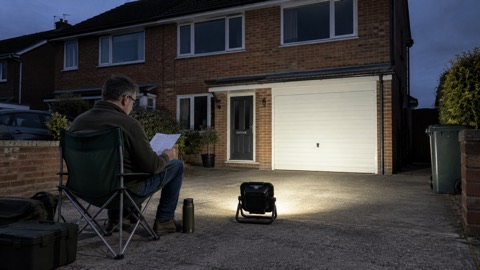 NEBO 5K Floodlight
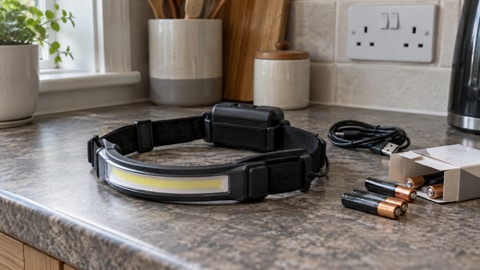 NEBO Curvbeam 600 Flex